-
------------
-

-

-
President Barack Obama speaks in the Roosevelt Room of the White House in Washington, Monday, March 23, 2009. Joining him, from left are, Treasury Secretary Timothy Geithner, the president, Federal Reserve Chairman Ben Bernanke. (Gerald Herbert/AP Photo)
-
"Obama's $1 Trillion Plan to End Bank Crisis: Treasury Secretary Tim Geithner Hopes to Attract Private Investors to Buy Toxic Assets"
By MATTHEW JAFFE, SCOTT MAYEROWITZ and JAKE TAPPER, ABC News, March 23, 2009—
President Obama said today that his economic team is "very confident" that the administration's newest effort to stabilize banks -- a mix of public and private funds that could total $1 trillion -- will help to free up credit.
The president spoke shortly after Treasury Secretary Timonthy Geithner officially announced the long anticipated program.
The plan aims to remove so-called toxic assets -- many of them bad mortgage investments -- from the banks' balance sheets through a private-public partnership. The program will rely heavily on private investors, such as hedge funds and private-equity firms, to buy up $500 billion to $1 trillion of assets with the government providing incentives such as low interest loans and sharing in both the risk and possible profits. Obama described the Public-Private Investment Program as "one more critical element" in a multi-pronged effort to help the economy recover.
He gave an optimistic assessment that the steps the administration has taken are nudging the economy in the right direction.
Obama said there are "glimmers of hope in the housing market," as well as signs that there is easier access to student loans, small business and car loans.
With the announcement of the latest mega-money project to right the economy, Obama said, "I'm very confident that... we're going to be able to make it happen."
With the bad assets off their balance sheets, banks would be expected to start lending again.
Wall Street seemed buoyed by the announcement, with the Dow up more than 400 points in the day's trading. That was in contrast to last month when Geithner first indicated the administration was considering such a plan, but the lack of details sent the market into a nearly 400 point plunge.
Investment giant BlackRock was downright enthusiastic about the new program.
The investment management firm is applying to be one of the government-selected managers and is willing to raise $5 billion or so of private money to partner with taxpayer dollars, Curtis Arledge, co-head of US Fixed Income Portfolio Management Group, at BlackRock told ABC News.
"We think many of these assets are trading at prices well below their intrinsic value," Arledge said.
BlackRock has already been buying such investments for some of its clients but now hopes to purchase more assets. Arledge said the government dollars and risk guarantees will expand the number of people who enter the mortgage-backed securities market.
The $1 trillion program is Obama's latest attempt to pull the economy out of its dive, but it's not the last. On Tuesday, the administration wil lay out its plans to increase its regulation of Wall Street to ensure that the current crisis is not repeated.
The administration needs to address two problems. First, banks are not lending because their balance sheets are weighed down by these deteriorating toxic assets. Second, the assets are tough to price because of currently depressed pricing levels.
To solve these problems, the treasury's plan is guided by a program with three general principles.
The new program will use between $75 billion-$100 billion of Treasury funds from the Troubled Asset Relief Program and leverage $500 billion with the potential to expand to $1 trillion of private purchasing power with financing from the Federal Reserve System and the Federal Deposit Insurance Corp.
Using the Fed and the FDIC, the government will leverage private capital by co-investing with the private sector. If the private sector has financing provided by the government, buying these assets becomes a more attractive option.
Second, the administration wants the market, not the government, to set the price for these assets.
"The greatest waste of taxpayer dollars would be us paying too much," an official said.
.
No Silver Bullet
Third, the private sector will invest alongside the taxpayer on an equal basis, so both parties share the downside risk and upside potential.
To accomplish this, the treasury will partner with the FDIC in a program where banks can bring assets they want to sell to the FDIC. The FDIC will provide leverage, then the assets will be sold in the market, where private market participants will bid on them, thereby setting the price. Then the government can co-invest with the private sector to buy pools of toxic assets and clean up the banks' balance sheets.
To address toxic securities, the treasury will partner with the Fed in a program building on an existing lending program. The Fed will provide leverage for private sector participants to buy securities.
Despite the enormous price tag attached to the program, Geithner said, "Our job is to try to fix this problem in our financial system at least cost to the taxpayer."
"This is not something that shields the private sector from risk," a senior administration official said. "If they do well, we will do well. If we do poorly, they will do poorly as well. So it avoids what's been so wrong in the past where you've had, as the president has said, 'Heads I win. Tails the taxpayer loses.'"
"We have seen and I expect to see a lot of interest from the private sector," Geithner said.
Some investors though might shy away, concerned about a populist revolt.
"There is a fear that if you do well off this, they are going to come after you," said Charles Biderman, CEO of TrimTabs Investment Research, which provides data to investors including many hedge funds. "I wouldn't want to participate with this. I don't want busloads of people coming to my house."
But Joel L. Naroff, president of Naroff Economic Advisors and chief economist for TD Bank, said that investors will participate.
"The question is: how much can they wring from the government to insulate themselves from this," Naroff said. "I don't think they are going to be tarred and feathered if they get involved in a partnership with the government and they make money off of it."
Besides, such profits wouldn't be seen for several years.
"If they are making money off it, it means that the market has moved forward, it means things are getting better and people's focus of attention will have changed," Noraoff said.
House Republican whip Eric Cantor called the plan "a shell game that hides the true cost of the program from the taxpayers that will be asked to pay for it."
The administration emphasizes that there is no "silver bullet" to solve this problem.
"This is a large problem that is going to take a long time to solve," a senior administration official said.
"We're attempting to coax a multitrillion-dollar market back to life in an extremely difficult economic and market environment and that's going to take time," the senior official said.
Today's detailed plan comes a month after the Obama administration first announced it would try to take the toxic assets off the banks' books. But the timing might be difficult.
"There is deep skepticism across the country, deep anger and outrage and frustration," Geithner said.
Because of that skepticism, he said, "We have to engender more confidence in the American people that we are going to use taxpayers' money effectively and wisely."
The public has grown weary of multibillion-dollar bailout after bailout, especially when learning about executives still buying private jets and receiving large bonuses. Last week, the nation learned that some executives at insurance giant AIG had gotten a total of $165 million in bonuses after the company gave received more than $170 billion in government bailouts to remain in business.
And today, ABC News revealed that JP Morgan is spending tens of millions on new corporate jets as well as a plush new hangar for its aircraft.
At the same time, government efforts to rein in such bonuses have made some banks and investors wary of doing business with the government.
.
Obama Says Some Assets "Completely Worthless"
Obama made the case for today's massive program during his appearance Sunday on "60 Minutes" when he argued that it's necessary to team up with Wall Street because there are "systemic risks" in the economy.
"There are certain institutions that are so big that if they fail, they bring a lot of other financial institutions down with them," he told "60 Minutes."
Still, there is the problem of how to value these "toxic assets" and Obama suggested on "60 Minutes" that some of them may be "completely worthless." Nevertheless, the banks holding them expect to sell them.
"The banks are going to be looking for something like 60 cents on the dollar and that the investors would only be willing to pay 30 cents," Douglas Elliott of the Brookings Institute told "Good Morning America."
Christina Romer, head of the Council of Economic Advisers, told "Good Morning America" that about 8 percent of the investment money will come from private sources, but the rest of the money to buy the toxic assets will come from taxpayers.
She emphasized that the $1 trillion program is just part of the effort to lift the economy that has included money for banks, for small businesses, for homeowners and a stimulus program to spend billions on highways, bridges and other infrastructure programs.
Administration officials said the new program was better than the two other alternatives.
Bad option No. 1: let the toxic assets stay on the banks' balance sheets, "the kind of hands-off approach that has led to other countries having financial crises that lasted years and years as opposed to months and months."
Bad option No. 2: have a single public bank buy up all the toxic assets, an approach in which "the taxpayer would take all the risk instead of sharing the risk" and that could involve the public bank overpaying for the assets.
-
ABCNew's Jonathan Karl contributed to this report
-
www.financialstability.gov
On Tuesday, February 10th, 2009, Treasury Secretary Timothy Geithner outlined a comprehensive plan to restore stability to our financial system. In the address, Secretary Geithner discussed the Obama Administration’s strategy to strengthen our economy by getting credit flowing again to families and businesses, while imposing new measures and conditions to strengthen accountability, oversight and transparency in how taxpayer dollars are spent. And Secretary Geithner explained how the financial stability plan will be critical in supporting an effective and lasting economic recovery.
-----
"Obama administration moves against bad bank assets"
By Tom Raum, Associated Press Writer, March 23, 2009
WASHINGTON --The Obama administration aimed squarely at the crisis clogging the nation's credit system Monday with a plan to take over up to $1 trillion in sour mortgage securities with the help of private investors. For once, Wall Street cheered. The announcement filled in crucial blanks in the administration's financial rescue package and formed what President Barack Obama called "one more critical element in our recovery."
The coordinated effort by the Treasury Department, the Federal Reserve and the Federal Deposit Insurance Corp. relies on a mix of government and private money -- mostly from institutional investors such as hedge funds -- to help banks rid their balance sheets of real-estate related securities that are now extremely difficult to value.
The goal, said Obama, is to get banks lending again, so "families can get basic consumer loans, auto loans, student loans, (and so) that small businesses are able to finance themselves, and we can start getting this economy moving again."
It was a huge gambit and one that came like a tonic to Wall Street, which had panned an earlier outline of the program that lacked detail.
Stocks soared, the Dow Jones industrial average shooting up more than 400 points, thanks to the bank-assets plan and a report showing an unexpected jump in home sales.
The plan is designed to help fix a value on the damaged mortgage loans and other toxic securities.
If the value of the securities goes up, the private investors and taxpayers would share in the gains. If the values go down, the government and private investors would incur losses.
"This will help banks clean up their balance sheets and make it easier for them to raise capital," Treasury Secretary Timothy Geithner told reporters.
The plan will take $75 billion to $100 billion from the government's existing $700 billion Troubled Asset Relief Program. The government will pair this with private investments and loans from the FDIC and the Fed to generate $500 billion in purchasing power.
Geithner said purchases eventually could grow to $1 trillion -- roughly half of the estimated $2 trillion of toxic assets on bank books now.
On the hot seat, Geithner has a lot personally tied to the success of the new program. His performance in the Cabinet, including his slowness in learning about multimillion dollar executive bonuses paid by insurance giant AIG after taking bailout money, has been severely criticized by some in Congress.
Geithner testifies on Tuesday before the House Financial Services Committee.
Under a typical transaction, for every $100 in soured mortgages being purchased from banks, the private sector would put up $7 and that would be matched by $7 from the government. The remaining $86 would be covered by a government loans.
The plan was introduced ahead of a summit next week in London of 20 major and developing economies struggling with the global recession.
Obama is trying to get other wealthy countries to do more to stimulate their economies with government spending, as the United States has done. However, other countries, particularly ones in Europe, are resisting U.S. calls for more stimulus and would prefer to see more internationally coordinated bank regulation.
The administration was expected to outline its plan for financial regulation overhaul later this week.
Geithner said taxpayers still could lose money on the deal but there was no fixing the system without risk.
Other options, such as having the government purchase the securities outright or letting them languish on bank balance sheets, would pose even greater vulnerabilities, he said, and it was important to find the right blend of risk versus reward.
"I am very confident this scheme dominates all the alternatives for trying to find that balance," he said.
The sentiment was echoed by congressional Democrats, who said risk seemed inevitable with any plan big enough to work.
But House Republican Whip Eric Cantor of Virginia called Obama's plan a "shell game" that hid the true cost.
He said he hoped the administration would consider instead an earlier Republican proposal to set up a government-sponsored insurance program for mortgage-related securities.
The administration plan "seems to offer little incentive for private investors to participate unless the subsidy is made so rich that it comes at the expense of the taxpayer," Cantor said in a statement.
The new program marks a return by the government to acquiring the hard-to-price toxic securities. Henry Paulson, who was treasury secretary in the final days of the Bush administration, abandoned plans to purchase these securities, largely because they were impossible to price.
The plan builds on earlier programs to pump money into banks, help some homeowners repay their mortgages and stimulate college, small business and other forms of lending.
"There's still great fragility in the financial systems, but we think that we are moving in the right direction," Obama said after meeting Geithner and Fed Chairman Ben Bernanke.
Obama said the plan will allow taxpayers to "share in the upside as well as the downside."
Treasury officials had no firm forecast on when the government would begin making the asset purchases although market expectations were that the process could begin within weeks.
-
AP writers Martin Crutsinger and Anne Flaherty contributed to this story.
-
-----
"Obama confident in latest bank bailout"
The Boston Globe Online, Political Intelligence, Posted by Foon Rhee, deputy national political editor, March 23, 2009, 12:30 P.M.
President Obama said today that he is "very confident" that the latest plan to take toxic assets off the backs of banks and other financial institutions will work and ease the credit crunch.
He told reporters that the plan detailed this morning by his embattled treasury secretary, Timothy Geithner, will build on the progress already made with the $787 billion economic stimulus package and with his proposals to stem home foreclosures.
The plan Geithner outlined relies on public-private partnerships -- with the private firms lured by federal largess -- to buy up the bad assets.
"We believe that this is one more element that is going to be absolutely critical in getting credit flowing again. It's not going to happen overnight. There's still great fragility in the financial systems, but we think that we are moving in the right direction," Obama said after his daily economic briefing.
"And we are very confident that, in coordination with the Federal Reserve and the FDIC, other relevant institutions, that we are going to be able to not only start unlocking these credit markets, but we're also going to be in position to design the regulatory authorities that are necessary to prevent this kind of systemic crisis from happening again."
His full remarks are below, as is the transcript of Geithner's press briefing on the plan:
THE PRESIDENT: Well, good morning. As all of you know, we have been busy on a whole host of fronts over the last several weeks, with the primary purpose of stabilizing the financial system so banks are lending again, so that the secondary markets are working again, in order to make sure that families can get basic consumer loans, auto loans, student loans; that small businesses are able to finance themselves and we can start getting this economy moving again.
As I've said before, there are a number of legs in the stool in the economic recovery. Step one is making sure that we had a stimulus package that was robust enough to fill the huge gap in demand that was created by the recession. Step two was making sure that we had a effective homeowners' plan to try to keep people in their homes and to stabilize the housing market. Because of the work that's already been done, you are starting to see glimmers of hope in the housing market that stabilization may be taking place. Mortgage rates are at a very, very low level, and you're starting to see some activity in the housing market.
We then took a series of steps to improve liquidity in what had been secondary markets that had been completely frozen. And we are now seeing activity in student loans and auto loans. We announced last week a small-business initiative that ensures that we have more activity and you start seeing small businesses being able to get credit again in order to sell products and services and make payroll.
And this morning, Secretary Geithner announced the latest element in this multi-pronged approach, and that is a mechanism that he, in close consultation with the Federal Reserve and the FDIC, has initiated in order to allow banks to take some of their bad assets off their books, sell them into a market, but do so in a way that doesn't just obligate taxpayers to buy at whatever price they're willing to sell these assets; instead, involves a public-private partnership that allows market participants who have every interest in making a profit to accurately price these assets so that the taxpayers share in the upside as well as the downside.
And we believe that this is one more element that is going to be absolutely critical in getting credit flowing again. It's not going to happen overnight. There's still great fragility in the financial systems. But we think that we are moving in the right direction. And we are very confident that, in coordination with the Federal Reserve and the FDIC, other relevant institutions, that we are going to be able to not only start unlocking these credit markets, but we're also going to be in a position to design the regulatory authorities that are necessary to prevent this kind of systemic crisis from happening again.
And I'm looking forward to traveling to the G20 so that we ensure that the activities that we're doing here in the United States are effectively matched with comparable action in other countries. And Secretary Geithner has already traveled and met with the finance ministers of the G20 states so that we can make sure that we're all moving on the same page.
So the good news is that we have one more critical element in our recovery. But we've still got a long way to go, and we've got a lot of work to do. But I'm very confident that, with the team that we've got assembled, we're going to be able to make it happen.
All right. Thank you guys.
Q Can you offer any assurances to taxpayers who are skeptical?
THE PRESIDENT: You know, I'll have a full press conference tomorrow night, and you guys are going to be able to go at it.
Thank you, guys.
SECRETARY GEITHNER: Thanks for coming. Nice to see you. Obviously we're announcing this morning the next stage of our broad plan to help repair the financial system. But I want to start by stepping back, putting this in broader context.
Just to state again the start proposition that to get this economy back on track we need to get this very powerful stimulus program in place as quickly as possible. It will help get millions of Americans back to work, help support and stimulate private investment. But for that to work, we need to move very aggressively to get our financial system back to the point where it's providing the credit necessary for recovery.
That agenda, the financial agenda, which is such a critical complement of recovery, has several critical parts. And let me just walk through these first before I get to the details of today's announcement.
First, we have put in place a series of very powerful targeted programs to help address the housing crisis, to help catalyze small business lending. We are moving to start a –- you saw last week –- a broad-based program to get the secondary markets working again, too. Those markets, as you know, are very critical to the capacity of auto financed markets to work, muni markets, student lending markets, consumer credit markets, also small business markets. And you saw last week that in the first stage of this new fed Treasury program $9 billion in issuance, four times the level of -- more than the last four months alone. And that will make a material difference in bringing interest rates down.
We announced as the first step in our broad framework a plan to make sure that banks have enough capital to survive a deeper recession. We're going through this very carefully designed capital assessment process, that's designed to bring a more consistent, more conservative, more forward-looking view of the scale of losses banks may face in a deeper recession. But the critical part of that program is to make it clear that they will be able to raise capital from the government if they can't raise in the markets so that they can get through a deeper recession. That will help reduce the odds of a deeper recession, help make sure, again, they can provide a level of lending that will be necessary to support recovery.
I just want to start with those three things before I go into today's announcement again, and go through them again to make you understand how important they are.
First, targeted programs to help address the housing crisis which have already helped bring interest rates down, will help millions of Americans be able to refinance, take advantage of lower rates, reduce monthly payments, help reduce foreclosure risk. Targeted program directly at the constraints on small business lending; very strong broad-based program that will help get securitization in markets going again. You saw its first initial launch last week. And a program of insurance -- you could call it capital insurance for the banking system so that banks have the cushion of capital necessary to lend and expand even if the economy goes through a broader -- a deeper recession.
Now, today -- today we're announcing a innovative plan for helping to provide a market for the legacy assets that are a core of this basic problem in our financial system. Right now, you know, banks are still holding on to a large amount of loans that were made before the recession, during the four years in the run-up to the peak of the boom.
Because there's no financing available to the markets, because there's huge uncertainty about the path of the recession, because there's a lot of uncertainty about how to value these assets, these markets are stuck. And to help unfreeze these markets, provide a mechanism for working through these problems, we're announcing today a two-part program.
One piece is a financing mechanism to allow banks to sell pools of loans. One piece is a financing mechanism for investors to sell and purchase securities. Structures are similar, and let me walk through the basic parts of the structures. In each case we're going to put capital alongside capital from private investors with financing from the government. So private investors will share the risk alongside with the taxpayer, and the taxpayer will share returns alongside private investors.
Used as a market mechanism for establishing pricing and value, that will help protect the government from overpaying for these assets and taking risks greater than we should. And it will help bring professional management to these things, and again, all with the objective of reducing risk to the taxpayer, improving our capacity –- have the market work with us to help get out of this.
As you see in the proposals, we expect to put enough capital on the table initially to help leverage or generate between 500 and perhaps up to a million of purchasing power for these programs.
Now, if you think about this alongside the capital program, this will help banks clean up their balance sheets; it will make it easier for them to help raise private capital; it will help provide a market for these legacy assets that will help reduce these liquidity risk premium markets, help reduce the risk that people see further downward spirals in these asset prices, and overall, help increase the lending capacity of the financial system and reduce credit spreads and lending rates.
Now, like any plan, you've got to consider them against the alternatives. One alternative is just to let this dynamic we now see across the system continue. Our judgment is that would result in the risk of greater deleveraging, a deeper credit crunch, greater headwinds for the economy going forward, and a longer, deeper recession.
Another alternative is to have the government come in and purchase directly these assets and hold those, manage them, and sell them over time. That would involve the government assuming much more risk than under this program; create much greater challenges for managing these things sensibly over time; and again leave, in our judgment, the government more exposed, assuming more risk than it should, more exposed to loss over time, and in our judgment not a plausible, effective alternative.
Now, we're the United States of America. We are not Sweden. We have a very complicated financial system. Getting through this requires banks being strong enough again they can lend comfortably through a deep recession, but that's not enough. We have to complement this program to help strengthen the banking system with a range of approaches to help get these securities markets back to the point where they're working again.
So that again the basic mechanics that are so important to small business lending, large business borrowing, consumer borrowing, auto finance, student loans, et cetera -- that entire framework of mechanism is back to the point where it's working better for recovery. So our approach is designed to do both those two things.
Now, we are going through a very challenging environment now. There is deep skepticism across the country, deep anger and outrage, frustration about the point -- about the place we are in as a country, where people that were careful and prudent in their financial decisions, businesses that were conservative in how they chose how much leverage they took on, are facing substantial damage because of the actions of a range of institutions that took too much risk and brought our financial system and our economy to the point where we're facing such an acute, deep recession.
That anger and outrage is perfectly understandable and if we are going to get through this we have to engender more confidence in the American people that we're going to use taxpayer's money effectively and wisely to, again, help get credit flowing again, help reduce borrowing costs. And we want to make sure that our assistance is not going to reward failure, to benefit people who got us into this mess -- and that is critically important.
But as the President said, we also need to make it clear that our actions need to be guided by the basic objective of doing what is necessary to help get recovery back more quickly. And that requires that we have a better functioning financial system, where people are willing to come in and take risk.
The great risk we face now is that after a long period of irresponsibility and excessive risk-taking, that the system will not take enough risk now. And for these programs to work, investors have to be prepared to take risk. And for them to take risk, they have to be more confident than they are today that there's going to be a clear set of rules of the game applied consistently and enforced fairly going forward.
I'm happy to take any questions. Yes.
Q Sir, you mentioned the municipal market. Chairman Frank and about 25 other members of Congress sent you and Chairman Bernanke a letter to provide temporary relief to the short-term municipal debt market. I'm wondering if that's been considered by Treasury, if that's a possibility at all?
SECRETARY GEITHNER: We're taking a careful look at it.
Q Could you repeat the question?
SECRETARY GEITHNER: The question is -- I believe is, a number of members of Congress, governors, elected officials across the country, have encouraged us to explore ways to help bring about further improvements in the muni market. There has been some improvement in the muni market and we are looking at a range of options to see if we help reinforce those improvements, including the specific measures that Chairman Frank and others are considering.
Yes.
Q Tim, obviously you set out the structure and framework today, but for good reasons you haven't delved into the pricing. The pricing on which you make finance available to the private sector will obviously be crucial for understanding how this is likely to affect asset prices and, indeed, then the stock prices and capital needs of banks. Can you at least give us in conceptual terms some indication of what will guide the pricing decisions here on the loans?
SECRETARY GEITHNER: All right, two basic pricing things are at issue here. One is how the price for the assets is established. And the principal -- a principal virtue of this mechanism is to use the financial interests of investors to help set the price. Because they have money at risk, they're going to make better judgments about how to set the price of these assets than the government could hope to make.
There's a second issue about the terms of the financing the government makes available, and let me just establish a basic principle there too. As you see across the range of things that the Federal Reserve has done over the past two years, one basic principle that's important is to say that you establish the pricing so that as conditions normalize, the market will no longer want to or find it economic to rely on financing from the government.
Basic principle underpin all the things the Fed has done and that's why you see in some parts of the Fed programs, the Fed balance sheet is shrinking even though we have a financial system so under acute pressure.
Yes.
Q Have you gotten any interest from the private sector in getting involved in this program?
SECRETARY GEITHNER: We have seen and I expect to see a lot of interest from the private sector.
Q Can you give us any names?
SECRETARY GEITHNER: But, you know, just to say -- just to make a point. You're going to have people -- this is true of any financial crisis -- who want the government to take on much more risk. So there are people who say that we'd like the government to take more risk or a greater share of the losses than this program identifies or anticipates. But I think you're going to see a fair amount of interest in this.
Yes.
Q Yes, on the executive pay parts of this, the plan is to have passive investors not subject to that. But what about the asset managers? Will they be subject to any pay restrictions?
SECRETARY GEITHNER: I'm going to answer this carefully. The basic answer is no. If you're already an institution that's received TARP assistance, then you would be covered by the conditions -- the range of conditions that will apply to people who receive capital from the government.
But these programs are different programs. These are generally available programs. They're designed -- like our housing plan, like the small business plan -- to get these broader markets working again. And for those reasons the comp conditions will not apply to the asset managers and investors in the program.
Q Are you concerned about a backlash from AIG in making that decision?
SECRETARY GEITHNER: No, this was a judgment that -- that broad strategy approach has been at the core of our strategy from the beginning. It was clear in the proposals the President laid out on February 4th. It underpins the subsequent comp conditions that were passed as part of recovery too, and I think there's really broad support for that judgment.
Yes.
Q Thank you. What happens if you go to all this trouble to figure out how much the FDIC is going to offer, in terms of leverage, and get all this together, have the auction, the price comes in, and the bank says, we don't like that price, we don't want to hand over?
SECRETARY GEITHNER: Well, again, you can't know for sure how much participation you're going to get, and people get a chance to sort of assess what the balance is for them. And the incentives banks face are very -- you know, right now, again, you don't really have a viable market in which to unload and sell these assets. But because you're holding on to them, it is harder for banks to generate greater confidence among their creditors and their investors; it's harder for them to raise capital privately.
So they face a balance. This will make it easier for them to raise capital privately because they'll have a cleaner balance sheet; there will be more confidence in the -- externally, people's capacity to evaluate their risk in that context. And that will help induce participation, as well.
But as I said, you know, in financial crises, people always want the government to take more risk, or try to put more of the losses on the balance sheet of the government. And we're trying to find a balance that's better for the taxpayer.
Q How long do you think it'll take to get these things up and running? I mean, it seems like there's a lot of evaluation required by the FDIC and by the banks and by the investors before you could have an auction like this.
SECRETARY GEITHNER: Well, again, the full -- all the financial agencies that are relevant to this are going to work very hard to put it in place as quickly as possible.
One of the great virtues of this is it builds off an established mechanism. The FDIC has a lot of experience in operating and running, and they're optimistic that they can move quite quickly on this front, and we think we also moved quite quickly on the securities front, as well.
I've been going left. I want to go right.
Q What happens if you sent some of the assets they sell, they sell for a low price, and then some of the banks have to write down what they have and some of the new banks become insolvent?
SECRETARY GEITHNER: Well, I don't think you should be particularly worried about that risk in the way this is designed, this program is designed. Because, just to step back a little bit and look at the bank piece of it -- again, banks have a right to sell a pool of loans to a dedicated fund which will bring in private capital with government financing for that purpose, and that helps reduce that risk again.
But again, you should think about this in the context of a broader program where the government is going to provide a facility, in the form of capital, as insurance against the risk of a deeper recession. So you should think about these as complementary things.
In any case, you're going to see the -- remember, the government is -- what we're basically saying is we will make sure that there is sufficient capital in the system for these institutions to manage through -- comfortably manage through a deeper recession. The virtue of that, of course, is that with that confidence, you're going to have a greater lending capacity in the system, reduce risk of sort of progressive cycles of deleveraging, and that'll make it more likely that you get recovery back on track more quickly.
Yes.
Q On the -- Dr. Romer was making the rounds this morning on the program on the networks. And she said that across the programs on the issue of leverage net/net, she estimated that private investors would end up putting about seven to eight cents on the dollar into the programs across all of them at the end of the day. Can you comment on that, and if so, how do you get to that number?
SECRETARY GEITHNER: Well, without looking into exactly what they said, I don't want to comment on her particular thing, so let me just do the basic objectives and design thing.
Again, dollar of capital from the Treasury alongside dollar of capital from a private investor, there's financing available from the government on top of that. For that financing to be at risk, the private investor has to lose all its equity. Okay?
Now, again, you have to look at the structure against the alternatives. And the alternative structures all involve the government taking on much more risk with much less protection against the, you know, endemic problem that governments have in this context of overpaying adverse selection, getting stuck with a range of risks they don't understand and can't manage. So that's what this is designed against. But you're --
Q Do you have a ballpark number on -- at the end of the day, rough estimate where private investors be at risk, or generally maybe --
SECRETARY GEITHNER: The key thing is their capital would be at risk. That's the key thing. So that's the important benefit in that context. So rather than having the government assume all the risk in an asset purchase scheme, you're having substantial risk borne by private investors in this context, and that -- you know, we're not doing that for their benefit. We're doing it because we think that's the most effective way to get these markets working again, to get risk premium down, borrowing costs down, in ways that leave the taxpayer less exposed.
Q But the government will be taking the majority of the risk here once the -- if you're doing one-for-one losses --
SECRETARY GEITHNER: Look, there is no doubt the government is taking risk. You cannot solve a financial crisis without the government assuming risk. The only question is, how best to do it, and what's the best way to do it; what's the way to do it where you get the incentives better and you're maximizing the impact of a marginal dollar of taxpayer assistance. And that's what this is designed to do. And I am very confident this scheme dominates all the alternatives for trying to find that balance.
Yes.
Q The FDIC obviously is very involved here. I talked to individual investors, smaller investors, over the weekend, and some of the stuff that they're worried about is exactly what's going on with the FDIC: one, that the FDIC needed to get that $100 billion credit line; two, are they going to extend the size of deposit insurance, because people are worried about should I buy a $250,000 CD if the insurance is going to expire at the end of the year; and third, what about money markets? Does that -- does the money market insurance program need to expand past April -- the end of April?
SECRETARY GEITHNER: Well, I want to step back one sec, because this is a very important issue. Americans can be fully confident that their deposits in the banking system are fully safe and protected. The FDIC has proposed -- and we are very supportive of this -- a range of different measures to give them a little greater flexibility for managing through this, including, temporarily, through a larger credit line from the government than the Treasury. And I think that's a prudent, necessary step; we're perfectly comfortable about that -- perfectly supportive of that.
Now, it's also important that the FDIC has extended their temporary guarantee program for an additional surcharge, for -- that allows banks and bank holding companies to issue debt at longer maturities. And we've made it very clear that we want to make sure that the banking system has the ability to meet its broader commitments as we go through this challenging period, because that's important to make sure that we allow -- well, it's sort of -- it's just basically central to trying to make sure that, again, there's going to be enough credit and rates come down. So those things are all very important.
Money market guarantee fund is another complement to that. And again, very important for the American people to understand, that we're going to do what's necessary to protect the system, to prevent the kind of catastrophic failure that could cause greater damage to recovery and the financial fabric of the system as we work through this challenging period.
Q It's a very tough question. I mean, one of my friends asked me, should I be thinking about pulling my money out of the money market, you know, when we get to -- when we get to the middle of April?
SECRETARY GEITHNER: Absolutely not. And you see -- again, if you look at, across the system, about the basic response of investors and depositors, I think you see a appropriate degree of confidence that those resources are safe and comfortable.
Yes.
Q Looking at this program, it seems as if you're talking about the TALF, talking about the FDIC -- all of this seems to be designed without having to ask for additional congressional appropriations. Do you anticipate a scenario in which more funding would need to be allocated and appropriated?
SECRETARY GEITHNER: We have substantial resources already provided by the Congress that we're going to put to work in support of this broad program.
In the President's budget, we put a reserve fund in the budget against the possibility that we would judge that additional resources would be required to do this on a scale that would, again, help us get out of this more quickly, at least ultimate cost to the taxpayer. And we will work with the Congress to try to make sure that there are enough resources over time to do this right.
But the judgment about, you know, what's going to be required is a judgment that we don't need to make at this time and are not prepared to make at this time.
But the basic point I want to underscore is that we have substantial resources that we're going to deploy in support of these programs now, and we will work with the Congress over time to try to make sure that we're doing this in a way that has maximum impact on trying to get recovery established more quickly than would otherwise be the case.
And again, the basic lesson -- I'm sorry, you guys, just give me one sec -- basic lesson of financial crises is that you get -- recessions are shorter, they cause less damage, you get lower future deficits, you solve the crisis at least cost to the taxpayer, if you move more forcefully earlier.
Yes.
Q Sir, you need to win back the confidence of the markets and support for your program. You also need the confidence and support from your international partners. Would you say that after Horsham, after the meeting in Horsham, you've moved closer to that goal? And have you heard anything at Horsham that you really liked and thought useful and that you should implement?
SECRETARY GEITHNER: Horsham being, for those of you that don't know, where the U.K. government hosted the last meeting of G7 finance ministers and central bank governors. Am I right, that's what you're referring to? Okay.
Well, as I said, I think you saw very broad-based support around the table in that room among the world's major economies. Those people -- countries in the room represent I think roughly 85 percent of GDP across the globe. You saw very broad support for the basic strategy that you need to have strong, sustained, macroeconomic stimulus; aggressive efforts to help recapitalize, strengthen financial systems; very substantial support for the international financial institutions so that they can -- they can help counteract, respond to this big withdrawal of capital flows from emerging market economies. We want them to be able to deploy a larger amount of resources more quickly in targeted ways to help affect the countries -- to help the countries most affected by the crisis, all in a framework where we're all committing to avoid protectionist measures and reaffirm our commitment to openness to trade and investment.
And alongside that, of course, we want to shape a strong consensus on reform of the architecture of the financial system to help make sure a crisis like this doesn't happen again. And there is very broad support, very broad consensus, across those countries -- countries with very diverse conditions, very diverse financial systems -- on the core elements of a very ambitious set of financial reforms.
So, as I said after that meeting, I think there is a very broad-based consensus, very strong support about those -- about that basic strategy. And I think you see the world really moving with us on this, and I think that will continue, because I think there's broad appreciation across the -- across the world as a whole about the scale of the challenges this crisis presents.
Q Are you saying there is support, there is agreement around American program, that there are no disagreements, the reports about disagreements were incorrect?
SECRETARY GEITHNER: Well, there are -- you know, we all have slightly different financial systems, so the precise mix of tools that we're going to employ domestically will differ. In our system, as I said, you know, banks are a critical role of our system, but we have a very complicated capital market that complements our banking system, and so to get our system through this, we're going to have to do things that other countries don't need to do.
But if you look at the core elements of the program, they all involve a mix of guarantees, funding assurances, capital from the government so you're recapitalizing parts of the system that need to be recapitalized, and where it's necessary, targeted programs. You're seeing many countries follow the lead of the United States in this context -- in the U.K., in Japan, and even other countries -- to provide direct supports for the credit markets as a complement for interventions in the banking system.
So in the precise mix of plans countries will adopt, will vary, of course, as it should, because our systems are different, but on the basic premise that you want to move aggressively, alongside fiscal stimulus to make sure financial systems are working better, there's broad support for that.
Yes.
Q On the pricing question again, sir, you've said the (inaudible) securities are the core of the problem, and moving them is --
SECRETARY GEITHNER: Loans and securities.
Q Loans and securities, critical. Can you tell us just a little bit about the lack of clarity? Is it because -- on the pricing -- is it because you haven't quite --
SECRETARY GEITHNER: You mean the features of what the exact price is?
Q Well, the --
SECRETARY GEITHNER: We're using a -- let's just step back for a sec. What we're using is a market mechanism to establish the price. So people will have to compete for the ability to take advantage of the financing program and the capital in order to do that.
So, you know, until you see that process work, you won't know where the market will clear.
Q The point is, they -- the potential investors -- can't tell how much it's going to cost them from the documents you've put out because the terms of the loans are still not --
SECRETARY GEITHNER: We're using a established framework we used for laying out all these programs, where we put out broad details of terms, people have a chance to react, those evolve so we figure out what's the best mix for the interests of the taxpayer. We're using the same basic approach.
And the mechanism here, again, on the loan side is based on an established mechanism. The FDIC has a lot of experience in operating and running auctions in these process. And I think that, you know, again, you're going to find a lot of people who will say that we'd like the government taking on more risk, or they'd like us to provide -- put more risk on the table in this context.
But I think that this is a -- you know, we're laying out enough details on broad terms that we can get this process to the point where we're operational relatively quickly.
Q Just to follow up. So what you're saying is you have enough detail in hand to do these deals on a case-by-case basis, is that it, rather than having a full set of terms that you roll out for everybody to look at all at once, is that it?
SECRETARY GEITHNER: No, we're laying out enough detail on terms that we can get to the point where we can make these operational quickly. But, you know, you have to lay out a framework so you can have a little bit of iteration and flexibility, just as -- I mean, again, just to use other models, just as the FDIC does when it runs its basic programs; just as the Fed does when it designs its basic programs; just like we did on the term asset-backed securities lending facility that was launched last week. You know, there's just a -- there has to be a bit of iteration on terms to make sure that we're getting the balance basically right.
Yes.
Q Mr. Secretary, how will you know this is working, on the loans and securities? And more importantly, how will the taxpayers know it is working? What's the metrics you've developed here or all developing?
SECRETARY GEITHNER: The best metric is to watch what happens to the capacity of people to borrow, and the price of credit and the price of these assets. That's the ultimate test.
You won't be able to fully judge from participation because the existence of these facilities will affect behavior and incentives. You know, in some sense it operates like a backstop. So you can have a backstop facility have big effects on behavior and on the basic dynamics and markets, even if there's relatively limited use. The best thing to watch, again, is what's happening to issuance of securities -- just like you saw last week with the first funding of the TALF. Look what happened -- overall issuance -- look what's happening to risk -- credit risk in markets. That will be the ultimate test.
Q Do you have a goal --
SECRETARY GEITHNER: More important than me doing a target for what happens to credit -- no. I think again, if you -- you want to look at the overall pattern of availability, credit borrowing and in some ways the price -- it'll be the best measure. And, you know, there's some markets where you've seen very substantial changes -- best example is the mortgage markets now, where interest rates have come down very dramatically, you're seeing refinancing rates really surge. But other parts of the credit markets, too, you're seeing issuance start to increase and spreads start to come down. That's the best measure.
Yes.
Q Looking at the example you give in the fact sheet -- the first program -- you start with talking about $100 in bank loans, but the private investor only has to kick in $6 for -- seems to be on the hook for $6 at the end of the day, and the FDIC guarantees between there and whatever was paid for the bad loan.
Do you think a person outside this room, outside the Beltway, looking at that would feel like that's a -- you know, you've gotten a good deal by getting someone to kick in $6 for a loan that is valued at a $100, that's being purchased for $84.
SECRETARY GEITHNER: I'm very confident you and your colleagues will do a good job of framing this thing -- (laughter) -- but let me just come back to the basic point. Okay? The point is, relative to what? What our job is, is to try to fix this problem in our financial system at least cost to the taxpayer and ways to get the incentives right so we can have private capital come in and not have the government do all of it.
And the alternative strategies would have the government either taking on all that risk ourselves, having all those losses on our balance sheet -- or, sitting back and letting this process of deleveraging continue to weigh on the American economy, pushing viable businesses closer to the edge, where they have to shrink their businesses to get through this. And that's not an alternative we're prepared to support.
The key thing is, again, that you -- people have to compete for the right to get access to financing in this context and they have to put money at risk for it to work.
Yes.
Q Can you clarify under both plans who is actually holding the assets at the end of the day, and explain to taxpayers what the upside is to all of that? How are they going to share in the upside of this program?
SECRETARY GEITHNER: These funds -- purchase assets -- they're managed by professionals who know how to do this for a living. If there is a return to these over time, which we expect there will be, taxpayers will share in that return. So taxpayers are getting to take the benefits of providing this financing to the market. Now, of course investors will share, too, in that return, as you would expect. That's the simplest way to describe it I think.
Q Mr. Secretary, can I ask you, how concerned are you that if the AIG bonus tax passes Congress that it will deter private investors from participating because they'll fear rules can be changed retroactively? And would you advise the President not to sign the legislation, should it come to his desk?
SECRETARY GEITHNER: Let me just repeat what the President said. You know, we're going to have to work through this and find the right balance.
It is very important that we do things that ensure and raise confidence in the American people that compensation practice are not rewarding failure, that taxpayers' money is not being used to reward people who should not be rewarded, and that the resources we're providing are going to benefit the overall economy and the financial system by, again, getting credit flowing again and getting interest rates down.
We need to balance that basic objective that we not reward failure against the hugely important imperative that we get the financial system doing what it needs to do for recovery. And we'll find that balance. We'll get that balance. We'll work with Congress carefully to make sure we get to a point where we have an appropriate balance. I'm very confident that we'll work through this.
Q And on this specific legislation?
SECRETARY GEITHNER: And on the specific legislation, like on any, we're going to look carefully at how this works through the Congress and try to make sure that we get this balance right.
Q And your advice to the President?
SECRETARY GEITHNER: I have advice for the President on lots of things, but I'm not going to share that with you now.
Q But just a follow-up on that, are you concerned that the private investor, seeing what's going on with AIG, with the potential to make very large returns under this program, multiples of the TALF, that there's capital appreciation, are going to be concerned that they're going to be hauled up before Congress and seen to be taking too large of a return for the risk they're taking?
SECRETARY GEITHNER: Again, the risk we face for the economy as a whole is after a period where there was just much too much risk-taking that right now the system is not going to be prepared to take enough risk to get through this. And so we have to find programs that make it possible for investors to take the risks they need that we get out of this sooner. And that will require confidence among investors that there's clearly established rules of the game consistently enforced going forward. And as I said, I'm confident we're going to work through this in a way that gets the right balance.
Nice to see you guys. Thank you very much.
------------
Analysis: "Geithner scores points, faces more risks"
By Jim Kuhnhenn, Associated Press Writer, March 23, 2009
WASHINGTON – The White House says it does not live or die by the ups and downs of the stock market. But others do. And on Monday, that was good for Timothy Geithner.
With credit markets frozen, a public in high dudgeon and a Congress on a populist crusade, President Barack Obama's Treasury secretary needed a bit of an uptick. He got it Monday when the Dow Jones industrial average shot up nearly 500 points after he unveiled his private-public partnership to help relieve banks of the toxic assets that have plunged the financial system into its crisis.
But Geithner still has lots to prove — to financial markets, to Congress and to Americans seething over executive bonuses and diminished 401k retirement accounts.
Unpaid back taxes cost him votes in the Senate during his confirmation. Bonuses for executives at embattled American International Group Inc. drew Republican calls for his resignation. And the Wall Street that proved so friendly on Monday could just as easily turn on him as it did last month when his broad outlines for a rescue plan landed with a thud.
No stranger to tough times, Geithner this week faces yet another test of his short Cabinet tenure.
The multitasking Geithner is not only rolling out a new relief plan for banks, he's also juggling an overhaul of the regulatory regime for the financial sector, facing a couple of potentially contentious hearings before Congress, and planning the agenda for the April 2 summit of top foreign leaders in London.
So far, so good.
"He fed the beast enough details to keep the beast happy — today, today," said Robert Litan, senior fellow for economic studies at the Brookings Institution, emphasizing the fickle nature of the stock market. "It's a very hungry beast and it's a very forgetful beast."
Last month, Obama in a televised news conference promised Geithner would unveil details of a banking rescue. When Geithner offered only a sketch of a plan in a badly reviewed speech, the markets tanked.
This time, Geithner easily spelled out details of the plan off-camera to a roomful of reporters at Treasury and granted an interview to CNBC. Then Obama placed his own stamp on the plan, making brief televised remarks at the White House with Geithner and Federal Reserve Chairman Ben Bernanke at his side.
"This is one more element that is going to be absolutely critical in getting credit flowing again," Obama said. "It's not going to happen overnight. There's still great fragility in the financial systems. But we think that we are moving in the right direction."
The rescue plan might still need a good sales pitch. The Dow's surge notwithstanding, Geithner and the administration are facing an ideological attack from the left and the right. Rep. Eric Cantor of Virginia, the second-ranking Republican leader in the House, called the plan "fundamentally flawed."
"In it's current form, Secretary Geithner's plan is a shell game that hides the true cost of the program from the taxpayers that will be asked to pay for it," Cantor said.
And liberal economist Paul Krugman, whose views as a columnist for The New York Times influence opinion in Congress, said the plan was "more than disappointing" in his Monday column. "In fact," he added, "it fills me with a sense of despair." He called for the government to take temporary control of insolvent banks. "That's what Sweden did in the early 1990s," he wrote.
The Obama administration has not hidden its disdain for Krugman's criticisms, and Geithner made his clear on Monday. "We are the United States of America," he said tartly. "We are not Sweden."
Moreover, Congress's attempts to rein in compensation for companies that receive financial aid has made some private investors wary of entering into a partnership with the federal government. Geithner will be walking that tight rope on Tuesday when he testifies before the House Financial Services Committee.
The hearing is billed as an examination of the $165 million in bonus payments made last week to employees of AIG's Financial Products division. The House last week overwhelmingly approved legislation setting a 90 percent tax on bonuses for employees of firms that receive financial aid. Over the weekend, Obama's economic team warned of possible dangers with such a targeted tax measure. Geithner, doubtless, will be asked to explain.
Sitting with Geithner at the witness table will be Bernanke and William Dudley, president and CEO of the Federal Reserve Bank of New York. The Fed, a source of AIG's federal assistance, was aware of the bonuses and concluded they were legally binding.
On Thursday, Geithner will testify before the House Financial Services Committee again, this time to unveil the administration's proposed overhaul to financial sector regulations. The administration and Congress and working on a series of fronts, including increased oversight and controls of previously unregulated markets such as hedge and private equity funds. Lawmakers and the administration also have embraced the idea of an overarching regulator, such as the Fed, that would oversee financial firms that could pose risks to the entire banking system.
Risk has become the by-word of the current financial crisis. As Geithner emphasized Monday, too much risk caused it, too little risk is perpetuating it.
And for Geithner, the risks don't seem to end.
-
EDITOR'S NOTE — Jim Kuhnhenn covers economics and politics for The Associated Press.
-
------------
"Treasury Details Plan to Buy Up Troubled Assets"
By BRIAN KNOWLTON and EDMUND L. ANDREWS, NY Times, March 24, 2009
WASHINGTON — The Obama administration formally presented the latest step in its financial rescue package on Monday, an attempt to draw private investors into partnership with a new federal entity that could eventually buy up to $1 trillion in troubled assets that are weighing down banks and clogging up the credit markets.
The Dow Jones industrial average was up sharply in afternoon trading on Monday, gaining more than 270 points. When the Treasury secretary, Timothy F. Geithner, spoke on Feb. 10 of a bank rescue plan without offering much detail, investors took that as a worrying sign and the Dow fell sharply, losing 380 points.
The Treasury secretary did not deny the uncertainties inherent in the new program on Monday but defended it as a practical approach. “There is no doubt the government is taking a risk,” Mr. Geithner said, “the only question is how best to do it.”
President Obama said later that he and his economic advisers were “very confident” that the program outlined by Mr. Geithner would start to unclog the credit markets.
“It’s not going to happen overnight,” the president said after meeting with his economic team. “There’s still great fragility in the financial systems. But we think that we are moving in the right direction.”
The president also reiterated his pledge “to design the regulatory authorities that are necessary to prevent this kind of systemic crisis from happening again.”
The success or failure of the plan carries not only enormous stakes for the nation’s recovery but certain political risks for Mr. Geithner as well. At least two Republican lawmakers have called for his resignation. And on Sunday, Senator Richard C. Shelby of Alabama, the ranking Republican on the Banking Committee, told Fox News that “if he keeps going down this road, I think that he won’t last long.”
Initially, a new Public-Private Investment Program will provide financing for $500 billion in purchasing power to buy those troubled or toxic assets — which the government refers to more diplomatically as legacy assets — with the potential of expanding later to as much as $1 trillion, according to a fact sheet issued by the Treasury Department.
At the core of the financing package will be $75 billion to $100 billion in capital from the existing financial bailout known as TARP, the Troubled Assets Relief Program, along with the share provided by private investors, which the government hopes will come to 5 percent or more. By leveraging this program through the Federal Deposit Insurance Corporation and the Federal Reserve, huge amounts of bad loans can be acquired.
The private investors would be subsidized but could stand to lose their investments, while the taxpayers could share in prospective profits as the assets are eventually sold, the Treasury said. The administration said that it expected participation from pension funds, insurance companies and other long-term investors.
The plan calls for the government to put up most of the money for buying up troubled assets, and it would give private investors a clearly advantageous deal. In one program, the Treasury would match, one for one, every dollar of equity that private investors invest of their own money in each “Public Private Investment Fund.”
On top of that, the F.D.I.C. — tapping its own credit lines with the Treasury — will lend six dollars for each dollar invested by the Treasury and private investors. If the mortgage pool turns bad and runs big losses, the private investors will be able to walk away from their F.D.I.C. loans and leave the government holding the soured mortgages and the bulk of the losses.
The Treasury Department offered this example to illustrate how the program would work: A pool of bad residential mortgage loans with a face value of, say, $100 is auctioned by the F.D.I.C. Private investors submit bids. In the example, the top bidder, an investor offering $84, wins and purchases the pool. The F.D.I.C. guarantees loans for $72 of that purchase price. The Treasury then invests in half the $12 equity, using funds from the $700 billion bailout program; the private investor contributes the remaining $6.
An attractive feature of the program is that it will allow the marketplace to establish values for the assets — based, of course, on the auction mechanism that will signal what someone is willing to pay for them — and thus might ease the virtual paralysis that has surrounded those assets up to now.
For a relatively small equity exposure, the private investor thus stands to make a considerable return if prices recover. The government will make a gain as well. In the worst case, the bulk of the risk would fall on the government. The presumption, of course, is that the auction will lead to realistic purchase prices.
One institutional investor said he was surprised that the government was lending so much of the money, saying that private investors have been willing to buy up pools of mortgage-backed securities with less “leverage” or outside borrowing than the Treasury proposed on Monday.
The true magnitude of the toxic-asset purchase program could amount to well over $1 trillion. Buried in Mr. Geithner’s announcement was the detail that the Treasury would sharply revise and expand its joint venture with the Federal Reserve, known as the Term Asset-backed Secure Lending Facility, which was originally created to finance consumer lending and some forms of business lending.
Starting soon, that program will be expanded to finance investors who want to buy existing mortgages and mortgage-backed securities, including commercial real estate mortgages. By allowing the so-called TALF program to buy up older assets, as well as new loans, the Treasury and Fed will be putting nearly an additional $1 trillion on the line — on top of all the money being provided through the F.D.I.C. program and the Treasury partnership programs announced on Monday.
The department defined three basic principles underlying the overall program. First, by combining government financing, involving the F.D.I.C. and the Federal Reserve, with private sector investment, “substantial purchasing power will be created, making the most of taxpayer resources,” the fact sheet said.
Second, private investors will share both in the risk and in the potential profits, the Treasury Department said, “with the private sector investors standing to lose their entire investment in a downside scenario and the taxpayer sharing in profitable returns.”
The third principle is the use of competitive auctions to help set appropriate prices for the assets. “To reduce the likelihood that the government will overpay for these assets, private sector investors competing with one another will establish the price of the loans and securities purchased,” the department said.
By emphasizing that private investors will share in the risk, the Treasury Department seemed to be seeking to reassure ordinary taxpayers that they will not bear the entire downside burden of yet another $1 trillion program.
At the same time, administration officials strove over the weekend to reassure potential investors that they would not be subjected to the sort of pressures, criticism and public outrage that followed reports of multimillion-dollar bonuses to executives of the American International Group.
The Treasury Department defended its approach as a compromise that would avoid the dangers both of being too gradual an approach and of burdening taxpayers with the entire risk.
“Simply hoping for banks to work legacy assets off over time risks prolonging a financial crisis, as in the case of the Japanese experience,” the department said. “But if the government acts alone in directly purchasing legacy assets, taxpayers will take on all the risk of such purchases — along with the additional risk that taxpayers will overpay if government employees are setting the price for those assets.”
The plan relies on private investors to team with the government to relieve banks of assets tied to loans and mortgage-linked securities of unknown value. There have been virtually no buyers of these assets because of their uncertain risk.
But some executives at private equity firms and hedge funds, who were briefed on the plan Sunday afternoon, are anxious about the recent uproar over millions of dollars in bonus payments made to executives of the American International Group.
Some of them have told administration officials that they would participate only if the government guaranteed that it would not set compensation limits on the firms, according to people briefed on the conversations.
Mr. Geithner made it clear on Monday that no limits on executive compensation would be imposed on companies that invest — unless the companies are already subject to such limitations as recipients of TARP money — because the government does not want to discourage investor participation.
-
Eric Dash and Rachel L. Swarns contributed reporting from Washington, and Andrew Ross Sorkin from New York.
-
------------
-

-
"Krugman Not Alone In Dislike of Geithner Plan"
blogs.abcnews.com/theworldnewser - March 24, 2009
Paul Krugman went against the grain yesterday. When the details of President Obama's (and Tim Geithner's) bank rescue plan were rolled out the stock market surged. A slew of big names in the industry said they liked what they saw and would be willing to jump in and buy the bad assets.
But there seemed to be a lone voice of dissent. The Nobel Prize winning New York Times columnist Paul Krugman said the plan was a really bad idea: "...the Geithner scheme would offer a one-way bet: if asset values go up, the investors profit, but if they go down, the investors can walk away from their debt. So this isn’t really about letting markets work. It's just an indirect, disguised way to subsidize purchases of bad assets."
Today he is joined by another Nobel Prize winning economist Joseph Stiglitz. Speaking at a conference in Hong Kong, Stiglitz also took exception to the idea that taxpayers will be used to ensure that those buying these toxic assets won't loose money. "Quite frankly, this amounts to robbery of the American people. I don't think it's going to work because I think there'll be a lot of anger about putting the losses so much on the shoulder of the American taxpayer."
And, there is no guarantee once the banks get these toxic assets off their books that they'll start lending again...what America needs to get the economy humming again.
Krugman writes there is a blue print for how America can work its way out of this banking crisis: "...there’s a time-honored procedure for dealing with the aftermath of widespread financial failure. It goes like this: the government secures confidence in the system by guaranteeing many (though not necessarily all) bank debts. At the same time, it takes temporary control of truly insolvent banks, in order to clean up their books."
-----
-

-
"Financial Policy Despair"
By PAUL KRUGMAN, Op-Ed Columnist, March 23, 2009
Over the weekend The Times and other newspapers reported leaked details about the Obama administration’s bank rescue plan, which is to be officially released this week. If the reports are correct, Tim Geithner, the Treasury secretary, has persuaded President Obama to recycle Bush administration policy — specifically, the “cash for trash” plan proposed, then abandoned, six months ago by then-Treasury Secretary Henry Paulson.
This is more than disappointing. In fact, it fills me with a sense of despair.
After all, we’ve just been through the firestorm over the A.I.G. bonuses, during which administration officials claimed that they knew nothing, couldn’t do anything, and anyway it was someone else’s fault. Meanwhile, the administration has failed to quell the public’s doubts about what banks are doing with taxpayer money.
And now Mr. Obama has apparently settled on a financial plan that, in essence, assumes that banks are fundamentally sound and that bankers know what they’re doing.
It’s as if the president were determined to confirm the growing perception that he and his economic team are out of touch, that their economic vision is clouded by excessively close ties to Wall Street. And by the time Mr. Obama realizes that he needs to change course, his political capital may be gone.
Let’s talk for a moment about the economics of the situation.
Right now, our economy is being dragged down by our dysfunctional financial system, which has been crippled by huge losses on mortgage-backed securities and other assets.
As economic historians can tell you, this is an old story, not that different from dozens of similar crises over the centuries. And there’s a time-honored procedure for dealing with the aftermath of widespread financial failure. It goes like this: the government secures confidence in the system by guaranteeing many (though not necessarily all) bank debts. At the same time, it takes temporary control of truly insolvent banks, in order to clean up their books.
That’s what Sweden did in the early 1990s. It’s also what we ourselves did after the savings and loan debacle of the Reagan years. And there’s no reason we can’t do the same thing now.
But the Obama administration, like the Bush administration, apparently wants an easier way out. The common element to the Paulson and Geithner plans is the insistence that the bad assets on banks’ books are really worth much, much more than anyone is currently willing to pay for them. In fact, their true value is so high that if they were properly priced, banks wouldn’t be in trouble.
And so the plan is to use taxpayer funds to drive the prices of bad assets up to “fair” levels. Mr. Paulson proposed having the government buy the assets directly. Mr. Geithner instead proposes a complicated scheme in which the government lends money to private investors, who then use the money to buy the stuff. The idea, says Mr. Obama’s top economic adviser, is to use “the expertise of the market” to set the value of toxic assets.
But the Geithner scheme would offer a one-way bet: if asset values go up, the investors profit, but if they go down, the investors can walk away from their debt. So this isn’t really about letting markets work. It’s just an indirect, disguised way to subsidize purchases of bad assets.
The likely cost to taxpayers aside, there’s something strange going on here. By my count, this is the third time Obama administration officials have floated a scheme that is essentially a rehash of the Paulson plan, each time adding a new set of bells and whistles and claiming that they’re doing something completely different. This is starting to look obsessive.
But the real problem with this plan is that it won’t work. Yes, troubled assets may be somewhat undervalued. But the fact is that financial executives literally bet their banks on the belief that there was no housing bubble, and the related belief that unprecedented levels of household debt were no problem. They lost that bet. And no amount of financial hocus-pocus — for that is what the Geithner plan amounts to — will change that fact.
You might say, why not try the plan and see what happens? One answer is that time is wasting: every month that we fail to come to grips with the economic crisis another 600,000 jobs are lost.
Even more important, however, is the way Mr. Obama is squandering his credibility. If this plan fails — as it almost surely will — it’s unlikely that he’ll be able to persuade Congress to come up with more funds to do what he should have done in the first place.
All is not lost: the public wants Mr. Obama to succeed, which means that he can still rescue his bank rescue plan. But time is running out.
-----
"Geithner plan will rob American taxpayers: Stiglitz"
By Susan Fenton and Deborah Kan, Reuters, Tuesday, March 24, 2009
HONG KONG (Reuters) - The U.S. government plan to rid banks of toxic assets will rob American taxpayers by exposing them to too much risk and is unlikely to work as long as the economy remains weak, Nobel Prize-winning economist Joseph Stiglitz said on Tuesday.
"The Geithner plan is very badly flawed," Stiglitz told Reuters in an interview during a Credit Suisse Asian Investment Conference in Hong Kong.
U.S. Treasury Secretary Timothy Geithner's plan to wipe up to US$1 trillion in bad debt off banks' balance sheets, unveiled on Monday, offered "perverse incentives," Stiglitz said.
The U.S. government is basically using the taxpayer to guarantee against downside risk on the value of these assets, while giving the upside, or potential profits, to private investors, he said.
"Quite frankly, this amounts to robbery of the American people. I don't think it's going to work because I think there'll be a lot of anger about putting the losses so much on the shoulder of the American taxpayer."
Even if the plan clears banks of massive toxic debt, worries about the economic outlook mean banks could still be unwilling to make fresh loans, while the prospect of a higher tax burden to pay for various government stimulus plans could further undermine U.S. consumers, he said.
Some Republican lawmakers have also expressed concern over the incentives offered by the government, which could end up providing private investors with more than 90 percent of the funds to buy the troubled assets. But President Barack Obama has said the plan was critical to a U.S. economic recovery,
Stiglitz, a professor at New York's Columbia University and a former World Bank chief economist, also urged G20 leaders at their London summit next month to commit to providing greater resources to developing countries and said China should be given bigger voting rights in the International Monetary Fund.
"The voices of developing countries, and countries like China that will provide a lot of the money, are not heard."
China would be hard pushed to reach its targeted 8 percent economic growth this year, but the important thing was that at least the Chinese economy was still growing, he said.
Stiglitz welcomed China's proposal on Monday for an overhaul of the world monetary system in which Zhou Xiaochuan, governor of the People's Bank of China, said the IMF's Special Drawing Right has the potential to become a super-sovereign reserve currency [ID:nPEK184558].
Stiglitz has long called for the U.S. dollar to be replaced as the only reserve currency. Basing a reserve system on a single currency whose strength depends on confidence its own economy is not a good basis for a global system, he says.
"We may be at the beginning of a loss of confidence (in the U.S. dollar reserve system)," he said. "I think there is support for some sort of global reserve system."
-
(Editing by Kim Coghill)
(susan.fenton@thomsonreuters.com; +852 2843 6367; Reuters Messaging: susan.fenton.thomsonreuters.com@reuters.net)
-
------------
"U.S. Seeks Expanded Power to Seize Firms: Goal Is to Limit Risk to Broader Economy"
By Binyamin Appelbaum and David Cho, Washington Post Staff Writers, Tuesday, March 24, 2009; A01
The Obama administration is considering asking Congress to give the Treasury secretary unprecedented powers to initiate the seizure of non-bank financial companies, such as large insurers, investment firms and hedge funds, whose collapse would damage the broader economy, according to an administration document.
The government at present has the authority to seize only banks.
Giving the Treasury secretary authority over a broader range of companies would mark a significant shift from the existing model of financial regulation, which relies on independent agencies that are shielded from the political process. The Treasury secretary, a member of the president's Cabinet, would exercise the new powers in consultation with the White House, the Federal Reserve and other regulators, according to the document.
The administration plans to send legislation to Capitol Hill this week. Sources cautioned that the details, including the Treasury's role, are still in flux.
Treasury Secretary Timothy F. Geithner is set to argue for the new powers at a hearing today on Capitol Hill about the furor over bonuses paid to executives at American International Group, which the government has propped up with about $180 billion in federal aid. Administration officials have said that the proposed authority would have allowed them to seize AIG last fall and wind down its operations at less cost to taxpayers.
The administration's proposal contains two pieces. First, it would empower a government agency to take on the new role of systemic risk regulator with broad oversight of any and all financial firms whose failure could disrupt the broader economy. The Federal Reserve is widely considered to be the leading candidate for this assignment. But some critics warn that this could conflict with the Fed's other responsibilities, particularly its control over monetary policy.
The government also would assume the authority to seize such firms if they totter toward failure.
Besides seizing a company outright, the document states, the Treasury Secretary could use a range of tools to prevent its collapse, such as guaranteeing losses, buying assets or taking a partial ownership stake. Such authority also would allow the government to break contracts, such as the agreements to pay $165 million in bonuses to employees of AIG's most troubled unit.
The Treasury secretary could act only after consulting with the president and getting a recommendation from two-thirds of the Federal Reserve Board, according to the plan.
Geithner plans to lay out the administration's broader strategy for overhauling financial regulation at another hearing on Thursday.
The authority to seize non-bank financial firms has emerged as a priority for the administration after the failure of investment house Lehman Brothers, which was not a traditional bank, and the troubled rescue of AIG.
"We're very late in doing this, but we've got to move quickly to try and do this because, again, it's a necessary thing for any government to have a broader range of tools for dealing with these kinds of things, so you can protect the economy from the kind of risks posed by institutions that get to the point where they're systemic," Geithner said last night at a forum held by the Wall Street Journal.
The powers would parallel the government's existing authority over banks, which are exercised by banking regulatory agencies in conjunction with the Federal Deposit Insurance Corp. Geithner has cited that structure as the model for the government's plans.
------------
"Afghan plan adds 4,000 US troops: Obama to include hundreds of civilian advisers"
By Farah Stockman and Bryan Bender, Boston Globe Staff, March 27, 2009
WASHINGTON - President Obama plans today to unveil his long-awaited new strategy for Afghanistan, which calls for sending as many as 4,000 more troops to train and advise the Afghan military along with hundreds more civilian advisers to help the Afghan government.
The reinforcements - aimed at beating back a Taliban resurgence in the country and preventing Al Qaeda from reestablishing a launching pad for terrorist strikes - are in addition to the 17,000 combat troops Obama already announced he would deploy this spring. They would bring the total number of US forces in the country to nearly 60,000; there are another 32,000 NATO troops.
Obama's decision to send additional US troops has drawn praise from many in Congress, who worried that the mission there suffered from neglect since 2003, as troops and resources flowed to Iraq, though some are wary. Last year, with 155 US military deaths in Afghanistan, was the bloodiest for US forces since the war began in 2001.
Senator John F. Kerry, chairman of the Foreign Relations Committee, applauded the renewed focus on Afghanistan but expressed concern yesterday that the new strategy should set out limited, realistic goals, and not be an open-ended commitment for more troops and more money.
"I want to hear with clarity what . . . the mission is," Kerry said. "Because there just have to be some limits."
Obama's plan will also expand a controversial program that sends social scientists to counsel the military on local customs and support counterinsurgency operations, two senior military officials said yesterday.
The expansion of the so-called "human terrain teams," which hire cultural anthropologists and other academics to help in the war effort, is likely to bring a mixed reaction. Anthropologists have protested that cooperation with military operations violates their code of ethics, and some analysts say the program has limited value, since it has trouble finding academics with deep knowledge of Afghanistan's languages and culture.
"There are not enough Afghan experts in the entire United States to staff more than one or two human terrain teams, which have been the Achilles' heel of the program from the start," said Chris Mason, a former State Department specialist on Afghanistan who is now a senior fellow at the Center for Advanced Defense Studies in Washington.
But military officials say the social scientist teams - which will increase from six to at least nine - are part of a "civilian surge" that will build up necessary institutions in the country and help the fledgling central government extend its authority to rural Taliban strongholds.
Secretary of State Hillary Rodham Clinton told reporters in Mexico yesterday that Obama is proposing "an integrated military-civilian strategy," and that the effective use of civilian trainers, aid workers, technical assistance is critical to success. It was not clear last night how many civilian advisers Obama will propose.
Yesterday, Obama's nominee for ambassador to Afghanistan - Lieutenant General Karl Eikenberry, a Harvard-educated military official who has served two tours in Afghanistan - appeared to set the stage for Obama's announcement, telling the Senate Foreign Relations Committee that additional US military trainers were badly needed to bolster the Afghan army.
He said the White House supported the Afghan government's goal to expand its army to 120,000 troops by next year. "This will be contingent on our ability to deliver a sufficient number of trainers," said Eikenberry, who said it has been evident since 2006 that "more energy was needed for the Afghan national army."
Although he did not specifically mention the terrain teams, he also said that Afghanistan needs more US civilian advisers to help Afghans tackle corruption and instill the rule of law. "Without real progress on these issues, success will be very difficult to achieve," he said.
Eikenberry said the Obama administration is also trying to beef up coordination with neighboring Pakistan to reduce safe havens for the Taliban and Al Qaeda, who strike at Afghanistan across a lawless border.
The State Department has already held a rare, trilateral meeting in Washington with top Pakistani and Afghan officials, and will hold another meeting in May aimed at intelligence cooperation, he said at his confirmation hearing.
Obama, who briefed congressional leaders in person and Afghan President Hamid Karzai and Pakistani President Asif Ali Zardari by phone late yesterday, was also expected to included increased humanitarian aid to Pakistan in his new strategy.
For more than a year, Kerry and Vice President Joseph Biden, the Foreign Relations Committee's former chairman, have sought to dramatically increase development aid to Pakistan, contingent on its government increasing its fight against militants. Yesterday Kerry said he would reintroduce the measure in a bill that would triple humanitarian aid to $1.5 billion a year - a move that officials said the White House supports.
Obama's plan is expected to include benchmarks that Afghanistan must meet to justify the increased troop levels and funding, the New York Times reported - a move that echoes the Bush administration's attempts to get Iraq to live up to specific goals during the darkest days of insurgency there.
Some analysts, however, said Obama's plan appears to rely too much on building up a strong central government, almost unknown in the country's history.
Mason, the former State Department official, said a bottom-up strategy focusing on alliances with local tribes would be more effective. He advocates deploying US troops in each of Afghanistan's 200 troubled districts, where they could interact with and protect people, rather than keep them in big military bases.
"When the history of this war is taught at West Point, the first thing the professor will say is: 'The enemy was present in the rural villages and districts 24 hours a day, seven days a week, 365 days a year, and we weren't."
But military officials say they have worked hard in recent years to come up with creative programs that can win the population's trust, crucial to any effective counterinsurgency strategy.
The human terrain program has become a cornerstone of that effort.
A Pentagon study completed this month recommended that the Joint Chiefs of Staff increase the number of such advisers across the military "by factors of three to five," along with a large expansion of cultural training for members of the military.
But the program has suffered setbacks since its inception in 2006. Three team members have been killed, one has been charged with espionage, and another pleaded guilty to manslaughter for killing a man who set his colleague on fire.
-
Material from wire services was used in this report.
-
-----
Analysis: "New war strategy requires outside help"
By ROBERT BURNS, Associated Press Writer Robert Burns, Associated Press Writer, news.yahoo.com - ap, March 27, 2009
WASHINGTON – The success of President Barack Obama's new war strategy depends heavily on factors beyond his control: Afghan competence, Pakistani cooperation and a greater willingness by Europeans and other allies to adopt the American view that al-Qaida is at the core of the conflict.
Each of those has been missing or, at best, has fallen short despite years of U.S. pushing and prodding.
That is why, after more than seven years of inconclusive combat, hundreds of American deaths, billions in financial aid and incomplete efforts to build self-sustaining Afghan security forces, Obama saw a need Friday to retool strategy, clarify U.S. war aims and seek more help from NATO and other partners.
There are important factors that Obama does control, and these are central to prospects for prevailing. The extra troops he is ordering to Afghanistan in combat and advisory roles can make a difference, as can additional U.S. civilian specialists to help Afghanistan build governing competence.
But even those U.S. approaches have risks and limitations, as Obama made clear in explaining why he must overcome skepticism in Congress about spending billions of dollars more on State Department and foreign assistance programs.
"Make no mistake, our efforts will fail in Afghanistan and Pakistan if we don't invest in their future," he said.
As he deepened the U.S. commitment — declaring the war crucial to protecting Americans against a repeat of the 9/11 attacks — Obama set the country on a path that is likely to require far more help from the rest of the world than it took for President George W. Bush to turn around the war in Iraq.
The new strategy starts in Afghanistan.
Obama said a vital ingredient in his formula for success will be reconciliation among at least some adversaries within the country. However, leaders of the radical Taliban movement want to regain control of the nation they ruled from the mid-1990s until the U.S. invasion in the weeks following the Sept 11, 2001, attacks. And efforts by the Afghan government to reconcile with some elements have thus far failed.
Obama said he has "no illusions that this will be easy," and he acknowledged there is an "uncompromising core" of the Taliban that is beyond reconciliation and must be defeated militarily.
The Afghan government itself is part of the problem. Rife with corruption and unable to extend its authority beyond the capital, Kabul, the government has failed to instill confidence in its ability to provide basic services in much of the country. That has given the Taliban room to increase its influence.
Obama tied the prospects for success in Afghanistan to rooting out al-Qaida terrorists in neighboring Pakistan, which has become a haven for the group. He described al-Qaida as "a cancer that risks killing Pakistan from within." But to the Pakistanis, a more worrying threat has been its powerful neighbor and nuclear rival, India, with whom the Pakistanis have fought three wars over the past 60 years.
In Afghanistan, the Bush administration pleaded for years with NATO allies to provide more troops for combat and for training Afghan forces. The increases it got were modest, leaving an unmet need that U.S. commanders have cited in explaining why the Taliban has remained resilient and Afghan forces have developed slowly.
In his remarks Friday, Obama appealed to NATO to accept "a shared responsibility to act." And he said he would take that message to Europe next week for meetings with NATO and European Union leaders.
A fundamental disconnect between Washington and its European allies has been the nature of the extremist threat and the role of military force in addressing it.
The Europeans have been reluctant to accept the U.S. view — held in common by Obama and Bush — that al-Qaida is a threat to the existence of democratic societies. And the Europeans see political, economic and humanitarian aid as more important than military intervention in achieving stability in Afghanistan and Pakistan.
That is why Afghanistan has increasingly become an American war — and why Obama sees a need to change that. "This is not simply an American problem; far from it," he said. "It is, instead, an international security challenge of the highest order."
And it is why people like Sen. Richard Lugar, a leading voice on foreign affairs, worry about the growing U.S. role.
"We are unlikely to succeed if military and political efforts in that country trend toward greater U.S. domination," he said Friday.
-
EDITOR'S NOTE — Robert Burns has covered national security affairs for The Associated Press since 1990.
-
------------
-

-
John Moore/Getty ImagesA US Marine on patrol listened to a radio message in a bazaar in Delaram, Afghanistan. (John Moore/Getty Images)
-
"Afghan war to take years, Obama declares: Sets plan to defeat Taliban, Al Qaeda"
By Bryan Bender and Farah Stockman, Boston Globe Staff, March 28, 2009
WASHINGTON - President Obama warned the American people yesterday to prepare for years of war in Afghanistan, and he unveiled a new strategy that will send more military trainers, civilian advisers, and foreign aid to combat the growing threat from terrorists in the region.
Obama sought backing to "take the fight to the Taliban," strengthen the Afghan and Pakistani security forces, and build durable local institutions, saying the campaign that began after the Sept. 11, 2001, attacks in the United States by Al Qaeda terrorists has been shortchanged by the war in Iraq.
"I don't ask for this support lightly," Obama said, his national security team behind him on stage. "These are challenging times. Resources are stretched. But the American people must understand that this is a down payment on our own future."
For the first time in his presidency, Obama publicly named Al Qaeda's top leaders - Osama bin Laden and Ayman al-Zawahiri, who are believed to be hiding in the lawless border region - to make his case.
"Let me be clear: Al Qaeda and its allies - the terrorists who planned and supported the 9/11 attacks - are in Pakistan and Afghanistan," he said in an address that sometimes echoed the dire language of his predecessor, George W. Bush. "Multiple intelligence estimates have warned that Al Qaeda is actively planning attacks on the United States homeland from its safe haven in Pakistan. And if the Afghan government falls to the Taliban - or allows Al Qaeda to go unchallenged - that country will again be a base for terrorists who want to kill as many of our people as they possibly can."
The president did not set a timetable for the US mission. His plan, the product of a two-month review, specifically calls for 4,000 US military trainers, on top of the 17,000 additional combat troops he approved last month. That would bring the US force to nearly 60,000, the most ever, and more than will be left in Iraq after the withdrawal of most combat troops by August 2010. The reinforcements will confront a growing Taliban insurgency and train Afghan forces to protect the local population.
He said hundreds of additional civilians will also be dispatched to "help the Afghan government serve its people and develop an economy that isn't dominated by illicit drugs," a primary source of income for the Taliban and Al Qaeda.
The plan also calls for $1.5 billion a year in additional aid for the next five years for the government of Pakistan, which has failed to crack down on the Taliban and its allies. Obama insisted, however, that the assistance will be contingent on Pakistan demonstrating "its commitment to rooting out Al Qaeda and the violent extremists."
As if to underscore Pakistan's challenge, the strategy was unveiled hours after a Taliban suicide bomber killed dozens of worshipers at a mosque in Peshawar, near the Afghan border.
Husain Haqqani, Pakistan's ambassador to Washington, called the new strategy an "extraordinarily positive sign," while President Hamid Karzai of Afghanistan watched the speech and said "he was extremely gratified by it," Richard Holbrooke, Obama's special envoy to the region, relayed to reporters.
Obama's plan also drew bipartisan praise in Congress. "Victory there is imperative, and President Obama and our troops on the ground in Afghanistan have my full support," said Senator John Cornyn, a Texas Republican.
Sarah Chayes, who runs a farming cooperative in southern Afghanistan and advises General David McKiernan, the commander of US and NATO forces, said in an e-mail that she, too, was relieved by the new emphasis. "There has been a lot of pressure on President Obama from a lot of quarters to think small," she said by e-mail. "But thinking small is exactly what happened to Afghanistan since 2002, and the result has been vastly expanded sanctuaries for extremists."
Others welcomed the focus on building up Afghan institutions at the local level over the central government in Kabul, which is considered corrupt and weak.
"Tip O'Neill famously said, 'All politics is local,' " said Peter Mansoor, a retired Army colonel who now teaches military history at Ohio State University. "That is probably truer of Afghanistan than any place on earth. What happens at the local level matters much more to the Afghan people than what happens in Kabul. They want something better in their lives and so far the Afghan government hasn't shown them anything."
Still, support for more US military forces is far from universal. "I certainly support the president keeping the American people safe from Al Qaeda," said Representative James McGovern, a Worcester Democrat. "But I have deep concerns. I get this sinking feeling that we are getting sucked into a war without end."
James Dobbins, Bush's envoy to Afghanistan in the wake of the US invasion in 2001, said Obama's strategy was largely a continuation of Bush's in recent years. "I think that the administration would like to present this as a significant departure from the Bush administration," he said. "I tend to think that is largely an effort of rebranding."
And others expressed little confidence the plan would change the situation in Pakistan. "US interests are far greater in Pakistan than they are in Afghanistan, [but] the effort that we are going to undertake in Afghanistan greatly overshadows the effort we're going to take in Pakistan," said Andrew Bacevich, a Boston University professor and former Army officer."
But Obama and his top aides sought yesterday to allay those concerns by insisting that the new strategy will be carefully measured against key "benchmarks" to gauge success - including progress toward the goal of a 134,000-member Afghan army by 2011.
"We will set clear metrics to measure progress and hold ourselves accountable," Obama pledged.
Bruce Riedel, a top Obama adviser who helped lead the strategic review, told reporters that the benchmarks are still being laid out, but said they are likely to include lowering the number of attacks on civilians and military casualties. Nearly 700 US troops have died in Afghanistan since 2001, while nearly 20 other nations have suffered casualties.
Obama said he will appeal for support for his strategy overseas, beginning in Europe next week. "As America does more, we will ask others to join us in doing their part," he said, citing the United Nations and NATO, which has 32,000 troops in Afghanistan. He also called on the UN to set up a "contact group" to coordinate efforts among Afghanistan, Pakistan, Russia, Iran, China, India, and other regional players.
A Taliban spokesman, reacting to the president's speech, told the Al Jazeera television network that Obama is repeating the mistakes of the Soviet Union, which lost 15,000 soldiers when it tried to occupy Afghanistan in the 1980s. "If more troops were going to win the war, then the Russians would have won the war," the spokesman was quoted as saying.
But in soaring rhetoric, Obama insisted the United States is up to the challenge. "The United States of America stands for peace and security, justice and opportunity," he said. "That is who we are, and that is what history calls on us to do once more."
-
Boston Globe correspondent Jillian Jorgensen contributed to this report.
-
------------
"'We will defeat you'"
The Boston Globe Online, March 28, 2009
Excerpts of President Obama's speech:
"The situation is increasingly perilous. It's been more than seven years since the Taliban was removed from power, yet war rages on, and insurgents control parts of Afghanistan and Pakistan . . . . Many people in the United States - and many in partner countries that have sacrificed so much - have a simple question: What is our purpose in Afghanistan? After so many years, they ask, why do our men and women still fight and die there? And they deserve a straightforward answer. . . .
"So I want the American people to understand that we have a clear and focused goal: to disrupt, dismantle, and defeat Al Qaeda in Pakistan and Afghanistan, and to prevent their return to either country in the future. That is the goal that must be achieved. That is a cause that could not be more just. And to the terrorists who oppose us, my message is the same: We will defeat you. . . .
"I remind everybody, the United States of America did not choose to fight a war in Afghanistan. Nearly 3,000 of our people were killed on September 11, 2001, for doing nothing more than going about their daily lives. Al Qaeda and its allies have since killed thousands of people in many countries. . . .
"So understand, the road ahead will be long and there will be difficult days ahead. But we will seek lasting partnerships with Afghanistan and Pakistan that promise a new day for their people. And we will use all elements of our national power to defeat Al Qaeda, and to defend America, our allies, and all who seek a better future."
------------
"The Price of Realism: President Obama's plan for Afghanistan and Pakistan is ambitious and expensive. It is also hard-headed."
The Washington Post, Editorial, Saturday, March 28, 2009; A12
THE STRATEGY for Afghanistan and Pakistan announced by President Obama yesterday is conservative as well as bold. It is conservative because Mr. Obama chose to embrace many of the recommendations of U.S. military commanders and the Bush administration, based on the hard lessons of seven years of war. Yet it is bold -- and politically brave -- because, at a time of economic crisis and war-weariness at home, Mr. Obama is ordering not just a major increase in U.S. troops, but also an ambitious effort at nation-building in both Afghanistan and Pakistan. He is right to do it.
Few Americans would dispute Mr. Obama's description yesterday of the continuing threat from Afghanistan and Pakistan's tribal areas. "Multiple intelligence estimates have warned that al-Qaeda is actively planning attacks on the U.S. homeland from its safe haven in Pakistan," he said. "And if the Afghan government falls to the Taliban -- or allows al-Qaeda to go unchallenged -- that country will again be a base for terrorists who want to kill as many of our people as they possibly can." The goal he stated was similarly simple and clear: "to disrupt, dismantle and defeat al-Qaeda in Pakistan and Afghanistan, and to prevent their return to either country in the future."
What distinguishes the president's plan -- and opens him to criticism from some liberals as well as conservatives -- is its recognition that U.S. goals cannot be achieved without a major effort to strengthen the economies and political institutions of Pakistan and Afghanistan. The Bush administration tried to combat the al-Qaeda threat with limited numbers of U.S. and NATO troops, targeted strikes against militants, and broad, mostly ineffective, aid programs. It provided large sums of money to the Pakistani army, with few strings attached, in the hope that action would be taken against terrorist camps near the Afghan border. The strategy failed: The Taliban has only grown stronger, and both the Afghan and Pakistani governments are dangerously weak.
The lesson is that only a strategy that aims at protecting and winning over the populations where the enemy operates, and at strengthening the armies, judiciaries, and police and political institutions of Afghanistan, can reverse the momentum of the war and, eventually, allow a safe and honorable exit for U.S. and NATO troops. This means more soldiers, more civilian experts and much higher costs in the short term: Mr. Obama has approved a total of 21,000 more U.S. troops and several hundred additional civilians for Afghanistan, and yesterday he endorsed two pieces of legislation that would provide Pakistan with billions of dollars in nonmilitary aid as well as trade incentives for investment in the border areas. More is likely to be needed: U.S. commanders in Afghanistan hope to obtain another brigade of troops and a division headquarters in 2010, and to double the Afghan army again after the expansion now underway is completed in 2011. Mr. Obama should support those plans.
Such initiatives are not the product of starry-eyed idealism or an attempt to convert either country into "the 51st state" but of a realistic appreciation of what has worked -- and failed -- during the past seven years. As Mr. Obama put it, "It's far cheaper to train a policeman to secure his or her own village or to help a farmer seed a crop than it is to send our troops to fight tour after tour of duty with no transition to Afghan responsibility." That effort will be expensive and will require years of steadiness. But it offers the best chance for minimizing the threat of Islamic jihadism -- to this country and to the world.
------------
"Obama pumps up his policy, regulatory agenda"
By Jim Kuhnhenn, Associated Press Writer, March 28, 2009
WASHINGTON --President Barack Obama and congressional Democrats are stepping through an economic minefield and sowing the ground with unprecedented initiatives that capitalize on the recession to rein in Wall Street and broaden government's reach.
Nothing better illustrated this watershed than the bustle and scope of the past few days.
Obama's treasury secretary, Timothy Geithner, touched off a Wall Street rally with a long-awaited plan to help rid banks of their toxic assets. Geithner rolled out a comprehensive overhaul of financial regulations in hopes of avoiding another meltdown. Congressional Democrats worked to put their own imprint on a budget full of ambition but saddled with deficits.
In each case, the policies showed a pumped up role for government: leveraging money from the private sector, taking over troubled institutions, better governing ever-expanding financial markets, and promising greater influence over health care, energy and education.
Just as government proved it could flex its muscle, it also showed where it could wilt.
After days of fuming over bonuses paid by insurer American International Group Inc., Obama and members of Congress checked their tantrums and moved on. The House and Senate budgets embraced Obama's policy priorities, but lawmakers delayed difficult decisions on how to pay for them.
The flurry coincided with and was partly motivated by Obama's first overseas trip, which starts with a stop in London for an economic summit Thursday of 20 major and developing nations. There are wide differences between the U.S. and Europe over how to prime economies. Also, China has suggested replacing the dollar with a new global currency.
"We're kind of at a critical point," says former Rep. Mickey Edwards, an Oklahoma Republican and Princeton University lecturer.
"Proposals that are being made are to have the U.S. government much more involved in financial and business decision making," Edwards said. "Whether it's leading up to the G-20 and saying how do we reassure the rest of the world of our leadership, or how do we have a regulatory system that works with what the world looks like now -- it's a big moment."
Obama's heaviest lifting came last week as he worked to save his domestic priorities and accommodate deficit-conscious Democrats while also standing squarely behind Geithner's bank rescue and financial regulation plans.
In the face of withering criticism from Republicans, who say his budget borrows, spends and taxes too much, Obama has used the economic crisis to justify his long-term fiscal blueprint, even though his own forecasts envision the country out of the recession by 2011.
"This budget is inseparable from this recovery, because it is what lays the foundation for a secure and lasting prosperity," he said during his prime-time press conference Tuesday.
Sen. Judd Gregg, the top Republican on the Senate Budget Committee, used his party's weekly radio address Saturday to slam Obama's grand spending plans. "We believe you create prosperity by having an affordable government that pursues its responsibilities without excessive costs, taxes or debt." said Gregg, R-N.H.
House and Senate budget writers trimmed some of Obama's spending proposals, cut his budget outlook from 10 years to five years, and refused to endorse administration plans for fees on greenhouse gas emissions and limits on tax deductions for wealthier earners. Still, they at least gave a symbolic endorsement of Obama's call to begin an overhaul of health care, reduce dependence on foreign oil and confront global climate change, leaving the politically crunching details for later.
The Democrats' budget plans also jettisoned $250 billion in spending that Obama had included in his budget as a placeholder for future bank rescues.
Geithner signaled the possibility of seeking more money when he spelled out a public-private partnership designed to leverage up to $1 trillion in purchases of such assets. But the request does not appear imminent. "We will work with the Congress to try to make sure that there are enough resources over time to do this right," he said.
The asset-purchase plan is certainly risky and could mean billions in losses for taxpayers. But it could rescue the banks and make money for both the government and the private investors down the road. That, at least, is Geithner's bet. And the stock market was, for the moment, betting with him. The Dow Jones industrial average shot up nearly 500 points the day of his announcement.
Covered in the afterglow, Geithner rolled out proposed rules for the financial sector, restructuring what many believe is a corroded regulatory framework dating back to the days of Franklin D. Roosevelt.
Geithner called for an entity that could seize large failing institutions, much like the Federal Deposit Insurance Corp. can take over banks. His plan also would set up an overarching authority to monitor Wall Street risk-taking and oversee markets that have operated in the shadows, such as hedge funds and exotic financial products.
As with the budget, the administration is capitalizing on the financial crisis to push for robust new rules. "We have a moment of opportunity now," Geithner said, "and we don't want to waste this opportunity."
Rob Shapiro, a former economic adviser to President Bill Clinton, said the question for the administration is how far it can push the sense of urgency before the public, and by extension Congress, becomes wary of the cost and perceives government intervention as intrusion.
"The hardest problem that they face, and consequently the country," said Shapiro, of NDN, a think tank formerly known as the New Democratic Network, "is the separation between what might be economically necessary and what is politically acceptable."
------
On the Net:
G-20: http://www.g20.org/
White House: http://www.whitehouse.gov/
------
"Overhaul Targets Money Market: Plan Also Limits Hedge Funds"
By Elizabeth Razzi, Special to The Washington Post, Sunday, March 29, 2009; G01
The broad regulatory overhaul outlined by Treasury Secretary Timothy F. Geithner last week is aimed at restoring confidence in the financial system, reducing the chances that people unknowingly invest in high-risk securities and boosting investors' protections from scam artists like Bernard L. Madoff. The effectiveness of the measures will probably depend on their final wording after Congress, regulators and the industry get through hashing out the details.
For individual investors, a few features are discernible based on the details released so far.
Money-market mutual funds are likely to be better protected against runs and panics.
Hedge funds will become cats with bells around their necks, much less likely to hide in, say, a too-big-to-fail insurance company called AIG.
The investment advisers and broker-dealers who handle your money are probably in for more scrutiny and tougher enforcement.
Money-market funds, in particular, were highlighted in the plan Geithner outlined last week. Investors have traditionally seen money-market funds as safe places to park cash, with a higher return than an insured bank account, without having to lock up the money for a long time. If you put in a dollar, you could always withdraw your dollar.
But when Lehman Brothers went into bankruptcy in September, the ripple effects caused one large money-market fund, Reserve Primary Fund, to "break the buck," meaning its net asset value dipped below one dollar a share and investors would lose some of their principal.
That sparked a run on money-market funds. "All of a sudden, there was risk where people had assumed risk not to exist," said Liz Ann Sonders, chief investment analyst for Charles Schwab.
The Treasury Department squelched the run by announcing a temporary guaranty program to cover money that people already had on deposit with money-market funds. More than 1,900 funds have chosen to participate in the Treasury's voluntary program.
The run may have been stopped, but the underlying risk still hasn't been addressed. The Treasury's protection covers only money that was already on deposit as of Sept. 19, 2008, and the program is set to expire on April 30. A Treasury spokesman said the department is considering an extension through Sept. 18.
Although money-market funds are already regulated by the Securities and Exchange Commission, Geithner has proposed that those regulations be strengthened to reduce the credit and liquidity risk of the funds.
The industry itself is advocating changes that would boost the liquidity and credit of money-market funds. Earlier this month, the Investment Company Institute's money-market working group recommended boosting funds' liquidity -- their ability to turn assets into cash -- by requiring that at least 5 percent of a fund's net assets be held in securities that can be tapped within one day, and that at least 20 percent of its net assets could be turned into cash within seven days. The group also advocated new measures to analyze the real credit risks of new investments held by money-market funds.
Some analysts expressed concern about the uncertainties involved with the government launching far-reaching "new rules of the road," as Geithner called his proposals.
Regulatory overreach is a concern, said Schwab's Sonders. "History is littered with post-crisis regulations," she said. "If there are undue restrictions on the operations of businesses, they may view it to be their job to get around them, and you sow the seeds of the next crisis."
But perhaps a regime of simpler and better-enforced rules would help coax investors back into investing some of the cash they have stockpiled on the sidelines. The stock market's rally over the past three weeks has tempted some money back into stocks, but investors' crisis of confidence has not yet lifted, Sonders said.
"It's better than it was last fall, but is it fully repaired? No," she said, "not even close. There's a fear factor in this environment that truly is unprecedented, because the land mines appear to be everywhere."
Michael Herbst, a mutual fund analyst with the Morningstar investment research company, said the industry could benefit from greater transparency regarding riskier financial instruments such as derivatives and credit-default swaps.
"It would enable the individual investor and adviser to make better-informed decisions," he said.
But he warned that overhauling the rules is not without risk. "If the government appears too heavy-handed or uninformed, they could actually spook investors worse."
------------
"Obama, Bankers Sit Face to Face: President Urges More Lending"
By Binyamin Appelbaum and Michael A. Fletcher, Washington Post Staff Writers, Saturday, March 28, 2009; D01
Lend more. Spend less.
That was President Obama's message yesterday during a meeting at the White House with the chief executives of the nation's largest banks. The president told the bankers he understood their critical role in renewed economic growth, and was committed to returning the industry to long-term health.
At the same time, Obama said the executives needed to understand and acknowledge the public's anger over the financial crisis and the massive paydays that have continued long after the industry went on the public dole.
"Excess is out of fashion," Obama said, according to participants in the gathering.
The president held himself up as an example, saying that he had not yet renovated the Oval Office and was still using George W. Bush's furniture, even noting the stains on the carpet. He urged the banks to show comparable "constraint and responsibility," adding that the nation had undergone a cultural shift.
The bankers, a roll call of industry titans including the heads of Bank of America, Citigroup and J.P. Morgan Chase, arrived with their own message: The government's steady support is a critical prerequisite for increased lending. The administration, they said, needs to provide more steadiness and support.
Several of the executives, each of whom had a chance to address the president, also offered specific accounts of their efforts to increase lending.
The meeting comes as the administration tries to craft a working relationship with an industry that is key to the nation's economic stability, while at the same time channeling a wave of public anger.
Just more than a week has passed since the outcry over bonuses to employees of American International Group led the president to call the payments an "outrage," and the House to pass a bill that would essentially seize through taxation the bulk of any bonus paid by a financial firm taking federal aid.
Obama has since tempered his rhetoric, and the Senate has slowed the legislation. Both moves are a response to warnings that hitting the banks would only hurt the economy.
Yesterday, Obama made this point explicitly, casting himself as a bulwark between an angry Congress and the banks who was seeking to push the industry toward necessary changes while shielding it from the consequences of populist rage.
"The president emphasized that Wall Street needs Main Street and that Main Street needs Wall Street," said White House press secretary Robert Gibbs.
"I think the president made a clean break with the rhetoric of last week," said Michael Paese of the Securities Industry and Financial Markets Association. Paese was one of several trade group representatives at the meeting.
The bankers also expressed optimism as they left the White House. "We look forward to working with the administration," said James Rohr, the chief executive of PNC, in a statement that summarized the public remarks of the others.
This account is based on the recollections and notes of several people who attended the meeting and who spoke on condition of anonymity because the session was private.
President Obama began by speaking about his concern for the continuing fragility of the financial system and his desire to find long-term solutions so that renewed lending could spark economic growth. He also said that systemic risks had been overlooked during the boom, and that there was a need for corrective action, a reference to the administration's blueprint for regulatory reform.
Treasury Secretary Timothy F. Geithner presented Congress earlier this week with an outline of the administration's financial regulatory plans. The issue is expected to be a major topic when the president meets next week in London with leaders of the world's largest industrial nations.
During the meeting yesterday, the president also returned several times to the need for the banks to behave modestly.
Obama at one point cast the issue through the eyes of "a single mom trying to make a mortgage payment," watching banks that get aid spending money on bonuses, and feeling what he described as justifiable anger. He added that such anger could derail the administration's efforts to help banks through programs designed to clear away troubled assets and provide new capital at public expense.
The president, however, spent most of the meeting listening. There were 13 executives seated with Obama, and he called on each in turn, beginning with Jamie Dimon, the chief executive of J.P. Morgan Chase.
Dimon told the president that banks had made mistakes: excessive lending, inadequate underwriting and paying some employees too much. He said, however, that the word "bank" had become an unfair shorthand for the wide variety of financial institutions that engaged in problematic behavior, including mortgage brokers, insurance companies and money-market mutual funds. He also expressed broad support for the administration's regulatory reform agenda.
Dimon was the first of several chief executives to tell the president that his bank has increased its lending.
The chief executive of Wells Fargo, John Stumpf, spoke of increased mortgage lending in recent months, which he described as a boon to the economy.
Richard Davis, the chief executive of U.S. Bancorp, told the president that his company was placing a particular emphasis on maintaining loans and lines of credit to longtime customers, particularly small businesses, even in cases in which the bank's risk models called for curtailing or ending those relationships.
Obama responded by encouraging all of the banks to maintain their relationships with existing customers, particularly small businesses. He told the banks that he was reading a lot of letters from smaller employers whose access to credit had been cut.
All of the banks at yesterday's meeting have received infusions of taxpayer money, and several of the executives told the president they were eager to repay those investments. The president said he would welcome repayments, but only if doing so would not curtail the banks' ability to make loans.
------------
"FDIC chief tells UMass audience she sees glimmer of hope amid economic chaos"
By MICHAEL McAULIFFE, mmcauliffe@repub.com, The Republican Newsroom, Friday, March 27, 2009, 10:22 P.M.
AMHERST - Sheila C. Bair, chairwoman of the Federal Deposit Insurance Corp., came home Friday, telling an audience at the University of Massachusetts at Amherst that while "there's still a lot of pain to go," she sees progress in the nation's fight to regain economic health.
"I see some glimmers of hope. I'm cautiously optimistic. The banks seem to be getting on better footing," Bair told an overflow audience in the Flavin Family Auditorium at the university's Isenberg School of Management.
Bair, who has been on leave from her post as an Isenberg professor since joining the FDIC in 2006, spoke for 30 minutes before taking questions. Afterward, a reception for her was held at the school.
Bair's appearance was open to the public, and the 220 seat auditorium was filled. People lined the walls and spilled out into the lobby, eager to hear the woman Forbes magazine last July ranked as the second most powerful woman in the world behind German Chancellor Angela Merkel.
"Taxpayers are right to be complaining loudly, and it's an unacceptable situation," Bair said of the current economic crisis.
Much current taxpayer ire stems from the conduct of insurance giant American International Group Inc., which received billions in bailout funds while executives took millions in bonuses.
Bair said Friday she believes an agency is needed with the authority to take over non-bank giants like AIG, as the FDIC does when a bank fails, and decide which employees stay and which go.
"We only have it for banks," Bair said, adding that the FDIC is a large agency with the expertise to handle such a task.
Bair also said the financial crisis "has gone far beyond where even I thought it would take us."
Bair, one of the first people to warn about the coming subprime lending crisis, said there were more than two million home foreclosures last year, with foreclosures "still rising this year."
On Monday, the Obama administration announced a plan to take over up to $1 trillion in toxic securities through a coordinated effort of the Treasury Department, Federal Reserve and FDIC. The plan relies on government and private money to help banks rid their balance sheets of real-estate-related securities that are extremely difficult to value.
------------
REUTERS
"Geithner won't say if more bailout money needed"
By Glenn Somerville, Sunday, March 29, 2009
WASHINGTON, March 29 (Reuters) - U.S. Treasury Secretary Timothy Geithner said on Sunday the government will have about $135 billion left after banks give back some bailout money and declined to say whether he will ask Congress for more.
Treasury expects the banks this year to return about $25 billion of money that they received from the government, because they were able to replace it with private capital or decided that they do not want money with strings attached.
"We have roughly $135 billion left of uncommitted resources. The rest is out the door," Geithner said on ABC-TV's "This Week with George Stephanopoulos" program. That means some $565 billion out of $700 billion approved by lawmakers last October already has been deployed and Geithner said banks still need help.
"A core part of our plan involves making sure banks have enough capital to provide the lending we're going to need to get recovery back on track," he said, adding that banks need to take risks and need to be in sound condition to do so.
"Some banks are going to need large amounts of assistance and we're going to make sure that assistance comes with conditions designed to make sure they restructure, provide accountability for management and ensure that these institutions are cleaner and stronger going forward."
SOME RETURN MONEY
A few banks, unhappy at limits on executive pay and other government scrutiny that has accompanied the bailout money, have said they intend to return the money to the Treasury.
Geithner said his estimate of funds remaining in the Troubled Asset Relief Program, or TARP, included "a very conservative judgment about how much money is likely to come back from banks that are strong enough not to need this capital now to get through a recession."
On NBC television's "Meet the Press" program, Geithner said it was essential the government step in to ensure that banks clean up their balance sheets, as it is doing so by promoting the establishment of public-private partnerships to rid banks of soured assets.
That program is supposed to take $500 billion of bad loans and assets off bank balance sheets, in the process attracting private capital into the bank-rescue effort and inducing banks to resume lending.
"We have two choices: we can leave it as it is, hope banks will earn their way out of this process over time, and I am certain that will create the risk of a deeper, longer recession," Geithner said.
On the ABC program, Geithner would not specify whether he expects to ask Congress for more money this year, though he did not rule it out.
A BRIDGE TO CROSS
"We have substantial resources, we're going to use them quickly, as carefully as we can ... to get credit flowing again and we'll cross that bridge when we come to it in terms of whether we'll need additional resources," he said.
Asked about aid for struggling U.S. auto companies, Geithner indicated it was coming provided that the automakers are ready to take tough measures to make sure they can make a competitive product for the long haul.
"That's going to require a lot of restructuring, and we're prepared as a government to help that process if we believe it's going to provide the basis for a stronger industry in the future," Geithner said.
President Barack Obama, on CBS television's "Face the Nation," said General Motors and Chrysler are "not quite there yet" with the restructuring progress needed to obtain more federal bailout money. Sacrifices are required from auto industry management, labor unions, shareholders, creditors, suppliers and dealers, he said.
In an acknowledgment of anger at bonuses that companies like insurer American International Group (AIG.N: Quote, Profile, Research, Stock Buzz) paid out while getting bailout money, Obama also said financial industry chieftains need to show some restraint if they want help.
"It's very difficult for me as president to call on the American people to make sacrifices to help shore up the financial system if there's no sense of mutual obligation and mutual help," he said.
Geithner was making a one-day trip to Colombia on Sunday to speak to the annual meeting of the Inter-American Development Bank, adding his voice to calls for institutions such as the International Monetary Fund to help counter the impact on emerging economies of the global financial downturn.
He will travel to London with Obama to attend a one-day session on Thursday of the Group of 20 rich and emerging-market countries where a commitment for increased funding for the IMF is widely seen as likely to be agreed.
-
(Editing by Maureen Bavdek and Steve Orlofsky)
-
------------
"Obama’s big government in bed with big business"
By Jonah Goldberg, Sunday, March 29, 2009, www.bostonherald.com, Op-Ed
Maybe we have it all backwards.
Here’s the basic story President Obama wants to tell. The last eight years were an economic disaster because President Bush and the Republicans ignored necessary government regulations and “investments.” The economic crisis has discredited “market fundamentalism,” as some liberals call it. Now, thanks to Bush’s hands-off approach to the economy, Obama has no choice but to get government much more involved. “To kick these problems down the road for another four years or eight years,” Obama sighs, “would be to continue the same irresponsibility that led us to this point.”
Indeed, Obama doesn’t feel compelled to merely remedy the mistakes of his predecessor; he believes it is vital that we renew the New Deal-style economic policies we strayed from when Ronald Reagan was elected. Not only must we pour vast sums of money into highways and mass transit, along with social insurance programs, we need to “reset” the relationship between government and big business. Just this week, the administration announced that it wants new powers to control not just banks, but other financial institutions and businesses that are “too big to fail.”
What if they’re looking at the economy through the wrong end of the telescope? For starters, Bush was hardly a laissez-faire president who ignored Obama’s oft-stated domestic priorities. Sure, Bush was more laissez-faire than Obama. But that’s not a very high bar.
Education spending under Bush rose 58 percent faster than inflation. Medicare spending, thanks largely to Bush’s prescription drug benefit (the largest expansion in entitlements since the Great Society), went up 51 percent during the Bush years. Spending on health research and regulation rose 55 percent. Spending on highways and mass transit went up by 22 percent.
Maybe that’s too little in Obama’s eyes, but it hardly validates Obama’s fictions about the last eight years. Let us also recall that Bush’s Wall Street bailout efforts were largely indistinguishable from Obama’s. Indeed, Obama’s treasury secretary, Timothy Geithner, was the co-pilot for Bush’s treasury secretary, Hank Paulson. Now that Geithner’s in the captain’s chair, there haven’t been many course corrections.
But perhaps the bigger picture is backwards as well.
After all, the bigger the business, the more reliable the partner for big government.
That’s why any huge corporation that plays ball on health care, or “green jobs,” or countless other initiatives, is hailed as a “forward-thinking” or “progressive” company. Companies such as GE, which stands to make billions from Obama’s energy proposals, are vital sidekicks in the new era of public-private partnerships. Why is Obama working tirelessly to save Detroit automakers? Because GM is a wonderful poster boy for peddling nationalized health care and UAW is an indispensable cog in the Democratic Party.
Would Barney Frank rather work with one giant Fannie Mae that will always take his phone calls and do his bidding, or a thousand smaller firms that would need to be herded like cats? I think we already know the answer.
Everyone agrees that we are spending trillions of dollars on firms “too big too fail.” Many of these firms got so big because politicians in both parties liked to have important businessmen take their phone calls, do their bidding and fund their campaigns. And maybe, just maybe, the lesson from the financial crisis isn’t to get big business and big government even more involved with each other, but to finally bust the trust between them.
-
Article URL: www.bostonherald.com/news/opinion/op_ed/view.bg?articleid=1161814
-
------------
"U.S. to Join U.N. Human Rights Council, Reversing Bush Policy"
By Colum Lynch, Washington Post Staff Writer, Tuesday, March 31, 2009; 4:15 PM
UNITED NATIONS, March 31 -- The Obama administration decided Tuesday to join the U.N. Human Rights Council, reversing a decision by the Bush administration to shun the United Nations' premier rights body to protest the influence of repressive states, according to U.N. diplomats and rights activists.
The United States will participate in elections in May for one of three seats on the 47-member council, joining a slate that includes Belgium, Norway and New Zealand. New Zealand has offered to step aside to allow the United States to run unchallenged, according to a U.S. official.
Human rights activists have been advocating U.S. membership in the council since its creation in March 2006. The United States is expected to announce its plan to join later Tuesday.
"This is a welcome step that gives the United States and other defenders of human rights a fighting chance to make the institution more effective," said a human rights advocate familiar with the decision. "I think everybody is just desperate to have the United States and Barack Obama run for the human rights council, and countries are willing to bend over backward to make that happen."
------------
"Congress votes on budget alternatives"
By David Espo and Andrew Taylor, Associated Press Writers, April 2, 2009
WASHINGTON --Congressional Democrats cast aside budget alternatives backed by conservatives and liberals alike on Thursday, a prelude to House and Senate passage of spending blueprints drawn to President Barack Obama's specifications.
The country wants "real change, and we have come here to make a difference," House Speaker Nancy Pelosi, D-Calif., said as both chambers worked on plans to boost spending on domestic programs, raise taxes on the wealthy in two years' time and clear the way for action later in the year on Obama's priority items of health care, energy and education.
Republicans in both houses accused Democrats of drafting plans that would hurt the recession-ravaged economy in the long run, rather than help it, and saddle future generations with too much debt.
"The administration's budget simply taxes too much, spends too much and borrows too much at a moment when we can least afford it," said the Senate Republican leader, Mitch McConnell of Kentucky.
Despite the rhetoric, there was no suspense as lawmakers engaged in an annual budget ritual destined to end in approval of the blueprints drafted by Obama's supporters and supported by the White House.
In the House, that meant voting first on doomed alternatives drafted by progressives, the Congressional Black Caucus, Republicans and a splinter group of conservatives. In the Senate, it meant a day of sifting through nonbinding proposals often meant to score political points.
The House plan called for spending $3.6 trillion in the budget year that begins Oct. 1, according to the Congressional Budget Office, compared with $3.5 trillion for the Senate version and $3.6 trillion for Obama's original plan.
The House plan envisioned a deficit of $1.2 trillion for 2010, falling to a projected $598 billion after five years. The comparable Senate estimates were $1.2 trillion in 2010 and $508 billion in 2014.
Obama's budget would leave a deficit of $749 billion in five years' time, according to congressional estimates -- too high for his Democratic allies.
To reduce the red ink, Democrats reduced Obama's proposed spending, ignored his call for another $250 billion in bailout money for the financial industry and assumed that his signature tax cuts of $400 for individuals and $800 for couples would expire in 2011.
The day's events capped a busy three months for the Democratic-controlled Congress that took office in January.
Moving with unusual speed, lawmakers have enacted a $787 billion economic stimulus measure, cleared the way for release of $350 billion in financial industry bailout funds, approved an expansion of children's health care and sent Obama legislation setting aside more than 2 million acres in nine states as protected wilderness.
While they represented victories for the administration, the budgets merely cleared the way for work later in the year on key presidential priorities -- expansion and overhaul of the nation's health care system, creation of a new energy policy and sweeping changes in education.
Major battles lie ahead, particularly over health care and energy. And while Obama made a series of specific proposals to fund his initiatives, congressional budget-writers avoided taking a position on his recommended curtailing of Medicare spending, for example, or imposing hundreds of billions of dollars in new costs on the nation's polluters.
The budget plans do not require Obama's signature, but the House and Senate will have to reconcile the two versions before they can move onto the next phase of Obama's agenda.
"We are not that far apart," said Rep. John Spratt, the South Carolina Democrat who chairs the House Budget Committee.
One difference, seemingly arcane, involved the ground rules to cover work later in the year on health care.
The House budget provides for a "fast-track" procedure that would bar Senate Republicans from attempting to filibuster the legislation Obama wants to remake the nation's health care system. Republicans have warned that the prospects for bipartisanship will all but vanish if majority Democrats attempt to muzzle them.
In a long day of debate in the House, Democratic liberals and Republican conservatives took turns Thursday presenting lost-cause alternatives that reflected varying priorities.
The Progressive Caucus advanced a plan to spend hundreds of billions more on domestic programs than Obama, while cutting back on his defense budget. It failed, 348-84.
Next came a proposal from the conservative Republican Study Conference that would have cut Obama's domestic spending proposals, and reduced taxes. It was defeated, 322-111.
The Congressional Black Caucus proposed immediately repealing Bush-era tax cuts for wealthy taxpayers, while adding a new tax on couples making over $1 million. It called for greater spending on domestic programs,including education, transportation and job training. It fell, 318-113.
House Republicans presented a comprehensive alternative, including a provision to eliminate the current government-run Medicare program for anyone currently under age 55. Upon turning 65, their Medicare coverage would come from plans operated by private insurance companies. Their costs would be paid at least in part with government funds.
The same proposal would have cut deeply into Obama's recommended spending levels for domestic programs such as education, parks and transportation, while cutting a variety of taxes and making sure that Bush-era tax cuts on the wealthy remained in existence.
Republicans said their alternative would have spent $4.8 trillion less than Obama's budget over 10 years, with significantly lower deficits.
Senate Republicans decided not to produce a comprehensive alternative budget, although Sen. John McCain, R-Ariz., and others advanced one that would have retained Bush-era tax cuts, spent more on defense, and curbed spending on Medicare and other programs. It failed, 60-38, on a near-party line vote.
Republicans also worked to limit Democratic options later in the year. They put the Senate on record against using fast-track rules to implement Obama's energy policy, which they said would impose a new energy tax of hundreds of millions of dollars.
------------
"Obama turns to survey researcher for census post"
By Hope Yen, Associated Press Writer, April 2, 2009
WASHINGTON --President Barack Obama on Thursday selected Robert M. Groves to be the next census director, turning to a survey researcher who has clashed with Republicans over the use of statistical sampling to lead the high-stakes head count.
The White House announced Obama's intention to nominate Groves, a former Census Bureau associate director of statistical design from 1990-92. If confirmed by the Senate, Groves will take the helm less than a year before the census, which has been beset by partisan bickering and will be used to apportion House seats and allocate billions in federal dollars.
Groves, 60, has spent decades researching ways to improve survey response rates, helping design surveys for agencies from the U.S. Bureau of Justice Statistics to the EPA and National Institutes of Health.
"The decennial census faces significant challenges, but I am confident that Robert's leadership will help us meet those challenges," said Commerce Secretary Gary Locke. "He is a respected social scientist who will run the Census Bureau with integrity and independence."
House Republicans expressed dismay over the selection of Groves, saying he raised serious questions about Obama's political intentions.
"We will have to watch closely to ensure the 2010 census is conducted without attempting ... statistical sleight of hand," said House Republican Leader John Boehner, R-Ohio.
When he was the bureau's associate director, Groves was among several officials who recommended the 1990 census be statistically adjusted to make up for an undercount of roughly 5 million people, many of them minorities in dense urban areas who tend to vote for Democrats.
But in a fierce political dispute that prompted White House staff to call advisers to the bureau and express opposition, the Census Bureau was overruled by Republican Commerce Secretary Robert Mosbacher, who called the proposed statistical adjustment "political tampering."
The Supreme Court later ruled in 1999 that federal law barred the use of statistical sampling to apportion House seats. Justices, however, indicated that adjustments could be made to the population count when redrawing congressional boundaries.
Locke has made clear that sampling will not be used for apportionment. He stated during his confirmation hearing that there are no plans to use sampling for redistricting, while indicating that sampling could be used to measure census accuracy or collect a wider range of demographic data.
Census experts have said it would be difficult at this point to make plans for sampling in the 2010 census for congressional redistricting purposes since the count is only a year away. It is more likely that Groves could have an impact on statistical methods as part of long-term planning for census surveys after 2010.
Groves, a professor at the University of Michigan, would take over at a critical time. Census officials acknowledge that tens of millions of residents in dense urban areas -- about 14 percent of the U.S. population -- are at high risk of being missed because of language problems and a deepening economic crisis that has displaced homeowners.
The government is devoting up to $250 million of the $1 billion in stimulus money for outreach, particularly for traditionally hard-to-count minorities.
But Hispanics, blacks and other groups are warning that traditional census outreach will not be enough, citing in particular rising anti-immigration sentiment after the Sept. 11, 2001 terror attacks.
Arturo Vargas, executive director of the National Association of Latino Elected and Appointed Officials, praised Groves as a well-regarded academic, calling the question of statistical adjustment in the 2010 census a "non-issue" because there are no plans for it.
Rep. William Lacy Clay, D-Mo., who chairs a House subcommittee on the census, said Groves will be a strong and effective manager for the bureau. "I look forward to working closely with him to reduce the undercount of minorities," said Clay, speaking also on behalf of the Congressional Black Caucus.
Republicans have been crying foul after the White House earlier this year indicated that it would take greater control over the census to address minority group concerns about Obama's initial nomination of GOP Sen. Judd Gregg as Commerce secretary.
Gregg later withdrew his nomination, partly citing disagreements over handling of the census. The White House has since made clear that Locke will make the final decisions regarding the 2010 head count.
Democrats and Republicans for years have disagreed on whether the census should be based on a strict head count or cross-checked against a "statistical adjustment" to include hard-to-track people, particularly minorities, who might have been missed.
Meanwhile, the cost of the 2010 census is estimated to be $15 billion, the most expensive ever, and experts have long said the Census Bureau must do more to reduce a persistent undercount among minorities, as well as to modernize what is basically a paper mailing operation that has been in place for decades.
On the Net:
Census Bureau: www.census.gov
Commerce Department: www.commerce.gov/
------------
"Analysis: But will it work?"
By Martin Crutsinger, AP Economics Writer, April 2, 2009
WASHINGTON --Will it all work? World leaders achieved the minimum at their London summit, cobbling together more resources for the International Monetary Fund and pledging to better regulate unruly financial markets. But no country would budge from its bottom line, so the biggest goals were not met.
Global markets cheered anyway, happy that the Group of 20 leaders were able to demonstrate unity in the midst of the worst financial crisis in decades.
In the end, the ability of President Barack Obama and the other leaders to paper over their differences may turn out to be the biggest achievement of all.
Despite some tough talk going into the meetings, including a threatened walkout by French President Nicolas Sarkozy if things didn't go his way, the leaders emerged with a show of common purpose.
Their final communique even contained a pleasant surprise in the form of a tidy $1.1 trillion pledged to help make sure emerging economies like those in Eastern Europe and Latin America can tap into sufficient resources at the International Monetary Fund to withstand the current turbulence.
That pile of money was easier to obtain because it won't force the United States or other countries to increase their deficits to supply the additional resources to the IMF. Instead, much of the increased support will come in the form of loans the major countries will agree to provide to the IMF if the agency needs more firepower.
The leaders also pledged to fill in the current gaps in financial regulation that have been laid bare by the troubles that began in subprime mortgage lending in the United States but have now spread to other types of loans not only in the U.S. but around the world.
Obama stood firm against a determined push from Sarkozy and German President Angela Merkel for creation of a global regulator to attack what the Europeans see as a U.S. brand of unfettered capitalism that brought the global economy to its knees.
In the end the U.S. argument prevailed. Instead of the more powerful global regulator, the summit called for better coordination among individual country regulators and increased transparency to provide more oversight of the so-called shadow banking system of hedge funds and other lightly regulated financial entities.
The approach adopted by the G-20 closely follows the outlines of a regulatory overhaul that U.S. Treasury Secretary Timothy Geithner unveiled last week.
Many economists believe this approach offers the best chance of repairing the flaws in the current system quickly, avoiding a long, drawn-out fight over creation of an all-powerful global overseer.
"I think the fact that the G-20 did not go for a global regulator was the right decision," said Morris Goldstein, a former top official at the IMF and now an analyst with the Peterson Institute for International Economics in Washington. "The key agreement they did achieve was to declare that any systemically important institution, such as hedge funds, will be regulated."
The G-20 empowered a renamed and expanded Financial Stability Board -- which will now include all the member countries in the G-20 -- to provide guidance and expertise in the regulatory overhaul effort. This group, formerly called the Financial Stability Forum, was created after the 1997-98 Asian currency crisis to provide a way for countries to discuss financial regulatory issues.
The G-20 also pledged an immediate effort to crack down on offshore tax havens, a loophole in the current global regulatory system that costs the United States and other nations billions of dollars in lost tax revenue each year. These offshore finance centers are also the home for many hedge fund operations.
But that effort's success could depend heavily on whether the major economies can bring enough pressure on countries such as Monaco and the Grand Cayman Islands.
Obama and his colleagues made all the right pledges to fight political pressure at home to raise protectionist barriers to protect domestic industries. The G-20 made the same pledge at their first leaders' summit last November in Washington. But since that time, 17 of the nations at that meeting, including the United States, have moved to protect domestic industries in the current downturn.
Even with that failure of will, analysts said, the problems would be much worse if there wasn't a G-20 process at work to keep nations from pursing the disastrous policies that turned the stock market crash of 1929 into the Great Depression of the 1930s.
"The main benefit of the G-20 is that it demonstrates that world leaders are working together and have a high level of commitment to quelling the crisis," said Mark Zandi, chief economist at Moody's Economy.com.
"They have taken a lesson from the Great Depression when countries didn't work together and that caused the whole system to crumble," Zandi said. "No one wants to see that happen again."
-
EDITOR'S NOTE -- Martin Crutsinger has covered the economy for The Associated Press for 25 years.
-
------------
The Boston Globe Online - Editorial: "Short Fuse" - April 5, 2009
"Obama: the sagacity of 'note'"
President Obama's exercise in conflict resolution at the recent G-20 summit in London revealed to world leaders the skills he mastered as an author and editor. French President Nicolas Sarkozy had angered China's President Hu Jintao by insisting that the summit's concluding communiqué name and shame unregulated tax havens - including China's in Hong Kong and Macao. Obama took each leader aside separately and persuaded them to accept a single word change in the communiqué. So instead of "recognizing" a list of naughty tax havens, the communiqué merely "notes" that list. Now the world may note what happens when a Harvard Law Review editor and graceful author is head of state.
"Republicans: Credibility up in smoke"
House Republican leader John Boehner's press office gleefully sent around copies of an Associated Press story Wednesday that tweaked President Obama for breaking a campaign promise. At a September campaign stop in New Hampshire, Obama pledged that "Under my plan, no family making less than $250,000 a year will see any form of tax increase." But aha! Obama signed a bill to expand the children's health insurance program known as S-Chip, and it includes a 62-cent increase in the cigarette tax, which took effect April 1. Never mind that Obama almost always made clear he was speaking about his income tax plan. More to the point, 40 Republican House members voted to expand the S-Chip program, tax increase and all. Will Boehner be sending out a press release on them?
------------
-

-
Sandra Henriquez would oversee public housing units in the nation.
-
"Obama taps Boston housing chief: Henriquez is credited with integrating units"
By Donovan Slack, Boston Globe Staff, April 14, 2009
President Obama has chosen a key Menino administration official to be an assistant secretary at the US Department of Housing and Urban Development.
Sandra B. Henriquez, the head of the Boston Housing Authority, is Obama's choice to be assistant secretary for Public and Indian Housing, according to a White House press release Friday.
"Our success in rebuilding America and laying the groundwork for a safer, more prosperous future depends in no small part on the talent, expertise, and dedication of public servants like these men and women," Obama said in the statement, which included other nominations. "I am confident that each of them will meet and exceed the high standard that the American people expect and deserve."
Henriquez, who has been BHA administrator since 1996, declined to comment yesterday, and her spokeswoman, Lydia Agro, said Henri quez would not be speaking publicly about the appointment until confirmed by the US Senate.
A HUD spokeswoman said a confirmation hearing has not been scheduled.
Mayor Thomas M. Menino said in a statement yesterday that Henriquez will be "sorely missed by all of us in Boston, but I wish her success with the Obama administration."
The mayor said that during her tenure, Henriquez pushed through public housing improvements worth $1 billion. And he said that public housing occupancy under Henriquez reached 97 percent and that federal assessors gave good grades to the physical condition of the housing units.
"Sandi has been an incredible and passionate advocate for affordable public housing, and I congratulate her on being nominated by President Obama for this wonderful opportunity," Menino said.
"We've been very fortunate to have her as BHA administrator for so long."
Henriquez's departure comes as Menino is preparing a potential reelection bid and leaves a large agency without a proven leader.
Menino spokeswoman Dot Joyce said a successor has not been identified.
Aside from the physical improvements to Boston's 54 public housing developments, Henriquez is credited with overseeing the transformation of the city's public housing agency from a civic embarrassment because of racial problems to a national model for addressing civil rights issues. Housing developments in South Boston and Charlestown were integrated, and racial incidents there decreased by 90 percent during Henriquez's tenure.
"She has been a star in the housing community within the Menino administration," Darnell Williams, president of the Urban League of Eastern Massachusetts, said yesterday. "He's going to have a tough act to fill her shoes."
In 2005, Henriquez told the Globe for a story about race relations that she believed the agency had "turned a corner in terms of our professionalism and responsiveness" to racial issues. She credited intensive staff training, tenant outreach, and a tough eviction policy.
Henriquez, who is African-American, also said she measured the progress by her own experience. In the late 1970s, Henriquez would visit the virtually all-white developments in South Boston and Charlestown only between 10 a.m. and 2 p.m., "and I generally didn't walk around unless I was escorted."
"Now, I walk everywhere," she told the Globe. "I don't have the same worries I had before."
City Councilor Rob Consalvo, chairman of the council's housing committee for the past two years, said yesterday Henriquez has been extraordinary to work with.
"No matter what the issue was, big or small, she was responsive," Consalvo said. "She returned phone calls, and she always worked with us to get the job done."
As assistant secretary for Public and Indian Housing, Henriquez would oversee HUD's public housing program, which assists about 3,000 public housing agencies that provide housing and housing-related aid to low-income families across the nation.
She also would oversee HUD's Native Hawaiian and Native American programs, which serve 562 federally recognized tribes.
-
Slack can be reached at dslack@globe.com.
-
----
A Reader's Comment - On 4/14/2009, "wtf021" wrote:
We are laying off teachers, cops and fireman yet ILLEGAL ALIENS get to live in public housing on our dime. And the person responsible for this is getting a promotion? Is it just me or is there something wrong with this picture. I think it is time to start over with our systems of government at all levels (local, state and federal).
------------
A BOSTON GLOBE EDITORIAL
"Cuba, sí! Embargo, no!"
April 15, 2009
AMERICA'S policy of trying to quarantine Cuba is the useless vestige of a vanished era. That policy never achieved its Cold War aims of hastening democratic change in Cuba and isolating the Castro regime, and in the two decades since the fall of the Berlin Wall it succeeded only in making the United States look foolish to Latin America and the rest of the world. So when President Obama lifted the ban on travel to the island by Cuban-Americans with family there and loosened restrictions on telecommunications providers, the move came as a belated adjustment to historical change.
Monday's ending of travel and spending prohibitions is justifiable on humanitarian, economic, and political grounds. The new policy can lighten the burden of poverty and restricted information for the population in Cuba. Americans with family in Cuba will no longer be hindered from visiting relatives on the island for as long and as often as they like. US telecommunications firms such as AT&T and Verizon will have a chance to compete for business in Cuba, bringing cellphone and Internet service, and satellite radio and TV.
However, Obama's policy change will be meaningful only if it foreshadows complete abolition of the trade embargo against Cuba and elimination of the ban on travel there for all US citizens. If the political objective of Cuba policy is to enable Cubans to see, hear, say, and write whatever they like, then the sooner the old Cold War barriers between them and the United States are brought down, the better.
Today, Cuba's 42,000 hotel rooms are occupied mostly by Canadians, Europeans, Asians, and visitors from other countries in Latin America. Once travel to Cuba becomes legal for all Americans, there will be an influx of US tourists. There will then be a boom not only in the tourist industry but in airline flights between the two countries.
In such a boom, economic activity would ramify throughout the island. US firms would be able to sell their products to a public that is already drawn to US brands. Eventually, this opening to Cuba is bound to result in grass-roots pressure for less state control of the economy, more access to unfiltered information, and a turn toward political pluralism.
If there was any doubt that the Cuban leadership is ready to accept an opening to America and Americans, it should have been put to rest by Fidel Castro, who wrote in a recent newspaper column that dialogue with the United States "is the only way to achieve friendship and peace between peoples." If the aging Cuban revolutionary is ready for a new relationship with the United States, only political inertia can stand in the way of a long-overdue reconciliation.
------------
Economy
"Obama Highlights Tax Breaks"
By Michael D. Shear, The Washington Post (Online), April 15, 2009
President Obama marked Tax Day 2009 with a White House event aimed at highlighting the tax breaks included in the stimulus bill and countering conservatives who launched nationwide tea parties to complain about taxes and rising government spending.
While a few hundred protestors dumped tea bags in Lafayette Square outside the White House, Obama presented nine taxpayers he said were better off financially because of his efforts.
"We have passed a broad and sweeping tax cut for 95 percent of American workers," Obama told reporters in the Old Executive Office building. "This tax cut was a core focus of my campaign, it was a core component of the American Recovery and Reinvestment Act, and it is the most progressive tax cut in American history. And starting April 1st, Americans saw this tax cut in the extra money that they took home with each paycheck."
In documents released to reporters, Obama touted 10 tax cuts that Americans are receiving as part of the government's overall effort to spur growth and consumer spending. Chief among those, he said, is a tax credit appearing now in people's pay checks and a first-time homebuyers tax credit.
He called the pay check tax cut "the most progressive tax cut in American history" and said it would help create a half-million jobs.
"For too long, we've seen taxes used as a wedge to scare people into supporting policies that increased the burden on working people instead of helping them live their dreams," he said. "That has to change."
The message from conservatives was very different, attacking Obama and Democrats in Congress for spending too much and failing to cut the tax burdens enough for most people.
In a statement issued just before Obama started talking, several conservative activists said that a "soaring tax and spend burden will cripple American taxpayers, stagnate the economy for years and stifle any real long term economic growth and stability."
The statement was signed by former attorney general Edwin Meese, Tony Perkins of the Family Research Council and Grover Glenn Norquist, President of Americans for Tax Reform, among others.
"There is no justification for the countless billions that citizens will have to pony up this tax season to fund liberalism's reckless abuse of the federal treasury," the statement said. "At exactly the time when working families could use a break, the Obama regime and the
liberal Democrats in Washington and state capitals are burdening them into a future of even more onerous tax days."
At his event, Obama presented taxpayers he said exemplify the benefits of the proposals he has made.
They included Chris and Guenna Wright of Marietta, Pa., a claims examiner at an insurance company who is married to a general manager at a Pottery Barn Kids outlet. White House aides said the couple qualify for the make work pay tax credit.
He also presented Clark Harrison of Preston, Md., a first-time home buyer who received an $8,000 home-buyers tax credit, and Alan Dale Givens of Manassas, Va., who the White House said is receiving thousands of dollars in tax incentives and tax credits.
------------
"The Small-Business Myth: The facts about who would pay proposed tax increases"
The Washington Post (Online), Editorial, Sunday, April 12, 2009; A16
SMALL BUSINESS is the cute puppy of American tax policy, along with its related breed, the family farm. Invoke small business, and the inevitable response is the policymaking equivalent of awwww, how sweet. Suggest that a proposed change might hurt small business, and you might as well be advocating torturing puppies. Now we like a cute puppy as well as the next editorial board, and we're all for small business, too. But the problem with the way this argument is deployed is that the facts often do not support the claims of harm.
Just recently, the small-business boogeyman came up in the debate over the estate tax -- specifically, whether it is unfair to impose a tax on estates in excess of $7 million per couple (the level this year) or whether the first $10 million of every estate should be exempt from taxation. Predictably, the advocates of the $10 million proposal, Sens. Jon Kyl (R-Ariz.) and Blanche Lincoln (D-Ark.), raised the small business/family farm canard. "Many have relatively low profit margins and are considered 'wealthy' by the government only because they own expensive equipment or land," they wrote in a letter to The Post.
In fact, nearly all small-business and family-farm estates are already shielded from having to pay estate tax. If the estate tax were kept at its current level, as President Obama advocates, only 430 business or farm estates would owe any tax whatsoever in 2011, according to an estimate by the Brookings Institution-Urban Institute Tax Policy Center. Moreover, it's not true that these estates would be forced to liquidate to come up with enough money to pay the estate tax. At current levels, 13 family farms and 41 family-owned businesses would not have had enough liquid assets to satisfy estate taxes in 2005, according to a study by the Congressional Budget Office. Even these would probably not have to be sold on account of a tax hit, because payments can be spread over a 14-year period.
The impact on small business is also deployed to argue against letting the Bush tax cuts for upper-income taxpayers expire. The Bush Treasury Department said that 7 percent of taxpayers with small-business income would be affected by a change in the top two tax rates; the Obama administration says that the correct number is 2 percent -- and that even this figure may overstate the number of what are generally considered small businesses, because it includes high-income partners in law firms, investment banks and the like.
Opponents of raising top marginal tax rates argue that this small slice of taxpayers is nonetheless responsible for generating a disproportionate share of small-business income -- about a quarter of the total, according to the Tax Policy Center -- and that higher rates would discourage entrepreneurship. As much as that seems like a matter of common sense, the evidence is far from clear. A 2006 study by Donald Bruce and Mohammed Mohsin found that "the top income tax rate has no economically significant effect" on entrepreneurship and that "it would take a 50-percentage-point cut in the top income tax rate to generate a one-percentage-point change in entrepreneurial activity." By that measure, the increase of three to five percentage points proposed by Mr. Obama hardly seems like a small-business job killer.
------------
"Professor Picked for Indian Affairs"
Associated Press, Saturday, April 11, 2009; The Washington Post (Online) - A05
A Native American who served as the attorney general of Idaho was nominated yesterday to become the head of the Bureau of Indian Affairs.
President Obama nominated Larry EchoHawk, a law professor at Brigham Young University in Utah and a member of the Pawnee tribe, to the post. As well as being a former attorney general, EchoHawk ran for Idaho governor in 1994, losing to Republican Phil Batt by fewer than 35,000 votes. Had he been elected, he would have been the nation's first Native American governor.
He became the first American Indian elected to a constitutional statewide office when he assumed the post of attorney general in the early 1990s, the White House said.
The embattled bureau has been without a leader since the resignation of Carl Artman last year. Artman took the post in 2007, and before that it had been vacant for two years.
The agency, which manages 66 million acres of land and oversees American Indian schools and other programs, and its parent, the Interior Department, have been embroiled in a lawsuit over trust land since 1996. The suit claims that Native Americans have been swindled out of billions of dollars in oil, gas, timber and other royalties since 1887.
Obama nominated Yvette Roubideaux last month as director of the Indian Health Service, part of the Department of Health and Human Services.
------------
"Hopeful cities, towns find limits on stimulus cash"
By Steve Leblanc, Associated Press Writer, Friday, April 17, 2009
BOSTON – Some town leaders say the federal stimulus package, with its promise of creating jobs, is neglecting to invest in the cornerstones of community life, from new city halls to recreation centers.
There's some money to hire police officers, but no money to rebuild the stations they work in. The opposite's true for firefighters. No money to hire more, but at least some funding to improve firehouses.
Money for wind turbines? Yes. New traffic signs? Yes. Hybrid car discounts? Yes.
Money for new libraries? No. New town halls? No. Swimming pools? No. School athletic stadiums? No.
While there may be some money to plunk solar panels on that aging municipal building, there's no money set aside to replace it.
"This is trickle-down stimulus," said Joseph Fernandes, town administrator in Plainville, Mass., a town of about 8,000 south of Boston. Fernandes was hoping for help building a new, $12.5 million fire, police and town hall complex, which he said could put people to work as quickly as some of the highway projects receiving stimulus dollars.
Early on, many state officials hoped the stimulus money would arrive in huge blocks with few strings. Most states pulled together what amounted to massive statewide wish lists, raising hopes for municipal makeovers.
In the end, Congress opted to funnel much of the money through existing federal channels and created a confusing hodgepodge of rules about which local projects might be eligible.
"Does it really matter if it's ... a police station or a fire station?" Fernandes said. "At the end of the day it's money that would have to be spent eventually."
Other local officials share that frustration.
When Chesterfield Township moved its library into one of Michigan's many abandoned factories in 2005, there was enough money to rehab only half of the aging structure. So when library director Marion Ashen Lusardi heard Congress was working on a stimulus package to spur construction, her eyes lit up.
"We thought this was great; maybe we can finish off the other half of the library," said Lusardi who spends her days assisting laid-off auto workers research jobs with the help of just eight Internet-connected computers.
Those dreams evaporated when Lusardi learned Congress hadn't set aside any stimulus money for projects like new libraries.
Jeffrey Simon, Director of Infrastructure Investment in Massachusetts, said he first imagined the stimulus package as a modern-day version of the New Deal-era Works Progress Administration, "where you end up with a whole series of phenomenally well-designed buildings that have lasting character."
"That's not what was in the legislation," Simon told The Associated Press. "It just plain didn't come out that way."
The frustration some municipal leaders feel must be balanced with the larger goal of putting as many people back to work as quickly as possible to help jump start the economy, according to Sen. Edward Kennedy.
"It's our hope and belief that the economic opportunity from this assistance will far outweigh the possible lost opportunities," said Kennedy, D-Mass.
Sen. Olympia Snowe, one of just three Republicans who voted in favor of the stimulus package, said some restrictions were needed to help guarantee the money is funneled to "shovel-ready," job-creating projects.
The sheer scale and complexity of the stimulus package has added to the confusion.
State officials were at first told there would be no money for the construction of new school buildings — in part because Senate moderates insisted on dropping a proposed school construction program before they would vote for the bill.
But the U.S. Department of Education has since said the law was worded in such a way that the construction of new elementary and high schools is authorized. Some stimulus money can even be spent on private schools, although religious schools aren't eligible.
Some communities are hoping they can find ways to work around the rules to help chip away indirectly at the costs of new buildings — such as tapping into stimulus dollars intended for renewable energy.
Jim Johnson, interim city administrator of Vernonia, Ore., is appealing for renewable energy stimulus money to help defray the cost of a new school building needed to replace the town's elementary, middle and high schools, damaged in a 2007 flood.
"We want to make the school one of the greenest schools in the country," said Johnson, who is hoping to use stimulus money to pay for a green roof for the school. "If you can't build the whole school, you might be able to build a green component."
In Barnstable, Mass., officials are looking for $910,000 to help equip a new community and youth center under construction with a wind and solar energy system, while officials in Ashburnham, Mass., hope for $2.3 million to build a new Department of Public Works building, one they said would feature a rooftop solar array and radiant heat floors.
And in Sanford, Maine, Town Manager Mark Green had begun to despair of seeing any stimulus money until he got word the town would receive $87,000 in energy grants. Green said it would help the town make its historic — and drafty — century-old town hall energy efficient.
"We had started doing energy conservation improvements but ran out of money," he said. "We're not looking for the federal government to do everything for us ... but we do appreciate the money we've gotten."
Mayors and town administrators may also be able to use some of the stimulus dollars to free up other money that they can then direct to projects that don't directly fall in the stimulus funding stream.
In Chesterfield Township, librarian Marion Ashen Lusardi isn't giving up hope of one day expanding her library to the other half of the factory building — or better yet, into a brand-new facility built on federal surplus land.
"People are really struggling here and as the public library we are doing everything we can," she said. "There is unfortunately a lot of empty factory space here."
------------
Analysis: "Obama policy on torture has two sides"
By Tom Raum, Associated Press Writer, April 18, 2009
WASHINGTON – President Barack Obama is trying to close a chapter in the nation's history that continues to haunt U.S. foreign policy.
Obama authorized the release of graphic "torture memos" that outlined the harsh interrogation tactics the CIA used during the administration of George W. Bush, but getting the abuses behind him is turning out to be more complicated than it may have seemed at first.
The disclosures have divided Obama's administration; some intelligence officials argued against the release. Also, Obama's decision to shield from prosecution those who carried out the practices is being challenged by human-rights activists and some Democrats.
Making the memos public was a victory for Attorney General Eric Holder.
Last July, Holder told a legal forum that the next president must move quickly to "reclaim America's standing in the world." To robust applause, Holder suggested closing the prison camp at Guantanamo Bay and ending "all U.S. programs and practices that are engaged in torture."
But where to send the remaining Guantanamo prisoners? And Obama's decision not to prosecute CIA operatives who engaged in now-banned harsh interrogation practices such as waterboarding is causing something of a political storm.
Much as President Ford's blanket pardon of former President Richard Nixon for Watergate crimes, Obama's decision is being questioned by those who say officials who committed wrongdoing should be held accountable. For instance, Sen. Patrick Leahy, D-Vt., chairman of the Senate Judiciary Committee, was quick to say that the memos only bolstered his argument for a proposed independent commission of inquiry.
Anthony Romero, the executive director of the American Civil Liberties Union, said Obama's amnesty proposal for those responsible "is simply untenable."
In deciding to release the four memos with little blacked out or otherwise censored, Obama sided with Holder, deputy attorney general in the Clinton administration.
The release went against the advice of other Obama advisers, including CIA Director Leon Panetta. He argued that releasing vivid descriptions of brutal tactics could set a dangerous precedent for future disclosures of intelligence sources and methods.
In fact, the release of the classified Bush-era memos was delayed for nearly a month in part because of strenuous objections from four previous CIA chiefs — Michael Hayden, Porter Goss, George Tenet and John Deutch.
Obama ultimately overruled those concerns.
Holder said the Justice Department would not prosecute CIA officers "who acted reasonably and relied in good faith on authoritative legal advice from the Justice Department that their conduct was lawful."
Furthermore, the department will represent and pay legal fees for any CIA officers who are sued or who face legal proceedings overseas, Holder said. There are several legal actions taken or in the works against Bush administration officials overseas.
Releasing the memos was the latest chapter in Obama's efforts to make amends for tactics of his predecessor in prosecuting "the war on terror," a term now banished from the White House lexicon.
In his first week in office, Obama revoked all Bush administration legal opinions that had been used to justify harsh interrogation tactics. He outlawed such interrogations and ordered closed secret CIA prisons overseas. He ordered the Guantanamo Bay prison in Cuba to be closed within a year.
Apologizing for past practices was a theme sounded on Obama's recent trip to Europe and the Middle East, where such interrogation and detainment policies had been roundly criticized by leaders of the region.
"I know that the trust that binds us has been strained, and I know that strain is shared in many places where the Muslim faith is practiced. Let me say this as clearly as I can: the United States is not at war with Islam," Obama said in a speech to Turkey's parliament.
James Zogby, president of the Arab American Institute, said Obama's "brave act of transparency must be followed by specific steps to hold Bush administration officials accountable for what they have done."
Sarah Mendelson, director of the Human Rights and Security Initiative at the Center for Strategic and International Studies in Washington, said the Obama administration "moved with stunning speed" in addressing past abuses.
"What people get really hung up about is the next step: whether there are going to be prosecutions, amnesties or commissions," she added. "And that part is going to play out over a long time."
-
EDITOR'S NOTE — Tom Raum has covered national and international affairs for The Associated Press since 1973.
-
------------
"Jeffrey Zients is Obama's pick for chief performance officer: The president also names Aneesh Chopra as his choice for chief technology officer. Obama says he's ready to clean house, revamping 'government operations from top to bottom.'"
By Mark Silva - mdsilva@tribune.com - From the Los Angeles Times - April 19, 2009
Reporting from Washington — President Obama today named a business management consultant as his choice to serve as the government's first chief performance officer, part of the new president's pledge to gain control over wasteful spending.
Jeffrey Zients, a consultant and entrepreneur, is the president's second nominee for the post.
The first, Nancy Killefer, withdrew her candidacy earlier this year to spare the Obama administration the "distraction" of a candidate with a personal tax problem in Washington. Killefer, a business consultant, had failed to pay employment taxes on her household help.
She withdrew in the midst of public controversy over Obama's first nominee for secretary of Health and Human Services, former Senate Majority Leader Tom Daschle, who withdrew after paying more than $120,000 in back federal income taxes.
For Obama, who entered office with an inaugural pledge to initiate "a new era of responsibility," gaining control over wasteful spending is part of an attempt to restore public confidence in government at a time when the nation faces record budget deficits and spending, as well as a recession that has cost millions of people their jobs and some their homes.
The president, who will call on his Cabinet officers Monday to recommend budget cuts, said today in his weekly radio and Internet address that he will announce "the elimination of dozens of government programs shown to be wasteful or ineffective" in coming weeks.
"If we're going to rebuild our economy on a solid foundation, we need to change the way we do business in Washington," Obama said in his address, in which he also named Zients and a chief technology officer, Aneesh Chopra. "We need to restore the American people's confidence in their government -- that it is on their side, spending their money wisely, to meet their families' needs."
Zients, with 20 years of business experience, served as chief executive and chairman of the Advisory Board Co. and chairman of the Corporate Executive Board, firms that provide business performance benchmarks. He is the founder and managing partner of Portfolio Logic. In his role as chief performance officer, he also will serve as deputy of the Office of Management and Budget.
Chopra, now serving as Virginia's secretary of technology, previously worked as managing director for the Advisory Board Co. The White House says his role as chief technology officer will be to promote technological innovation in government.
The president, proposing a record $3.55-trillion federal budget for 2010, also faces record budget deficits, which he has pledged to cut in half by the end of his term.
In addition, Obama confronts persistent criticism from Republicans in Congress that his spending and deficits are irresponsible in the face of a recession. In addition to seeking a budget with new initiatives in healthcare, energy and more, he has won a $787-billion economic stimulus bill and committed hundreds of billions of dollars to federal bailouts of the banking, insurance and auto industries and home mortgage lending.
From the start, Obama's attempt to project a commitment to efficiency and "transparency" in government has been sidetracked by the personal financial problems of some of his top appointees, chiefly Daschle.
Killefer's failure to pay employment taxes on household help for a year and a half resulted in a tax lien being placed against her home.
"I recognize that your agenda and the duties facing your chief performance officer are urgent," Killefer wrote in her letter of withdrawal, allowing that "in the current environment" her tax problem "could be used to create exactly the kind of distraction and delay those duties must avoid."
"It's not news to say that we are living through challenging times," Obama said in his address today, delivered while he was at the Summit of the Americas in Trinidad and Tobago. He made note of "the worst economic downturn since the Great Depression, a credit crisis that has made that downturn worse and a fiscal disaster that has accumulated over a period of years.
"But as surely as our future depends on building a new energy economy, controlling healthcare costs and ensuring that our kids are once again the best educated in the world, it also depends on restoring a sense of responsibility and accountability to our federal budget," he said. "Without significant change to steer away from ever-expanding deficits and debt, we are on an unsustainable course."
On Monday, the president said, he will ask his Cabinet members to recommend specific budget cuts.
The magnitude of this task, in a government with a budget of more than $3 trillion, can be seen in one of the cuts that Obama cites as already underway: Homeland Security Secretary Janet Napolitano is ending consulting contracts to create new seals and logos that have cost the agency $3 million since 2003.
Defense Secretary Robert Gates is targeting billions of dollars in Defense contracting for elimination, while his own budget grows.
"In the coming weeks," Obama said today, "I will be announcing the elimination of dozens of government programs shown to be wasteful or ineffective. In this effort, there will be no sacred cows and no pet projects."
His team of management, technology and budget experts will "help us revamp government operations from top to bottom and ensure that the federal government is truly working for the American people," the president said.
"None of this will be easy," he said in his address. "Big change never is. But with the leadership of these individuals, I am confident that we can break our bad habits, put an end to the mismanagement that has plagued our government and start living within our means again."
------------
-

-
President Barack Obama gestures as he delivers a speech during the opening ceremony of the Summit of the Americas on Friday, April 17, 2009 in Port-of-Spain, Trinidad and Tobago. (AP Photo/Evan Vucci)
-
"Obama: Like families, govt to make hard choices"
By Will Lester, Associated Press Writer, April 18, 2009
WASHINGTON --Families are making tough decisions about their money and so too will their government, President Barack Obama said Saturday, promising that spending cuts are coming -- and soon.
At a Cabinet meeting Monday, the president will ask department and agency heads for specific proposals for trimming their budgets.
"If we're going to rebuild our economy on a solid foundation, we need to change the way we do business in Washington. We need to restore the American people's confidence in their government -- that it is on their side, spending their money wisely, to meet their families' needs," Obama said in his weekly radio and Internet address, released while he attended the Summit of the Americans in Trinidad.
To help achieve his goal of an efficient government, Obama announced the appointment of Jeffrey Zients, a founder and managing partner of the investment firm Portfolio Logic, as chief performance officer. Zients, who also will serve as deputy director for management of the Office of Management and Budget, will work to streamline processes and cut costs.
On that front, Obama gave notice he wants to act quickly.
"In the coming weeks, I will be announcing the elimination of dozens of government programs shown to be wasteful or ineffective," he said. "In this effort, there will be no sacred cows and no pet projects. All across America, families are making hard choices, and it's time their government did the same."
Homeland Security Secretary Janet Napolitano is ending consulting contracts to create new seals and logos that, Obama said, have cost the department $3 million since 2003. Obama also cited Defense Secretary Robert Gates' plan to overhaul contracting procedures and eliminate billions in wasteful spending and cost overruns.
The president praised Sens. John McCain, R-Ariz., and Carl Levin, D-Mich., who are leading the effort in Congress.
Republicans have kept up a steady stream of criticism of Obama's spending, both of his $787 billion stimulus plan and his $3.6 trillion budget proposal.
"Earlier this week, President Obama said that we need to get serious about fiscal discipline by trimming waste in the federal budget," Rep. Kevin McCarthy, R-Calif., said in the GOP address. "Republicans couldn't agree more. We want to work with the president to get our financial house back in order."
"It's irresponsible to borrow more than all previous American presidents combined. And it must stop if we want to get our economy moving again," McCarthy said. "When will all this spending and borrowing end?"
Obama said he's determined to try to cut costs.
"That is why I have assembled a team of management, technology and budget experts to guide us in this work," he said, "leaders who will help us revamp government operations from top to bottom and ensure that the federal government is truly working for the American people."
Along with Zients at chief performance officer, Obama named Aneesh Chopra, currently the technology secretary for Gov. Tim Kaine of Virginia, as the country's chief technology officer.
On Feb. 3, Nancy Killefer withdrew her candidacy to be the first chief performance officer for the federal government, saying she didn't want her mishandling of payroll taxes on her household help to become a distraction for the administration. Killefer was one of several Obama choices for top positions who have dealt with tax problems.
-
On the Net:
Obama address: www.whitehouse.gov
McCarthy address: www.youtube.com/RepublicanConference
Portfolio Logic: www.portfoliologic.com
-
------------
"Obamas made $2.7 million last year"
By Associated Press, Wednesday, April 15, 2009 - www.bostonherald.com - U.S. Politics
WASHINGTON - President Barack Obama and his wife Michelle, millionaires from his best-selling books, made $2.7 million last year and paid just under one-third of their adjusted income in federal taxes.
While the income, mostly his, was far more than the U.S. median household income of about $50,000, it was quite a decrease from the $4.2 million the Obamas made in 2007.
Both years, nearly all of the earnings came from Obama’s best-selling books. "Dreams from My Father" and "The Audacity of Hope" — brought in about $2.5 million in royalties last year, according to copies of the returns released by The White House on Wednesday, the federal filing deadline.
Obama earned $139,204 as a Democratic senator from Illinois last year before leaving his seat after winning the November election. Michelle Obama received a salary of $62,709 from the University of Chicago Hospitals, where she was an executive.
The couple’s total federal tax came to $855,323. That was 32 percent of their adjusted gross income of $2,656,902.
The Obamas overpaid by $26,014, and elected to apply that amount to their 2009 taxes.
The couple’s federal tax deductions included about $50,000 in home mortgage interest.
They reported contributing $172,050 to charity last year, including $25,000 each to the CARE international relief agency and the United Negro College Fund.
They gave a total of $1,400 to five churches. In contrast to 2007, they gave nothing to the Trinity United Church of Christ. Barack Obama was a longtime member of the church, and gave it $26,270 in 2007, but resigned from it and cut ties with its pastor, the Rev. Jeremiah Wright, after Wright made incendiary comments that became a campaign issue.
The Obamas’ total Illinois income tax was $78,765, their state return showed.
The White House also released Vice President Joe Biden’s tax returns. Biden and his wife Jill earned $269,256 last year.
The Bidens’ main sources of income were salaries from the Senate, Widener University, Delaware Technical & Community College and royalties from the audio rights to the vice president’s memoir, "Promises to Keep."
According to tax returns released by the vice president’s office, the Bidens paid $46,952 in federal income taxes and $11,164 in Delaware state income taxes. They donated $1,885 to charity.
Biden served in the Senate from 1973 until Jan. 15 of this year (2009).
------------
"Rolling down the track"
The Berkshire Eagle, Editorial, Monday, April 20, 2009
The proposal by President Barack Obama Thursday to jump-start the development of a high-speed rail network in the United States is an acknowledgment of America's failure to lessen its dependence on the automobile, which leaves the nation overly reliant upon domestic and foreign oil companies and polluting fossil fuel. In terms of the Berkshires, any expansion of passenger rail service, whether high-speed or the more traditional relaxed pace, would be welcome.
The president will designate $8 billion from the transportation stimulus package for high-speed rail, with regional transportation offices to compete for the funding. The Midwest Regional Initiative out of Chicago appears, to its credit, best prepared to hit the tracks running, providing additional incentive for other transit groups to get caught up. The president cited 10 corridors with high-speed potential, including northern New England and an east-west line in neighboring New York State.
There are obvious limits to what this $8 billion can accomplish, but if it can get America to think in terms of passenger trains it will have accomplished plenty beyond whatever high-speed rail is ultimately laid down. High-speed rail is common in other nations, among them Japan (a line linking major cities that averages 180 mph), Spain (150 mph average) and France (133 mph average). They are literally and figuratively racing ahead of us.
Amtrak's Acela Express between Boston and Washington D.C. averages 110 mph and is the only train in the nation at all worthy of being called high-speed. In Europe, where gas prices are far higher than they are here, there has long been an incentive for government investment in mass transit, as well as the development of high-mileage automobiles. Just because this has been "happening elsewhere, not here," as the president said Thursday, doesn't mean it cannot happen here.
Progress on rail came to a halt during the years when the oil lobby held sway in the White House, and today our highways are even more clogged, our airports even more congested. As the president pointed out Thursday, this reality blocks economic growth while contributing to air pollution, necessitating an ambitious rail program that will have the added benefit of job creation in a bad economy.
There was a time when creation of a high-speed line along the Massachusetts turnpike was at least being discussed, but even if that idea is not realistic, the Berkshires need passenger service beyond the modest Boston-Chicago Amtrak link that comes through Pittsfield. Governor Patrick is a proponent of rail, but his plans, now jeopardized by the budget crunch, were focused on the eastern end of the state.
It used to be possible to take the train from New York City to south Berkshire County or nearby Canaan, New York, as did many Gilded Age New Yorkers, and with the county's New York orientation, such a link would be a considerable boost for both business and cultural tourism. Unfortunately, the best option for that link, Metro North, makes only periodic northward lunges, most recently to Wassaic, New York on Route 22. That is welcome, but still a long way off, and considerable track work would surely be needed to again extend the line to the Berkshires.
Still, President Obama has at the very least reintroduced passenger rail travel to the national discourse. Now, let's see if we can get our trains up to speed.
-
www.topix.net/forum/source/berkshire-eagle/T98UFE50Q33MMJ4MM
-
------------
"Stakes high as Congress returns"
By Thomas Ferraro and Richard Cowan, Reuters, Monday, April 20, 2009
WASHINGTON (Reuters) - Barack Obama's presidency has been a wild ride for the U.S. Congress and lawmakers are bracing for more turbulence when they begin returning on Monday to tackle an array of tough issues from healthcare to energy.
In the three months since Obama took office, his fellow Democrats in Congress have overcome Republican objections and unleashed a raft of spending to try to buoy the sinking economy.
With the Senate coming back on Monday and the House in on Tuesday, following a two-week recess, the Democratic leadership in both chambers will press its advantage, while undeterred Republicans dig in their heels.
"Now the agenda gets more ambitious, and by definition more contentious," said Andrew Taylor, chairman of the political science department at North Carolina State University, noting Democrats may have trouble within their own ranks over some of the most ambitious spending proposals.
"The whole notion of deficits is going to make some Democrats uneasy," Taylor said.
Democrats take heart from polls that show Obama remains highly popular and the public has more confidence in Democrats than in Republicans to solve the nation's problems.
Yet there is no sign Republicans, who opposed Obama's $787 billion economic stimulus package and $3.5 trillion budget plan, are about to cooperate with what they denounce as Obama's liberal "tax-and-spend" policies.
Instead, they see a political opportunity -- and last week aired a television and radio ad campaign targeting 43 potentially vulnerable House Democrats who they accused of endorsing "a reckless spending spree."
The Democrats are in largely conservative districts, which had close elections in 2008 and could tip to Republicans in the 2010 midterm vote.
"We will continue to hold these Democrats accountable for rubber-stamping (House of Representatives Speaker) Nancy Pelosi's agenda that will burden middle-class families and inflict further damage on an already fragile economy," said Ken Spain of the House Republican campaign committee.
SENATE BATTLEGROUND
Democrats, who extended their control of Congress in the 2008 elections, can ram a bill through the House on a majority vote. They may face increased problems in the Senate where they need 60 votes in the 100-member chamber to clear Republican roadblocks.
With 58 votes now, Democrats need at least a couple of Republican senators to hit 60. They won over three to help pass Obama's stimulus plan, but one of them -- Pennsylvania's Arlen Specter -- faces a tough re-election challenge and may be reluctant to cross party lines again on some issues.
One of the first agenda items will be Senate consideration of a bill backed by Democrats and some Republicans to tighten laws against financial fraud.
At stake on other fronts are some of the chief policy goals of the Obama administration, including its plan to restructure the U.S. healthcare system and to cut U.S. emissions of carbon dioxide and other pollutants blamed for climate change.
Some Republicans say they are willing to talk -- but only if the Democrats play ball.
"It can happen, but they have to get together with people like me. It's uphill. It's very complex," said Republican Senator Orrin Hatch.
An early test will come when House and Senate negotiators work to resolve differences between the budget plans, each totaling about $3.5 trillion, that their chambers approved for the new fiscal year that starts on October 1.
One point of contention will be whether to include provisions that would enable Democrats to "fast-track" legislation to overhaul healthcare -- a move Republicans oppose but may be unable to stop.
ECONOMY WILL DECIDE
Political analysts say poll results showing public support for Obama's economic agenda strengthens the Democratic hand in the short term.
"The polls give Obama the ability and leverage to say no to criticism that he's doing too much too fast," said Ethan Siegal of the Washington Exchange, a private firm that tracks Washington for institutional investors.
Republicans have been looking for political traction and last week helped back a national series of "tea party" anti-tax protests they hope will help their party's bid to be seen as a "fiscally responsible" alternative to Obama's Democrats.
"House Republicans share the American people's frustration and are proposing better solutions," House Republican leader John Boehner said in a statement supporting the protests.
While Republicans are now on the defensive, Obama and Democrats will be warily watching the economy.
"If the economy turns around, which it cyclically should do close to the 2010 election ... then these cat fights over healthcare, energy and education aren't going to make a difference," Siegal said.
"If the economy doesn't turn around, (voters) are going to remember it was bad when Obama came in and he has done nothing for me and therefore I'm voting Republican."
-
(Additional reporting by Donna Smith, Jeremy Pelofsky, Susan Cornwell and Kevin Drawbaugh; Editing by Peter Cooney)
-
(For more about the U.S. political scene please visit Reuters "Front Row Washington" online at blogs.reuters.com//frontrow/ )
-
------------
"Obama’s Revenue Plans Hit Resistance in Congress"
By CARL HULSE, The New York Times, April 20, 2009
WASHINGTON — President Obama is running into stiff Congressional resistance to his plans to raise money for his ambitious agenda, and the resulting hole in the budget is threatening a major health care overhaul and other policy initiatives.
The administration’s central revenue proposal — limiting the value of affluent Americans’ itemized deductions, including the one for charitable giving — fell flat in Congress, leaving the White House, at least for now, without $318 billion that it wants to set aside to help cover uninsured Americans. At the same time, lawmakers of both parties have warned against moving too quickly on a plan to auction carbon emission permits to produce more than $600 billion.
The unwillingness to embrace some of the major White House tax and revenue proposals has frustrated administration officials. They note that lawmakers, many of them supporters of the president’s ambitious agenda, clamor to hold down the deficit while balking at the proposals to finance his program.
Clint Stretch, a top tax policy analyst for the consulting firm Deloitte Tax, said, “The president and the budget committees have set very ambitious targets for revenue raising, and they did it against a set of proposals that are going to be very hard to enact.”
As Congress prepares to reconvene after a recess, senior lawmakers and aides say they are only now beginning to confront the lack of new sources of money, especially for moving the nation toward universal health coverage, a goal for which Democrats hope to deliver a plan this year.
“It is a challenge,” said the chairman of the Senate Budget Committee, Kent Conrad, Democrat of North Dakota. For the health care effort, “you are talking about hundreds of billions of dollars under any formulation.”
Among other setbacks for the White House, 10 Senate Democrats joined Republicans this month in pushing to protect more wealthy American families from the reach of the federal estate tax, a change that could cost the Treasury $100 billion over 10 years. Businesses and their Congressional allies are coming together to try to fend off an effort to close corporate tax loopholes.
Administration officials say they have not given up on pushing at least some elements of their original plans through Congress. Even if they cannot prevail, they say, they can find some new sources of revenue that, along with new efficiencies in care and savings in Medicare and Medicaid, will allow them to forge ahead with the health care plan.
“There are lots of different ways of skinning this cat and making the numbers work,” said Peter R. Orszag, director of the White House Office of Management and Budget.
The difficulty in winning support for tax changes in isolation has also convinced the administration that a broader rewriting of tax laws is the best approach, perhaps as soon as next year.
“All roads in the future lead to tax reform,” said Rahm Emanuel, the White House chief of staff.
In adopting a pair of budgets that House and Senate negotiators hope to reconcile in the next few weeks, Congressional Democrats put off the tough questions of how to pay for the president’s chief priorities.
But those budgets require that initiatives in health and energy be “deficit neutral” within a matter of years. That requirement, coupled with the opposition to the financing options pushed by the White House, has many lawmakers and senior aides predicting that Congress will have no choice but to take aim at taxing employer-provided health benefits, which now remain tax-free no matter how generous.
Senator Max Baucus, a Montana Democrat and chairman of the Finance Committee, has indicated that he is open to taxing some high-value coverage plans, and Mr. Conrad has said he also suspects that taxing high-end plans will ultimately have to be part of the health care equation.
But Mr. Obama campaigned against the idea of taxing health benefits when his Republican opponent, Senator John McCain of Arizona, proposed it during the presidential campaign. Just the other day Robert Gibbs, the White House press secretary, said that the president remained opposed to the idea and that it could run contrary to his pledge not to raise taxes on Americans earning less than $250,000 a year.
Any effort to dip into employer-paid health benefits, then, could put the Democratic-controlled Congress at odds with Mr. Obama or force him into a stark reversal, both unattractive options.
Given the difficulties in finding a way to pay for health care, and given the extended time that Democrats have allowed themselves before money to pay for it must catch up with the spending, Senator Judd Gregg of New Hampshire predicts that Democrats will not pay for it at all or will use gimmicks to mask the costs. “They are going to play games,” said Mr. Gregg, the senior Republican on the Budget Committee, “and ultimately they are going to add it to the deficit.”
But Democrats say they are committed to finding ways to pay for a significant health care overhaul, as well as a new energy policy and other Obama initiatives.
Administration officials say there is a tremendous amount of money to be found in savings gained through changes in health care delivery and information technology, and such savings will reduce the revenue Congress must find. “By combining Medicare and Medicaid savings and these game-changing efficiency improvements with some additional revenue,” said Mr. Orszag, the president’s budget chief, “I think a deficit-neutral health care reform is eminently doable.”
------------
"White House on defensive over spending cuts"
By Ross Colvin, Reuters, Monday, April 20, 2009
WASHINGTON (Reuters) - President Barack Obama challenged U.S. government departments on Monday to find $100 million in savings, but the move was mocked by critics who said the government spent that amount in just 13 minutes.
Obama, who has vowed to cut the country's ballooning deficit in half by 2013, told his Cabinet at their first meeting to identify the spending cuts and report back in three months.
Asked by a reporter after the meeting if the $100 million was not just a drop in the bucket, Obama acknowledged it was, saying: "$100 million there, $100 million here. Pretty soon, even in Washington, it's going to add up to real money."
He said his government had launched a number of initiatives to cut spending, which has exploded as his administration grapples with the worst economic crisis in decades.
"None of these savings by themselves are going to solve our long-term fiscal problems, but taken together they can make a difference, and they send a signal that we are serious about changing how government operates," Obama said.
But opposition Republicans derided the publicity given by Obama's Democrat administration to the $100 million savings drive, saying the government was projected to spend $4 trillion this fiscal year alone.
"That works out to $7.6 million in spending per minute. It will take about 13 minutes for the federal government to spend $100 million," Congressional Republicans said in a statement.
DEFICIT SPENDING
Republicans have accused Obama and Democrats in Congress of wasteful spending, saying the $3.6 trillion 2010 budget plan carries too much deficit spending. The United States posted a record $956.8 billion budget deficit for the first half of fiscal 2009 that began last October 1, the Treasury Department has said.
"I appreciate the efforts to save millions by identifying unnecessary or duplicative government spending. But let's not forget that at the same time they're looking for millions in savings, the president's budget calls for adding trillions to the debt," Senate Minority Leader Mitch McConnell said.
The Obama administration has repeatedly stressed that it inherited a $1.3 trillion deficit from the Bush administration and that much of the current spending has been to fund financial and economic rescue programs.
White House spokesman Robert Gibbs, however, found himself on the defensive over the $100 million plan at his daily news briefing when he faced questions over whether the normally media-savvy administration had stumbled in highlighting the effort to cut what amounts to a tiny fraction of the deficit.
"Only in Washington D.C. is 100 million not a lot of money ... It is for hundreds of millions of people," Gibbs said.
Obama's first Cabinet meeting on Monday had one person missing -- Kansas Governor Kathleen Sebelius, his nominee for health secretary. The Senate Finance Committee is expected to vote on her nomination on Tuesday. The Senate is expected to act on the nomination quickly.
-
(Additional reporting by Matt Spetalnick, Richard Cowan, Thomas Ferraro and Donna Smith, editing by Philip Barbara)
-
------------
"Denting the Deficit: $100 million won't do it. Here are five changes that could."
A Washington Post Editorial, Wednesday, April 22, 2009
PRESIDENT OBAMA is requiring government agencies to find $100 million in savings. Next year's budget deficit will be $1.4 trillion. The new reductions would generate savings equal to 0.007 percent of that -- something like trying to deal with a $5,000 credit card debt by forgoing a pack of gum.
We understand the importance of symbolism, and we're all for telling the Department of Homeland Security, as Mr. Obama did, that the $3 million it has given to consultants to come up with new logos is more than enough. The trouble is not this acknowledged drop in the bucket; the trouble is that Mr. Obama is simultaneously emptying the bucket a lot faster with spending proposals and a reluctance to take steps to really dent the deficit.
Here are a number of policies the administration and Congress could consider if they wanted to go beyond symbolism. None would be easy, but they would have the potential to generate significant savings or revenue and generate at least some bipartisan support.
-- Raise the Social Security retirement age beyond the slated increase to 67 to 68. As people live longer, it makes sense that they work a bit longer, too. This change could be made gradually, and eventually would save $10 billion a year, with savings left over to strengthen the disability program to protect manual laborers and those who need to retire early.
-- Change the tax treatment of health insurance. The policy of taxing wages but not employer-provided health insurance leads to the over-consumption of health insurance, which contributes to growing health-care costs while creating an unfair tax break for those with high incomes. It would be more sensible to at least cap the tax break at the cost of an average plan, for a savings of $25 billion a year.
-- Reduce farm subsidies, which run well over $10 billion most years. Price supports have led to an industry overly dependent on government giveaways. They should be replaced with a fairer system of self-sustaining insurance. Mr. Obama has proposed a fairly timid version of subsidy reform, and even that is running into stiff opposition.
-- Reduce Social Security benefits for the well-off while protecting those who depend on the program. As controversial as Social Security reform is, every serious policy expert recognizes the need for changes, including benefit reductions. Better targeted reductions than across-the-board cuts.
-- The government's transportation trust fund is running out of money. Raise gas taxes, untouched since 1993, or establish a tax on vehicle miles traveled to help pay for the roads and rails that need rebuilding. Airlines and, especially, private aviation need to pay more to upgrade the air traffic control system.
All told, these policies could yield savings and revenue of roughly $75 billion a year. That's not enough to close the budget deficit or meet spending needs, but it's more than a hunt for loose change.
-
Do you have a different view of this issue? Debate a member of the editorial board today in the Editorial Judgment discussion group.
-
------------
"Credit Card Reforms Pressed by Obama"
By Michael A. Fletcher and Nancy Trejos, Washington Post Staff Writers, Friday, April 24, 2009
President Obama met with executives from 13 of the nation's largest credit card issuers at the White House yesterday and pressed them to curb excessive fees and provide consumers with more straightforward contracts.
Obama told the executives that he supports pending legislation to stamp out unfair practices, such as raising interest rates on outstanding balances even when consumers have paid their bills on time.
"I think that there has to be strong and reliable protections for consumers -- protections that ban unfair rate increases and forbid abusive fees and penalties," Obama said after the meeting. "The days of anytime, any reason rate hikes and late fee traps have to end."
Obama said plain language should be used in complicated credit card statements. "No more fine print, no more confusing terms and conditions," he said. "We want clarity and transparency from here on out."
The meeting came as anger grows against credit card companies, whose practices have come under intense scrutiny by consumers and legislators. At the same time, the companies have been hit by fast-rising default rates, which have strapped their businesses and, the companies say, have made it harder for them to extend credit at favorable rates.
Obama has been calling for tougher regulation of credit card lending since his days in the Senate. Yesterday's meeting is part of the White House's efforts to press middle-class issues with top financial executives. Several weeks ago, he met with banking executives, telling them to rein in bonuses and other extravagances.
At yesterday's session, Obama cited letters he has received from Americans complaining about sudden changes in their credit card terms. "He often gets letters from people that discuss their credit card rate increasing overnight, their bill date changing, their being charged enormous fees, and then interest on top of those fees," White House press secretary Robert Gibbs said.
White House officials said that while the meeting was cordial, industry officials told the president that pending Federal Reserve rules go far enough to protect consumers. The president disagreed. The executives also told Obama of the challenges they face, including raising money through securitization of their loans.
"It was a meeting where the president was very frank in talking to the execs, that he had concerns about some of the practices the industry has been engaged in," said Edward L. Yingling, president and chief executive of American Bankers Association, who attended the meeting. "But at the same time . . . he recognizes the importance of the industry, and both sides indicated that they needed to work together, to work through this and move on."
Other industry officials also struck a conciliatory tone.
"We are pleased and supportive of the president's message of increasing disclosures and consumer protection as well as recognizing the importance of credit cards as an important source of funding," said Scott Talbott, senior vice president at the Financial Services Roundtable, which represents large financial institutions.
The Federal Reserve in December passed new rules that would ban such practices as raising interest rates on existing balances except under certain circumstances, assessing late fees if the borrower was not given 21 days to make a payment and applying payments over the minimum in a way that maximized interest charges.
While the changes were sweeping, consumer advocates said they fell short because the card companies are not required to comply until July 1, 2010.
Earlier this week, the House Financial Services Committee passed a Credit Cardholders' Bill of Rights that would codify the Fed's regulations. The measure is expected to reach the floor next week. The Senate is considering a stronger measure, which would prohibit companies from charging more than one over-limit fee per billing period, charge interest on fees, charge a fee to make a payment and raise interest rates at anytime for any reason. The bill would also limit aggressive marketing by card issuers to borrowers under 21.
Obama told the credit card officials that he generally backs legislative action and that his administration would work with Congress to see that it becomes law.
Asked whether there has to be a balance between protecting consumers and allowing credit companies to make money, Obama was quick to respond.
"We think that it's been out of balance," he said. "And so we think we need to create a new equilibrium where credit is flowing, those who are issuing credit are able to make a reasonable profit -- but they're doing so in a way that is responsible and consumers are not finding themselves in a bad situation that they didn't anticipate."
------------
-

-
President Obama applauded Holocaust survivor Elie Wiesel during the Holocaust remembrance ceremony yesterday. (Chip Somodevilla/Getty Images)
-
"At Holocaust remembrance, Obama warns against the dangers of silence"
By Associated Press - April 24, 2009
WASHINGTON - President Obama stood yesterday with Jewish leaders at a solemn Holocaust remembrance in a cavernous Capitol hall, proclaiming: "Never again."
Obama warned against what he called the dangers of silence, saying that every day, somewhere in the world people must resist the urge to turn away from scenes of horror, hate, injustice, and intolerance.
All people, he said, must "fight the impulse to turn the channel" from distressing TV images of suffering, the sort of inhumanity known not only in the time of Nazi Germany, but more recently in Rwanda and Darfur.
Obama declared that people cannot wrap themselves "in the false comfort that others' sufferings are not our own." The president also called for people to "make a habit of empathy, to recognize ourselves in each other."
The risk of genocide has not been eliminated since about 6 million Jews were systematically murdered by Nazi Germany and its collaborators during World War II, he said.
"We've seen it, in this century, in the mass graves and the ashes of villages burned to the ground and children used as soldiers and rape used as a weapon of war," Obama said.
Without naming names, he noted that some still deny the Holocaust. At the same time, Obama said that apathy in the face of such a mind-set must be fought at all times.
Iranian President Mahmoud Ahmadinejad recently caused a stir at a UN conference by accusing Israel of being a racist nation. Earlier in yesterday's ceremony, Holocaust survivor and Nobel laureate Elie Wiesel noted his disgust with Ahmadinejad's comments and thanked the Obama administration for boycotting the UN conference.
Obama said part of the responsibility for the Holocaust rests with people who "accepted the assigned role of bystander."
He paid tribute to those who risked their own safety to help those targeted by the Nazis escape, including five rescuers from Poland who participated in a candle lighting ceremony.
"They remind us that no one is born a savior or a murderer," he said. "They teach us that no one can make us into bystanders without our consent, and that we are never truly alone."
He also cited stories of hope, in places where vicious conflict has given way to forgiveness.
"Our fellow citizens of the world, showing us how to make the journey from oppression to survival, from witness to resistance, and ultimately to reconciliation," Obama noted.
The annual Holocaust Day of Remembrance event is organized by the United States Holocaust Memorial Museum.
------------
-

(AP Photo)
-
The Boston Globe, Op-Ed, ANDREW J. BACEVICH
"Obama's sins of omission"
By Andrew J. Bacevich, April 25, 2009
THE HISTORY of American liberalism is one of promoting substantively modest if superficially radical reforms in order to refurbish and sustain the status quo. From Franklin Roosevelt's New Deal to Bill Clinton's New Covenant, liberals have specialized in jettisoning the redundant to preserve what they see as essential. In this sense, modern liberalism's great achievement has been to deflect or neutralize calls for more fundamental change - a judgment that applies to President Obama, especially on national security.
Granted, Obama has acted with dispatch to repudiate several of George W. Bush's most egregious blunders and for this he deserves credit. In abrogating torture, ordering the Guantanamo prison camp closed, and setting a deadline for withdrawing troops from Iraq, Obama is turning the page on a dark chapter in American statecraft. After the hectoring and posturing that figured so prominently in his predecessor's style, the president's preference for dialogue rather than preaching is refreshing.
But however much Obama may differ from Bush on particulars, he appears intent on sustaining the essentials on which the Bush policies were grounded. Put simply, Obama's pragmatism poses no threat to the reigning national security consensus. Consistent with the tradition of American liberalism, he appears intent on salvaging that consensus.
For decades now, that consensus has centered on what we might call the Sacred Trinity of global power projection, global military presence, and global activism - the concrete expression of what politicians commonly refer to as "American global leadership." The United States configures its armed forces not for defense but for overseas "contingencies." To facilitate the deployment of these forces it maintains a vast network of foreign bases, complemented by various access and overflight agreements. Capabilities and bases mesh with and foster a penchant for meddling in the affairs of others, sometimes revealed to the public, but often concealed.
Bush did not invent the Sacred Trinity. He merely inherited it and then abused it, thereby reviving the conviction entertained by critics of American globalism, progressives and conservatives alike, that the principles underlying this trinity are pernicious and should be scrapped. Most of these progressives and at least some conservatives voted for Obama with expectations that, if elected, he would do just that. Based on what he has said and done over the past three months, however, the president appears intent instead on shielding the Sacred Trinity from serious scrutiny.
What the president is doing and saying matters less than what he has not done. The sins of omission are telling: There is no indication that Obama will pose basic questions about the purpose of the US military; on the contrary, he has implicitly endorsed the proposition that keeping America safe is best accomplished by maintaining in instant readiness forces geared up to punish distant adversaries or invade distant countries. Nor is there any indication that Obama intends to shrink the military's global footprint or curb the appetite for intervention that has become a signature of US policy. Despite lip service to the wonders of soft power, Pentagon spending, which exploded during the Bush era, continues to increase.
There are differences, to be sure. Bush counted on high-tech manned aircraft above and mechanized ground forces below to make quick work of any foe, with Iraq the point of main effort. Ostensibly learning from Bush's failures, Obama is taking a modified approach, centering his attention on "Af-Pak." His preference is for high-tech unmanned aircraft, the weapon of choice for an expanded Israeli-style program of targeted assassination in Pakistan. Meanwhile, when it comes to ground forces, Obama's inclination is to park the tanks and get troops out among the people, as his intensified effort to pacify Afghanistan suggests.
Obama's revised approach to the so-called Long War, formerly known as the Global War on Terror, should hearten neoconservative and neoliberal exponents of American globalism: Now in its eighth year, this war continues with no end in sight. Those who actually expected Obama to "change the way Washington works" just might feel disappointed. Far than abrogating the Sacred Trinity, the president appears intent on investing it with new life.
-
Andrew J. Bacevich, a professor at Boston University, is the author of "The Limits of Power: The End of American Exceptionalism."
-
------------
The Boston Globe, Op-Ed, MARY GRAHAM
"Transparency and the right to know"
By Mary Graham, April 25, 2009
WHAT DO THESE recent incidents have in common: home purchases based on misleading mortgage costs; deaths associated with widespread contamination of the blood thinner heparin; and huge financial losses suffered by even sophisticated investors on exotic debt instruments?
They all represent costly failures of government policies that are supposed to give the public crucial facts about hidden risks in everyday choices - in mortgage documents, medications, or investment opportunities.
President Obama, in his first full day in office, promised to make recommendations to improve transparency in 120 days. White House staff are tackling tough "right to know" issues - how to organize and tag government data to make it more easily searchable, how to encourage agencies to take an active approach to openness, what to do about Bush-era inventions like secret but unclassified information.
So far, however, they are not tackling the broken transparency policies that Congress designed to save lives, protect health, and reduce needless financial losses. The two assumptions behind such policies are right. First, Americans often make health care, investment, and other crucial decisions by themselves rather than handing them over to experts. Second, markets don't always provide the information that people need to make informed choices.
As a result, everyone needs more facts -- and those facts are supposed to be presented in standardized, timely, and understandable ways so people can compare mortgage lenders, credit card deals, surgery outcomes, and more.
But most transparency policies fail. They fail because they don't allow accurate comparisons. They fail because politics or conflicts of interest keep important risks hidden. Or they fail because disclosure doesn't keep pace with new risks created by fast-changing markets. Consider:
At least a third of home buyers can't tell from government-mandated disclosures when mortgages include large balloon payments, and half can't identify something as basic as the loan amount, according to the Federal Trade Commission.
Firms that rate complex debt instruments also have a stake in their sale, arguably distorting their ratings.
Government disclosures fail to provide easy comparisons of credit card penalty rates and other hidden fees.
Hospitals have successfully resisted performance measures directly related to health outcomes such as infections, re-hospitalizations, or mortality rates. Instead, government monitors such practices as hand-washing and appropriate medication.
Tracking systems designed to protect the nation from life-threatening food and drug contamination don't work in fast-changing international markets.
Product recalls leave unsafe medical devices in use because they are usually voluntary, do not transmit information well throughout the supply chain, and do not provide enforcement.
These are fixable problems. But the fixes require presidential leadership.
First, Obama should order his Cabinet to ensure that all transparency policies provide complete information that can be understood by ordinary citizens. There should be a premium on clarity and common sense.
Second, he should require officials responsible for designing these policies to talk to each other - whether they are working on disclosure requirements concerning financial risks, healthcare, airline safety, or energy conservation. There are common lessons in effective communication that can be learned through collaboration.
Finally, he could direct agencies to devise better ways of tracking unforeseen risks, whether they concern new financial instruments, drug side effects, or food contamination.
Why should a busy president take on another challenge? Because the challenge is unavoidable. Neither the economy nor healthcare can be fixed unless transparency policies are fixed. Markets and ordinary citizens can cope with risks as long as they can understand them. It's uncertainty that creates paralysis. Repairing transparency policies would give Obama a powerful new instrument for change.
-
Mary Graham is co-author of "Full Disclosure: the Perils and Promise of Transparency," and co-directs the Transparency Policy Project at the Harvard Kennedy School.
-
------------
"Checking in on the Economy: Way too soon to break open the champagne"
The Washington Post, Editorial, Sunday, May 3, 2009
THE RECENT smattering of good economic news -- the stock market is up more than 25 percent from its low point in March, housing starts have increased and consumer confidence is finally on the rise -- has left some observers turning to the next phase of recovery. As reassuring as it is to have a few up arrows, there is a long way to go before anything resembling a sustainable recovery can be proclaimed. Far-reaching governmental action on the fiscal, monetary and financial sector fronts has been critical in putting a floor on this downturn. But a dramatic and steady "V-shaped" recovery can hardly be counted upon, given the many economic challenges remaining. The U.S. economy contracted 6.1 percent during the first quarter of the year. The International Monetary Fund projects that the global economy will contract by 1.3 percent this year and remain sluggish in 2010, and it predicts a total of $4 trillion in credit write-downs over the next two years. The message is depressingly clear: The world is not yet out of the woods.
One of the lessons of past recessions is that a premature attempt to return to business as usual can abort a fledgling recovery. Talk of a second stimulus package has subsided, but Washington may have to spend more to prop up the economy. Other countries, particularly those with more room to borrow, will have to step up as well. The Federal Reserve faces the challenge of using its many tools to bring down interest rates while preparing an exit strategy for when the risk of inflation starts to outweigh the risk of deflation. Even if officials do everything right, unemployment, currently at 8.5 percent, is likely to move into double-digit territory before heading down.
And then there is the central question that has yet to be addressed: What will be the driver of growth? For decades, the world has depended on the U.S. consumer to gobble up goods, helping to fuel global growth. But U.S. household wealth has fallen $13 trillion, or 20 percent; it is unlikely that consumers could return to prior levels of spending even if they learned nothing from this crisis. Over time the United States will have to increase its investment rate and exports, while countries that have been saving too much, particularly China, will have to find ways to increase domestic demand. So far old patterns persist, with the United States leading the way in borrowing its way out of this recession. Borrowing and saving nations have yet to come close to an understanding of how this imbalanced relationship will change.
Over time, again, the United States and other high-borrowing countries will have to set in place fiscal plans to get their debt levels under control while being careful not to implement the contractive policies before the recovery is stable. Necessary spending reductions and tax increases should be staggered and phased in gradually so as not to be destabilizing. Timing, and a new global grand bargain, will be key in securing a lasting recovery. Let's hope the good news keeps coming, but let's not underestimate the challenges ahead.
------------
"Cutting Off Competence: The administration's inflexible policy on lobbyists and lobbying is having some perverse effects."
The Washington Post, Editorial, Saturday, May 9, 2009
IN THE WAKE of the Jack Abramoff scandal, President Obama was right to err on the side of strictness in restricting lobbyists entering government, and we supported his rule. But we think it's worth asking whether the costs are outweighing the benefits.
The president was right to slow the revolving door so that those who serve in his administration cannot cash in quickly after leaving. The rules will prevent senior officials from lobbying the executive branch -- not just the departments in which they served -- for the remainder of Mr. Obama's service.
On the entry side of the revolving door, the administration barred those who had been registered lobbyists in the past two years from serving in departments that they had lobbied, even if their government work would not involve issues on which they had lobbied. This limitation had its silly aspects -- you want health-care experts at the Department of Health and Human Services, for example, and some very good health-care experts have been registered lobbyists -- but the administration built in some needed flexibility by allowing for waivers.
However, after an early waiver given to Raytheon Corp.'s chief in-house lobbyist, William J. Lynn, to become deputy defense secretary, the administration was bombarded with accusations of hypocrisy. The lesson that Team Obama took from this was not to use its waivers more wisely but to crack down on them -- and to broaden the prohibition, in practice, to exclude lobbyist candidates from consideration even for jobs in departments or agencies that they hadn't lobbied. As a result, too many qualified candidates have been denied positions for which they are suited simply because of a lobbyist taint.
This approach could have the perverse consequence of driving lobbying underground and reducing the openness that the Obama administration says it wants to promote. The decision about whether to register as a lobbyist isn't always clear-cut; in the past, many people registered out of an abundance of caution. Now, some are saying privately that they will avoid registering if at all possible, shedding less sunlight on lobbying activities.
The Obama administration is also making a mistake by barring lobbyists from, well, lobbying it in some circumstances. The administration's rules on distributing stimulus funds bar registered lobbyists from telephoning or meeting with government officials about specific projects; they can make contact only in writing, with documents to be posted on the government's Web site. We understand the good-government impetus here. But why distinguish between lobbyists and corporate executives or local government officials seeking the funds, who have the biggest interests at stake? The rules are up for review soon. They should be rethought.
------------
"The President's Budget: Leaving the hard choices for the next one"
The Washington Post, Editorial, Sunday, May 10, 2009
"WE CAN no longer afford to leave the hard choices for the next budget, the next administration or the next generation," declared President Barack Obama last week as he unveiled his budget. Well, yes, but that is exactly what he does. We just hope that it is only until the next budget rather than the next administration.
The White House has tried to produce as much hoopla as possible around a proposed $17 billion in savings. But while the savings are nice as far they go, they are part of a budget that will add trillions to the national debt. The budget relies on so much borrowing that it will cost taxpayers more than $4 trillion just to cover interest payments for the next 10 years -- more than twice what the federal government will spend on education, energy, homeland security and veterans combined. The president has made the point repeatedly that there is still more to do in fixing fiscal problems, but he is clearly front-loading his agenda with new spending priorities. The strategy of delaying the tough choices on entitlement and tax reform runs the risk of bumping up against that predictable refrain, "we can't do that in an election year!"
That's one reason we were encouraged by a speech last week by House Majority Leader Steny H. Hoyer (D-Md.). On Social Security, the dreaded "third rail," he delivered a firm scolding to both parties: Democrats, for persistent demagoguery on the issue, and Republicans for refusing to countenance any mention of tax increases. He mentioned specific reforms such as cutting benefits, raising the retirement age and increasing taxes. That provides a far more helpful foundation for discussions than an insistence that only tax increases on the very rich are needed, as some members of his party suggest.
On health care, Mr. Hoyer emphasized the importance of controlling costs rather than expanding coverage and said Congress would have to do more than what the administration is proposing to get health-care costs under control. In his plea for bipartisanship, he recognized Republican concerns that any tax increases would simply be swallowed up by new entitlement spending rather than getting deficits under control. At the same time, he reflected Democrats' worry that making changes to popular entitlement programs could undermine support for them.
Another local politician, Rep. Frank R. Wolf (R-Va.), has also pushed persistently for entitlement reform, championing a commission that would put all proposals on the table. In the Senate, Lindsey O. Graham (R-S.C.) has courageously tried to get Social Security reform moving while showing a willingness to talk about both spending and revenue options, which is refreshingly realistic from a conservative Republican. Congress is not exactly bursting with members who are willing to face up to the stark realities created by our unending appetite for borrowing to fund the budget; too many members fall back on "we don't have a problem" or "no new taxes." But if the president means what he says about not delaying the hard choices, there are a number of politicians who seem ready to join him.
------------
"Obama AWOL on gay rights"
By Eugene Robinson, Saturday, May 9, 2009, www.bostonherald.com - Op-Ed
WASHINGTON - Believe it or not, often I can see the other side of an argument. I know that tough gun control laws save lives, for example, but I also see clarity in the Second Amendment. I support affirmative action, but I realize that providing opportunity to some worthy individuals can mean denying opportunity to others. Thinking about some issues involves discerning among subtle shades of gray.
On some issues, though, I only see black and white. Among them is the “question” of granting full equal rights to gay and lesbian Americans, which really isn’t a question at all. It’s a long-overdue imperative, one that the nation is finally beginning to acknowledge.
Before his inauguration, President Barack Obama called himself a “fierce advocate of equality for gay and lesbian Americans.” Now, with the gay marriage issue percolating in state after state and the Pentagon’s “don’t ask, don’t tell” policy ripe for repeal, it’s time he put some of his political capital where his rhetoric is.
On Wednesday, Maine became the fifth state to legalize gay marriage; similar legislation in New Hampshire has been sent to the governor. Politicians in Washington who want to avoid what they see as a dangerous controversy have a convenient escape: They can say that the marriage issue should be left to the states, and that the question of whether a legal gay marriage in one state should be recognized everywhere has already been addressed by Congress and ultimately will be settled by the courts.
But that’s a dodge, not a stance. It certainly can’t be confused with leadership.
Favoring “civil unions” amounts to another dodge. Obama took the “civil unions” route during the campaign and has stuck with it.
I believe gay marriage should be legal, and it’s hard for me to imagine how any “fierce advocate of equality” could think otherwise.
Obama sensibly advocates the repeal of “don’t ask, don’t tell.” He should press the case by reminding opponents of letting gays serve openly in the military that their arguments - it would hurt morale and discourage re-enlistment - are often the same arguments made 60 years ago against racial integration in the armed forces. That was bigotry then, and it’s bigotry now.
Obama should also make the obvious case that forcibly discharging capable soldiers for being gay, at a time when our overstretched military is fighting two wars, can only be described as insane.
What the president shouldn’t do is stay away from the marriage debate on the grounds that it’s not a matter for the federal government. For one thing, he’s on record as favoring repeal of the 1996 Defense of Marriage Act, which blocked federal recognition of same-sex marriages and relieved states of any obligation to recognize out-of-state gay marriages.
I’m not being unrealistic. I know that public acceptance of homosexuality is still far from universal. But attitudes have changed - more than enough for a popular, progressive president to speak clearly about a matter of fundamental human and civil rights.
------------
"A Race Against Time in Pakistan's War on the Taliban"
By Omar Waraich, TIME, Islamabad, Monday May 18, 2009
An airborne camera slowly pans over a range of thickly forested and jagged mountains. "This is the area of Piochar," says Maj. Gen. Athar Abbas, citing the suspected hideout of the Swat Valley's Taliban leadership. The camera stops, and zooms in as crosshairs appear on the screen. "This is a training camp," adds the military's chief spokesman. "If you look, you can see where [the Taliban fighters] practice firing, where they live." Small, blurred makeshift battlements are faintly visible. There is a short sharp burst of fire from the fighter jet on which the camera is mounted, leaving a column of smoke rising from the target.
The video footage provided at a recent briefing offers a rare glimpse into the Pakistani military's battle to drive the Taliban out of the Swat Valley and its surrounds. Stung by criticism at home and abroad for dithering while the Taliban extended its grip on the country's northwest, the military three weeks ago launched a large-scale offensive against the militants - and it claims to have scored major successes, killing over 1,000 militants - including a slew of mid-level Taliban commanders - and hammering their infrastructure. In the face of the ferocious assault, say Army sources, the militants are shaving off their trademark beards and fleeing the area. But the battle, which has displaced 1.5 million civilians, is far from over, and the heaviest fighting still to come. And the military leadership fears that the longer it persists, the more likely that public support for the offensive will erode in the face of the heavy toll it has wrought. (See pictures of Pakistan beneath the surface)
There's no question that the Army is taking the fight to the Taliban to a degree unprecedented until now. Last week, it dropped commandoes into Piochar, headquarters of Swat Taliban commander Maulana Fazlullah, as fighter jets targeted militants from the air. The location was first identified as a Taliban stronghold in the closing months of former President Pervez Musharraf's term in office, but it was left unmolested until now. Although the military claims to have restored control of 80% of the Buner area, reports from the area suggest fierce fighting is still underway there - and also in Lower Dir, weeks after the military declared victory in that area. (See pictures of refugees fleeing the Swat fighting)
Military commanders are keen to wrap up the fight in Buner and Lower Dir within coming days in order to focus their fire in Swat, where an estimated 4,000 well-armed, well-trained militants are dug in on terrain favorable to insurgents. The army claims that the local Taliban there has been reinforced by militants from Waziristan, southern Punjabis who have fought in Kashmir, and jihadists from central Asia. "Ten per cent of the militants have come from outside," Gen. Abbas told reporters in Islamabad on Saturday. "There should be no doubt that the money, arms and equipment is coming from the border," he said, in a reference to Afghanistan as an alleged route for militants travelling to reinforce the militants fighting in Swat. (Read "How a Terror-Linked Charity is Finding New Life Amid Pakistan's Refugee Crisis)
The military's plan for retaking Swat, eliminating the Taliban's command structure has been given priority. "In an insurgency, the leadership is the center of gravity," says Gen, Abbas. Although the military claims to have killed a number of key local commanders during the current offensive, Fazlullah and his top lieutenants remain at large, some of them still using some 36 pirate radio stations to issue propaganda messages. "The transmission can be heard for two to three minutes before it is jammed," says Gen. Abbas, "but then they begin using a different frequency."
Aware that public support for the campaign is likely to ebb, the government and military recognize that they have a limited time-frame in which to work. Unlike previous military campaigns against militants on home soil, the Swat offensive enjoys widespread public support. "We feel this was our only option because the alternative vision presented by the Taliban - girls being flogged, people beheaded, schools burned - is not the Pakistan we want," says Mushahid Hussain, a prominent politician, echoing a growing mood. "There is more cohesion now between the politicians, the media, civil society and the army." In a bid to maintain that support, Army Chief of Staff Gen. Ashfaq Kayani has been giving closed door briefings to political leaders and senior Pakistani media figures.
"The army is now in the frame of mind that the longer [the operation persists], the more the difficulty will increase," says a parliamentary leader who attended a recent briefing but was not authorized to speak publicly about the discussion. "They want this to be over in the next four to six weeks." Winning the battle in Swat may, however, take longer than that - the military is anticipating a bloody battle for Swat's main town of Mingora, where the Taliban are hunkered down for an urban showdown. Even if Swat is cleared, fighting could spread, as retreating Taliban militants open new fronts. Fighting has flared up in new parts of Swat and in the tribal areas, as well as in parts of Bajaur cleared by the military earlier this year.
Still, the military is pressing ahead, determined that, as Gen. Abbas put it, "the militants and terrorists will be eliminated and wiped out from the area." But counterinsurgency experts have warned that tactical victories can be quickly reversed if they're not consolidated through local political and reconstruction efforts. Victory over the Taliban in Swat, warns the parliamentary leader briefed by the military, "has to involve the return of the refugees and their rehabilitation. There has to be a reconstruction process. The civil administration has to be re-establish itself, and they must also ensure that an adequate police force is in place."
For now, however, the focus is on dealing the Taliban a decisive blow before the political consensus behind the Army's campaign begins to crumble.
------------
-

-
May of 2009
-
Jonathan Melle:Andrea "Luciforo"::Barack Obama:Dick Cheney
-
------------
-

-
Chip Somodevilla/Getty Images
-
"A Hispanic pick for high court: Obama names federal judge Sotomayor"
By Susan Milligan, Boston Globe Staff, May 27, 2009
WASHINGTON - President Obama nominated federal Judge Sonia Sotomayor to the US Supreme Court yesterday, selecting a woman who is a product of both New York City public housing and Ivy League universities, and who would become the first Hispanic and third female to serve on the high court.
Calling the 54-year-old Sotomayor "an inspiring woman," Obama praised her three-decade career as a corporate litigator, prosecutor, and federal appellate judge. But in his first chance to shape the closely divided high court, Obama also said her real-life experience filled his desire for a justice who has "a sense of compassion, an understanding of how the world works and how ordinary people live."
The president cited Sotomayor's humble upbringing, including her father's death when she was 9 years old, and the diabetes that ended her childhood dream of becoming a police officer or detective. Along the way, he added, "she's faced down barriers, overcome the odds, lived out the American Dream that brought her parents here so long ago" without losing touch with the inner-city community that nurtured her.
Should she be confirmed to replace retiring Justice David Souter, who voted with the court's liberals, Sotomayor would probably not change the Supreme Court's ideological makeup, in which conservatives - including Chief Justice John Roberts - hold the majority. President George H.W. Bush nominated her to the federal bench in 1992, and President Clinton promoted her to the federal appellate court in 1998.
In a brief, emotional statement, Sotomayor, the child of Puerto Rican parents, thanked her family and her mother, who worked two jobs to take care of her and her brother, and somehow scraped together private-school tuition in the process. "I am an ordinary person who has been blessed with extraordinary opportunities and experiences," she said.
Sotomayor, viewed as a moderate liberal, gave no indication of her judicial philosophy, or her views on such contentious issues as abortion, affirmative action, or gay marriage. But she said her personal story - from the South Bronx housing projects to Princeton University honors graduate to the editorship of the Yale Law Journal - and professional background helped her appreciate the "variety of perspectives" on cases she would hear on the high court.
"It has helped me to understand, respect, and respond to the concerns and arguments of all litigants who appear before me, as well as to the views of my colleagues on the bench," she said. "I strive never to forget the real-world consequences of my decisions on individuals, businesses, and government."
Women's organizations, Hispanic groups, and civil-liberties organizations like People for the American Way cheered Sotomayor's nomination and lauded the historic breakthrough for a Latina woman. The high court currently has just one woman - Justice Ruth Bader Ginsburg, who is battling pancreatic cancer - and no Hispanic has ever been nominated to it.
Democrats, who hold power in Congress, called for a speedy confirmation, and White House press secretary Robert Gibbs said yesterday that Senator Charles Schumer, a New York Democrat, will begin the process by escorting Sotomayor on customary visits to senators when Congress returns from this week's recess.
Several conservative organizations, meanwhile, derided Sotomayor as an "activist" jurist bent on a liberal agenda, a view Gibbs called premature. When her 17-year record on the bench becomes public, he said, "I don't think anybody could reasonably argue, based on looking at her cases, that she's somebody that legislates from the federal bench."
Leading Republican lawmakers, including Senator Jeff Sessions of Alabama, the ranking Republican on the Senate Judiciary Committee, congratulated Sotomayor and pledged to keep an open mind, but vowed to scrutinize her record during her confirmation hearings.
"We will engage in a fair and thorough examination of Ms. Sotomayor's previous judicial opinions, speeches, and academic writings to determine if she has demonstrated the characteristics that great judges share: integrity, impartiality, legal expertise, and a deep and unwavering respect for the rule of law," Sessions said in a statement.
Though Sotomayor's confirmation hearings could begin as early as July, Senator Orrin Hatch, Republican of Utah and a senior member of the Judiciary Committee, said it was unlikely the panel could finish the process before Congress's August recess.
Just examining Sotomayor's several hundred published opinions, aside from her speeches and other writings, will take time, said Kristi Remington, a former Bush administration Justice Department official who helped coordinate the confirmation process for Bush Supreme Court nominees.
In a statement, Senate majority leader Mitch McConnell, Republican of Kentucky, pledged to treat Sotomayor fairly, but his spokesman would not rule out a GOP filibuster if Republicans find her views unacceptable.
When Republicans were in the majority, senators toyed with eliminating the filibuster because Democrats used it to block several of President Bush's court nominees. But with Democrats holding the White House and a 59-40 Senate advantage - which could grow to a filibuster-resistant 60-40 majority, if Democrat Al Franken is seated as Minnesota's next senator - the GOP has had a change of heart, especially since the filibuster has become the party's only procedural weapon to block Democrats from ramming through legislation and nominations.
"We haven't ruled it out. Democrats changed the rules" when they tried to filibuster the nomination of conservative Justice Samuel Alito to the high court, said Don Stewart, McConnell's spokesman.
Senate Judiciary Committee chairman Patrick Leahy, a Vermont Democrat who was in Afghanistan yesterday when Obama called him to tell him of the pick, said in a statement he hoped his Republican colleagues would give Sotomayor a fair hearing, even though some conservative interests "have said they are 'spoiling for a fight,' no matter who was nominated."
"This will not be decided by the interest groups on the left or the right," he added.
Obama's nomination of Sotomayor puts Republicans in a quandary: if they easily confirm her, they will relinquish some of their power as the minority, but if they fight to defeat her and lose, they could appear weak, inhibiting their bargaining power on legislation on healthcare and finance policy. And while gunning for Sotomayor might please conservatives, it could also anger Hispanic voters, whom the GOP needs to rebuild, analysts said.
Bush enjoyed substantial support among Latinos, and took more than 40 percent of the Hispanic vote in 2004, but the party's stance on immigration angered voters during last year's election. Republican presidential nominee Senator John McCain of Arizona captured just 31 percent of the Latino vote.
"That's why they lost the election big time," said Larry Klayman, founder of both Freedom Watch and Judicial Watch, both conservative groups. `'The Republicans just blew it, and if they do it again, they're going to blow it even more."
-----
-

-
"Sonia Sotomayor"
By Boston Globe Correspondent Alan Wirzbicki, May 27, 2009
Born: June 25, 1954; New York, N.Y.
Education: Bachelor's degree, Princeton University, 1976; law degree, Yale Law School, 1979.
Experience: assistant district attorney, New York County, 1979-84; private practice, New York City, 1984-92; judge, US District Court, Southern District of New York, 1992-98; judge, US Court of Appeals for Second Circuit, 1998-present.
Family: Divorced; no children.
Quote: "I chose to be a lawyer, and ultimately a judge, because I find endless challenge in the complexities of the law. I firmly believe in the rule of law as the foundation for all of our basic rights."
SOURCE: Associated Press
Major cases
Racial preferences: In 2008, Sotomayor joined a three-judge panel that sided with the city of New Haven after the city was sued by a group of white firefighters. The plaintiffs claimed they had been unfairly denied promotions despite top scores on an exam. The US Supreme Court heard the firefighters appeal and is expected to deliver its ruling next month.
Environment: In 2007, Sotomayor ruled against a power plant, favoring a strict interpretation of Clean Water Act. The ruling was overturned by the US Supreme Court in an opinion written by Justice Antonin Scalia - one of six Sotomayor decisions that have been overruled.
Second Amendment: In 2009, she joined a three-judge panel in ruling that the Second Amendment did not protect the right to own nunchucks, a martial arts weapon. The plaintiff is seeking an appeal to the Supreme Court.
Foreign rulings: In a dissenting opinion to a 2000 case revolving around a child welfare treaty, Sotomayor argued that US courts should take into account judicial decisions in foreign countries that were also party to the same treaty. Many conservatives have opposed any use of foreign rulings in US court decisions.
Labor rights: In her best-known ruling outside legal circles, Sotomayor ended the Major League Baseball strike when she sided with players against owners in March 1995. The ruling preserved free agency and ended a 232-day work stoppage that had cancelled the 1994 World Series.
-----
"Cases, talks offer hints to her views"
By Michael Kranish and Alan Wirzbicki, Boston Globe Correspondent, May 27, 2009
WASHINGTON - Introducing Sonia Sotomayor yesterday as his first Supreme Court nominee, President Obama relished telling her up-from-poverty life story and highlighting her history-making ethnic roots. But he stressed that he picked her because of her intellect, judicial experience, and her determination "to approach decisions without any particular ideology or agenda."
Obama, however, was quickly challenged by critics who contended she was picked more for her personal story - and her gender and ethnicity - than her legal credentials. They buttressed their contention by noting that she recently joined a three-judge panel that ruled unanimously against white firefighters in a case that centers on racial preferences. Critics also pointed to two speeches - one in which Sotomayor suggested that "our experiences as women and people of color affect our decisions," another in which she said that judges sometimes make policy.
As a result, the Sotomayor storyline almost immediately split in two directions - a heartwarming narrative of Horatio Alger proportions to her defenders, and a cautionary tale of liberal judicial activism to her critics. While the Democratic-controlled Senate is expected to confirm her, Sotomayor's life and record nonetheless are certain to be hotly debated in the weeks to come.
"Her personal story is an impressive one," said Laurence Tribe, a Harvard Law School professor who advised Obama on the nomination and attended yesterday's announcement at the White House. Tribe strongly supports Sotomayor's nomination, but he agreed that the New Haven, Conn., firefighter case is one of the most divisive facing the Supreme Court in its term ending next month "and certainly her role in it will be a subject of continuing controversy."
Drawing widespread condemnation from conservatives, the three-judge panel that included Sotomayor backed the city of New Haven, which was sued by a group of white firefighters who claimed they were unfairly denied promotions when the city invalidated an exam because no African-Americans and only two Hispanics were likely to be made lieutenants or captains based on the results.
Conservative colleagues on the Second US Circuit Court of Appeals rebuked the panel, saying that its six-sentence ruling "failed to grapple with the questions of exceptional importance" raised by the case.
Sotomayor has been involved in one decision related to abortion, often the most contentious issue during confirmation hearings. In a 2002 case, she backed the Bush administration's policy of withholding foreign aid funding to groups that provide or support abortions, dismissing the groups' claim that the government was trampling on their First Amendment rights by denying funding. "The government is free to favor the anti-abortion position over the pro-choice position, and can do so with public funds," she wrote.
In an interview yesterday, Nancy Northup, president of the Center for Reproductive Rights, downplayed the ruling, which she noted upheld a prior precedent. Still, she called on senators to press Sotomayor on her stance on abortion in her confirmation hearing.
While Democrats praised Sotomayor, some Republican senators expressed concern. Senator John Cornyn of Texas said in a statement that Sotomayor "must prove her commitment to impartially deciding cases based on the law, rather than based on her own personal politics, feelings, and preferences."
Harsher criticism came from some analysts, including Ilya Shapiro of the libertarian Cato Institute. While Shapiro agreed that Sotomayor's personal story is extraordinary, he said that she "is not a star of the federal judiciary" and that she was nominated largely because Obama wanted to name the first Hispanic to the Supreme Court.
Sotomayor, 54, a self-described "kid from the Bronx," grew up in public housing. Her father, a welder, died when she was 9. Her mother often worked two jobs as she brought up Sotomayor and her brother. One day, while Sotomayor watched "Perry Mason" - the television defense attorney - she decided to be a judge.
Sotomayor won scholarships to Princeton University and Yale Law School, where she was editor of the law review. After serving as a local prosecutor in New York and working as a corporate lawyer, she was successfully nominated by President George H.W. Bush in 1992 to the federal district court, where she famously ended a baseball strike in a 1995 case in which she sided with the players' union. In 1997, President Clinton nominated her to the federal appeals court, and she was confirmed on a 68-to-28 vote in which she drew some bipartisan support, but all 28 "no" votes came from Republicans.
On the federal bench, Sotomayor has taken centrist to left-leaning positions on civil rights, business regulation, and privacy. But legal analysts cautioned that gauging Sotomayor's judicial philosophy from her rulings is unusually difficult because judges on the Second Circuit often work in three-judge panels, with only one judge writing a ruling. Indeed, in some cases, such as the one of the Connecticut firefighters, Sotomayor has never publicly explained her reasoning behind the decisions.
"It's hard to get a sense of her individually as opposed to whatever the panel decides," said Carl Tobias, a constitutional law professor at University of Richmond.
Several speeches also provide insights into her thinking, analysts say, and portions of them have been seized on by critics. In a 2001 speech at the University of California at Berkeley, she said that "America has a deeply confused image of itself that is in perpetual tension" between a nation proud of its ethnic diversity and the view that Americans should "function and live in a race and colorblind way." She then reeled off statistics that showed a dearth of Hispanic and female judges, which she called "sort of shocking."
"I wonder whether by ignoring our differences as women or men of color we do a disservice both to the law and society," she said, adding: "I would hope that a wise Latina woman with the richness of her experience would more often than not reach a better conclusion than a white male who hasn't lived that life."
Four years later at Duke law school, Sotomayor said the "court of appeals is where policy is made."
Critics have seized upon her comment as evidence that she would legislate from the bench, while her defenders said she was citing the difference between district and appeals courts. "I know this is on tape, and I should never say that because we don't make law. I know," she quickly added in the speech. "I'm not promoting it, I'm not advocating it."
-----
A BOSTON GLOBE EDITORIAL
"Sotomayor's journey"
May 27, 2009
IN NOMINATING federal appeals court judge Sonia Sotomayor for the nation's highest court yesterday, President Obama stressed her "extraordinary journey" from public housing in the South Bronx to the upper reaches of the judicial system. But despite her personal history, Sotomayor's professional record is notable less for its iconoclasm than for its steadiness and solidity.
Sotomayor, now a judge on the Second Circuit Court of Appeals, would become the first Hispanic on the Supreme Court. By any measure, she is well prepared for the job. A graduate of Princeton and Yale Law School, she has worked as a prosecutor and as a corporate lawyer in civil cases. And her previous service as a federal district court judge would be a crucial addition to the court.
Currently, only departing Justice David Souter has experience as a trial judge. By proposing Sotomayor as his replacement, Obama has answered his own complaint that current Supreme Court justices - most of whom entered the federal judiciary at the lofty appellate level - often consider cases through too abstract a prism.
Some liberal activists hoped that Obama would seek a firebrand to counter Antonin Scalia, the darling of the right. Yet Sotomayor has made her reputation not on hot-button social issues but on matters ranging from environmental regulation to the baseball business. While she presumably shares Obama's support for abortion rights, she upheld Bush-administration restrictions on family-planning activities by US-funded nonprofits overseas.
Even so, conservative groups have seized upon an offhand remark in 2005 - her description of federal appeals courts as the place "where policy is made" - as evidence that Sotomayor would legislate from the bench. The attack is disingenuous; appellate judges by necessity guide lower courts among competing interpretations of often ambiguous laws. Sotomayor's critics would fault her for even acknowledging the power that appellate judges wield.
Despite a strong Democratic majority in the Senate, Obama's nominee should be ready for probing confirmation hearings. In a crucial affirmative-action case, she voted to uphold New Haven's ability to throw out a promotion exam in which minority firefighters fared poorly, but the judges did not explain their reasoning. Senators should press for her analysis of the issue. Sotomayor also has little record on the limits of executive power - which has emerged as a vital issue in the years since Sept. 11.
Short of any unexpected revelations about her record or her philosophy, though, the Senate should confirm Sonia Sotomayor. However intriguing her personal background, she also has the experience to make an excellent Supreme Court justice.
------------
"Geithner to unveil stimulus tax credits in Boston"
By Steve LeBlanc, Associated Press Writer, May 27, 2009
BOSTON --Treasury Secretary Tim Geithner is set to announce the recipients of $1.5 billion in business tax credits.
He is to speak Wednesday in Boston about the New Markets Tax Credit program. It's designed to create and save jobs in areas hit hard by the economic downturn.
The program is funded through the federal stimulus package. President Barack Obama has said the stimulus package will save or create about 3.5 million jobs nationally. Critics have questioned how the administration plans to count saved jobs.
The tax credits can be used to help finance projects and businesses in economically stressed rural and urban communities.
Geithner plans to release the list of new recipients after visiting the site of a past recipient in Boston.
------------
-

-
"We simply cannot afford to postpone health reform any longer." -- President Obama
-
"Obama lays out health overhaul: Open to requiring coverage for all; Wants public, private options"
By Lisa Wangsness, Boston Globe Staff, June 4, 2009
WASHINGTON - Laying out in the clearest terms yet what he wants in a healthcare overhaul, President Obama told Congress yesterday that he strongly believes Americans should have the choice of a new public health insurance plan that would compete against private insurers.
Obama said he is also "open" to requiring individuals to obtain insurance coverage - which he opposed during his campaign - as long as there is a hardship exemption for those who cannot afford it, an approach similar to the system in Massachusetts. He said he supports forcing employers to contribute to their employees' insurance but that there should be exemptions for small businesses.
In a detailed two-page letter to key senators released yesterday, the president wrote that he wants to "fully offset the cost of healthcare reform" by cutting an additional $200 billion to $300 billion from Medicare and Medicaid over the next decade, on top of the $309 billion reduction he has already proposed in the government's two main healthcare programs for the poor, elderly, and disabled.
Unlike the last president to attempt a healthcare overhaul - Bill Clinton, who submitted a 1,342-page bill to Congress in 1993 - Obama has left the drafting to lawmakers. But the letter to Senators Edward M. Kennedy, chairman of the health committee, and Max Baucus, chairman of the finance committee showed that Obama is now taking a more active, public role. On Tuesday, the president called in Democrats on the two committees beginning the monthlong process of writing healthcare legislation, which he said he wants delivered to his desk by October.
"We simply cannot afford to postpone health reform any longer," he wrote. "In short, the status quo is broken, and pouring money into a broken system only perpetuates its inefficiencies."
Healthcare costs are rising dramatically, and it would cost an estimated $1.5 trillion to cover the estimated 50 million uninsured Americans.
To find more savings in Medicaid and Medicare, Obama said he would consider a significant change in the workings of a commission of leading health economists and other specialists that advises Congress on changes to Medicare. Congress currently has to enact the panel's recommendations for them to become law.
Under one proposed approach, the commission's recommendations would become law unless Congress objected - a process similar to the one used to close military bases in the last two decades and one sure to be controversial among doctors and hospitals. They have strongly resisted some of the commission's ideas, such as lowering payments, and have successfully lobbied Congress to ignore them.
The proposal "would really change the game," said John Rother, director of legislation and public policy for AARP, which represents Americans over age 50.
"It would move reimbursement toward a more expert-based and less politically-based system, and I think it's probably a positive," he said. "But I'm sure you'd get a different view from provider groups."
The president also said he was strongly committed to cutting healthcare costs by improving how care is delivered, pointing specifically to the Mayo Clinic in Minnesota and the Cleveland Clinic in Ohio, two highly-regarded institutions whose costs fall well below the national average.
"We need to learn from their successes and replicate those best practices across our country," Obama wrote.
Obama also reiterated that no one should be denied coverage because of preexisting conditions, and that all insurance plans should provide basic coverage of preventive care and catastrophic illness. He said he would like to create a health insurance exchange - a kind of Travelocity for health insurance, something like the one Massachusetts created in its 2006 law - to make shopping for insurance easy and the prices transparent.
The letter pleased liberals, who said it sent a strong signal that the president would not abandon the idea of a public insurance option, which they see as critical to reining in the profits of the healthcare industry, but which Republicans view as a potentially deadly threat to private insurers.
"This will give them a better range of choices, make the healthcare market more competitive, and keep insurance companies honest," Obama wrote.
Richard Kirsch, head of the liberal coalition Health Care for America Now, said he was "thrilled" by the public option language in the letter: "It is now clearer than ever that this choice will be a fundamental part of the reform sent to the President's desk this year," he said.
The main insurance lobby, America's Health Insurance Plans, is waiting to see what is finally proposed, said its spokesman Robert Zirkelbach. "Consumers, providers, and employers have all raised concerns about the unintended consequences of a government-run plan and the impact it would have on the quality of care."
Obama opened and closed his letter with an appeal for cooperation with Republicans, and with business and health industry lobbies who helped torpedo the Clinton plan. Senator Chuck Grassley of Iowa, the ranking Republican on the Finance Committee and a vigorous opponent of a public insurance plan, praised the letter, which he said "doesn't draw lines in the sand," and the president's "commitment to a bipartisan outcome."
Senator Chris Dodd, a Connecticut Democrat who has been leading many of the health committee meetings in Kennedy's absence while he undergoes treatment for brain cancer, said he expected to unveil an outline next week of the panel's bill, which is supposed to be merged with Baucus's bill before the full Senate votes this summer.
Dodd said he still hoped for a bipartisan package, but acknowledged that some Republicans would not accept a public health insurance option. He said the committee was considering as many as five versions of the public plan, but "there is no consensus at this point" about how it would be structured.
The president reiterated his support to help pay for healthcare by rolling back tax deductions for the wealthiest families, but steered clear of a subject that is sure to flare up in the coming weeks: whether to tax a portion of employer-sponsored healthcare benefits, which are now exempt from federal income taxes.
After Tuesday's meeting at the White House, Baucus said that Obama suggested he was open to taxing healthcare benefits to help finance the bill, but the White House issued an immediate clarification that such a tax was not his first choice. Obama did not address the issue in his letter.
-
Susan Milligan of the Globe staff contributed to this report. Lisa Wangsness can be reached at lwangsness@globe.com.
-
------------
-

-
Jewish settlers carried a Torah scroll on Thursday at a construction site on the West Bank. The White House wants a freeze on the growth of the settlements. (Rina Castelnuovo for The New York Times)
-
News Analysis: "Obama Pins Mideast Hope on Limiting Settlements"
By ETHAN BRONNER, The New York Times, June 6, 2009
JERUSALEM — Iran seems to be hurtling toward nuclear weapons capacity, Hezbollah could win Sunday’s election in Lebanon and Hamas is smuggling long-range rockets into Gaza again. So why is President Obama focusing such attention on the building of homes by Israeli Jews in the West Bank?
That, in essence, is the question being angrily posed by the Israeli government of Prime Minister Benjamin Netanyahu and underscores one of the biggest shifts in American policy toward the Israeli-Palestinian conflict in three decades. While every administration has objected to Israeli settlement building in occupied lands, the Obama administration has selected it as the opening issue that could begin to untie the Gordian knot of the conflict.
American officials hope that by getting Israel to freeze settlement building on land where the Palestinians expect to build their future state, they can then press Saudi Arabia and other regional powers to offer Israel concessions like low-level trade or tourism. In addition, stopping the construction would remove a major concern of the Palestinians that their land is slowly disappearing under settler housing. In his Cairo speech on Thursday, the president again called for an end to the settlement building.
“Obama may have found the soft underbelly of Israel, because ending settlements is a consensus issue in the world, among American Jewry and even among a majority of Israelis,” said Yossi Beilin, a former leftist minister and member of Parliament who now runs a private consulting firm. “He needs a strong regional coalition to leave Iraq — and not to leave it to Iran. And it seems like he sees ending settlements as a way to start this process. The only question is whether Netanyahu can do what is needed.”
The administration is starting with settlements for two reasons. It wants to send a message to the Arab world that the previous eight years of siding consistently with Israel are over — hence the Cairo speech and the focus on improving relations with Muslims. And it is one place where it actually has leverage — given the American backing of Israel, it can push Israel to live up to its commitment far more easily than it can persuade Hamas to abandon violence.
A poll published in Friday’s Yediot Aharonot newspaper lends some credence to the view that most Israelis would be willing to go along. Asked whether Mr. Netanyahu should acquiesce to Mr. Obama’s demands or risk American sanctions, a small majority favored acquiescing. When asked whether Israel should freeze settlement construction, another slim majority agreed. But when asked about “natural growth” of families in the settlements, a majority favored making allowances.
The issue of natural growth has surfaced so prominently because while the Israeli government presents it as a simple humane need to make room for expanding families, the data show that settler growth has been enormous in recent years and nearly all of it has been labeled natural growth.
While stopping the bulldozers seems like a relatively easy request of Israel, it is politically dicey for Mr. Netanyahu and technically complicated. His governing coalition includes parties with right-wing constituencies whose central goal is to expand settlements. Moreover, 40 years of settlement building have created interlocking bureaucracies and constituencies that will be hard to stop.
As Yossi Verter, a political analyst, put it in the liberal newspaper Haaretz on Friday, Mr. Netanyahu “will have to decide over the coming weeks whom he would rather pick a fight with: the powerful American administration, whose president sees himself in an almost messianic role, or his own coalition and members of his party.”
Whether Mr. Netanyahu can do it and survive politically is not the only question here. A second is whether this new American approach holds any promise.
“I am not a Greater Israel guy and I have no objection to dismantling settlements as part of a peace deal, but getting so hung up on freezing settlement growth is not wise because it is not the most important issue out there,” argued Efraim Inbar, director of the Begin-Sadat Center for Strategic Studies at Bar Ilan University.
The far bigger concern, he said, is that the Palestinians are unable to make similar concessions because of their political divisions and weakness.
Israelis have turned rightward and most analyses suggest that the reason is a growing fear of regional threats, notably Iranian-backed parties like Hezbollah and Hamas, on Israel’s borders.
Sarah Honig, a columnist for The Jerusalem Post, a conservative paper, put it this way a week ago in a column: “Settlements aren’t the problem and removing them isn’t the solution. Israel foolishly dismantled 21 Gaza Strip settlements in 2005. Did peace blossom all over as a result? Precisely the reverse occurred. The razing of Israeli communities was regarded as terror’s triumph, expediting the Hamas takeover.”
The settlements are a complex issue that resonates in surprising ways here. Zionism began 125 years ago through the Jewish purchase of land in Palestine and the building of settlements on what the Jews saw as their ancient homeland. When Israel won additional territory in the 1967 war, a conflict it felt was imposed on it, many here viewed it as the miraculous continuation of Jewish national rebirth in the biblical heartland. Religious Jews began settling there, but others were attracted by low prices, open space and a pioneering ethos.
Criticism ensued immediately, including American government condemnation. The Fourth Geneva Convention forbids a country to settle its civilians in areas conquered militarily. Israel set up military outposts that turned into civilian settlements.
Palestinians were enraged. Some resorted to terrorism, leading some Israelis to argue that settlements were a vital front line to protect the heartland.
After Israel and the Palestine Liberation Organization agreed in 1993 to mutual recognition and began negotiating the terms of a Palestinian state, Israel ended construction of new settlements. But the boundaries of existing settlements were large, and over the next decade, the settler population more than doubled and now stands at nearly 300,000.
In 2003, Israel and the Palestinians signed the so-called road map for a two-state solution, calling on Israel to freeze all settlements, and on the Palestinians to dismantle terror networks. Neither has done so.
The Israelis say they had unwritten agreements with the Bush administration to continue building, as long as no new settlements were built. Bush officials say that is only partially true. The Obama administration says such winks and nods are over. It is signaling the Arab world that it is shifting policy. Whether it does so, and how the Netanyahu government responds, will make for high drama in the coming months.
------------
"Obama: 'Time to deliver' on health care"
By Erica Werner, Associated Press Writer, June 6, 2009
WASHINGTON --President Barack Obama said "it's time to deliver" on his health care agenda, using his weekly radio and Internet address to focus on his domestic priority even while traveling overseas.
His remarks airing Saturday were timed to gatherings in living rooms and coffee shops around the country by tens of thousands of people to discuss health care. The weekend events, organized by his campaign, were intended to try to build a groundswell of support for congressional action.
"If we do nothing, everyone's health care will be put in jeopardy," Obama said.
"Fixing what's wrong with our health care system is no longer a luxury we hope to achieve -- it's a necessity we cannot postpone any longer," said the president, who attended D-Day ceremonies in France on Saturday.
The first bill containing language to put in place his health care goals has begun circulating on Capitol Hill. Draft legislation from the Senate Health, Education, Labor and Pensions Committee would require employers to cover their employees or pay a penalty, and would guarantee coverage for all.
That parallels Obama's goals of lowering costs, ensuring choice, and providing coverage to some 50 million uninsured Americans.
Obama articulated those goals again in his radio address and in a videotaped message prepared for supporters at the community meetings.
"Any health care reform must be built around fundamental reforms that lower costs, improve quality and coverage and also protect consumer choice," Obama said in the radio address.
He said he supports a plan that would not add to the budget deficit, touching on a major issue that remains unresolved little more than a week away from the first scheduled votes in Senate committees.
Congress still hasn't figured out how to pay for a health overhaul that could cost $1.2 trillion to $1.5 trillion or even more over a decade. Obama has put forward some ideas, including cuts to Medicare and Medicaid. Others he's suggested, including limiting some tax deductions rich people can take, have already gotten shot down on Capitol Hill.
And despite Obama's stated preference for a bipartisan solution, that's looking hard to achieve.
Although he didn't mention the issue in his radio address, Obama supports a new public insurance plan that would give all Americans the opportunity of getting government-sponsored care.
Private insurers are adamantly opposed, fearing they'd be driven out of business, as are most Republicans. Senate Minority Leader Mitch McConnell spoke in the Senate almost every day this past week against the concept and reiterated the point in an interview with radio reporters Friday.
"The key to a bipartisan bill is to not have a government plan in the bill, no matter what it's called," said McConnell, R-Ky. "When I say no government plan, I mean no government plan. Not something described some other way, not something that gets us to the same place by indirection. No government plan."
Obama barely mentioned such opposition in his address.
"When you bring together disparate groups with differing views, there will be lively debate. And that's a debate I welcome," the president said. "But what we can't welcome is reform that just invests more money in the status quo -- reform that throws good money after bad habits."
-
On the Net: www.whitehouse.gov
-
------------
ABC News: The Note, 6/10/2009
"Deeds & Words -- Can Obama reconcile with himself on health care reform?"
abcnews.com - June 10, 2009
-

-
By RICK KLEIN
-
On a day for outsiders (at least in Virginia), the outsider-turned-insider in the White House needs to win an inside game -- one he’s playing from the outside, too.
Members of the Obama army may or may not be the force the president wants them to be, but they’ve got quite a bit to reconcile in their marching orders already.
The path to health care reform has already led President Obama away from the campaign’s clarity -- the clarity that his supporters once signed up for, and that the opposition can’t wait to hold them to.
As the health care bill that’s the centerpiece of the Obama agenda takes shape, it looks increasingly likely to include items the president fought as a candidate -- with the possibility of one each from the primary (universal mandate) and the general (taxing health benefits)
That doesn’t even include other controversial items -- ones some Republicans are setting up as deal-killers: the public option, and penalties on employers that don’t provide coverage. (Don’t forget you have to pay for the whole thing, too.
Like much in the world of sound policy, the big items have uncertain constituencies inside Congress. And even though one of the concepts is borrowed from Sen. John McCain, R-Ariz., it’s not an idea with wide acceptance inside a Republican Party that’s rediscovering its commitment to fiscal discipline
“The great unknown of the health-care debate as it unfolds in the months ahead is whether the current political landscape will prove more hospitable to mandates, cost controls and tax increases -- all measures now on the table that helped doom the Clinton plan,” Shailagh Murray writes for The Washington Post. “Passage of a health-care bill of the scope Congress is contemplating would be an extraordinary feat, but it is fraught with political peril, win or lose. . . . Republicans are betting that the specter of ‘big government’ can still unsettle voters.”
With each new detail, a new ad campaign is born. (And just wait until the funding mechanisms -- read: taxes -- fall into place.
“Democratic leaders in both houses said they would require individuals to carry insurance and employers to help pay for it. But they have yet to decide how to raise the necessary tax revenue,” Robert Pear writes in The New York Times. “Leaders in both chambers said they wanted to establish a new public health insurance program, which would compete with private insurers. But they have not settled on the details.”
(Don’t miss the fact that Senate Minority Leader Mitch McConnell, R-Ky., is on the Senate floor daily to rail against the health plan. It worked for Gitmo…
Back in your court, Mr. President: “A Senate plan to overhaul the nation's health system is likely to include a new tax on some employer-provided health benefits that exceed the value of the basic plan offered to federal employees, currently about $13,000 a year for a family of four, the chairman of the Senate Finance Committee said yesterday,” Lori Montgomery writes in The Washington Post. “Sen. Max Baucus (D-Mont.) said he is drafting the health reform measure, which he expects to unveil next week. He told reporters that taxing employer-provided benefits is ‘perhaps the best way to raise money for an overhaul of the health-care system’ and offered details about the form that tax is likely to take.”
“For some Americans, especially the affluent and those with traditional job-based medical insurance, there could be new or higher taxes,” the Los Angeles Times’ Noam Levey writes. “Shadowing the debate, which is expected to dominate Washington's summer and extend into the fall, are the same vexing controversies that have derailed almost all previous efforts to reshape the U.S. healthcare system.”
Contours of compromise? “If those early drafts are any indication, the [Senate] HELP version [of the public plan] would look a lot like Medicare,” Time’s Karen Tumulty reports. “The House version, on the other hand, would have a government plan that looks a lot like a private insurance company. . . . That's a very big difference. Where the insurance industry says that it would go broke if it had to compete with a Medicare-like option, some of the big companies say privately they could live with a government plan, if it had to sustain itself (as they do) on the premiums they collect, and if it is subject to the same regulatory rules that they are.”
How many defections can Democrats afford? “I’m not open to a public option,” said Sen. Mary Landrieu, D-La., per The Hill’s Mike Soraghan.
The inside push: “House Speaker Nancy Pelosi and Majority Leader Steny Hoyer are double-teaming powerful chairmen and rank-and-file members to save health care reform from a repeat of the Democratic Party infighting that helped kill it in 1994,” Patrick O’Connor and Chris Frates write for Politico. “In a closed-door session Tuesday, Pelosi assured rank-and-file Democrats that she won’t move forward on a bill without their consent. ‘We have to hear from you,’ one participant quoted Pelosi as saying.”
Still shooting for bipartisanship: “The game plan is to keep the Republicans in the room,” Rep. Richard Neal, R-Mass., told The Boston Globe’s Lisa Wangsness after a meeting at the White House. “[The president] was very clear about that.”
But: “The battle over health care is already turning into a partisan brawl,” ABC’s Jonathan Karl and Kristina Wong report.
Said Sen. Jon Kyl, R-Ariz.: “Americans don't want government-run insurance companies any more than they want government-run car companies.”
Sensing a messaging theme? “Those are two words we hear a lot today: Washington takeover,” said Sen. Lamar Alexander, R-Tenn., per ABC’s Z. Byron Wolf.
Is there a plan yet, really, if it’s not paid for? “Democrats are postponing a decision on the contentious issue of how to pay for the health plan,” The Wall Street Journal’s Naftali Bendavid and Janet Adamy report. “The delay will give lawmakers time to get a better handle on cost estimates. It could also give them a chance to sell the public on the benefits of expanded health care before talking about how to pay for them.”
You really can’t have it all -- can you? “Just as Mr. Reagan glossed over the contradictions of his spending, tax cuts and deficit-reduction plan 30 years ago, the health-care reform folks today are ignoring the virtual impossibility of insuring everyone while cutting costs and giving consumers freedom to choose health providers and treatments,” Quinnipiac’s Peter Brown writes in the Capital Journal column.
Taking on some political weaknesses -- though not particularly strongly: “The ‘pay-as-you-go’ budget formula plan is significantly weaker than a proposal Obama issued with little fanfare last month,” per the AP’s Andrew Taylor. “It would carve out about $2.5 trillion worth of exemptions for Obama’s priorities over the next decade. His health care reform plan also would get a green light to run big deficits in its early years. But over a decade, Congress would have to come up with money to cover those early year deficits.”
“The PAYGO rules will apply to new tax cuts and mandatory spending, with four major exemptions -- any renewal of the 2001 and 2003 tax cuts, the continued efforts to ‘patch’ the Alternative Minimum Tax, any effort to address physician's payments in Medicare, and modifying the estate tax,” ABC’s Jake Tapper and Sunlen Miller report. “In addition, discretionary spending -- roughly 40% of the federal budget -- is not covered by PAYGO.”
“[Obama’s] congressional allies -- and his own actions -- threatened to undermine his message of fiscal discipline,” The Wall Street Journal’s Jonathan Weisman writes. “House appropriators on Tuesday unveiled spending numbers for the coming fiscal year that push up domestic outlays by 10.4%, after lawmakers used gimmicks to get around the pay-as-you-go rules Mr. Obama is embracing.”
About that discipline: It’s nice that the government is getting TARP money back, but deficit reduction?
“The president’s assertion that the national debt will be lessened by $68 billion seems less than certain,” ABC’s Jake Tapper and Sunlen Miller report. “During his Senate confirmation hearing on June 4, Herbert M. Allison Jr., nominee to the assistant secretary for financial stability, said any repayment could be extended to additional firms.”
Said White House press secretary Robert Gibbs: “I certainly wouldn't rule it out, but I also wouldn't rule it in.”
A battle that would be consuming a week under different circumstances: “A bill to fund the wars in Iraq and Afghanistan has turned into a major legislative challenge on Capitol Hill, as members press President Obama from the left and the right on a number of fronts: the logistics of closing the Guantanamo Bay detention facility, the release of photos showing abuse of detainees and a proposed loan to the International Monetary Fund,” Perry Bacon Jr. reports in The Washington Post.
The liberal blog FireDogLake is rallying the troops to urge Democrats to vote no.
Judge Sonia Sotomayor’s hearings are set for July 13 -- and Republicans are going to keep making noise about that being too soon.
We just hope the judge’s brother has cleared his calendar: “It's just insulting,” Juan Sotomayor tells ABC’s Claire Shipman about some of the name-calling since his sister was nominated for the high court. “Angry is just beginning of the emotion that I could describe.”
On the “wise Latina” comment: “I'm not going to pretend I know what she was talking about, and I'm sure it was done in a context that was meant totally different than it was taken out of. And it's not my place to say that,” Juan Sotomayor said, on “Good Morning America” Wednesday.
As for the hearings, the announcement of an early start date for hearings had the effect of “infuriating Republicans who said that they had been blind-sided and that the timetable would recklessly short-circuit the review process,” David M. Herszenhorn reports in The New York Times. “But as Republican leaders went to the Senate floor yowling in protest on Tuesday afternoon, they seemed virtually powerless to slow the confirmation proceedings.”
“Republicans claim they would have to read 76 cases per day of her record to be prepared for her hearings, math based on the fact that Judge Sotomayor has heard appeals on over three thousand cases in her current job on the Court of Appeals,” per ABC’s Sarah Tobianski. “But Sotomayor has only 264 published opinions on the Second Circuit, according to Democrats on the Judiciary Committee.”
A boycott in the making? “If I’m ready to attend, I will attend. If I’m not, I won’t,” said Sen. Tom Coburn, R-Okla., a member of the Judiciary Committee, per Politico’s Alex Isenstadt and Manu Raju.
NPR’s David Welna: “Committee rules say at least eight members must be present -- and at least two of them must be members of the minority -- for business to take place. So if at least six of the seven Republicans on the panel were to stay away, no executive action could be taken to advance the process, including voting to forward the nomination to the full Senate.”
A different strategy, per the Christian Broadcasting Network’s David Brody, who has the video: “The Christian group ‘Faith and Action in the Nation's Capitol’ has made its way to Capitol Hill and Supreme Court Nominee Sonia Sotomayor might be interested in what they did. They blessed the doors of Senate Hart Building Room 216 with prayer and oil because they believe this will be the room most likely used for her confirmation hearing which begins July 13th.”
In Virginia, a re-match is set -- with national implications, certainly and surely
Creigh Deeds beat Terry McAuliffe in Tuesday’s Democratic gubernatorial primary -- convincingly, and your marquee 2009 match-up is set, as Deeds takes on Republican Bob McDonnell.
“This time, the two men with deep roots in the state will not only battle for Virginia's highest office, but will do so in an election that is expected to draw intense national attention and be viewed as a bellwether for the Democratic Party,” Rosalind S. Helderman writes in The Washington Post. “Their 2005 race for attorney general was dominated by law-and-order issues. Now, the campaign will emphasize the serious pocketbook concerns facing Virginia voters and will trace the themes that dominated the primary: jobs, the environment, energy.”
“Both national parties are looking to the contest as a warm up for the 2010 midterm elections and for signs of how voters are responding to the policies of President Barack Obama and congressional Democrats,” Susan Ferrechio writes in the Washington Examiner.
“Deeds dominated his rivals, winning vote-rich counties such as Chesterfield, Henrico, Fairfax and Prince William and cities such as Richmond, Roanoke, Norfolk and Virginia Beach. He carried 10 of Virginia's 11 congressional districts; McAuliffe took the 3rd District,” Tyler Whitley and Jim Nolan write in the Richmond Times-Dispatch. “Political analysts said Deeds, as the most moderate of the three candidates, could have a better chance of defeating McDonnell on Nov. 3.”
The Macker, gracious in defeat: “Virginia needs Creigh Deeds,” Terry McAuliffe said.
A week into the general election in New Jersey: “Fresh from his Republican primary victory, former federal prosecutor Christopher Christie leads Democratic incumbent Gov. Jon Corzine 50 – 40 percent among likely voters in the New Jersey Governor’s race, according to a Quinnipiac University poll released today.”
Some clarity coming to Wall Street? “The Obama administration is dropping its plan to cap salaries at firms receiving government bailout money, leaving them subject to congressionally imposed limits on bonuses, according to people familiar with the matter,” per The Wall Street Journal. “The move is likely to end months of confusion on Wall Street about separate pay directives from the White House and Congress. The administration is expected to announce the compromise on Wednesday. In addition to standing behind the restrictions passed by Congress in February, the administration plans to push for broad changes in compensation practices across the financial-services industry, these people say.”
Who’s this designed to help recover? (And how many jobs will this save or create? Will that count the reporters assigned to gaffe-duty?)
“Vice President Joseph Biden will kick off what the White House is billing as his ‘Road to Recovery’ tour on Thursday, traveling to communities across the country to highlight stimulus bill projects,” Keith Koffler writes for Roll Call. “Congressional Democrats have been demanding a more public role from the White House in touting the stimulus and its effects on job creation.”
Before you run for president, you have to learn how to return phone calls: “Watching the dinner-speaker spectacle develop, then unravel, then redevelop (Will she or won't she speak/attend?) felt like watching a middle-school romance in which a friend tells another friend that so-and-so has a crush on you-know-who, but don't tell anybody. A little silly, in other words. And embarrassing,” Kathleen Parker writes in The Washington Post.
“Seven months after the election, Palin still can't shoot straight. Unless something changes dramatically and soon, ‘Missed Opportunity’ should be the title of her memoir,” Parker writes.
“It's a measure of the Republican Party's problems that its members managed to turn their biggest fundraising event this year into a circus highlighting their own differences. The question of whether Alaska Gov. Sarah Palin would show up eclipsed virtually anything said about President Obama or the party's vision,” The Washington Post’s Dan Balz writes.
Dissecting Sanford’s stand: Gov. Mark Sanford, R-S.C., “tried to decline the economic stimulus funds, intended for education and law enforcement. In a case that boiled down to a power struggle between two branches of state government, the court said the Legislature had allocated the money and Sanford had to apply for it,” Jill Lawrence writes for Politics Daily. “His stand is certainly a bracing antidote to empathy, a trait much maligned these days in conservative circles. But that's hardly the path to the White House, for Sanford or for his party.”
Team Romney finds a way to pay the bills. From the release going out Wednesday: “Four political veterans with a strong mix of campaign, government and private sector experience today announced the formation of the Shawmut Group LLC, a Boston-based strategic communications, public affairs and political consulting firm,” per the press release. “The Shawmut Group consists of Beth Myers, Peter Flaherty and Eric Fehrnstrom, all of whom served in senior leadership roles with former Massachusetts Governor Mitt Romney, and Rob Cole, a senior aide and political adviser to former New York Governor George Pataki.”
ABC’s John Berman goes from running for president back to playing pundit in his latest “Quick Fix” segment -- and George W. Bush and Britney Spears have something in common, if you know what I mean.
The Kicker:
“I think the only thing she said to me is, 'Hey, they paid for my flight to Washington.' ” -- Juan Sotomayor, on his sister’s reaction to being named to the Supreme Court, on “GMA” Wednesday.
“When I travel 250 miles to make a case on how to save the state a lot of money ... and the guy comes into his office and starts playing with his BlackBerry, I was miffed.” -- Billionaire Thomas Golisano, to the New York Daily News, in the first recorded instance of a legislative body switching party control because of a handheld electronic device.
-
Follow The Note on Twitter: http://twitter.com/thenote
-
For up-to-the-minute political updates check out The Note’s blog . . . all day every day: http://blogs.abcnews.com/thenote/
-
------------
THE BOSTON GLOBE - POLITICAL NOTEBOOK: "Obama spars with insurers"
By Associated Press, June 24, 2009
WASHINGTON - President Obama squared off yesterday with the insurance lobby over industry charges that a government health plan he backs would dismantle the employer coverage Americans have relied on for a half-century and overtake the system.
The harsh exchange came after months of polite White House photo-ops at which the administration and insurers emphasized their search for common ground.
“If private insurers say that the marketplace provides the best quality healthcare . . . then why is it that the government, which they say can’t run anything, suddenly is going to drive them out of business?’’ Obama said in response to a question at a White House news conference.
“That’s not logical,’’ he said, responding to an industry warning that government competition would destabilize the employer system that now covers more than 160 million people.
“The public plan, I think, is an important tool to discipline insurance companies,’’ Obama said.
That’s not what the industry thinks. In a letter to senators released yesterday, the two largest industry groups warned in stark terms that a government plan would take over the system.
America’s Health Insurance Plans and the Blue Cross Blue Shield Association also said they don’t believe it’s possible to design a government plan that can compete fairly with private companies in a revamped market. “Regardless of how it is initially structured, a government plan would use its built-in advantages to take over the health insurance market,’’ said the insurers’ letter.
-&-
"Obama says he’s still smoking a little"
WASHINGTON - It fell to President Barack Obama to confirm the gossip that his aides had spent weeks trying to snuff out: He still sneaks an occasional cigarette.
“There are times where I mess up,’’ Obama said at a White House news conference yesterday. But, the president hastened to add, he never smokes in front of his young daughters and not on a daily basis.
“Look, I’ve said before that as a former smoker I constantly struggle with it. Have I fallen off the wagon sometimes? Yes,’’ Obama said. “Am I a daily smoker, a constant smoker? No.’’
------------
"Obama leaves door open to health benefits tax"
The Boston Globe, By David Espo and Philip Elliott, Associated Press, June 25, 2009
WASHINGTON - President Obama left the door open to a new tax on healthcare benefits yesterday, and officials said top lawmakers and the White House were seeking $150 billion in concessions from the nation’s hospitals as they sought support for legislation struggling to emerge in Congress.
“I don’t want to prejudge what they’re doing,’’ the president said, referring to proposals in the Senate to tax workers who get expensive insurance policies. Obama, who campaigned against the tax when he ran for president, drew a quick rebuff from organized labor.
Obama also fielded a pointed personal question during an ABC News town hall at the White House yesterday. The prime-time program was the latest in a string of events designed to build public support for his plan to slow the rise in healthcare costs and expand coverage to the nearly 50 million uninsured.
Dr. Orrin Devinsky, a neurologist at the New York University Langone Medical Center, challenged Obama: What if the president’s wife and daughters got sick? Would Obama promise that they would get only the services allowed under a new government insurance plan he is proposing?
If “it’s my family member, if it’s my wife, if it’s my children, if it’s my grandmother, I always want them to get the very best care,’’ Obama said.
The United States is the world’s only developed country that lacks universal healthcare. About 50 million of the US population of 300 million have no health insurance. The poor and elderly receive government care, but most Americans rely on private insurance, usually received through their employers.
The administration and its allies pushed yesterday for a prominent display of progress in the Senate before Congress begins a weeklong vacation tomorrow.
Senate Finance Committee Chairman Max Baucus, a Democrat, labored in a series of meetings to produce at least an outline of legislation that could command bipartisan support. Of the five House of Representatives and Senate committees working on healthcare, Finance is the only one that appears to have a chance at such an agreement.
Key Republicans pressed the White House for assurances that any concessions made now would not merely lead to additional demands at a later date. “We want to know the president is working in good faith along the way as we are,’’ said Senator Olympia Snowe of Maine after meeting with Nancy-Ann DeParle, the top White House official on the issue.
Several officials said Baucus was negotiating with representatives of the nation’s hospitals, hoping to conclude an agreement that would build on an $80 billion weekend deal with the pharmaceutical industry.
Hospitals were being asked to accept a reduction of roughly $155 billion over the next decade in fees they are promised under government programs such as Medicare and Medicaid, according to numerous officials.
Officials at the American Hospital Association and the Federation of American Hospitals said they could not comment on any discussions.
Baucus is seeking similar concessions from nursing homes, insurance companies, medical device makers, and possibly others, noting that any legislation would create a huge new pool of customers for industry providers.
At its heart, any legislation is expected to require insurance companies to offer coverage to any applicant, without exclusions or higher premiums for pre-existing medical conditions.
Baucus has said he hopes to hold the size of any legislation to $1 trillion or less, and in private negotiations, there were discussions about further scaling back eligibility for insurance subsidies from the government.
Additionally, Baucus was still searching for ways to cover the cost of his emerging legislation, and numerous officials said he appeared roughly $200 billion shy of achieving that goal.
At the White House, Obama was asked if he was open to taxing healthcare benefits - a proposal he opposed vigorously in the campaign for the White House. “I have identified the ways that I think we should finance this. I think Congress should adopt them,’’ he said on ABC’s “Good Morning America.’’
------------
"Politics Takes Chunk Out of White House Payroll"
Yahoo! News - Real Clear Politics OPINION By Mike Memoli - July 2, 2009
During his two months on the campaign trail as Barack Obama's running mate, Joe Biden was fond of sharing his father's witticisms with audiences to illustrate a point. One of the more common ones went something like this: "Don't tell me what you value. Show me your budget, and I'll tell you what you value."
Barack Obama promised voters he would change the way Washington does business and turn the page the tired politics of the past. But newly-released documentation of White House employee salaries suggests that his administration has placed a premium on political counsel.
Among the 22 staffers earning the top salary of $172,200 is White House director of political affairs Patrick Gaspard. His deputy, Michael Dillon, earns $113,000 a year. And four regional directors in the Office of Political Affairs are paid a more modest $75,000 a year.
Each administration since President Reagan has had an Office of Political Affairs as part of the Executive Office of the President. President Bush employed as many as nine political aides in the White House during the election year of 2004. In 2005, the first year of his second term, that number shrunk to one.
But President Obama's decision to keep an Office of Political Affairs under the White House umbrella was a disappointment to lawmakers in both parties and good government advocates who see no benefit to the public in having a partisan operation in the West Wing financed at taxpayer expense. John McCain actually vowed to eliminate it if elected. And already, Obama's campaign organization (Organizing for America) is now embedded in the Democratic National Committee, separate from the White House.
That six employees account for more than a half million of the White House payroll further shows how politics is inseparable from policy. Not included but equally involved in political considerations, senior advisers David Axelrod and Peter Rouse are among the $172,200 salary club. So is Rahm Emanuel, now President Obama's Chief of Staff, but also a renowned partisan animal who once served as President Clinton's in-house political adviser and whose take no prisoners attitude as Chair of the DCCC helped Democrats recapture the House in 2006.
The upper echelon of earners in the Obama White House also includes a host of top advisers in legislative affairs, legal issues, and specific policy areas like health care and the environment. More than two dozen staffers at the "special assistant level" earn $130,000 for their roles in shaping Obama's busy agenda. Not far behind at more than $100,000 though is Reggie Love, the president's so-called "body man" who attends to the commander-in-chief's routine personal requests.
The annual disclosure of salary information of White House employees is a highlight for reporters looking for just this kind of information. But it's an unwelcome tradition for those working at 1600 Pennsylvania Avenue, one that the young crop of new staffers may not have considered even as they agreed to work in an administration that promised greater transparency.
To that end, the fact that the White House itself disclosed the information this year is notable. Typically, the figures are only made public after the required report to Congress each administration must make each year is leaked to the media. Instead, this year it was posted the White House blog Wednesday by Macon Phillips, director of New Media, "consistent with President Obama's commitment to transparency." Incidentally, Phillips is among the 123 staffers making six figures, at a salary $115,000.
In tough economic times, the information is likely to face additional scrutiny, particularly since the overall White House payroll would increase from 2008 if all staffers accrue their annual wage. All told, 455 White House employees earn on average $77,320, up four percent from 2008. The median salary is $62,000, which means that as many employees earn more than that as earn less; last year the figure was $55,400. Unlike past years, however, the top salary has remained the same, a result of a freeze Obama ordered immediately upon taking office.
The 22 most senior officials who earn that top wage also includes staff secretary Elizabeth Brown, press secretary Robert Gibbs and chief speechwriter John Favreau. Meanwhile, 51 junior staffers earn the minimum salary of $36,000, including West Wing receptionist Darienne Page, press assistant Kevin Lewis and assistant speechwriter Kyle O'Connor.
But for the sizable number of employees who transitioned from the campaign to the White House, even those at the lowest levels are enjoying a stimulus plan of sorts - higher pay in addition to a much more prestigious address.
------------
-

-
As chief negotiator for the N.H. employees’ union, Diana Lacey has fought for healthcare that is “responsible and affordable.’’ (Cheryl Senter for The Boston Globe)
-
"Healthcare overhaul could limit tax breaks on benefits"
By Lisa Wangsness, Boston Globe Staff, July 4, 2009
WASHINGTON - For the secretaries and environmental engineers, game wardens and van drivers who work for the state of New Hampshire, surgery is free, even at Boston’s top teaching hospitals if it’s necessary. So are MRIs, CT scans, and X-rays.
Pregnant women pay nothing for prenatal care; alcoholics aren’t billed for short stints in rehab. Seeing a therapist costs just $10, as many as 20 visits a year, and prescription drugs top out at $30 for a three-month mail-order supply. New Hampshire state employees get $450 annually toward gym memberships, if they go regularly, or $200 toward their own treadmill - and there’s a $150 annual reimbursement for yoga classes, diabetes clinics, and nutritional counseling.
They have what some call “gold-plated’’ or “Cadillac’’ health insurance. For just $60 a month, state workers’ families get coverage worth $20,400 a year, about 62 percent more than the plan the average American family gets through work. And because the federal government excludes health benefits from taxation, they pay no income taxes on any of it.
But that may be about to change.
Desperate to find ways to pay for a healthcare overhaul that could cost more than $1 trillion over the next decade, Congress has begun to look longingly at limiting the tax exclusion on employer-sponsored health benefits, which cost the federal government an estimated $225 billion in foregone tax revenue in 2008.
Ending the tax break entirely is out of the question politically, but next week the Senate Finance Committee is likely to propose limiting it in some fashion - by requiring people with the most expensive insurance, or the highest incomes, or both, to pay some taxes on their health benefits. President Obama, who is urging Congress to send him a bill this year, dislikes the idea but has not ruled it out.
Opponents of the tax exclusion want to get rid of it because they say it is grossly unfair - it gives the biggest tax break to those with the highest salaries and the best benefits, while the millions of Americans who don’t get insurance through their employer get little or no help at all.
“It provides enormous tax breaks to those who need them least, and little or nothing for millions of working families who really need help,’’ said Robert E. Moffit, director of the conservative Heritage Foundation’s Center for Health Policy. “If you are going to give a tax break, you should give it to taxpayers evenly.’’
But Diana Lacey, the chair of collective bargaining for the New Hampshire state employees’ union, says it’s wrong to call their plan “Cadillac’’ coverage, or to encourage employers to offer workers skimpy coverage. A health overhaul, she said, should “bring people up to the standard we have - healthcare that is responsible and affordable and you don’t have to go bankrupt to get the treatment you need.’’
Defending the status quo is an unlikely set of allies - executives of major corporations, who like being able to use tax-free health benefits to attract and retain employees; labor union leaders, who argue their members have sacrificed higher wages over the years to gain and retain good coverage; and some liberals who believe all Americans should have a generous health plan.
The Laborers’ International Union of North America, which represents some 508,000 construction workers and government employees whose family plans can be worth $18,000 or more in the most expensive healthcare markets, has already begun running ads targeting senators who want to limit the tax exclusion.
“If they think they’re protesting in Iran, if they pass a healthcare bill that’s going to tax my members’ benefits, they ain’t seen nothing yet,’’ said Terry O’Sullivan, the union’s president.
The Laborers’ International and other unions argue that tax policy should support workers who put a high value on good health benefits, so they don’t face bankruptcy or need public assistance when they get sick. The New Hampshire state employees’ union estimates that its members earn 20 percent less than other public sector workers in the state after repeatedly giving up raises in contract negotiations to keep their the generous benefits. It was an arrangement that for years also suited the thrifty state of New Hampshire - it could offer its workers a valuable benefit at a discount.
“It was cheaper for them to do that than to pay us more money,’’ Lacey said. She said the union, now involved in protracted negotiations with the state, would probably renegotiate its contract if the tax exclusion were limited.
Critics of the tax exclusion say it contributes to out-of-control growth in healthcare spending: Not taxing health benefits lets employers offer healthcare plans at a discount, which leads to more generous coverage that encourages beneficiaries to use more medical services. And since the supply of medical care is limited, costs rise for everyone.
“They don’t have has much incentive to think about things that would hold down the cost of healthcare as those of us who have less benefits do,’’ said Paul Van de Water of the liberal Center on Budget and Policy Priorities.
Over time, the benefits that allowed Lacey to get great healthcare without falling into debt as a young single mother have become an enormous liability for New Hampshire taxpayers. In fiscal 2008, employees’ medical and dental bills added up to nearly $234 million, according to state figures, up from $77 million in 1999.
As a result, the state has gradually pressured workers to contribute more to their healthcare in the form of modest monthly contributions and small copays. It’s a trend happening around the country as employees are facing growing out-of-pocket costs, according to research by the Kaiser Family Foundation.
Limiting the exclusion, however, will not be easy politically.
Larry Levitt, vice president of the Kaiser Foundation, points out that its polling shows 54 percent of Americans oppose the idea. Most of those who were open to it instantly changed their minds when told it could result in fewer employers providing coverage, or that it would take away a benefit that some employees had accepted instead of wage increases. Most people, Levitt noted, have health insurance they like and would not welcome paying taxes on it.
“I think it will put more pressure on Congress to demonstrate the benefits to the middle class of the rest of the health reform plan,’’ Levitt said.
As a candidate, Obama assured voters he wouldn’t increase taxes on families earning less than $250,000 a year, and he spent millions of dollars on TV ads lambasting Republican John McCain’s proposal to replace the tax exclusion for health benefits with a tax credit for all Americans. With pressure mounting to pass a hugely expensive healthcare bill, Obama has said he would consider capping the tax break but would prefer to limit itemized income tax deductions for higher earners as a way to pay for the healthcare overhaul.
Capping tax-free health benefits at the price of a basic family plan offered to members of Congress - about $13,500 a year - would raise $420 billion over the next decade. The Senate Finance Committee is considering a higher limit of $17,000, or about $4,500 more than the average family plan costs.
“You’re going to have a fight on your hands no matter what,’’ said MIT economist Jonathan Gruber, an advocate of limiting the tax deduction, who is advising the administration and Congress. “It’s a trade-off between raising enough money to make the fight worth it and how many people you have to fight with.’’
-
Lisa Wangsness can be reached at lwangsness@globe.com.
-

-
-----
"Taxing health benefits"
boston.com - July 4, 2009
Amount that would be raised in 2010-19 for healthcare overhaul if the income tax exclusion for healthcare benefits is capped at:
▸Value of a standard plan available to members of Congress, about $13,500 a year: $418.5 billion
▸Value of a standard plan for single taxpayers with adjusted gross income of more than $100,000 a year or couples filing jointly of more than $200,000 annually: $161.9 billion
▸50 percent of insurance premium amount for all taxpayers: $1.173 trillion
SOURCE: Joint Committee on Taxation
------------
OPINION - July 6, 2009
"Tilting at Windmill Jobs: The 'stimulus' promised a jobless peak of 8%; it's now 9.5%."
About the best we can say about yesterday's June jobs report is that employment is usually a lagging economic indicator. At least we hope it is, because the loss of 467,000 jobs for the month is one more sign that the economy still hasn't hit bottom despite months of epic fiscal and monetary reflation.
The report is in many ways even uglier than the headline numbers. Average hours worked per week dropped to 33, the lowest level in at least 40 years. This means that millions of full-time workers are being downgraded to part-time, as businesses slash labor costs to remain above water. Because people are working less, wages have fallen by 0.3% this year. Factories are operating at only 65% capacity, while the overall jobless rate hit 9.5%. Throw in discouraged workers who want full-time work, and the labor underutilization rate climbed to 16.5%.
The news is even worse for young people, with nearly one in four teenagers unemployed. Congress has scheduled an increase in the minimum wage later this month, which will price even more of these unskilled youths out of a vital start on the career ladder. One useful policy response would be for Congress to rescind the wage hike to $7.25 an hour (from $6.55) that is scheduled for July 24. But the union economic model that now dominates Washington holds that wages only matter for those who already have jobs. The jobs that are never created don't count.
The goods producing sector -- Americans who make things -- shed 223,000 more jobs last month. Asked about these job losses by the Associated Press yesterday, President Obama said Congress should pass his cap-and-tax on carbon energy because "If we're weatherizing every building and home in America, if we are creating windmills and solar panels and biofuel facilities, that is a huge promising area not only for jobs here in the United States, but also for export growth." But even under the most optimistic scenario, not every hard-hat worker in America can make windmill blades and solar panels. With manufacturing on its back, enacting a new energy tax to drive more jobs offshore is crazy even on Keynesian grounds.
Of course, the economy can't keep falling forever, and most forecasters still see a recovery starting this year. The decline in manufacturing slowed last month and housing sales have picked up -- both positive leading indicators. The plunge in inventories means industrial production and durable goods orders are bound to increase. Consumers are also spending more again, albeit with more caution than if gasoline hadn't increased by $1 a gallon in recent months and if they felt more confident about their job security.
The real question is how strong and sustained any expansion will be. If the "stimulus" were working as advertised, it ought to be very strong. Washington has thrown trillions of dollars at this recession, including that famous $787 billion in more spending that was supposed to yield $1.50 in growth for every $1 spent. This followed the $168 billion or so stimulus that George W. Bush and Nancy Pelosi promised in February 2008 would prevent a recession. The jobless rate that month was 4.8%.
Most of this government spending has gone to transfer payments -- Medicaid, jobless benefits and the like -- that do nothing for jobs or growth. The spending that might create jobs -- on roads, say -- is dribbling out with typical government efficiency. Meanwhile, the money for all of this has to come from somewhere, and Democrats are already saying it will require big (unstimulating) tax increases in 2011, and perhaps sooner.
The Administration argues that the recession would be worse without the stimulus, which is impossible to disprove. However, it's worth recalling that Mr. Obama's economists predicted late last year that the stimulus would keep the jobless rate from exceeding 8%. That was a percentage point and a half ago. It's far more likely that the economy would have been better off without the spending, and the higher taxes and debt financing that it implies.
As always, a sustained expansion and job creation must come from private investment and risk-taking. Yet as America's entrepreneurs look at Washington they see uncertainty and higher costs from a $1 trillion health-care bill; higher energy costs from the cap-and-tax bill that just passed the House (see below); new restraints on consumer lending in the financial reform bill; new tariffs and threats of trade protection; limits on compensation and banker baiting; and the possibility of easier unionization, among numerous other Congressional brainstorms.
None of this inspires "animal spirits." The best thing Mr. Obama could do to create jobs would be to declare he's dropping all of this and starting over.
-
Printed in The Wall Street Journal, page A13
-
------------
"Congress Shifts Into High Gear to Tackle Full Agenda"
By NAFTALI BENDAVID and GREG HITT - JULY 6, 2009
WASHINGTON -- Lawmakers return to the Capitol on Monday for a five-week blitz that will help determine the fate of President Barack Obama's agenda.
The Senate will be occupied for much of the summer with confirmation hearings on Supreme Court nominee Sonia Sotomayor, beginning July 13, followed by a floor debate on her nomination. Democratic leaders also hope to push health plans through the House and Senate before their summer break begins Aug. 8.
It is a daunting schedule, and Senate Majority Leader Harry Reid (D., Nev.) and House Majority Leader Steny Hoyer (D., Md.) are keeping lawmakers in Washington for five-day workweeks in July, rather than their usual Tuesday-through-Thursday routine.
"This will be one of the most challenging periods in the legislative session," Reid spokesman Jim Manley said. "But with a little bit of cooperation from the Republicans -- cooperation that has been mostly absent -- we can get all of our work done."
Republicans say they have objected to the Democrats' initiatives because they involve massive spending with little benefit.
Several factors put pressure on Democrats to accomplish their major goals this year. Mr. Obama outlined an ambitious agenda upon taking office, in addition to programs to tackle the financial crisis and the ailing economy. A president's political capital often dissipates over his tenure, and legislative compromise is harder in election years. In addition, the Democrats may lose seats in Congress in 2010, as a president's party often does in midterm elections.
That means Democrats need to make big progress this month. Congress is pressing forward on the dozen must-pass spending bills for the fiscal year beginning Oct. 1, and Senate committees will tackle the climate-change bill recently passed by the House.
But Ms. Sotomayor's confirmation and the health-care battle are the big items. Supreme Court confirmation fights have become fierce in recent years, and this one will be no exception, though it appears likely the Senate will confirm Ms. Sotomayor, a federal appeals-court judge in New York.
Republicans wanted to wait until after the August recess to vote on her nomination, giving them more time to scrutinize her record. But Democrats insisted on the earlier vote, fearing the delay would give critics time to undermine her.
On health care, House Democrats hope to engineer a floor vote by the end of this month. Their legislation will include a public health plan to give consumers an alternative to private insurers, and they are looking at a range of potential funding sources, including a surtax on the wealthy.
"Money, money, money," said Rep. Charles Rangel (D., N.Y.), when asked about the remaining decisions on health care. Mr. Rangel, who is chairman of the tax-writing Ways and Means Committee, declined to discuss details, but added, "This is the roughest part of the process."
Still, Democrats want a House vote this month. "There is a clear understanding that health-care reform is the next item in the economic foundation we are building," said Nadeam Elshami, spokesman for House Speaker Nancy Pelosi (D., Calif.). "Our goal remains to get it passed in the House by the end of July."
In the Senate, Finance Committee Chairman Max Baucus (D., Mont.) is pursuing a centrist bill in hopes of winning Republican support. Rather than a public plan, Mr. Baucus is considering a network of nonprofit health cooperatives.
He is also weighing other financing options for the health overhaul, such as a tax on employer-provided health benefits for upper-income workers.
Even if Mr. Baucus can forge a bipartisan deal, it isn't clear that Democratic leaders can get a health bill through the Senate this month.
That is because the Baucus bill must be melded with a more-liberal alternative pushed by Sen. Chris Dodd (D., Conn.). Those negotiations could take days or weeks. And Democratic leaders have left themselves a narrow window for floor action on health care -- the two weeks between Ms. Sotomayor's confirmation hearing and the Aug. 3 floor debate on her nomination.
If a bipartisan deal emerges on health care, "the prospects for that are rapidly improved," said Sen. Evan Bayh (D., Ind.). But he is dubious about the notion of quick passage. "If history is any guide," he said, "it'll take longer than we expect."
-
Write to Naftali Bendavid at naftali.bendavid@wsj.com and Greg Hitt at greg.hitt@wsj.com
-
Printed in The Wall Street Journal, page A3
-
------------
"Obama to make history in Africa"
Boston.com - Political Intelligence - Posted by Foon Rhee, deputy national political editor, July 10, 2009
The first African-American president will arrive later today for his first visit to Africa. So understandably, there is quite a bit of buzz.
In Ghana, his public schedule on Saturday includes meeting Ghana's president at Christianborg Castle in Accra, then attending an event on maternal health at La General Hospital, and speaking to the Ghanaian parliament. Obama and Michelle Obama will travel to Cape Coast, where they will meet with Head Chief Osabarima Kwesi Atta II at his residence.
Obama's father was Kenyan, though he was raised by his Kansas-born mother. At the G-8 summit in Italy, Obama related his own family history as he pushed for more aid so that African countries can combat hunger and become self-sufficient in food.
"My father traveled to the United States a mere 50 years ago and yet now I have family members who live in villages -- they themselves are not going hungry, but live in villages where hunger is real," he said at the closing news conference today. "And so this is something that I understand in very personal terms, and if you talk to people on the ground in Africa, certainly in Kenya, they will say that part of the issue here is the institutions aren't working for ordinary people. And so governance is a vital concern that has to be addressed.
"Now keep in mind -- I want to be very careful -- Africa is a continent, not a country, and so you can't extrapolate from the experience of one country. And there are a lot of good things happening," he added. "Part of the reason that we're traveling to Ghana is because you've got there a functioning democracy, a President who's serious about reducing corruption, and you've seen significant economic growth.
"So I don't want to overly generalize it, but I do want to make the broader point that a government that is stable, that is not engaging in tribal conflicts, that can give people confidence and security that their work will be rewarded, that is investing in its people and their skills and talents, those countries can succeed, regardless of their history."
The White House put out a list of events being held in conjunction with Obama's speech by US embassies across Africa, below:
EXAMPLES OF WHAT U.S. EMBASSIES IN AFRICA ARE DOING TO ENGAGE AFRICAN PUBLIC ON THE PRESIDENT'S GHANA SPEECH
The U.S. Mission to the African Union (Addis Ababa, Ethiopia) will host a screening/panel discussion at the African Union’s historic plenary hall for over 200 representatives of 53 African countries.
Embassy Cotonou (Benin) will bookend its screening for over 100 with video highlights from President Obama’s inauguration and the AF Bureau’s 50th anniversary celebration (October 2008).
Embassy Freetown (Sierra Leone) will host screenings for over 500 at community cinema centers throughout the country, as the centerpieces of its traditional/new media outreach that has reached the bulk of the country’s population.
The Somalia Virtual Presence post (co-located in Kenya with Embassy Nairobi) will host a screening/discussion with the 50 Somali officials/media that are scheduled to be in Nairobi that day.
Embassy Djibouti (Djibouti) will host its screening/discussion the Ambassador’s residence for 100 guests.
Embassy Pretoria (South Africa) will cap the new media outreach that has reached millions with screenings for over 1000 invited guests in Pretoria, Johannesburg, Capetown and Durban.
Embassy Lilongwe (Malawi) had to rent a hall and utilize its American corner to accommodate the 200 guests invited to its screening.
Embassy Luanda (Angola) will conclude the traditional/new media outreach that has reached tens of thousands with a screening/discussions at the Ambassador’s residence.
Embassy Brazzaville (Republic of Congo) will host a screening/discussion for 100 at its Villa Washington community center.
Embassy Abidjan (Cote d’Ivoire) will use its network of three American Corners in addition to the Embassy to screen the speech for over 500 guests.
The State Department’s African Regional Media Hub arranged for Safaricom, Kenya’s leading mobile phone network provider, to streaming the speech live from a VOA feed. Safaricom’s subscriber base is 17 Million, and it reaches into the most remote corners of the country.
Our Embassy in South Africa partnered with MXit, a continent-wide social networking service, to solicit question an comments for the president. Hundreds of thousands of Africans responded.
------------
Analysis: "Obama returns to health, energy fights"
By Charles Babington, Associated Press Writer, July 10, 2009
L'AQUILA, Italy --Barack Obama's problems back in Washington, largely brought on by fellow Democrats, have hardly gone away while he's been off summiting in Europe and visiting Africa. In fact, they've gotten worse.
The president returns home this weekend vowing to keep fighting for his health care initiative, which has hit bumps in the Democratic-controlled House and Senate as lawmakers quarrel over what it should include how to pay for it. He's also trying to guide a bill to overhaul U.S. energy policy through the Senate, where members are unlikely to have been encouraged by the modest concessions he won on climate change from fast-growing nations.
And, as Obama acknowledged at a news conference Friday after the G-8 summit near Rome, the global recession continues to drive up social needs in the United States and other countries while making it tougher for governments to raise money to address them.
Obama, who will fly home late Saturday from Ghana, spent the week working on arms control, global warming and other knotty issues with an almost dizzying succession of leaders from nearly 40 countries. But Congress "is always tougher" to deal with, he told reporters with a smile.
Those words might have been a flattering bow to the lawmakers controlling the fate of his top domestic priorities. But they underscored the challenges that got even more challenging in the few days he was away.
That was especially true of his efforts to overhaul the nation's health care system by covering virtually every American, streamlining medical treatments and costs and giving people more insurance options.
"It is my highest legislative priority over the next month," Obama said.
But things have not gone well lately. Conservative House "Blue Dog" Democrats are demanding significant changes before supporting the legislation. They want more cost reductions and greater focus on rural health care, among other things, and their demands forced the House to delay action.
In the Senate, meanwhile, a potential bipartisan deal was undermined this week when Senate Majority Leader Harry Reid signaled displeasure with its call for a new tax on employer-subsidized health benefits.
With the goal of an early August accord looking in doubt, Obama said Friday: "I never believe anything is do-or-die. But I really want to get it done by the August recess" for Congress.
Obama offered no new negotiating stands but indicated he would continue to press Americans at large to demand action from Congress.
"My biggest job is to explain to the American people why this is so important and give them confidence that we can do better than we're doing right now," he said.
"We are closer to achieving serious health care reform that cuts costs, provides coverage to American families" and "allows them to keep their doctors and plans," the president said. "We're closer to that significant reform than at any time in recent history. That doesn't make it easy."
Obama said he expects to succeed in "tough negotiations in the days and weeks to come."
Another domestic priority is a wide-ranging energy bill, narrowly approved by the House last month but now facing hurdles in the Senate. Various Senate factions want concessions that could undo the narrow majority cobbled together in the House. Differences between the two chambers would have to be reconciled before a bill could be sent to Obama's desk.
Some senators want more offshore oil and gas drilling. Others want more power transmission lines. And liberals and conservatives are clashing on an issue that Obama dealt with extensively at the Group of Eight summit: how to slow global warming by restricting greenhouse gas emissions, mainly carbon. Those restrictions could result in higher energy costs for businesses and their customers.
In Italy, Obama repeatedly told world leaders about the U.S. House legislation, which calls for deep reductions in America's greenhouse gas emissions in the coming decades. If America can do it, he told fast-growing countries such as China, India and Brazil, then they should be willing to make commitments, too.
But those countries largely balked, leaving Obama with only modest gains in the effort to reduce heat-trapping gases worldwide by 2050.
That setback in climate talks could rob the president of political momentum that the House vote had triggered. Obama may find it harder to press senators to join his call to be world leaders on climate change if massive producers and consumers of energy, such as China, are not on board.
For three days in the central Italian mountains this week, Obama made his global-warming arguments to a diverse assemblage of elected leaders and diplomats. For the rest of the summer, he will toil in the far more circumscribed world of Capitol Hill and the White House.
-
EDITOR'S NOTE -- Charles Babington covers the White House for The Associated Press.
-
------------
"The Stimulus Trap"
By PAUL KRUGMAN, Op-Ed Columnist, The New York Times, July 10, 2009
As soon as the Obama administration-in-waiting announced its stimulus plan — this was before Inauguration Day — some of us worried that the plan would prove inadequate. And we also worried that it might be hard, as a political matter, to come back for another round.
Unfortunately, those worries have proved justified. The bad employment report for June made it clear that the stimulus was, indeed, too small. But it also damaged the credibility of the administration’s economic stewardship. There’s now a real risk that President Obama will find himself caught in a political-economic trap.
I’ll talk about that trap, and how he can escape it, in a moment. First, however, let me step back and ask how concerned citizens should be reacting to the disappointing economic news. Should we be patient and give the Obama plan time to work? Should we call for bigger, bolder actions? Or should we declare the plan a failure and demand that the administration call the whole thing off?
Before you answer, consider what happens in normal times.
When there’s an ordinary, garden-variety recession, the job of fighting that recession is assigned to the Federal Reserve. The Fed responds by cutting interest rates in an incremental fashion. Reducing rates a bit at a time, it keeps cutting until the economy turns around. At times it pauses to assess the effects of its work; if the economy is still weak, the cutting resumes.
During the last recession, the Fed repeatedly cut rates as the slump deepened — 11 times over the course of 2001. Then, amid early signs of recovery, it paused, giving the rate cuts time to work. When it became clear that the economy still wasn’t growing fast enough to create jobs, more rate cuts followed.
Normally, then, we expect policy makers to respond to bad job numbers with a combination of patience and resolve. They should give existing policies time to work, but they should also consider making those policies stronger.
And that’s what the Obama administration should be doing right now with its fiscal stimulus. (It’s important to remember that the stimulus was necessary because the Fed, having cut rates all the way to zero, has run out of ammunition to fight this slump.) That is, policy makers should stay calm in the face of disappointing early results, recognizing that the plan will take time to deliver its full benefit. But they should also be prepared to add to the stimulus now that it’s clear that the first round wasn’t big enough.
Unfortunately, the politics of fiscal policy are very different from the politics of monetary policy. For the past 30 years, we’ve been told that government spending is bad, and conservative opposition to fiscal stimulus (which might make people think better of government) has been bitter and unrelenting even in the face of the worst slump since the Great Depression. Predictably, then, Republicans — and some Democrats — have treated any bad news as evidence of failure, rather than as a reason to make the policy stronger.
Hence the danger that the Obama administration will find itself caught in a political-economic trap, in which the very weakness of the economy undermines the administration’s ability to respond effectively.
As I said, I was afraid this would happen. But that’s water under the bridge. The question is what the president and his economic team should do now.
It’s perfectly O.K. for the administration to defend what it’s done so far. It’s fine to have Vice President Joseph Biden touring the country, highlighting the many good things the stimulus money is doing.
It’s also reasonable for administration economists to call for patience, and point out, correctly, that the stimulus was never expected to have its full impact this summer, or even this year.
But there’s a difference between defending what you’ve done so far and being defensive. It was disturbing when President Obama walked back Mr. Biden’s admission that the administration “misread” the economy, declaring that “there’s nothing we would have done differently.” There was a whiff of the Bush infallibility complex in that remark, a hint that the current administration might share some of its predecessor’s inability to admit mistakes. And that’s an attitude neither Mr. Obama nor the country can afford.
What Mr. Obama needs to do is level with the American people. He needs to admit that he may not have done enough on the first try. He needs to remind the country that he’s trying to steer the country through a severe economic storm, and that some course adjustments — including, quite possibly, another round of stimulus — may be necessary.
What he needs, in short, is to do for economic policy what he’s already done for race relations and foreign policy — talk to Americans like adults.
------------
-

-
"Sotomayor pledges impartial justice if confirmed"
By David Espo And Mark Sherman, Associated Press Writers, July 13, 2009
WASHINGTON – Her confirmation all but assured, Sonia Sotomayor pledged Monday to serve the "larger interest of impartial justice" rather than any narrow cause if she becomes the first Hispanic on the Supreme Court.
"My personal and professional experiences help me listen and understand, with the law always commanding the result in every case," Sotomayor told senators at a nationally televised confirmation hearing.
The remarks about judicial philosophy were her first since President Barack Obama nominated the South Bronx-born and Ivy League-educated veteran of 17 years on the federal bench. They appeared aimed at Republicans who have questioned her commitment to impartiality in light of a 2001 remark that experience as a "wise Latina" might give her an advantage over white males.
The 55-year-old appeals court judge spoke after several hours of speechmaking in which Democrats on the Senate Judiciary Committee praised her as a Hispanic pioneer well qualified for the high court and Republicans questioned her impartiality as well as President Barack Obama's views in nominating her.
Despite GOP misgivings, Sen. Lindsey Graham, R-S.C., told Sotomayor, "Unless you have a complete meltdown, you're going to get confirmed."
"And I don't think you will" have a meltdown, he added quickly as Sotomayor sat listening, her face in a half-smile.
In her remarks, Sotomayor said, "The progression of my life has been uniquely American," that of a child of Puerto Rican parents who moved to New York during World War II. "I want to make one special note of thanks to my mom," she said. "I am here today because of her aspirations and sacrifices for my brother Juan and me."
"Mom, I love that we are sharing this together," said Sotomayor, whose father died when she was 9. She turned as she spoke, whispering a thank-you to her mother, seated one row behind her in the packed hearing room.
Sotomayor, who spoke for only about five minutes, returns on Tuesday to begin hours of questioning from committee members who will cast the first votes on her appointment.
The role of racial politics in the day's proceedings became clear within minutes after Sen. Patrick Leahy, the committee chairman, rapped the opening gavel.
"She's been a judge for all Americans. She'll be a justice for all Americans," said the Vermont Democrat.
Leahy likened Sotomayor to other judicial pioneers, citing Thurgood Marshall, the first black justice, as well as Louis Brandeis, the first Jew, and Sandra Day O'Connor, the first woman.
"Let no one demean this extraordinary woman," Leahy said in a warning to committee Republicans to tread lightly in the days ahead.
Sen. Jeff Sessions of Alabama, the senior Republican, vowed a "respectful tone" and "maybe some disagreements" when lawmakers begin questioning Sotomayor on Tuesday.
Moments later, he took aim at Sotomayor's 2001 statement that her standing as a "wise Latina woman" would sometimes allow her to reach a better decision than a white male.
"I will not vote for, and no senator should vote for an individual nominated by any president who believes it is acceptable for a judge to allow their own personal background, gender, prejudices or sympathies to sway their decision," he said.
"Call it empathy, call it prejudice or call it sympathy, but whatever it is, it's not law," Sessions said. "In truth, it's more akin to politics, and politics has no place in the courtroom."
That was a reference to Obama's declaration — made before he named Sotomayor — that he wanted a person of empathy on the high court.
Sen. Sheldon Whitehouse, D-R.I., made a spirited rebuttal later in the morning. "The empathy that President Obama saw in you has a constitutionally proper place" in the judiciary," he said.
Obama named Sotomayor, 55 and a child of the South Bronx, to replace retiring Justice David Souter. While Souter was appointed by President George H.W. Bush, a Republican, he became a reliable member of the court's liberal faction.
If confirmed, Sotomayor is not expected to alter the court's balance on controversial issues such as abortion and affirmative action.
Sotomayor, who has served 17 years as a federal judge, including 11 on the appeals court, listened silently for hours to the senators until her time to speak arrived. She was sworn in before reading her statement.
Leahy and Sessions escorted her to her seat before the hearing began into the first Supreme Court nominee by a Democratic president in 15 years.
Other Republicans tried to straddle competing political demands, noting the historical nature of the occasion — Hispanics are the fastest growing portion of the electorate — while trying to keep faith with the criticisms raised by conservatives.
"I would hope every American is proud that a Hispanic woman has been nominated to sit on the Supreme Court," said Sen. Jon Kyl, R-Ariz.
Moments later, he added, "From what she has said, she appears to believe that her role is not constrained to objectively decide who wins based on the weight of the law but who, in her opinion, should win."
"The factors that will influence her decisions apparently include her gender and Latina heritage and foreign legal concepts that get her creative juices going." he said.
Sen. Orrin Hatch, R-Utah, broadened that line of skepticism to include Obama. He noted that as a senator, the president opposed Janice Rogers Brown, an African-American appointee to the appeals court by President George W. Bush.
"He argued that the test of a qualified judicial nominee is whether she can set aside her personal views" and decide cases on their merits, Hatch said.
Hatch added, "But today, President Obama says that personal empathy is an essential ingredient in judicial decisions."
Graham was the only senator of either party to touch openly on the underlying politics of the nomination.
"The Hispanic element of this hearing is important, but ... this is mostly about liberal and conservative politics more than it is about anything else," he said.
Graham hinted that he would vote to confirm Sotomayor, but he was the only Republican to sound so inclined.
The most fertile ground for Republican questioning appears to be on race and ethnicity, focused on Sotomayor's "wise Latina" comment and a ruling on white firefighters from New Haven, Conn., who won their Supreme Court case last month.
By a 5-4 vote last month, the high court agreed with the firefighters, who claimed they were denied promotions on account of their race after New Haven officials threw out test results because too few minorities did well. The court reversed a decision by a New York appeals court panel that included Sotomayor.
------------
"Defiant Obama seeks to revive health care overhaul"
By Erica Werner And Ricardo Alonso-zaldivar, Associated Press Writers, July 13, 2009
WASHINGTON – A defiant President Barack Obama sought Monday to revive his faltering plan to overhaul health care, delivering a full-throated promise to get comprehensive legislation and summoning lawmakers crucial to his effort to the White House.
"Don't bet against us. We are going to make this thing happen," Obama told a news conference intended to focus on his nominee for surgeon general, Dr. Regina Benjamin.
The appearance in the Rose Garden was the president's first public outing since his weeklong overseas trip — and the first after an up-and-down week in Congress. Consensus on his top domestic priority has proven elusive and the Democratic leadership's ambitious timetable for floor votes this summer has slipped.
While the president was out of the country sizing up foreign leaders, rank-and-file lawmakers took a look at the emerging details of health care legislation and many decided they didn't like what they saw. They called a time out. In the House, conservative Democrats rebelled over costs. In the Senate, the Democratic leadership pulled the plug on a controversial financing scheme that a moderate Democrat worked out with Republican counterparts.
Despite Obama's determination, there's no guarantee he'll succeed in the effort to get all Americans covered and try to better manage costs. With lawmakers concerned about costs above all else, Congress may decide to expand coverage slowly, phasing it in over a number of years.
House Speaker Nancy Pelosi, D-Calif., House Majority Leader Steny Hoyer, D-Md., and Senate Majority Leader Harry Reid, D-Nev., were to meet with Obama at the White House on Monday afternoon. Joining the leaders at the session were Senate Finance Committee Chairman Max Baucus, D-Mont., and House Ways and Means Committee Chairman Charles Rangel, D-N.Y.
Baucus and Rangel are in charge of the crucial job of coming up with how to pay for a comprehensive health care overhaul that would cost at least $1 trillion over 10 years, mostly for subsidies to help cover nearly 50 million uninsured Americans. But the two Democrats are taking very different routes. Rangel is shaping a bill that Democrats can support. Baucus is striving for a bipartisan compromise, which would have better chance of winning broad support, and which Obama says he wants.
Obama lost no time signaling that he intends to be in the forefront of the action.
"I just want to put everybody on notice, because there was a lot of chatter during the week that I was gone," the president said. "Inaction is not an option."
He also ruled out any tax increase affecting the middle class, complicating lawmakers' efforts to pay for overhaul.
"During the campaign I promised health care reform that would control costs, expand coverage and ensure choice and I promised that Americans making $250,000 a year or less would not pay more in taxes. These are promises that we're keeping as reform moves forward," Obama said.
House Democrats may be able to muscle a bill through the floor by August.
"We will be on schedule," Pelosi told reporters. Nonetheless, release of a bill — originally set for last Friday — was delayed until Tuesday. And Pelosi indicated more changes are likely as leaders try to keep intact a Democratic caucus that includes liberals and conservatives. "It won't be the final product," Pelosi said. "It is just the beginning."
Underscoring that political challenge, the campaign arm of the House GOP targeted more than 60 potentially vulnerable House Democrats on Monday with news releases asking whether they planned to support the Democrats' "massive government health care takeover" and "job-killing tax hike."
In the Senate, it's going to take longer than the House to even get started.
White House press secretary Robert Gibbs said Obama would urge lawmakers to forgo part of their August recess to continue working on health care legislation.
Up to now, the president has avoided debating policy details, choosing instead to make the broader case for a health care overhaul, and leaving the day-to-day negotiations to his aides. Yet if Congress is getting stuck in a policy swamp, Obama may the only one who can get things moving again. He hinted as much on Monday: "Muscles in this town to bring about big changes are a little atrophied but we are whipping people back into shape," he said.
A more direct role for the president would be fraught with political risks. He'd get the blame if the effort collapses.
"The president's role is going to be critical, but it needs to be wielded very carefully and at exactly the right moment," said Drew Altman, president of the nonprofit Kaiser Family Foundation, a clearinghouse for health care information. "I think we're at a point where most of the heavy lifting still has to be done in Congress."
Lawmakers face four major issues: the overall cost of expanding coverage and how to pay for it, whether to create a government health insurance plan, requiring employers to contribute to workers' coverage, and the benefits tax that blew up the Senate plan — but still retains some support.
House Democrats have proposed raising income taxes on the wealthy. That appears to face opposition in the Senate, where a bipartisan group of senators is trying to reassemble a financing package now missing a key component: an unpopular tax on high-cost health insurance benefits, which would have raised $320 billion out of a $1 trillion package.
On Monday, the Senate Health, Education, Labor and Pensions Committee pushed to complete a partisan bill by Tuesday that would create a government-run health plan to compete with private insurers and require employers to provide coverage. Sponsors say the legislation would lead coverage for 97 percent of Americans. Its incomplete price tag is $600 billion over 10 years as the panel — one of five in Congress working on health care — is leaving some major cost issues to the Senate Finance Committee.
Senate Republican leader Mitch McConnell of Kentucky warned that the Democratic proposals would push the nation deeper in debt without fixing the problems.
"Every proposal we've seen would cost a fortune by any standard," McConnell warned.
-
Associated Press writer Philip Elliott contributed to this report.
-
------------
-

-
"Obama nominates new Peace Corps director"
AP via Boston.com - July 14, 2009
WASHINGTON - President Barack Obama says he will nominate a career international development specialist to be director of the Peace Corps.
Aaron Williams is the vice president for international business development with RTI International. He has helped design and manage assistance programs in Africa, Latin America, the Middle East and Asia.
Williams was a senior manager at the U.S. Agency for International Development and reached the rank of career minister in the Senior Foreign Service.
If confirmed, Williams will fill a slot that has been occupied in an acting capacity by Jody K. Olsen, the Peace Corps' deputy director since 2002. Williams is a former Peace Corps volunteer, serving in the Dominican Republic in 1967-1970.
------------
"Obama's financial reforms grind forward under fire"
By Kevin Drawbaugh, Reuters News Online, Wednesday, July 15, 2009
WASHINGTON (Reuters) – Two key components of the Obama administration's bold plan to reshape U.S. financial regulation came under attack on Wednesday, with lawmakers and lobbyists engaged in a reform debate of immense scope.
An informal panel of market experts issued a report in New York calling into question a core piece of the administration's plan -- putting the Federal Reserve in charge of monitoring big-picture, or systemic, financial risk in the economy.
The Fed is too "tarnished" and distracted by other duties to handle such a job, said the Investors' Working Group of big money management firms and two ex-chairmen of the Securities and Exchange Commission, William Donaldson and Arthur Levitt.
The report came amid growing skepticism on Capitol Hill about assigning the Fed systemic risk regulator duties, although the administration remains committed to the approach.
At the same time, the top financial reform architect in the U.S. House of Representatives defied the administration over its proposal to eliminate the federal thrift charter, the legal statute underlying the U.S. savings and loan industry.
Democratic Representative Barney Frank, chairman of the House Financial Services Committee, said the thrift charter should be altered, but not scrapped entirely.
Frank's stance on the thrift problem will greatly influence its solution.
Months of discussion and deal-making over such issues lie ahead for the Obama administration's plan, with changes to its original proposals seen as certain, alongside efforts to reconcile it with a parallel reform effort under way in the European Union.
But on Wednesday, with stock markets surging on hopes of recovery from a recession in its 19th month, parts of the Obama plan were already changing segments of the financial industry.
------------
-

-
Anthony Johnson, who is said to resemble President Obama, holds up the letter he wrote to the president. (Caroline Bonnivier / Berkshire Eagle Staff)
-
"Special delivery"
By Benning W. De La Mater, The Berkshire Eagle, Saturday, July 11, 2009
PITTSFIELD -- They call him "Baby Obama."
Meet Anthony Johnson, a 5-year-old soon-to-be first-grader at Egremont Elementary School who bears a close resemblance to President Barack Obama.
Anthony is a big fan of the commander in chief, so much so he asked his grandmother, Maria Brodeur, if he could write the President a letter.
"I'm happy you are our President," penned Anthony on Jan. 31 in kindergarten script, replete with letters both big and small.
In the letter, the two included a photo Brodeur snapped of Anthony standing next to a cutout of Obama.
Just two weeks ago, Anthony heard back from his elder lookalike.
"Your kind words echo the message of millions of Americans who have welcomed me and my family to the White House with an outpouring of goodwill," wrote the President in what looks to be a form letter.
"We couldn't believe it," said Brodeur, also known as "Bamma" to Anthony.
The letter arrived in a manilla envelope at the Brodeur house on Deborah Avenue, where Anthony and his mother Sarah Reagan live.
The signature looks to be scrawled in pen, although there's a chance it's stamped.
Obama recently told the press that he takes time out of his busy schedule to read and reply to as many letters and e-mails as he can.
"I've taken to the practice of reading 10 letters ... every night, just to hear from voices outside of my staff," he said.
He's received at least 40,000 to date.
Brodeur said she plans on framing the letter, which is stamped with an official White House seal.
"This will be a keepsake for him," Brodeur said. "He'll have this forever."
Since Obama declared his run for the presidency, friends of the Brodeurs have commented on the resemblance between Anthony and Obama. Anthony thinks it's pretty "cool."
While playing T-ball and fiddling with Bakugan Battle Brawlers action figures may take a back seat to fixing the Middle East, Anthony is similar to Obama in that he's resolute about his future.
He already knows he wants to join the Navy, just like his uncle, Shaun Reagan, who served in the Iraq theater.
And it looks as though Obama has a fan for life.
"He's a nice guy," Anthony said. "I like him being my president."
-
To reach Benning W. De La Mater: bdelamater@berkshireeagle.com, (413) 496-6243.
-
www.topix.net/forum/source/berkshire-eagle/T6RSV3PG8VDIFH6JC
-
------------
-

-
Goldman Sachs chairman and CEO Lloyd Blankfein testifies before the House Financial Services Committee on Feb. 11, 2009.
-
"Goldman Sachs' Financial Boom: A Political Mess for Obama?"
By MICHAEL SCHERER, WASHINGTON, TIME via news.yahoo.com - July 17, 2009
In a clear departure from the historical norm, the White House is not cheering the return of huge profits to Wall Street. On the contrary, the recent windfalls at Goldman Sachs and JPMorgan, and the promise of giant year-end paydays for banking executives and traders, has caused a bit of consternation in the West Wing, coming as it does so soon after the taxpayer bailouts saved the entire financial system from total collapse.
"If I were a Wall Street firm, I would perhaps be cognizant of the fact that the financial regulatory-reform process is only beginning in Congress," warns a senior White House official, speaking about the political problems that huge paydays at Wall Street firms could create later this year, when new laws to regulate the industry will be written on Capitol Hill. Officials have also begun to worry aloud whether the Wall Street firms learned anything from the catastrophic financial crisis that was largely of their making or whether they are now returning to the old business of making short-term profits that create long-term risks.
On July 14, Goldman Sachs posted second-quarter profits of $3.44 billion, more than the company made in all of 2008 and about on par with the precrisis gilded age, while announcing that it had set aside $11.4 billion this year to compensate workers, or $386,489 per employee. The huge profits were hailed on Wall Street as another sign that the crisis might be ending. On July 15, the Dow Jones industrial average jumped 3.1%, and other banking giants are expected to issue their own similarly glowing reports. On July 16, JPMorgan announced that it had earned $2.7 billion in the second quarter.
The good news for traders has created two distinct concerns for President Obama's advisers. The first problem is political. For much of the year, populist revulsion at Wall Street greed has been palpable. Obama, who prides himself on his cool countenance, has repeatedly channeled this fury, flashing anger and frustration at the logic of financial titans, who continued to justify huge paydays even as their banks begged financial lifelines from the U.S. taxpayer. "That is the height of irresponsibility," the President said in January, after a report emerged of large 2008 bonuses on Wall Street. "It is shameful."
But the President has thus far resisted calls for a heavy government hand in limiting financial paydays, aside from certain limits on senior executives at firms that have not paid back some taxpayer funds and a number of proposals for regulators to develop new ways of better tying compensation to long-term risks. That leaves the White House vulnerable in the coming months. If Wall Street decides to cash in on its recent winnings despite the public rhetoric of the Administration, the contrast with the nation's still growing unemployment rate couldn't be starker. "It's just got to feel wrong to a lot of people," says Douglas Elliott, a fellow at the Brookings Institution, speaking of the Goldman compensation announcement. "It seems to me a political mistake."
The eye-popping Goldman profits also create a policy problem for lawmakers, including the President, as they try to reform the financial system to ensure that history does not repeat itself. At issue is not just the safeguards that traders are using to ensure that another crisis of confidence doesn't occur, but whether traders on Wall Street are taking advantage of the public backstop against systemic failure to create personal profits. "We want financial systems to be healthy," says Robert Gibbs, the White House press secretary. But, he adds, "the President continues to have concerns that compensation will be based on risky behavior instead of performance."
Though both Goldman and JPMorgan have paid back their infusion of Treasury dollars, the recent crisis has made clear to investors that the firms are considered by U.S. policymakers to be "too big to fail." The crisis has also created a premium for those firms willing to take on more risk in trades. According to company data, Goldman - which converted to a commercial bank at the height of the crisis in order to gain easier access to cheaper government credit - has significantly reduced its leverage ratio, which measures how much money it borrows, from 27.9 at the beginning of 2008 to 14.2 today. At the same time, Goldman has increased the amount of money it is risking on a day-to-day basis, and the number of competitors it faces in the marketplace has significantly shrunk, with onetime stalwarts like Bear Stearns and Lehman Brothers becoming casualties of the crisis.
The President's financial reforms, which were sent to Congress earlier this summer, have yet to be acted upon by the banking committees in the House and Senate, and White House officials do not expect concrete legislative action until late this year at the earliest. That means that both the White House and Congress can expect many more months of needing to explain why it is O.K. for Wall Street to be thriving while the rest of the country, and much of the world, is suffering. As Gibbs explained on July 15, when asked about the big Wall Street paydays, "It is something that continues to be a great concern."
-
www.time.com/time/politics/article/0,8599,1911056,00.html?xid=rss-fullnation-yahoo
-
(Read "Despite the Economy's Struggles, Stock Market Soars.")
www.time.com/time/business/article/0,8599,1910819,00.html
-
(Read "Obama Urges Congress Not to Block the Bailout.")
www.time.com/time/business/article/0,8599,1871532,00.html
-
(Read "Obama's AIG Outrage: All Talk, No Action.")
www.time.com/time/politics/article/0,8599,1885668,00.html
-
(Read "Goldman's Profits: Gambling with Taxpayer Money?")
www.time.com/time/business/article/0,8599,1891281,00.html
-
------------
-

-
Getty/photo illustration
-
"White House Making Nice With Wall Street"
thepage.time.com - Tuesday, March 24th, 2009
WSJ: After months of criticism, the Obama team is now reaching out to the financial industry.
Geithner lobbied execs Monday to build support for his bailout plan.
Axelrod: "We can't have an economic recovery without Wall Street."
------------
mid-July of 2009
-

-
"US military deaths in Afghanistan region at 667"
By The Associated Press, July 17, 2009
As of Friday, July 17, 2009, at least 667 members of the U.S. military had died in Afghanistan, Pakistan and Uzbekistan as a result of the U.S. invasion of Afghanistan in late 2001, according to the Defense Department. The department last updated its figures Friday at 10 a.m. EDT.
Of those, the military reports 499 were killed by hostile action.
Outside the Afghan region, the Defense Department reports 68 more members of the U.S. military died in support of Operation Enduring Freedom. Of those, three were the result of hostile action. The military lists these other locations as Guantanamo Bay Naval Base, Cuba; Djibouti; Eritrea; Ethiopia; Jordan; Kenya; Kyrgyzstan; Philippines; Seychelles; Sudan; Tajikistan; Turkey; and Yemen.
There were also four CIA officer deaths and one military civilian death.
-----
"US military deaths in Iraq war at 4,327"
By The Associated Press, July 17, 2009
As of Friday, July 17, 2009, at least 4,327 members of the U.S. military had died in the Iraq war since it began in March 2003, according to an Associated Press count.
The figure includes nine military civilians killed in action. At least 3,460 military personnel died as a result of hostile action, according to the military's numbers.
The AP count is one fewer than the Defense Department's tally, last updated Friday at 10 a.m. EDT.
The British military has reported 179 deaths; Italy, 33; Ukraine, 18; Poland, 21; Bulgaria, 13; Spain, 11; Denmark, seven; El Salvador, five; Slovakia, four; Latvia and Georgia, three each; Estonia, Netherlands, Thailand and Romania, two each; and Australia, Hungary, Kazakhstan and South Korea, one death each.
-
The latest deaths reported by the military:
Three soldiers died Thursday when Contingency Operating Base Basra was attacked by indirect fire.
-
On the Net: www.defenselink.mil/news/
-
------------
"Obama, Republicans spar on healthcare"
Boston.com - Political Intelligence, Posted by Foon Rhee, deputy national political editor, July 18, 2009
The high-stakes battle over healthcare takes today to dueling Internet and radio addresses.
In his weekly address, President Obama tells Americans that the status quo is unacceptable and the chance for fixing healthcare might not come again for years.
"This is an issue that affects the health and financial well-being of every single American and the stability of our entire economy," he says, after a week during which doubts grew in Congress about how to pay for the overhaul, the official budget keeper warned that the legislation would not control public spending on healthcare, and calls became louder for slowing down the process.
"It’s about every family unable to keep up with soaring out of pocket costs and premiums rising three times faster than wages. Every worker afraid of losing health insurance if they lose their job, or change jobs. Everyone who’s worried that they may not be able to get insurance or change insurance if someone in their family has a pre-existing condition.
"This is the system we have today. This is what the debate in Congress is all about: Whether we’ll keep talking and tinkering and letting this problem fester as more families and businesses go under, and more Americans lose their coverage. Or whether we’ll seize this opportunity – one we might not have again for generations – and finally pass health insurance reform this year, in 2009."
Obama also directly takes on his critics, asserting that it's "simply not true" that the overhaul will lead to record government deficits and saying that it's not true that the plan calls for government bureaucrats instead of families picking doctors.
"Finally, opponents of health reform warn that this is all some big plot for socialized medicine or government-run health care with long lines and rationed care. That’s not true either. I don’t believe that government can or should run health care," the president says. "But I also don’t think insurance companies should have free reign to do as they please."
In the Republican response, Senator Jon Kyl of Arizona warned about "a government takeover of the healthcare system," new "job-killing taxes" on small businesses, and "rationing" of care.
He also accused Democrats of trying to rush through legislation "because the more Americans know about it, the more they oppose it. Something this important needs to be done right, rather than done quickly."
"Republicans have put forward common-sense ideas, including rooting out Medicare and Medicaid fraud, reforming medical liability laws to discourage frivolous lawsuits, strengthening wellness and prevention programs that encourage healthy living, and allowing small businesses to band together and purchase health insurance like large corporations do," said Kyl, the No. 2 Republican in the Senate leadership.
“We know Americans would prefer us to work together to ensure access to affordable quality healthcare for all. But Americans do not want a government takeover of health care that will jeopardize their current coverage, ration care, and create mountains of new debt and higher taxes.
Obama's address can be viewed here, Kyl's can be seen here, and both their remarks are below:
-
OBAMA'S REMARKS
Right now in Washington, our Senate and House of Representatives are both debating proposals for health insurance reform. Today, I want to speak with you about the stakes of this debate, for our people and for the future of our nation.
This is an issue that affects the health and financial well-being of every single American and the stability of our entire economy.
It’s about every family unable to keep up with soaring out of pocket costs and premiums rising three times faster than wages. Every worker afraid of losing health insurance if they lose their job, or change jobs. Everyone who’s worried that they may not be able to get insurance or change insurance if someone in their family has a pre-existing condition.
It’s about a woman in Colorado who told us that when she was diagnosed with breast cancer, her insurance company – the one she’d paid over $700 a month to – refused to pay for her treatment. She had to use up her retirement funds to save her own life.
It’s about a man from Maryland who sent us his story – a middle class college graduate whose health insurance expired when he changed jobs. During that time, he needed emergency surgery, and woke up $10,000 in debt – debt that has left him unable to save, buy a home, or make a career change.
It’s about every business forced to shut their doors, or shed jobs, or ship them overseas. It’s about state governments overwhelmed by Medicaid, federal budgets consumed by Medicare, and deficits piling higher year after year.
This is the status quo. This is the system we have today. This is what the debate in Congress is all about: Whether we’ll keep talking and tinkering and letting this problem fester as more families and businesses go under, and more Americans lose their coverage. Or whether we’ll seize this opportunity – one we might not have again for generations – and finally pass health insurance reform this year, in 2009.
Now we know there are those who will oppose reform no matter what. We know the same special interests and their agents in Congress will make the same old arguments, and use the same scare tactics that have stopped reform before because they profit from this relentless escalation in health care costs. And I know that once you’ve seen enough ads and heard enough people yelling on TV, you might begin to wonder whether there’s a grain of truth to what they’re saying. So let me take a moment to answer a few of their arguments.
First, the same folks who controlled the White House and Congress for the past eight years as we ran up record deficits will argue – believe it or not – that health reform will lead to record deficits. That’s simply not true. Our proposals cut hundreds of billions of dollars in unnecessary spending and unwarranted giveaways to insurance companies in Medicare and Medicaid. They change incentives so providers will give patients the best care, not just the most expensive care, which will mean big savings over time. And we have urged Congress to include a proposal for a standing commission of doctors and medical experts to oversee cost-saving measures.
I want to be very clear: I will not sign on to any health plan that adds to our deficits over the next decade. And by helping improve quality and efficiency, the reforms we make will help bring our deficits under control in the long-term.
Those who oppose reform will also tell you that under our plan, you won’t get to choose your doctor – that some bureaucrat will choose for you. That’s also not true. Michelle and I don’t want anyone telling us who our family’s doctor should be – and no one should decide that for you either. Under our proposals, if you like your doctor, you keep your doctor. If you like your current insurance, you keep that insurance. Period, end of story.
Finally, opponents of health reform warn that this is all some big plot for socialized medicine or government-run health care with long lines and rationed care. That’s not true either. I don’t believe that government can or should run health care. But I also don’t think insurance companies should have free reign to do as they please.
That’s why any plan I sign must include an insurance exchange: a one-stop shopping marketplace where you can compare the benefits, cost and track records of a variety of plans – including a public option to increase competition and keep insurance companies honest – and choose what’s best for your family. And that’s why we’ll put an end to the worst practices of the insurance industry: no more yearly caps or lifetime caps; no more denying people care because of pre-existing conditions; and no more dropping people from a plan when they get too sick. No longer will you be without health insurance, even if you lose your job or change jobs.
The good news is that people who know the system best are rallying to the cause of change. Just this past week, the American Nurses Association, representing millions of nurses across America, and the American Medical Association, representing doctors across our nation, announced their support because they’ve seen first-hand the need for health insurance reform.
They know we cannot continue to cling to health industry practices that are bankrupting families, and undermining American businesses, large and small. They know we cannot let special interests and partisan politics stand in the way of reform – not this time around.
The opponents of health insurance reform would have us do nothing. But think about what doing nothing, in the face of ever increasing costs, will do to you and your family.
So today, I am urging the House and the Senate, Democrats and Republicans, to seize this opportunity, and vote for reform that gives the American people the best care at the lowest cost; that reins in insurance companies, strengthens businesses and finally gives families the choices they need and the security they deserve.
Thanks.
-
KYL'S REMARKS
“Hello. I’m Senate Republican Whip Jon Kyl, of Arizona.
“Republicans believe all Americans should have access to quality health care and that we must find ways to reduce health care costs.
“The debate in Washington is about how we can achieve these goals.
“Republicans have put forward common-sense ideas, including rooting out Medicare and Medicaid fraud, reforming medical liability laws to discourage frivolous lawsuits, strengthening wellness and prevention programs that encourage healthy living, and allowing small businesses to band together and purchase health insurance like large corporations do.
“These changes do not require government takeover of the healthcare system, or massive new spending, job-killing taxes, or rationing of care.
“Democrats in Congress have a different approach. Their plan would increase spending by more than two trillion dollars when fully implemented, and would, according to the nonpartisan Congressional Budget Office, “’add additional costs onto an already unsustainable system.’
“It would empower Washington, not doctors and patients, to make health care decisions and would impose a new tax on working families during a recession. A study by the respected Lewin Group shows it would also move millions of people who are happy with their current insurance to a new government plan.
“They propose to pay for this new Washington-run health care system by dramatically raising taxes on small business owners. Small businesses create jobs -- approximately two-thirds of new jobs in the last decade.
“With a shaky economy and the need for new jobs, the last thing the President and the Congress should do is impose new taxes on America’s small businesses. New taxes on small business would cripple job creation, especially jobs for low-wage earners.
“This week, the Director of the Congressional Budget Office told the Senate Budget Committee that the health care-reform measures drafted by Democrats would worsen our economic outlook by increasing deficits and driving our nation more deeply into debt. So, there’s good reason to be skeptical when the President tells us we need to pass the Democrats’ bill to help the economy.
“The President and Congressional Democrats have even proposed cutting Medicare to pay for their plan.
“How can we justify dipping into funds for seniors’ care to pay for a new government plan, especially since Medicare is already in financial trouble? This would ultimately lead to shortages, rationing, and the elimination of private-plan choices—something our seniors rightly fear.
“These are not the right steps to achieving the reform Americans want.
“But the President and some Democrats insist we must rush this plan through. Why? Because the more Americans know about it, the more they oppose it. Something this important needs to be done right, rather than done quickly.
“We know Americans would prefer us to work together to ensure access to affordable quality health care for all. But Americans do not want a government takeover of health care that will jeopardize their current coverage, ration care, and create mountains of new debt and higher taxes.
“We urge Democrats to support a plan that would lead to real reform and include the innovative ideas Republicans have put forward that would cut costs, improve access, and preserve the kind of care that millions of Americans already have and like. That’s the kind of reform Americans would be sure to support.”
------------
"Young, minority voters surged to polls in 2008"
Boston.com - Political Intelligence, Posted by Foon Rhee, deputy national political editor, July 20, 2009
The numbers tell the story of President Obama's success -- get your voters out to the polls, and keep the other guy's away.
New Census Bureau data out today shows that while overall voter turnout in percentage terms was the same last November as four years earlier, participation increased substantially among groups most enthused about Obama and most excited about the prospect of the nation's first black president.
About 131 million people reported voting in last year's presidential election, an increase of about 5 million from 2004 -- including 2 million more black voters, 2 million more Hispanic voters, and about 600,000 more Asian voters.
Also, voters 18 to 24 years old were the only age group to show a statistically significant increase in turnout, reaching 49 percent in 2008 compared with 47 percent in 2004. Blacks had the highest turnout rate among young voters -- 55 percent, an 8 percentage point increase from 2004.
On the other side, the number of non-Hispanic white voters remained statistically unchanged, and older white voters were less likely to vote last November.
That caused the overall 2008 voter turnout to remain statistically unchanged -- at 64 percent -- from 2004.
"The 2008 presidential election saw a significant increase in voter turnout among young people, blacks and Hispanics," Thom File, a voting analyst with the Census Bureau's Housing and Household Economic Statistics Division, said in a statement. "But as turnout among some other demographic groups either decreased or remained unchanged, the overall 2008 voter turnout rate was not statistically different from 2004."
To see the detailed figures, go here:
www.census.gov/population/www/socdemo/voting/cps2008.html
------------
"FACT CHECK: Obama's health care claims adrift?"
By Calvin Woodward And Jim Kuhnhenn, Associated Press Writers, July 22, 2009
WASHINGTON – President Barack Obama's assertion Wednesday that government will stay out of health care decisions in an overhauled system is hard to square with the proposals coming out of Congress and with his own rhetoric. Even now, nearly half the costs of health care in the U.S. are paid for by government at all levels. Federal authority would only grow under any proposal in play.
A look at some of Obama's claims in his prime-time news conference:
OBAMA: "We already have rough agreement" on some aspects of what a health care overhaul should involve, and one is: "It will keep government out of health care decisions, giving you the option to keep your insurance if you're happy with it."
THE FACTS: In House legislation, a commission appointed by the government would determine what is and isn't covered by insurance plans offered in a new purchasing pool, including a plan sponsored by the government. The bill also holds out the possibility that, over time, those standards could be imposed on all private insurance plans, not just the ones in the pool.
Indeed, Obama went on to lay out other principles of reform that plainly show the government making key decisions in health care. He said insurance companies would be barred from dropping coverage when someone gets too sick, limits would be set on out-of-pocket expenses, and preventive care such as checkups and mammograms would be covered.
It's true that people would not be forced to give up a private plan and go with a public one. The question is whether all of those private plans would still be in place if the government entered the marketplace in a bigger way.
He addressed some of the nuances under questioning. "Can I guarantee that there are going to be no changes in the health care delivery system?" he said. "No. The whole point of this is to try to encourage changes that work for the American people and make them healthier."
He acknowledged then that the "government already is making some of these decisions."
___
OBAMA: "I have also pledged that health insurance reform will not add to our deficit over the next decade, and I mean it."
THE FACTS: The president has said repeatedly that he wants "deficit-neutral" health care legislation, meaning that every dollar increase in cost is met with a dollar of new revenue or a dollar of savings. But some things are more neutral than others. White House Budget Director Peter Orszag told reporters this week that the promise does not apply to proposed spending of about $245 billion over the next decade to increase fees for doctors serving Medicare patients. Democrats and the Obama administration argue that the extra payment, designed to prevent a scheduled cut of about 21 percent in doctor fees, already was part of the administration's policy, with or without a health care overhaul.
Beyond that, budget experts have warned about various accounting gimmicks that can mask true burdens on the deficit. The bipartisan Committee for a Responsible Federal Budget lists a variety of them, including back-loading the heaviest costs at the end of the 10-year period and beyond.
___
OBAMA: "You haven't seen me out there blaming the Republicans."
THE FACTS: Obama did so in his opening statement, saying, "I've heard that one Republican strategist told his party that even though they may want to compromise, it's better politics to 'go for the kill.' Another Republican senator said that defeating health reform is about 'breaking' me."
-
Associated Press writer Ricardo Alonso-Zaldivar contributed to this report.
-
------------
Analysis: "Obama putting more emphasis on restraint"
By Tom Raum, Associated Press Writer, July 23, 2009
WASHINGTON – At a critical moment in his presidency, Barack Obama finds increasing need to talk about taming federal deficits as he struggles with a dour economy.
It's not just that Republicans are keeping up a relentless and punishing attack on his health care overhaul and other spending priorities. It's also that Americans are losing confidence in Obama's ability to lead an economic recovery. Increasingly, they are worried about their jobs and the impact of the nation's mushrooming debt on future generations.
An Associated Press-GfK Poll shows public confidence has reversed on whether the president's $787 billion stimulus package, passed by Congress in February, will ultimately work to improve the economy.
In January, 58 percent were confident it would. Now, it's the opposite, with 58 percent saying they doubt the stimulus will bring any significant improvement.
Forty-seven percent still think it's too early to pass final judgment on whether the plan is working. But of those who say they are decided, three times as many say the stimulus has harmed the economy than those who say it has helped.
Other polls have shown similar slippage on Obama's economic stewardship, although his overall approval rating remains solid — 55 percent in the AP-Gfk poll conducted July 16-20. Still, that's down nine points from April.
In contrast to the increasing public gloom, many economists see fledgling signs of an economic recovery and expect the recession to end late this year. But economists also know that, historically, job losses nearly always continue long after a recession has officially ended.
The darkening mood comes as Obama tries to rally public support for overhauling the nation's health care system, his top legislative priority, but one expected to cost about $1 trillion over 10 years. His mission is to convince the public and Congress that his health care plan will benefit Americans as well as strengthen the economy in the long run.
It's been a hard sell.
Fiscally conservative Democrats are skeptical. And Republicans have seized on the change in public sentiment to pound Obama for failing to create or save the jobs he promised while greatly overburdening the federal budget.
South Carolina Republican Sen. Jim DeMint has predicted the health care legislation could be Obama's "Waterloo moment" and could break his presidency — a remark Obama now cites as the kind of partisan politics-as-usual in Washington he is seeking to end.
"I think the Republican attack on the deficit is succeeding because it's real," said Rob Shapiro, a former economic adviser to President Bill Clinton, and chairman of Sonecon, an economic-consulting firm.
Obama is factual in saying he inherited a trillion-dollar-plus deficit from predecessor George W. Bush, "but he made it worse," Shapiro said. The deficit in the current budget year is now estimated to come in at more than $1.8 trillion, pushed higher by the stimulus spending, bailouts and increasing war costs.
Shapiro said he believes White House officials are taking the GOP attacks very seriously. "They're also concerned about long-term deficits and the impact they could have on the economy and on the ability to act two, three years down the road — which of course is moving up to the re-election season," he said.
Obama clearly has been putting more emphasis on the importance of getting spending under control even as he tries to prod a recovery.
"We have to do what businesses and families do. We've got to cut out the things we don't need to pay for the things we do," Obama said at a town-hall style meeting Thursday in Shaker Heights, Ohio, a suburb of Cleveland. The meeting followed a prime-time news conference the night before in which Obama sought to rally public support for his health plan.
The AP-Gfk poll showed that 61 percent of those surveyed oppose any additional stimulus package. Nearly half, 49 percent, now say Obama is trying to change things too quickly, up from 32 percent in April. And 80 percent are worried that increasing federal debt will harm the future of their children and grandchildren. The national debt — the total of accumulated annual deficits — is currently $11.6 trillion.
The AP-GfK Poll was conducted July 16-20 and involved landline and cell phone interviews with 1,006 adults nationwide. It has a margin of sampling error of plus or minus 3.1 percentage points.
Democratic pollster Mark Mellman said "there's no question that, over time, the chief executive pays a price if things aren't going well in the economy." While Obama's overall approval rating is still strong, "the fact that it's declined makes it a little harder for him to wield the same kind of threat over Congress as he might have some months ago," Mellman said.
Some economists warn that this recession is so deep, it may take much longer than in the past for a rebound even after some economic growth resumes.
Job losses have now wiped out all the job gains since the last recession in 2001, the first time that has happened since the 1930s.
Heidi Shierholz, an economist at the Economic Policy Center, a labor-funded think tank, noted that the jobless rate continued to rise for 19 months after the 2001 recession was declared over.
"If the unemployment rate is still increasing, people are not going to feel good," Shierholz said.
___
Associated Press writer Trevor Tompson contributed to this report.
-
EDITOR'S NOTE — Tom Raum covers the economy and politics for The Associated Press.
___
On the Net: AP-GfK poll: http://www.ap-gfkpoll.com
------------
"Obama offers 'Race to the Top' contest for schools"
By Libby Quaid, Ap Education Writer, July 24, 2009
WASHINGTON – Using money as bait, President Barack Obama challenged states and school districts Friday to raise their academic standards, improve teacher quality and allow more innovation if they want a chance at roughly $5 billion in new grants.
Obama said the broad goals are to give every child a chance to succeed and to boost the educational foundation of the nation's economy. Yet the "Race to the Top" program is also specifically targeted at expanding reforms the administration wants, such as linking teacher pay to how well students do on tests.
"This competition will not be based on politics or ideology or the preferences of a particular interest group," Obama said in an appearance at the Education Department. "Instead, it will be based on a simple principle: whether a state is ready to do what works."
The president added: "Not every state will win and not every school district will be happy with the results. But America's children, America's economy, America itself will be better for it."
Obama said the states and districts that apply for money will be evaluated by clear criteria, with rewards going to those that adopt strong standards and common tests; that get high-quality teachers in the classroom; and that allow expansions of charter schools, which are public schools that operate with more independence. He endorsed the idea of linking student achievement to teacher pay — a hotly debated idea in education — but said it should be just one factor in compensation.
As he has with other domestic priorities, Obama said reforming education has been talked about without enough action for years.
Speaking of the need to improve academics nationwide, he said: "We have no choice. And I'm absolutely confident that we can make it happen."
The $5 billion education fund, part of the economic stimulus law enacted this year, is seen as Obama's shot at revamping schools over the next couple of years.
A state will have to meet a series of conditions to earn points and boost its chances. Some of those conditions are controversial, especially among teachers' unions, which make up an influential segment of Obama's Democratic base.
For example, the administration says it will not award money to states that bar student performance data from being linked to teacher evaluations. Several states, including California, New York and Wisconsin, have such a prohibition.
But there are also elements the unions will embrace; states can earn points by submitting letters of support from state union leaders.
The Obama administration is using the stimulus not only to help schools ride out the recession but to try to transform the federal government's role in education. Education Secretary Arne Duncan envisions the dollars going to perhaps 10 to 20 states that can serve as models for innovation.
The $5 billion fund might not seem like much, considering the stimulus bill provided $100 billion for schools. But the fund is massive compared with the $16 million in discretionary money Duncan's predecessors got each year for their own priorities.
Moreover, the fund has taken on added importance because in many states, the bulk of the stimulus money is being used to fill increasingly larger budget holes, and not for the innovations Obama wants.
A report from the Government Accountability Office earlier this month said school districts are planning to use the money mostly to prevent teacher layoffs.
"Most did not indicate they would use these funds to pursue educational reform," the report said. The GAO is the investigative arm of Congress.
Already, the promise of an extra $5 billion has helped Duncan prod state legislatures to do the administration's bidding.
For example, he warned Tennessee lawmakers they could lose out on the money if they kept blocking a bill to let more kids into charter schools; within weeks, the bill was enacted and signed into law.
"It's amazing the amount of progress, literally, without us spending a dime," Duncan said.
The Education Department will gather public comment on its rules for the $5 billion fund for the next 30 days; applications will be available in October, and the first round of money should be awarded early next year.
------------
"Antitrust chief sees industry resistance: Some Democrats question fairness to smaller firms"
By Stephen Labaton, New York Times, July 26, 2009
WASHINGTON - President Obama’s top antitrust official and some senior Democratic lawmakers are preparing to rein in a host of major industries, including airline and railroad giants, moving so aggressively that they are finding some resistance from officials within the administration.
The official, Christine A. Varney, the antitrust chief at the Justice Department, has begun examining complaints by the phone companies Verizon and AT&T that their rivals - major cable operators like Cablevision and Cox Communications - improperly prevent them from buying sports shows and other programs that the cable companies produce, industry lawyers said.
At the request of some lawmakers, notably Senator Bernard Sanders, independent of Vermont, Varney is examining whether small agricultural operations are being hampered unfairly by large food processors, particularly in the milk industry, congressional aides said.
Varney has also challenged agreements that the Federal Trade Commission and consumer groups say discourage pharmaceutical companies from marketing more generic drugs. And she is examining a settlement between Google and book publishers and authors to make more books available online.
These efforts, described in interviews with officials at the White House, the Justice Department, other agencies and Congress, amount to a major policy reversal. Under the Bush administration the Justice Department did not prosecute cases in which some dominant companies engaged in potentially anticompetitive behavior, often because those officials did not believe such behavior was harmful to consumers.
Democrats have spent years trying to gain the support of businesses, and the policy changes under way may have long-term political implications for their party. Some companies would like to see more aggressive antitrust enforcement against their rivals, while others could be hurt by it.
In some cases, though, the new approach is being opposed by administration officials. Some fear that the crackdown is coming at a bad time, as corporate America reels from the recession. Other officials embrace the Bush administration’s view that larger companies and industry alliances can provide consumer benefits by making their businesses more efficient.
One clash played out recently when the Transportation Department, rejecting many of Varney’s recommendations, approved an antitrust immunity request involving a global alliance of nine airlines; Continental Airlines wanted to join the alliance to share routes, marketing and revenue.
The antitrust division argued the immunity was unnecessary for approving the newly reconstituted alliance and that it could lead to rates rising from 6 percent to 15 percent for many routes, according to public filings.
The Transportation Department rejected that analysis for most of the routes and instead endorsed a policy popular during the Bush administration that favored such industry agreements out of a desire for efficiency.
The disagreement became so heated that the president’s chief economic adviser, Lawrence H. Summers, was called in to mediate.
Administration officials said that Summers did not take sides in the dispute but urged the two agencies to reach an agreement as they sought to balance the interests of the industry against those of consumers.
In a second area, senior Democrats are proposing legislation to eliminate an exemption from antitrust law for commercial railroad companies. It would give the antitrust division the authority to scrutinize the railroads for anticompetitive practices.
The proposal has been sought by a coalition of railroad shippers. But so far the administration has not taken a position on the measure.
The antitrust division under Varney scrapped the Bush administration’s monopoly guidelines, which had sharply limited the government’s ability to prosecute large corporations that used their market dominance to elbow out competitors.
Now the division has opened inquiries in the financial services and wireless phone industries. The division’s wireless inquiry is looking at, among other things, whether it is legal for phone makers to offer a particular model, like the iPhone or the Palm Pre, exclusively to one phone carrier. It is examining the sharp increase in text-messaging rates at several phone companies. And it is scrutinizing obstacles imposed by the phone companies on low-price rivals like Skype.
Though Varney has the backing and encouragement of senior Democratic lawmakers in the House and Senate, some agencies have been less open to the change in policy.
------------
-

-
Alan Solomont
-
"Demcocrat fundraiser soon may be ambassador"
By Dave Wedge, Saturday, July 11, 2009, www.bostonherald.com - Local Politics
Massachusetts Democratic fund-raiser Alan Solomont, who helped raise $800,000 for President Obama, is close to being tapped for an ambassador’s post to Spain, several sources told the Herald.
Solomont, one of the nation’s biggest Democratic money men, is in Washington receiving official State Department training for the plum position, sources said.
Solomont was unavailable for comment yesterday, and his secretary said only that he is in Washington until July 20.
But several sources close to Solomont confirmed he is the president’s choice for the Madrid post. An official announcement is expected soon, and his appointment will need Senate approval.
Solomont has long been rumored to be in line for an ambassadorship as a reward for his early support of Obama and his massive fund-raising effort. Under Solomont, the New England Obama committee raised more money per capita than any other region.
A Boston-based nursing home mogul and Jewish philanthropist, Solomont is recognized as one of the most powerful fund-raisers in the party, reportedly helping bring in $35 million for U.S. Sen. John F. Kerry’s failed 2004 presidential run.
He currently chairs the board of the Corporation for National and Community Service, which oversees the AmeriCorps volunteer program under Obama. Solomont recently was criticized for supporting the firing of the corporation’s inspector general, who uncovered financial scandals involving Obama supporters.
------------
"Obama calls for deeper U.S.-Chinese ties"
By Steve Holland And Paul Eckert, 7/27/2009
WASHINGTON (Reuters) – The United States urged China on Monday to spend more at home to help put the global economy back on a sustainable path, saying the two countries shared common ambitions despite their divisions.
Opening two days of bilateral talks, President Barack Obama said the United States and China needed to overcome mutual wariness and deepen cooperation on everything from the global economic crisis to climate change and North Korea.
"Let's be honest: we know that some are wary of the future," Obama said, acknowledging the two countries would never see eye to eye on every issue but needed to think of themselves as partners rather than rivals.
"The relationship between the United States and China will shape the 21st century, which makes it as important as any bilateral relationship in the world," he said. "That reality must underpin our partnership."
At the start of the U.S.-China Strategic and Economic Dialogue, both Obama and Treasury Secretary Timothy Geithner urged Beijing to encourage more domestic consumption, but did not repeat previous appeals to revalue its currency, the yuan.
"As Americans save more and Chinese are able to spend more, we can put growth on a more sustainable foundation, because just as China has benefited from substantial investment and profitable exports, China can also be an enormous market for American goods," Obama said.
Geithner also said China could boost the world economy by encouraging domestic consumption.
"China's success in shifting the structure of the economy toward domestic-led growth, including a greater role for spending by China's citizens, will be a huge contribution to more rapid, balanced and sustained global growth," he said.
The Obama administration has sought to tread gently on sensitive issues that have separated the two countries in the past, although the president risked Beijing's displeasure by urging it to respect its ethnic and religious minorities.
RIGHTS OF MINORITIES
"Just as we respect China's ancient culture and remarkable achievements, we also strongly believe that the religion and culture of all peoples must be respected and protected, and that all people should be free to speak their minds," Obama said.
"That includes ethnic and religious minorities in China, as surely as it includes minorities within the United States."
The comments will be seen as a reference to unrest among ethnic Uighurs and Tibetans in western China and subsequent crackdowns from Beijing.
Most of Obama's remarks focused on the need to deepen cooperation to help restore economic growth because the current crisis knows no borders.
"That is why we must remain committed to strong bilateral and multilateral coordination," he said.
The U.S.-Chinese economic relationship is complicated. The United States has consistently been China's best customer for products from shoes to furniture, creating a yawning trade deficit that has caused economic and political friction.
The deep U.S. recession has forced many Americans to cut back on spending and boost savings. Still, the United States ran a record $268 billion trade deficit with China in 2008.
The top Chinese official at the talks, Wang Qishan, said the world economy is at a critical moment, moving out of crisis and toward recovery.
Wang said China's economy had responded to stimulus efforts and "is showing increasing signs of stabilization and rebound."
"I'm confident this crisis will finally be over," he said.
Obama said the United States and China can promote financial stability through greater transparency and regulatory reform, pursue free and fair trade and seek to conclude "an ambitious and balanced Doha Round," referring to long-running global trade talks.
Secretary of State Hillary Clinton praised Chinese cooperation in dealing with North Korea's nuclear weapons but said the path ahead would not always be easy.
"We cannot expect to be united on every issue at every turn, but we can be of one mind and heart on the need to find this common ground as we build a common and better future."
The United States needs to sustain Chinese resolve over North Korea, where tensions are escalating after several missile launches and the testing of a nuclear device in May.
Obama said the United States and China "must continue our collaboration to achieve the denuclearization of the Korean peninsula and make it clear to North Korea that the path to security and respect can be traveled if they meet their obligations."
He also called for greater unity on efforts to prevent Iran from acquiring a nuclear weapon and ending the suffering in Sudan's troubled Darfur region.
-
(Additional reporting by Glenn Somerville, Sue Pleming and Emily Kaiser; Editing by Alan Elsner and Simon Denyer)
-
------------
Op-Ed: "Health reform will empower families against market constraints"
By Health and Human Services Secretary Kathleen Sebelius, The Yahoo! Newsroom, Tuesday, July 28, 2009
Washington, DC — For decades, Washington has talked about fixing a broken health care system. And for decades Washington failed to act – allowing the special interests to stall reform while the cracks in the system turned into crevices, then craters.
But today, we are closer than ever to the change we need. Key committees in Congress have reached a striking degree of consensus about how to control costs, guarantee coverage, and provide more choices for every American. America’s doctors and nurses have announced their support. And even hospitals, drug and insurance companies have pledged to do their part to control costs.
Change is never easy and recently, some defenders of the status quo have made themselves heard.
One Republican Senator said, “If we’re able to stop Obama on this, it will be his Waterloo. It will break him.” And a leading political strategist urged fellow Republicans to “resist the temptation” to be “constructive or, at least responsible,” and instead work to “kill” health care reform.
These opponents of change may understand how to score political points in Washington, but they don’t seem to understand the stakes for the country. The health care status quo is unacceptable and unsustainable for our families, our businesses, and our nation as a whole.
Today nearly 46 million Americans are uninsured and are one illness or accident away from losing everything. Millions more are under-insured. Since 2004, the number of under-insured families – those who pay for coverage but are unprotected against high costs – rose by 60 percent.
Even Americans with insurance find themselves paying more and getting less. In the past decade, premiums have doubled, rising three times as fast as wages and leaving families scrambling to close the gap. Last year, more than half of Americans skipped their medications or postponed medical because they couldn’t afford it.
Businesses – especially small businesses – aren’t faring much better. Skyrocketing health costs are making it even harder to compete in today’s global economy and forcing business owners to choose between staying afloat and providing health care for their workers.
At the same time, health care spending today consumes 30 percent more of state and local budgets than it did 20 years ago, forcing governments to choose between cutting services and raising taxes. And our national budget faces the same threat, with health care costs representing the single largest contributor to exploding long-term deficits.
America can’t afford to wait any longer for health care reform.
Some opponents of reform will try to scare Americans into thinking they’ll lose what they already have. Millions of Americans are happy with the coverage they have now, so let’s be clear: under any plan the Obama administration will support, if you like your health insurance you can keep your health insurance; if you like your doctor you can keep your doctor.
In fact, the real threat to what works in our system comes from doing nothing. Without action, prices will continue to spiral out of control. More Americans will not be able to afford insurance at all, and those who can will continue to pay more for less.
So what will reform actually look like?
First, to provide Americans with more affordable choices, we’ll set up a marketplace where you can compare plans and pick the one that’s right for you. None of the plans would be allowed to deny you coverage because of a pre-existing condition. And one of the options should be a public plan that would increase competition and keep private insurance companies honest.
Second, we have to align incentives for doctors and hospitals so that they’re rewarded based on the quality of care they provide, not on how many tests or procedures they prescribe.
Third, we need to move from a sickness system to a wellness system. By investing in prevention and emphasizing healthy lifestyles, we can save money while improving health.
Finally, reform must not add to our deficit over the next ten years. To that end, we have already identified hundreds of billions of dollars in savings – savings from money that’s already being spent on health care, but is funding waste and overpayments to insurance companies.
Put together, these changes will make quality, affordable coverage available to every American while bending the cost curve so that we don’t bury our children in debt. Fixing the system has never been so critical, and it has never been more squarely within our reach. Now it’s time to make reform a reality.
-
Kathleen Sebelius is the Secretary of Health and Human Services in President Barack Obama's Cabinet. She was the Democratic governor of the state of Kansas from 2003 to 2009.
-
------------
Analysis: "Tough decision time for Obama on health"
By Charles Babington, Associated Press Writer, 7/28/2009
WASHINGTON – After months of talk, decision time is nearing for President Barack Obama on health care.
Bipartisan Senate negotiators are weakening some of his top priorities, leaving the president with a difficult choice: He can give ground, and implore disappointed liberals to go along with him. Or he can try to ram through a Democratic bill with his wishes intact, infuriating Republicans.
His eventual decision could be a pivotal moment in his presidency. Remaking health care is Obama's top domestic priority. He wants to expand coverage, contain costs, make insurance more competitive and change the way doctors and hospitals are compensated.
Liberals, noting that Democrats control the House, Senate and White House, see no need for serious compromises. Some moderates and independents, however, say a one-party solution would undermine public confidence in the plan and poison the atmosphere in Congress for the rest of Obama's term.
For now, the president continues to hold his cards close, giving lawmakers more time to seek a compromise that could attract some Republican votes. But many Democrats are impatient, ready for Obama to insist that Republicans either endorse the main elements of his proposal or step aside as a Democrats-only bill is enacted.
"He's going to have to choose pretty soon," Sen. Lindsey Graham, a South Carolina Republican, said Tuesday.
If Obama decides to run roughshod over the Republicans, Graham said, "he'll ruin his administration" by destroying his image as a political healer under a big tent.
But many Democrats want Obama to stand firm on his campaign proposals.
"Because we want three Republicans to come along on this, we betray what the American people want?" said Sen. Sherrod Brown, D-Ohio. "I don't think so."
The outlines of Obama's approaching choice are taking shape. Bipartisan negotiators on the Senate Finance Committee — the panel making the biggest effort to gain support from both parties — are starting to show details of their thinking. In several crucial respects, they fall well short of Obama's health care proposals.
For instance, Obama's campaign called for large employers either to provide their workers with health insurance or pay into a national fund to subsidize insurance for low-income people. The Senate Finance plan would require some type of contribution from large employers, but senators said Tuesday they believed it wouldn't go as far as Obama's "pay or play" plan.
Obama also proposed to help pay for health care by trimming tax deductions taken by high-income earners. Lawmakers rejected the idea months ago, and the Senate Finance plan offers no alternative means of extracting new revenue from wealthy people.
Most troubling to many liberal Democrats, the Senate Finance plan does not call for a robust government-run option for buying health insurance. It calls for an insurance cooperative, but liberals such as Sen. Bernard Sanders, a Vermont Independent, say that's unacceptable.
"I think we have the votes to pass a strong bill," he said, which would include a public option for health insurance that is comparable to Medicare in its reach and cost controls. If Republicans don't agree, Sanders said, then Senate Democrats can use a strong-arm tactic called "reconciliation" to pass major elements of Obama's plan without any GOP votes.
Asked if he would like Obama to speak out more forcefully for his campaign proposals, Sanders answered: "Yeah."
White House adviser David Axelrod said it's too early for Obama to fully endorse the Senate Finance Committee's bipartisan approach or the liberals' call to stand firm.
"This is the legislative process," Axelrod said Tuesday. "The important thing is to keep the process moving forward."
"There's no doubt that what we'll have at the end of the day will not fully satisfy any major player in this process," he said. The most important goal, he said, is to improve the nation's health care system.
"Everyone is going to have to give a little to get there," Axelrod said.
But in a political system dominated by Democrats, some liberals say a down-the-middle approach will give conservatives and Republicans more influence than they have earned. Instead of everyone giving a little, they wonder if either GOP lawmakers or liberal activists will have to give a lot.
Obama has more power to answer that question than anyone. Decision time is coming.
___
EDITOR'S NOTE: Charles Babington covers the White House for The Associated Press.
-
------------
"Obama stresses consumer protections in healthcare bill"
Boston.com - Posted by Foon Rhee, deputy national political editor, July 29, 2009
President Obama takes his healthcare road show today to two Southern states that proved pivotal to his election in November.
And with healthcare overhaul bills mired in legislative muck and public support dropping, he's retooling his message to speak directly to consumers.
The president held a town hall at Broughton High School in Raleigh, N.C., then will hold another Q&A with employees at the Kroger supermarket in Bristol, Va., at about 4:15 p.m. EST. Obama became the first Democratic presidential candidate to win both states in more than a generation, contributing to his electoral landslide.
In his primetime news conference last week and in appearances since, Obama has reached out to Americans who already have insurance or Medicare, trying to reassure them that they won't be hurt by the overhaul, either by losing care or getting smacked by higher costs.
Today, he is stressing the protections for consumers that he will insist be in any overhaul bill.
"First of all, nobody is talking about some government takeover of healthcare," Obama told the crowd in Raleigh. "I'm tired of hearing that.... Under the reform I’ve proposed, if you like your doctor, you keep your doctor. If you like your healthcare plan, you keep your healthcare plan. These folks need to stop scaring everybody."
"But what a lot of the chatter out there hasn’t focused on is the fact that if you’ve got health insurance, the reform we’re proposing will also help you because it will provide more stability and security," he added. "Because the truth is, we have a system today that works well for the insurance industry, but it doesn’t always work well for you. What we need, and what we will have when we pass these reforms, are health insurance consumer protections to make sure that those who have insurance are treated fairly and insurance companies are held accountable."
(His full remarks and answers to questions are are below.)
The consumer protections include:
-- Banning insurance companies for refusing to offer coverage due to pre-existing medical conditions.
-- Capping how much insurers can charge annually for out-of-pocket expenses, deductibles, or co-pays.
-- Requiring insurers to fully cover regular check-ups and tests, including mammograms and eye and foot exams for diabetics.
-- Prohibiting insurers from dropping or reducing coverage for those who become seriously ill.
-- Banning insurers from charging people based on gender.
-- Stopping insurance companies from placing annual or lifetime caps on benefits.
-- Making sure that young adults as old as 26 can be covered under family insurance policies.
-- Requiring insurers to renew policies as long as premiums are paid in full, even if the policyholder becomes ill.
UPDATE: Obama, en route to Virginia, issued a statement noting the progress in Congress today.
In the Senate, key negotiators said they had pared the costs of a plan to cover 95 percent of Americans by 2015 to about $900 billion over 10 years, putting the price tag under the unofficial $1 trillion target the White House has set. In the House, the leadership, the White House, and fiscally conservative Blue Dog Democrats worked out a deal that will allow a bill to move forward in committee, but will delay a floor vote until September.
“I want to thank the members of both the Senate and House of Representatives for continuing their work on health reform to provide more stability and security for Americans who have insurance, and quality, affordable coverage for those who don’t," Obama said. "I’m especially grateful that so many members, including some Blue Dogs on the Energy and Commerce Committee, are working so hard to find common ground. Those efforts are extraordinarily constructive in strengthening this legislation and bringing down its cost.”
OBAMA'S REMARKS AND Q&A IN RALEIGH
THE PRESIDENT: Hello, North Carolina! (Applause.) Thank you so much. All right, please, everybody have a seat. I am so excited to be back in Raleigh, to be back in North Carolina. (Applause.) This is a community and a state that has been so good to me. (Applause.) And I know that part of the reason is because I travel with one of your home boys, Reggie Love. (Applause.) But I hope it's more than that.
A couple of people I want to acknowledge very quickly. First of all, I just want to thank Sara Coleman for the wonderful introduction. Give her a great round of applause. (Applause.) She brought me a Cupcake Factory teeshirt -- (laughter) -- but no cupcakes. (Laughter.) I mean, I know I've been talking about health care a lot, but I think cupcakes are good for your health. (Laughter.) So, next time.
I also want to acknowledge the Broughton High School Jazz Ensemble. (Applause.) I want to thank Gardner Taylor for the invocation -- (applause) -- Tom Gill for the Pledge of Allegiance -- (applause) -- Chelsea Cole for the National Anthem -- (applause) -- Del Burns, our Wake County Public Schools Superintendent. (Applause.)
I want to thank Stephen Mares, the Broughton High School principal. (Applause.) I want to thank your own Governor, Bev Perdue, who is here. (Applause.) Unfortunately, Senator Kay Hagan, Senator Richard Burr, and Congressman Brad Miller can't be here because they're all working hard in Washington. Give them a big round of applause. (Applause.)
We also have the Raleigh Mayor, Charles Meeker, is here. Where's Charles? There he is, right here. (Applause.) We've got the Speaker of the House right here. Give them a big round of applause. (Applause.) I hear that the former governor, Jim Hunt, is in the hall -- right? (Applause.)
There are a lot of elected officials, I'm starting to get into trouble. (Laughter.) So I'm going to stop there and just say thank you to all of them for their outstanding service.
It is not only great to be back in Raleigh, it is also nice to get out of Washington. (Laughter.) With all the noise and the fussing and the fighting that goes on, it's pretty easy for the voices of everyday people to get lost, and for folks to forget why they're there.
So when I took office in January, I asked to receive 10 letters -- to see 10 letters from people across the country every day. They're just selected by the mail room. We get about 40,000 letters a day; they send me about 10 a day, and I read through them. And some of them are heartbreaking, people talking about the tough times they're going through; some of them are inspiring. Most of the letters these days are about one thing, and that's the economy. So this is a town hall meeting, but before I take your questions, I want to spend a few minutes just talking about where we are and where we need to go on the economy.
I don't know whether you've seen the latest cover of Newsweek magazine on the rack at the grocery store, but the cover says, "The Recession is Over." Now, I imagine that you might have found the news a little startling. (Laughter.) I know I did. Here is what's true. We have stopped the freefall. The market is up and the financial system is no longer on the verge of collapse. (Applause.) That's true. We're losing jobs at half the rate we were when I took office six months ago. (Applause.) We just saw home prices rise for the first time in three years, so there's no doubt that things have gotten better. (Applause.)
We may be seeing the beginning of the end of the recession. But that's little comfort if you're one of the folks who have lost their job and haven't found another. Unemployment in North Carolina is over 10 percent today. A lot of small businesses like Sara's are still struggling with falling revenue and rising costs. Health care premiums, for example, are rising twice as fast as wages, and much more for small businesses -- something that I'll talk about a little bit later. So we know the tough times aren't over. But we also know that without the steps we have already taken, our troubled economy -- and the pain it's inflicting on North Carolina families -- would be much worse.
So let's look at the facts. When my administration came into office, we were facing the worst economy of our lifetimes. We were losing an average of 700,000 jobs per month. It was nearly impossible to take out a home loan or an auto loans or a student loan and loans for small business to buy inventory and make payroll. And economists across the ideological spectrum -- conservatives and liberals -- were fearing the second coming of a Great Depression.
At the time, there were some who thought doing nothing was somehow an option. I disagreed. We knew that some action was required. We knew that ending our immediate economic crisis would require ending the housing crisis where it began, or at least slowing down the pace of foreclosures. That's why we took unprecedented action to stem the spread of foreclosures by helping responsible homeowners stay in their homes and pay their mortgages. We didn't stop every foreclosure; wouldn't help every single homeowner who had gotten overextended. But folks who could make their payments with a little bit of help, we were able to keep them in their homes.
Ending this immediate crisis also required taking steps to avert the collapse of our financial system, which, as Federal Chairman Bernanke said the other day, was a real possibility. Now, let me just say this about banks. I know it didn't seem fair to many Americans to use tax dollars to stabilize banks that took reckless risks and helped to cause this problem in the first place. It didn't seem fair to me, either. And even though the bank bailout began under the previous administration, and I wasn't always happy with the lack of accountability when it was first begun, I do believe that it was actually necessary to step in, because by unlocking frozen credit markets and opening up loans for families and businesses, we helped stop a recession from becoming a depression. And by the way, taxpayers are already being paid back by the banks -- with interest.
We also took steps to help a struggling auto industry emerge from a crisis largely of its own making. Again, some folks thought, why are we doing that? There was a strong argument to let General Motors and Chrysler go under, and I know many of you probably share that view. And if we had been in ordinary times - not teetering on the brink of depression -- we might have exercised other options, because if you make a series of bad decisions that undermine your company's viability, the folks back here, they probably wouldn't get bailed out, your company wouldn't be in business. And many folks didn't see why these companies should be treated any differently. But in the midst of a recession, their collapse would have wreaked even worse havoc across our economy.
So I said if GM and Chrysler were willing to do what was necessary to make themselves competitive, and if taxpayers were repaid every dime they put on the line, it was a process worth supporting. We saved hundreds of thousands of jobs as a result. And we expect to get our money back.
Now, even as we worked to address the crisis in our banking sector, in our housing market, in our auto industry -- and by the way, there was a flu that came by during that process -- (laughter) -- we also began attacking our economic crisis on a broader front. Less than one month after taking office we enacted the most sweeping economic recovery package in history. And by the way, we did so -- (applause) -- we did so without any earmarks or wasteful pork barrel projects, pet projects, that we've become accustomed to. Not one was in there. (Applause.)
Now, there's a lot of misinformation about the Recovery Act or the stimulus, whatever you want to call it. So let me just lay out the facts, because I think some folks are confused. As I was driving in, everybody was -- there were some folks cheering and then were some folks with signs. (Laughter.) So I hope they're paying attention, because I want to make sure everybody understands exactly what the Recovery Act was all about.
To date, roughly a quarter of the Recovery Act's funding has been committed; over 30,000 projects have been approved; thousands have been posted online, as part of an effort to uphold the highest standards of transparency and accountability when it comes to our economic Recovery Act.
Now, the Recovery Act is divided into three parts. And I know a lot of people think, oh, this is just blown-up government and wasting money. Let me describe exactly where this money went, just so if your friends or neighbors talk to you, you can give them the right information.
One-third of the entire Recovery Act is for tax relief for you, for families and small businesses -- one-third of it. (Applause.) Ninety-five percent of you got a tax cut. You may not notice it -- (laughter) -- because it's appearing in your paycheck on a weekly -- every time you get a paycheck, as opposed to you getting a lump sum. Because it turned out that by spreading it out, it had more of a potential to stimulate the economy. That's what the economists advised us to do. But a third of it is going to tax breaks, to individuals and small businesses. That's money in your pocket to buy cupcakes and other necessities of life. (Laughter.)
So for Americans struggling to pay rising bills with shrinking wages, we have kept a campaign promise to put a middle class tax cut in the pockets of 95 percent of working families -- that began showing up in your paycheck about three months ago. (Applause.) We also cut taxes for small businesses on the investments that they make.
So just remember this, one-third of it -- if you think about the recovery, it was a little under $800 billion -- a third of it went to tax cuts. And all those folks who are complaining about growing government and all that stuff -- we are actually cutting your taxes; giving your money back so you can spend it. That's a third.
Another third of the money in the Recovery Act is for emergency relief that is helping folks who've borne the brunt of this recession. For Americans who were laid off, we expanded unemployment benefits -- a measure that's already made a difference for 12 million Americans. (Applause.) So we extended unemployment insurance; that's made a difference in 12 million Americans, including 300,000 folks here in North Carolina who would have been cut off from unemployment insurance if we hadn't extended it. (Applause.)
We're making health insurance 65 percent cheaper for families who were relying on COBRA while looking for work. (Applause.) So let me just see a show of hands. How many people know what COBRA is? All right. So you know that if you lose your job, you're allowed to keep your health insurance by paying premiums through COBRA. Here's the problem: If you've lost your job and your premium is $1,000 right at a time when you've got no job, it's hard to come up with that money, right? So what we did in the recovery package was to say, we're going to give -- 65 percent of those costs we will pick up so that you can keep your health insurance while you're looking for a job. (Applause.)
And for states who were facing historic budget shortfalls -- I was just talking to the Governor and the Speaker. We provided assistance that has saved the jobs of tens of thousands of teachers and police officers and firefighters. (Applause.)
So that's the second third. I just want to remind everybody: first third, tax cuts; second third was providing emergency relief to families who had lost their jobs, for their insurance, and to support them with unemployment insurance, and states that otherwise would have billions of dollars in shortfalls.
Now, that's two-thirds of the money of the Recovery Act. And if we hadn't put that in place, imagine the situation that people would be going through right now. It would be a lot worse, and the states would be going through a lot tougher times, having to make cuts that they don't want to make.
All right, so this brings us to the last third -- and this is where the critics will say, okay, well maybe we agree with the tax cuts, maybe we agree with the assistance to the states and individuals, but what about that last third, all those investments? Well, you know what, we decided that the last third should be for short-term and long-term investments that are putting people back to work, and build a stronger economy for the future. (Applause.)
And I want you to know this money is not being wasted. We're seeing the results of these investments here in Raleigh and across North Carolina. The Beltline is being resurfaced between Wake Forest Road and Wade Avenue. (Applause.) The Raleigh Durham Airport is renovating its runways. (Applause.) The City of Raleigh's transit system is building a new operations and maintenance facility. (Applause.) Over 500 people are going to work as part of a summer youth work initiative. (Applause.) Water treatment plants are being renovated throughout the Triangle.
These are the kinds of projects being launched across the country -- to rebuild crumbling roads and highways and bridges and waterways -- with the largest new investment in our national infrastructure since Eisenhower built the Interstate Highway System in the 1950s. And that puts people to work right away, but it also creates a long-term, sustainable economic future.
Now, I know that there are some critics in Washington -- maybe out there -- (laughter) -- they say, well, you've been too slow getting these projects started. They're saying we should have broken ground on all our highway projects on the first day. Well, that's impossible, especially because I wanted to be sure we did our homework and invested our tax dollars only in those projects that actually created jobs and jumpstarted our economy. (Applause.)
So we knew that it was going to take a few months before these projects got online. That takes time -- if you're going to do it right. And we've already eliminated wasteful projects that didn't meet this test -- because every taxpayer should have the assurance that we're investing their hard-earned tax dollars responsibly.
So just remember, if somebody asks you about the stimulus or the recovery: one-third of it is in your pocket in tax cuts; one-third of it is unemployment insurance relief, help on COBRA, and making sure that states don't have to make cuts that would make things worse; one-third of it, investments in roads and bridges, putting people back to work. So it will take time to achieve a complete recovery. We're not going to rest until anyone who's looking for work can find a job. (Applause.) But there should be little debate that the steps we took, taken together, have helped stop our economic freefall.
That's the story of the first six months. It's cost some money to do this, although I've got to say, when I hear critics talk about out-of-control spending, I start scratching my head. I can't help but remember those same critics contributed to a $1.3 trillion deficit that I inherited when I took office. (Applause.) I mean, seriously. I'm now President so I'm responsible for solving it, but I do think we shouldn't have a selective memory -- (laughter) -- in terms of spending habits. You hand me a $1.3 trillion bill and then you're complaining six months later because we haven't paid it all back. (Applause.)
A debt, by the way, that was partially a result of two tax cuts that went primarily to the wealthiest few Americans and a Medicare drug program that wasn't paid for. (Applause.) These are the same folks who are now complaining about, well, health care, we can't afford health care. You passed the prescription drug plan -- didn't pay for it -- (applause) -- handed the bill to me.
Now, because of that debt, a lot of people are saying we can't go any further in tackling our problems; we definitely can't do health care -- too much debt, too big deficits. Look, I understand the concern about debt. I have to -- I'm looking at these spreadsheets every day. We dug ourselves a deep hole. And because of the recovery package that we put together, that has added to it. So we now have problems. We're going to have to tighten our belt. But we can't do it in the middle of the stimulus. We can't do it in the middle -- just as the economy is coming out of recession. No economist would recommend that.
And I do understand people who feel like they've had to cut back, so why shouldn't the government have to cut back; why start a new government program now? So let me just explain why the health of the American people and the American economy demands health insurance reform. I want to just explain briefly reform, what it will mean for you. And then we'll start taking questions.
First of all, nobody is talking about some government takeover of health care. I'm tired of hearing that. (Applause.) I have been as clear as I can be. Under the reform I've proposed, if you like your doctor, you keep your doctor. If you like your health care plan, you keep your health care plan. These folks need to stop scaring everybody. (Applause.) Nobody is talking about you forcing -- to have to change your plans.
But if you're one of the 46 [million] Americans who don't have coverage today, or you've got that coverage where you got a $10,000 deductible, so it's basically house insurance, it's not health insurance -- (laughter) -- you pay the premiums so you won't lose your house if you get hit by a bus, heaven forbid -- then you'll finally be able to get quality, affordable coverage.
But what a lot of chatter out there hasn't focused on is the fact that if you've got health insurance, then the reform we're proposing will also help you because it will provide you more stability and more security. Because the truth is we have a system today that works well for the insurance industry, but it doesn't always work well for you. (Applause.) So what we need, and what we will have when we pass these reforms, are health insurance consumer protections to make sure that those who have insurance are treated fairly and insurance companies are held accountable.
Let me be specific. We will stop insurance companies from denying you coverage because of your medical history. (Applause.) I've told this story before -- I will never forget watching my own mother, as she fought cancer in her final days, worrying about whether her insurer would claim her illness was a preexisting condition so they could wiggle out of paying for her coverage. How many of you have worried about the same thing? (Applause.) A lot of people have gone through this. Many of you have been denied insurance or heard of someone who was denied insurance because they got -- had a preexisting condition. That will no longer be allowed with reform. (Applause.) We won't allow that. (Applause.) We won't allow that.
With reform, insurance companies will have to abide by a yearly cap on how much you can be charged for your out-of-pocket expenses. No one in America should go broke because of an illness. (Applause.)
We will require insurance companies to cover routine checkups and preventive care, like mammograms and colonoscopies -- (applause) -- eye and foot exams for diabetics, so we can avoid chronic illnesses that cost not only lives, but money. (Applause.)
No longer will insurance companies be allowed to drop or water down coverage for someone who's become seriously ill. That's not right, it's not fair. (Applause.) We will stop insurance companies from placing arbitrary caps on the coverage you can receive in a given year or in a lifetime. (Applause.)
So my point is, whether or not you have health insurance right now, the reforms we seek will bring stability and security that you don't have today -- reforms that will become more urgent and more urgent with each passing year.
So, in the end, the debate about reform boils down to a choice between two approaches. The first is projected to double your health care costs over the next decade, make millions more Americans uninsured, bankrupt state and federal governments, and allow insurance companies to run roughshod over consumers. That's one option. That's called the status quo. That's what we have right now.
I want everybody to understand this. If we do nothing, I can almost guarantee you your premiums will double over the next 10 years because that's what they did over the last 10 years. It will go up three times faster than your wages, so a bigger and bigger chunk of your paycheck will be going into health insurance. It will eat into the possibility of you getting a raise on your job because your employer is going to be looking and saying, I can't afford to give you a raise because my health care costs just went up 10, 20, 30 percent. And Medicare, which seniors rely on, is going to become more and more vulnerable. On current projections, Medicare will be in the red in less than 10 years.
So that's the status quo. When everybody goes around saying, why is Obama taking on health care -- that's the answer. That's one option. I don't like that option. You shouldn't either. (Applause.) That plan doesn't sound too good. That's the health care system we have right now.
So we can either continue with that approach, or we can choose another approach, one that will gradually bring costs down; will improve quality and affordability for every American when it comes to their health care; and will help get our exploding deficits under control. That's the health care system we can bring about with reform.
So back in Washington, there's been a lot of talk about the politics of health care and who's up and who's down, and what it will mean for my party if this -- will my presidency be damaged severely if we don't pass health care. I keep on saying to people, I've got health care. (Laughter.) This is not for me. (Applause.)
Here in North Carolina you know this isn't about politics. This is about people's lives. This is about people's businesses. This is about the future. (Applause.) I want our children and our grandchildren to look back and say this is when we decided to take the politics out of it and start doing something for the future of this country. (Applause.)
I'm going to need your help, Raleigh, let's go do it. (Applause.)
Thank you. Thank you. Thank you very much. All right. I was getting fired up there at the end. (Laughter.) Okay. So this is the town hall portion.
AUDIENCE MEMBER: (Inaudible.)
THE PRESIDENT: Sorry, I can't hear you, sir. Sir, I'll be happy to take your question, but -- all right, I'll be happy to take your question, but maybe let's do it in an orderly fashion. Thank you, sir, we appreciate you.
Where was I? Here's what we're going to do. We're going to go girl-boy-girl-boy -- (laughter) -- we're going to go around the room. I'm going to try to take as many questions as I can. If you can keep your answers short -- or your questions short, I'll try to keep my answers short. And just raise your hand -- I won't be able to get to everybody. There are people with microphones in the audience, so if you can wait until somebody with a microphone finds you, that way we'll be able to hear your questions. People with the microphones, can you wave, just so I can see you? All right, there they are.
All right, so I said girl-boy-girl-boy -- we'll start with this young lady right here. She's coming with the microphone -- the one in the white blouse. And please introduce yourself if you don't mind. Why don't you stand up so everybody can see you.
Q Okay. I'm so honored to be here and thank you for taking my question first. Well, I'm really nervous. I guess I want to ask --
THE PRESIDENT: What's your name?
Q My name is Kim.
THE PRESIDENT: Hey, Kim.
Q And I'm here from the Chapel Hill area.
THE PRESIDENT: Great.
Q As the wife of a family physician, we see people not only coming into that specialty less and less often, but also leaving that specialty because it's so, so hard as a young family to make that work -- long hours, not great reimbursement, not great pay, with huge amounts of debt when you come out of medical school. So what are you thinking of to entice more people to come into that speciality? Because you can insure every person in America and if there's not a physician there to see that person you still don't have health care. So what are you going to do to entice people to come -- (applause.)
THE PRESIDENT: This is a great question. Just so everybody understands what we're talking about here, it used to be that the most common type of doctor was the family physician. You'd go in and they knew you and they knew your family. And every once in a while you'd go to a specialist, but basically you were dealing with a family doctor. Increasingly, the economics of being a primary care physician or a family doctor is a bad deal for a lot of medical students, because they come out with hundreds of thousands of dollars of debt.
But it turns out that a primary care physician, as Kim just pointed out, their reimbursement rates are lower; the system doesn't reimburse for things like preventive care. If they stop one of their patients from smoking, they don't get reimbursed for that. But they do get reimbursed if they're a surgeon and they have to open up somebody's chest. Now, actually that first part of it is probably more valuable to the person's health and to the society as a whole, but if it's not rewarded, then fewer and fewer people go into that branch of medicine.
If we pass health reform -- when we pass health reform -- then what we're going to -- (applause) -- and more people now have access to the system, it is going to be vital that we increase the number of primary care physicians.
The best way for us to do it is twofold: One is to change how we reimburse; changes in the delivery system. So what we're trying to do is we're trying to say, in all these systems, insurance companies, they should reimburse for preventive care. If a health system is making sure that a diabetic is taking their meds or monitoring their diet, they should get reimbursed for that, not just getting reimbursed for the $30,000 foot amputation after somebody gets into real medical trouble. So one thing to do is to change reimbursement so that the incomes of primary care physicians are more comparable with specialists.
The second thing is to provide scholarships and financial incentives for young medical students who are willing to go into the primary care field. If you combine those two things -- (applause) -- if we combine those two things, then we can change I think the incentives for a lot of doctors so that we get more and more primary care physicians.
All right? Okay. It's a man's turn. This gentleman right here. We've got to find a mic for you.
Q Thank you, Mr. President. My brother is -- he has a family of four and two children. His daughter is a disabled child -- MS -- and he receives Medicaid. He managed -- he works a job -- he managed to save $3,000, and at this point Medicaid stopped all benefits helping him. And I want to know, does your health care plan include reforms for the Medicaid system and these kind of injustices? (Applause.)
THE PRESIDENT: We have reforms for Medicare and Medicaid in terms of the delivery system. Now, what you're referring to is benefit levels and how they're calculated, and that has not been the central focus of the reform initiatives we've been putting forward. We're going to have to examine some of those benefit mechanisms. I have to tell you, though, it's always a little bit tricky because, on the one hand, you're right that your brother should be able to save up some money for emergencies or for a college fund or what have you, and not suddenly lose all their -- the Medicaid benefits. On the other hand, we've got to make sure that Medicaid isn't used by people who could afford to pay for health care themselves. So trying to find that balance is always difficult.
Without looking at your brother's particular situation, I could not tell you exactly what needs to be done to modify it. But I do think that under Medicaid and Medicare, we can make the system more efficient, and we can encourage better practices that will reduce the cost overall, so that would reduce cost for taxpayers and reduce cost for your brother. And that is a goal, I think, that is a win-win for everybody. It's not going to solve all these problems but it's important.
Okay, I'm going to turn back to one of these small businesses. It's a lady's turn, though, sorry. (Laughter.) So we got one right here.
Q Mr. President, is this on?
THE PRESIDENT: Yes.
Q My name is Patty Briguglio. I own a company called MMI Public Relations. I have 20 employees and I provide health care benefits for them. And so I wouldn't blow it, I've written down my question. What current long-term social program created and run by the government should we look to as a model of success and one that we as taxpayers should be confident that a new government-run health care system would be better than the current system in place? In other words, what are you going to do differently?
THE PRESIDENT: Well, let me say this. Just in the health care arena, I point to two areas: Medicare and the VA are both government-run health care programs that have very high satisfaction rates. Generally, if you look at surveys, they have actually very high satisfaction rates.
Now, the VA, because it's a self-contained system, meaning that people see patients year after year because they're not -- it's not dependent on what job they have -- they can actually do some things in terms of prevention and wellness and some of the things that I just talked about that have helped to lower their costs and improve quality of care in a pretty impressive way.
Medicare is a different situation because seniors really like Medicare generally, they appreciate the security that it provides. And by the way, we're in the 44th anniversary of the passage of Medicare. Prior to that, senior citizens were extraordinarily vulnerable. And so it is a successful program.
The problem with Medicare is the same problem that we have with the health care system generally, which is health care inflation has driven costs up. That's not unique to Medicare. In fact, this is something that's important to know -- that health care inflation under Medicare has actually gone down at a -- has actually increased at a lower rate than in the private sector, all right?
So let me repeat what I just said, because everybody always says, well, government can't run anything. Medicare costs have gone up more slowly than health care costs in the private sector. So the private insurance that you're getting, you have actually seen your premiums go up faster than Medicare has cost taxpayers, even though seniors have high satisfaction rates with Medicare.
Now, having said all that, it's all relative. Medicare still needs to be a lot better and more efficient. And there are examples of how we can make the entire health care system more efficient. We know where these examples are -- the Mayo Clinic, the Cleveland Clinic, Geisinger, Kaiser Permanente -- there are health systems around the country that actually have costs that are as much as 20 or 30 percent lower than the national average and have higher quality.
And so the question is, why is that? What is it that they're doing differently than other systems? And there are some patterns that start coming into place. For example, number one is that they have a patient-focused practice where instead of worrying about how they're billing -- so how many tests they're ordering or how many procedures they're ordering -- all they're focused on is the patient. And part of what helps is their doctors are all on salaries so they don't even know what the economics of any decisions that they're making are.
Then it turns out you also have a group practice so that when you come in, the family physician, your primary care physician, has already coordinated with all the specialists. So instead of having to go to four different doctors and four different tests, you go take one trip and you see all of them all at once, and they all help diagnose you and coordinate your care throughout the process.
They've got health information technologies so that when you take a test, it actually gets forwarded to the next doctor and the next doctor and to the nurse and the pharmacist, so that there aren't any errors. (Applause.) So there are a whole range of practical things that they're doing that are improving quality and lowering costs at the same time.
Now, there's no reason that we can't duplicate that in both private and public settings across the board. But in order to do that we're going to have to change how we reimburse for exams. So we've got to say to doctors and hospitals, we're not going to reimburse you for the number of tests you provided -- we're going to reimburse you instead for the quality of the outcome.
Here's another example. Right now we just reimburse hospitals no matter how many times they readmit you. Now, if you took your car to the shop and they fixed it, or you thought they fixed it, and then two, three weeks later you go back in and they're having to do the same thing, you wouldn't feel good about paying twice for the exact same thing that you thought had been fixed. But under Medicare there is no penalty to hospitals for having very high readmission rates compared to their peers.
So those are the kinds of things that can be changed.
Now, your broader question may just be: I don't have confidence in government. But as I pointed out -- I just want to go back to my original point, Medicare costs have gone up more slowly than private sector health care costs. That is documented.
Q Sorry, you do say that we know Medicare has this problem, that they're paying for readmittance. Why don't we reform that now? That's a government program. Why are we allowing that?
THE PRESIDENT: That's exactly what I want to reform. (Applause.) No, no, maybe I'm just -- I don't understand your question. That's exactly the changes that we want to make. Those are exactly the changes that we want to make. That's what we're proposing.
And what happens when we propose that is, then people start trying to scare you by saying -- I mean, I've got seniors right now who are writing to me -- let me address the seniors in the audience -- I've been getting letters, people saying, I hear that you're going to take my Medicare away. I've received letters that say, I don't want a government-run program, I don't want socialized medicine, and by the way don't touch my Medicare. (Laughter.) No, I do.
Because what's happened is, in this debate, on the one hand, people are worried about change -- they're nervous that even though they may not be satisfied with what they have, what we create might be worse; and every proposal that you make, it's very easy to use scare tactics to make people think that you're going to lose your Medicare, we're going to ration your care, et cetera -- this is going to cost way too much.
And so part of my job is just to try to get the facts in front of people. I want to make these reforms that you just talked about as part of the overall change in health care. And by the way -- here's an important point -- you've been hearing these figures that say, it's going to cost a trillion dollars for this new health care program. So then of course people think, well, we can't afford that; a trillion dollars, that's a lot of money. First of all, just to keep it in perspective, that's a lot less than we spend on the war on Iraq, but that's -- (applause) -- but it's still a lot of money. Two-thirds of the cost to cover everybody in America -- two-thirds of it could actually be paid for by money that's already in the health care system that taxpayers are paying that's being wasted.
So let me give you an example: $177 billion over 10 years is spent on subsidies to insurance companies under something called Medicare Advantage. There's no showing that seniors are healthier using Medicare Advantage than using regular Medicare, but taxpayers, you fork over an additional $177 billion to them over 10 years. You take that out, that right there helps pay for millions of people who could get coverage.
So we've already identified $500 billion to $600 billion worth of savings that are already being spent by taxpayers that would help pay for the reforms that we're talking about. (Applause.) But you wouldn't know that from watching the news. And by the way, that -- so a trillion dollars is over 10 years, so that's $100 billion a year -- $600 billion of it already paid for by money that you're already using -- that's already being used, but just not used wisely in the health care system. That's what we're talking about. And for that we can have 40 million people who don't have health insurance getting health insurance.
And small businesses, you're already paying health insurance -- so you're already paying; you would get a tax credit -- we're putting $43 billion on the table to help reduce your costs directly, for your care. (Applause.) So 95 percent of small businesses would benefit from subsidies if they're already providing health insurance for their employees.
And if they're not providing health insurance for their employees -- the problem is small businesses typically have a much tougher time getting health insurance and they pay higher premiums because you've got a smaller pool. You're only 20 people -- it's not like some big Fortune 500 company with a thousand people, they can drive a harder bargain. You'll be able now to join and access health care through a health care exchange that we set up so that you're able to be part of a pool that can leverage lower prices. (Applause.)
This is not something that is impossible to do, but we've got to overcome the understandable skepticism that somehow Washington can never get anything right. I mean, that's the biggest challenge we have right now, is just people sort of generally have skepticism about Washington. And I -- look, I understand that. That's why I ran for President, because I was skeptical about what was happening in Washington. (Applause.)
All right, it's a man's turn. This gentleman right up in front here. He's got a -- he looks quite popular. Everybody was pointing at him.
Q Thank you very much, Mr. President. My name is Bill Purcell. I'm one of those primary care doctors you were talking about, a pediatrician. I also have a little job in the North Carolina Senate. (Laughter.) But I can see in my practice a patient and make a correct diagnosis and prescribe the right medicine, but if a patient can't afford the medicine, they don't get treatment. What can we do about the high cost of prescription drugs in America? (Applause.)
THE PRESIDENT: Since I gave a very long answer on the last one, I'll try to keep this one short. We pay 77 percent more for prescription drugs in America than any other country does -- 77 percent more than any other country. Now, if you talk to the pharmaceutical industry, they'll say, well, a lot of the research and development is done in this country, and that's how we're developing the great new drugs. That accounts for maybe 20 to 30 percent of the difference in the cost. The rest of it has to do with marketing. It has to do with the fact that basically the pharmaceutical industry can get away with it.
And what happened when the prescription drug bill was passed several years ago under Medicare, they specifically prohibited you -- they prohibited Medicare from negotiating with the drug companies for the cheapest available price on drugs; specifically said you cannot negotiate. So what we've said is, in this reform process, we are going to turn that around. (Applause.)
And to the pharmaceutical industry's credit, they have sat down and started negotiating and they've already said -- they've already put $80 billion in deep discounts and rebates on the table that would help to close the so-called doughnut hole that a lot of seniors are suffering under Medicare. They've already committed to that. That would cut the costs of the doughnut hole in about half. So that's a significant savings. I think we can obtain more savings.
One other thing that's being debated right now on Capitol Hill, though, that people need to keep an eye on -- one of the way to lower prescription drug costs is to move to generics. And the problem right now is, is that the drug companies want, after they've come up with a drug, they want to keep that patent for 12 years. And there's a debate about can we lower that to seven years before it goes generic so that people can enjoy lower prices on those drugs.
Those are some of the debates that will be taking place alongside the health care reform debate. But overall, there's no reason why we should not be able to at least pay in the ballpark of what other countries are paying for the exact same drug, and that will be a major focus in this health care reform legislation. (Applause.)
All right. It's a woman's turn -- young lady right there who's on the rail.
Q Good afternoon, Mr. President.
THE PRESIDENT: Good afternoon.
Q First I wanted to thank you for your Supreme Court nomination -- I mean, appointment. (Applause.)
THE PRESIDENT: She's going to do well.
Q And all the hard work that you've been doing on the economy and with the health care reform. (Applause.) I had the opportunity with my family last year to meet you in Bristol, Virginia. My father gave you the cane to help you out doing the health care reform. But my current question is, I consider myself an average American. I worked for a corporate 500 company for 25 years and been unemployed for the past two years. And I prepared to teach mathematics in the middle school system in my hometown in Virginia, which I haven't gotten the opportunity to do that yet, but I volunteered in the school system and on your campaign. So my question is, I believe that most average Americans are for the health reform, but they are afraid of change. So what -- what would you say to the average American, what do you believe the impact or the cost impact is for the average person that needs health care?
THE PRESIDENT: All right. If you already have health care, if you've already got health insurance, then I can't guarantee that immediately you'll have -- your premiums will go -- be cut in half, but what I can guarantee is, is that your costs will be lower than if we don't have reform. I believe that strongly.
So if we can just get to the point where your premiums are going up as fast or your wages or your profits or your income, that would be a pretty good deal. Most people would take that. And I think that we can start bending the curve on our costs.
I can definitely guarantee, if you've already got health insurance, that you won't be barred from getting health insurance because of a preexisting condition; you won't lose your health insurance if you change jobs or you lose your job; you'll have more security in the health insurance that you have than you do now. That will be written into the legislation. That will be part of the overall reform process.
I can also say with some certainty that if we pass this health care reform proposal, that not only will millions of Americans who don't have health insurance be getting insurance, but it will be much easier for small business owners to provide health insurance for their employees and to get health insurance for themselves -- because a lot of small businesses, it's not just a matter of getting insurance for your employees, it's also just finding insurance yourself. If you're self-employed, good luck trying to find insurance right now. And by being able to buy it through a health insurance exchange, you will then be part of a broader group that has leverage over the insurance companies and will be able to get a better deal for you.
So bottom line is your costs certainly will not go up and they very well could go down, depending on the kind of insurance that you have right now. And if you've got health insurance we're not going to ask you to change it.
Now, it is true -- just full disclosure here -- remember I said two-thirds of this can be paid for through savings in the system already. If we're going to cover everybody, then we've still got to pay for that one-third. And that's not an inconsequential amount. That's somewhere around $30 billion a year over the next 10 years. And there are a bunch of different ways of paying for it.
I've suggested that we could pay for it just by reducing the itemized deductions for people who make over $250,000 a year, like myself. And that right there would -- that would pay for it. There are other suggestions that are out there and we are still debating those in Washington. The one thing that I've said is we're not going have middle-class folks bear that burden -- they can't afford it right now. (Applause.)
So for the average American, you stand to gain significantly if you don't have health insurance. If you do have health insurance, you will have more security. And if you're a small business, you will be in a better position to provide health insurance for yourself and your employees over the long term.
All right, I've got time for one more question. And this gentleman right here has been waiting a long time.
Q How are you doing, Mr. President?
THE PRESIDENT: Good.
Q Thank you for everything you're doing -- from my heart. (Applause.)
THE PRESIDENT: Thank you.
Q This is more a political question than a technical question. I wondered -- I hear a lot, especially the opposition, complaining that they don't have time to read these thousands of pages in your health care plan. And I was wondering, on the one hand, we've been in this -- all this has existed for a long time; what difference does a couple of months, so we allow them to read it? And we just, you know, we just don't hear that anymore.
THE PRESIDENT: Good. Well, let me just say this about sort of the politics of health care reform.
First of all, this bill, even in the best-case scenario, will not be signed -- we won't even vote on it probably until the end of September or the middle of October. We're just trying to get it -- all these different bills out of committee. So that means that any one of these senators, if they want to take this bill home with them during the August recess, they would have more than enough time to read it. (Applause.)
So, second point: We've been debating this for 40 years now. So some of the folks -- some of the folks sincerely want to get it right, and we want to give them enough time to get it right. We don't want to just do it quickly, we want to do it right. But some folks specifically said on the other side, the more we can delay, the better chance we have of killing the bill -- because what happens in Washington is the longer it takes, the more the special interests can start getting in there and trying to knock it down. But --
AUDIENCE MEMBER: (Inaudible.)
THE PRESIDENT: Well, we did give them a deadline and sort of we missed that deadline, but that's okay.
We are -- here is my promise -- and by the way, I've been keeping my promises since I got into office. (Applause.) We will not sign -- I will not sign a health care bill that is not deficit-neutral, that is not paid for; I will not sign a bill that does not have all the reforms that we need to lower health care inflation over the long term. We will not sign a bill that isn't right for the American people. (Applause.)
AUDIENCE MEMBER: (Inaudible.)
THE PRESIDENT: I'm for the public option. (Applause.)
So I just want everybody to know, Congress will have time to read the bill. They will have time to debate the bill. They will have all of August to review the various legislative proposals. When we come back in September, I will be available to answer any question that members of Congress have. If they want to come over to the White House and go over line by line what's going on, I will be happy to do that. (Applause.)
We are not trying to hide the ball here. We're trying to get this done. But the American people can't wait any longer. (Applause.) They want action this year. I want action this year. And with your help, we're going to make it happen, North Carolina.
Thank you very much, everybody. God bless you.
------------
"A look at the deal worked out on health care"
By ERICA WERNER (AP) – July 29, 2009
WASHINGTON — The White House, Democratic leaders and four fiscally conservative House lawmakers worked out a deal Wednesday to move ahead on sweeping health care legislation.
The agreement would allow a committee vote, preserving momentum on President Barack Obama's top domestic priority.
The deal calls for exempting more small businesses from a requirement to offer coverage, trimming subsidies to help people buy health insurance, and making any government-sponsored insurance plan negotiate payment rates with medical providers — instead of dictating them.
The House Energy and Commerce Committee planned to begin work on the bill Thursday. Amendments to the legislation would include provisions of the deal. The committee is the last of three in the House to act on the legislation, and Chairman Henry Waxman, D-Calif., hoped to finish by Friday when lawmakers leave for their monthlong August recess.
The House has put off a vote on the overall legislation until September.
The deal gave momentum to the push for health care heading into the August recess, while saving face for all sides in the intraparty Democratic dispute over the legislation's size and scope.
The White House, Speaker Nancy Pelosi, D-Calif., and Waxman praised the progress. The conservative to moderate Blue Dogs head home without being blamed by liberals for derailing the effort. However, there was immediate backlash from House liberals to some provisions of the deal — particularly the reduction in subsidies and the change to the government-sponsored insurance plan.
"The question is have we given up too much," said Rep. Eliot Engel, D-N.Y., a member of the Energy and Commerce Committee.
Presuming Waxman gets the bill through his committee, all sides will have the summer to rethink their positions and plan for September. New cost estimates by the Congressional Budget Office, lobbying by all sides on the issue and public opinion could change minds by the time lawmakers return.
The Blue Dogs did not commit themselves to doing anything when the full House votes in several weeks. They could support the bill or, once again, oppose it en masse and hold it hostage to new demands.
Pelosi will face one of the summer's bigger challenges. She will have to figure out how to find enough votes from liberal and moderate Democrats while weaving a single bill out of the three measures approved by the Energy and Commerce, Ways and Means, and Education and Labor committees.
The leader of the Blue Dogs, Rep. Mike Ross, D-Ark., said the deal included:
_Exempting businesses with payrolls of up to $500,000 from a requirement to provide insurance to employees or pay a penalty. The existing bill had set the level at $250,000.
The penalty would hit businesses with payrolls between $500,000 and $750,000 on a sliding scale before kicking in fully at 8 percent of payroll.
_Poor people would get subsidies to help them buy care after spending 12 percent of their income on premiums, instead of 11 percent in the existing bill.
_Payment rates to doctors and other medical providers in a new public insurance plan would be negotiated with the secretary of Health and Human Services, instead of tied to Medicare rates as the bill now says. The Blue Dogs contend that change will lead to fairer payment rates.
_In addition to the public plan, states will have the option of setting up health care co-ops. Details on that were still being worked out.
_Instead of the federal government picking up the full cost of an expansion of Medicaid, states would pick up part of the costs.
Ross said that together the changes would cut costs in the $1.5 trillion bill by about $100 billion, though the new break for small businesses and the decision to allow negotiated rates in the public plan would also add significant costs, so it wasn't clear that there was any net cost savings from the deal.
-
Associated Press writer Alan Fram contributed to this report.
-
------------
-

-
BATTLEGROUND
"The Lobbying Web"
By JOHN HARWOOD, The New York Times, Week in Review, August 2, 2009
Washington, D.C.
PRESIDENT OBAMA entered the White House challenging Washington’s political culture and promising a retooled health care system. Now the persistence of the former threatens his ability to deliver the latter.
Mr. Obama’s jampacked domestic agenda, from new rules for Wall Street to limits on carbon emissions, has set off a full-scale lobbying brawl involving the “narrow interests” he derided in his Inaugural Address. The health care fight represents the biggest brawl of all.
The $133 million in lobbying expenditures by health industry interests in the second quarter of 2009 alone — the most of any sector by far, according to the Center for Responsive Politics — hardly sounds like the change Mr. Obama or his supporters had in mind. And in fact the strategic course the White House has chosen may have had the unintended effect of increasing the breadth and complexity of the battle involving those interests.
There are two reasons for that. The first is that Mr. Obama’s aides, having studied the failure of the health overhaul effort in 1993-94, decided to defer to Congress in assembling legislation rather than hand lawmakers a specific proposal as President Bill Clinton had done. That made Congress the pressure point from the start. And individual members of Congress, lacking the president’s clout or bully pulpit, are easier for lobbyists to influence.
Second, the Congressional route has yielded different proposals in various committees rather than a single administration plan. That, in turn, has muffled the clarity of the administration’s advocacy, while accelerating the lobbying scramble on Capitol Hill as affected interests fan out in pursuit of multiple targets.
“In 1993, it was more of a ‘yes or no’ thing,” said Howard Paster, then Mr. Clinton’s White House lobbyist and now executive vice president the WPP Group, parent company to a host of top Washington lobbying firms. “Now it’s ‘yes, but,’ or ‘no, but’ or ‘on which bill?’ You have to go retail — committee by committee.”
Certainly, shifts in the broader political environment have improved Mr. Obama’s chance of success, no matter what lobbyists do, and the legislative push did make progress last week. He won the 2008 election with a mandate for change. The remorseless march of health inflation since 1993, by threatening to bankrupt government, businesses and American families alike, has increased unease about the status quo.
Thus major health providers like hospitals and drug companies have reached deals with the White House pledging savings to help finance expanded coverage. The health insurance industry, which ran the famous “Harry and Louise” TV spots attacking the Clinton plan, now runs ads declaring, “Let’s fix health care.” The American Medical Association, perennial foe of “socialized medicine,” has endorsed the plan of House Democratic leaders.
“In 1993-94, you had the whole of K Street united in raising concerns about the consequences of reform,” said Karen Ignagni, chief executive of the insurers’ lobby America’s Health Insurance Plans. “The opposite is true today.”
Because of the economic threat posed by the current system’s woes, she added, “What unites most of the large organizations is concern about the consequences of not enacting reform.”
Indeed, a preponderance of TV ads so far in the health care fight have carried a pro-reform message. But in 2009 the air wars are less relevant because of the continuing diffusion of media outlets.
They are also misleading.
That’s because industry interests, while professing support for Mr. Obama’s effort in general, are aggressively pressing their objections to particular provisions. The pharmaceutical industry, which spent $68 million on second-quarter lobbying, has worked to extend patent protection for biologic drugs beyond the levels favored by some reform advocates, and to limit the use of price comparisons in studies comparing the effectiveness of different treatments.
Health insurers have lobbied fiercely against a government-run “public option” for health insurance, an Obama priority that key lawmakers have moved to dilute or drop altogether. Their efforts so upset the speaker of the House, Nancy Pelosi, a strong advocate of the public option, that last week she condemned insurance industry leaders as “villains.”
Mr. Obama and Democratic leaders can use such language to push back against health industry lobbyists; it appeals to deep public skepticism about special interests in the capital, especially on the political left. At a focus group sponsored by the University of Pennsylvania’s Annenberg Public Policy Center last week among independent voters in Towson, Md., a rental agent, Remi Brooke, labeled special interests in Washington as “organized crime”; a graphic designer, Louis Moriconi, added, “We’re really at the mercy of the power groups, the lobbyists and the financiers.” Both voted for Mr. Obama in 2008.
Yet other strains of public opinion play into the hands of Mr. Obama’s adversaries. Recent polls show mounting concern over levels of government spending and deficits — and fear that hasty action on health care may add to the problem. Republicans, some conservative Democrats, and industry opponents find a ready audience among Americans for their calls to delay.
After conducting the focus group of independent voters, the Democratic pollster Mr. Hart concluded: “These people are just saying, ‘slow down. Mr. President.’ ” That, in fact, has happened, with House and Senate leaders scuttling Mr. Obama’s call for floor action before the August Congressional recess.
The question now is whether the delay will scuttle Mr. Obama’s ambitions altogether, by allowing opponents of action to turn up the heat when lawmakers return home to their districts. Already, conservative critics on cable television, radio and the Internet have helped create a surprising volume of public criticism so quickly after Mr. Obama’s sweeping election victory.
That public criticism represents another tool for the administration’s partisan foes and lobbyists alike. Compared with 1993-94, there’s “much less health provider hostility, and much greater citizen hostility,” said Representative Jim Cooper of Tennessee, one of the so-called Blue Dogs in the House seeking greater cost controls.
The volume of incoming messages “is about wearing out our 12 interns, plus my regular staff,” Mr. Cooper concluded. “It’s probably going to be a rocky August for everybody.”
Liberal activists insist the story will end differently than it did for Mr. Clinton. Richard Kirsch, who directs the liberal lobbying coalition Health Care for America NOW, said field organizers in 43 states were prepared to ensure that advocates for reform were heard in the scores of town meetings that lawmakers will conduct.
“This time the reform community is ready to go,” added Ralph Neas, a former civil rights lobbyist who now heads the bipartisan National Coalition on Health Care. That includes efforts to mobilize “grass-tops” opinion leaders in individual Congressional districts, as well as “grass-roots” voters.
Another danger, however, is an erosion in the expectation of Congressional action. This expectation has encouraged key health industry players, in Mr. Kirsch’s words, to try to “thread the needle to get reform passed that protects their profits.” If prospects dim, that dynamic could reverse, tempting industry groups to abandon the effort altogether — forcing the White House to lobby the lobbyists to remain on board. But no one is counting on any diminution in the determination or ability of health care lobbyists to make their case on Capitol Hill.
Mr. Obama promised in the campaign to limit the influence of lobbyists, and instituted new restrictions on their ability to join his administration. Washington veterans say the impact of those moves so far, however, has been confined to the White House. They have been largely limited to depriving Mr. Obama of the services of some Democrats disqualified from administration service because of past lobbying for corporations or liberal interests.
“In general, the view of lobbying is that it’s just as effective on the Hill as ever,” said Mr. Paster, the former Clinton lobbyist.
As a Democrat, Mr. Paster said he remained optimistic that Congress would pass a health care bill that Mr. Obama could claim as a significant political victory. But “significant in terms of changing” the health care system? he asked. “I worry about that a lot.”
-
John Harwood is co-author with Gerald F. Seib of “Pennsylvania Avenue: Profiles in Backroom Power,” published by Random House in paperback this year.
-

-
------------
"FACT CHECK: Distortions rife in health care debate"
By Charles Babington, Associated Press Writer, Sunday, August 2, 2009
WASHINGTON – Confusing claims and outright distortions have animated the national debate over changes in the health care system. Opponents of proposals by President Barack Obama and congressional Democrats falsely claim that government agents will force elderly people to discuss end-of-life wishes. Obama has played down the possibility that a health care overhaul would cause large numbers of people to change doctors and insurers.
To complicate matters, there is no clear-cut "Obama plan" or "Democratic plan." Obama has listed several goals, but he has drawn few lines in the sand.
The Senate is considering two bills that differ significantly. The House is waiting for yet another bill approved in committee.
A look at some claims being made about health care proposals:
CLAIM: The House bill "may start us down a treacherous path toward government-encouraged euthanasia," House Republican Leader John Boehner of Ohio said July 23.
Former New York Lt. Gov. Betsy McCaughey said in a July 17 article: "One troubling provision of the House bill compels seniors to submit to a counseling session every five years ... about alternatives for end-of-life care."
THE FACTS: The bill would require Medicare to pay for advance directive consultations with health care professionals. But it would not require anyone to use the benefit.
Advance directives lay out a patient's wishes for life-extending measures under various scenarios involving terminal illness, severe brain damage and situations. Patients and their families would consult with health professionals, not government agents, if they used the proposed benefit.
CLAIM: Health care revisions would lead to government-funded abortions.
Tony Perkins of the Family Research Council says in a video, "Unless Congress states otherwise, under a government takeover of health care, taxpayers will be forced to fund abortions for the first time in over three decades."
THE FACTS: The proposed bills would not undo the Hyde Amendment, which bars paying for abortions through Medicaid, the government insurance program for the poor. But a health care overhaul could create a government-run insurance program, or insurance "exchanges," that would not involve Medicaid and whose abortion guidelines are not yet clear.
Obama recently told CBS that the nation should continue a tradition of "not financing abortions as part of government-funded health care."
The House Energy and Commerce Committee amended the House bill Thursday to state that health insurance plans have the option of covering abortion, but no public money can be used to fund abortions. The bill says health plans in a new purchasing exchange would not be required to cover abortion but that each region of the country should have at least one plan that does.
Congressional action this fall will determine whether such language is in the final bill.
CLAIM: Americans won't have to change doctors or insurance companies.
"If you like your plan and you like your doctor, you won't have to do a thing," Obama said on June 23. "You keep your plan; you keep your doctor."
THE FACTS: The proposed legislation would not require people to drop their doctor or insurer. But some tax provisions, depending on how they are written, might make it cheaper for some employers to pay a fee to end their health coverage. Their workers presumably would move to a public insurance plan that might not include their current doctors.
CLAIM: The Democrats' plans will lead to rationing, or the government determining which medical procedures a patient can have.
"Expanding government health programs will hasten the day that government rations medical care to seniors," conservative writer Michael Cannon said in the Washington Times.
THE FACTS: Millions of Americans already face rationing, as insurance companies rule on procedures they will cover.
Denying coverage for certain procedures might increase under proposals to have a government-appointed agency identify medicines and procedures best suited for various conditions.
Obama says the goal is to identify the most effective and efficient medical practices, and to steer patients and providers to them. He recently told a forum: "We don't want to ration by dictating to somebody, 'OK, you know what? We don't think that this senior should get a hip replacement.' What we do want to be able to do is to provide information to that senior and to her doctor about, you know, this is the thing that is going to be most helpful to you in dealing with your condition."
CLAIM: Overhauling health care will not expand the federal deficit over the long term.
Obama has pledged that "health insurance reform will not add to our deficit over the next decade, and I mean it."
THE FACTS: Obama's pledge does not apply to proposed spending of about $245 billion over the next decade to increase Medicare fees for doctors. The White House says the extra payment, designed to prevent a scheduled cut of about 21 percent in doctor fees, already was part of the administration's policy.
Beyond that, the nonpartisan Congressional Budget Office said the House bill lacks mechanisms to bring health care costs under control. In response, the White House and Democratic lawmakers are talking about creating a powerful new board to root out waste in government health programs. But it's unclear how that would work.
Budget experts also warn of accounting gimmicks that can mask true burdens on the deficit. The bipartisan Committee for a Responsible Federal Budget says they include back-loading the heaviest costs at the end of the 10-year period and beyond.
------------
-

-
In this photograph provided by 'Meet the Press,' White House adviser Larry Summers appears on 'Meet the Press'' Sunday, Aug. 2, 2009, at the NBC studios in Washington.
(AP Photo/Meet The Press, William B. Plowman)
-
"2 Obama officials: No guarantee taxes won't go up"
By Philip Elliott, Associated Press Writer, 8/2/2009
WASHINGTON – President Barack Obama's treasury secretary said Sunday he cannot rule out higher taxes to help tame an exploding budget deficit, and his chief economic adviser would not dismiss raising them on middle-class Americans as part of a health care overhaul.
As the White House sought to balance campaign rhetoric with governing, officials appeared willing to extend unemployment benefits. With former Federal Reserve Chairman Alan Greenspan saying he is "pretty sure we've already seen the bottom" of the recession, Obama aides sought to defend the economic stimulus and calm a jittery public.
Treasury Secretary Timothy Geithner and National Economic Council Director Larry Summers both sidestepped questions on Obama's intentions about taxes. Geithner said the White House was not ready to rule out a tax hike to lower the federal deficit; Summers said Obama's proposed health care overhaul needs funding from somewhere.
"There is a lot that can happen over time," Summers said, adding that the administration believes "it is never a good idea to absolutely rule things out, no matter what."
During his presidential campaign, Obama repeatedly vowed "you will not see any of your taxes increase one single dime." But the simple reality remains that his ambitious overhaul of how Americans receive health care — promised without increasing the federal deficit — must be paid for.
"If we want an economy that's going to grow in the future, people have to understand we have to bring those deficits down. And it's going to be difficult, hard for us to do. And the path to that is through health care reform," Geithner said. "We're not at the point yet where we're going to make a judgment about what it's going to take."
Selling that proposal, however, has proved tricky.
On Friday, the government released a report that suggested the worst recession in the United States since World War II appears on the verge of ending. The economy dipped only slightly in the second quarter of this year — falling at a 1 percent annual pace, better than expected.
The president cautioned against instant turnaround, though.
"Well, as I've said, I think we maybe are beginning to see the end of the recession, but it's still going to be some time before we are seeing companies hiring again. That's usually the last thing that happens," Obama said in an interview with Univision that aired on Sunday.
"So I think we are still going to have a tough remainder of the year — probably until next year — but, you know, at least what we are seeing — we've pulled back from the possibility of a depression. That's not the danger."
Many analysts think the economy is starting to grow again in the current quarter, setting up a long-awaited recovery.
"Most private forecasters — and let's use their judgment — suggest you're going to see unemployment start to come down maybe beginning in the second half of next year," Geithner said, adding those same economists predict positive growth during the second half of this year.
At the same time, Geithner and other administration officials are contemplating how to ask Congress to extend — again — unemployment benefits for the millions of Americans who have lost their jobs in recent months. The proposal drew measured support from Sen. Jim DeMint, R-S.C., as long as the benefits are drawn from the already approved economic stimulus package.
"We need to take care of those who are unemployed, but we also need to make sure they get jobs," he said.
Those jobs, though, are still elusive. Greenspan said the economy is slowly coming back.
"Collapse, I think, is now off the table. We were teetering for a while," he said.
Greenspan said he doesn't think the Federal Reserve should be considering raising interest rates to ward off inflation, although he added that the Fed will have to rein in credit and raise rates at some point.
Obama's opponent for the presidency, Sen. John McCain, questioned whether the administration's actions will prove beneficial for the country.
"I think it's pretty clear, if you pump trillions of dollars into the economy, you will see some recovery," the Arizona Republican said while giving Obama credit for the improvement. "But the long-term consequences, I think, are going to be, unfortunately, devastating unless we do something about it."
Geithner and Greenspan appeared on ABC's "This Week." Summers appeared on NBC's "Meet the Press" and CBS's "Face the Nation." DeMint was interviewed on "Fox News Sunday." McCain spoke with CNN's "State of the Union."
------------
-

-
"Analysis: Some health care numbers don't tally"
By Tom Raum, Associated Press Writer, Monday, August 3, 2009
WASHINGTON – Some of President Barack Obama's health care numbers don't seem to add up. And that's complicating his efforts to pass his top domestic priority.
Obama could be falling into the same trap that snagged George W. Bush when he was pushing private accounts for Social Security as part of his "ownership society" in 2005. Bush's claims that the proposal would help shore up Social Security's long-term finances were hard to document mathematically and wound up feeding greater public skepticism.
Obama claims his health effort will not dig the nation deeper into debt and over time will help reduce deficits. He has vowed to not sign any health bill that raises deficits.
But even the nonpartisan Congressional Budget Office says that none of the health plans pending on Capitol Hill would control long-term spending, and that ones with the elements Obama wants would add around $1 trillion to the deficit over the next 10 years.
Furthermore the CBO said an administration-backed independent council of medical experts to recommend Medicare cuts would only yield modest savings.
The White House stands by its claims. Its allies claim that CBO forecasts, for instance, don't reflect potential future cost savings that might be expected from the prevention of illness achieved from wider health care coverage.
A recent report by the White House Council of Economic Advisers claims that the government can cut the projected level of health spending by 15 percent over the next decade and by 30 percent over the next 20 years. However, some of those reductions would come from fewer services rather than lower payments to providers.
Recent polls show increasing anxiety over federal budget deficits and the failure of Congress to figure out how to pay for health care overhaul.
Suggestions have ranged from taxes on soft drinks to a surcharge on wealthy individuals, from a tax on health insurance benefits paid by employers — opposed by Obama in last year's campaign — to a proposed tax on insurance companies. That, plus letting existing Bush tax cuts expire for wealthier Americans.
White House Budget Director Peter Orszag, a former CBO director, insists that the health care effort "is deficit neutral over the first decade."
Other budget experts are dubious.
During his presidential campaign, Obama repeatedly vowed "you will not see any of your taxes increase one single dime" — although he also talked about raising taxes on families making more than $250,000 to pay for health care. On Sunday, Larry Summers, Obama's chief economic adviser, said the health care overhaul needs funding from somewhere and refused to rule out higher taxes on middle-income Americans.
"There is a lot that can happen over time," Summers said, adding that the administration believes "it is never a good idea to absolutely rule things out, no matter what."
Some analysts note that new taxes to support the health care plan would begin in 2011 but the benefit parts wouldn't be fully up and running for several more years, resulting in one-time-only extra revenue.
"From what we've seen so far, I don't look at this as a cost-saving effort," said Robert Bixby, executive director of the Concord Coalition, a budget watchdog group. "I don't know how they're going to pay for it, even over the first ten years. Getting off the launch pad is difficult, then controlling the orbit hasn't been figured out yet."
The House headed home for their August recess, and the Senate plans to begin its recess at week's end, after missing Obama's original deadlines for health care votes in each chamber.
At home, lawmakers are certain to be buffeted by constituents who polls show are becoming uneasy over the health legislation debate.
Even members of Obama's party are voicing skepticism while Republicans have mounted a full-bore attack on the program as a costly and risky government "takeover" during a deep recession.
The contentious debate carries overtones of Bush's ill-fated efforts to partially privatize Social Security.
Fresh off a re-election victory, Bush claimed in early 2005 that his proposal to let younger workers set up private investment accounts would help shore up Social Security's finances. He traveled around the country promoting the scheme, much as Obama is today with his health care effort.
Bush insisted such accounts will grow fast enough to provide a better return than the present system. At the time, the Dow was close to 11,000, far above where it sits today.
The Bush White House projected that setting up private accounts would have a "net neutral effect" on deficits. Sound familiar?
But that was true only over the long term, 75 years or more. In the shorter term, creation of private accounts would have required heavy federal borrowing to finance the payment of benefits to current retirees.
Bush eventually made it clear those setting up such accounts would also have to relinquish an offsetting portion of their future guaranteed retirement benefits.
Lawrence Summers, a top Obama economics adviser, said Sunday that, "What the president has been completely clear on is that he is not going to pursue any of his priorities — not health care, not energy, nothing — in ways that are primarily burdening middle-class families. That is something that is not going to happen," he told CBS.
Health care programs almost always cost more than first projected, including — Obama likes to point out — Bush's Medicare prescription-drug program. "You passed a prescription drug plan and didn't pay for it, handed the bill to me," Obama said in remarks directed at Republicans.
"That's been the history of all these kinds of programs," says Harvard economist Martin Feldstein, who was chairman of the Council of Economic Advisers from 1982 to 1984. He cited both Medicare and Medicaid as examples.
Obama has said the health legislation is vital to achieving economic recovery. But others worry that Obama could damage his cause by overstating his case.
-
EDITOR'S NOTE: Tom Raum covers the economy and politics for The Associated Press.
-
------------
-

-
President Obama walked off Marine One. “I have great health insurance and so does every member of Congress,’’ he said. (Kristoffer Tripplaar/Getty Images/Pool)
-
"Congress seen out of touch on health: Taxpayers fund their care plan"
By Mark Z. Barabak and Faye Fiore, Los Angeles Times, August 3, 2009
Too much, too fast, too expensive. Those are some of the objections lawmakers have thrown up against the healthcare overhaul Democrats are attempting on Capitol Hill.
But many feel Congress is out of touch. How, they wonder, can lawmakers empathize with the underinsured or those lacking insurance when they receive a benefits package - heavily subsidized by taxpayers - that most Americans can only envy?
Among the advantages: a choice of 10 healthcare plans that provide access to a national network of doctors, as well as several HMOs that serve each member’s home state. By contrast, 85 percent of private companies offering health coverage provide their employees one type of plan. Take it or leave it.
Lawmakers also get special treatment at Washington, D.C.’s, federal medical facilities and, for a few hundred dollars a month, access to their own pharmacy and doctors, nurses, and medical technicians standing by in an office conveniently located between the House and Senate chambers.
In all, taxpayers spent about $15 billion last year to insure 8.5 million federal workers and their dependents, including Postal Service employees, according to the Office of Personnel Management.
There are generous plans available in private industry. But the federal coverage far surpasses that of 70 million people in the United States who are underinsured and financially at risk in the event of a major health crisis - not to mention the estimated 46 million people in the country who have no medical insurance.
“For the average worker, the Federal Employees Health Benefits Plan would probably look quite attractive,’’ said Pete Sepp, a spokesman for the National Taxpayers Union, a pinch-penny advocacy group.
Indeed, a question often surfaces: Why can’t everyone enjoy the same benefits as members of Congress? The answer: The country probably couldn’t afford it - not without reforms to bring costs way, way down.
Given their choices, lawmakers can tailor coverage in a way most Americans cannot. If a child has asthma, for example, a federal employee might opt for coverage that costs a little more but has a bigger doctor network and lower office-visit fees.
The plan most favored by federal workers is Blue Cross, Blue Shield, which covers a family for about $1,030 a month. Taxpayers kick in $700 and employees pay the rest. Seeing a doctor costs $20. Generic prescriptions cost $10. Immunizations are free. There is no coverage limit.
Federal employees also have a significant benefit denied the average American: There is no such thing as a preexisting condition, which keeps many sick people from obtaining insurance. Once hired, federal workers are eligible for coverage no matter their health, with no waiting period.
Voters sense a disconnect.
A recent Gallup Poll found about half of those surveyed said they have “a good understanding’’ of the issues involved in the healthcare debate.
By contrast, respondents believed that fewer than 3 in 10 members of Congress share that understanding.
Lawmakers’ ample benefits make a ripe target.
Senator Tom Coburn of Oklahoma, a Republican, sponsored an amendment requiring members of Congress to forgo their current health coverage and enroll in any government plan they pass to compete with private insurers.
“Let’s demonstrate leadership and confidence in the system,’’ Coburn said before his amendment squeaked through the Senate Health Committee.
A similar measure was defeated in the House.
A spokesman for House Speaker Nancy Pelosi demurred when asked if she would sign up for a government-run plan. The California Democrat joined President Obama in pushing unsuccessfully for passage of a healthcare bill before lawmakers headed home for their summer recess.
“The point is to give people a choice,’’ said Pelosi’s communications director, Brendan Daly. “If you like what you have now, you can keep it. If you don’t like it, you’ll have other choices that are available to you.’’
Virtually every president since Franklin D. Roosevelt has considered expanded or universal medical coverage. President Eisenhower, a famous cost-cutter, signed into law the legislation giving federal employees their generous benefits. His reasons were partly personal: His mother-in-law’s illness required two years of medical care that took a steep financial and emotional toll on the president. Politically, the hope was to spur more private employers to follow the government’s lead.
Obama, wielding his own prod, opened a recent news conference with a pointed reference to the disparity between lawmakers and those they serve.
“I have great health insurance and so does every member of Congress,’’ Obama said, noting he also has a doctor standing by around the clock. “This debate is about the letters I read when I sit in the Oval Office every day and the stories I hear at town hall meetings.’’
Antonia Ferrier, a spokeswoman for House Republican leader John Boehner - a leading opponent of Democrats’ overhaul efforts - said the Ohio congressman hears “the exact same concerns that Democrats hear [from constituents]. There’s no question he wants to do something,’’ Ferrier said. “He also is concerned, though, that whatever we do we do it right and don’t exacerbate the economic downturn and make it worse.’’
------------
-

-
Federal Appeals Judge Sonia Sotomayor left a Manhattan courthouse yesterday after the US Senate approved her nomination to the Supreme Court on a largely party-line vote. Sotomayor, who will be sworn in tomorrow to replace the retiring David Souter, will become the first Hispanic justice in the court's history and the third female. (Mary Altaffer/Associated Press)
-
"Dream of D.C. bipartisanship shrivels: Vote on court pick reflects the old divide"
By Susan Milligan, Boston Globe Staff, August 7, 2009
WASHINGTON - Hopes for a bipartisan approach to solving the nation’s ills, a goal President Obama made a core element of his “change’’ election campaign pitch, have virtually evaporated as party-line feuding and harsh exchanges between political leaders overshadow their earlier efforts to work together.
The Supreme Court confirmation of Judge Sonia Sotomayor yesterday garnered just nine GOP votes in the Senate. Several Republicans lauded Sotomayor’s personal history but voted against her anyway, citing past Democratic treatment of GOP nominees to the court, a clear sign that partisan payback is alive and well.
The proposed expansion of healthcare coverage to all Americans - an ambitious undertaking that Democrats desperately hoped would win bipartisan backing - is evolving with little GOP support. Obama and Democratic Senate leaders in recent days have raised the possibility of trying to pass a healthcare overhaul without reaching across the aisle, using a parliamentary maneuver to prevent Republicans from blocking the bill with a filibuster.
And while Republicans were wary earlier this year of personally criticizing the popular president, they have been emboldened by Obama’s drop in public opinion polls, slamming the “Obamacare’’ package that has been crafted largely on the Hill and not in the White House.
To this, add earlier partisan splits over Obama’s economic stimulus package, childhood healthcare, and an equal-wage bill.
“The idea that Washington is ever going to be anything other than a partisan town doesn’t really float,’’ said Lee Miringoff, director of the nonpartisan Marist Institute for Public Affairs in Poughkeepsie, N.Y. While the majority Democrats see a rare opportunity to push through game-changing legislation, “the Republicans aren’t going to roll over and join this crusade,’’ he said.
Obama ran on a theme to “change the culture’’ of Washington, and initially, his outreach appeared to soothe long-simmering tensions on Capitol Hill. Lawmakers in both parties responded to Obama’s nonconfrontational tone.
Even conservative Representative Louis Goehmert of Texas remarked on the respectful treatment he received from White House chief of staff Rahm Emanuel when Goehmert called with a policy suggestion. The president hosted a bipartisan cocktail party at the White House.
But the landscape has changed dramatically for Obama after his first half-year in office, with his efforts to reach out to Republicans having diminishing returns.
A recent pattern of partisan warfare over Supreme Court nominees continued yesterday. Obama’s opponent in the presidential campaign, Arizona Republican John McCain, who has cultivated an image as a moderate and frequently broke from former president George W. Bush, joined most of his party in the Senate yesterday and voted against Sotomayor. So did Senator Orrin Hatch of Utah, even though he voted in favor of Sotomayor for her US Court of Appeals position in 1998.
Republicans have launched a full-on assault on the healthcare bill, with Senator Jim DeMint, Republican of South Carolina, personalizing the issue by calling it Obama’s “Waterloo.’’ House Minority Leader John Boehner, Republican of Ohio, released a Web video ridiculing the healthcare plan and targeting Obama as the driving force behind it.
Senate Majority Leader Harry Reid, Democrat of Nevada, shot back yesterday, accusing the GOP of being taken over by talk-radio personalities that he said are encouraging conservatives to disrupt Democratic congressmen’s town meetings on healthcare.
“They’re taking their cues from talk-show hosts, Internet rumor-mongers, and insurance rackets,’’ Reid said, holding a piece of Astroturf, the common Washington expression for a phony grass-roots movement.
Asked directly yesterday whether the president was losing patience with the quest for bipartisanship, White House press secretary Robert Gibbs said no. But Gibbs indicated that Obama would not wait much longer before giving up on a strong bipartisan healthcare bill.
A few Senate Democrats have already alluded to the option of attaching at least some of the healthcare package to a budget bill - a parliamentary maneuver that would mean just a simple majority of senators would be required to approve it.
Republicans chafe at the idea of attaching healthcare to a bill that cannot be filibustered.
“I think the health bill will be the ultimate test,’’ said Senator Judd Gregg, Republican of New Hampshire.
“If it’s a bipartisan bill, then we can argue [Obama is] governing from middle as a post-partisan president.’’
Representative Edward Markey, a veteran Malden Democrat heavily involved in both the climate change and healthcare bills in the House, said Democrats want the GOP on board, but will not let the opposing party stand in the way of passing Obama’s agenda.
“These are historic bills. They have to be completed,’’ Markey said in an interview.
“We want to do it on a bipartisan basis, but we will move forward to accomplish the goal with or without the support of those who are obstinately opposed to change.’’
John Pitney, a former House GOP staffer who is now a professor at Claremont McKenna College in Claremont, Calif., said Obama, like previous presidents, is limited in his ability to bring long-battling members of Congress together.
Obama was “initially seen as a different kind of figure’’ in Washington, Pitney said. “But reality has bought him back to earth. He’s mortal. Like other presidents, his numbers have come down, and when numbers come down, the political attacks begin.’’
------------
"Analysis: To-do list largely undone"
By Andrew Taylor, Associated Press Writer – August 8, 2009
WASHINGTON – Midway through the first year of their party's control of Congress and the White House, President Barack Obama and fellow Democrats can point to early signs the nation is beginning to shake off its worst recession in seven decades.
Yet there are glaring holes in their to-do list: The biggest and most difficult priorities had not been accomplished as Obama reached the six-month mark, ending the normal honeymoon period most presidents enjoy.
While Obama and the Democrats did manage to enact the $787 billion stimulus, much remains undone:
_Health care coverage for most of the estimated 48 million people who lack it has failed to pass either the House or Senate, despite a now-expired deadline set by Obama.
_His global warming initiative squeaked through the House — though it opened major rifts in the party — but arrived in the Senate as a dead letter.
_An overhaul of lending and investing laws and a restructuring of the government's regulatory structure to prevent a repeat of last year's financial and credit market collapses are on the back burner for the time being.
Obama and congressional Democrats did succeed in pushing through a massive package of tax cuts, benefit increases and job-producing public works projects to help alleviate the recession. And they expanded health care coverage to millions more children, clamped down on cigarette producers and placed the first Hispanic on the Supreme Court.
They also bought some popularity by offering as much as $3 billion in government rebates of $3,500 and $4,500 for people to trade in old gas guzzlers for new cars or trucks that get better mileage.
Democrats remain confident that a massive overhaul of the U.S. health care system will win passage by the end of the year. The initiative, however, has lost the aura of inevitability that surrounded it in the spring. It squeaked through a key House committee only after moderate "Blue Dog" Democrats prevailed upon House Speaker Nancy Pelosi, D-Calif., to postpone a full House vote until the fall.
Many of them felt stung by their politically scorching votes to combat global warming by raising Americans' electric bills, a top Pelosi priority, despite mounting evidence the Senate probably won't vote on it this year. Appropriations Committee Chairman David Obey, D-Wis., a top Pelosi ally, acknowledged recently the early vote on global warming made it more difficult to keep pace on health care reform.
Polls show that voters are losing faith in Obama's $787 billion economic recovery bill and are increasingly worried about the government's mushrooming debt.
The president's overall approval rating is still solid, in the mid-50s in most polls, including a 55 percent rating in an AP-Gfk poll conducted July 16-20. But it has slipped from the levels that for a time kept Republicans from criticizing Obama directly. Now the gloves are off, and the tone in Washington is as partisan as ever.
Pollster Andrew Kohut of the Pew Research Center for the People and the Press says that while Obama has slipped in the polls, the ground hasn't fallen out from under him.
"Most importantly, the more general questions about confidence in him show no erosion," Kohut said. "People still think that he's going to fix the economy."
A president's signature accomplishment typically occurs in his first year in office, before the August congressional recess. It was tax cuts for Ronald Reagan and deficit reduction for George W. Bush, though health reform proved elusive for Bill Clinton.
Obama's top accomplishment clearly is the $787 billion measure blending federal spending and tax cuts to try to revive the economy. It was initially popular in public surveys, but 58 percent of those polled in the mid-July AP-Gfk poll said they were not confident it is helping the economy. Only 9 percent said were very confident that it is.
"We're pointed in the right direction," Obama said Friday as new unemployment figures showed a slight dip in the jobless rate — even as the economy shed 247,000 jobs in July. "We're losing jobs at less than half the rate we were when I took office."
Lawmakers will return in September for a 3 1/2-month sprint that will include trying to pass some kind of health care bill that Obama and Democrats can claim victory on, the dozen appropriations bills that so far feature double-digit spending increases for 2010 and deceptively difficult legislation to beef up regulation of the financial system.
The Senate, or at least some of its committees, may also take a stab at global warming.
Still looming ominously are annual budget deficits projected to never dip below $600 billion in the coming decade. The eye-popping $1.8 trillion or more deficit expected for the current year is already weighing down Obama's agenda — and also his standing with voters, especially with independents.
New deficit figures due later this month are expected to show continuing erosion. They promise to complicate Obama's agenda, both this fall and for the remainder of his term. For starters, financing Obama's health care bill is consuming the easier-to-achieve spending cuts and tax increases that will no longer be possible when he inevitably turns to reining in deficits.
If and when he does tackle the deficit — either next year or after the 2010 midterm elections — he'll be hard-pressed to keep his promise not to raise taxes on couples making less than $250,000.
But even as Obama's popularity slips slightly and approval ratings for Democrats in Congress remain low, both retain a key advantage: They're not Republicans, whose numbers are even worse. Chances of a political tsunami like that when Republicans swept Democrats from control of Congress in 1994 seems unlikely. Obama is still better-regarded than then-President Bill Clinton
"In 1993 and 1994, the Republicans were ascendant," said pollster Kohut. "We're talking about a very different situation for the Republican Party. ... The party's ratings are very low, and it's not seen as having a leader."
___
EDITOR'S NOTE — Andrew Taylor covers Congress and budget policies for The Associated Press.
-
------------
-

-
Bruce Josten, chief lobbyist of the U.S. Chamber of Commerce, is seen on Capitol Hill in Washington, Tuesday, August 4, 2009. (AP Photo/Susan Walsh).
-
"Chamber of Commerce opposed to Obama's plans"
By Jim Kuhnhenn, Associated Press Writer, Sunday, August 9, 2009
WASHINGTON – If President Barack Obama wants to take the measure of his opposition, he only has to glance across Lafayette Park from the White House. There, behind 10 massive Corinthian columns, is the headquarters of the U.S. Chamber of Commerce — a leading critic of the administration's health care and banking overhaul plans.
A fortress for the business community, the chamber has emerged as a multitasking, multimillion-dollar defender of the private sector against presidential initiatives. As lawmakers spend time at home during their August vacation hearing from constituents, the chamber is adding its own heat to the season.
There's a $2 million campaign against Obama's proposals that would make the government a competitor in the health insurance market. It's trying to make the case for insurers, which oppose a government-run insurance alternative but want to work with the White House to mandate coverage for all.
The chamber also has become a pointed critic of a White House plan to create a consumer finance protection agency and is assembling finance sector trade groups to push for a delay in legislation.
With 3 million members, the chamber is working with local and regional affiliates on letter-writing campaigns to lawmakers and plans to track their public appearances to make sure they hear the chamber's point of view.
The summer effort is just a start.
The group also is readying an ambitious $100 million campaign to advocate for businesses and a free enterprise system, which chamber officials believe is under attack. The chamber is putting lawmakers on notice: the issues campaign will be timed to lead into the 2010 congressional elections.
"You've got an administration pushing the federal government into a bigger and bigger footprint," Bruce Josten, the chamber's chief lobbyist, said in an interview. "CEOs start to get concerned when they see that. We felt we needed someone to step into this space."
Critics point out the chamber objects to government interference in the private sector even though it supported federal efforts to rescue the financial industry with hundreds of billions of dollars and to bail out struggling automakers. What's more, the chamber is setting itself up as a foil to the administration on health care while insurers and the health industry seek to negotiate with the White House.
As part of its health care effort, the chamber is running newspaper and online ads against a government-run insurance option that are targeted to moderate Democrats and Republicans in five states. On banking rules, it recently organized the financial industry to call for a delay in legislation that would set up a consumer protection agency.
The chamber stands out for the bluntness of its criticism.
A trade group representing drug manufacturers, for instance, is running an ad broadly supporting health care changes. In a reversal, the ad features a fictional couple, Harry and Louise, who appeared in ads by the insurance industry in 1993 opposed to President Bill Clinton's health plan.
The insurance industry opposes a government-run alternative to private insurers. But instead of criticizing, America's Health Insurance Plans is running ads encouraging universal coverage and calling for "bipartisan reforms."
"We've been focusing on what we're for," said Robert Zirkelbach, the group's spokesman.
Wary of having the chamber identified as an uncompromising opponent of health care change, Josten caused a stir recently with a letter to the Senate Finance Committee urging action on a bipartisan proposal before the August recess. Republican leaders have demanded that the pace of deliberations slow down. But Josten said "the business community vitally needs better policy alternatives to be proposed by Congress."
Josten said he also wanted to "send a signal of what is passable." What's more, he said, if the committee reached a compromise now, the chamber's policy team would have all of August to scrutinize it. "If it's a terrible bill, it gives me a target," he said.
The health care issue has become prominent on airwaves. So far, the administration has a significant spending advantage, getting support from Organizing for America, which grew out of Obama's presidential campaign and is now a subsidiary of the Democratic National Committee, and from labor and liberal allies.
Evan Tracey, who tracks political advertising as president of the Campaign Media Analysis Group, said that as of the first week of August, the amount spent on ads supporting an Obama-styled plan totaled more than $22 million to more than $8 million against it.
One of the leading spenders against Obama's plan is Conservatives for Patients Rights, a group led and largely financed by Rick Scott, a former hospital executive. Scott was chief executive of Columbia/HCA, a health care company that pleaded guilty to overbilling charges.
Tracey identified an additional $22 million in ads — many from the drug or insurance industries — that advocate changes in health care without specifying support for a particular proposal.
The chamber's efforts to limit the reach of Obama's banking regulation plans is less visible, matching the issue's lower profile with the public. But the chamber wasted no time taking on the role of overarching critic while the various sectors in the financial industry took issue with more specific aspects of Obama's plans.
The chamber has been especially critical of a proposed agency to regulate consumer financial products such as credit cards and bank loans. It also has objected to proposals that would require shareholders to vote on executive pay packages, even if the votes are nonbinding.
"The chamber on this bill has drawn the line in the sand very early on," said Tom Quaadman, who heads the chamber's Center for Capital Markets Competitiveness. "We have made a decision that we are going to be involved in this fight, that we're going to be involved in it in a very big way."
Heather Booth, the campaign director of a pro-regulation coalition of labor and consumer activists called Americans for Financial Reform, said the confrontation over a consumer agency is "being treated as a showdown" The organization has held events outside local chambers of commerce and is putting pressure on moderate and conservative Democrats.
Opponents, Booth said, "are frightening businesses that otherwise would have an interest in reform."
___
On the Net: U.S. Chamber of Commerce: www.uschamber.com
-

-

-
(AP Photos/Manuel Balce Ceneta).
-
------------
"AARP tells Obama: No health plan endorsement yet"
RICARDO ALONSO-ZALDIVAR, The Associated Press, 8/11/2009
(AP) — WASHINGTON - A group usually seen as one of Barack Obama's allies in the health care debate -AARP- says the president went too far Tuesday when he said the seniors lobby had endorsed the legislation pending in Congress.
AARP is sensitive to the issue because polls show that Medicare beneficiaries are worried their health care program will be cut to subsidize coverage for the uninsured.
At the town hall in Portsmouth, N.H., Obama said, "We have the AARP onboard because they know this is a good deal for our seniors." He added, "AARP would not be endorsing a bill if it was undermining Medicare."
But Tom Nelson, AARP's chief operating officer, said, "Indications that we have endorsed any of the major health care reform bills currently under consideration in Congress are inaccurate."
Like Obama, AARP wants action this year to cover the uninsured and restrain health care costs, but the organization has refrained from endorsing legislation. Nelson said AARP would not endorse a bill that reduces Medicare benefits.
A spokesman said the Medicare cuts that have been proposed so far would not affect benefits.
------------
"Why We Need Health Care Reform"
By BARACK OBAMA, Op-Ed Contributor, The New York Times Online, OPINION, August 16, 2009
OUR nation is now engaged in a great debate about the future of health care in America. And over the past few weeks, much of the media attention has been focused on the loudest voices. What we haven’t heard are the voices of the millions upon millions of Americans who quietly struggle every day with a system that often works better for the health-insurance companies than it does for them.
These are people like Lori Hitchcock, whom I met in New Hampshire last week. Lori is currently self-employed and trying to start a business, but because she has hepatitis C, she cannot find an insurance company that will cover her. Another woman testified that an insurance company would not cover illnesses related to her internal organs because of an accident she had when she was 5 years old. A man lost his health coverage in the middle of chemotherapy because the insurance company discovered that he had gallstones, which he hadn’t known about when he applied for his policy. Because his treatment was delayed, he died.
I hear more and more stories like these every single day, and it is why we are acting so urgently to pass health-insurance reform this year. I don’t have to explain to the nearly 46 million Americans who don’t have health insurance how important this is. But it’s just as important for Americans who do have health insurance.
There are four main ways the reform we’re proposing will provide more stability and security to every American.
First, if you don’t have health insurance, you will have a choice of high-quality, affordable coverage for yourself and your family — coverage that will stay with you whether you move, change your job or lose your job.
Second, reform will finally bring skyrocketing health care costs under control, which will mean real savings for families, businesses and our government. We’ll cut hundreds of billions of dollars in waste and inefficiency in federal health programs like Medicare and Medicaid and in unwarranted subsidies to insurance companies that do nothing to improve care and everything to improve their profits.
Third, by making Medicare more efficient, we’ll be able to ensure that more tax dollars go directly to caring for seniors instead of enriching insurance companies. This will not only help provide today’s seniors with the benefits they’ve been promised; it will also ensure the long-term health of Medicare for tomorrow’s seniors. And our reforms will also reduce the amount our seniors pay for their prescription drugs.
Lastly, reform will provide every American with some basic consumer protections that will finally hold insurance companies accountable. A 2007 national survey actually shows that insurance companies discriminated against more than 12 million Americans in the previous three years because they had a pre-existing illness or condition. The companies either refused to cover the person, refused to cover a specific illness or condition or charged a higher premium.
We will put an end to these practices. Our reform will prohibit insurance companies from denying coverage because of your medical history. Nor will they be allowed to drop your coverage if you get sick. They will not be able to water down your coverage when you need it most. They will no longer be able to place some arbitrary cap on the amount of coverage you can receive in a given year or in a lifetime. And we will place a limit on how much you can be charged for out-of-pocket expenses. No one in America should go broke because they get sick.
Most important, we will require insurance companies to cover routine checkups, preventive care and screening tests like mammograms and colonoscopies. There’s no reason that we shouldn’t be catching diseases like breast cancer and prostate cancer on the front end. It makes sense, it saves lives and it can also save money.
This is what reform is about. If you don’t have health insurance, you will finally have quality, affordable options once we pass reform. If you have health insurance, we will make sure that no insurance company or government bureaucrat gets between you and the care you need. If you like your doctor, you can keep your doctor. If you like your health care plan, you can keep your health care plan. You will not be waiting in any lines. This is not about putting the government in charge of your health insurance. I don’t believe anyone should be in charge of your health care decisions but you and your doctor — not government bureaucrats, not insurance companies.
The long and vigorous debate about health care that’s been taking place over the past few months is a good thing. It’s what America’s all about.
But let’s make sure that we talk with one another, and not over one another. We are bound to disagree, but let’s disagree over issues that are real, and not wild misrepresentations that bear no resemblance to anything that anyone has actually proposed. This is a complicated and critical issue, and it deserves a serious debate.
Despite what we’ve seen on television, I believe that serious debate is taking place at kitchen tables all across America. In the past few years, I’ve received countless letters and questions about health care. Some people are in favor of reform, and others have concerns. But almost everyone understands that something must be done. Almost everyone knows that we must start holding insurance companies accountable and give Americans a greater sense of stability and security when it comes to their health care.
I am confident that when all is said and done, we can forge the consensus we need to achieve this goal. We are already closer to achieving health-insurance reform than we have ever been. We have the American Nurses Association and the American Medical Association on board, because our nation’s nurses and doctors know firsthand how badly we need reform. We have broad agreement in Congress on about 80 percent of what we’re trying to do. And we have an agreement from the drug companies to make prescription drugs more affordable for seniors. The AARP supports this policy, and agrees with us that reform must happen this year.
In the coming weeks, the cynics and the naysayers will continue to exploit fear and concerns for political gain. But for all the scare tactics out there, what’s truly scary — truly risky — is the prospect of doing nothing. If we maintain the status quo, we will continue to see 14,000 Americans lose their health insurance every day. Premiums will continue to skyrocket. Our deficit will continue to grow. And insurance companies will continue to profit by discriminating against sick people.
That is not a future I want for my children, or for yours. And that is not a future I want for the United States of America.
In the end, this isn’t about politics. This is about people’s lives and livelihoods. This is about people’s businesses. This is about America’s future, and whether we will be able to look back years from now and say that this was the moment when we made the changes we needed, and gave our children a better life. I believe we can, and I believe we will.
-
Barack Obama is the president of the United States.
-
------------
"President shifts focus to renting, not owning: Using $4.25b to build affordable housing"
By Joseph Williams, Boston Globe Staff, August 16, 2009
WASHINGTON - The Obama administration, in a major shift on housing policy, is abandoning George W. Bush’s vision of creating an “ownership society’’ and instead plans to pump $4.25 billion of economic stimulus money into creating tens of thousands of federally subsidized rental units in American cities.
The idea is to pay for the construction of low-rise rental apartment buildings and town houses, as well as the purchase of foreclosed homes that can be refurbished and rented to low- and moderate-income families at affordable rates.
Analysts say the approach takes a wrecking ball to Bush’s heavy emphasis on encouraging homeownership as a way to create national wealth and provide upward mobility for low- and working-class families, especially minorities. Housing and Urban Development Secretary Shaun Donovan’s recalibration of federal housing policy, they said, shows that the Obama White House has acknowledged that not everyone can or should own a home.
In addition to an ideological shift, the move is a practical response to skyrocketing foreclosure rates, tight credit, and the economic crisis.
“I’ve always said the American dream should be a home - not homeownership,’’ said Representative Barney Frank, chairman of the House Financial Services Committee and one of the earliest critics of the Bush administration’s push to put mortgages in the hands of low- and moderate-income people.
Conservatives, however, believe that President Obama and HUD shouldn’t head too far in the other direction; in some cases, rent can be more expensive than a mortgage payment.
Done properly, they say, homeownership can bolster the tax base and bring stability to neighborhoods and families, reducing crime and helping people achieve financial independence.
The $4.25 billion set aside for the creation of rental housing will come from $14 billion that HUD has received from the federal economic stimulus package. Another $4 billion of the money will be used to fix up the nation’s existing public housing stock of 1.2 million units.
The funds for new units will be available under competitive grants, and officials in Massachusetts said they will be among the states aggressively competing for the money.
In Boston, more than 20,000 households are on a waiting list for affordable rental housing, said Lydia Agro, a spokeswoman for the Boston Housing Authority. “There’s definitely a need out there,’’ she said.
City, state, and federal officials said they could not yet estimate how many new rental units will be created with stimulus money, but HUD said the “tens of thousands’’ of apartments and town houses it will produce nationwide will ease an increase in homelessness that has resulted from the foreclosure crisis.
Carol Galante, HUD’s assistant secretary for multifamily housing, said HUD will still be in the business of helping people buy homes using existing lending subsidies.
The difference from the Bush administration, she said, is “we’re trying to have a balanced policy. We’re not trying to say homeownership isn’t important, because it is. But we have to be sure we’re helping people get into homes that are sustainable for them.’’
RealtyTrac, a private company that follows homeownership trends, reported Thursday that the number of foreclosure notices issued to homeowners nationwide increased 9 percent during the first half of 2009. At the same time, the US Census Bureau reported that the vacancy rates for homeowner housing nationwide crept up for the second consecutive quarter, further signs of the ongoing mortgage crisis. The foreclosures are displacing large numbers of families, who will need new housing.
“People who were owners are going to be renting for a while,’’ said Margery Turner, vice president for research for The Urban Institute, a Washington think tank that studies social and economic policy.
“There is a housing stock that is sitting vacant. There is a real opportunity here’’ to use those homes as rental property and solve both problems, she said.
In addition to the stimulus money, Obama’s budget also seeks $1.8 billion for the construction of rental housing, the same amount that Congress approved in the last year.
David John, a senior analyst at The Heritage Foundation, a conservative policy center, said it remains to be seen whether the Obama administration’s decision to step away from the Republican administration’s “ownership society’’ will have a positive effect on minorities and the working class.
John said the benefits of homeownership are greater than just building equity in a house.
For example, he said, children of parents who own homes do better in school.
“There’s more stability in the family and overall an improvement in society,’’ he said.
“Usually, homeownership brings with it a sense of building towards the future, rather than living day to day.’’
Still, he said, renting is better than putting a family in a house that it cannot afford. “It’s a mixed bag,’’ he said.
In the past few weeks, Donovan, the former housing commissioner in New York City, has embarked on a series of cross-country trips to cities like Seattle and Anchorage to highlight the federal stimulus money being used to build low- and moderate-income rental housing units. Donovan was unavailable for an interview.
Bush made homeownership a signature issue of his tenure.
In remarks before a panel discussion on promoting minority homeownership in 2002, Bush said America is “a nation of owners. Owning something is freedom, as far as I’m concerned.’’
But that vision disappeared over the last two years as the housing market plunged, leaving homeowners struggling under mortgages they could no longer afford for a home that was no longer worth what they paid.
As mortgage defaults piled up, banks that made the risky loans imploded, helping trigger the global financial crisis.
“This notion that a home was your source of wealth was a recent one,’’ Frank said. “People thought that prices would go up, and up, and up, and up.’’
Frank said he never bought the idea that Americans could keep borrowing to support higher and higher home prices.
“My answer was, I wish I could eat more and not gain weight,’’ he said.
-
Joseph Williams can be reached at jowilliams@globe.com.
-
------------
"Obama addresses veterans"
Posted by Foon Rhee, deputy national political editor, Boston.com - August 17, 2009
President Obama, all about health care all the time recently, returned his attention today again to the wars in Afghanistan and Iraq.
For the first time, an African-American commander-in-chief addressed the nation's largest group of combat veterans, the Veterans of Foreign Wars convention in Phoenix.
While Obama has been stumping for his health care plan, renewed violence is threatening the handover of security to the government in Iraq, where 130,000 US troops remain. Obama has pledged to withdraw all combat troops by next August.
"The transition to full Iraqi responsibility for their own security is now underway. This progress is a testament to all those who have served in Iraq, both uniformed and civilian. And our nation owes these Americans -- and all who have given their lives -- a profound debt of gratitude," Obama told 13,000 VFW members.
"As Iraqis take control of their destiny, they will be tested and targeted. Those who seek to sow sectarian division will attempt more senseless bombings, more killing of innocents. This we know," he added. "But as we move forward, the Iraqi people must know that the United States will keep its commitments."
In Afghanistan, US and coalition forces dealt with the bloodiest month yet in July and casualties are piling up this month as well in advance of a key national election. About 62,000 US troops are fighting there, including most of the 21,000 additional forces that Obama dispatched to lead a new strategy to root out al Qaeda and its Taliban allies in the remote border region with Pakistan.
"They've gone into new areas -- taking the fight to the Taliban in villages and towns where residents have been terrorized for years. They're adapting new tactics, knowing that it's not enough to kill extremists and terrorists; we also need to protect the Afghan people and improve their daily lives. And today, our troops are helping to secure polling places for this week's election so Afghans can choose the future that they want," Obama said.
"These new efforts have not been without a price. The fighting has been fierce. More Americans have given their lives. And as always, the thoughts and prayers of every American are with those who make the ultimate sacrifice in our defense. As I said when I announced this strategy, there will be more difficult days ahead. The insurgency in Afghanistan didn’t just happen overnight. And we won’t defeat it overnight. This will not be quick nor easy," the president added.
"But we must never forget. This is not a war of choice. This is a war of necessity. Those who attacked America on 9/11 are plotting to do so again. If left unchecked, the Taliban insurgency will mean an even larger safe haven from which al Qaeda would plot to kill more Americans. This is not only a war worth fighting. This is fundamental to the defense of our people."
In his speech, the president also reprised "a vision American leadership" that amounts to the "Obama doctrine" on the use of military force: "I have made it a priority to enlist all elements of our national power in defense of our national security -- our diplomacy and development, our economic might, and our moral example. Because one of the best ways to lead our troops wisely is prevent the conflicts that cost American blood and treasure tomorrow."
"I will only send you into harm's way when it is absolutely necessary," he added. "When I do, it will be based on good intelligence and guided by a sound strategy. I will give you a clear mission, defined goals, and the equipment and support you need to get the job done."
The Obama doctrine also includes a top-to-bottom review of Pentagon spending and weapons procurement to root out waste and fraud. "We cannot build the 21st century military we need -- and maintain the fiscal responsibility that Americans demand -- unless we fundamentally reform the way our defense establishment does business," he said. "It's a simple fact. Every dollar wasted in our defense budget is a dollar we can't spend to care for our troops, or protect America, or prepare for the future."
He threw in a joke about an expensive new presidential helicopter he doesn't want: "Maybe you heard about this. Among its other capabilities, it would let me cook a meal while under nuclear attack. I’ll tell you something. If the United States of America is under nuclear attack, the last thing on my mind will be whipping up a snack."
Obama also stressed his efforts to help returning veterans, including the new GI Bill that includes enhanced educational benefits.
"We will fulfill our responsibility to our forces and our families," he said. "That is why we're increasing military pay, that's building better family housing and funding more childcare and counseling to help families cope with the stresses of war. And we've changed the rules so military spouses can better compete for federal jobs and pursue their careers.
"We will fulfill our responsibility to our wounded warriors. For those still in uniform, we're investing billions of dollars for more treatment centers, more case managers, and better medical care so our troops can recover and return to where they want to be -- with their units."
Many veterans are also wary about what a health care overhaul would mean to them, especially after the Obama administration initially floated the idea of charging vets' private insurance for treatment related to service injuries.
The proposal was designed to generate more than $540 million a year for the Department of Veterans Affairs, but after veterans' groups leaders complained in March, the White House said that the president, after hearing concerns that the proposal "might, under certain circumstances, affect veterans and their families' ability to access health care," has "instructed that its consideration be dropped."
To ease those concerns, Obama made a blanket promise today: "One thing that reform won't change is veterans health care. No one is going to take away your benefits. That is the plain and simple truth."
Obama's full prepared remarks are below:
OBAMA'S PREPARED REMARKS
Thank you, Commander Gardner, for your introduction and for your lifetime of service. I was proud to welcome Glen and your executive director, Bob Wallace, to the Oval Office just before the Fourth of July, and I look forwarding to working with your next commander—Tommy Tradewell.
Let me also salute Jean Gardner and Sharon Tradewell, as well as Dixie Hild, Jan Title and all the spouses and family of the Ladies Auxiliary. America honors your service as well.
Members of the Veterans of Foreign Wars, I am honored and humbled to stand before you as Commander-in-Chief of the finest military the world has ever known. And we’re joined by some of those who make it the finest force in world—from Luke Air Force Base, members of the 56th Fighter Wing.
Whether you wear the uniform today, or wore it decades ago, you remind us of a fundamental truth. It’s not the powerful weapons that make our military the strongest in the world. It’s not the sophisticated systems that make us the most advanced. No, the true strength of our military lies in the spirit and skill of our men and women in uniform.
You know this. It is the story of your lives. When fascism seemed unstoppable and our harbor was bombed, you battled across rocky Pacific islands and stormed the beaches of Europe, marching across a continent—my own grandfather and uncle among your ranks—liberating millions and turning enemies into allies.
When communism cast its shadow across so much of the globe, you stood vigilant in a long Cold War—from an airlift in Berlin to the mountains of Korea to the jungles of Vietnam. When that Cold War ended and old hatreds emerged anew, you turned back aggression from Kuwait to Kosovo.
And long after you took off the uniform, you’ve continued to serve: supporting our troops and their families when they go to war and welcoming them when they come home; working to give our veterans the care they deserve; and when America’s heroes are laid to rest, giving every one that final fitting tribute of a grateful nation. We can never say it enough: for your service in war and in peace, thank you VFW.
Today, the story of your service is carried on by a new generation—dedicated, courageous men and women who I have the privilege to lead and meet every day.
They’re the young sailors—the midshipmen at the Naval Academy who raised their right hand at graduation and committed themselves to a life of service.
They’re the soldiers I met in Baghdad who have done their duty, year after year, on a second, third or fourth tour.
They’re the Marines of Camp Lejeune, preparing to deploy and now serving in Afghanistan to protect Americans here at home.
They’re the airmen, like those here today, who provide the close air support that saves the lives of our troops on the ground.
They’re the wounded warriors—at Landstuhl and Walter Reed and Bethesda and across America—for whom the battle is not to fight, but simply to speak, to stand, to walk once more.
They’re the families that my wife Michelle has met at bases across the country. The spouses back home doing the parenting of two. The children who wonder when mom or dad is coming home. The parents who watch their sons and daughters go off to war. The families who lay a loved one to rest—and the pain that lasts a lifetime.
To all those who have served America—our forces, your families, our veterans—you have done your duty. You have fulfilled your responsibilities. And now a grateful nation must fulfill ours. And that is what I want to talk about today.
First, we have a solemn responsibility to always lead our men and women in uniform wisely. This starts with a vision of American leadership that recognizes that military power alone cannot be the first or only answer to the threats facing our nation.
In recent years, our troops have succeeded in every mission America has given them, from toppling the Taliban to deposing a dictator in Iraq to battling brutal insurgencies. At the same time, forces trained for war have been called upon to perform a whole host of missions. Like mayors, they’ve run local governments and delivered water and electricity. Like aid workers, they’ve mentored farmers and built new schools. Like diplomats, they’ve negotiated agreements with tribal sheikhs and local leaders.
But let us never forget. We are a country of more than 300 million Americans. Less than one percent wears the uniform. And that one percent—our soldiers, sailors, airmen, Marines and Coast Guardsmen—have borne the overwhelming burden of our security. In fact, perhaps never in American history have so few protected so many.
The responsibility for our security must not be theirs alone. That is why I have made it a priority to enlist all elements of our national power in defense of our national security—our diplomacy and development, our economic might and our moral example. Because one of the best ways to lead our troops wisely is prevent the conflicts that cost American blood and treasure tomorrow.
As President, my greatest responsibility is the security and safety of the American people. As I’ve said before, this is the first thing that I think about when I wake up in the morning. It's the last thing that I think about when I go to sleep at night. And I will not hesitate to use force to protect the American people or our vital interests.
But as we protect America, our men and women in uniform must always be treated as what they are: America’s most precious resource. As Commander-in-Chief I have a solemn responsibility for their safety. And there is nothing more sobering than signing a letter of condolence to the family of serviceman or woman who has given their life for our country.
That is why I have made this pledge to our armed forces: I will only send you into harm’s way when it is absolutely necessary. When I do, it will be based on good intelligence and guided by a sound strategy. And I will give you a clear mission, defined goals and the equipment and support you need to get the job done.
That is our second responsibility to our armed forces—giving them the resources and equipment and strategies to meet their missions. We need to keep our military the best trained, the best-led, the best-equipped fighting force in the world. That’s why—even with our current economic challenges—my budget increases defense spending.
We will ensure that we have the force structure to meet today’s missions. That is why we’ve increased the size of the Army and Marines Corps two years ahead of schedule and have approved another temporary increase in the Army. And we’ve halted personnel reductions in the Navy and Air Force. This will give our troops more time home between deployments, which means less stress on families and more training for the next mission. And it will help us put an end, once and for all, to stop-loss for those have done their duty.
We will equip our forces with the assets and technologies they need to fight and win. So my budget funds more of the Army helicopters, crews and pilots urgently needed in Afghanistan; the intelligence, surveillance and reconnaissance that gives our troops the advantage; the special operations forces that can deploy on a moment’s notice. And for all those serving in Afghanistan and Iraq, including our National Guard and Reserve, more of the protective gear and armored vehicles that saves lives.
As we fight in two wars, we will plan responsibly, budget honestly and speak candidly about the costs and consequences of our actions. That is why I’ve made sure my budget includes the cost of the wars in Iraq and Afghanistan.
In Iraq, after more than six years of war, we took an important step forward in June. We transferred control of all cities and towns to Iraq’s security services. The transition to full Iraqi responsibility for their own security is now underway. This progress is a testament to all those who have served in Iraq, uniformed and civilian. And our nation owes these Americans—and all who have given their lives—a profound debt of gratitude.
As they take control of their destiny, Iraqis will be tested and targeted. Those who seek to sow sectarian division will attempt more senseless bombings, more killing of innocents. This we know.
But as we move forward, the Iraqi people must know that the United States will keep its commitments. And the American people must know that we will move forward with our strategy. We will begin removing our combat brigades from Iraq later this year. We will remove all our combat brigades by the end of next August. And we will remove all our troops from Iraq by the end of 2011. And for America, the Iraq war will end.
By moving forward in Iraq, we’re able to refocus on the war against al Qaeda and its extremist allies in Afghanistan and Pakistan. That is why I announced a new, comprehensive strategy in March. This strategy recognizes that al Qaeda and its allies had moved their base to the remote, tribal areas of Pakistan. This strategy acknowledges that military power alone will not win this war—that we also need diplomacy and development and good governance. And our new strategy has a clear mission and defined goals—to disrupt, dismantle and defeat al Qaeda and its extremist allies.
In the months since, we’ve begun to put this comprehensive strategy into action. And in recent weeks, we’ve seen our troops do their part. They’ve have gone into new areas—taking the fight to the Taliban in villages and towns where residents have been terrorized for years. They’re adopting new tactics, knowing that it’s not enough to kill extremists and terrorists; we also need to protect the Afghan people and improve their daily lives. And today, our troops are helping to secure polling places for this week’s election so Afghans can choose the future they want.
These new efforts have not been without a price. The fighting has been fierce. More Americans have given their lives. And as always, the thoughts and prayers of every American are with those who make the ultimate sacrifice in our defense.
As I said when I announced this strategy, there will be more difficult days ahead. The insurgency in Afghanistan didn’t just happen overnight. And we won’t defeat it overnight. This will not be quick. This will not be easy.
But we must never forget. This is not a war of choice. This is a war of necessity. Those who attacked America on 9/11 are plotting to do so again. If left unchecked, the Taliban insurgency will mean an even larger safe haven from which al Qaeda would plot to kill more Americans. So this is not only a war worth fighting. This is fundamental to the defense of our people.
Going forward, we will constantly adapt our tactics to stay ahead of the enemy and give our troops the tools and equipment they need to succeed. And at every step of the way, we will assess our efforts to defeat al Qaeda and its extremist allies, and to help the Afghan and Pakistani people build the future they seek.
Even as we lead and equip our troops for the missions of today, we have a third responsibility to fulfill. We must prepare our forces for the missions of tomorrow.
Our soldiers, sailors, airmen, Marines and Coast Guardsmen adapt to new challenges everyday. But as we all know, much of our defense establishment has yet to fully adapt to the post-Cold War world, with doctrine and weapons better suited to fight the Soviets on the plains of Europe than insurgents in the rugged terrain of Afghanistan. Twenty years after the Cold War ended, this is not simply unacceptable. It is irresponsible. And our troops and taxpayers deserve better.
That is why our defense review is taking a top-to-bottom look at our priorities and posture, questioning conventional wisdom, rethinking old dogmas and challenging the status quo. We’re asking hard questions about the forces we need and the weapons we buy. And when we’re finished, we’ll have a new blueprint for the 21st century military we need. In fact, we’re already on our way.
We’re adopting new concepts—because the full spectrum of challenges demands a full range of military capabilities—the conventional and the unconventional, the ablilty to defeat both the armored division and the lone suicide bomber; the Intercontinental Ballistic Missile and the Improvised Explosive Device; 18th-century-style piracy and 21st century cyber threats. No matter the mission, we must maintain America’s military dominance.
So even as we modernize our conventional forces, we’re investing in the capabilities that will reorient our force of the future: an Army that is more mobile and expeditionary and missile defenses that protect our troops in the field; a Navy that not only projects power across the oceans but operates nimbly in shallow, coastal waters; an Air Force that dominates the airspace with next-generation aircraft—manned and unmanned; a Marine Corps that can move ashore more rapidly in more places. And across the force, we’re investing in new skills and specialties. Because in the 21st century, military strength will be measured not only by the weapons our troops carry, but by the languages they speak and the cultures they understand.
But here’s the simple truth. We can’t build the 21st century military we need—and maintain the fiscal responsibility that Americans demand—unless we fundamentally reform the way our defense establishment does business. It’s a simple fact. Every dollar wasted in our defense budget is a dollar we can’t spend to care for our troops, protect America or prepare for the future.
You know the story. The indefensible no-bid contracts that cost taxpayers billions and make contractors rich. The special interests and their exotic projects that are years behind schedule and billions over budget. The entrenched lobbyists pushing weapons that even our military says it doesn’t want. The impulse in Washington to protect jobs back home building things we don’t need at a cost we can’t afford.
This waste would be unacceptable at any time. But at a time when we’re fighting two wars and facing a serious deficit, it’s inexcusable. It’s unconscionable. It’s an affront to the American people and to our troops. And it’s time for it to stop.
This isn’t a Democratic issue or a Republican issue. It’s about giving our troops the support they need. And that’s something on which all Americans can agree. So I’m glad that I have a partner in this effort in a great veteran, a great Arizonan, and a great American who has shown the courage to stand and fight this waste—Senator John McCain. And I’m proud to have Secretary of Defense Robert Gates—who has served under eight presidents of both parties—leading this fight at the Pentagon.
Already, I’ve put an end to unnecessary no-bid contracts. I signed bipartisan legislation to reform defense procurement so weapons systems don’t spin out of control. And even as we increase spending on the equipment and weapons our troops do need, we have proposed cutting tens of billions of dollars in waste we don’t need.
Think about it. Hundreds of millions of dollars for an alternate second engine for the Joint Strike Fighter—when one reliable engine will do just fine. Nearly two billion dollars to buy more F-22 fighter jets when we can move ahead with a fleet of newer, more affordable aircraft. Tens of billions of dollars to put an anti-missile laser on a fleet of vulnerable 747s.
And billions of dollars for a new presidential helicopter. Maybe you heard about this. Among other capabilities, it would let me cook a meal while under nuclear attack. I’ll tell you something. If the United States of America is under nuclear attack, the last thing on my mind will be whipping up a snack.
It’s simple enough. Cut the waste. Save taxpayer dollars. Support the troops. But we all know how Washington works. The special interests, contractors and entrenched lobbyists are invested in the status quo. And they’re putting up a fight.
But make no mistake, so are we. If a project doesn’t support our troops, we will not fund it. If a system doesn’t perform, we will terminate it. And if Congress sends me a defense bill loaded with that kind of waste, I will veto it. We will do right by our troops and taxpayers. We will build the 21st century military we need.
Finally, we will fulfill our responsibility to those who serve by keeping our promises to our people.
We will fulfill our responsibility to our forces and families. That is why we’re increasing military pay, building better family housing and funding more childcare and counseling to help families cope with the stresses of war. And we’ve changed the rules so military spouses can better compete for federal jobs and pursue their careers.
We will fulfill our responsibility to our wounded warriors. For those still in uniform, we’re investing billions of dollars for more treatment centers, more case managers and better medical care so our troops can recover and return to where they want to be—with their units.
But for so many veterans the war rages on—the flashbacks that won’t go away, the loved ones who now seem like strangers, the heavy darkness of depression that has led too many of our troops to take their own lives. Post-Traumatic Stress and Traumatic Brain Injury are the defining injuries of today’s wars. So caring for those affected by them is a defining purpose of my budget—billions of dollars for more treatment and mental health screening to reach our troops on the frontlines and more mobile and rural clinics to reach veterans back home. We will not abandon these American heroes.
We will fulfill our responsibility to our veterans as they return to civilian life. I was proud to co-sponsor the Post-9/11 GI Bill as a senator. Thanks to VFW members across the country—and leaders like Arizona’s Harry Mitchell in Congress—it’s now the law of the land. And as President, I’m committed to seeing that it is successfully implemented.
For so many of you, like my grandfather, the original GI Bill changed your life—helping you to realize your dreams. And it transformed America—helping to build the largest middle class in history. We’re saying the same thing to today’s Post-9/11 veterans—you pick the school, we’ll help pick up the bill.
And as these veterans start showing up on campuses, I’m proud that we’re making this opportunity available to all those who have sacrificed, including reservists and National Guard members and spouses and children, including kids who’ve lost their mom or dad. In an era when so many people and institutions have acted irresponsibly, we chose to reward the responsibility and service of our forces and their families.
Whether you left the service in 2009 or 1949, we will fulfill our responsibility to deliver the benefits and care that you earned. That’s why I’ve pledged to build nothing less than a 21st-century VA. And I picked a lifelong soldier and a wounded warrior from Vietnam to lead this fight—General Ric Shinseki.
We’re dramatically increasing funding for veterans health care. This includes hundreds of millions of dollars to serve veterans in rural areas as well as the unique needs of our growing number of women veterans. We’re restoring access to VA health care for a half-million veterans who lost their eligibility in recent years—our Priority 8 veterans.
And since there's been so much misinformation out there about health insurance reform, let me say this. One thing that reform won't change is veterans health care. No one is going to take away your benefits. That's the truth.
We’re keeping our promise on concurrent receipt. My budget ensures that our severely disabled veterans will receive both their military retired pay and their VA disability benefits. And I look forward to signing legislation on advanced appropriations for the VA so that the medical care you need is never held up by budget delays.
I’ve also directed Secretary Shinseki to focus on a top priority—reducing homelessness among veterans. Because after serving their country, no veteran should be sleeping on the streets.
And we’re keeping our promise to fulfill another top priority at the VA—cutting the red tape and inefficiencies that cause backlogs and delays in the claims process. This spring, I directed the departments of defense and veterans affairs to create one unified lifetime electronic health record for members of the armed forces—a single electronic record, with privacy guaranteed, that will stay with them forever. Because after fighting for America, you shouldn’t have to fight over paperwork to receive the benefits you earned.
Today, I can announce that we’re taking another step. I have directed my Chief Performance Officer, my Chief Technology Officer and my Chief Information Officer to join with Secretary Shinseki in a new reform effort. We’re launching a new competition to capture the very best ideas of our VA employees who work with you every day.
We’re going to challenge each of our 57 regional VA offices to come up with the best ways of doing business, harnessing the best information technologies, breaking through the bureaucracy.
And then we’re going to fund the best ideas and put them into action. All with a simple mission—cut those backlogs, slash those wait times and deliver your benefits sooner. I know, you’ve heard this for years. But with the leadership and resources we’re providing, I know we can do this. And that is our mission.
Taken together, these investments represent an historic increase in our commitment to America’s veterans—a 15 percent increase over last year’s funding levels and the largest increase in the VA budget in more than 30 years. And over the next five years we’ll invest another $25 billion more.
These are major investments, and these are difficult times. Fiscal discipline demands that we make hard decisions—sacrificing certain things we cannot afford. But let me be clear. America’s commitments to its veterans are not just lines in a budget. They are bonds that are sacrosanct—a sacred trust we are honor bound to uphold. And we will.
These are the commitments we make to the patriots who serve—from the day they enlist to the day they are laid to rest. Patriots like you. Patriots like Jim Norene.
His story is his own, but in it we see the larger story of all who serve. A child of the Depression who grew up to join that greatest generation. A paratrooper in the 502nd Parachute Infantry Regiment of the 101st Airborne. Jumping in a daring daylight raid into Holland to liberate a captive people. Rushing to Bastogne at the Battle of the Bulge where his commanding general—surrounded by the Germans and asked to surrender—declared, famously, “Nuts.”
For his bravery, Jim was awarded the Bronze Star. But like so many others, he rarely spoke of what he did or what he saw—reminding us that true love of country is not boisterous or loud but, rather, the “tranquil and steady dedication of a lifetime.”
He returned home and built a life. Went to school on the GI Bill. Got married. Raised a family in his small Oregon farming town. And every Veterans Day, year after year, he visited schoolchildren to speak about the meaning of service. And he did it all as a proud member of the Veterans of Foreign Wars.
Then, this spring, Jim made a decision. He would return to Europe once more. Eighty-five years old, frail and gravely ill, he knew he might not make it back home. But like the paratrooper he always was, he was determined.
Near Bastogne, he returned to the places he knew so well. At a Dutch town liberated by our GIs, schoolchildren lined the sidewalks and sang The Star-Spangled Banner. And in the quiet clearing of an American cemetery, he walked among those perfect lines of white crosses of fellow soldiers who had fallen long ago, their names forever etched in stone.
Then—back where he had served 65 years before—Jim Norene passed away. At night. In his sleep. Quietly. Peacefully. The “tranquil and steady dedication of a lifetime.”
The next day, I was privileged to join the commemoration at Normandy to mark that day when the beaches were stormed and a continent was freed. There were presidents and prime ministers and veterans from the far corners of the earth. But long after the bands stopped playing and the crowds stopped cheering, it was the story of a departed VFW member that echoed in our hearts.
Veterans of Foreign Wars, you have done your duty—to your fallen comrades, to your communities, to your country. You’ve always fulfilled your responsibilities to America. And so long as I am President, America will always fulfill its responsibilities to you.
God bless you. God bless all our veterans. And God bless the United States of America.
-
READER's COMMENTS:
Great, it only took the VA three years to process my disability claims. VA low-balled my disability awards, so, now I wait another two years for the appeal. VA destroys claim documents, disregards medical documents in C-Files, and treats the veteran with contempt as a second class citizen. Abraham Lincoln must be rolling around in his grave, if he saw how veterans are currently being treated by the agency that is mandated to care for veterans. Greatful country, what greatful country, most americans could care less, including the VA and our elected representatives. Mr. president, you may want to look at www.vawatchdor.org, and read about the terrible VA issues, and, the suffering of disabled veterans.
Posted by Disabled Soldier, August 17, 2009
------------
"Obama Targets Backlog Of Veterans' Claims"
By Ed O'Keefe, Washington Post Staff Writer, Tuesday, August 18, 2009
The Obama administration is calling once again on federal employees to submit ideas on improving government services. This time, it is targeting the time and effort it takes to process veterans' disability benefits.
The number of unresolved disability claims has soared this year, prompting protests from veterans groups and members of Congress. The American Legion said in late June that the number was approaching 1 million claims, but Department of Veterans Affairs officials dispute that figure.
Under the plan announced Monday by President Obama, rank-and-file employees with VA's Veterans Benefits Administration will be asked to suggest, through a Web-based computer program, how to reduce the department's backlog. The VBA has about 18,400 employees, most of whom work at its 57 regional offices.
Top department officials will work with Chief Information Officer Vivek Kundra, Chief Performance Officer Jeffrey Zients and Chief Technology Officer Aneesh P. Chopra to pick the best suggestions and implement them by year's end.
The goal is to "cut those backlogs, slash those wait times and deliver your benefits sooner," Obama told the Veterans of Foreign Wars on Monday at their national convention in Phoenix.
This is the second time Obama has called on Kundra, Zients and Chopra to quickly tackle a challenge. In June, the president gave them just 90 days to work with Citizenship and Immigration Services on a new Web site that would provide immigration applicants with updates on their status via text messages or e-mail. The site will launch in the coming weeks.
Chopra said Monday in an interview that working on such issues as immigration and veterans' services in a quick fashion helps the White House meet long-term policy goals.
"It makes coming to work very exciting when you can combine the broader policy debates around budgets and legislation and executive orders with tangible, operational, on-the-ground change," he said.
The plan Obama announced Monday is separate from an April request that all rank-and-file federal employees submit cost-saving ideas that could be incorporated into the federal budget. Details on that program are expected next month.
During his speech in Phoenix, Obama also noted that his proposed 2010 budget includes a 15 percent increase in VA funding, the largest boost in more than 30 years.
"America's commitments to its veterans are not just lines in a budget. They are bonds that are sacrosanct, a sacred trust we are honor-bound to uphold. And we will," he said.
------------
-

-
FILE - In this April 29, 2009 file photo, White House senior adviser David Axelrod walks on the South Lawn of the White House in Washington. President Barack Obama's push for a national health care overhaul is providing a financial windfall in the election offseason to Democratic consulting firms that are closely connected to the president and two top advisers. (AP Photo/Charles Dharapak, FILE)
-
"Firms with Obama ties profit from health push"
By Sharon Theimer, Associated Press Writer, August 19, 2009
WASHINGTON – President Barack Obama's push for a national health care overhaul is providing a financial windfall in the election offseason to Democratic consulting firms that are closely connected to the president and two top advisers.
Coalitions of interest groups running at least $24 million in pro-overhaul ads hired GMMB, which worked for Obama's 2008 campaign and whose partners include a top Obama campaign strategist. They also hired AKPD Message and Media, which was founded by David Axelrod, a top adviser to Obama's campaign and now to the White House. AKPD did work for Obama's campaign, and Axelrod's son Michael and Obama's campaign manager David Plouffe work there.
The firms were hired by Americans for Stable Quality Care and its predecessor, Healthy Economy Now. Each was formed by a coalition of interests with big stakes in health care policy, including the drug maker lobby PhRMA, the American Medical Association, the Service Employees International Union and Families USA, which calls itself "The Voice for Health Care Consumers."
Their ads press for changes in health care policy. Healthy Economy Now made one of the same arguments that Obama does: that health care costs are delaying the country's economic recovery and that changes are needed if the economy is to rebound.
There is no evidence that Axelrod directly profited from the group's ads. Axelrod took steps to separate himself from AKPD when he joined Obama's White House. AKPD owes him $2 million from his stock sale and will make preset payments over four years, starting with $350,000 on Dec. 31, according to Axelrod's personal financial disclosure report.
A larger issue is a network of relationships and overlapping interests that resembles some seen in past administrations and could prove a problem as Obama tries to win the public over on health care and fulfill his promise to change the way Washington works, said Sheila Krumholz, executive director of the Center for Responsive Politics, a government watchdog group.
"Even if these are obvious bedfellows and kind of standard PR maneuvers, it still stands to undercut Obama's credibility," Krumholz said. "The potential takeaway from the public is 'friends in cahoots to engineer a grass roots result.'"
White House spokesman Ben LaBolt said that Axelrod has had no communications with Healthy Economy Now or with Americans for Stable Quality Care, and his payments aren't affected by the ad contracts. Axelrod's son, a salaried AKPD employee, doesn't work with either coalition "or stand to benefit from that work," LaBolt said.
"David Axelrod has fully complied with the toughest-ever ethics rules for administration officials, including divesting from AKPD before the administration began," LaBolt said.
Ken Johnson, a PhRMA senior vice president, said GMMB and AKPD were the only two firms working on the $24 million in ads. He declined to reveal how much each was paid beyond saying that each received a small percentage of the total. The coalition's campaign team decided to hire the two firms, he said.
"In a perfect world, it's a distraction we don't need right now, but these are very gifted consultants who have done very good work," Johnson said. "And it's also important to remember that at the end of the day, the coalition partners determine the message."
Healthy Economy Now spokesman Jeremy Van Ess said the two firms were hired because "they are the best at what they do. Period." The coalition didn't seek approval or direction on any of its activities from the White House, said Van Ess, a partner in a consulting firm that has worked on Democratic Senate election activities and a former speechwriter for Senate Majority Leader Harry Reid, D-Nev.
AKPD and GMMB both proudly proclaim their connections to Obama on their Web sites.
AKPD has a full page on Axelrod that includes pictures of Obama. In one photo, Obama hugs Plouffe on election night.
"We are deeply honored to have been part of Barack Obama's historic campaign to change America and the world," GMMB says on its Web site. GMMB's partners include Jim Margolis, a senior strategist for Obama's presidential campaign.
Both GMMB and AKPD also have worked for Democrats this year. The Democratic National Committee paid AKPD at least $106,000 for polling, media production, communication consulting and travel costs from February through April. The Democratic Congressional Campaign Committee paid GMMB roughly $75,000 from February through June for ads. And GMMB took in at least $9,000 this year from Senate leader Reid's political action committee for communications consulting.
------------
"Obama breaks vacation, keeps Bernanke at Fed"
By Philip Elliott, Associated Press Writer, August 25, 2009
OAK BLUFFS, Mass. --President Barack Obama announced Tuesday he wants to keep Ben Bernanke on as Fed chairman, saying he shepherded America through the worst economic crisis since the Great Depression.
"Ben approached a financial system on the verge of collapse with calm and wisdom; with bold action and out-of-the-box thinking that has helped put the brakes on our economic freefall," said Obama, with Bernanke standing by his side. "Almost none of the decisions he or any of us made have been easy."
Obama made the announcement while on vacation on the island of Martha's Vineyard off the coast of Massachusetts after aides said initially that the president intended a news-free week there. Both he and Bernanke sported the open-collar look.
Bernanke, 55, is credited with turning the economy away from its deepest and longest recession since the 1930s. Now he faces the challenge of meeting White House expectations to chart the full economic recovery considered critical to Obama's legacy.
In sticking with a Republican for the nation's top banker, the Democratic president was aiming for stability at a time of continuing, though easing, crisis. The move was designed to reassure the U.S. financial sector as well as foreign central banks that the Obama administration isn't changing course on its largely well-received approaches to the financial meltdown and overall monetary policy.
The announcement also came nearly concurrently with a piece of bad economic news. Obama interrupted his vacation to telegraph his decision just ahead of a White House report that gave more bleak assessments of the nation's deficit picture.
Figures released by the White House budget office on Monday foresee a cumulative $9 trillion deficit from 2010-2019, $2 trillion more than the administration estimated in May. Moreover, the figures show the public debt doubling by 2019 and reaching three quarters the size of the entire national economy.
The White House said Obama decided on the last-minute schedule addition to help "put him more in `vacation mode." "There's been a lot of speculation out there, and the president wanted to put it to rest," Deputy Press Secretary Bill Burton told reporters as the presidential entourage headed from the site of the announcement to a golf course.
Bernanke's early tenure was as complicated as the crisis facing the banks he sought to save.
The Fed chairman's successful, although unconventional, strategy to move the economy away from recession, unlock frozen credit and stabilize spiraling financial markets depended in large part on creating radical and unprecedented lending programs. But he's not without his detractors, and the Democratic chairman of the Senate Banking Committee, Connecticut's Chris Dodd, immediately warned of a thorough hearing before Bernanke would be confirmed for a second four-year term.
With such controversy surrounding some of his decisions, Bernanke's fate had been the subject of speculation for months.
Many on Wall Street and in academic circles had viewed Bernanke as the best choice to tackle continued high unemployment, fight off any threat of inflation and take on the next set of risky, difficult decisions.
Announcing his decision to bypass prominent Democratic economic figures for the job, Obama had nothing but praise for Bernanke.
The president also put in a plug for his own administration's actions to stabilize the financial system, restructure the auto industry and approve $787 billion in stimulus spending.
Appearing in makeshift press workspace on the island, Bernanke said that if confirmed by the Senate, he'd work to provide "a strong foundation for growth and stability" in the economy.
"The Federal Reserve, like other economic policy makers, has been challenged by the unprecedented events of the past few years," Bernanke said. "We have been bold or deliberate as circumstances demanded, but our objective remains constant: to restore a more stable financial and economic environment in which opportunity can again flourish and in which Americans hard work and creativity can receive their proper rewards."
The economy is emerging from recession and is poised for growth. However, it will be slow-going and the unemployment rate, now at 9.4 percent, is likely to top 10 percent this year before it starts going down.
For Obama, there was little political downside in choosing to nominate Bernanke. The move displays bipartisanship and a steady, unchanging hand on the economic tiller. Fully occupied with an attempted health care overhaul, Obama's team could little afford the distraction of changing the head of the Fed.
Bernanke was appointed Fed chairman by President George W. Bush and sworn in Feb. 1, 2006, following Alan Greenspan's 18-year tenure.
------
Associated Press writers Jim Kuhnhenn in Washington, Jeannine Aversa in Jackson Hole, Wyo., and Glen Johnson and Jason Bronis in Oak Bluffs, Mass., contributed to this report.
------------
-

-
(Early-September of 2009).
-
------------
"Obama promotes new ways to save for retirement"
By Charles Babington, Associated Press Writer, September 5, 2009
WASHINGTON – The recession has eaten into people's nest eggs so the government is promoting ways to make it easier to save for retirement.
One initiative that President Barack Obama outlined in his weekly radio and Internet address Saturday will allow people to have their federal tax refunds sent as savings bonds. Others are meant to require workers to take action to stay out of an employer-run savings program rather than having to take action to join it.
"We know that automatic enrollment has made a big difference in participation rates by making it simpler for workers to save," Obama said. "That's why we're going to expand it to more people."
The new federal steps, which do not require congressional action, include:
_Making it easier for small companies to set up 401(k) retirement savings plans in which all workers are automatically enrolled unless they ask to be omitted. Employers can set default amounts of each worker's pay — perhaps 3 percent — to automatically be deposited into the accounts without being taxed. Workers can raise or lower the contribution levels, and they choose how to invest the money. They will pay taxes on the money only when they withdraw it as retirees, when their tax rates are likely to be lower than when they are working full-time. A similar process would apply to savings plans called SIMPLE-IRAs.
_Allowing such plans to automatically increase the amount that workers save over time unless the workers object.
_Allowing people to check a box on their federal tax returns asking that any refund be sent as a savings bond. More than 100 million U.S. households receive refund checks each year, and many are promptly cashed and spent.
_Allowing workers, when leaving a job, to direct unused vacation pay to a retirement savings account rather than taking it in cash.
"This recession has not only led to the loss of jobs, but also the loss of savings," Obama said, citing declines in home values as well as sources of retirement income.
"If you work hard and meet your responsibilities, this country is going to honor our collective responsibility to you: to ensure that you can save and secure your retirement. That is why we are announcing several commonsense changes that will help families put away money for the future," Obama said.
The administration earlier asked Congress to make it easier to set up retirement accounts for people whose workplaces do not offer them. No legislation has moved thus far.
"Tens of millions of families have been, for a variety of reasons, unable to put away enough money for a secure retirement," Obama said. "Half of America's work force doesn't have access to a retirement plan at work. And fewer than 10 percent of those without workplace retirement plans have one of their own."
Nearly half of the U.S. work force has little or nothing beyond Social Security benefits to get by on in old age, Treasury Secretary Timothy Geithner said.
"Just as the administration is dedicated to reviving the economy and getting people back to work, so too it is dedicated to helping put retirement security within the reach of all Americans," Geithner said in a statement.
While saving for retirement is universally seen as a good idea, any increase in savings rates could somewhat slow the nation's rebound from the economic recession.
___
On the Net:
Obama address: www.whitehouse.gov
Treasury and IRS information on retirement savings: www.irs.gov/retirement.
------------
"FACT CHECK: Obama uses iffy math on deficit pledge"
By Calvin Woodward And Erica Werner, Associated Press Writers, September 10, 2009
WASHINGTON – President Barack Obama used only-in-Washington accounting Wednesday when he promised to overhaul the nation's health care system without adding "one dime" to the deficit. By conventional arithmetic, Democratic plans would drive up the deficit by billions of dollars.
The president's speech to Congress contained a variety of oversimplifications and omissions in laying out what he wants to do about health insurance.
A look at some of Obama's claims and how they square with the facts or the fuller story:
___
OBAMA: "I will not sign a plan that adds one dime to our deficits either now or in the future. Period."
THE FACTS: Though there's no final plan yet, the White House and congressional Democrats already have shown they're ready to skirt the no-new-deficits pledge.
House Democrats offered a bill that the Congressional Budget Office said would add $220 billion to the deficit over 10 years. But Democrats and Obama administration officials claimed the bill actually was deficit-neutral. They said they simply didn't have to count $245 billion of it — the cost of adjusting Medicare reimbursement rates so physicians don't face big annual pay cuts.
Their reasoning was that they already had decided to exempt this "doc fix" from congressional rules that require new programs to be paid for. In other words, it doesn't have to be paid for because they decided it doesn't have to be paid for.
The administration also said that since Obama already had included the doctor payment in his 10-year budget proposal, it didn't have to be counted again.
That aside, the long-term prognosis for costs of the health care legislation has not been good.
CBO Director Douglas Elmendorf had this to say in July: "We do not see the sort of fundamental changes that would be necessary to reduce the trajectory of federal health spending by a significant amount."
___
OBAMA: "Nothing in this plan will require you or your employer to change the coverage or the doctor you have."
THE FACTS: That's correct, as far as it goes. But neither can the plan guarantee that people can keep their current coverage. Employers sponsor coverage for most families, and they'd be free to change their health plans in ways that workers may not like, or drop insurance altogether. The Congressional Budget Office analyzed the health care bill written by House Democrats and said that by 2016 some 3 million people who now have employer-based care would lose it because their employers would decide to stop offering it.
In the past Obama repeatedly said, "If you like your health care plan, you'll be able to keep your health care plan, period." Now he's stopping short of that unconditional guarantee by saying nothing in the plan "requires" any change.
___
OBAMA: "The reforms I'm proposing would not apply to those who are here illegally." One congressman, South Carolina Republican Joe Wilson, shouted "You lie!" from his seat in the House chamber when Obama made this assertion. Wilson later apologized.
THE FACTS: The facts back up Obama. The House version of the health care bill explicitly prohibits spending any federal money to help illegal immigrants get health care coverage. Illegal immigrants could buy private health insurance, as many do now, but wouldn't get tax subsidies to help them. Still, Republicans say there are not sufficient citizenship verification requirements to ensure illegal immigrants are excluded from benefits they are not due.
___
OBAMA: "Don't pay attention to those scary stories about how your benefits will be cut. ... That will never happen on my watch. I will protect Medicare."
THE FACTS: Obama and congressional Democrats want to pay for their health care plans in part by reducing Medicare payments to providers by more than $500 billion over 10 years. The cuts would largely hit hospitals and Medicare Advantage, the part of the Medicare program operated through private insurance companies.
Although wasteful spending in Medicare is widely acknowledged, many experts believe some seniors almost certainly would see reduced benefits from the cuts. That's particularly true for the 25 percent of Medicare users covered through Medicare Advantage.
Supporters contend that providers could absorb the cuts by improving how they operate and wouldn't have to reduce benefits or pass along costs. But there's certainly no guarantee they wouldn't.
___
OBAMA: Requiring insurance companies to cover preventive care like mammograms and colonoscopies "makes sense, it saves money, and it saves lives."
THE FACTS: Studies have shown that much preventive care — particularly tests like the ones Obama mentions — actually costs money instead of saving it. That's because detecting acute diseases like breast cancer in their early stages involves testing many people who would never end up developing the disease. The costs of a large number of tests, even if they're relatively cheap, will outweigh the costs of caring for the minority of people who would have ended up getting sick without the testing.
The Congressional Budget Office wrote in August: "The evidence suggests that for most preventive services, expanded utilization leads to higher, not lower, medical spending overall."
That doesn't mean preventive care doesn't make sense or save lives. It just doesn't save money.
___
OBAMA: "If you lose your job or change your job, you will be able to get coverage. If you strike out on your own and start a small business, you will be able to get coverage."
THE FACTS: It's not just a matter of being able to get coverage. Most people would have to get coverage under the law, if his plan is adopted.
In his speech, Obama endorsed mandatory coverage for individuals, an approach he did not embrace as a candidate.
He proposed during the campaign — as he does now — that larger businesses be required to offer insurance to workers or else pay into a fund. But he rejected the idea of requiring individuals to obtain insurance. He said people would get insurance without being forced to do so by the law, if coverage were made affordable. And he repeatedly criticized his Democratic primary rival, Hillary Rodham Clinton, for proposing to mandate coverage.
"To force people to get health insurance, you've got to have a very harsh penalty," he said in a February 2008 debate.
Now, he says, "individuals will be required to carry basic health insurance — just as most states require you to carry auto insurance."
He proposes a hardship waiver, exempting from the requirement those who cannot afford coverage despite increased federal aid.
___
OBAMA: "There are now more than 30 million American citizens who cannot get coverage."
THE FACTS: Obama time and again has referred to the number of uninsured as 46 million, a figure based on year-old Census data. The new number is based on an analysis by the Kaiser Commission on Medicaid and the Uninsured, which concluded that about two-thirds of Americans without insurance are poor or near poor. "These individuals are less likely to be offered employer-sponsored coverage or to be able to afford to purchase their own coverage," the report said. By using the new figure, Obama avoids criticism that he is including individuals, particularly healthy young people, who choose not to obtain health insurance.
___
Associated Press writer Jim Kuhnhenn contributed to this report.
------------
"GOP raps Dems for hushing insurers on Medicare"
By Charles Babington, Associated Press Writer, September 22, 2009
WASHINGTON – Republican lawmakers rebuked the Obama administration Tuesday for telling health insurance companies to stop warning elderly customers they'll lose benefits in health care legislation, which some equated to a gag order.
At least one prominent insurer has misrepresented the pending bills to frighten older Americans, the administration says. But GOP leaders said the companies, whose income could be reduced by the legislation, are entitled to free speech and political debate.
Tuesday's exchanges came as a Senate committee began debating a health care bill most Republicans oppose. President Barack Obama supports the bill's main provisions, and the flap over insurance companies' mailers is the latest front in a long-running dispute.
"It is outrageous that the Obama administration is trying to keep seniors in the dark about the consequences of congressional Democrats' costly government-run health care bills," House Republican leader John Boehner of Ohio said.
The Senate's GOP leader, Mitch McConnell of Kentucky, said citizens and companies "have a fundamental right to talk about legislation they favor or oppose."
McConnell called the notice to insurance companies a "gag order, enforced through an agency of the federal government."
The Centers for Medicare and Medicaid on Monday sent a notice to all companies that sell private Medicare coverage and stand-alone drug plans to seniors. Saying at least one insurer was misleading those customers about the proposed legislation, it told the companies "to immediately discontinue all such mailings to beneficiaries and to remove any related materials directed to Medicare enrollees from your Web sites."
The warning came after Senate Finance Committee Chairman Max Baucus, D-Mont., launched an investigation of Humana Inc. Humana is one of the largest private insurers participating in a program called Medicare Advantage.
Federal subsidies to private Medicare plans average about 14 percent higher than those involved in traditional fee-for-service Medicare coverage. The health care bills pending in Congress would reduce or eliminate the difference.
Obama has insisted that despite those reductions and other planned cuts to Medicare providers, seniors would not see their benefits reduced under a health care overhaul. Congressional Budget Office Director Douglas Elmendorf contradicted that Tuesday under questioning by Finance Committee Republicans, saying seniors in the private Medicare Advantage plans could see reduced benefits under Baucus' legislation.
Proposed changes "would reduce the extra benefits that would be made available to beneficiaries through Medicare Advantage plans," Elmendorf said.
A Humana mailer, now discontinued, told customers, "if the proposed funding cut levels become law, millions of seniors and disabled individuals could lose many of the important benefits and services that make Medicare Advantage health plans so valuable." It encouraged customers to contact their members of Congress.
Peter Ashkenzaz, a spokesman for the Centers for Medicare and Medicaid, defended the agency's notice to insurers.
"Because these are Medicare contractors," he said, "we want to make sure that the health plans' communications to beneficiaries are not violating marketing requirements or using protected information like Medicare mailing lists improperly."
McConnell criticized Baucus, without saying his name, for targeting Humana, which is headquartered in Louisville, Ky. Humana executives have contributed heavily to McConnell's Senate campaigns and a university center named for him.
Baucus said Monday, "it is wholly unacceptable for insurance companies to mislead seniors regarding any subject — particularly on a subject as important to them, and to the nation, as health care reform."
His office said Tuesday he stands by those remarks.
___
Associated Press writer Erica Werner contributed to this report.
------------
"Congress readies stopgap spending bill"
By Andrew Taylor, Associated Press Writer, September 23, 2009
WASHINGTON --With the beginning of the new fiscal year just a week away, Democrats controlling Congress are preparing to push through a stopgap spending bill to guarantee against a government shutdown.
The routine measure is needed because Congress has failed to wrap up work on any of the 12 annual spending bills for agency budgets that it passes each year.
Several of the bills, including measures funding the departments of Agriculture, Homeland Security and Veterans Affairs are in House-Senate talks and are likely to soon face final votes and be presented to President Barack Obama.
But Republicans are bristling because Democrats are planning to add the monthlong stopgap spending bill to a $4.7 billion measure funding the operations of Congress.
The legislative branch bill is typically one of the easiest to produce, though lawmakers usually don't like to advance it first since it opens them to accusations that they are taking care of their own budget before passing budgets of crucial Cabinet departments such as the Pentagon.
Rep. Robert Aderholt, R-Ala., complained that Democrats were presenting them with an unfair vote by forcing them to either approve the congressional operations budget, which represents a 6 percent increase over current levels, or being cast as voting for a government shutdown if they oppose the combined bill.
Democrats responded that Republicans had used the identical maneuver when controlling Congress three years ago by merging a stopgap funding bill with the Pentagon budget.
The House-Senate negotiating session is slated for Thursday morning, and the combined measure could clear Congress for Obama's signature by the end of the week.
------------
"U.S. Senate panel set to advance healthcare overhaul"
By Donna Smith, October 2, 2009
WASHINGTON (Reuters) – The U.S. Senate Finance Committee on Friday wrapped up debate on a massive overhaul of the U.S. healthcare system and prepared to vote on the legislation next week.
"We can be proud of what we've done here," Committee Chairman Max Baucus said as the panel completed the amendment process and set a vote for next week. The panel is awaiting an official cost estimate on the roughly $900 billion measure before advancing the measure to the full Senate.
The bill calls for sweeping insurance market reforms and seeks to rein in soaring medical costs and expand coverage to millions of uninsured people.
U.S. President Barack Obama praised the panel's work.
"We are now closer than ever before to finally passing reform that will offer security to those who have coverage and affordable insurance to those who don't," he said in a statement.
In its seventh day of debate, the committee moved to try to make the medical coverage people will be required to purchase more affordable. It also changed the proposed tax on high-cost insurance policies to provide for more generous plans for retirees and workers in high-risk professions before the tax kicks in.
DEALS FOR LOW INCOME EARNERS
The bill would impose a 40 percent excise tax on insurance plans in excess of $8,000 for individuals and $21,000 for families. An amendment approved on a 13-10 party line vote raises those levels for retirees and high-risk professions, such as coal miners, to $9,850 and $26,000 respectively.
The panel also voted 12 to 11 mostly along party lines in favor of a proposal by Democratic Senator Maria Cantwell that would allow states to negotiate deals with healthcare plans for those on low incomes.
"We are going to do everything we can to drive down the cost of insurance ... at least this amendment is a start," Cantwell said.
Healthcare reform is Obama's top domestic priority and the Senate Finance Committee is the last of five congressional committees to complete its work on the overhaul. The bill will be merged with one approved earlier by the Senate Health, Education, Labor and Pensions Committee before it is taken to the full Senate in mid-October.
The panel also voted 14-8 for an amendment offered by Democrat Blanche Lincoln that would set a $500,000 limit on the amount of executive pay that health insurance companies can deduct from taxable income.
The panel voted 22-1 for an amendment by Democratic Senator Charles Schumer and Republican Olympia Snowe that would exempt more lower income people from the requirement to purchase insurance and delay implementation of penalties for failure to purchase insurance.
The Baucus bill would have allowed hardship waivers only if the cost of insurance exceeded 10 percent of a person's income. The amendment lowered that threshold to 8 percent.
PENALTIES DELAYED
The amendment would also delay imposition of penalties on people who fail to purchase insurance. As a result, there would be no penalties for anyone who failed to purchase in 2013, while after that penalties would be phased in by increments of $200 a year, Snowe said.
The bill eventually would impose a maximum tax penalty of $950 for individuals and $1,900 for families that fail to purchase insurance.
Snowe, who holds a crucial Republican swing vote for the healthcare overhaul, argued against penalties until lawmakers are sure affordable health coverage is available.
"Let's make sure this system works for the average American," she said.
The proposal would create state-based exchanges where individuals without employer-sponsored coverage and small businesses could shop for insurance. But the exchanges would not include a government-run plan or "public option" backed by many Democrats.
Instead, the committee's bill would create nonprofit insurance cooperatives to create competition.
The Cantwell amendment accepted by the committee would allow states to voluntarily negotiate with healthcare plans to provide coverage to people with incomes lower than twice the poverty level, about $44,000 for a family of four, but who are not eligible for the Medicaid health program for the poor.
"It is a public plan, but negotiated with the private sector," Cantwell said, adding that federal money would be provided to states that tried the program.
(Editing by Eric Walsh)
------------
"Analysis: Progress on health care, challenges loom"
By David Espo, Ap Special Correspondent, October 8, 2009
WASHINGTON – More than nine months in the making, the health care bill soon to emerge from the Senate Finance Committee is the only one judged so far to meet President Barack Obama's conditions for significantly expanding insurance coverage without raising federal deficits, at the same time it slows the rise in medical costs.
Now the challenge for the White House and Democratic leaders is to rewrite it by Christmas in ways that can command a congressional majority, without running afoul of administration specifications.
"We are much closer than we have been to accomplishing the elusive goal of reforming health care" than ever before, Rep. Henry Waxman, D-Calif., told reporters on Thursday during a break in marathon leadership meetings on the issue.
"I am encouraged at how far we have come, and I think we're going to make it," he added.
Numerous controversies are ahead for Democrats struggling to pass legislation over intense and possibly unanimous Republican opposition. The biggest involves allowing the government to sell insurance in competition with private industry, a step favored by liberals and opposed by many moderates in the party. And House Democrats have yet to draft a bill that clearly meets Obama's objectives.
But Democrats have made significant strides since Labor Day, when they returned to the Capitol in near disarray after an August spent absorbing attacks from noisy conservative critics at home.
What gave Waxman's comments fresh significance was a letter from the Congressional Budget Office that landed Wednesday on the other side of the Capitol, giving a positive review to the bill that the Senate Finance Committee will approve early next week.
Sen. Max Baucus, D-Mont., the committee chairman and principal architect of the measure, hailed the estimates within moments of receiving them.
"This legislation, I believe, is a smart investment on our federal balance sheet. It's an even smarter investment for American families, businesses and our economy," he said on the Senate floor. The committee votes on the bill Tuesday.
The draft would "result in a net reduction in federal budget deficits of $81 billion over the 2010-2019 period," CBO director Stephen Elmendorf wrote. He raised the possibility of significant savings, possibly in the range of $650 billion to $1.4 trillion for the decade after, although he added quickly there was an "even greater degree of uncertainty" involved with making projections so far into the future.
In his speech last month to a joint session of Congress, Obama said this:
"I will not sign a plan that adds one dime to our deficits — either now or in the future. Period. And to prove that I'm serious, there will be a provision in this plan that requires us to come forward with more spending cuts if the savings we promised don't materialize."
The bill crafted in the Finance Committee meets both criteria, according to the CBO, which is the widely recognized as the arbiter of the budgetary claims routinely issued by lawmakers.
Obama also said the legislation he wants would "provide more security and stability to those who have health insurance. It will provide insurance to those who don't. And it will slow the growth of health care costs for our families, our businesses and our government."
According to CBO's calculations, the number of uninsured would fall by 29 million if the bill were passed, and 94 percent of the eligible population would have coverage. While about 25 million would remain without insurance, about two-thirds of them are illegal immigrants who are specifically excluded from the legislation.
The bill also contains consumer protections along the lines Obama outlined. Insurers would be barred from denying coverage on the basis of pre-existing conditions, for example, and the federal government would limit the increase in premiums charged on the basis of age or family size.
As for slowing the growth of health care costs, CBO has said previously that steps to reduce the tax subsidies that currently go into health insurance would contribute toward that goal.
The Senate Finance Committee bill includes one such provision, placing an excise tax of 40 percent on parts of high-cost insurance policies. Supporters also point to a provision that gives an independent commission authority to recommend savings in Medicare that would go into effect automatically unless Congress substituted a set of cuts of equal size.
Reining in the cost of future medical care "is part of what we must do," House Speaker Nancy Pelosi, D-Calif., said Thursday, but other Democrats said they remain doubtful that the legislation headed for a vote in coming weeks fully meets Obama's objectives.
At present, the bill that the House Democratic leadership is drafting contains neither the tax on high-cost insurance, which labor unions oppose, nor the commission, which hospitals and other providers oppose as an unpredictable threat to their incomes.
It's also likely that the House bill, as currently envisioned, would allow federal deficits to rise beginning a decade from now.
____
EDITOR'S NOTE: David Espo is AP's chief congressional correspondent.
------------
-

-
The U.S. economy grew in the third quarter for the first time in more than a year as government stimulus helped lift consumer spending and home building, fueling an unexpectedly strong advance. (REUTERS/Graphic).
-

-
Bar chart showing the monthly and annual changes in the US GDP rate since 2007. US officials armed with new data said Friday that President Barack Obama's stimulus plan had saved or created nearly 650,000 jobs, and likely more than a million. (AFP/Graphics)
-
------------
"As jobs vanish, factory towns slow to see stimulus"
By Matt Apuzzo And Justin Juozapavicius, Associated Press Writers, November 1, 2009
WASHINGTON – Many communities hit hardest by job losses, those built around dying factories and mills, have been slowest to see relief from President Barack Obama's stimulus plan, underscoring how hard it is for Washington policymakers to create lasting work in areas that need it most.
The manufacturing industry has shed hundreds of thousands of jobs during the recession as plants have closed or scaled back. Places such as the southwest Missouri city of Lamar, tucked amid endless fields of winter wheat and soybeans, have seen the cornerstones of their economies disappear, leaving a gap that even billions in roadwork and government aid cannot fill.
Lamar began feeling the recession ahead of the rest of the country, when the furniture-maker O'Sullivan Industries closed its doors in mid-2007, immediately leaving 700 workers unemployed and turning its factory into a million-square-foot vacancy.
That began what city manager Lynn Calton calls "a slow death." Stores folded. A 50-year-old car dealership went under. One in 10 jobs disappeared last year. Everyone suffered, from the downtown florist to the dentist who cleaned the factory workers' teeth.
Even Mayor Keith Divine filed for unemployment when his furniture store went out of business. He now sells carpet and mattresses and says he hasn't seen evidence of the 640,000 jobs saved or created nationwide thanks to the $787 billion stimulus.
"What work? Where?" Divine asks.
For the Obama administration, Lamar is as much a problem of expectations as it is of policy. For all the items contained in the stimulus, from tax cuts to road work to new schools, nothing could quickly replace what factory towns like Lamar had lost.
That's why the White House says it's unfair to judge the stimulus by the unemployment rate because no amount of stimulus was going to keep Lamar's unemployment rate from approaching 12 percent.
Nationwide, only 2,500 of the 640,000 stimulus jobs announced Friday were in the manufacturing industry, and many of those appear to be mislabeled. Teachers were the biggest winners because states used federal aid to fill budget gaps, then credited the money with avoiding layoffs — even if no such layoffs were planned.
"We haven't seen any improvements in our town," said Gary Macklem, the mayor of Croswell, Mich., a small city in a county built on farming and factories, where unemployment has hovered just below 20 percent all year. "We lost two factories and the other factories are hanging by a shoe string."
One of the goals written into the stimulus was to help "those most impacted by the recession." And there are provisions to do just that, from increasing unemployment and Medicaid benefits to paying for worker retraining. Places such as Croswell and Lamar also probably would have been worse off if their states had endured their budget crises without federal help.
And there are billions of dollars to upgrade the electrical grid and encourage alternative energy, an historic investment expected to spur manufacturing of wind turbines, solar panels and clean-running buses.
"Will the stimulus program by itself turn around the decades-long decline in that sector? Of course not," said White House economic adviser Jared Bernstein. "But it will help, and it will help in some of the most key areas, where manufacturing can shift from contracting to expanding."
Such benefits are harder to see than a job and a paycheck. In manufacturing towns, those have been difficult to create. When they appear, they're not what the town is used to.
O'Sullivan Industries was the kind of company that hired kids right out of high school, a company where workers could eventually pull down $16 an hour and work overtime when the plant was running six days a week. Some employees had been there for 30 or more years. People who wanted to start a family and put down roots in their hometown could go get jobs at O'Sullivan.
The stimulus can't create those types of jobs, at least not directly and not right away. So despite Lamar's need, the county saw just 22 jobs from the stimulus. They are temporary positions working on a local highway project, not the kind of thing someone from O'Sullivan could easily walk into.
"They were building ready-to-assemble furniture. Somebody out there pouring concrete is a whole different job," said Calton, the city manager. "I don't know if those people were able to get on with someone doing a highway project."
They weren't. The highway contract went to a company that brought in crews from hours away.
Those workers count themselves as lucky, but already fear what may come next. One man has a toddler and said he'll take dishwashing jobs to get by once the stimulus project is over. Word down at the union hall is that things haven't been this bad in 10 years.
"You put your name on the list, and you're No. 90 or No. 106," said Bob Williams, who has worked construction since 1968. "You ain't going to work tomorrow."
In Monroe County, Ala., Georgia-Pacific Corp. idled its plywood mill this year, leaving 300 workers without jobs. In August, Fruit of the Loom closed its dye plant, laying off more than 100.
These were good jobs with benefits and retirement plans, said Mike Kennedy, the mayor of the county seat of Monroeville, the childhood home of author Harper Lee and the likely inspiration for the town in her book "To Kill a Mockingbird."
Unemployment is approaching 19 percent and the city budget is strained. Kennedy said he's hoping to receive stimulus money to make buildings more energy efficient. That would create some jobs.
But so far, Monroeville has seen just 8 jobs from the stimulus, according to the latest data.
"We got stimulus money to build sidewalk," Kennedy said.
-
Juozapavicius contributed to this report from Lamar, Mo.
-
------------
-

-
President Barack Obama walks with Senior Adviser David Axelrod, left, Reggie Love, personal aide, center, and Phil Schiliro, legislative affairs director, right, Saturday, Nov. 7, 2009, as they return to the White House from Capitol Hill. (AP Photo/Ron Edmonds)
-
"House narrowly passes landmark health care bill"
By David Espo, AP Special Correspondent, November 7, 2009
WASHINGTON --In a victory for President Barack Obama, the Democratic-controlled House narrowly passed landmark health care legislation Saturday night to expand coverage to tens of millions who lack it and place tough new restrictions on the insurance industry. Republican opposition was nearly unanimous.
The 220-215 vote cleared the way for the Senate to begin debate on the issue that has come to overshadow all others in Congress.
A triumphant Speaker Nancy Pelosi likened the legislation to the passage of Social Security in 1935 and Medicare 30 years later.
"It provides coverage for 96 percent of Americans. It offers everyone, regardless of health or income, the peace of mind that comes from knowing they will have access to affordable health care when they need it," said Rep. John Dingell, the 83-year-old Michigan lawmaker who has introduced national health insurance in every Congress since succeeding his father in 1955.
In the run-up to a final vote, conservatives from the two political parties joined forces to impose tough new restrictions on abortion coverage in insurance policies to be sold to many individuals and small groups. They prevailed on a roll call of 240-194.
Ironically, that only solidified support for the legislation, clearing the way for conservative Democrats to vote for it.
The legislation would require most Americans to carry insurance and provide federal subsidies to those who otherwise could not afford it. Large companies would have to offer coverage to their employees. Both consumers and companies would be slapped with penalties if they defied the government's mandates.
Insurance industry practices such as denying coverage on the basis of pre-existing medical conditions would be banned, and insurers would no longer be able to charge higher premiums on the basis of gender or medical history. In a further slap, the industry would lose its exemption from federal antitrust restrictions on price gouging, bid rigging and market allocation.
A cheer went up from the Democratic side of the House when the bill gained 218 votes, a majority. Moments later, Democrats counted down the final seconds of the voting period in unison, and and let loose an even louder roar when Pelosi grabbed the gavel and declared, "the bill is passed.'
From the Senate, Majority Leader Harry Reid of Nevada issued a statement saying, "We realize the strong will for reform that exists, and we are energized that we stand closer than ever to reforming our broken health insurance system."
The bill drew the votes of 219 Democrats and Rep. Joseph Cao, a first-term Republican who holds an overwhelmingly Democratic seat in New Orleans. Opposed were 176 Republicans and 39 Democrats.
Nearly unanimous in their opposition, minority Republicans cataloged their objections across hours of debate on the 1,990-page, $1.2 trillion legislation.
United in opposition, minority Republicans cataloged their objections across hours of debate on the 1,990-page, $1.2 trillion legislation.
"We are going to have a complete government takeover of our health care system faster than you can say, `this is making me sick,'" jabbed Rep. Candice Miller, R-Mich., adding that Democrats were intent on passing "a jobs-killing, tax-hiking, deficit-exploding" bill.
But with little doubt about the outcome, the rhetoric lacked the fire of last summer's town hall meetings, when some critics accused Democrats of plotting "death panels" to hasten the demise of senior citizens.
The legislation would require most Americans to carry insurance and provide federal subsidies to those who otherwise could not afford it. Large companies would have to offer coverage to their employees. Both consumers and companies would be slapped with penalties if they defied the government's mandates.
Insurance industry practices such as denying coverage on the basis of pre-existing medical conditions would be banned, and insurers would no longer be able to charge higher premiums on the basis of gender or medical history. In a further slap, the industry would lose its exemption from federal antitrust restrictions on price gouging, bid rigging and market allocation.
At its core, the measure would create a federally regulated marketplace where consumers could shop for coverage. In the bill's most controversial provision, the government would sell insurance, although the Congressional Budget Office forecasts that premiums for it would be more expensive than for policies sold by private firms.
The bill is projected to expand coverage to 36 million uninsured, resulting in 96 percent of the nation's eligible population having insurance.
To pay for the expansion of coverage, the bill cuts Medicare's projected spending by more than $400 billion over a decade. It also imposes a tax surcharge of 5.4 percent on income over $500,000 in the case of individuals and $1 million for families.
The bill was estimated to reduce federal deficits by about $104 billion over a decade, although it lacked two of the key cost-cutting provisions under consideration in the Senate, and its longer-term impact on government red ink was far from clear.
Democrats lined up a range of outside groups behind their legislation, none more important than the AARP, whose support promises political cover against the cuts to Medicare in next year's congressional elections.
The nation's drug companies generally support health care overhaul. And while the powerful insurance industry opposed the legislation, it did so quietly, and the result was that Republicans could not count on the type of advertising campaign that might have peeled away skittish Democrats in swing districts.
Over all, the bill envisioned the most sweeping set of changes to the health care system in more than a generation, and Democrats said it marked the culmination of a campaign that Harry Truman began when he sat in the White House 60 years ago.
Debate on the House floor had already begun when Obama strode into a closed-door meeting of the Democratic rank and file across the street from the Capitol to make a final personal appeal to them to pass his top domestic priority.
Later, in an appearance at the White House, he said he had told lawmakers, "to rise to this moment. Answer the call of history, and vote yes for health insurance reform for America."
Participants also said Obama had referred to this week's shooting rampage at Fort Hood, Texas, in which 13 people were killed. His remarks put in perspective that the hardships soldiers endure for the country are "what sacrifice really is," as opposed to "casting a vote that might lose an election for you," said Rep. Robert Andrews, D-N.J.
It appeared that a compromise brokered Friday night on the volatile issue of abortion had finally secured the votes needed to pass the legislation.
As drafted, the measure denied the use of federal subsidies to purchase abortion coverage in policies sold by private insurers in the new insurance exchange, except in cases of incest, rape or when the life of the mother was in danger.
But abortion foes won far stronger restrictions that would rule out abortion coverage except in those three categories in any government-sold plan. It would also ban abortion coverage in any private plan purchased by consumers receiving federal subsidies.
Disappointed Democratic abortion rights supporters grumbled about the turn of events, but pulled back quickly from any thought of opposing the health care bill in protest.
One, Rep. Jan Schakowsky, D-Ill., detailed numerous other benefits for women in the bill, including free medical preventive services and better prescription drug coverage under Medicare. "Women need health care reform," she concluded in remarks on the House floor.
A Republican alternative was rejected on a near party line vote of 258-176.
It relied heavily on loosening regulations on private insurers to reduce costs for those who currently have insurance, in some cases by as much as 10 percent. But congressional budget analysts said the plan would make no dent in the ranks of the uninsured, an assessment that highlighted the difference in priorities between the two political parties.
It was a theme of Obama's remarks to Democrats at midmorning.
The president said Democrats have a 70-year history of creating and defending programs like Social Security and Medicare, Andrews said afterward, adding Obama had said the day's vote "is going to define the difference between the Republican and Democratic parties for decades."
-
Associated Press writers Phil Elliott, Alan Fram and Erica Werner contributed to this report.
-
------------
"AP IMPACT: A stream of WH health care visits"
By SHARON THEIMER and JULIE HIRSCHFELD DAVIS, Associated Press Writers, 11/25/2009
WASHINGTON (AP) -- President Barack Obama's top aides met frequently with lobbyists and health care industry heavyweights as his administration pieced together a national health care overhaul, according to White House visitor records obtained Wednesday by The Associated Press.
The records disclose visits by a broad cross-section of the people most involved in the health care debate, weighted heavily toward those who want to overhaul the system.
The list includes George Halvorson, chairman and CEO of Kaiser Health Plans; Scott Serota, president and CEO of the Blue Cross and Blue Shield Association; Kenneth Kies, a Washington lobbyist who represents Blue Cross/Blue Shield, among other clients; Billy Tauzin, head of PhRMA, the drug industry lobby; Richard Umbdenstock, chief of the American Hospital Association, and numerous lobbyists.
The AP in early August asked the White House to produce records identifying communications that top Obama aides - including chief of staff Rahm Emanuel, senior advisers David Axelrod, Valerie Jarrett and Pete Rouse, and 18 others - had with outside interests on health care. The AP in late September narrowed its request to White House visitor records for those officials on the topic of health care.
The White House on Wednesday provided 575 visitor records covering the period from Jan. 20, when Obama was inaugurated, through August. The records give the name of each visitor to the White House complex to see people on AP's list, the date of the visit, the White House staffer they were supposed to see and, in some cases, the purpose of the visit. The records do not identify the visitors' employers, say on whose behalf they were there or give any specifics of what was discussed.
The records list the kinds of people usually involved in Washington policymaking: business, union and trade association executives, lobbyists and political strategists. Wednesday's disclosure was significant because of Obama's campaign promise to change business as usual in Washington, and because he voluntarily released records showing the access of special interests as the administration crafted national health care policy.
Earlier this year, the White House announced agreements under which hospitals and the drug industry promised cost savings in return for the overhaul's expected expansion in the number of insured patients. The arrangements were hammered out in private meetings, drawing comparisons to Vice President Dick Cheney's secret talks with the energy industry as he helped President George W. Bush draft a national energy policy. In that case the Bush White House steadfastly fought efforts to have visitor records released.
Obama recently began releasing visitor information on a rolling basis, and the White House put out another batch Wednesday afternoon apart from AP's request. The president "vowed to run the most transparent and ethical administration in our history, and our release of these records underscores our commitment to following through on that," said White House spokesman Reid Cherlin. He added that the list demonstrates that the president is listening to voices from across the health care spectrum.
Several lobbyists for powerful health care interests, including insurers, drug companies and large employers, visited the White House complex, the records show:
- Laird Burnett, a top lobbyist for insurer Kaiser Foundation Health Plan Inc., and a former Senate aide. Kaiser has spent some $1.7 million lobbying Congress over the past two years.
- Joshua Ackil, a lobbyist whose clients include Intel, U.S. Oncology Inc., and Knoa Software Inc., all of which have reported lobbying on the health care overhaul. Ackil met with Dan Turton, the White House's deputy legislative affairs director who works with the House, in August.
- Peter Orszag, Obama's budget chief, met in late March with representatives for Blue Cross/Blue Shield, including chief executive Serota, in-house lobbyists Alissa Fox and Kris Haltmeyer, and Kies, one of its outside lobbyists and a former top GOP congressional tax aide.
- Amador "Dean" Aguillen, a former aide to Nancy Pelosi but now with Ogilvy Government Relations, appears to have attended the same Aug. 21 meeting with Turton that Ackil did. At Ogilvy, Aguillen works on behalf of clients including pharmaceutical companies SanofiPasteur and Takeda Pharmaceuticals America, Pfizer Inc., and Amgen USA Inc., all of which reported lobbying on health care issues this year.
- Joel Johnson, a lobbyist with close ties to Rahm Emanuel, appears to have met with his friend one-on-one in May, according to the logs. Johnson, a partner at the Glover Park Group, lobbies for several health interests including United Healthcare Services Inc. and Kinetic Concepts Inc., a medical products maker.
- Dr. Ezekiel Emanuel, a health care ethicist, special White House adviser on health care and brother to Rahm Emanuel, met in late March with lobbyists and executives from the pharmaceutical giant Merck & Co. Inc. The meeting included the company's chief executive, Richard Clark, and a vice president, Richard Pasternak, as well as in-house lobbyist Jane Horvath. Also attending was Jonathan Hoganson, a lobbyist at an outside firm who represents Merck as well as PhRMA, the drug industry's major trade association, and several other of its large members including AstraZeneca and Abbott Labs.
- Rahm Emanuel had an early July meeting with two labor leaders, John Sweeney, then the president of the AFL-CIO, and Gerald McEntee of the American Federation of State, County and Municipal Employees and their top lobbyists, Bill Samuel and Chuck Loveless. Sweeney and the AFL-CIO's Samuel also had a visit with Emanuel in March.
The logs show a late-July meeting between Nancy-Ann DeParle, the director of Obama's Office of Health Reform, and lobbyists from the Business Roundtable, the association representing chief executives of major U.S. firms. The group has spent $9.3 million lobbying over the past two years and is keenly interested in the outcome of the health overhaul debate. Among the attendees were the group's top lobbyist, John Castellani, and Antonio Perez, the CEO of Eastman Kodak Company.
White House officials met repeatedly with the American Medical Association, which has pushed hard - over the objections of some physicians - for the health overhaul and a corresponding pay hike for doctors. Ezekiel Emanuel included Dr. J. James Rohack, the AMA's president, in a large meeting in March. DeParle met in August with the association's top lobbyist, Richard Deem. That same day, she also huddled with Richard Trachtman, who lobbies for the American College of Physician Services Inc., which represents internists.
Ezekiel Emanuel met in March with executives and lobbyists from Trinity Health, a Michigan-based company that bills itself as the country's fourth-largest Catholic health system. Listed as attending the meeting were Joseph Swedish, the company's chief executive, and Paul Conlon, another top executive, as well as in-house lobbyists and two from the Washington firm Alston & Bird LLP. The lobbying firm is professional home to several former senior health officials in Congress and past administrations, as well as former Democratic Sen. Tom Daschle, who served as majority leader and was Obama's original pick as health and human services secretary.
Representatives of the seniors lobby AARP also met repeatedly with White House officials, the records show. Obama's senior adviser Valerie Jarrett met in June with Barry Rand, the group's chief executive, and two of his top lobbyists, John Rother and Nancy LeaMond. Rother and LeaMond were back the following month with a third lobbyist, David Sloane, to meet with Orszag.
AARP in early November endorsed the House Democratic health care bill, giving the legislation a major boost.
The broader White House disclosure Wednesday - issued in response to specific requests - included just over 2,000 visits from the time of Obama's inauguration through August. The White House plans in December to start posting all White House visitor records from mid-September onward, and to do so periodically.
They show the expected, eclectic parade of administration officials, economists, consultants, dignitaries and guests to special functions. Oprah Winfrey's two visits are logged. Reflecting the tenor of the times, the most frequent visitor was Lee Sachs, the Treasury Department's point man on the financial crisis, who came to the White House more than 60 times.
-
Associated Press writers Ricardo Alonso-Zaldivar, Jim Drinkard, Alan Fram, Jim Kuhnhenn and Calvin Woodward contributed to this report.
-
------------
"The costs of Obama's ambitions"
The Washington Post (Online), Politics, December 5, 2009
Seven days cannot encapsulate the whole of a presidency but the past week has been a vivid illustration of the arc of President Obama's first year in office.
The main events of the week for the White House -- an Afghanistan speech and a jobs summit -- provided fresh insights into the limits to Obama's ambitions and the scale of the risks he has taken on for himself and his party.
Begin with the president's ambitions. At the opening of his presidency, there was hardly a problem that Obama wasn't prepared to confront aggressively. The economy? Bailouts for banks and automakers and a huge stimulus package to short-circuit the recession. Iraq? Set a date for withdrawal promptly. Health care? Go for it immediately, and with primary colors not pastels. Energy and climate change? Ditto. Afghanistan? Send the brigades long advocated as a candidate.
Some of these were decisions of necessity (the economy). Others reflected campaign promises he could not afford to break (Iraq). Still others represented promises that might have been deferred but were not (health care).
Taken together, they signaled the enormous ambitions that came to define Obama's conception of his presidency. They also helped to create an increasingly contentious political climate in reaction to that agenda.
Fast forward to today. Obama's announcement that he is sending an additional 30,000 troops to Afghanistan represents a major military escalation of that conflict. But it is also an escalation in search of a more limited mission than the one he seemed to have endorsed only months earlier.
To be fair to Obama, he has long believed the key to Afghanistan was a combination of some additional resources and scaled-back ambitions. Even as a candidate who said Afghanistan was the central front in the war on terror, Obama resisted suggesting that the United States had the capacity to create a Jeffersonian democracy there and clearly did not believe that was possible. Unlike former President George W. Bush with Iraq, Obama was thinking then about defining his goals ways to avoid an open-ended commitment.
The deliberations over the proposal by Gen. Stanley McChrystal for an additional 40,000 troops went on so long in part because Obama was reluctant to sign on to a mission that could last a decade, result in untold casualties, consume a trillion dollars in taxpayers' money and become a nation-building exercise in a country with no history of wanting to become such a society.
Obama may have decided to send more troops to Afghanistan than he ever thought would be necessary when he was a candidate, but he was still trying to constrain the scope of the investment and tamp down on Bush-era rhetoric of victory and spreading democracy. Whether he can truly avoid a protracted engagement in Afghanistan remains to be seen, but Obama has tried to signal to the nation, the Afghan government and the Pentagon that he doesn't intend to be there indefinitely.
A different reality confronts Obama on the economic front. Friday's jobs report was the best in the past two years, with the unemployment rate dropping unexpectedly from 10.2 percent to 10 percent. It was the latest sign that the stimulus package has had a positive effect. But as Christina Romer, chairman of the Council of Economic Advisers, put it, "The unemployment rate remains unacceptably high."
Obama's jobs summit on Thursday and his road trip to Allentown, Pa., on Friday -- planned before anyone knew what Friday's jobless report would say -- were meant to show his concern to voters who may be angry that Wall Street has been given billions as Main Street struggles. Obama was saying to the country what former President George H.W. Bush once said during the recession that lingered into his 1992 reelection campaign: "Message: I care."
Given the political sensitivity, Obama displayed a sense of urgency about dealing with joblessness at the White House gathering. "I am not interested in taking a wait-and-see approach when it comes to creating jobs," he said. But he was forced to acknowledge he can only do so much. "We don't have enough public dollars," he said, "to fill the hole of private dollars that was created as a consequence of the crisis.
That would be true with any economic downturn the size of the one that hit last year. But the limits of Obama's ambition on this front are the result of fiscal realities in part of his own making. The amount of money he has spent on economic recovery and that he wants to spend on health care have produced record projections of red ink. To do more he must scrounge for money and check his appetite.
His advisers say he is likely to tap some of the money remaining in the Troubled Asset Relief Program for new job-creating initiatives. That is a sign that dealing with the deficit will continue to take a backseat to the human and political problem of unemployment. But there are limits. The fiscal squeeze has grown acute during his presidency. That will rule decisions for the remainder of his time in office. Passage of a health care bill will virtually guarantee that there is no room for big initiatives later.
Obama has now tied his party and his presidency to policies that could make 2010 extremely difficult for the Democrats and it's clear that political considerations influenced the Afghanistan debate inside the administration and the renewed focus on jobs.
He sought a middle course on Afghanistan designed to give people on both sides of the debate something to hang onto even if they were not fully satisfy with it in its entirety. On the economy, the White House was responding to the clamor from Democrats on Capitol Hill, who worry about heading into the 2010 midterm elections with unemployment still in double digits.
The year began with a mountain of problems facing the president. He attacked them with an expansive sense of the possible. Many of those problems still remain to be solved. But if the past week is a guide, Obama is approaching them with a greater appreciation for how far his ambitions can take him and the political costs of trying to do so.
------------
"Citing 'just war,' Obama accepts peace prize: After escalating the Afghan conflict, he notes contradiction"
By Michael A. Fletcher and Scott Wilson, The Washington Post, December 11, 2009
OSLO -- President Obama delivered an impassioned rationale for war in accepting the 2009 Nobel Peace Prize on Thursday, a paradox that he acknowledged, even as he defended the United States' record abroad in promoting human rights, individual freedom and global security.
Just over a week after announcing an escalation of the U.S. war effort in Afghanistan, Obama spoke candidly to an audience in Oslo that included European dignitaries and officials representing countries deeply opposed to the conflict. He did not receive applause until more than halfway through his speech -- and even then not for his defense of "just war," but for his decision to close the military brig at Guantanamo Bay, Cuba, and prohibit torture.
The remarks offered a lofty, ideological justification for sending 30,000 more U.S. troops to Afghanistan, and stood in sharp contrast to the more technical argument he made in favor of escalation last week at the U.S. Military Academy at West Point, N.Y. His audience reached beyond the vaulted ceilings of Oslo City Hall to electorates in the United States and Europe, where many believe the war is no longer worth fighting.
While the president invoked the Rev. Martin Luther King Jr., and called himself a "living testimony to the moral force of nonviolence," Obama also recalled the halting of Hitler's army during World War II to argue that, sometimes, only force can resolve injustice and protect civilians. In an echo of predecessor George W. Bush, he noted that "evil does exist in the world."
"I face the world as it is, and cannot stand idle in the face of threats to the American people," Obama said in the speech, formally known as the Nobel Lecture. "To say that force may sometimes be necessary is not a call to cynicism. It is a recognition of history: the imperfections of man and the limits of reason."
The apparent contradiction of a wartime president accepting a prize for peace provided the fulcrum for Obama's 36-minute acceptance speech, which he delivered to about 1,000 people, including Norway's royal family and top government officials.
But the president also used the address to acknowledge the criticism that, less than a year into his presidency, he is undeserving of a prize that has been given to "Schweitzer and King, Marshall and Mandela."
After receiving the award with "great gratitude and great humility," Obama reminded the audience that he is "at the beginning, and not the end, of my labors on the world stage" and cited rights activists around the world who "have been jailed and beaten in the pursuit of justice."
"I cannot argue with those who find these men and women -- some known, some obscure to all but those they help -- to be far more deserving of this honor than I," he said.
The award consists of a diploma and a gold medal bearing the etched face of Alfred Nobel, a wealthy chemist who invented dynamite and endowed the prize more than a century ago. It also carries $1.4 million in cash, which the White House has said Obama will donate to charity. At least some of the money, White House press secretary Robert Gibbs has said, might go to a group focused on microfinance, the development specialty of Obama's late mother.
During the speech, Obama reprised foreign policy themes that he has spelled out previously, including the importance of working through the international organizations in an age of nuclear proliferation and environmental threats.
Some of his collective appeals for global unity are beginning to show some tentative results, including a more concerted approach by China, India and the United States to address climate change, a stronger international response to the nuclear programs of Iran and North Korea, and NATO's recent pledge of thousands of additional troops to Afghanistan. But the president warned that the "old architecture" that the United States helped establish after World War II -- from the Untied Nations to global treaties -- is "buckling under the weight of new threats," including transnational terrorism and the rising instance of civil war.
Since taking office with a pledge to turn the page on the Bush administration's unilateralism, Obama has been criticized by conservatives for attempting to engage American adversaries, including those with poor human rights records, with fresh diplomacy.
But on Thursday, he singled out the governments of Burma, Zimbabwe and Iran as being politically repressive, while warning that "human rights cannot be about exhortation alone" and "at times, it must be coupled with painstaking diplomacy."
In remarks to reporters before his address, Obama reiterated his commitment to begin withdrawing U.S. troops in July 2011, a time frame endorsed by Gen. Stanley A. McChrystal, the commander of U.S. and NATO forces in Afghanistan, but criticized by some as unrealistic.
"The pace at which that takes place, the slope of a drawdown, how it occurs tactically, those are all going to be conditions-based," Obama said. "We're not going to see some sharp cliff, some precipitous drawdown."
Norwegian Prime Minister Jens Stoltenberg, who appeared alongside Obama, announced that his country would increase its financial contribution to the Afghan police and military to $110 million over the next four years -- a response to Obama's call for international coalition partners to provide more troops and money to the effort.
"You're beginning to see some green shoots from Obama's foreign policy," said Rahm Emanuel, the president's chief of staff. "It's hard work. But it's far better to be working in partnership to advance America's interests."
In explaining his views on the "justified" use of force, Obama called for strict adherence to international law, rejecting the concept of "holy war" and urging mankind to "reach for the world that ought to be."
He went on to say that the United States "must remain a standard-bearer" in upholding the laws of war, "even as we confront a vicious adversary that abides by no rules." He drew applause when he declared, "We lose ourselves when we compromise the very ideals that we fight to defend."
He added: "Whatever mistakes we have made, the plain fact is this: The United States of America has helped underwrite global security for more than six decades with the blood of our citizens and the strength of our arms."
Wilson reported from Washington. Staff writer William Branigin in Washington also contributed to this report.
------------
-

-
FILE - In this Jan. 20, 2009 file photo, Barack Obama, left, takes the oath of office from Chief Justice John Roberts to become the 44th president of the United States on Capitol Hill in Washington. (AP Photo/Jae C. Hong, File)
-
"PROMISES, PROMISES: Many Obama pledges unkept"
By Philip Elliott, Associated Press Writer, January 14, 2010
WASHINGTON --President Barack Obama ends his first year in office with his to-do list still long and his unfulfilled campaign promises stacked high.
From winding down the war in Iraq to limiting lobbyists, Obama has made some progress. But the president has faced political reality and accepted -- sometimes grudgingly -- compromises that leave him exposed to criticism. Promises that have proven difficult include pledges not to raise taxes, to curb earmarks and to shut down the Guantanamo Bay detention facility in Cuba by the end of his first year.
"We are moving systematically to bring about change, but change is hard," Obama told a town hall crowd in California. "Change doesn't happen overnight."
That was in March.
During his two-year campaign, Obama thrilled massive crowds with soaring speeches, often railing against an Iraq war that now is seldom mentioned. His presidential comments now are often sober updates on issues like terrorism and the economy, a top priority now that emerged as a major issue only in the campaign's final weeks.
Obama's campaign ambition has been diluted with a pragmatism that has been the hallmark of Year One -- without much of the progress he had hoped.
A look at some of the promises:
------
THE ECONOMY, TAXES AND DEFICITS
Obama inherited an economy in severe distress that has since shown marked improvement. With the crisis developing so close to last year's election, it wasn't the focus of his earlier campaign promises. But Obama managed to craft his main anti-recession measure to address one of the top political commitments.
He campaigned on a pledge to provide a $1,000 tax credit to 95 percent of all working families, and almost delivered.
The $787 billion stimulus bill included an $800 tax credit for couples making up to $150,000, and a declining credit for those making up to $190,000. The Tax Policy Center estimates that 90 percent of taxpayers qualified for a tax cut under the stimulus package.
In a Dover, N.H., campaign stop, Obama pledged that "no family making less than $250,000 will see their taxes increase -- not your income taxes, not your payroll taxes, not your capital gains taxes, not any of your taxes."
True, unless you're a smoker.
Obama, himself an occasional smoker, signed into law a 159 percent increase in the tax on a pack of cigarettes. Other tobacco products were hit with similar or much steeper increases to help pay for a children's health initiative, enabling him to keep another promise to make sure all kids have health insurance.
Obama also promised to cut the federal budget deficit by more than half in his first term. That now appears unlikely, given the spending on the stimulus and the billions of dollars spent on bank and auto company bailouts. The 2009 federal budget deficit hit a record $1.42 trillion, and the red ink in the first two months of fiscal 2010 was nearly 6 percent higher than the same period in 2009.
------
FOREIGN POLICY
As a candidate, Obama touted his early opposition to the Iraq war and pledged to pull all U.S. combat troops out within 16 months. As president, he pushed that deadline back two months, to August 2010.
Even then, he will leave 35,000 to 50,000 military personnel in Iraq through 2011 to train, equip and advise Iraqi security forces, and to help in counterterrorism missions.
As a candidate, he vowed to prosecute the war against al-Qaida in Afghanistan, arguing that Iraq had distracted the U.S. from its anti-terror priorities. By the end of his first year, he had retooled the Afghan war strategy, replaced the U.S. commander there, doubled the number of U.S. troops in the country and ordered another 30,000 there by the middle of this year.
He also promised to "end the use of torture without exception" in U.S. anti-terror campaigns and to close Guantanamo Bay, which he called "a recruiting tool for our enemies." He signed an executive order outlawing torture, cruelty and degrading treatment of prisoners. A companion order closing the Guantanamo prison has proven more challenging.
Congress refused to fund the transfer of any Guantanamo detainees to U.S. prisons, and foreign countries are reluctant to accept them. Obama did order the purchase of an Illinois prison to house up to 100 Guantanamo detainees. Still, Guantanamo cannot be closed until the disposition of more than 200 remaining detainees is resolved. A failed attempt at bombing a Detroit-bound airliner on Christmas has made that more difficult.
Obama also campaigned to restore U.S. prestige abroad by engaging allies and adversaries alike, a direct swipe at George W. Bush, his predecessor. Now, he's finding that rhetoric tough to live up to.
He vowed to use "tough, direct diplomacy" to keep Iran from obtaining nuclear weapons. Once in office, he offered dialogue to Tehran, made direct appeals to the Iranian people and included Iran in multinational discussions, while insisting that Iran not be permitted to develop nuclear weapons.
The power centers in Tehran have largely shrugged, and Obama so far has been unable to unite a coalition of countries behind new economic sanctions intended to block Iran's development of nuclear weapons.
A solution for North Korea's nuclear program also remains elusive. Its envoy to the United Nations said his nation is willing to conduct talks, but only if all sanctions against it are lifted.
------
TERRORISM
On his 2008 campaign Web site, Obama declared that "we must redouble our efforts to determine if the measures implemented since 9/11 are adequately addressing the threats our nation continues to face from airplane-based terrorism," including screening all passengers against "a comprehensive terrorist watch list."
The verdict on that promise came last month, when an alleged terrorist known to authorities boarded an airliner bound for Detroit from overseas carrying explosives in his clothes. Disaster was averted when he botched an attempt to ignite the bomb.
------
HEALTH CARE
During his political run, Obama said he would increase the number of people covered by health insurance and pay for it by raising taxes on families making more than $250,000 a year and by taxing companies that do not offer coverage to employees.
Although lawmakers have taken steps toward the broad outline Obama promised, it remains unfinished. The House and Senate have passed versions of the plan, but major differences remain. And Obama's left flank is none too pleased with the compromises to this point, which have all but eliminated a government-run insurance option, something he called for in the campaign.
Even the process has violated one campaign pledge.
"We'll have the negotiations televised on C-SPAN, so that people can see who is making arguments on behalf of their constituents, and who are making arguments on behalf of the drug companies or the insurance companies," Obama said.
That hasn't happened. Instead, Democrats in Congress and the White House have made multibillion-dollar deals with hospitals and pharmaceutical companies in private. C-SPAN asked to televise the negotiations between the House and Senate versions; the White House insists it hasn't seen the request.
------
OTHER ISSUES
On other domestic promises, from energy to education, Obama has been faced with a tight budget, a struggling economy and a deficit-conscious public that he will need to court if he seeks another term in 2012.
Early on, he had to recant his pledge not to sign legislation that includes lawmakers' pet projects. "When I'm president, I will go line by line to make sure that we are not spending money unwisely," Obama had said in September.
But Congress controls spending, and Obama hasn't been willing to veto bills approved by his Democratic allies on Capitol Hill. For example, he signed what he called an "imperfect" $410 billion spending bill that included 7,991 so-called "earmarks" totaling $5.5 billion. He had little choice. The measure, a holdover from the Bush presidency, was needed to keep government from shutting down.
Obama also promised to require lawmakers seeking money for earmarks to justify their requests in writing 72 hours before they're voted on in Congress.
That hasn't happened yet. Nor has his pledge to post legislation online for five days before acting; he broke that pledge with his first bill, a non-emergency measure giving workers more time to bring pay discrimination lawsuits. A promised ban on lobbyists serving in his administration hasn't been absolute; a few former lobbyists were granted exemptions.
White House Press Secretary Robert Gibbs explained that by saying:
"Even the toughest rules require reasonable exceptions."
-
www.boston.com/news/nation/washington/articles/2010/01/14/promises_promises_many_obama_pledges_unkept/?comments=all#readerComm
-
------------
-

-
Barack Obama, pausing during a speech about the devastating earthquake in Haiti last week, began his presidency with lofty goals, but is ‘no different than any other politician in Washington,’ according to Great Barrington Selectman Walter ‘Buddy’ Atwood. (Associated Press).
-
"[Berkshire] County residents mixed on Obama’s first year"
By Dick Lindsay, Berkshire Eagle Staff, 1/17/2010
President Obama still has the admiration of many in Berkshire County, but he’s receiving mixed reviews for his performance in his first year on the job.
The local assessment of Obama comes from The Eagle’s recent random survey of area political leaders and residents. The former U.S. Senator from Illinois wraps up his inaugural year in the White House on Wednesday. He was sworn in on Jan. 20, 2009, as the country’s first black president.
In an unscientific poll on The Eagle’s Web site last week, a record number of voters (3,150) responded in a 24-hour period, and the greatest number of them -- 49.3 percent -- gave Obama a "B" grade for his first year. Meanwhile, he earned an "A" from 18.4 percent of voters, a "C" from 20.3 percent, and an "F" from 12 percent. There was no "D" grade.
Nationally, polls have shown a wide decline in Americans’ approval of Obama since he first took office. According to the latest Gallup Poll, he enters his second year with one of the lowest approval ratings of any president in the past half-century -- 50 percent of Americans approved of his job performance at the first of January, and 44 percent disapproved.
Obama started his presidency with his campaign buzz words of "hope" and "change," but he immediately encountered monumental problems at home and abroad.
"How would you like to inherit two wars -- Iraq and Afghanistan -- an economy facing a meltdown second only to the Great Depression, and an aggressive agenda regarding health-care reform," Pittsfield Mayor James M. Ruberto said. "He’s got his plate full and doing the best he can in his first year."
"I have admiration not for what he’s done, but what he’s going through," said North Adams Mayor Richard Alcombright.
Great Barrington resident Don Victor, who served in the Air Force from 1952 to 1974 during four different presidencies, said Obama has performed "admirably."
"While I give him an ‘A’ for effort," Victor said, "He gets a ‘B-minus’ for actually following through on what he promised."
One campaign promise was to deliver a major overhaul of the U.S. health-care system, extending coverage to millions of Americans who don’t have it. State Rep. Christopher N. Speranzo, D-Pittsfield, said he expects Obama to fulfill his promise because of the way he handled the health-care reform issue.
"He tackled it in a very cooperative way with Congress," Speranzo said. "He let the legislative process take its course."
However, Great Barrington Board of Selectmen Chairman Walter "Buddy" Atwood, a staunch Republican, views health-care reform as too costly and an example of politics as usual in the nation’s capital.
"Obama is no different than any other politician in Washington," Atwood said.
Local Democrats and Republicans also are split on Obama’s economic recovery effort through the $787 billion federal stimulus package. Pittsfield Democrat Sharon Karlin views the plan similar to President Franklin Delano Roosevelt’s New Deal more than 70 years ago.
"People are hoping Obama is like Roosevelt and can turn the country around right away," Karlin said.
However, Republican Steve Cozzaglio, of Lee, said the stimulus money was doled out "too slowly" and that it’s done little to help the average American.
"There’s billions of dollars not being spent," Cozzaglio said. "Both of my sons are out of work. What are we doing about it?"
While Obama has done an "admirable" job dealing with the economy, State Rep. William "Smitty" Pignatelli, D-Lenox, said: "He needs to be more aggressive in getting people back to work."
As for the war on terrorism, nearly everyone surveyed believes the Obama administration is fighting a losing battle.
"There isn’t anybody in the world who can straighten out the mess Obama [has inherited]," said Williamstown’s Norman Burdick, who has no political party affiliation.
Obama announced late in 2009 that he will send another 30,000 troops into Afghanistan to battle the Taliban. Hans Heuberger, of Great Barrington, said Obama must "focus more on the pursuit of terrorists" and less on politically changing other countries.
"Turning around Afghanistan into some type of democracy is beyond comprehension," Heuberger said.
So how can Obama improve his presidency in his second year?
Peter Giftos, executive director of the Berkshire County Republican Association, wants Obama to stop "bypassing major congressional committees" when it comes to political appointments and foreign policy.
"I hope he turns around. I hope he changes," Giftos said.
"He must continue to be ambitious and reach out to those who want to be constructive partners in government," added State Sen. Benjamin B. Downing, D-Pittsfield.
And Obama needs more time to keep his presidential campaign promises.
"It’s one year," Barbara Winters, of Becket, said. "It took [George W. Bush] eight years to wreck the country. It’s easier to wreck than to build." The Associated Press contributed to this report.
-
To reach Dick Lindsay: rlindsay@berkshireeagle.com, or (413) 496-6233.
-
www.topix.net/forum/source/berkshire-eagle/TUGFMBJJOCPBK8ECV
-
------------
"Obama's 7 Retirement Initiatives for the Middle Class"
By Emily Brandon, U.S. News & World Report, January 26, 2010
The White House previewed several tax cuts and spending programs yesterday that President Barack Obama will discuss in Wednesday's State of the Union address. Many of the proposals aim to help middle class families prepare for retirement. Here are 7 ways your retirement benefits could soon change.
Automatic IRAs. Employers who do not offer a retirement plan may soon be required to enroll their employees in a direct-deposit IRA unless the worker opts out. New tax credits would help pay employer administrative costs and small firms would be exempt from participation. The administration has also recently streamlined the process for companies to automatically enroll their workers in existing 401(k) plans.
Nationwide 401(k) Match. The Saver's Credit could be expanded to match 50 percent of the first $1,000 of retirement account contributions for families earning up to $65,000 and to provide a partial credit to families earning up to $85,000. This tax credit would also be made refundable for families with no income tax liability.
Outlining 401(k) Fees. The Obama administration supports making 401(k) investment, record-keeping, and other fees more transparent so retirement savers can better choose among investments.
More investment advice. Obama plans to encourage retirement plan sponsors to make unbiased investment advice available to workers and provide protections against conflicts of interest when financial advisers recommend specific products.
Advancing annuities. Products that guarantee lifetime income, such as annuities, will soon be promoted by the White House as a way to reduce the risk that retirees will outlive their savings.
A target-date review. The administration plans to review the quality of target-date funds and require more clear disclosures about their risks of losses, fees, and the methodology of their automatic shifts of assets over the course of an individual's lifetime.
Caregiver assistance. The proposed Caregiver Initiative adds $50 million to programs that provide transportation, adult day care, and in-home services such as aides to help seniors bathe and cook. It also would allocate $52.5 million for caregiver support programs that provide temporary respite care and referrals to critical services. The White House says the extra funding will allow nearly 200,000 additional caregivers to be served and 3 million more hours of respite care to be provided.
Tell us, will these initiatives help middle class families to prepare for retirement?
------------
"Obama Unveils Deficit-Increasing $3.8T Budget: Budget Projects $1.56T Deficit"
MARTIN CRUTSINGER, AP Economics Writer, February 1, 2010
WASHINGTON -- President Barack Obama unveiled a multitrillion-dollar spending plan Monday, pledging an intensified effort to combat high unemployment and asking Congress to quickly approve new job-creation efforts that would boost the deficit to a record-breaking $1.56 trillion.
Obama's new budget blueprint preaches the need to make tough choices to restrain run-away deficits, but not before attacking what the administration sees as the more immediate challenge of lifting the country out of a deep recession that has cost 7.2 million jobs over the past two years.
The result is a budget plan that would give the country trillion-dollar-plus deficits for three consecutive years. Obama's new budget projects a spending increase of 5.7 percent for the current budget year and forecasts that spending would rise another 3 percent in 2011 to $3.83 trillion.
"Until America is back at work, my administration will not rest and this recovery will not be finished," Obama declared in his budget message.
Addressing the fact that his budget first projects big increases in the deficit before starting to lower these imbalances, Obama told reporters, "It's very important to understand, we won't be able to bring down this deficit overnight given that the recovery is still taking hold and families across the country still need help."
Obama's budget offers tax cuts for businesses, including a $5,000 tax credit for hiring new workers this year, help for the unemployed and $25 billion more for cash-strapped state governments. All the temporary measures would boost the deficit over the next two years by $245 billion.
The deficit for this year would surge to a record-breaking $1.56 trillion, topping last year's then-unprecedented $1.41 trillion gap, a number which had dwarfed the previous record of $454.8 billion set in 2008 under former President George W. Bush.
The administration is forecasting that deficits over the next decade will add an additional $8.5 trillion to the national debt, even if Congress adopts the administration's package of proposals to trim future deficits starting in 2011. Those include a three-year freeze on spending for government programs, an effort which does not touch popular benefit programs such as Social Security and Medicare and which also exempts defense and homeland security. It also proposes a boost in taxes on the wealthiest Americans, families making more than $250,000 annually, by allowing the Bush tax cuts of 2001 and 2003 to expire.
Republicans were not impressed with Obama's deficit cutting, saying that it fell far short of the bold steps needed in light of the fiscal challenges the country is facing.
"This country is sinking into a fiscal quagmire," said Sen. Judd Gregg, the top Republican on the Senate Budget Committee. "These circumstances call for a bold, game-changing budget that will turn things around."
The administration argued that Obama inherited a deficit that was already topping $1 trillion when he took office and, given the severity of the downturn, the president had to spend billions stabilizing the financial system and jump-starting economic growth.
Obama's new budget carries forward the pledge he made in his State of the Union address: To put full attention on reviving the moribund U.S. economy, an effort to convince recession-battered voters that Democrats are in tune with the issues that affect their lives.
Obama's new budget assumes enactment of a comprehensive health care program, the issue that dominated the president's first year in office. Passage of that proposal is currently stalled with Democrats trying to figure out how to cope with the loss of a key Democratic seat that gave them the 60 votes they needed to overcome a Republican filibuster.
Obama's job proposals would push government spending in 2010 to $3.72 trillion and increase that amount to $3.83 trillion in the 2011 budget year, which begins on Oct. 1.
The deficit in 2011 would total $1.27 trillion, the third straight trillion-dollar-plus imbalance. The deficit would fall to $828 billion in 2012 but would remain at levels surpassing any previous deficits through 2020.
The deficit for this year would be 10.6 percent of the total economy, a figure unmatched since the country was emerging from World War II. The administration does not trim the deficit below 3.6 percent of GDP for any year in the next decade, failing to meet its goal of lowering the deficit to 3 percent of GDP by 2015.
White House Budget Director Peter Orszag said the administration will rely on a deficit commission which the president will create by executive order to recommend ways to further reduce the deficit plus cope with deficits projected to soar further in the next decade with the retirement of millions of baby boomers.
Much of the spending surge starting in 2008 reflects the cost of massive economic stimulus measures passed by Congress to deal with the worst economic downturn since the Great Depression. The surge in the deficits reflects not only the increased spending but also a big drop in tax revenues, reflecting the 7.2 million people who have lost jobs since the recession began and weaker corporate tax receipts.
Obama's new budget attempts to navigate between the opposing goals of pulling the country out of a deep recession and getting control of runaway deficits. The administration insists that once the recession is history, the government will turn its attention to attacking the deficits.
On the anti-recession front, Obama's new budget proposed extending the popular Making Work Pay middle-class tax breaks of $400 per individual and $800 per couple through 2011. They were due to expire after this year. The budget also proposes making $250 payments to Social Security recipients to bolster their finances in a year when they are not receiving the normal cost-of-living boost to their benefit checks because of low inflation. Obama will also seek a $25 billion increase in payments to help recession-battered states.
In a bow to worries over the soaring deficits, the administration proposed a three-year freeze on spending beginning in 2011 for many domestic government agencies. It would save $250 billion over the next decade by following the spending freeze with caps that would keep increases after 2013 from rising faster than inflation.
Military, veterans, homeland security and big benefit programs such as Social Security and Medicare would not feel the pinch. Federal support for elementary and high school education would get what the administration termed the biggest increase in history. The Pell Grant college tuition program which would see an increase of $17 billion to just under $35 billion, helping an additional 1 million students.
The budget reveals some of the changes the administration is seeking in an overhaul of the No Child Left Behind school accountability law. The administration wants to change how schools are judged to be succeeding or failing, looking not only at a single year's test score but at how kids and schools are progressing over time.
In Obama's new budget, there would be substantial increases for homeland security and veterans programs -- exempt from Obama's partial freeze -- with a 3.4 percent increase in the Pentagon's core budget to $549 billion for next year.
The administration would kill $175 billion worth of Environmental Protection Agency clean water accounts used as a pork-barrel kitty by Congress.
Obama also kills his predecessor's signature space program to return astronauts to the moon. NASA had already spent $9.1 billion on the program, which was projected to cost $100 billion by 2020. Obama's new budget said NASA will be "launching a bold new effort" with an extra $1.2 billion annually for five years, money expected to be used to encourage private companies to build, launch and operate their own spacecraft for the benefit of NASA and others. NASA would pay the private companies to carry U.S. astronauts.
The new Obama budget will also include a proposal to levy a fee on the country's biggest banks to raise an estimated $90 billion to recover losses from the government's $700 billion financial rescue fund.
-
AP writers Andrew Taylor, Stephen Ohlemacher, Seth Borenstein, Darlene Superville and Libby Quaid contributed to this report.
-
------------
"Analysis: Obama's dangerous political gambit"
By Jennifer Loven, AP White House Correspondent, February 3, 2010
WASHINGTON --Slapping Republicans with one hand, extending olive branches with the other, President Barack Obama is playing a dangerous political game.
It's not a new one.
And it just might work.
Fearful of losses in the November congressional and gubernatorial elections, Democrats have been urging Obama to help them stay competitive by throwing tougher punches at Republicans. Those calls grew louder after the Democrats' stunning loss two weeks ago of a Senate seat in Massachusetts, seen as an indictment of Democratic control over Congress and the White House and a potentially disturbing bellwether for the fall voting.
Obama is complying, day after day.
Since last Wednesday's State of the Union address, the president has held two campaign-style town hall meetings, including one Tuesday in New Hampshire, where two House races and a Senate seat are in play this year. He used both events to call out Republicans for opposing him on health care, federal spending and other issues. He also spoke at a meeting last week of House Republican lawmakers, where each side aired complaints against the other, sometimes sharply, and then appeared before Senate Democrats on Wednesday.
"We have led," he said of his party. But of Republicans, he said this: "We extend a hand and get a fist in return."
Even if his newly combative approach notches the president some rhetorical wins, though, he risks alienating people at the same time.
As a candidate, Obama built a winning brand as a change agent, a politician above politics. That outsider, reformer image, while attractive particularly to all-important independent voters, is difficult for any politician to maintain once the messy obligations and barriers of governing take over. It is even easier to lose once the bare-knuckled zingers start flying.
What's more, Obama's sharper tone comes at a time of deepening voter ire about Washington's politics of division and inability to solve pressing problems.
"That's the rub," said White House press secretary Robert Gibbs, acknowledging that the White House knows it risks losing as much as, perhaps more than, it gains.
Sensing opportunity, Republicans are taking note. Countering Obama's portrayal of himself as above the political fray, the Republican National Committee sent out a video of what it called the president's "perpetual campaigning" of late.
So the White House is treading carefully.
As the president turns up the heat on the GOP, he will continue to reach out too, asking Republicans to engage seriously in negotiations on legislation and regularly defining areas -- such as offshore drilling, nuclear power, clean-coal production, education reforms and deficit reduction -- where cooperation may be possible. This serves two purposes: showing himself the willing conciliator and putting Republicans on the spot.
On Tuesday in New Hampshire, as he has done almost daily of late, Obama made a play for bipartisanship. "Democrats can't do this alone -- nor should we," he said.
While he spoke there, the White House also releasing a letter from Obama to U.S. Chamber of Commerce President Tom Donohue asking for support from the leading business lobby -- often a chief opponent of Obama's -- for his jobs proposals.
Then on Wednesday, Obama invited members of Congress from both parties to a White House meeting next week, following through on his State of the Union promise to meet regularly with Republican and Democratic leaders. Some Republicans also are asked to the White House this Sunday for Super Bowl-watching with Obama.
All these outreach efforts and pleas for cooperation are actually the flip side of one of the main lines of criticism Obama is lobbing at Republicans: They, too, even as the minority party in Congress, and especially now with the new power the Massachusetts election afforded them, must share the burden of governing and accountability from voters if the nation's ills go unsolved. Specifically, Obama is frequently taking Republicans to task for switching positions on important issues recently just to score points with voters.
For instance, he says some of those who opposed last year's $787 billion economic stimulus package and who continue to argue that it isn't creating or saving jobs haven't shied away from taking credit back home for projects the legislation paid for. "They've found a way to have their cake and vote against it too," Obama said in New Hampshire, as usual naming no one in particular.
He also criticized Republicans for opposing a bill to create a bipartisan commission on reducing the deficit -- including seven GOP senators who once co-sponsored the bill.
"You can't walk away from your responsibilities to confront the challenges facing this country because you think it's good short-term politics," he warned.
The language in New Hampshire was the sharpest he's unleashed yet.
And he's not done.
As Obama seeks to right his presidency and his agenda amid falling poll numbers and ballot box losses, he and his advisers have concluded that the gloves must come off more often. Hence the tough talk in Wednesday's session with Senate Democrats, and more that's planned in the coming weeks, a senior administration official said.
The idea is to stop allowing Republicans to define the White House through their nearly unanimous opposition to Obama's proposals and to start using them as a foil to better define Democrats, said the official, who spoke on condition of anonymity to more freely describe private White House planning.
Obama also plans another line of criticism: Draw clearer contrasts between the Democratic and Republican approaches to the nation's problems. As Gibbs said, "You may not be sold completely on what we've been doing but look at the alternative."
Obama won't be the first president to engage in this political brinksmanship, portraying himself as a reasonable type willing to give while painting the other side as obstructionist and petty.
And, much as voters tell pollsters they're not fooled by the contradictory messages and love Mr. Nice Guy best, Election Day results often don't bear that out.
-
EDITOR'S NOTE -- Jennifer Loven has covered the White House for The Associated Press since 2002. Associated Press writer Ron Fournier contributed to this report.
-
------------
"Obama's $1.5 billion financing plan would help struggling homeowners in 5 states"
By Michael D. Shear (shearm@washpost.com) and Renae Merle, Washington Post Staff Writer; A14, February 20, 2010
LAS VEGAS -- President Obama unveiled a $1.5 billion program to aid the states hardest hit by the foreclosure crisis, a small but targeted effort to address a housing problem that continues to resist government solutions.
The program, which administration officials called an "innovation fund," is modest in size and reach and comes as the administration's chief foreclosure-prevention program faces criticism for not doing more to help borrowers.
Speaking to the Las Vegas Chamber of Commerce, Obama said the program would allow states to find new ways to help struggling homeowners. "That means that here in Nevada, we're going to be able to prevent some foreclosures that otherwise would have happened," he said Friday afternoon. "The goal is to target communities at the center of the crisis and to empower local agencies that know these communities best."
Obama made the same promise at a town hall meeting earlier in the day, telling about 1,700 people in Henderson, a suburb near Las Vegas, that "government has a responsibility to help deal with this problem."
He made the announcement alongside Senate Majority Leader Harry M. Reid (D-Nev.), who faces a tough reelection battle this year. "I have been working with President Obama and his administration on solutions to address Nevada's housing crisis for a while now, and this policy will help people who are struggling," Reid said.
Confronting the foreclosure issue is a key part of the White House's effort to convince Americans that the president is fighting for them during one of the worst economic downturns in generations.
Under the program, state housing finance agencies from California, Nevada, Arizona, Michigan and Florida will share the funds and test new approaches to the housing crisis. Those states have been among the hardest hit by foreclosures, with home values declining more than 20 percent. The initiative will be financed through the government's Troubled Assets Relief Program.
White House officials said the initiative is one of many efforts the administration has launched to help homeowners stay in their homes. But they also acknowledged the growing challenge that unemployment and falling home prices have posed to mortgage relief efforts, and said the state programs might generate solutions that could be applied more widely.
The administration's marquee foreclosure-prevention program, Making Home Affordable, was unveiled a year ago but has struggled to gain traction. Through January, the mortgage payments of nearly 1 million borrowers were temporarily lowered under the program, but most borrowers must prove they qualify for permanent aid and some are at risk of losing the help.
Housing advocates have complained that Making Home Affordable, which lowers payments to 31 percent of income, is not well suited for two growing groups of troubled borrowers: unemployed people who might not be able to afford any payment, and those who owe more than their home is worth.
About 20 percent of borrowers find themselves owing significantly more than their homes are worth, a situation known as being underwater. Those borrowers are at greater risk of foreclosure, and banking industry officials worry that they will abandon their mortgages.
Many borrowers are also saddled with a second mortgage, such as a home-equity loan, which can be difficult to modify. A federal program in which lenders would lower borrowers' payments on second liens has also struggled to get off the ground.
The new plan is likely to disappoint housing advocates who have been calling for greater changes in mortgage relief efforts. Housing advocates in Ohio, for example, have already called for the new program to be expanded to more states.
"I think it's a good move for those states [that are included]," said John Taylor, president of the National Community Reinvestment Coalition. "It's a help, but it's not the national solution."
This is the second administration program aimed at bolstering state housing finance agencies, which typically provide loans to low- and moderate-income borrowers. Last year, the Treasury Department injected $29 billion into the agencies. They had struggled as investors shied away from buying their debt, making it difficult for them to finance loans.
Under the new initiative, state housing finance agencies would be asked to create locally tailored solutions to the housing crisis, administration officials said.
For example, an administration official said, a more than 20-year-old Pennsylvania program that offers unemployed workers low-interest loans to pay their mortgages appears to have been successful. Under that program, borrowers are eligible for loans of up to $60,000 that can be repaid over an extended period.
------------
"Administration Makes Push for Consumer Agency"
By SEWELL CHAN, The New York Times, February 24, 2010
WASHINGTON — The Obama administration continued its push on Tuesday for the creation of a Consumer Financial Protection Agency that could regulate mortgages, auto loans and credit cards. The agency has emerged as the main stumbling block in the Congressional debate over legislation to overhaul financial regulations.
Michael S. Barr, the assistant Treasury secretary for financial institutions, on Tuesday morning laid out the case for separating consumer oversight from existing supervision of banks and credit unions. On Monday, the Treasury Secretary Timothy F. Geithner and the White House press secretary, Robert Gibbs, called new consumer protections fundamental components of any regulatory overhaul.
The administration’s push comes as the Democratic chairman and ranking Republican on the Senate Banking Committee are expected to unveil competing versions of the regulatory reform bill later this week. The White House has been urging the chairman, Christopher J. Dodd, Democrat of Connecticut, to include the consumer agency in his version. The House included the consumer agency in a regulatory overhaul that passed, on a largely party-line vote, in December.
Critics of the proposal argue that it would interfere with “prudential regulation,” the rules set up to preserve the safety and soundness of financial institutions. Mr. Barr tried to allay those concerns.
“Our proposal will strengthen the banking system, not weaken it,” he told the Credit Union National Association in a speech at the Washington Convention Center. “More transparent markets, markets where nonbanks are subject to oversight, markets with fewer unfair or deceptive practices — these are markets in which banks and credit unions will be stronger.”
Industry groups — including the United States Chamber of Commerce, the American Bankers Association and the Financial Services Roundtable — have been fiercely lobbying against the consumer proposal.
In his remarks, Mr. Barr said the Bush administration had also endorsed the idea of separating “business conduct” regulation — protections for investors and consumers — from prudential regulation. “Safety-and-soundness regulators have their eyes trained on risks to banks, not risks to consumers,” Mr. Barr said.
He said the federal government spent at least 15 times more on consumer compliance and enforcement for banks and credit unions than for nonbank financial institutions, even though there are at least 5 times as many of the latter as of the former. A separate agency, he said, would help correct “misallocation of federal resources,” make consumer protection a priority and create “a level playing field for all providers.”
The bill’s greatest impact would be on the largest financial institutions. Under the House bill, Mr. Barr said, existing regulators would have the primary responsibility for consumer protection for 98 percent of banks and savings and loans and 99 percent of credit unions. (Those regulators include the Federal Reserve, the Federal Deposit Insurance Corporation, the Office of the Comptroller of the Currency and the Office of Thrift Supervision.)
Mr. Barr also said that a new agency would be required to share information with existing regulators and that the agencies would be required to coordinate their efforts. “The system we have proposed will be more likely to bring bank weaknesses to the attention of prudential regulators than a system in which consumer compliance supervision is subordinated to prudential supervision,” he said.
The United States Chamber of Commerce, which started a Web site, StoptheCFPA.com, says it supports clear and concise disclosures to consumers about the risks of financial products, as well as crackdowns on fraudulent and predatory practices. But the chamber argues that creating a “big, new, expensive government bureaucracy” would choke off credit to small businesses, limit consumer choices and lead to higher prices.
The proposal for a Consumer Financial Protection Agency was born out of a journal article that a Harvard law professor, Elizabeth Warren, wrote in 2007. The Obama administration embraced the proposal when it presented its regulatory proposal to Congress last June. Ms. Warren is now the chairwoman of the Congressional Oversight Panel for the Troubled Asset Relief Program, the 2008 bailout package that has been used to rescue financial institutions, automakers and other companies.
Supporters of the consumer agency have been outspent and are less organized than the opponents. Groups supporting the idea include the Consumer Federation of America and two fairly new coalitions, Americans for Financial Reform and Business for Shared Prosperity.
The debate over the consumer agency led to a breakdown in talks between Mr. Dodd and the ranking Republican on the Banking Committee, Richard C. Shelby of Alabama. The two men had been trying since last fall to forge a bipartisan agreement on a regulatory overhaul.
Another point of contention is the degree to which bank supervision should be consolidated, and whether the Federal Reserve should retain its power to oversee bank holding companies.
Other, less contentious elements under consideration include the creation of a council, led by the Treasury secretary, to detect systemic risk in the financial system; new regulations for the over-the-counter derivatives market and for credit rating agencies; reforms in corporate governance and executive pay; and a mechanism to dissolve any company deemed “too big to fail” before it can damage the economy and require another government bailout.
------------
"Growth may be sputtering: Strong quarter not likely to be sustained"
Associated Press, February 27, 2010
WASHINGTON (AP) - The recovery is losing steam.
The economy is now likely expanding at just half the brisk 5.9 percent pace at which the government on Friday estimated it grew last quarter. Business spending will make up for some of a slowdown in consumer spending - but not likely enough to reduce the jobless rate much.
All that adds up to a long slog ahead for an economy trying to get back on firm footing after the worst recession since the 1930s. The economy continues to grow. But it won't feel like much of a recovery this year amid high unemployment, record-high home foreclosures and tight credit.
Stuart Hoffman, chief economist at PNC Financial Services Group, called the year-end growth spurt "a one-hit wonder."
In a fresh reading on the nation's economic standing, the Commerce Department bumped up its growth estimate for the final quarter of 2009, from a 5.7 percent growth rate estimated a month ago. It was the strongest showing in six years.
Roughly two- thirds of the growth came from a burst of manufacturing - but not because consumer demand was especially strong. In fact, consumer spending weakened at the end of the year, even more than the government first thought.
Instead, factories were churning out goods for businesses that had let their stockpiles dwindle to save cash. If consumer spending remains lackluster as expected, that burst of manufacturing - and its contribution to economic activity - will fade.
The signs aren't hopeful. Consumer confidence took an unexpected dive in February, and unemployment stands at 9.7 percent.
After losing his job in October, Kevin Young, 44, has been cutting back on spending.
Two weeks ago, he disconnected his cable service. Before that, he cut his cell phone plan and car insurance to the minimum.
" I don't go out at all," said Young, who's attending Washington University in St. Louis in the evenings to earn his certification in project management.
Not only is the late 2009 growth spurt fading, but the wobbly housing market is showing fresh signs of weakness.
Sales of previously occupied homes fell sharply in January for the second straight month, to their lowest point since summer. The results were far worse than forecast. On Wall Street, the Dow Jones industrial average edged higher, closing up 4.23 points.
The National Association for Business Economics predicts the economy will expand at only a 3 percent pace in the first quarter of this year. The next two quarters should log similar growth, the association's forecasters say.
Unlike past rebounds driven by the spending of shoppers, this one is hinging more on spending by businesses and foreigners. Businesses boosted spending on equipment and software at a sizzling 18.2 percent pace, the fastest in nine years.
And foreigners snapped up U. S.- made goods and services, which propelled exports to grow at 22.4 pace, the most in 13 years.
------------
"Obama signs Patriot Act extension without reforms"
By Michael B. Farrell, The Christian Science Monitor, March 1, 2010
San Francisco – President Obama signed a one-year extension of three sections of the USA Patriot Act on Saturday without any new limits on the measures that many liberal groups and Democrats said were necessary to safeguard American civil liberties.
The provisions allow the government, with permission from a special court, to obtain roving wiretaps over multiple communication devices, seize suspects’ records without their knowledge, and conduct surveillance of a so-called “lone wolf,” or someone deemed suspicious but without any known ties to an organized terrorist group.
The Patriot Act drew heavy criticism from Democrats – Obama even once said it needed to be dialed back – during the Bush administration. But experts suggest that a string of foiled terrorist plots over the past year combined with the Democrats' falling ratings amid the healthcare debate blunted any move to reform the act, which was passed in the wake of 9/11.
“We’ve stopped 28 terrorist attacks since 9/11,” says James Carafano, a homeland security expert at The Heritage Foundation. “The Patriot Act has been a big part of that."
He says the only disappointment regarding Obama’s extension of the three temporary provisions is that “it was only for one year.” That, he says, may have been done “so they won’t get beat up so much on the left.”
In September, the Monitor covered Congressional hearings on the Patriot Act in which the Obama administration asked for an extension of some of its key surveillance measures. At the time, some Democrats proposed adding oversight to the provisions.
But when the law moved through Congress last week and reached the President on Saturday, a day before the measures were due to expire, it remained unchanged.
The American Civil Liberties Union (ACLU) has long called for the act’s section 215, which gives the government easier access to a suspects’ records, to be curtailed.
Michelle Richardson, ACLU legislative counsel, says “this very powerful tool” should be limited to "suspected terrorist only.” Right now, she says, it gives the government overly broad power to seize records in investigations not connected to terrorism.
The ACLU doesn’t want these provisions to go away altogether, she says. “All we want are some common sense checks and balances in there.”
Ms. Richardson said politics was certainly a factor in the Democrats' decision not to pick a fight with Republicans over Patriot Act reforms. “This year has become about bread and butter domestic issues,” she says.
But while many Democrats chose to punt on a Patriot Act revision, she says, some did so “on the premise that the extra year would give more time to work out” adjustments that would narrow its scope. “It will be our goal to hold their feet to the fire to make sure that happens,” she says.
Still, even though Obama was critical of the law as a senator, Republican lawmakers suggest they will resist any move to change the Patriot Act.
"Recent terror attacks, such as those at Ft. Hood and on Christmas Day, demonstrate just how severe of a threat we are facing," said Sen. Jeff Sessions (R-Ala.), according to the Associated Press. "This extension keeps Patriot's security measures in place and demonstrates that there is a growing recognition that these crucial provisions must be preserved."
------------
"The nation's capital is one sorry spectacle these days"
By Steven Thomma, McClatchy Newspapers, March 5, 2010
WASHINGTON — Washington has its moments when the nation's capital shines for all the world to see. Inaugurations. The Fourth of July .
This isn't one of them.
Recent days instead have shown Washington at its worst. An ethics mess in the House of Representatives , even in its ethics committee. A nasty fight over spending in the Senate with the two major parties scrambling for political advantage rather than helping Americans in need.
The White House exploding in leaks and back-stabbing over who's to blame for the failures of President Barack Obama's first year. Lobbyists flooding the capital to stop financial revisions. One senator, Ben Nelson , D- Neb. , holding up the health care overhaul to extort special terms for his state. Another, Richard Shelby , R- Ala. , blocking 70 presidential appointees to extort help in getting projects for his state.
The result? Four out five Americans say Washington is so caught up in its own political intrigues that it can't even begin to fix the nation's big problems.
"It looks ugly, just ugly," said Sherry Bebitch Jeffe, a political scientist at the University of Southern California .
"Washington looks totally dysfunctional right now. They can't seem to get even the most basic problems solved or even addressed," said Whit Ayres , a Republican pollster. "It looks paralyzed by gridlock, by partisan sniping. And the country's fed up with it."
A new McClatchy-Ipsos poll underscored the sentiment, with 80 percent of Americans saying that Washington is broken and unable to function. The survey also found that those Americans who blame either party are pretty evenly split over whether to blame the Democrats or the Republicans.
There's little doubt, however, that public dismay at all this is fueling the rise of "tea party" rage, Sarah Palin populism and even Jon Stewart's mordant comic commentary on current events.
The Democrats, of course, vowed to change Washington. Obama in 2008 promised a post-partisan politics and a Washington that would do the people's business in the open, unbowed by lobbyists. Rep. Nancy Pelosi , D- Calif., in 2006 promised an era of bipartisanship once her party took control of Congress , and "the most honest, most open and most ethical Congress in history."
It doesn't look that way right now.
Last week the House ethics committee admonished Rep. Charles Rangel, D- N.Y., the chairman of the House Ways and Means Committee and one of the top Democrats in Congress , for taking corporate-financed trips to the Caribbean . Within days, he had to step down from his committee post at the very moment it should be at the center of important national issues.
Moreover, the ethics committee also admonished the woman who'd been legal counsel to the late ethics committee chairwoman for skirting House ethics rules to help Rangel and others take corporate-financed trips to the Caribbean.
Some critics thought that the admonishments were inexcusably weak punishment, however.
"The ethics committee is operating as before, which is nonfunctioning," said Melanie Sloan, the executive director of Citizens for Responsibility and Ethics in Washington, a watchdog group.
Further, the Senate was tied up for days when Sen. Jim Bunning, R- Ky. , tried to force it to cut spending on one program to pay for new spending on other urgent priorities, such as extending unemployment benefits.
Democrats harangued Bunning; the White House called him "irrational" and Senate Democrats spotlighted him to discredit his party because he was holding up popular spending.
The Democrats didn't mention that Obama himself had proposed cutting the same federal program, tax credits for an alternative fuel used in the paper industry called "black liquor." Few Republicans rallied to Bunning's side, despite their party's universal complaint about runaway deficits.
Meanwhile, lobbyists stalked the halls of Capitol Hill, many looking to stop new regulation of banks in the wake of Wall Street's economy-shaking meltdown.
Polls find that Americans favor new banking regulations by 2-1, but the Senate hasn't acted. Liberal activists say it's because Obama and Congress haven't reined in the lobbyists.
"President Obama, you made promises. We believed you. But nothing changed," said a Web ad launched last week by the Agenda Project, a group that's pushing for new bank regulations.
Erica Payne, the director of the group, said that banks and other financial firms had spent $400 million trying to influence Congress since the financial crisis started, and that banks that got taxpayer bailout money increased their lobbying budgets by 13 percent over the final three months of last year.
"Has Washington changed? The short answer is no," Payne said. "The long answer is heck no."
At the other end of Pennsylvania Avenue, the White House sank into a web of intrigue over the president's top aide on a scale not seen since the polarizing John Sununu was the chief of staff to the first President George Bush.
Liberals complained that Obama's chief of staff, Rahm Emanuel, is the roadblock to enacting their agenda, while friends and allies of Emanuel used The Washington Post as a megaphone to argue that Obama was to blame, not Emanuel, for such first-year missteps as failing to close the Guantanamo Bay prison as promised.
A Post page-one story called Emanuel "a force of political reason" who could've steered the White House to a much more successful first year "if the president had heeded his advice on some of the most sensitive subjects of the year: health-care reform, jobs and trying alleged terrorists in civilian courts."
Said the Post's veteran columnist David S. Broder, often called "the dean of political journalists": "In the space of 10 days, thanks in no small part to my own newspaper, the president of the United States has been portrayed as a weakling and a chronic screw-up who is wrecking his administration despite everything that his chief of staff, Rahm Emanuel, can do to make things right."
In his column, Broder pronounced that "remarkable fiction."
Said liberal blogger Dan Froomkin: "This hypercompetitive bantam rooster (Emanuel) is attempting to blame others for what went wrong. That's evidently so important to him that he's trying to take a victory lap around the wreckage of what was once such a promising presidency."
------------
"Obama seeks to overhaul ‘No Child Left Behind’: Plan would dismantle annual school benchmarks championed by Bush"
(AP) March 13, 2010
ATLANTA - President Barack Obama is promising parents and their kids that with his administration's help they will have better teachers in improved schools so U.S. students can make up for academic ground lost against youngsters in other countries.
A plan to overhaul the 2002 education law championed by President George W. Bush was unveiled by the Obama administration Saturday in hopes of replacing a system that in the last decade has tagged more than a third of schools as failing and created a hodgepodge of sometimes weak academic standards among states.
"Unless we take action — unless we step up — there are countless children who will never realize their full talent and potential," Obama said during a video address on Saturday. "I don't accept that future for them. And I don't accept that future for the United States of America."
In the proposed dismantling of the No Child Left Behind law, education officials would move away from punishing schools that don't meet benchmarks and focus on rewarding schools for progress, particularly with poor and minority students. Obama intends to send a rewrite to Congress on Monday of the law.
The proposed changes call for states to adopt standards that ensure students are ready for college or a career rather than grade-level proficiency — the focus of the current law.
The blueprint also would allow states to use subjects other than reading and mathematics as part of their measurements for meeting federal goals, pleasing many education groups that have said No Child Left Behind encouraged teachers not to focus on history, art, science, social studies and other important subjects.
And, for the first time in 45 years, the White House is proposing a $4 billion increase in federal education spending, most of which would go to increase the competition among states for grant money and move away from formula-based funding.
The blueprint goes before the House Education and Labor Committee on Wednesday as Obama pushes Congress to reauthorize the education law this year, a time-consuming task that some observers say will be difficult. Committee Chairman George Miller, a Democrat from California, praised Obama's plan.
"This blueprint lays the right markers to help us reset the bar for our students and the nation," Miller said in a prepared statement.
New name for 'No Child'
Education Secretary Arne Duncan briefed a handful of governors, lawmakers and education groups on the plan Friday, including Georgia Gov. Sonny Perdue, a Republican.
"The governor is very supportive of the direction the secretary is going," said Perdue's spokesman Chris Schrimpf.
A few other highlights from the blueprint:
— By 2020, all students graduating from high school would need to be ready for college or a career. That's a shift away from the current law, which calls for all students to be performing at grade level in reading and math by 2014.
— Give more rewards — money and flexibility — to high-poverty schools that are seeing big gains in student achievement and use them as a model for other schools in low-income neighborhoods that struggle with performance.
— Punish the lowest-performing 5 percent of schools using aggressive measures, such as having the state take over federal funding for poor students, replacing the principal and half the teaching staff or closing the school altogether.
— Duncan has said the name No Child Left Behind will be dropped because it is associated with a harsh law that punishes schools for not reaching benchmarks even if they've made big gains. He said the administration will work with Congress to come up with a new name.
-----
"Obama and NCLB: The good--and very bad--news"
By Valerie Strauss, Column, The Washington Post, "The Answer Sheet: A School Survivor Guide for Parents (and everyone else)", March 13, 2010
George Bush could have not realized how much of a friend President Obama would be to his No Child Left Behind initiative.
Obama bashed NCLB when he was running for president, saying that obsession with high-stakes standardized tests was no way to run an education system.
But Saturday we learned the vision that Obama and his education secretary, Arne Duncan, have for the post-NCLB era, and, unfortunately, it doesn’t look much different.
Now that Obama lives in the White House, he seems to have developed a certain fondess for some of the key concepts of NCLB that essentially doomed it to fail: the high-stakes standardized testing regime, the punishment for the lowest-achieving schools, the arbitrary deadlines for success.
Yes, the Obama plan will eliminate some of the unrealistic mandates of NCLB.
The accountability system known as “adequate yearly progress” — the measure of how much progress schools, school districts and states made annually based on a cockamamie formula involving standardized test scores — will end. That’s good. Under AYP, even excellent schools were deemed to be failing.
But another arbitrary accountability system will be put in its place — and the current standardized testing schedule put in place by NCLB will remain. Very bad. The lowest achieving 5 percent of schools in every state will be punished even harder than under NCLB, according to my colleague Nick Anderson, who reported about the Obama plan today.
NCLB had a deadline of 2014 for all students in all public schools to achieve “proficiency” in basic subjects under a scheme that was impossible to reach.
Everybody knew it was illusory — even the legislators who passed it. Goals, they said, are good to set, even if they are unreachable. That may be true, but certainly not if that unattainable goal is connected to an unworkable accountability system.
The Obama plan understands that--at least about the 2014 deadline. But it sets up a new deadline of 2020 for states to have all kids on a path to “college and career readiness” — whatever that path is supposed to look like.
Teachers complained that under NCLB, curriculum narrowed to only those things that were tested (math and reading), that they wound up devoting too much classtime to test prep so the school could meet the AYP requirements, and that teachers were being given all the responsibility of raising student achievement but none of the decision-making ability.
Obama today promised to treat teachers “like the professionals they are.” What Obama and Duncan have in store for teachers makes one wonder just how they think professional teachers should actually be treated.
The Obama plan does include funds for schools to broaden their curriculum and bring back some of the subjects that lost their presence — the arts, science, history, physical education, etc. Good.
And he said that he doesn’t want to penalize teachers under the NCLB when their students don’t improve.
But one of the most egregious efforts promoted by Obama and Duncan would link standardized test scores of students to teacher performance evaluations and pay. That means that all of the other factors that might go into a student’s test score — whether they are tired, or hungry, or can’t see well, or have a toothache, or were distracted in class, or have test anxiety, etc. — don’t actually matter.
Until this point Obama and Duncan had been on the wrong education course, promoting their $4.35 billion Race to the Top competition in which states actually compete for funds by proposing reform plans that include initiatives Duncan likes. The losing states don’t get anything. Too bad for them.
NCLB had important goals: ensuring that every child in America had access to a quality education and was prepared to attend and succeed in college. The law, however, was doomed to fail by its very structure.
From the early looks of it, the Obama and Duncan education vision can’t succeed either.
I always cringe when school reformers say that what they are doing is only “for the children.” But, really, it’s hard to see how the kids who need the most help are going to get it from this new plan.
So many people had so many high hopes for Obama’s impact on education. How disappointed they are that he sounds like another George Bush.
------------
"Health Care 101: A consumer primer on Obama's bill"
By Ricardo Alonso-zaldivar, Associated Press Writer, March 15, 2010
WASHINGTON – It took lawmakers a year to shape President Barack Obama's health care bill. If it finally passes Congress, it'll take the better part of a decade to write the user manual for consumers and doctors, employers and insurance companies.
Some health insurance consumer protections would go into place immediately, significant but limited in scope. The big expansion in coverage comes in four years. About 25 million people would sign up, with most getting tax credits to help pay premiums. Ripple effects continue well after Obama has to leave office in 2017, if he's re-elected.
But even if the 2,700-plus-page bill passes, it's only the end of the beginning. The Obama blueprint will be carried out under less-than-ideal circumstances. Rising medical costs and an aging population will keep squeezing the federal budget. Lawmakers will have to revisit hard choices they sidestepped.
"This is going to play out over a generation," said Andrew Hyman, who oversees health insurance research for the nonpartisan Robert Wood Johnson Foundation. "It will address how people get coverage, how health care is delivered, and how health care is paid for."
The House is expected to vote on the final legislation this week, with the Senate to follow later. Here's a primer on some of the major effects for consumers and other key players:
_IMMEDIATE CHANGES
Uninsured people with medical problems will have a workable alternative. The bill pumps $5 billion into high-risk insurance pools run by the states to provide coverage to those in frail health. Taxpayer-backed insurance won't be free, but premiums should be much lower than what's charged by private insurers willing to take those in poor health.
For people with private health insurance — about two-thirds of Americans — there would be some new safeguards. For example, insurers would be barred from placing lifetime dollar limits on coverage and from canceling policies except in cases of fraud. Children could stay on their parents' coverage until age 26.
_THE SELF-EMPLOYED
Starting in 2014, self-employed people and those whose employers don't offer coverage would be able to pick a plan through a health insurance exchange, like a supermarket. It's modeled on the federal employee health program available to members of Congress, with a range of private plans. Small businesses could also join.
About 25 million people would buy coverage through state exchanges, and nearly 6 in 10 would be eligible for help with their premiums. The new tax credits would be computed according to income and other household characteristics. The money would go straight to the insurer. To consumers it would look like a discount — generous for lower-income families, less so for those solidly in the middle class.
For example, a family of four making $44,000 would pay $2,763 in premiums _about 6 percent of its income_ for a policy worth $9,435.
But a similar family making $66,000 would have to pay $6,257 in premiums, close to 10 percent of its income. That may be less than a mortgage, but it's more than a car payment.
Once the exchanges open, most Americans would be required to carry health insurance or pay a fine. Medicaid would be expanded to cover childless adults living near poverty, bringing the total who'd gain coverage to more than 30 million.
People with employer-provided insurance would not see major changes. But if they lost their job, they'd be able to get coverage through the exchange.
_SENIORS
Seniors have been understandably worried about the health care plan, much of it financed with Medicare cuts the government's own experts say could be unsustainable.
In the crosshairs are subsidies to private Medicare Advantage insurance plans, which now enroll about one-quarter of seniors. The government overpays the plans when compared to the cost of care under traditional Medicare. That largesse translates to lower costs for seniors in the plans, and the overhaul could trigger an exodus from Medicare Advantage as insurers are forced to raise rates to stay in business.
But seniors stand to gain as well. Obama would gradually close the coverage gap in the middle of the Medicare prescription drug benefit. The so-called doughnut hole would start to shrink immediately, but it wouldn't be fully closed until 2020. In the meantime, seniors in the gap would get a 50 percent discount on brand name drugs.
The plan also improves preventive benefits for seniors in traditional Medicare.
_DOCTORS
Primary care doctors and general surgeons practicing in underserved areas such as inner cities and rural communities would get a 10 percent bonus from Medicare. But the more significant changes for doctors would unfold slowly. The goal is to start rewarding doctors for keeping patients healthy, not just treating them when they get sick.
The plan would use Medicare as a testing ground for new ways of coordinating care for patients with multiple chronic illnesses such as high blood pressure, diabetes and heart problems, a common combination. Primary care doctors would become care managers for such patients, keeping close tabs on medications and basic health indicators.
Doctors and hospitals would be encouraged to band together in "accountable care organizations" modeled on the Mayo Clinic.
_EMPLOYERS
Obama's plan wouldn't require employers to provide insurance to their workers, but it would hit them with a stiff fine if even one of their workers gets a federally subsidized coverage. Companies with 50 or fewer workers would be exempt, and those with 25 workers or fewer could get federal assistance.
But the fines could turn into a big headache for many employers, particularly since they may not be able to tell if their workers are getting benefits from the government. For example, a company with 100 employees that fails to provide coverage could face a fine of $140,000 under the plan Obama unveiled Feb. 22. Getting the bill from the IRS would become a dreaded moment for business owners.
_INSURANCE COMPANIES
Health insurance companies would face unprecedented federal regulation and particularly close scrutiny of their bottom line. A fixed percentage of income from premiums would have to go to medical care, otherwise insurers would be forced to provide rebates to consumers. That share is 85 percent for large group plans, and 80 percent for plans in the small group and individual markets.
One of the central reforms of the bill won't start until 2014, when the exchanges open. From then on, insurers will not be able to turn away people with medical problems or charge them more.
-----
"FACT CHECK: Premiums would rise under Obama plan"
By Ricardo Alonso-Zaldivar, Associated Press Writer, AP News, March 17, 2010
WASHINGTON (AP) -- Buyers, beware: President Barack Obama says his health care overhaul will lower premiums by double digits, but check the fine print.
Premiums are likely to keep going up even if the health care bill passes, experts say. If cost controls work as advertised, annual increases would level off with time. But don't look for a rollback. Instead, the main reason premiums would be more affordable is that new government tax credits would help millions of people who can't afford the cost now.
Listening to Obama pitch his plan, you might not realize that's how it works.
Visiting a Cleveland suburb this week, the president described how individuals and small businesses will be able to buy coverage in a new kind of health insurance marketplace, gaining the same strength in numbers that federal employees have.
"You'll be able to buy in, or a small business will be able to buy into this pool," Obama said. "And that will lower rates, it's estimated, by up to 14 to 20 percent over what you're currently getting. That's money out of pocket."
And that's not all.
Obama asked his audience for a show of hands from people with employer-provided coverage, what most Americans have.
"Your employer, it's estimated, would see premiums fall by as much as 3,000 percent," said the president, "which means they could give you a raise."
A White House press spokesman later said the president misspoke; he had meant to say annual premiums would drop by $3,000.
It could be a long wait.
"There's no question premiums are still going to keep going up," said Larry Levitt of the Kaiser Family Foundation, a research clearinghouse on the health care system. "There are pieces of reform that will hopefully keep them from going up as fast. But it would be miraculous if premiums actually went down relative to where they are today."
The statistics Obama based his claims on come from two sources. In both cases, caveats got left out.
A report for the Business Roundtable, an association of big company CEOs, was the source for the claim that employers could save $3,000 per worker on health care costs, the White House said.
Issued in November, the report looked generally at proposals that Democrats were considering to curb health care costs, concluding they had the potential to significantly reduce future increases.
But the analysis didn't consider specific legislation, much less the final language being tweaked this week. It's unclear to what degree the bill that the House is expected to vote on within days would reduce costs for employers.
An analysis by the Congressional Budget Office of earlier Senate legislation suggested savings could be fairly modest.
It found that large employers would see premium savings of at most 3 percent in 2016, compared with what their costs would have been without the legislation. That would be more like a few hundred dollars instead of several thousand.
The claim that people buying coverage individually would save 14 percent to 20 percent comes from the same budget office report, prepared in November for Sen. Evan Bayh, D-Ind. But the presidential sound bite fails to convey the full picture.
The budget office concluded that premiums for people buying their own coverage would go up by an average of 10 percent to 13 percent, compared with the levels they'd reach without the legislation. That's mainly because policies in the individual insurance market would provide more comprehensive benefits than they do today.
For most households, those added costs would be more than offset by the tax credits provided under the bill, and they would pay significantly less than they have to now. However, the budget office estimated that about 4 in 10 customers shopping for an individual policy would not be eligible for tax credits - and would face higher premiums on average than without the legislation.
The premium reduction of 14 percent to 20 percent that Obama often cites would apply only to a portion of the people buying coverage on their own - those who want to keep the skimpier kinds of policies available today.
Their costs would go down because more young people would be joining the risk pool and because insurance company overhead costs would be lower in the more efficient system Obama wants to create.
The president usually alludes to that distinction in his health care stump speech, saying the savings would accrue to those people who continue to buy "comparable" coverage to what they have today.
But many of his listeners may not pick up on it.
"People are likely to not buy the same low-value policies they are buying now," said health economist Len Nichols of George Mason University. "If they did buy the same value plans ... the premium would be lower than it is now. This makes the White House statement true. But is it possibly misleading for some people? Sure."
------------
"President Obama signs landmark health bill into law, urges Senate to pass revisions"
By Scott Wilson, Lori Montgomery and William Branigin, Washington Post Staff Writers, March 23, 2010
President Obama signed into law on Tuesday his top domestic policy initiative -- a sweeping overhaul of the U.S. health-care system that has eluded his predecessors for generations -- then urged the Senate to quickly pass a package of revisions demanded by the House.
In a signing ceremony in the East Room of the White House, Obama hailed the legislation to revamp the nation's $2.5 trillion health-care system, saying it shows the United States "faces its challenges and accepts its responsibilities."
Hours later, the Senate began debating the House's package of revisions, known as a reconciliation bill, under a rule that permits passage with a simple majority, rather than the filibuster-proof 60-vote majority that Senate Democrats lost in January when a Republican won a special election in Massachusetts. Senate Republicans nevertheless launched an uphill battle to repeal the health-care overhaul.
"The bill I'm signing will set in motion reforms that generations of Americans have fought for and marched for and hungered to see," Obama said before putting his signature on the legislation. While he said it would take four years to fully implement some of the law's provisions, he highlighted measures that take effect this year.
Obama signed the massive bill after addressing a congratulatory audience that included lawmakers who supported the measure. No Republicans voted for the bill in the House or Senate, and Democrats who opposed it were not invited, White House officials said. They said those Democrats would not have wanted to attend anyway.
Republicans bitterly denounced the legislation Tuesday, and more than a dozen GOP state attorneys general promptly filed lawsuits challenging it as unconstitutional.
"Most Americans out there aren't celebrating today," Senate Minority Leader Mitch McConnell (R-Ky.) said later in a floor speech. "They're dumbfounded by the fact that Congress just passed this 2,685-page monstrosity against their wishes."
Before Obama spoke, Vice President Biden offered effusive praise for the president in an introduction that hailed him as a historic leader for pushing his signature domestic initiative despite long odds.
"Mr. President, you're the guy that made it happen," Biden told Obama to applause from the gathering. As Obama stepped to the lectern, Biden embraced him and was captured on the microphone telling him, "This is a big [expletive] deal."
Obama told the audience, "Today I'm signing this reform bill into law on behalf of my mother, who argued with insurance companies even as she battled cancer in her final days." He also dedicated the bill to a list of other Americans who have contacted him about their health-care problems, some of whom were in attendance.
He said it has been easy at times to succumb to cynicism and to doubt America's ability to overhaul its health-care system.
"But today we are affirming that essential truth . . . that we are not a nation that scales back its aspirations. We are not a nation that falls prey to doubt or mistrust," Obama said. "We are a nation that faces its challenges and accepts its responsibilities."
He concluded: "Here in this country we shape our own destiny. . . . That is what makes us the United States of America. And we have now enshrined . . . the core principle that everybody should have some basic security when it comes to their health care."
Before he signed the overhaul of the health-care system, a Republican attempt to torpedo the final piece of the package failed.
After meeting Monday with representatives of both parties, the Senate parliamentarian, Alan Frumin, determined that the final element of the health package could advance under fast-track budget rules, known as reconciliation, that protect it from a Republican filibuster.
The Senate moved to take up the reconciliation bill Tuesday afternoon.
Together, the two pieces of legislation would cost $940 billion over the next decade and extend health-insurance coverage to an estimated 32 million Americans who are currently uninsured. The package is aimed at stemming the soaring growth in the cost of health-care and reducing the federal deficit by more than $1.3 trillion over the next 20 years.
Referring to the reconciliation bill, Obama said the Senate "still has a last round of improvements to make" to the legislation, and he expressed confidence that the Senate would make them "swiftly." The remark drew cheers from the House members in the audience, who narrowly passed the Senate bill and the House fixes Sunday night in separate votes.
The White House later issued a statement expressing strong support for the reconciliation bill, which it said includes provisions to "eliminate wasteful subsidies for student loan lenders."
In his floor speech, Senate GOP leader McConnell charged that the Democratic legislation was "diverting us from the real task of enacting common-sense health-care reforms." Americans "wanted us to get at the root of this problem, which is cost," he said.
"You can call [the new law] a lot of things . . . but you can't call it reform," McConnell said. "So Democrats here in Washington can celebrate all they want, but the celebration is going to be short-lived. The American people are not fooled."
Obama said the legislation was a testament to "the historic leadership and uncommon courage" of the lawmakers, "who have taken their lumps during this historic debate." That elicited more cheers, as well as laughter when one legislator interjected, "Yes, we did."
After the signing ceremony, Obama headed to the Interior Department for a longer speech to a larger audience including interest groups and others who could not fit into the East Room event.
"After a century of striving, after a year of debate, after a historic vote, health care reform is no longer an unmet promise," Obama said. "It is the law of the land."
Addressing opponents who he said are still "fighting change" and "still making a lot of noise about what this reform means," Obama sought to dispel what he described as "misinformation" about the legislation. He told senior citizens, "These reforms will not cut your guaranteed benefits." And he said a health insurance exchange scheduled to be established in 2014 was "originally a Republican idea."
Obama said, "I'm confident that you will like what you see: a common-sense approach that maintains the private insurance system but makes it work for everybody."
While many challenges to the nation remain, "we can take our next steps with new confidence, with a new wind at our backs," he said. "Because we know it's still possible to do big things in America. Because we know it's still possible to rise above the skepticism, to rise above the cynicism, to rise above the fear."
Bringing the audience to its feet, Obama continued: "There will be difficult days ahead. . . . But let us always remember the lesson of this day and the lesson of history: that we as a people do not shrink from a challenge; we overcome it. . . . We don't fear the future; we shape the future. That's what we do. That's who we are."
White House advisers have made clear that Obama is more gratified by the passage of the landmark health-care legislation than by actually winning the presidency.
Now a president who has been criticized for being long on ambition and short on accomplishment has achieved something that eluded predecessors as far back as Theodore Roosevelt, who called for health-care reform a century ago.
But, history aside, what does it mean for Obama and his party this November?
The question annoys White House officials, even as they prepare to showcase the legislation's most immediate effects and its historic significance during events such as a trip to Iowa later this week.
"I assume the president will talk about health care for a long time," White House Press Secretary Robert Gibbs told reporters Monday. "I have no doubt that we'll be on the road extensively in the fall as it relates to health-care reform and as it relates to helping those that supported health care last night and supporting Democrats, even some that didn't."
White House officials have said since Obama took office that, if the president achieved his agenda, political success would naturally follow. But Obama is going to have to help it along, as it turns out, given the splits that have opened up within his own party during the long fight for health-care reform.
With some success, Republicans have called the legislation a "government takeover" of one-sixth of the economy, even though, to the left's chagrin, it does not include a government-run insurance option. Obama's East Room signing ceremony marked a renewed effort to counter the Republican argument.
It included Americans who will benefit from the legislation's most immediate impact, some of them characters who have appeared in his speeches over the past year.
Some of those benefits that kick in this year include a provision barring insurance companies from excluding children with preexisting conditions and another that allows children to remain on their parents' health-insurance policy until the children are 26 years old.
A few of the less popular provisions will be phased in over several years, including the requirement that all Americans buy health insurance. Some states prepared legal challenges to that element of the legislation. Gibbs said he expects those suits to fail in court.
Minutes after Obama signed the bill, attorneys general from at least 13 states sued the federal government, alleging that the new law is unconstitutional.
In Virginia, a Democratic state lawmaker launched a campaign Tuesday to try to stop Attorney General Ken Cuccinelli II from challenging the health-care legislation in a separate lawsuit. Cuccinelli, a conservative Republican, fulfilled his pledge to file suit "as soon as the ink is dry" on Obama's signature. Del. David Englin called the effort "an egregious waste" of Virginians' taxpayer dollars.
In the latest political wrangling, Republicans, led by Sen. Judd Gregg (R-N.H.), had argued that the reconciliation bill being taken up by the Senate should be stripped of fast-track protection -- a move that would essentially kill it -- because provisions related to a new tax on high-cost health insurance policies would impermissibly impact the Social Security trust fund. Reconciliation bills are prohibited from making "recommendations" that impact the trust fund.
For days, Senate Democrats have said they were confident they could beat back the parliamentary challenge, the first of many expected this week as the Senate drives toward final passage by Friday. Although the new tax on high-cost insurance policies might affect the sums collected through the Social Security payroll tax, that effect is indirect, they said, noting that nothing in the measure would explicitly impact Social Security. Democrats also noted that numerous reconciliation bills have successfully included policies with a tangential effect on Social Security, including the 2001 tax cuts sought by then-President George W. Bush.
Late Monday, Frumin sent an e-mail to budget aides from both parties, confirming that the challenge "is not well taken," according to a copy of the missive obtained by The Washington Post.
Senate Budget Committee Chairman Kent Conrad (D-N.D.) was cheered by the news: "We believe the parliamentarian is clearly correct based on the precedents," he said in a statement. Republicans did not immediately respond to requests for comment.
The ruling laid to rest a dispute that had been brewing since last week, when Gregg first announced his intent to raise the challenge while the House was still in the final throes of approving the two-part health package.
The House on Sunday approved the health bill passed by the Senate on Christmas Eve -- a tough vote for many House Democrats who disliked the Senate bill -- then passed a package of revisions to remove the most objectionable provisions. Obama opted to sign the main health-care bill into law before the Senate took up the package of revisions.
------------
"Obama to Open Offshore Areas to Oil Drilling"
The New York Times, March 31,2010
The Obama administration is proposing to open vast expanses of water along the Atlantic coastline, the eastern Gulf of Mexico and the north coast of Alaska to oil and natural gas drilling for the first time, officials said Tuesday.
The proposal -- a compromise that will please oil companies and domestic drilling advocates but anger some residents of affected states and many environmental organizations -- would end a longstanding moratorium on oil exploration along the
East Coast from the northern tip of Delaware to the central coast of Florida, covering 167 million acres of ocean.
------------
"Biggest job gain in 3 yrs pushes up interest rates: Interest rates, dollar rise on government report that March was best month for jobs in 3 years"
Stephen Bernard and Tim Paradis, AP Business Writers, April 2, 2010
NEW YORK (AP) -- The biggest increase in jobs in three years pushed interest rates to their highest level since before the worst days of the credit crisis in 2008.
With the stock market closed for Good Friday, investors had a shortened day of trading in the bond market to react to the Labor Department's report that employers added the most jobs in March since before the recession began in December 2007.
Treasury prices fell after the report, sending their yields higher. Bond prices tend to fall as investors' confidence grows and demand for safe-haven investments wanes.
The yield on the 10-year Treasury note rose to 3.94 percent from 3.87 percent late Thursday, its highest level since last June and the latest sign of confidence that the U.S. economy is recovering. The yield on the 10-year note is tied to many kinds of consumer loans. The increase could raise borrowing costs for mortgages and other debt.
Chik Quintans, a certified mortgage planner at Atlas Mortgage Inc. in Lynnwood, Wash., said rates have gone up following the jobs report. The rate on a 30-year fixed mortgage Friday was 5.125 percent, up from 4.875 late Thursday. Less than two weeks ago, the rate was about 4.75 percent.
Barclays Capital Research called the increase in hiring by private employers "solid." Other analysts also said the numbers were encouraging, pointing to a higher open when stock trading resumes Monday.
"The bond market seems to have taken it as a very positive number," said Andrew Neale, head of portfolio management at Fogel Neale Partners in New York.
It was an unusual day for investors, with the biggest economic news of the month coming out on a holiday for stock markets in U.S. and Europe.
Stock futures contracts rose in an abbreviated session of electronic trading. U.S. investors will get their first taste of how the upbeat report will drive stocks when trading in Asia begins late Sunday. Dow Jones industrial average futures and Standard & Poor's 500 index futures each rose about 0.3 percent.
The yield on the 10-year note is approaching 4 percent, a level that hasn't been seen since October 2008, just before the financial crisis peaked. The 10-year's yield went as high as 4.09 percent that month, before plummeting as low as 2.06 percent in December 2008 as the credit crisis erupted and investors poured money into bonds as they cut back their exposure to risk.
Friday's trading was the closest the yield has been to 4 percent since June, when it reached 3.96 percent.
The Labor Department said employers added 162,000 jobs in March. Economists had forecast an increase of 190,000 jobs. However, private employers accounted for most of the growth. Some analysts had forecast that temporary government hiring for the 2010 census would play a bigger role.
The dollar rose as confidence increased about the U.S. economy. The ICE Futures US dollar index, which measures the dollar against six currencies, rose 0.6 percent.
------------
"Obama Limits When U.S. Can Use Nuclear Weapons"
The New York Times, April 5, 2010
WASHINGTON -- President Obama said Monday that he was revamping American nuclear strategy to substantially narrow the conditions under which the United States would use nuclear weapons, even in self defense.
The strategy eliminates much of the ambiguity that has deliberately existed in American nuclear policy since the opening days of the Cold War. For the first time, the United States is explicitly committing not to use nuclear weapons against non-nuclear states that are in compliance with the Nuclear Non-Proliferation Treaty, even if they attacked the United States with biological or chemical weapons, or launched a crippling cyberattack.
------------
"Leading indicators jump 1.4 pct, topping estimates"
By Tali Arbel, Ap Business Writer, April 19, 2010
NEW YORK – A gauge of future economic activity jumped 1.4 percent in March, the fastest pace of growth in 10 months.
The rise in the Conference Board's index of leading economic indictors suggests economic growth is likely to continue for the next three to six months.
Economists polled by Thomson Reuters had expected the index to grow 0.9 percent last month.
The report says the leading indicators' growth was 0.4 percent in February and 0.6 percent in January, up from previous estimates of 0.1 percent and 0.3 percent.
"The indicators point to a slow recovery that should continue over the next few months," Ken Goldstein, an economist at the Conference Board, said.
The gauge is made up of data on housing, jobs, manufacturing and financial markets, most of which has already been released. Seven of the 10 indicators increased in March, led by a big difference between overnight and 10-year interest rates, known as the interest rate spread, and a pickup in average weekly hours worked in the manufacturing sector.
A widening gap between short- and long-term interest rates is often a positive signal. It can mean investors expect economic activity to pick up.
Building permits for homes and rising stock prices also propped up the index. A decrease in consumer expectations, the money supply and manufacturers' new orders for capital goods weighed it down.
Some of the bounce was due to a rebound from the harsh winter that suppressed activity in the housing market and at factories in the Northeast, said economist Josh Shapiro at research firm MFR Inc.
But the stronger reading also reflects recent data about the economy, said Jennifer Lee, an economist at BMO Capital Markets. Consumer spending at shops, employment figures and corporate spending on technology have all improved.
The economy added 162,000 jobs in March, the biggest gain in three years, according to the government.
"A year ago, I don't think anyone would have seen such a nice recovery in the U.S. economy," Lee said. Last week, BMO raised its estimate for 2010 gross domestic product to 3.3 percent growth, up from 3.1 percent, because of stronger consumer spending, manufacturing and hiring.
------------
"Rosy reports: Home sales jump, jobless claims fall"
By Alan Zibel, AP Business Writer, April 22, 2010
WASHINGTON – The economy is improving, with home sales up, jobless claims down and inflation tame. Yet there are concerns the economic rebound won't get much juice from the housing market, which is being fueled by government tax breaks.
Sales of previously occupied homes grew by nearly 7 percent last month, more than expected, the National Association of Realtors said Thursday. It was a welcome sign after three months of declines, and a solid kickoff to what's expected to be a strong spring selling season.
Nevertheless, many analysts caution that the housing rebound could fade in the second half of the year. They predict a flood of low-priced foreclosures will hit the market and push down prices in a destabilizing "double dip."
Another threat to the U.S. economic recovery is fallout from the Greek debt crisis. On Thursday, Europe's statistics agency found that Greece's budget deficit last year was larger than previously thought, which may push the country to seek emergency loans. Shares on Wall Street were down in the morning, but ended the day modestly higher.
So far, "the recovery looks like it will continue," said Jay Feldman, senior economist with Credit Suisse. "We don't see another recession."
Underscoring that view, the government reported Thursday that new claims for unemployment benefits fell by 24,000 to a seasonally adjusted 456,000, the Labor Department said.
And in a separate report, the government said wholesale prices rose 0.7 percent last month. But excluding volatile food and energy costs, prices rose only 0.1 percent, which means there is little risk of inflation.
Speaking in lower Manhattan, President Barack Obama said the economy is recovering in what he called "the fastest turnaround in growth in nearly three decades."
The Obama administration says its policies have helped stop the housing freefall. The government is offering tax credits to homebuyers and trying to stem foreclosures by paying incentives to lenders who rework loans for troubled borrowers.
The government is offering an $8,000 credit for first-time buyers and $6,500 for current homeowners who buy and move into another property. To qualify for these tax incentives, buyers must have a signed contract complete by the end of next week and must complete the sale by the end of June. Nearly 1.8 million households have used the credit at a cost of $12.6 billion, according to the Internal Revenue Service.
Scrambling to get in before the April 30 deadline, buyers pushed up March's sales pace to a seasonally adjusted annual rate of 5.35 million, the highest since December. Analysts had forecast sales would increase to 5.28 million.
"You have buyers who have been looking and looking at properties and realizing that it's almost too late," said Kathi McLeod, sales manager for Windermere Real Estate in Boise, Idaho. "They're really scrambling and jumping into deals."
But critics contend the administration's policies will do little but postpone the pain. They say the government shouldn't be providing a subsidy to buyers who would have acted anyway. And so far, the government's foreclosure prevention effort hasn't made a dent.
Home prices could fall another 10 to 20 percent, warns Dean Baker, co-director of the Center for Economic and Policy Research, a liberal Washington think-tank.
"These policies aren't going to have much effect," in the long run, he said, adding that, "Why would we want to keep prices up so that some sucker can come in and pay a bubble-inflated price?"
Indeed, there are already signs of weakness. A government index of home prices, also released Thursday, declined 0.2 percent in February, the third-straight monthly drop. Nationally, the median sales price in March was $170,700, nearly unchanged from a year earlier, the National Association of Realtors said.
Despite warnings that the market will worsen, real estate agents are seeing business boom this spring.
"When people are optimistic about everything, then they are going to spend money, and that can only help the economy," said Mike Bowman, president of a Century 21 agency in Grapevine, Texas.
In the Orlando, Fla. area, some homes near Walt Disney World that once sold for $300,000 are now selling for around $90,000, said real estate agent Dana Hall. Buyers, she said, "are getting steals."
Nationally, sales are up 18 percent from their low in early 2009, but are still down 26 percent from their peak in fall 2005. Last month's sales rose in every region, surging more than 7 percent in the Midwest and South, 6.6 percent in the West and 6 percent in the Northeast.
-
AP Business Writers Erin Conroy, Christopher S. Rugaber and Adrian Sainz contributed to this report from New York, Washington and Miami.
-
------------
"Federal law may limit BP liability in oil spill"
By ERICA WERNER, Associated Press Writer, May 3, 2010
WASHINGTON – A federal law may limit how much BP has to pay for damages such as lost wages and economic suffering in the Gulf Coast oil spill, despite President Barack Obama's assurances that taxpayers will not be on the hook.
A law passed in response to the 1989 Exxon Valdez spill in Alaska makes BP responsible for cleanup costs. But the law sets a $75 million limit on other kinds of damages.
Economic losses to the Gulf Coast are likely to exceed that. In response, several Democratic senators introduced legislation Monday to raise the liability limit to $10 billion, though it was not clear that it could be made to apply retroactively.
White House press secretary Robert Gibbs said Monday the administration's commitment was for BP to pay for all costs associated with the spill.
Obama said the same thing during a tour of the area Sunday. "Let me be clear: BP is responsible for this leak; BP will be paying the bill," the president said.
Kenneth Baer, spokesman for the Office of Management and Budget, also noted that if BP were found to have acted negligently in the spill or to have violated federal laws, the damages cap under the Oil Pollution Act would be lifted.
Baer said BP could also be held liable under additional federal or state laws.
"You can be sure that BP will be held accountable to the full extent of the law," he said.
Nevertheless, the existence of the liability cap might complicate Obama's commitments to make BP pay for numerous costs anticipated in the Gulf such as shortened fishing seasons and lost tourism. It is not clear how high those costs could rise.
"We're glad that the costs for the oil clean up will be covered, but that's little consolation to the small businesses, fisheries and local governments that will be left to clean up the economic mess that somebody else caused," said Sen. Robert Menendez, D-N.J., a sponsor of the legislation raising the cap, which the administration said it supported.
BP issued a fact sheet Monday committing to pay "all necessary and appropriate cleanup costs" as well as "legitimate and objectively verifiable claims for other loss and damage caused by the spill." A company representative did not immediately return a phone message seeking comment on whether claims would be paid out over $75 million.
Beyond the $75 million in law, the federal government also maintains an Oil Spill Liability Trust Fund supported by industry fees. It can make a total of $1 billion in payouts per incident to individuals, businesses and governments.
Roughly 2.6 million or more gallons has spilled into the Gulf since the April 20 blast that sunk an oil rig and killed 11 workers.
On Monday afternoon top administration officials, including Interior Secretary Ken Salazar, Homeland Security Secretary Janet Napolitano, economic adviser Lawrence Summers and energy adviser Carol Browner, met with BP CEO Tony Hayward and BP America Chairman and President Lamar McKay at the Interior Department.
The 90-minute meeting was closed to reporters, but officials said discussion centered ongoing response efforts, as well as an update on BP's mitigation plans for potentially affected Gulf Coast states. It was the latest in a series of meetings between administration officials and BP.
BP officials said little as they left the session.
"Very constructive dialogue," Hayward told reporters as he and other BP officials got into a car.
Summers and Browner declined to comment.
-
Associated Press writers Matthew Daly and Frederic J. Frommer contributed to this report.
-
------------
ANALYSIS
"Elena Kagan Nomination: Expect A Fight In The Senate"
Bill Lucey, The Huffington Post, May 10, 2010
"I think it's a home run."
That was the reaction of David Greenberg, professor of history and journalism at Rutgers University, to the news that President Obama nominated Elena Kagan to the Supreme Court.
"She's young, liberal, eminently qualified and personally appealing," Greenberg added.
So at age 50, Solictor General Kagan becomes only the fourth woman nominated to the nation's highest court; two of those nominations coming within the last nine months, strengthening even further President Obama's appeal to women (a mighty and growing voting bloc), but a nominee who comes with limited judicial experience and some controversial opinions such as opposing previous administrations' bans against gays serving in the military and denying trials to military combatants.
Like many of Obama's Cabinet picks, Kagan has some Chicago roots. While serving on the faculty of the University of Chicago Law School in 1991, Kagan met Obama who was teaching there at the time.
Without many public legal opinions to scrutinize, the Senate Judiciary Committee won't have much to measure her constitutional leanings in the weeks leading up to the hearings.
Currently, the biggest question is whether Obama made the best choice nominating someone who hasn't been a sitting judge. The last time this happened (aside from Harriet Miers in 2005) was when Lewis Powell and William Rehnquist were nominated by Richard Nixon on the same day in 1972.
Legal scholars, such as Jonathan Entin, professor of law and political science at Case Western University, rejects the biting criticism directed at Obama that because Kagan isn't a sitting judge, it means she's not qualified. Entin cited other able justices over the last century or so, such as Louis Brandeis, Charles Evans Hughes, George Sutherland, Owen Roberts, Hugo Black, William Orville Douglas, Felix Frankfurter, Robert Jackson, Earl Warren and Byron White, who came to the court with little judicial experience but exhibited ideological expertise in dealing with divisive constitutional issues.
Despite limited judicial experience, it would be hard to make a compelling case the New York native isn't qualified; having served as dean of the Harvard Law School, and since 2009, as solicitor general, a prestigious position many consider a stepping stone to the U.S. Supreme Court.
Other solicitor generals nominated to the Supreme Court, include: William Howard Taft, Stanley Reed, Robert Jackson, and Thurgood Marshall.
Oddly enough, liberals might have more of an issue with Kagan than conservatives, particularly on the question of whether her confirmation will tilt the court further to the right.
Robert W. Gordon, professor of law and legal history at Yale University, thinks Kagan is likely to move the court further to the right -- but with so few legal opinions, it's hard to tell.
"She will probably be much more sympathetic to government regulation than the conservative wing of the court," Gordon said. "One big unanswered question is what her views are on executive power and national security. Stevens was a strong liberal on most of those issues. Kagan may -- I stress may -- incline more to supporting government claims of emergency power."
During her confirmation hearings for solicitor general, Sen. Lindsay Graham (R-SC) asked the nominee if a member of an enemy force should be detained without trial, an opinion supported by Attorney General Eric Holder. Kagan responded, "I think that makes sense, and I think you're correct that that is the law."
Another fear liberals might have with Kagan concerns an article she wrote in 2001 in the Harvard Law Review, "Presidential Administration," which some have interpreted as expressing support for expansive executive authority, coming as it did during the height of President George W. Bush's war on terror. The Scotus Law Blog, however, dismisses such criticism as misguided. "The article" Tom Goldstein writes, "has nothing to do with the questions of executive power that are implicated by the Bush policies -- for example, power in times of war and in foreign affairs. "It is instead concerned with the President's power in the administrative context - i.e., the President's ability to control executive branch and independent agencies."
One issue conservatives might take issue with involves Kagan's refusal to let military recruiters on the campus of Harvard University when she was dean of Harvard Law school, because she, along with the college, disagreed with the military's "Don't Ask, Don't Tell" policy, a policy which Harvard felt discriminated against gays serving openly in the military.
Hard-lined conservatives consider this to be a sure sign of how she'll vote on other contentious gay issues: such as supporting a constitutional amendment to allow gay marriage.
Of course, the fisticuffs over Kagan's nomination might not have any ideological motivation at all. Republicans and Democrats, remember, don't seem to need to have much of a reason for disagreeing these days. Opposing Kagan might just be good politics for Republicans, much like opposing health care, financial reform and a host of other legislative hot-button items have bitterly divided both parties.
Responding to the hostility from the far right, which seems prone to oppose any nominee Mr. Obama offers, Professor Entin says, "It says a lot about the state of American political discourse, that some of these folks want to have a serious debate about whether a former dean of the Harvard Law School who enjoys almost universal respect from colleagues of all philosophies and seems to have done an excellent job as Solicitor General is qualified to sit on the Supreme Court."
"Not that I'm surprised," Entin adds, "given the degradation of civic culture these days."
Whether Kagan's nomination will lead to an ideological showdown is uncertain.
The solicitor general seems a relatively safe choice with a history of being conciliatory rather than confrontational. As dean of the Harvard Law School, for example, Kagan distinguished herself by developing strong relationships with conservative and liberal professors and helping end feuds within her department. Despite some opposition, she hired Jack Goldsmith, a former assistant attorney general in the Office of Legal Counsel, who was believed to have played a part in authoring the Bush Administration's wartime interrogation policy. In her first years at Harvard, Kagan introduced a new tradition: free coffee and bagels for students
As it stands, the Scotus Law Blog head count shows she'll likely be confirmed, but not quite as easily as Sonia Sotomayor with 58 supporting her, 30 opposed, leaving 14 votes up for grabs.
Two historical footnotes:
Should Kagan be confirmed, she would join Justices Scalia, Ginsburg, and Breyer who served as law professors before their appointment as court of appeals judges.
According to Professor Entin, Kagan would additionally become the fourth law school dean to serve on the Supreme Court. The others were William Howard Taft who was dean at the University of Cincinnati in the 1890's, Harlan Fiske Stone who was dean at Columbia, and Wiley Rutledge who was dean at the University of Iowa.
------------
"Freshmen Run Away From Obama"
By Jennifer Bendery and Steven T. Dennis, CQ-Roll Call, May 23, 2010
The House Democratic freshmen who rose to power riding candidate Barack Obama's coattails in 2008 are now eager to strut their independence heading into the midterms.
Some rookies opposed Obama's cap-and-trade climate change bill; others rejected his health care plan. But even those members who backed all of the president's signature initiatives are ready to show that they can win their first re-election bids without leaning on Obama's star power.
"You have to be an independent, no matter what," Rep. Kathy Dahlkemper said. The Pennsylvania Democrat pointed to her vote against the climate change bill, which she said is an economic loser for southwest Pennsylvania, and her fight for abortion funding restrictions in the health care bill as evidence of her independence.
Dahlkemper said that while she would be "very happy to welcome" Obama to her district, she didn't know how much of a help or a hindrance he would be.
"I just think we don't quite know yet where his popularity is," she said. "The best thing I can do is get out and shake hands and look people in the eye. They want to see me and they want to know what I'm doing. ... I'm much less concerned about who's going to come in and campaign for me."
Rep. Betsy Markey of Colorado, who voted against the House health care bill but ultimately voted for the final plan, said she didn't think it would make much difference either way if the president stumped in her district.
"It's always an honor when the president makes an offer to visit. But this is a Colorado race," she said.
Nearly all freshman Democrats embraced Obama's broad economic plan as soon as they came to office -- and that includes last year's $787 billion stimulus package that cut taxes and increased spending in an unprecedented effort to blunt the recession.
Republicans have been aggressively attacking Democrats for that vote ever since, accusing them of endorsing out-of-control Washington spending while failing to stay focused on jobs and the economy.
In an e-mail sent May 21 to the districts of more than a dozen freshman Democrats, Ken Spain, communications director for the National Republican Congressional Committee, blasted them for "running scared" from their state's unemployment problems and cited the "failed trillion-dollar stimulus flop" as proof that they are out of touch.
But first-term Democrats may be looking at newly minted Rep. Mark Critz for inspiration. The Pennsylvania Democrat performed better than expected in last week's special election to replace the late John P. Murtha -- and he did so by running as an independent-minded Democrat who is pro-gun, anti-abortion and against Obama's health care plan.
"At the end of the day, each of us is judged by what we've done," said Virginia Democrat Tom Perriello.
Obama didn't carry Perriello's district in 2008, but the lawmaker has voted for all of the president's signature issues. He said he is "proud to have stood with him" on legislation he agreed with and would welcome a joint appearance with the president in his district -- even though some of his constituents may not be Obama's biggest fans.
"It might upset some people. Probably the same people who weren't real crazy about me either," Perriello said.
Rep. Frank Kratovil Jr. of Maryland, a freshman from a district Obama lost by 18 points, said his victory proved that people vote for the individual and don't necessarily base their votes on a party or a president.
"Everyone views us as the pawns of things we can't control," he said. "Ultimately these things are decisions about two or three people."
And while Kratovil has staked out areas of independence -- he voted against health care but for cap-and-trade -- he sees no advantage in attacking Obama, either.
"I have never been one to believe in throwing other people under the bus to make yourself look better. I don't agree with [Obama] on everything, but there are things I do. I am my own guy. ... I think overall the president's done the best job he can given the incredible difficult situation he found himself in."
Freshmen in states hit hardest by the recession say they are eager to focus on the work they have done for their constituents, while also bashing Republicans for having no solutions, saying it was the GOP that fell asleep at the switch when the economy crashed under President George W. Bush.
Rep. Steve Driehaus of Ohio said that while he doesn't agree with Obama on some issues, he welcomes the president to his Cincinnati district because it gives him a chance to draw comparisons between Obama's and Bush's economic policies.
"I will compare Bush to Obama any day of the week," he said.
His home-state Democratic colleague, Rep. John Boccieri, said he has already had Obama come to Ohio as part of his push for health care overhaul and was among the freshmen who voted for health care and climate change legislation. But he said his focus will be on results, not politicians.
"The face of this debate is not [Speaker] Nancy Pelosi, Barack Obama or [Senate Majority Leader] Harry Reid," said Boccieri, "it was Jack Hillyer from my congressional district, who lost his health insurance even though he had a motorcycle dealership, and he sat in my office almost in tears and said, 'Congressman, I hope I can live for two years so I can get on Medicare.'"
------------
"Obama gets an earful in clash with GOP senators"
By Charles Babington, Associated Press Writer, May 25, 2010
WASHINGTON – If President Barack Obama thought having a private lunch with Republican senators would ease partisan tensions in Congress, he grabbed the wrong recipe.
The president walked into a remarkably contentious 80-minute session Tuesday in which GOP senators accused him of duplicity, audacity and unbending partisanship. Lawmakers said the testy exchange left legislative logjams intact, and one GOP leader said nothing is likely to change before the November elections.
Obama's sharpest accuser was Bob Corker of Tennessee, a first-term senator who feels the administration undermined his efforts to craft a bipartisan financial regulation bill.
"I told him I thought there was a degree of audacity in him even showing up today after what happened with financial regulation," Corker told reporters, with perhaps a dig at Obama's book "The Audacity of Hope."
"I just wanted him to tell me how, when he wakes up in the morning, comes over to a luncheon like ours today, how does he reconcile that duplicity?"
Four people who were in the room said Obama bristled and defended his administration's handling of negotiations. On the way out, Corker said, Obama approached him and both men repeated their main points.
"I told him there was a tremendous disconnect from his words and the actions of his administration," Corker said.
White House spokesman Bill Burton, who attended the session in the Capitol, said the exchange "was actually pretty civil."
The senators applauded Obama, who had requested the luncheon, when he entered and left the room. Obama told reporters as he departed, "It was a good, frank discussion about a whole range of issues."
Some Republicans were less kind.
"He needs to take a Valium before he comes in and talks to Republicans," Sen. Pat Roberts, R-Kan., told reporters. "He's pretty thin-skinned."
Sen. David Vitter, R-La., said he addressed Obama, "trying to demand overdue action" on the giant oil spill damaging Gulf coast states. He said got "no specific response" except Obama's pledge to have an authoritative White House official call him within hours.
Sen. John McCain of Arizona, Obama's 2008 presidential opponent, said he pressed the president on immigration issues. McCain said he told Obama "we need to secure the border first" before taking other steps. "The president didn't agree," he said.
Later, McCain said his views were unchanged by Obama's decision to send an additional 1,200 National Guard troops to boost security along the U.S.-Mexico border.
At the lunch, McCain said he defended his state's pending immigration law, which Obama says could lead to discrimination. It directs police, when questioning people about possible law violations, to ask about their immigration status if there is "reasonable suspicion" they're in the country illegally.
At the luncheon, McCain said, "I pointed out that members of his administration who have not read the law have mischaracterized the law — a very egregious act on their part."
Burton said Obama told McCain that he has read the Arizona law himself, and his concerns remain.
After the luncheon, no one suggested the two parties were even a smidgen closer to resolving differences over energy, immigration and other issues that Obama has said he wants to act on this year.
"We simply have a large difference of opinion that's not likely to be settled until November about taxes, spending and the debt," said Sen. Lamar Alexander, R-Tenn.
Senators said the November elections — all 435 House seats, 36 Senate seats and another three dozen governors' seats are up for grabs — were not overtly mentioned. But they were an unmistakable backdrop.
Republicans hope for big gains, maybe even control of the House. They are banking on voter resentment of Obama initiatives such as the new health care law, and many see little point in cooperating with Obama and Democratic lawmakers at this point.
Sen. John Barrasso, R-Wyo., complained to Obama about the partisan genesis of the health care law, enacted without a single Republican vote in Congress. Administration aides repeatedly have said GOP input was welcome, but none within reason turned up.
It's hard to know if Obama genuinely thought his luncheon visit would melt some of the partisan iciness. Several Republican senators and aides in the room said he seemed to be going through the motions, not making real efforts at consensus.
"What's really important is not so much the symbolism of bipartisanship as it is the action of bipartisanship," Sen. John Thune, R-S.D., told reporters later.
Citing the scant or zero Republican support for the health care law, financial regulation bill and last year's financial stimulus, Thune said, "What we haven't seen is sort of the matchup between the rhetoric and the actions to follow through."
As the Senate wrapped up its business Tuesday, Obama was flying to California to headline a fundraiser for Sen. Barbara Boxer, one of Congress' most liberal members and a top GOP target this fall.
-
Associated Press writers Julie Hirschfeld Davis, Laurie Kellman, Jim Kuhnhenn, Julie Pace and Erica Werner contributed to this report.
-
------------
-

-
President Barack Obama is photographed after delivering a televised address from the Oval Office of the White House in Washington, Tuesday June 15, 2010. President Obama said the nation will continue to fight the oil spill in the Gulf of Mexico for 'as long as it takes.' (AP Photo/Alex Brandon)
-
"FACT CHECK: Obama left blanks in oil spill speech"
By CALVIN WOODWARD, Associated Press Writer, June 16, 2010
WASHINGTON – In assuring Americans that BP won't control the compensation fund for Gulf oil spill recovery, President Barack Obama failed to mention that the government won't control it, either.
That means it's anyone's guess whether the government can, in fact, make BP pay all costs related to the spill.
Obama aimed high in his prime-time Oval Office address Tuesday night — perhaps higher than the facts support and history teaches — as he vowed to restore livelihoods and nature from the still-unfolding calamity in the Gulf of Mexico.
A look at some of his statements and how they compare with those facts:
OBAMA: "We will make BP pay for the damage their company has caused and we will do whatever's necessary to help the Gulf Coast and its people recover from this tragedy. ... Tomorrow, I will meet with the chairman of BP and inform him that he is to set aside whatever resources are required to compensate the workers and business owners who have been harmed as a result of his company's recklessness. And this fund will not be controlled by BP. In order to ensure that all legitimate claims are paid out in a fair and timely manner, the account must and will be administered by an independent, third party."
THE FACTS: An independent arbiter is no more bound to the government's wishes than an oil company's. In that sense, there is no certainty BP will be forced to make the Gulf economy whole again or that taxpayers are off the hook for the myriad costs associated with the spill or cleanup. The government can certainly press for that, using legislative and legal tools. But there are no guarantees and the past is not reassuring.
It took 20 years to sort through liability after the Exxon Valdez oil spill in Alaska, and in the end, punitive damages were slashed by the courts to about $500 million from $2.5 billion. Many people who had lost their livelihoods in the spill died without ever seeing a check.
___
OBAMA: "In the coming days and weeks, these efforts should capture up to 90 percent of the oil leaking out of the well."
THE FACTS: BP and the administration contend that if all goes as planned, they should be able to contain nearly 90 percent of the worst-case oil flow. But that's a big "if." So far, little has gone as planned in the various remedies attempted to shut off or contain the flow. Possibly as much as 60,000 barrels a day is escaping. BP would need to nearly triple its recovery rate to reach the target.
___
OBAMA: Temporary measures will capture leaking oil "until the company finishes drilling a relief well later in the summer that is expected to stop the leak completely."
THE FACTS: That's the hope, but experts say the relief well runs the same risks that caused the original well to blow out. It potentially could create a worse spill if engineers were to accidentally damage the existing well or tear a hole in the undersea oil reservoir.
___
OBAMA: "From the very beginning of this crisis, the federal government has been in charge of the largest environmental cleanup effort in our nation's history."
THE FACTS: Early on, the government established a command center and put Coast Guard Adm. Thad Allen in charge of coordinating the overall spill response. But officials also repeatedly have emphasized that BP was "responsible" and they have relied heavily on BP in making decisions from hiring cleanup workers to what oil dispersing chemicals to use. Local officials in the Gulf region have complained that often they don't know who's in charge — the government or BP.
___
OBAMA: "We have approved the construction of new barrier islands in Louisiana to try and stop the oil before it reaches the shore."
THE FACTS: Louisiana Gov. Bobby Jindal and local officials pleaded for weeks with the Army Corps of Engineers and the spill response command for permission to build about 40 miles of sand berms along the barrier islands.
State officials applied for an emergency permit to build the berms May 11, but as days went by Jindal became increasingly angry at federal inaction. The White House finally agreed to a portion of the berm plan on June 2. BP then agreed to pay for the project.
The corps was worried that in some cases such a move would alter tides and drive oil into new areas and produce more harm than good.
___
OBAMA: "Already, I have issued a six-month moratorium on deepwater drilling. I know this creates difficulty for the people who work on these rigs, but for the sake of their safety and for the sake of the entire region, we need to know the facts before we allow deepwater drilling to continue."
THE FACTS: Obama issued a six-month moratorium on new permits for deepwater drilling but production continues from existing deepwater wells.
___
Associated Press writers Matthew Daly, H. Josef Hebert and Jim Drinkard in Washington, Brian Schwaner in New Orleans and Carol Druga in Atlanta contributed to this report.
------------
"Analysis: Obama couldn't give McChrystal a pass"
By Steven R. Hurst, Associated Press Writer, June 23, 2010
WASHINGTON – President Barack Obama had little choice. Already weakened by the seemingly insolvable Gulf oil spill and his party's dicey prospects in the coming congressional election, Obama could not afford to give his Afghanistan commander a pass for his inflammatory public words.
In essence, Gen. Stanley McChrystal fired himself. It fell to Obama to make the announcement.
The real surprise Wednesday was that Obama persuaded four-star Gen. David Petraeus, who steered U.S. military fortunes in Iraq out of a dark place, to take over from McChrystal. Petraeus was instrumental in the naming of McChrystal 13 months ago to shoulder the burden of the lagging U.S. war effort in Afghanistan.
When word first exploded in Washington on Monday about what McChrystal and aides told Rolling Stone magazine about the Obama administration's conduct of the nine-year-old war, the only course left to the president was to show prudence, conduct a pro forma White House meeting with McChrystal and then announce the general's ouster.
Speaking just outside the Oval Office after meeting McChrystal and then his Afghan war team, Obama said he still held his former commander in high regard but could not overlook what he saw as a challenge to the constitutional chain of command. He said the general's conduct "undermines the civilian control of the military."
Obama, speaking as emphatically as at any time in his presidency, then declared that the United States would not back down from the fight in Afghanistan, where the war appears increasingly in disarray.
"We need to remember what this is all about," Obama said, raising his voice. "Our nation is at war. We face a very tough fight in Afghanistan. But Americans don't flinch in the face of difficult truths or difficult tasks. We persist and we persevere."
That's a difficult sales job for a president beleaguered by the unrelenting gush of oil from the BP well, by the public's doubts about his signature health care law and by persistent unemployment near 10 percent.
Already snarled in an extraordinarily partisan climate, Obama is suffering under the impression he has been weak in handling the Gulf oil spill.
Polls now find a majority of Americans no longer think the Afghanistan war is worth fighting, a feeling mirrored by public opinion among many of America's allies in the fight to deny power to Taliban militants and wipe out their al-Qaida compatriots hiding along the border in Pakistan.
Obama's selection of Petraeus, who was already overseeing the Afghanistan and Iraq wars as chief of the U.S. Central Command, sends a strong signal of stability to allies and the armed forces that the U.S. strategy in Afghanistan will press ahead without disruption.
"This is a change in personnel, but it is not a change in policy," Obama said.
Publicly, he declared: "I welcome debate among my team, but I won't tolerate division." He said much the same privately, telling his full war cabinet in a Situation Room meeting that the backbiting must end.
With the war at what some see as a tipping point — a planned summer offensive against the Taliban coming together haltingly and a deadline to begin drawing down forces just a year away — McChrystal's outburst against his superiors came at a horrible moment for the president already weighed down by confounding domestic issues.
The president, nevertheless, sought to cede no ground, stood fast as commander in chief, took bitter Afghan lemons and did his best to make lemonade.
___
EDITOR'S NOTE — Steven R. Hurst has written about international relations for 30 years.
------------
U.S. Politics: "Obama not living up to promise to protect scientific integrity, some scientists say"
By Tom Hamburger and Kim Geiger, Tribune Washington Bureau via bostonherald.com on Sunday, July 11, 2010
WASHINGTON — When he ran for president, Barack Obama attacked the George W. Bush administration for putting political concerns ahead of science on such issues as climate change and public health. And during his first weeks in the White House, Obama ordered his advisers to develop rules to "guarantee scientific integrity throughout the executive branch."
Many government scientists hailed the president’s pronouncement. But a year and a half later, no such rules have been issued. Now scientists charge that the Obama administration is not doing enough to reverse a culture that they contend allowed officials to interfere with their work and limit their ability to speak out.
"We are getting complaints from government scientists now at the same rate we were during the Bush administration," said Jeffrey Ruch, an activist lawyer who heads an organization representing scientific whistle-blowers.
White House officials, however, said they remained committed to protecting science from interference and that proposed guidelines would be forwarded to Obama in the near future.
But interviews with several scientists — most of whom requested anonymity because they fear retaliation in their jobs — as well as reviews of e-mails provided by Ruch and others show a wide range of complaints during the Obama presidency:
—In Florida, water-quality experts reported government interference with efforts to assess damage to the Everglades stemming from development projects.
—In the Pacific Northwest, federal scientists said they were pressured to minimize the effects they had documented of dams on struggling salmon populations.
—In several Western states, biologists reported being pushed to ignore the effects of overgrazing on federal lands.
—In Alaska, some oil and gas exploration decisions given preliminary approval under Bush moved forward under Obama, critics said, despite previously presented evidence of environmental harm.
The most immediate case of politics allegedly trumping science is what some government and outside environmental experts said was the decision to fight the Gulf of Mexico oil spill with huge quantities of potentially toxic chemical dispersants despite advice to examine the dangers more thoroughly.
And the Union of Concerned Scientists, a Washington-based organization, said it has received complaints from scientists in key agencies about the difficulty of speaking out publicly.
"Many of the frustrations scientists had with the last administration continue currently," said Francesca Grifo, the organization’s director of scientific integrity.
For example, Grifo said, one biologist with a federal agency in Maryland complained that his study of public health data was purposefully disregarded by a manager who is not a scientist. The biologist, Grifo said, feared expressing his concerns inside and outside the agency.
Most of the examples provided by Ruch, Grifo and others come from scientists who insist on anonymity, making it difficult for agencies to respond specifically to the complaints. Officials at those agencies maintain that scientists are allowed and encouraged to speak out if they believe a policy is at odds with their findings.
The director of the White House Office of Science and Technology Policy, John P. Holdren, said in a statement last month that the president effectively set policy in his March 2009 memorandum calling for administration-wide scientific integrity standards.
"There should not be any doubt that these principles have been in effect — that is, binding on all executive departments and agencies," Holdren said, and that "augmentation of these principles" will be coming soon.
Still, Grifo said, the volume of complaints indicates a real problem and makes it "vital" that the Obama administration issue additional instructions. While overall respect for science may have improved under Obama, several scientists said in interviews that they were still subject to interference.
Ruch, referring to reports from government scientists in Alaska, said that under Bush, the agency that issues oil and gas drilling leases "routinely prevented scientists from raising ecological concerns about the effects of oil spills, introduction of invasive species and any other issue that might trigger the need for fuller environmental review."
In keeping the Bush Interior Department managers and policies in place, Ruch said, Obama appointees have "turned a blind eye toward federal court rulings that said Bush-era lease reviews were environmentally deficient, as well as a GAO report documenting how agency scientists were routinely stifled and ignored."
Kendra Barkoff, a spokeswoman at Interior, disagreed with Ruch’s assertion, saying that Interior Secretary Ken Salazar "has made it very clear that decisions will be made based on a cautious, science-based approach."
Ruch’s organization, Public Employees for Environmental Responsibility, said it had also been contacted by an EPA toxicologist who said a request for review of the toxicity of oil dispersants in the Gulf of Mexico was rebuffed.
The 39-year EPA veteran, Hugh B. Kaufman, said he has heard similar complaints from colleagues. Kaufman believes that his agency "gave the green light to using dispersants without doing the necessary studies."
A past EPA administrator, William Reilly, said in an interview with CBS last month that he refused to allow the toxic chemicals’ use after the 1989 Exxon Valdez disaster off the coast of Alaska because of the potential effect on salmon.
Democratic Rep. Jerry Nadler of New York, who has proposed legislation to prohibit dispersant use until further scientific studies are completed, said the EPA "has been entirely irresponsible," in its review of dispersants.
In May, EPA Administrator Lisa Jackson acknowledged that dispersants could be problematic, but that "they are used to move us toward the lesser of two difficult environmental outcomes."
EPA press secretary Adora Andy said, "The data we have seen to date indicate that dispersant is less toxic than oil."
"If the science indicates dispersant are causing more damage than they’re preventing, (Jackson) will be the first to sound the alarm," Andy said.
Despite the complaints from scientists at EPA and elsewhere, White House officials say the administration’s commitment to science has not wavered.
"It is important to appreciate that this administration has made scientific integrity a priority from Day 1 — in the people we’ve appointed, the policies we’ve adopted, the budgets we’ve proposed, and the processes we follow," says Rick Weiss, an analyst and spokesman for the Office of Science and Technology Policy.
White House science adviser Holdren told the House Science and Technology Committee in February that his office had been delayed in releasing its guidelines on scientific integrity due to "the difficulties of constructing a set of guidelines that would be applicable to all agencies and accepted by all concerned."
Scientists and environmental groups have lauded Obama for appointing highly regarded scientists to top posts within the administration. But so far, critics said, those appointments have not eliminated the problems faced by lower-level government scientists.
For example, Ruch said, he has been contacted by two federal scientists who charged that their efforts to implement stricter water quality rules had been suppressed.
In the Pacific Northwest, Ruch said, his organization has heard in the past 16 months from multiple federal fisheries biologists who report that they are under pressure not to overstate the impact of dams on wild salmon.
And in Western states, federal biologists report that they are under pressure not to disclose the full impact of cattle grazing on federal lands, according to Ruch’s and other groups.
Katie Fite of the Western Watersheds Project, a group that monitors grazing, backs those allegations. Fite said that scientists had complained to her that "all of the incentives are geared to support grazing and energy development," which could adversely affect plants and other animals.
"Basically, science is still being scuttled," Fite said. "We are heartbroken."
Most critics said they were disappointed that protection of science and scientists did not become more of a priority after the election.
Eric Glitzenstein, a Washington attorney who has filed suit to block projects approved by the Army Corps of Engineers, the Fish and Wildlife Service and other agencies, said he had expected the culture to change under Obama.
"The administration’s been in long enough that if that was going to happen, we should have seen it by now," he said. "We simply haven’t."
------------
-

-
President Obama signed the Dodd-Frank Wall Street Reform and Consumer Protection Act at the Ronald Reagan Building in Washington on Wednesday (7/21/2010). (Doug Mills/The New York Times)
-
"Obama Signs Overhaul of Financial System"
By HELENE COOPER, The New York Times, July 21, 2010
WASHINGTON — President Obama signed into law on Wednesday a sweeping expansion of federal financial regulation, marking another — and perhaps last — major legislative victory before the midterm elections in November, which could recast the Congressional landscape.
The signature achievement — a response to the 2008 financial crisis that fundamentally alters the relationship between Wall Street and the federal officials charged with regulating it — is a culmination of two years of fierce lobbying and intense debate over how to deal with the financial excesses that tipped the nation into the worst recession since the Great Depression.
The law subjects more financial companies to federal oversight, regulates many derivatives contracts and creates a panel to detect risks as well as a consumer protection regulator. A number of the details have been left for regulators to work out, inevitably setting off complicated tangles down the road that could last for years.
But “because of this law, the American people will never again be asked to foot the bill for Wall Street’s mistakes,” Mr. Obama said before signing the legislation. “There will be no more taxpayer-funded bailouts. Period.”
He was surrounded by a group of mostly Democratic lawmakers and advocates of the reform legislation, including the House speaker, Nancy Pelosi, of California and the Senate majority leader, Harry Reid, of Nevada, as well as Senator Christopher J. Dodd of Connecticut and Representative Barney Frank of Massachusetts, whom Mr. Obama lauded for ushering the bill through their respective committees.
The White House orchestrated a major signing ceremony at the Ronald Reagan Building across from the Commerce Department to trumpet the new law. “These reforms represent the strongest consumer financial protections in history,” the president said.
Mr. Obama took pains to try to show how the complex legislation, with is dense pages on derivatives practices, will protect ordinary Americans.
“If you’ve ever applied for a credit card, a student loan, or a mortgage, you know the feeling of signing your name to pages of barely understandable fine print,” Mr. Obama said. “But what often happens as a result, is that many Americans are caught by hidden fees and penalties, or saddled with loans they can’t afford.”
He said the law would crack down on abusive practices in the mortgage industry, simplifying contracts and ending hidden fees and penalties, “so folks know what they’re signing.”
The law expands federal banking and securities regulation from its focus on banks and public markets, subjecting a wider range of financial companies to government oversight, and imposing regulation for the first time on “black markets” like the enormous trade in credit derivatives.
It creates a council of federal regulators, led by the Treasury secretary, to coordinate the detection of risks to the financial system, and it provides new powers to constrain and even dismantle troubled companies.
And it creates a powerful regulator, appointed by the president, to protect consumers of financial products, which will be housed in the Federal Reserve. The first visible result may come in about two years, the deadline for the consumer regulator to create a simplified disclosure form for mortgage loans.
Mr. Obama gave a shout-out to the three Republican senators — Susan Collins and Olympia J. Snowe of Maine and Scott P. Brown of Massachusetts — who broke with their party to approve the bill, saying that they “put partisanship aside, judged the bill on the merits, and voted for reform.”
------------
-

Rep. Jim Langevin (D-R.I.) speaks at an event to mark the American With Disabilities Act's 20th anniversary. The House also voted this week to make the Internet and television more accessible. Photo Credit: Alex Brandon/Associated Press
-
"Anniversary of ADA brings presidential order to hire more disabled workers"
By Lisa Rein, Washington Post Staff Writer, July 28, 2010; B03
As the country marks the 20th anniversary of the Americans With Disabilities Act this week, the Obama administration and Congress are taking steps to give the disabled greater access to federal jobs and technology.
Under a new executive order from President Obama, federal agencies will step up efforts to hire 100,000 disabled employees over the next five years. Ten years ago this month, President Bill Clinton laid out the same goal in a similar order, Obama wrote in Monday's order, but "few steps were taken to implement [the order] in subsequent years."
According to a report released this week by the Equal Employment Opportunity Commission, workers with targeted disabilities -- including deafness, blindness, missing extremities, mental retardation and partial or complete paralysis -- represent less than 1 percent of the federal workforce.
The order directs the Office of Personnel Management, in consultation with the Labor Department, the EEOC and the Office of Management and Budget, to design strategies within 60 days for recruiting and hiring disabled workers. Personnel managers at government agencies must be trained in employing the disabled. Agencies will then be required to develop plans for recruiting and keeping the workers.
The president also announced rules, being written by the Justice Department, to prohibit discrimination against the disabled by government agencies and private businesses. And beginning in 2012, all new construction must meet enhanced design standards for doors, windows, elevators and bathrooms. The requirement will have to be followed by stores, restaurants, schools, stadiums, hospitals, hotels and theaters.
The House, meanwhile, approved legislation that would make the Internet and television more accessible to the disabled.
The bill, which passed 348 to 23 and moves to the Senate, would set federal standards for the telecommunications industry requiring that online television programs be captioned for the deaf and mandating that telecom equipment used to make calls over the Internet be compatible with hearing aids.
The bill also would require buttons or similar devices on remote controls that access closed captioning on television.
The Americans With Disabilities Act became law on July 26, 1990, signed by President George H.W. Bush to ban workplace discrimination against qualified people with disabilities and require improved access to public places and transportation.
------------
"Senate confirms Kagan as 112th justice"
By Julie Hirschfeld Davis, Associated Press Writer, August 5, 2010
WASHINGTON – The Senate confirmed Elena Kagan Thursday as the Supreme Court's 112th justice and the fourth woman in its history, granting a lifetime term to a lawyer and academic with a reputation for brilliance, a dry sense of humor and a liberal bent.
The vote was 63-37 for President Barack Obama's nominee to succeed retired Justice John Paul Stevens.
Five Republicans joined all but one Democrat and the Senate's two independents to support Kagan. In a rarely practiced ritual reserved for the most historic votes, senators sat at their desks and stood to cast their votes with "ayes" and "nays."
Kagan watched on TV in the conference room at the solicitor general's office, with her Justice Department colleagues looking on. She's to be sworn in Saturday afternoon at the court by Chief Justice John Roberts.
Obama, traveling in Chicago, said Kagan will make an outstanding justice who understands that her rulings affect people, and called the addition of another woman to the court a sign of progress for the country. He invited Kagan to the White House Friday for a ceremony marking her confirmation.
The vote, Obama said, was "an affirmation of her character and her temperament; her open-mindedness and evenhandedness; her determination to hear all sides of every story and consider all possible arguments."
Kagan isn't expected to alter the ideological balance of the court, where Stevens was considered a leader of the liberal wing. But the two parties clashed over her nomination and the court itself. Republicans argued that Kagan was a politically motivated activist who would be unable to put aside her opinions and rule impartially. Democrats defended her as a highly qualified trailblazer for women who could bring a note of moderation and real-world experience to a polarized court they said was dominated by just the kind of activists the GOP denounced.
Kagan is the first Supreme Court nominee in nearly 40 years with no experience as a judge, and her swearing-in will mark the first time in history that three women will serve on the nine-member court together.
Her lack of judicial experience was the stated reason for one fence-sitting Republican, Sen. Scott Brown of Massachusetts, to announce his opposition to Kagan's confirmation Thursday, just hours before the vote.
Though calling her "brilliant," Brown — who had been seen as a potential GOP supporter — said she was missing the necessary background to serve as a justice.
"The best umpires, to use the popular analogy, must not only call balls and strikes, but also have spent enough time on the playing field to know the strike zone," Brown said.
Democrats said they hoped Kagan would act as a counterweight to the conservative majority that's dominated the Supreme Court in recent years.
"I believe she understands that judges and justices must realize how the law affects Americans each and every day. That understanding is fundamental," said Sen. Patrick Leahy, D-Vt., the Judiciary Committee chairman. With her confirmation, he said, "the Supreme Court will better reflect the diversity that made our country great."
Most Republicans portrayed Kagan as a partisan who will use her post to push the Democratic agenda from the bench.
Kagan "is truly a person of the political left — now they call themselves progressives — one who has a history of working to advance the values of the left wing of the Democratic Party, and whose philosophy of judging allows a judge to utilize the power of their office to advance their vision for what America should be," said Sen. Jeff Sessions of Alabama, the top Republican on the Judiciary Committee.
Just one Democrat — centrist Sen. Ben Nelson of Nebraska — crossed party lines to oppose Kagan.
A handful of mostly moderate Republicans broke with their party to back her: Maine Sens. Susan Collins and Olympia Snowe, South Carolina's Sen. Lindsey Graham, retiring Sen. Judd Gregg of New Hampshire, and Indiana Sen. Richard Lugar.
They argued that partisanship should play no role in debates over the Supreme Court and have called Obama's nominee qualified.
Still, it was clear that unlike in past decades — when high court nominees enjoyed the support of large majorities on both sides — party politics was driving the debate and vote on Kagan, much as it did last year when the Senate considered Obama's first pick, Justice Sonia Sotomayor, and former President George W. Bush's two nominees, Chief Justice John Roberts and Justice Samuel Alito.
GOP senators have criticized Kagan for her decision as dean to bar military recruiters from the Harvard Law School career services office because of the prohibition against openly gay soldiers. Republicans spent the last hours of debate accusing her of being hostile to gun rights, and they have also spent considerable time criticizing her stance in favor of abortion rights.
Kagan revealed little about what kind of justice she would be in weeks of private one-on-one meetings with senators and several days of testimony before the Judiciary panel, despite having famously penned a law review article blasting Supreme Court nominees for obfuscating before the Senate. She dodged questions about her personal beliefs on a host of hot-button issues and declined repeatedly to "grade" Supreme Court rulings.
But her public appearances and documents unearthed from her time serving as a Clinton administration lawyer and domestic policy aide painted a portrait of the kind of personality she'll bring to the bench. She came across as a sharp intellect who enjoys the thrust and parry of legal debate, someone who's willing to throw elbows to make her opinions heard but nonetheless eager to facilitate consensus. She also showed flashes of a playful, dry wit senators said would serve her well in sometimes tense court deliberations.
Kagan will be no stranger to the eight justices she is to join on the Supreme Court, having served as the government's top lawyer arguing cases before them in a post often referred to as the "10th justice." She's already friendly with a number of them, not least Antonin Scalia, the conservative justice who is her ideological opposite.
Kagan's nomination to a seat on the nation's highest court drew relatively little notice this summer, with the public and elected officials preoccupied by bad economic news and the Gulf oil spill, and many lawmakers nervously eyeing the November midterm congressional elections.
But senators used the debate to press their dueling visions of the Supreme Court.
When sworn in, Kagan will join two other women on the court, Ruth Bader Ginsburg and Sotomayor, who was Obama's first nominee. Sandra Day O'Connor was the first woman appointed to the court, by President Ronald Reagan. She served from September 1981 to January 2006.
Not since 1972 has the Senate confirmed a Supreme Court nominee without experience as a judge. That year, both William Rehnquist and Lewis Powell Jr. joined the court.
------------
President Obama said on Friday that he supports the construction of a mosque near Ground Zero in New York, saying that opposing the project is at odds with American values. "Let me be clear: as a citizen, and as President, I believe that Muslims have the same right to practice their religion as anyone else in this country," he said at a White House ceremony marking the traditional breaking of the daily Ramadan fast, according to prepared remarks. "That includes the right to build a place of
worship and a community center on private property in lower Manhattan, in accordance with local laws and ordinances." Some leading Republicans have urged that the mosque project be halted. (The Washington Post, August 13, 2010).
------------
"Obama puts bark in consumer watchdog: Elizabeth Warren"
By Kevin G. Hall, Mcclatchy Newspapers, September 16, 2010
WASHINGTON — President Barack Obama's decision to appoint Harvard Law School professor Elizabeth Warren on Friday to oversee the creation of the new Bureau of Consumer Financial Protection cheered consumer advocates and Democrats Thursday, while dismaying Republicans and business groups.
Warren was one of the intellectual architects of the new bureau, created by the recent legislation to overhaul financial regulations. The agency is mandated to guard against dangers to consumers from financial products such as mortgages and credit cards, much as the Consumer Product Safety Commission does for toys or jewelry tainted by lead.
A specialist in contract law who rose to national prominence from humble Oklahoma roots, Warren is loved by consumer advocates for her charge-ahead style — and loathed by many business groups for the same reason.
Because she's a lightning rod, she faced a tough Senate confirmation fight if Obama nominated her to head the new bureau for a five-year term as its formal director. The Senate battle could've lasted months.
To avoid that, Obama chose to make her an assistant to the president and special adviser to Treasury Secretary Timothy Geithner , a staff position that doesn't require Senate confirmation. The White House will announce her appointment on Friday, an administration official told McClatchy on condition of anonymity because the announcement's not yet public.
Even without being named the bureau's director, Warren's expected to wield broad power — hiring the staff and setting the mission. Once she's got the bureau up and running, Obama can appoint a formal director, to whom Warren could pass the baton of leadership, the administration official said.
Consumer advocates were thrilled.
"We at the National Consumer Law Center have worked with Elizabeth Warren for years and are excited that she will be instrumental in setting the course for the Consumer Financial Protection Bureau . Elizabeth has a deep understanding of the needs of consumers and the ways in which the financial system has let them down," the advocacy group said in a statement.
In a similar statement, the group Americans for Financial Reform said, "As financial reform moves through the treacherous path of regulation writing, Wall Street is busy trying to thwart regulators from doing the job Congress laid out — keeping the big banks in check. With Elizabeth Warren leading the way, and the public keeping up its vigilance, they will not succeed."
The U.S. Chamber of Commerce was appalled.
"By not allowing Ms. Warren's nomination to be considered through the regular order of the full Senate confirmation process, the administration has circumvented one of the very few checks on a big new agency that already has been given an unprecedented concentration of regulatory powers," David Hirschmann , the president of the chamber's Center for Capital Markets Competitiveness , said in a statement. "This maneuver is an affront to the pledge of transparency and consumer protection that's purported to be the focus of this new agency."
Sen. Olympia Snowe , R- Maine , also was unhappy.
"This agency has enormous, wide-ranging powers, and we can only assess that in a thorough confirmation process. I regret the president is circumventing that process. It's not about Elizabeth Warren . What the president has done raises a very critical question about the direction the president intends to take with the bureau. There are a lot of issues to be explored. To do this in the shadows is only going to facilitate more cynicism," Snowe told McClatchy .
On the other hand, Sen. Jeff Merkley , D- Ore. , a Senate Banking Committee member, was delighted.
"It's a superb appointment by the White House . The bill is structured so the agency would be set up in Treasury. She's just the right person to be leading the effort."
Republicans consider Warren hostile to the financial services sector. However, she wears that as a badge of honor, unabashedly critical of how banks duped homeowners and credit card holders in the run-up to the financial system's near collapse in 2008.
In "Capitalism: A Love Story," by liberal filmmaker Michael Moore , Warren made clear her distaste for bank-underwritten mortgages that she felt were wrong for many consumers.
"Financial products, and they are products just like posters, are sold today with the most dangerous features embedded in them because that's what drives profitability," she said in an interview that's an extra on the DVD version. "You can't buy a toaster in America that has a one-in-five chance of exploding, but you can buy a mortgage that has a one-in-five chance of exploding, and they don't have to tell you about it."
"We have consumer protection for everything you touch, taste, feel . . . but there's no equivalent for credit cards, for mortgages, there's nothing," Warren added.
Warren's had a prickly relationship with Geithner, who on paper will be one of her two bosses, Obama being the other.
As the head of the special Congressional Oversight Panel looking into how bank bailout funds are spent, she's clashed repeatedly with Geithner for what she said was a lack of cooperation and transparency. Warren's panel also issued a scathing report last October condemning the lack of progress in the Obama administration's efforts to stem foreclosures.
( David Lightman contributed to this article.)
ELIZABETH WARREN : AT A GLANCE
— A Harvard University School of Law professor, specializing in contract law.
— The author of two best-selling books, The Two Income Trap, and All Your Worth.
— A former chief adviser to National Bankruptcy Review Commission .
— A member of the Economic Inclusion Committee of the Federal Deposit Insurance Corp.
— Named by National Law Journal as one of top 50 most influential women attorneys.
— A former Sunday School teacher with law degree from Rutgers University , and an undergraduate degree from the University of Houston .
------------
ELECTION 2010
"GOP captures US House: A sharp rebuke to Obama and his party"
By Matt Viser, Boston Globe Staff, November 3, 2010
WASHINGTON — Anxious and angry voters last night handed control of the US House to the Republican Party, altering the terrain of American politics in what amounted to a sweeping no-confidence signal to Democrats after President Obama’s first two years in office.
Yesterday’s national election results delivered a severe blow to Democrats, who have suffered politically from an economy that continues to sputter despite massive spending on Wall Street bailouts and government stimulus programs.
Republicans were expected to pick up at least 55 seats by the time all the votes were counted. But in a significant bright spot for Democrats on a night of heavy losses, they were on track to retain a crucial base of power in the Senate, where key victories in Connecticut, Delaware, West Virginia, Nevada, and California established a firewall against a Republican takeover. In one of the night’s most symbolic races, Senate majority leader Harry Reid will retain his post after surviving a strong challenge from Tea Party-backed Sharron Angle.
In that sense, the voter rebuke of 2010 appeared to be falling short of the midterm course correction in 1994, when Americans transferred control of both chambers of Congress to Republicans after the first two years of Bill Clinton’s presidency.
Still, the volatility of the American electorate was displayed plainly once again: It was the third election year in a row that voters had severely punished the party in power.
The split verdict raised a high probability of further gridlock in a Congress that most Americans view as dysfunctional and mired in partisan squabbling.
But it could also provide greater incentive for a young president to compromise as he seeks to reposition himself for the 2012 presidential election. House minority leader John Boehner, declaring victory in the race for control of the House late last night, said Obama should heed the verdict of US voters.
“The American people have sent an unmistakable message to him tonight, and that message is: Change course. We hope President Obama will respect the will of the people,’’ he said.
Obama has scheduled a press conference today at which he is expected to lay out his response to the election results.
This election featured the emergence of a broad, relatively leaderless conservative movement, the Tea Party, which shook the establishment of both parties and underscored deep dissatisfaction with businessas usual in Washington.
Republicans fared well through the politically pivotal industrial Midwest, winning crucial House, Senate, and governor’s races in states from Pennsylvania to Illinois. That includes snatching away a key jewel for Republicans — the Senate seat in Illinois formerly held by Obama.
In many states, the fervor of grass-roots Tea Party activism overcame the Democrats’ vaunted get-out-the-vote machine that swept Obama into office two years ago. By early this morning, Republicans had picked up six Senate seats previously held by Democrats, and had defeated two longtime incumbents, Blanche Lincoln of Arkansas and Russ Feingold of Wisconsin. Tea Party-backed candidates won last night in several states, including Rand Paul in Kentucky and Marco Rubio in Florida.
“I have a message!’’ Paul told supporters in Bowling Green, Ky. “A message that is loud and clear and does not mince words: We’ve come to take our government back!’’
Republicans were also hoping to roll up gains in governors’ offices across the country. Voters in 37 states yesterday were electing governors, making crucial choices that could have an impact on congressional redistricting plans next year. Republicans captured several gubernatorial seats formerly held by Democrats, including ones in Kansas, Michigan, and Tennessee and a key seat in the swing state of Pennsylvania.
A new cast of leaders will assume posts in the House when it convenes next year, while Democrats, including several members of the Massachusetts delegation, will lose key chairmanships.
This year’s changing of the guard was signaled early on. Yesterday’s election capped a raucous campaign season that began in January with Republican Scott Brown’s surprising US Senate victory in Massachusetts, where he seized the seat left empty by the death last year of Edward M. Kennedy.
Republicans, who for two years have been able to rail against the establishment, now must pivot into power and share responsibility for the problems plaguing the country.
And Tea Party-backed candidates who oppose interventions by federal government now must find a way to operate within the system.
“They’ve been such bitter critics of the president,’’ said Ross Baker, a political science professor at Rutgers University. “The heat now is really on the Republicans. They are victims of their own success.’’
Even though bank bailouts were passed during the final months of the George W. Bush administration, Obama was in charge by the time controversies over executive pay and new revelations of Wall Street abuses emerged.
The president and Democrats won passage of a $787 billion government stimulus package widely credited by economists with preventing the economy from sliding into a depression. But the stimulus and the health care bill became symbols of big, expensive, ineffective government a narrative that was expertly exploited by Obama’s foes in the GOP.
With unemployment stuck above 9 percent, Democrats appeared unable to effectively sell their legislative accomplishments to the public.
“The one thing that has really surprised me in this entire election cycle is Democrats across the country have tried to disown the agenda that they’re responsible for putting into place,’’ said David Cohen, a political science professor at the University of Akron.
“It becomes almost like they’re embarrassed for their votes, and it’s hard to run a campaign if you’re embarrassed about your votes and won’t speak proudly of them,’’ he said.
Two freshman House Democrats who did speak proudly of their votes supporting Obama’s agenda, Tom Perriello in Virginia and Alan Grayson in Florida, both lost. Perriello was the only House candidate whom Obama campaigned for directly.
Several longtime incumbents, including John Spratt in South Carolina and Chet Edwards in Texas, also lost.
More than one-third of those surveyed said their votes were cast in opposition to Obama, according to preliminary results from an exit poll conducted for the Associated Press, and about 40 percent said they considered themselves supporters of the Tea Party movement.
Eight in 10 voters surveyed expressed worry about the economy over the next year, and about six in 10 named the economy as the country’s biggest problem.
The elections were also driven by bitter campaign ads, many of them funded by outside groups that formed nonprofit organizations to shield their contributors and take in private donations.
The nonpartisan Center for Responsive Politics projects that $4 billion was spent on this year’s elections, dwarfing the $2.85 billion spent on the 2006 midterms.
The money helped the GOP dramatically extend its reach, allowing it to compete in new districts across the country and target Democratic incumbents who normally went unchallenged.
About one-fourth of the 435 House seats this year were competitive, while in a typical midterm election only about 10 percent are seriously contested, according to Baker.
Obama, who spent the past few weeks stumping across the country attempting to revitalize the Democratic base, spent yesterday at the White House giving a string of radio interviews.
“Even though my name is not on the ballot, my agenda is going to be dependent our agenda is going to be dependent on whether folks turn out and vote today,’’ he told KPWR in Los Angeles.
“Across the board, things have gotten better over the last two years,’’ he added. “We can only keep it up if I’ve got some friends and allies in Congress and in State Houses.’’
Boehner has generally avoided major speeches in the closing days of the election. But this week he promised to hold weekly votes to cut federal spending; he has also vowed to make repealing the health care law a top priority.
Some races are expected to be undecided for days or weeks, with razor-thin margins being decided by absentee ballots.
The parties could also mount legal challenges in states where the results are narrow. Alaska could be a prime example, where Senator Lisa Murkowski launched a write-in campaign after losing the Republican primary to Tea Party favorite Joe Miller.
The results from provisional ballots could be crucial in determining the winner, and Democrats are hoping it could create a path for their nominee, Sitka Mayor Scott McAdams.
Some analysts are also starting to question whether 2008 was the political realignment that it was once thought to be, one that appeared to mark a shift toward a more liberal agenda.
“Conservatism has reemerged,’’ said Julian E. Zelizer, a Princeton University history professor. “The assumption of 2008 was that the Bush and Reagan years were over, and we’re in this new progressive era in American politics. You have to wonder; was the election that much of a sea change. It starts to look [like] a reaction to Bush in particular, rather than a reaction to the conservative movement . . . 2008 looks a little different after tonight.’’
The party of the president historically loses during the first midterm after his election, and most analysts point to 1994 as the most recent historic parallel. That year, following Clinton’s first two years in office, Republicans gained 54 House seats and eight Senate seats.
Prior to that, the biggest gain during a midterm election cycle was in 1946, when Republicans gained 55 House seats and 13 Senate seats in the middle of President Harry Truman’s first term.
Two years after that, however, Democrats rebounded dramatically and gained 75 House seats and nine Senate seats. Truman was also reelected in an upset over Republican Thomas E. Dewey.
Matt Viser can be reached at maviser@globe.com.
------------
"President Obama signs tax-cut bill"
The Washington Post, Breaking News, December 17, 2010, 4:19 PM
President Obama has signed an $858 billion tax cut package, the most significant tax bill in nearly a decade. The legislation blocks a Jan. 1 spike in income taxes for millions and renews jobless benefits for those affected by the worst recession in 80 years. However, many in Obama's own party are angry about the compromise, which extends for two years Bush-era tax cuts for the wealthiest Americans.
------------
"By one measure, federal taxes lowest since 1950"
By Stephen Ohlemacher, Associated Press, February 7, 2011
WASHINGTON – Taxes too high?
Actually, as a share of the nation's economy, Uncle Sam's take this year will be the lowest since 1950, when the Korean War was just getting under way.
And for the third straight year, American families and businesses will pay less in federal taxes than they did under former President George W. Bush, thanks to a weak economy and a growing number of tax breaks for the wealthy and poor alike.
Income tax payments this year will be nearly 13 percent lower than they were in 2008, the last full year of the Bush presidency. Corporate taxes will be lower by a third, according to projections by the nonpartisan Congressional Budget Office.
The poor economy is largely to blame, with corporate profits down and unemployment up. But so is a tax code that grows each year with new deductions, credits and exemptions. The result is that families making as much as $50,000 can avoid paying federal income taxes, if they have at least two dependent children. Low-income families can actually make a profit from the income tax, and the wealthy can significantly cut their payments.
"The current state of the tax code is simply indefensible," says Sen. Kent Conrad, D-N.D., chairman of the Senate Budget Committee. "It is hemorrhaging revenue."
In the next few years, many can expect to pay more in taxes. Some increases were enacted as part of President Barack Obama's health care overhaul. And many states have raised taxes because — unlike the federal government — they have to balance their budgets each year. State tax receipts are projected to increase in all but seven states this year, according to the National Council of State Legislatures.
But in the third year of Obama's presidency, federal taxes are at historic lows. Tax receipts dropped sharply in 2009 as the economy sank into recession. They have since stabilized and are expected to grow by 3 percent this year. But federal tax revenues won't rebound to pre-recession levels until next year, according to CBO projections.
In the current budget year, federal tax receipts will be equal to 14.8 percent of the Gross Domestic Product, or GDP, the lowest level since Harry Truman was president. In Bush's last year in office, tax receipts were 17.5 percent of GDP, just below their 40-year average.
The lack of revenue, combined with big increases in spending, means the federal government will have to borrow 40 cents for every dollar it spends this year. The annual federal budget deficit is projected to reach a record $1.5 trillion.
Lawmakers from both political parties vow to tackle the nation's financial problems. Republicans in Congress promise big spending cuts, and Obama says he wants to reshape corporate taxes, closing loopholes to pay for lower overall rates. Few in Washington, however, are calling for big tax increases, at least in the short term.
"America's tax system is clearly broken," Donald Marron, a former economic adviser to Bush, told the Senate Budget Committee at a recent hearing. "It fails at its most basic task, which, lest we forget, is raising enough money to pay for the federal government."
At the request of The Associated Press, The Tax Institute at H&R Block compared 2008 and 2010 tax bills for families at various income levels, showing how their taxes have changed since Obama took office. Taxpayers are filing their 2010 tax returns this spring, while 2008 was the last full year that Bush was president. The scenarios assume that each family had the same income, filing status and number of dependent children in both years.
Income tax rates remain unchanged. But many taxpayers are seeing their bills drop under Obama because of more generous tax credits for college students, working families, homebuyers and the working poor. Many of the changes were enacted as part of the big economic stimulus package passed in 2009.
Congress also extended Bush-era tax cuts through 2012. Lawmakers let Obama's Making Work Pay tax credit expire at the end of 2010, but they replaced it with a one-year cut in Social Security payroll taxes that is already showing up in workers' paychecks.
Some scenarios:
• A married couple with two young children and a combined income of $25,000 will pay no federal income taxes for 2010. Instead, they'll get a payment of $7,085 — up from $6,700 in 2008. The larger payment comes mainly from a more generous Earned Income Tax Credit, which provides subsidies to the working poor. They will also get a $1,000-per-child tax credit. The example illustrates how complicated tax returns can be, even for low-income families, said Kathy Pickering, executive director of The Tax Institute at H&R Block.
• A married couple with two children, including one in college, and a combined income of $50,000 would pay no federal income taxes, instead getting a payment of $734 from the government this year. However, they did better in 2008 when they netted a $1,234 payment from the government. That's because Obama's Making Work Pay credit was worth less to them than the Bush-era economic stimulus payment they received in 2008.
• A single person making $50,000 while paying interest on a student loan would have a 2010 tax bill of $5,325 — a $63 decrease from 2008. The difference is due to an inflation-based increase in the standard deduction and personal exemption.
• A married couple with two children, including one in college, with some modest investments and a combined income of $200,000 will see their federal income tax bill drop by $780, to $28,496. Their tax bill is lower than in 2008 largely because itemized deductions are no longer limited for high-income families.
• A rich couple with two kids in college, larger investments and a combined income of $1 million will see their taxes drop by $6,740, to $277,699 in 2010. Their tax bill is lower than in 2008 because they were able to defer a larger portion of their income to retirement accounts, and because itemized deductions are no longer limited for high-income families.
------------
"AP sources: Obama to propose cuts in heating aid"
By Darlene Superville, AP, February 9, 2011
WASHINGTON – President Barack Obama wants to cut $2.5 billion from a $5 billion home heating aid program for the poor, two people familiar with his 2012 budget proposal said Wednesday, halving the popular fund as he looks for places to rein in federal spending.
The proposal would cut the Low-Income Home Energy Assistance Program to its 2008 level of about $2.5 billion.
The individuals, including a congressional aide who was briefed on the proposal, discussed the details on condition of anonymity because Obama's spending plan has not been issued. It was being released on Monday, and covers the budget year beginning Oct. 1.
Separately, House Republicans on Wednesday outlined a plan for $35 billion in immediate spending cuts that would practically eliminate the program's contingency fund, cutting it by $400 million. The fund totaled $490 million, according to the program's website.
Sen. John Kerry, D-Mass., urged Obama not to cut the funding. He said more than 3 million families would lose assistance.
"I've always supported serious efforts to restore fiscal sanity, but in the middle of a brutal, even historic, New England winter, home heating assistance is more critical than ever to the health and welfare of millions of Americans, especially senior citizens," Kerry said.
Obama has said tough choices must be made about how to spend scarce federal dollars to rein in spending and reduce the budget deficit and the nation's mounting debt.
The spending proposal was first reported by National Journal.
The association of state officials who administer the heating program says the number of households needing help paying energy bills is expected to hit a record high this year for the third straight year.
The National Energy Assistance Directors' Association opposes any program cuts. It says the number is expected to climb to 8.9 million households, up from 8.3 million last year and 7.7 million the year before. The association blames the increases on the weak economy and continued high energy prices.
Associated Press writers Andrew Taylor and Frederic J. Frommer contributed to this report.
------------
"Obama administration proposes higher fees, down payments for homebuyers; replacing Fannie Mae, Freddie Mac"
Washington Post, February 11, 2011
The Obama administration on Friday proposed raising fees for borrowers and requiring large down payments for mortgages in an effort to reduce the government's outsize footprint in the housing market.
It also proposed three options for eliminating Fannie Mae and Freddie Mac, but warned that abolishing the mortgage giants without replacing them could have "particularly acute costs in its potential impact on access to credit for many Americans."
------------
"Obama sends Congress $3.73 trillion budget"
By Martin Crutsinger, AP Economics Writer, February 14, 2011
WASHINGTON—President Barack Obama sent Congress a $3.73 trillion budget Monday that holds out the prospect of eventually bringing deficits under control through spending cuts and tax increases. But the fiscal blueprint largely ignores his own deficit commission's view that the nation is imperiled unless huge entitlement programs like Social Security and Medicare are slashed.
Obama called his new budget one of "tough choices and sacrifices," but most of those cuts would be held off until after the end of his first term.
Overall, Obama proposed trimming the deficits by $1.1 trillion over a decade. The administration is projecting that the deficit will hit an all-time high of $1.65 trillion this year and then drop sharply to $1.1 trillion in 2012, with an expected improvement in the economy and as reductions in Social Security withholding and business taxes expire.
Obama's 2012 budget would actually add $8 billion to the projected deficit for that year because the bulk of the savings he would achieve through a freeze in many domestic programs would be devoted to increased spending in areas Obama considers priorities, such as education, clean energy and high-speed rail.
"We have more work to do to live up to our promise by repairing the damage this brutal recession has inflicted on our people," Obama said.
The president went to a middle school outside of Baltimore to highlight the education initiatives in his budget and told the crowd, "We can't sacrifice our future."
Republicans, who took control of the House in the November elections and picked up seats in the Senate in part because of voter anger over the soaring deficits, called Obama's efforts too timid. Lawmakers are set to begin debating on Tuesday $61 billion in cuts for the remaining seven months of fiscal 2011.
"Presidents are elected to lead and address big challenges," said Republican House Budget Committee Chairman Paul Ryan of Wisconsin. "The big challenge facing our economy today and our country tomorrow is the debt crisis. He's making it worse, not better."
Even some Democrats complained that Obama needed a more vigorous attack on future budget deficits.
"We need a much more robust package of deficit and debt reduction over the medium- and long-term. It is not enough to focus primarily on cutting the non-security discretionary part of the budget," said Senate Budget Committee Chairman Kent Conrad, D-N.D., who called for a budget presentation matching the ambition of Obama's deficit commission.
The $14 trillion national debt -- the cumulative total of deficits since the beginning of the Republic -- would grow to $16.7 trillion by Sept. 30, 2012, Obama's budget projects. Much of that debt is owed to China.
Obama's deficit commission made a host of painful recommendations including raising the Social Security retirement age and curbing benefit increases, eliminating or sharply scaling back popular tax breaks, reforming a financially unsound Medicare program and almost doubling the federal tax on gasoline. Obama included none of these proposals in his new budget. The deficit panel called for savings by making these politically tough choices of $4 trillion over a decade, four-times the savings that Obama is projecting.
The Obama budget plan, which is certain to be changed by Congress, would spend $3.73 trillion in the 2012 budget year, which begins Oct. 1, a reduction of 2.4 percent from what Obama projects will be spent in the current budget year.
Of the $1.1 trillion in deficit savings that Obama is projecting over the next 10 years, two-thirds would come from spending cuts including $400 billion in savings from a five-year freeze on domestic programs that account for one-tenth of the budget. The other one-third of deficit savings would come from tax increases such as limiting the tax deductions taken by high income taxpayers, a proposal that Obama put forward last year only to have it rejected by Congress. Obama also proposes raising taxes on energy companies.
The president's projected $1.65 trillion deficit for the current year would be the highest dollar amount ever, surpassing the $1.41 trillion deficit hit in 2009. It would also represent 10.8 percent of the total economy, the highest level since the deficit stood at 21.5 percent of gross domestic product in 1945, reflecting heavy borrowing to fight World War II.
The president's 2012 budget projects that the deficits will total $7.21 trillion over the next decade with the imbalances never falling below $607 billion. Even then that would exceed the deficit record before Obama took office of $458.6 billion in 2008, President George W. Bush's last year in office.
Administration officials project that the deficits will be trimmed to 3.2 percent of GDP by 2015 -- one-third of the projected 2011 imbalance and a level they said would not harm the economy.
However, to achieve the lower deficits required the administration to assume the costs of the wars in Iraq and Afghanistan would plummet to $50 billion annually after 2012. The budget also fails to pay for the cost of keeping Medicare payments for doctors from being cut after 2013. Obama's budget also makes assumptions about economic growth that are more optimistic that those offered by many private economists.
While cutting many programs, the new budget does propose spending increases in selected areas of education, biomedical research, energy efficiency, high-speed rail and other areas that Obama judged to be important to the country's future competitiveness in a global economy.
In the energy area, the budget would support Obama's goal of putting 1 million electric vehicles on the road by 2015 and doubling the nation's share of electricity from clean energy sources by 2035.
The budget proposes program terminations or spending reductions for more than 200 programs at an estimated savings of $33 billion in 2012. Programs targeted for large cuts included Community Development Block Grants, trimmed by $300 million. A program that helps pay heating bills for low-income families would be cut in half for a savings of $2.5 billion. Another program supporting environmental restoration of the Great Lakes would be reduced by one-fourth for $125 million in savings.
The biggest tax hike would come from a proposal to trim the deductions the wealthiest Americans can claim for charitable contributions, mortgage interest and state and local tax payments. The administration proposed this tax hike last year but it was a nonstarter in Congress.
Obama's budget would also raise $46 billion over 10 years by eliminating various tax breaks to oil, gas and coal companies.
While Obama's budget avoided painful choices in entitlement programs, it did call for $78 billion in reductions to Pentagon spending over five years. That would be achieved by trimming what it views as unnecessary weapons programs such as the C-17 aircraft, the alternative engine for the Joint Strike Fighter aircraft and the Marine expeditionary vehicle.
Administration officials said that the savings from limiting tax deductions for high income taxpayers would be used to keep the Alternative Minimum Tax from hitting more middle-class families over the next two years.
The budget proposes $1 billion in cuts in grants for large airports, almost $1 billion in reduced support to states for water treatment plants and other infrastructure programs and savings from consolidating public health programs run by the Centers for Disease Control and various U.S. Forest Service programs.
The administration also proposed saving $100 billion from Pell Grants and other higher education programs over a decade through belt-tightening with the savings used to keep the maximum college financial aid award at $5,550.
The surge in deficits reflect the deep 2007-2009 recession, the worst since the Great Depression, which cut into government tax revenues as millions were thrown out of work and prompted massive government spending to jump-start economic growth and stabilize the banking system.
Republicans point to still-elevated unemployment levels and charge the stimulus programs were a failure. The administration contends the spending was needed to keep the country from falling into an even deeper slump.
Associated Press writers Andrew Taylor, Darlene Superville and Jim Kuhnhenn contributed to this report.
------------
"Analysis: Obama budget focuses on short term"
By Tom Raum, Associated Press, February 14, 2011
WASHINGTON—President Barack Obama's 2012 budget places a big bet that an improving economy will shoulder much of the burden for shrinking giant government deficits. After all, it worked for Ronald Reagan in 1984, and maybe the magic can work for Obama as well.
Obama's $3.73 trillion budget blueprint holds out the prospect of lower deficits in the future even as it projects that the annual shortfall will spike to $1.65 trillion in the current budget year. That would be the highest dollar amount ever, and the largest as a percentage of the economy since World War II.
Predictably, Obama's budget was immediately hit by Republicans for not going far enough on the spending-cut side and relying too much on tax increases.
The Republicans have their own plans which call for far deeper spending cuts than Obama is seeking. The GOP proposals are extremely light on the new-taxes side of the ledger.
But neither the Obama plan nor proposals put forward by Republicans deal with the real problem: the government's long-term debt, which now stands at $14.1 trillion and is growing. Both Obama and the GOP focus in their proposals on short-term deficits rather than long-term debt.
"America is emerging from the worst recession in generations," Obama asserts in his introductory "Budget Message of the President."
And, indeed it is. Despite stubborn unemployment, corporate profits are booming, credit markets are once again functioning smoothly and the stock market is booming.
As companies and individuals make more money, government deficits will shrink as tax receipts go up and recession-fighting spending goes down. But the so-called structural deficit -- largely spending for Social Security, Medicare and other guaranteed-benefit programs -- will keep rising until overall debt levels become unsustainable.
"My view is that the president's budget punted on the structural deficits issue. He did not give us any clear path forward to deal with them," said David Walker, former comptroller general of the United States and now head of a balanced-budget advocacy group called Comeback America Initiative.
Obama also ignored nearly all of the spending cut and tax increase recommendations of his own bipartisan deficit commission.
Reagan's GOP suffered a heavy loss of congressional seats in 1982, two years after his sweeping presidential victory. The losses were due in large part to what was then described as the worst recession since the Great Depression.
But by 1984, the economy was once again thriving. And Reagan was re-elected in a landslide.
"I don't think there's any question that the Obama team is focused on the Reagan re-election strategy," said GOP consultant Rich Galen. "Reagan won 49 states in 1984 because it was `morning in America' again because the economy had come back. I think the Obama people are rolling the dice."
Of course, in that earlier rebound, jobs returned relatively quickly. Now the unemployment rate is at 9 percent even though the recession officially ended in the summer of 2009 and private forecasts suggest it will still be 8 percent or higher or so by Election Day 2012. In fact, Obama's own budget document projects a jobless rate of 8.6 percent in 2012.
EDITOR'S NOTE: Tom Raum covers politics and the economy for The Associated Press.
------------

President Barack Obama speaks in the East Room of the White House in Washington Tuesday, Feb. 15, 2011, during the Medal of Freedom recipients ceremony. (AP Photo/Charles Dharapak)
"Obama lauds Medal of Freedom recipients"
By Darlene Superville, Associated Press, February 15, 2011
WASHINGTON — Rep. John Lewis has been to the White House on many occasions, but Tuesday's visit truly was unique. An "impossible dream," as the former civil rights activist would later describe it.
Lewis, former President George H.W. Bush and 13 others received the Presidential Medal of Freedom, the nation's highest civilian honor for contributions to society.
A product of the 1960s civil rights movement, Lewis was chairman of the Student Nonviolent Coordinating Committee and helped organize sit-ins at segregated lunch counters in the South.
In 1965, as he led a peaceful march for voting rights from Selma to Montgomery, Ala., he and others were severely beaten by Alabama state troopers in what became known as "Bloody Sunday." The event is credited with helping to spur passage of the 1965 Voting Rights Act.
President Barack Obama, who awarded the medals at a White House ceremony, said Lewis had taken to heart a quote that asks, "If not us, then who? If not now, then when?"
"Generations from now, when parents teach their children what is meant by courage, the story of John Lewis will come to mind: an American who knew that change could not wait for some other person or some other time," Obama said.
The Georgia congressman said the award was even more special coming from Obama.
"If someone had told me that one day I would be standing in the White House and an African-American president would be presenting me the Medal of Freedom I would say, 'Are you crazy? Are you out of your mind?'" he told reporters afterward. "It's just an impossible dream."
Some of the loudest applause was for Bush, who has devoted nearly 70 of his 86 years to public service, starting when he joined the Navy on his 18th birthday. He also was a congressman from Texas, U.N. ambassador, Republican Party chairman, U.S. envoy to China, director of central intelligence, vice president for two terms and the 41st president for one term.
"His life is a testament that public service is a noble calling," Obama said. Bush's wife, Barbara, and their children listened from the front row. "His humility and his decency reflect the very best of the American spirit. Those of you who know him, this is a gentleman."
A touching moment came during the presentation for Dr. Tom Little, an optometrist from New York who was killed by the Taliban last August during a humanitarian mission in Afghanistan. His wife, Libby, accepted. She appeared emotional and Obama rubbed her back as her husband's medal citation was read.
The other medal recipients are:
--John H. Adams, co-founder of Natural Resources Defense Council
--Maya Angelou, an author and poet who wrote and recited one of her works at President Bill Clinton's inauguration in 1992.
--Warren Buffett, chairman and chief executive of Berkshire Hathaway and one of the world's richest men. The famed investor is also a philanthropist and leader of an effort challenging the country's wealthiest people to step up their charitable giving.
--Jasper Johns, an artist whose work has dealt with themes of perception and identity. He is considered a major influence on pop, minimalist and conceptual art.
--Gerda Weissmann Klein, Holocaust survivor, author and founder of Citizenship Counts, an organization that teaches students to cherish being American citizens.
--Yo-Yo Ma, a world-renowned cellist and 16-time Grammy winner who is known for his interpretations of Bach and Beethoven. He played at Obama's inauguration and at other White House events.
--Sylvia Mendez, a civil rights activist of Mexican and Puerto Rican descent.
--Angela Merkel, the first woman and first East German to serve as chancellor of a unified Germany. She did not attend the ceremony, but Obama said she'd be paying him a visit soon.
--Stan Musial, Hall of Fame baseball player who spent 22 seasons with the St. Louis Cardinals.
--Bill Russell, the former captain of the Boston Celtics and first black man to become an NBA head coach.
--Jean Kennedy Smith, founder of VSA, a nonprofit organization that promotes the artistic talents of people with disabilities.
--John J. Sweeney, president emeritus of the AFL-CIO.
President Harry S. Truman established the Presidential Medal of Freedom in 1945 to recognize civilians for their efforts during World War II. President John F. Kennedy reinstated the medal in 1963 to honor distinguished service.
------------
"Obama to address nation on Monday about Libya"
By ROBERT BURNS and BEN FELLER, Associated Press, March 25, 2011
WASHINGTON – To a nation and a Congress seeking answers, President Barack Obama on Monday will offer his most expansive explanation of the U.S. role in the Libyan war, delivering a speech that is expected to cover the path ahead and his rationale about the appropriate use of force.
Obama's 7:30 p.m. EDT speech, to be given from the National Defense University in Washington, comes as leading Republican lawmakers and some from his own party have pressed him for clarity about the goals and exit strategy of the United States. Obama and top U.S. security officials spent about an hour talking to lawmakers on Friday, with the president answering direct questions from critics.
For a president who was on a Latin American outreach trip when the U.N.-sanctioned military assault on the Libyan regime began, the speech offers him his best chance to explain the purpose and scope of the mission to a nation already weary of war. Obama has spoken about the matter since authorizing the use of force, but not in a setting as prominent as an evening speech, as he seeks to take command of the story.
Obama is expected to explain how the U.S.-led campaign is shifting to NATO control, and how the multinational approach with Arab support puts the United States in the strongest position to achieve the goals of protecting Libyan civilians, a White House official said.
The president will also put the Libyan campaign into a broader context of his decisions about the use of force, said the official, who spoke on condition of anonymity to discuss the president's thinking. U.S.-led forces began launching missile strikes last Saturday against embattled Libyan strongman Moammar Gadhafi's defenses to establish a no-fly zone and prevent him from attacking his own people.
With the Obama administration eager to take a back seat, it remained unclear when NATO would assume command of the no-fly patrols. Also unclear was when — and even if — the U.S. military's Africa Command would hand off to NATO the lead role in attacking Libyan ground targets.
The U.S. commander in charge of the overall international mission, Army Gen. Carter Ham, told The Associated Press, "We could easily destroy all the regime forces that are in Ajdabiya," but the city itself would be destroyed in the process. "We'd be killing the very people that we're charged with protecting."
Instead, the focus is on disrupting the communications and supply lines that allow Gadhafi's forces to keep fighting in Ajdabiya and other urban areas like Misrata, Ham said in a telephone interview from his U.S. Africa Command headquarters in Stuttgart, Germany.
The White House announcement of Monday's speech came after Obama's teleconference Friday with a bipartisan group of key members of Congress. The call came amid complaints on Capitol Hill that Obama was not adequately consulting about the intervention in Libya with Capitol Hill.
During the call, Obama and other U.S. officials emphasized to lawmakers that the United States' military role would be decreasing going forward, according to an official who listened to the conversation and spoke on condition of anonymity because of the sensitivity of the closed meeting.
Obama reiterated the U.S. position that Gadhafi should leave power. But he said, as he has publicly, that the United States planned to follow the mission of the UN Security Council resolution — which centers on the protection of Libyan civilians. The campaign is not aimed at killing Gadhafi, the official said.
House Speaker John Boehner asked a series of questions and got direct answers from both the president and Joint Chiefs of Staff Chairman Adm. Mike Mullen, the official said. The president also took questions from the Senate's top Republican, Mitch McConnell, and from other lawmakers.
After the call, a spokesman for Boehner said the speaker wants the Obama administration to do more to explain how the mission in Libya "is consistent with U.S. policy goals."
And Sen. John McCain of Arizona, who also participated in the call, remained concerned that the current military action might not be enough force Gadhafi out of power, spokeswoman Brooke Buchanan said.
Buchanan said McCain, the top Republican on the Senate Armed Services Committee, supports the military intervention in Libya but fears it could lead to a stalemate that leaves Gadhafi's regime in place.
Obama also faced political pressure from his own party, with one prominent Democrat expressing reservations about the wisdom of continuing the military mission.
"I know the president carefully weighed all the options before taking this emergency action but now that our military has prevented an immediate disaster, I have very serious concerns about what this intervention means for our country in the coming weeks," Sen. Jay Rockefeller, D-W.Va., said.
Senate Armed Services Committee Chairman Carl Levin, D-Mich., gave Obama a strong endorsement after speaking with the president and his advisers.
"The president gave a very clear, very strong presentation," Levin said. "I continue to believe there will be strong bipartisan support in Congress. He clearly answered the questions about the mission and planned schedule for the handoff of the principal responsibility for population protection to NATO and Arab countries."
Meanwhile, a Pentagon official said Friday that even as other nations begin taking a larger role in the international air assault mission in Libya, the Pentagon was considering adding Air Force gunships and other attack aircraft that are better suited for tangling with Libyan ground forces in contested urban areas like Misrata.
Navy Vice Adm. William Gortney told a Pentagon news conference that for the second consecutive day, all air missions to enforce a no-fly zone over Libya were flown by non-U.S. aircraft, and U.S. planes conducted about half the missions attacking Libyan air defenses, missile sites and ground forces. Qatar became the first Arab nation to join the effort, flying F-16s in support of the no-fly zone.
"The division of labor between the U.S. and our partners has largely evened out," Gortney said.
In his interview with the Associated Press, Ham said the U.S. expects NATO will take command of the no-fly zone mission on Sunday, with a Canadian three-star general, Charles Bouchard, in charge. Bouchard would report to an American admiral, Samuel Locklear, in Locklear's role as commander of NATO's Allied Joint Force Command Naples, Ham said.
If NATO also decides to take on a wider mission broadly defined by the United Nations Security Council as protecting Libyan civilians from their own government — a mission that is currently carried out under U.S. command — then Bouchard might command that effort, too, Ham said.
In announcing on Thursday that NATO had agreed to take on the no-fly zone mission, Secretary of State Hillary Rodham Clinton said the campaign was evolving in line with Obama's plan to limit U.S. involvement.
"We're already seeing a significant reduction in the number of U.S. planes involved in operations as the number of planes from other countries increases in numbers," she said.
Gortney, however, said there has been no reduction in the number of American planes participating. In fact, he said the Pentagon was considering bringing in side-firing AC-130 gunships, helicopters and armed drone aircraft that could challenge Libyan ground forces that threaten civilians in cities like Misrata. The U.S. has avoided attacking in cities thus far out of fear that civilians could be killed or injured. AC-130 gunships, which operate at night at low altitude, can attack with unusual precision.
Gortney is staff director for the Joint Chiefs of Staff.
NATO's governing body, the North Atlantic Council, is expected to meet again on Sunday to revisit whether the alliance will take command of the rest of the Libya operation, including the protection of civilians.
Associated Press writers Jim Kuhnhenn, Pauline Jelinek, Matthew Lee, Donna Cassata, Richard Lardner and Erica Werner contributed to this report.
------------

House Speaker John Boehner of Ohio listens at left, as Senate Majority Leader Harry Reid of Nev. speaks to reporters outside the White House in Washington, Thursday, April 7, 2011, after their meeting with President Obama regarding the budget and possible government shutdown. (AP Photo/Pablo Martinez Monsivais)
"Time's up: shutdown looms without agreement"
By Ben Feller, AP White House Correspondent, April 8, 2011
WASHINGTON — A deadline looming, Congress' top Democrat accused Republicans on Friday of risking a government shutdown because they want to make it harder "for women to get cancer screenings."
Senate Majority Leader Harry Reid unleashed his attack as his main antagonist in long-running negotiations, Speaker John Boehner, said spending cuts -- not social issues -- was blocking agreement to prevent a shutdown at midnight.
The maneuvering unfolded as President Barack Obama canceled a trip to Indianapolis and spoke in separate phone calls with Reid and Boehner.
"Discussions between the leaders and the White House aimed at reaching a budget agreement are continuing," White House press secretary Jay Carney said in a written statement.
"I assure you, these are not unresolvable issues," added Senate Republican Leader Mitch McConnell of Kentucky.
Obama, Reid and Boehner met at the White House on Thursday evening for the third time in two days, and their aides struggled without success to reach agreement in middle-of-the-night talks in the Capitol.
Republicans have been seeking $40 billion in cuts, as well as several other provisions to advance the conservative agenda backed by a rank and file that includes dozens of first-termers elected with the support of tea party activists.
As the Senate opened for business, Reid said the two sides had reached agreement on $38 billion in spending cuts and the only hangup was a Republican demand to cut a federal program that provides women's health and family planning services.
"They are willing to throw women under the bus, even if it means they'll shut down the government," he said.
"Republican leaders in the House have only a few hours left to look in the mirror, snap out of it and realize how positively shameful that would be."
But Boehner said the two sides were "close to a resolution" on the non-spending issues, and there was "only one reason that we do not have an agreement as yet, and that issue is spending."
"When will the White House and when will Senate Democrats get serious about cutting federal spending?" he asked rhetorically.
Boehner urged Obama to reconsider a veto threat against legislation to keep the government open for one additional week while negotiators continue working on a deal to fund federal programs through Sept. 30.
That measure includes $12 billion in spending cuts, and provides enough funds to keep the Pentagon in operation through Sept. 30.
Barring an agreement or perhaps another temporary bill to keep the government operating, the shutdown of most of the government would begin at midnight. Many essential workers, such as mail carriers, air traffic controllers and the military, would stay on the job.
Obama said ominously on Friday night that the machinery of a shutdown was already in motion.
"I expect an answer in the morning," Obama told reporters Thursday evening as representatives from the White House and Capitol Hill plunged ahead with negotiations into the night.
The aides were trying to cobble together a deal on how much federal spending to slash, where to cut it and what caveats to attach as part of a bill to fund the government through Sept. 30. A temporary federal spending measure expires at midnight Friday.
As the pressure mounted, Obama abruptly postponed plans to promote his agenda in Indiana on Friday.
For a nation eager to trim to federal spending but also weary of Washington bickering, the spending showdown had real implications.
A closure would mean the furloughs of hundreds of thousands of workers and the services they provide, from processing many tax refunds to approving business loans. Medical research would be disrupted, national parks would close and most travel visa and passport services would stop, among many others.
Obama spoke after a double-barreled day of meetings with Boehner and Reid. The three have held four such meetings this week.
Throughout Thursday, the president, Reid and Boehner bargained and blustered by turns, struggling to settle their differences while maneuvering to avoid any political blame if they failed.
With the economy just now beginning to create jobs in large numbers, the president said a shutdown would damage the recovery.
"For us to go backwards because Washington couldn't get its act together is just unacceptable," he said.
But agreement remained elusive.
Republicans passed legislation through the House at midday to fund the Pentagon for six months, cut $12 billion in domestic spending and keep the federal bureaucracy humming for an additional week.
"There is absolutely no policy reason for the Senate to not follow the House in taking these responsible steps to support our troops and to keep our government open," Boehner said.
Obama flashed a veto threat even before the bill passed on a 247-181, mostly party-line vote. The administration issued a statement calling it "a distraction from the real work" of agreeing on legislation to cover the six months left in the current fiscal year, and there was no indication Reid would allow a vote on it.
As they left the White House after the evening meeting, Reid and Boehner issued a brief written statement that said they had narrowed their disagreements and said they would "continue to work through the night to attempt to resolve" the remaining ones.
On Friday morning, House Minority Whip Steny Hoyer, D-Md., said that talks have progressed "70 percent of the way on the numbers," but said the two sides are still squabbling about Republican riders to the legislation that would change abortion and environmental policy.
"There's no deal yet," he said on NBC's "Today" show. Hoyer blamed Republicans, saying that "when we were in charge of the House and had disagreements with George Bush, we compromised." He said he's "embarrassed" that Congress has put the country on the brink of shutdown, calling it "inappropriate."
Republicans want deeper spending cuts than the Democrats favor and also are pressing for provisions to cut off federal funds to Planned Parenthood and stop the Environmental Protection Agency from issuing numerous anti-pollution regulations.
"They're difficult issues. They're important to both sides and so I'm not yet prepared to express wild optimism," the president said.
For all the brinksmanship -- and the promise of more in the Senate on Friday -- there was agreement that a shutdown posed risks to an economy still recovering from the worst recession in decades.
The political fallout was less predictable, especially with control of government divided and dozens of new tea party-backed Republicans part of a new GOP majority in the House. Twin government shutdowns in the mid-1990s damaged Republicans, then new to power in Congress, and helped President Bill Clinton win re-election in 1996.
This time, individual lawmakers worked to insulate themselves from any political damage. Sens. Sherrod Brown, D-Ohio, and Ben Nelson, D-Neb., both seeking new terms in 2012, became the latest to announce they would not accept their congressional salary during any shutdown. "If retroactive pay is later approved, I'll direct my part to the U.S. Treasury," Nelson said. Some two dozen senators of both parties scurried to make similar pledges.
One day before the shutdown deadline, events unfolded in rapid succession.
In a shift in position, Obama said he would sign a short-term measure keeping the government running even without an agreement to give negotiations more time to succeed.
At the White House, a senior budget official said the impact of a shutdown "will be immediately felt on the economy."
For all the tough talk, it did not appear the two parties were too far from a deal.
Officials in both parties said that in the past day or so, Democrats had tacitly agreed to slightly deeper spending cuts than they had been willing to embrace, at least $34.5 billion in reductions.
Agreement on that point was conditional on key details, but it was a higher total than the $33 billion that had been under consideration.
It also was less than the $40 billion Boehner floated earlier in the week -- a number that Republicans indicated was flexible.
There also were hints of Republican flexibility on the ban they were seeking to deny federal funds to Planned Parenthood. Officials said that in talks at the White House that stretched on after midnight on Wednesday, Republicans had suggested giving state officials discretion in deciding how to distribute family planning funds that now go directly from the federal government to organizations such as Planned Parenthood.
That would presumably leave a decision on funding to governors, many of whom oppose abortion, and sever the financial link between the federal government and an organization that Republicans assail as the country's biggest provider of abortions.
Associated Press writers David Espo, Jim Kuhnhenn and Darlene Superville contributed to this report.
------------
"'Historic' deal to avoid government shutdown"
By David Espo, AP Special Correspondent, April 8, 2011
WASHINGTON — Perilously close to a government shutdown, President Barack Obama and congressional leaders forged agreement late Friday night on a deal to cut about $38 billion in federal spending and avert the first closure in 15 years.
Obama hailed the deal, a bit more than an hour before a midnight deadline, as "the biggest annual spending cut in history," and House Speaker John Boehner said that over the next decade it would cut government spending by $500 billion.
"This is historic, what we've done," said the third man in the talks, Senate Majority Leader Harry Reid, D-Nev.
They announced the agreement less than an hour before government funding was due to run out. The shutdown would have closed national parks, tax-season help lines and other popular services, though the military would have stayed on duty and other essential efforts such as air traffic control would have continued in effect.
On side issues -- "riders," the negotiators called them -- the Democrats and the White House rebuffed numerous Republican attempts to curtail the reach of the Environmental Protection Agency and sidetracked their demand to deny federal funds to Planned Parenthood.
Anti-abortion lawmakers did succeed in winning a provision to ban the use of federal or local government funds to pay for abortions in the District of Columbia.
Racing to beat the deadline, lawmakers worked to pass an interim measure to prevent a shutdown, however brief, and keep the federal machinery running for the next several days.
The Senate acted within minutes, and House members were called into session to follow suit as midnight neared.
The deal came together after six grueling weeks and an outbreak of budget brinksmanship over the past few days as the two sides sought to squeeze every drop of advantage in private talks.
------------
"Debt Ceiling Crisis Looms After Budget Deal: Congress Now Has a New Hurdle to Overcome in Passing an Increase on the Federal Debt Limit"
By KEVIN DOLAK, ABC News, April 10, 2011 —
After a government shutdown was avoided on Friday with a $38 billion trimming from the 2010 baseline budget, lawmakers have a new hurdle to overcome: passing an increase on the federal debt limit to avoid defaulting on interest payments on the national debt -- a battle that will be over not billions, but a trillion dollars.
The federal debt limit stands at $14.294 trillion. In order to keep the government functioning, this must be raised significantly by May 16 -- or "catastrophic" consequences will result, according to Treasury Secretary Tim Geithner.
He said that this week's financial crisis was "modest in comparison" to what is coming down the road.
Without action by Congress, a number of government programs will wind up halted, limited or delayed -- including military salaries and retirement benefits, Social Security and Medicare payments, interest on the debt, unemployment benefits and tax refunds.
"Default by the United States would precipitate a crisis worse than the one we just went through," Geithner said to a Senate Appropriations subcommittee. "It would force us of course to cut critical payments to our seniors and it would be a reckless, irresponsible act to this country."
"I find it inconceivable that the Congress would not act to increase the limit," he said.
In order to avoid a default on interest payments, Congress must expand the debt ceiling another trillion dollars. The nine most recent increases since 1997 have averaged $977 billion in borrowing authority.
According to Geithner, any default on payments by the United States will lead to much higher interest rates and borrowing costs for Americans, while resulting in declining home values and reduced retirement savings for people across America.
Some economists fear that a failure to act could push America deeper into recession then the crisis that began in 2008. It had been perceived to be "a recovery-ending event," by Ben Bernanke, the Federal Reserve chairman.
Raising the debt ceiling has become a hot-button issue on both sides of the aisle, with newly elected Republicans -- including several Tea Party members -- looking at the crisis as an opportunity to take a major stand on government spending.
Speaking on the Senate floor on Friday night, Senate Republican Leader Mitch McConnell made it clear that raising the nation's debt is the contentious issue for the party.
"The president's asked us to raise the debt ceiling and Senate Republicans and House Republicans -- and I hope many Democrats as well -- are going to say, Mr. President, in order to raise the debt ceiling, we need to do something significant about the debt," McConnell said.
One House Republican strategy to reduce the deficit, which was outlined last week by Budget Committee Chairman Paul Ryan, R-Wis., would be to cut taxes while reducing programs like Medicare, which would be replaced with a program that would force beneficiaries to purchase private insurance with government funds.
Meanwhile, President Obama will be outlining a long-term plan for the deficit on Wednesday, according to an update this morning on White House Communications Director Dan Pfeiffer's Twitter account.
But from the way House Republicans are speaking, the battle this week was just a preview of the struggles to come.
Rep. Adam Kinzinger, R-Ill., said that the time for changes has come.
"If they want to ask us to raise the debt ceiling, we are going to see some fundamental restructuring at how we do business," he said.
------------
"New Dem money group to take on GOP"
By: Jeanne Cummings, POLITICO, April 29, 2011
Democrats with ties to the Obama White House on Friday are launching a two-pronged fundraising effort aimed at countering deep-pocketed GOP groups in 2012 — and adopting some of the same policies on unlimited, secret donations that President Barack Obama himself has long opposed, the organizers tell POLITICO.
The two groups, Priorities USA and Priorities USA Action, aim to raise $100 million to defend Obama’s reelection bid from an expected onslaught of attack ads from similar Republican outside money organizations activated in the 2010 midterms, organizers say.
The Priorities companion committees will have one that discloses donors — and one that doesn’t, a practice Obama hammered during last year’s election cycle as undermining the democratic process.
The Priorities group also is jettisoning an Obama rule aimed at limiting the influence of special interests by welcoming unlimited contributions from lobbyists, labor unions, corporations and political action committees — sources that are still banned from giving to the president’s reelection campaign, organizers said.
“While we agree that fundamental campaign finance reforms are needed, Karl Rove and the Koch brothers cannot live by one set of rules as our values and our candidates are overrun with their hundreds of millions of dollars,” said Bill Burton, a former White House spokesman and co-founder of the organization.
“We will follow the rules as the Supreme Court has laid them out, but the days of a double standard are over,” he added.
Some Democrats bristled at what they saw as a sort of unilateral disarmament by Obama in 2008, when the candidate made clear that he didn’t want outside money groups working on his behalf and set sharp limits on who could — and couldn’t — give to his campaign. Obama still managed to raise three-quarters of a billion dollars, smashing past fundraising records.
But Obama’s top strategist David Axelrod sent a powerful signal late last year that Obama had changed his view — telling POLITICO that the White House would welcome Democratic outside money in 2012, to fend off what Axelrod predicted could be up to $500 million in spending by GOP groups such as Crossroads GPS.
Crossroads GPS, a group founded under the guidance of GOP strategists Rove and Ed Gillespie, accepts unlimited contributions from donors whose identities can be kept secret.
And in case there’s any doubt that Obama’s campaign welcomes the new Priorities effort, its leadership team includes Burton, a former deputy White House press secretary; Sean Sweeney, who was a senior adviser to former White House Chief of Staff Rahm Emanuel, and former Clinton political strategist Paul Begala. Geoff Garin, who was a senior adviser to Hillary Clinton’s 2008 campaign, is also among the group’s top strategists and will be its lead polling expert.
Among the group’s first supporters are Ellen Malcolm, the wealthy founder of the pro-abortion rights group Emily’s List; Harold Ickes, a former Clinton adviser; Jon Youngdahl, a Service Employees International Union political strategist.
They also include Jay Dunn, a longtime party fundraiser; Greg Speed, a longtime progressive advocate and media consultant; and Rob McKay, a major Democratic donor who is head of the McKay Family Foundation.
The influential SEIU, one of the nation’s largest labor unions, also is among the first donors to the joint effort.
Hollywood producer Jeffrey Katzenberg donated to the effort and has agreed to help raise money for the committees. Former Obama Florida finance director and Commerce Department official Teddy Johnston is also going to work to generate contributions and serve as executive director of Priorities USA Action.
Priorities USA will be registered under the tax code as a social welfare group, which means it does not have to disclose its donors, according to a memo outlining the effort. Crossroads GPS is registered under the same tax code.
Priorities USA will run independent issue ads advocating “economic policies that generate jobs here in America through innovation, education and investment in the infrastructure vital to our future success,” the memo states.
“It will oppose right-wing attempts to harm the American middle class in order to bestow special treatment on special interests,” it added.
Priorities USA Action will become a so-called Super PAC, an organization that will accept unlimited donations and disclose its contributors to the Federal Election Commission. It will run ads, send direct mail and do other work to support Democratic candidates or, more likely, attack Republicans.
“This is an effort to level the playing field,” said Sweeney. “Americans deserve an honest debate about job creation, the economy, national security and education. That debate will never happen if only right-wing extremists are engaged on the battlefield.”
According to Burton, the organizers debated abandoning the president’s rule against donations from lobbyists and political action committees and accepting secret donations.
They ultimately concluded that “the Supreme Court changed the rules and made this a completely different environment” and “we won’t be boxed in by a double standard.”
The court ruling he refers to is a January 2010 decision in Citizens United vs. the Federal Election Commission that cleared the way for corporations and labor unions to tap their treasuries and make unlimited donations to some political groups. They are still are banned from giving to party committees and candidates.
In response to that ruling, Rove and Gillespie helped form American Crossroads, which did disclose donors, and Crossroads GPS, which didn’t. During last year’s midterms, they raised a combined $70 million, of which the donors of about $43 million are still secret. The vast majority of that money was spent attacking Democratic candidates for the House and Senate.
Corporate players also stepped up their presence, most notably Charles and David Koch, owners of a giant energy firm, who contributed to candidates and committees alike.
The Kochs are hoping to generate about $88 million to influence the 2012 campaign, an attendee at a Koch summit told POLITICO. Crossroads has announced it hopes to raise $120 million to spend in the 2012 presidential campaign.
Burton said Priorities hopes to collect about $100 million. “We don’t think we’ll be able to match them dollar for dollar,” he said.
Creation of an outside group dedicated to the presidential campaign has been in the works for months and represents the final piece of a new infrastructure of progressive organizations that will take on Republican and business-backed groups at all levels.
In recent months, Democratic groups that had been hastily formed in the 11th hour of the 2010 campaign to try to protect some House and Senate candidates have been reorganized and merged to create two entities.
Majority PAC will focus on Senate races. Donors to it will be disclosed, but contributors to a companion arm — Patriot Majority — will be kept secret.
The committee is being headed by two former aides to Senate Majority Leader Harry Reid (D-Nev.), Rebecca Lambe and Susan McCue. The leadership also includes two former heads of the Democratic Senatorial Campaign Committee, J.B. Poersch and Jim Jordan. Craig Varoga, who heads Patriot Majority PAC, which ran ads on Reid’s behalf last year, and fundraiser Monica Dixon are also involved.
House Majority PAC, which is being run by Ali Lapp, a former campaign director at the Democratic Congressional Campaign Committee during Emanuel’s tenure, will assist vulnerable House members. The committee began airing its first ads last week, which criticize Republicans who voted for a conservative budget that overhauls Medicare.
Beyond the organizations focused on the presidential campaign, Senate and House races, other progressive groups are planning to play more active or new roles in 2012.
Emily’s List, which helps elect female Democrats who support abortion rights, will take on a niche role by providing independent ads to support the six women Senate incumbents up for reelection.
And American Bridge, a group founded by David Brock, who heads Media Matters, will have two subsidiaries: An organization financed with anonymous donors that will do opposition research on Republican candidates that will be shared with the other groups and an arm that will run independent ads and that will disclose its donors.
“I think progressives saw what the Republicans did and we not only want to replicate it but do it better,” said Chris Harris, spokesman for American Bridge.
As the Republican groups did in the last election, the Democratic organizations will share and coordinate their activity with each other to avoid duplication and maximize the impact of their resources.
None of these groups can legally strategize or communicate with official party committees and candidates.
However, Republicans easily overcame those barriers in 2010 by publicly announcing their ad buys and campaign messages so the independent operators could see where there were gaps and craft commercials that dovetailed with candidate themes.
The Democrats could have an advantage in coordinating their efforts because their network of groups is smaller, tightly knit and clearly focused — a byproduct of their study of the GOP effort.
American Crossroads last year tried to coordinate the efforts of a hodgepodge of conservative outlets, some new and some old. The coalition ranged from the U.S. Chamber of Commerce to the Susan B. Anthony List, an anti-abortion rights group.
Combined, the groups spent about $190 million, mostly on attack ads and mailings. The late-to-the-game Democratic groups spent about $94 million.
“We’re eager to meet Karl Rove and the Koch brothers in the public arena,” said Begala. “As long as they’re spending millions telling lies in their effort to destroy the middle class, we will answer them by telling the truth.”
------------
"Step-by-step: How the U.S. killed Bin Laden"
By Aamer Madhani, National Journal, May 2, 2011
Soon after coming to office, President Obama made it clear that killing or capturing Bin Laden was one of his highest national security priorities.
But it wasn't until last summer that intelligence officials caught a break in their pursuit.
In September 2010, the CIA presented Obama with a set of assessments that indicated Bin Laden could be hiding in a compound in northwest Pakistan. Starting in mid-March, the president convened at least nine National Security Council meetings to discuss the intelligence suggesting Bin Laden may be hiding out virtually in plain sight.
The CIA developed their theory through leads from individuals in Bin Laden's inner circle and other captured fighters following Sept. 11. Intelligence officials were repeatedly told about one courier working for Bin Laden, as someone that America's Most Wanted Man deeply trusted.
The detainees provided U.S. officials the courier's nickname, and identified him as protégé of Khalid Sheikh Mohammed and a trusted assistant of Abu Faraj al Libbi, once Al Qaeda's third highest ranking official. (He was captured in 2005).
The president finally gave the order for the operation to pursue Bin Laden on the morning of April 29--just before he departed for Alabama to visit areas ravaged by last week's tornadoes that tore through the southern U.S., a senior administration official said.
Early this morning in Pakistan, the strike began.
By 1 p.m. in Washington, top advisers had gathered at the White House. Around 2 p.m., Obama huddled with them to review final preparations for the operation. He returned to Situation Room at 3:32 p.m. for another update, and by 3:50 he was given word that Bin Laden was "tentatively identified" as among those killed in the operation. At 7 p.m., Obama was told it was a "high probability" that it was, indeed, Bin Laden.
The entire operation took just 40-minutes and involved a small U.S. team, a senior administration official said.
In addition to Bin Laden, four others on the compound -- an adult son of Bin Laden and two of Bin Laden's couriers -- were killed in the strike on the compound in an affluent suburb about 35 miles outside of Islamabad. A woman, who an administration official said was used as a human shield, was also killed in the operation.
Administration officials offered scant details about how Bin Laden conducted himself in his final moments--only saying that he was felled in a firefight.
No Americans were killed in the operation, which was kept secret from the Pakistani government until after it was completed. But an administration official said that a helicopter was lost in the operation.
Before announcing the news that Bin Laden had been killed, Obama called former Presidents Bill Clinton and George W. Bush to deliver the news.
By the time Obama stepped to the podium, hundreds had gathered outside the White House to celebrate the president's biggest national security victory of his presidency.
------------
May 7, 2011
Re: Obama was right to kill Osama
I believe President Barack Obama was right to kill Osama Bin Laden. I come from the school of Human Rights for politics, and in a perfect World, Osama Bin Laden would have been arrested and faced justice in a court of law. But we do not live in a perfect World, and real politics reflects our need for power, money, and security. That is what Obama was dealing with here. Obama did not choose to make Osama into a martyr. By burying Osama Bin Laden at sea, there could be no shrine for his followers. If I were in Obama's shoes, I would have killed both the proverbial Adolf Hitler and Osama Bin Laden for the cause of Human Rights in our imperfect World. If Hitler had been killed in the 1920's or even the 1930's, millions of innocent lives would have been spared and the Holocaust would have been averted. By taking out the leader of Al Quada, Obama may have stopped future attacks on the U.S.A. and our allies overseas. Obama saved lives by killing Osama Bin Laden.
Our political system should guarantee and protect our fundamental entitlements to Human Rights. All citizens and peoples should have the rights to practice their respective consciences in religion and government. The powers of the state should be limited to the rule of just laws that provide for the health, safety and common welfare of the people. I believe in Human Rights, but not absolutely, because we live in an imperfect World. If there are dangerous enemies that choose to kill and terrorize innocent people, those enemies should be killed by the order of our President. By killing those like Hitler, the President is standing for the cause of Human Rights in our imperfect World.
I hope President Obama is successful at defeating our country's enemies and standing for Human Rights.
- Jonathan Melle
------------
"Obama Backs Mideast Plan Based on 1967 Borders"
The New York Times, May 19, 2011
Declaring that "the dream of a Jewish and democratic state cannot be fulfilled with permanent occupation," President Obama said that a settlement of the Israeli-Palestinian conflict must embody two sovereign states based on pre-1967 borders.
------------
"Stocks Close Down More Than 2% on Bleak Economic Reports"
The New York Times, June 1, 2011
Stocks on Wall Street slumped more than 2 percent and Treasury yields fell sharply on Wednesday as new economic statistics sent a bleak picture of the employment and manufacturing sectors.
A monthly report from ADP Employer Services, the payroll processing firm, said that private employers added 38,000 jobs in May, the smallest increase since last September. And an index of manufacturing fell to a 19-month low.
------------
"Obama 'overruled lawyers' in Libya war debate"
June 18, 2011
WASHINGTON (AFP) – President Barack Obama overruled two senior government lawyers in deciding that he had the authority to continue US military operations in Libya without Congressional approval, The New York Times has reported.
In reaching his conclusion Obama rejected the opinions of Jeh Johnson, the Pentagon general counsel, and Caroline Krass, the acting head of the Justice Department?s Office of Legal Counsel, The Times reported late Friday, citing unnamed officials familiar with the deliberations.
Johnson and Krass both told the White House they believed that US military activity in the NATO-led air war over Libya amounted to "hostilities."
Under the 1973 War Powers Resolution (WPR), a president has 60 days to get authorization from Congress -- which under the US constitution has the authority to declare war -- for a military deployment. Failing that, the Resolution sets a further 30 days to withdraw US forces from harm's way.
Obama however agreed with two other top government lawyers -- White House counsel Robert Bauer and State Department legal adviser Harold Koh -- who said the US military action in Libya did not amount to "hostilities" because it was in a support role.
The White House said it would not comment on the Times report, but spokesman Eric Schultz described the deliberations as "a robust process."
The WPR "has been subject to intense debate since it was first enacted in 1973, and even critics of the administration's position concede the legitimacy of different points of view," said Schultz, adding that "there was a full airing of views within the administration."
He said the White House would not discuss the internal process in which Obama receives legal advice, but said: "It should come as no surprise that there would be some disagreements, even within an administration, regarding the application of a statute that is nearly 40 years old to a unique and evolving conflict."
Reports of internal disagreements, despite being downplayed by the White House, are certain to fuel the building political row in Washington over the US role in NATO's Libya mission, and claims in Congress that the president overstepped his powers in ordering the conflict.
That Obama is reported to have overruled a top Pentagon lawyer will also likely add to speculation of differences of approach on some national security issues between the White House and the Defense Department -- key figures including Defense Secretary Robert Gates were seen as skeptical of US intervention in Libya from the outset.
The White House on Wednesday made their case for participating in the NATO-led assault on Moamer Kadhafi's forces in a 30-page report to lawmakers.
The document was compiled after Republican House Speaker John Boehner sent a scathing letter to the president warning that US operations would be illegal come Sunday because they lacked formal congressional approval.
"US forces are playing a constrained and supporting role in a multinational coalition," the White House report said, noting that the use of force was being used solely to protect civilians, enforce a no-fly zone and an arms embargo.
A senior administration official added: "we are not engaged in any of the activities that typically over the years in war powers analysis has been considered to constitute hostilities within the meaning of the statute."
------------
"Fed to End Stimulus Measures as Planned"
The New York Times, June 22, 2011
The nation’s central bank said Wednesday that it would complete the planned purchase of $600 billion in Treasury securities next week as scheduled, and then suspend its three-year-old economic rescue campaign, leaving in place the aid it already is providing but doing nothing more, for now, to boost growth.
“The economic recovery is continuing at a moderate pace, though somewhat more slowly than the committee had expected,” the Fed said in a statement. “The committee expects the pace of recovery to pick up over coming quarters and the unemployment rate to resume its gradual decline.”
The Fed’s policy board, the Federal Open Market Committee, voted unanimously to maintain its two-year-old commitment to hold a benchmark interest rate near zero “for an extended period.”
------------
"House Spurns Obama on Libya but Does Not Cut Funds"
The New York Times, June 24, 2011
The House of Representatives dealt a symbolic blow to President Obama on Friday by resoundingly failing to approve a bill authorizing the contentious military operations in Libya. But the House stopped short of a total desertion of a war-time president by also rejecting a measure to limit financing to support the military operations.
------------
"Obama says talks on debt must include tax hikes"
By Erica Werner, Associated Press, July 3, 2011
WASHINGTON - President Obama said yesterday that “nothing can be off-limits’’ in the budget debate - even though Republicans have said tax increases are. The president said every tax break and federal program must come under scrutiny.
With an Aug. 2 deadline looming to raise the government borrowing limit, the president used his weekly radio and Internet address to urge Congress to make a deal.
He also renewed his call for Congress to eliminate some tax breaks for the well-off as part of any agreement. Republicans want deep spending cuts without any tax increases, while Obama and the Democrats urge what they term a balanced approach. That plan includes new revenue in the form of higher taxes for some, though Democrats steer clear of using phrases such as “tax increases’’ or “higher taxes.’’
“Now, it would be nice if we could keep every tax break, but we can’t afford them,’’ Obama said. “Because if we choose to keep those tax breaks for millionaires and billionaires, or for hedge-fund managers and corporate jet owners, or for oil and gas companies pulling in huge profits without our help - then we’ll have to make even deeper cuts somewhere else.’’
“Nothing can be off-limits, including spending in the tax code, particularly the loopholes that benefit very few individuals and corporations,’’ the president said.
Republicans used their weekly address to criticize Obama on the economy and renew their opposition to tax increases.
“The president and Democrats in Congress must recognize that their game plan is not working. It’s time to acknowledge that more government and higher taxes is not the answer to our problem,’’ said Senator Dan Coats, an Indiana Republican.
He said that it was time for the government to “stop spending money we don’t have and to enact policies that will grow our economy and get Americans back to work.’’
Lawmakers and the administration are seeking deficit cuts in the range of $2.4 trillion during the coming decade to balance a similar increase in the debt limit.
Currently the debt limit is $14.3 trillion.
------------
"Top lawmakers target ‘grand bargain’ for debt plan"
By Alec MacGillis and Lori Montgomery, The Washington Post, July 16, 2011
Even as President Obama and congressional leaders focus on a fallback plan to lift the nation’s debt ceiling, top Democrats and Republicans have begun to map a new way to craft the same sort of ambitious deficit-cutting plan they abandoned last week.
As part of the deal being discussed to raise the debt ceiling, leaders on Capitol Hill are forming an especially powerful congressional committee that would be charged with drawing up a new “grand bargain,” possibly by the end of the year.
Key elements for a big deal remain in place. Obama has been clear that he wants one and has started making the case to skeptical factions of his own party that getting the nation’s fiscal house in order is in their best interest. House Speaker John A. Boehner (R-Ohio) also remains committed to an ambitious plan, having told his troops that he didn’t become speaker to do small things. And, perhaps most critically, the markets are demanding it. The credit rating agency Standard & Poor’s says Washington must agree to reduce the debt by $4 trillion over 10 years to avert a downgrade.
“We cannot as a country fail to deal with the debt threat,” said Senate Budget Committee Chairman Kent Conrad (D-N.D.), one of the bipartisan “Gang of Six” senators who tried to reach an agreement in recent months. “Every serious economic analysis tells us we’ve reached the danger zone. And just kicking the can down the road? That can’t be. We’re better than that. We’ve got to be better than that.”
But hopes for a grand resolution in coming months face the same question that hangs over the current crisis: whether tea-party-aligned conservatives in Congress who forced the debt-ceiling showdown will provide the necessary votes for an eventual major deal, even if it includes new taxes.
The Gang of Six — which tried to come up with its own plan — disbanded last week after failing to reach agreement on how to cut spending and raise taxes. Meanwhile, the big deal pursued by Obama and Boehner faltered amid criticism from congressional Republicans opposed to additional revenue.
House Whip Eric Cantor (R-Va.), who has emerged as the leader of this contingent, has argued against such a deal. But his views may be shifting along with those of some rank-and-file House Republicans whose imaginations have been captivated by the idea of slicing as much as $5 trillion out of the federal budget over the next decade.
In a caucus meeting last week, some freshmen wanted to know whether they could slice that much out of the budget in the next two years, GOP aides said. (Answer: no. The entire federal government is expected to spend about $3.6 trillion this year.)
In public at least, conservatives are maintaining that the answer is to “cut, cap and balance” — passing a balanced-budget amendment that would cap federal spending at 18 percent of the nation’s gross domestic product, down from its current 24 percent.
The House is expected to vote Tuesday on such an amendment, but it has scant odds of getting the needed supermajority in the Senate. Democrats say an 18 percent cap in a country with an aging population and rising health-care costs would lead to ruinous cuts.
But conservatives said Saturday that they are holding out for the amendment and are not ready to accept a stopgap measure being put together by Senate leaders Mitch McConnell (R-Ky.) and Harry M. Reid (D-Nev.) that would raise the debt ceiling before the nation hits its borrowing limit Aug. 2.
“I didn’t get elected to punt this problem down the road another six months,” said Rep. Jason Chaffetz (R-Utah). “We are the body, we are the commission to make these tough decisions. . . . Guys like me are not coming along. We’re not going along just to get along.”
Rep. Allen B. West (R-Fla.) was equally blunt. “The quote-unquote McConnell-Reid plan is no plan. That’s the acquiescence of the responsibilities of our Congress,” he said. “It’s nothing but the typical D.C. two-step, and I’m not going to be part of that.”
Under the stopgap plan, Congress would allow Obama to raise the debt ceiling in three increments totalling $2.5 trillion over the next year. Each time, Congress would vote on a resolution of disapproval, allowing Republicans to blame the increases on Obama.
To get backing from House Republicans, McConnell and Reid are adding $1.5 trillion in spending cuts. And they are drawing up the committee, with six lawmakers from each party, which would report by the end of the year.
The committee would resemble the fiscal commission chaired last year by Alan Simpson and Erskine Bowles, minus presidential appointees. But its path would be easier: The panel will require only a simple majority to report a plan to Congress, it would be protected from Senate filibuster and it would not be subject to amendment, similar to the system used for closing military bases.
The same lawmakers appointed to the fiscal commission may not be appointed to the new committee. Aides said Reid, for one, is likely to make different choices. But Sen. Richard J. Durbin (D-Ill.) said there is little doubt where the committee will start.
“We all keep coming back to the same basic parameters. The Bowles-Simpson plan really laid out how you reach $4 trillion. And there aren’t a lot of things they didn’t consider,” Durbin said. “There are only so many moving parts here.”
The commission recommended saving $3.8 trillion by raising the retirement age for Social Security, slashing spending across government and wiping out more than $100 billion a year in popular tax breaks, including the tax deduction for mortgage interest and the tax-free treatment of employer-provided health insurance. It recommended larger Pentagon cuts and revenue increases than the White House sought this month.
The Gang of Six arrived at about $4.65 trillion in savings, according to Conrad, but disbanded after failing to get buy-in from its Republican members, especially Sen. Tom Coburn (Okla.). He plans to offer his own proposal Monday, the most ambitious yet, with $9.5 trillion in savings.
Skeptics of a Simpson-Bowles type of grand bargain have, until recently, included Reid and McConnell. Reid has been outspoken about the need to protect Social Security benefits. He is also eager to avoid cuts to Medicare that would undermine Democrats’ ability to campaign against the House GOP’s plan to eventually replace Medicare with a system of subsidies to buy private coverage.
Obama countered last week that Democrats should want a major fiscal deal, because it would make it easier to win approval for spending on their priorities in the next few years.
“If you care about making investments in our kids and making investments in our infrastructure and making investments in basic research,” he said, “then you should want our fiscal house in order so that every time we propose a new initiative somebody doesn’t just throw up their hands and say, ‘Ah, more big spending, more government.’ ”
Two conservative Senate Republicans said Saturday that they are highly doubtful that the new committee would produce a real solution, which is why they are holding out for a balanced-budget amendment.
Sen. Mike Lee (Utah) said, “The question isn’t so much whether [the committee] could come up with something; it’s whether what it comes up with is something Congress could follow” over time. Sen. Patrick J. Toomey (Pa.) said the “abdication of responsibility” to a committee was “disturbing.”
“I understand what Senator McConnell is trying to do here,” Toomey said. “But at the end of the day, this arrangement is going to authorize the president to issue another $2.5 trillion in debt, and I can’t be part of that.”
------------

"Obama picks bank critic Cordray for consumer job"
By Caren Bohan and Alina Selyukh, Reuters, July 18, 2011
WASHINGTON (Reuters) - President Barack Obama on Sunday chose former Ohio Attorney General Richard Cordray to head the new agency charged with protecting U.S. consumers from abusive mortgage lending practices and hidden credit card fees.
The pick allows Obama to sidestep some of the controversy he would have faced had he nominated Elizabeth Warren, who is credited with conceiving the idea for the new consumer agency but is viewed by many on Wall Street as a foe.
The president is still likely to face a big fight with Republicans on the pick of Cordray, a close Warren ally who has a record of cracking down on the financial industry. His selection requires Senate confirmation.
"He's from the same mold as Elizabeth Warren but he is easier to get approved," said Matt McCormick, portfolio manager at Bahl & Gaynor Investment Counsel Inc in Cincinnati, Ohio.
He said Obama was "bowing to the inevitable" in choosing the lesser-known Cordray over the more controversial Warren.
Though Obama's fellow Democrats control the Senate, Republicans could use a procedural move to block a confirmation vote. An event is planned at the White House on Monday at 1:05 p.m. ET to formally roll out Obama's choice.
The Consumer Financial Protection Bureau will open its doors on Thursday (July 21, 2011), the one-year anniversary of Obama's signing of the Dodd-Frank financial oversight law.
Obama will meet on Monday with heads of financial regulatory agencies to hear updates on the law's implementation.
Republicans and the banking industry have disparaged the consumer agency as an unnecessary layer of regulation that, if overzealous, could restrict consumer choice and lending.
Senate Republicans signaled on Sunday they would be reluctant to confirm a new head of the bureau unless their demands were met for major changes to the agency's structure.
As an adviser to Obama and Treasury Secretary Timothy Geithner, Warren has led the effort to set up the new agency.
Her outspoken criticism of Wall Street has made her a lightning rod for conservatives and the industry.
But Warren is a hero to many Democrats and consumer advocates who were disappointed at Obama's decision not to name her. She welcomed Cordray's nomination in a statement in which she called him tough and smart -- "exactly the combination this new agency needs."
Warren will leave her role in the Obama administration, a U.S. official said. A professor of law, Warren will return to Harvard University after helping with the agency's transition, a person familiar with the matter said.
Some Democrats are urging Warren to challenge Massachusetts Republican Senator Scott Brown, whose seat is up for re-election in 2012.
'BEST QUALIFIED'
"With her track record of standing up to Wall Street and fighting for consumers, Elizabeth Warren was the best qualified to lead this bureau that she conceived," said Stephanie Taylor, co-founder of the Progressive Change Campaign Committee. She said she hoped Cordray would continue Warren's legacy.
Cordray -- whom one bank lobbyist called "all the hard edge and ambition of Warren without the charm" -- is known as a vocal critic of the banking industry.
"I would not expect a ton of pro-business policies. I would expect him to be very aggressive," Bahl & Gaynor's McCormick said about Cordray, who is a five-time champion of the television game show "Jeopardy," which tests contestants' knowledge.
In Ohio, Cordray was known as a leader among state attorneys general in a probe of dubious mortgage foreclosure practices. He lost his re-election bid last year and in December, joined Warren's team working on enforcement matters for the new consumer agency.
In a 2009 interview, Cordray told Reuters it was his duty as Ohio attorney general to hold Wall Street to account. He said taxpayers were focused on creating wealth while banks, brokerages and insurers were trying to shuffle around that wealth for their own profit.
"It's a badge of honor for us," Cordray said then about his litigation against major financial firms, including Bank of America.
Obama views the consumer bureau as one of the most important parts of the landmark financial regulation law he signed in the aftermath of the 2007-2009 markets meltdown.
"American families and consumers bore the brunt of the financial crisis and are still struggling in its aftermath to find jobs, stay in their homes, and make ends meet," Obama said in a statement on Sunday. He said Cordray had "spent his career advocating for middle class families."
In May, 44 Senate Republicans vowed to block confirmation unless the consumer agency's leadership was changed to a board instead of a single director and other changes are made.
"Congress raised concerns about the lack of transparency and accountability, but the Obama administration still hasn't addressed those concerns," John Ashbrook, a spokesman for Senate Republican leader Mitch McConnell, said in a statement after the news broke that Cordray would get the nomination.
(Additional reporting by Dave Clarke and Karey Wutkowski; Editing by Eric Beech, Vicki Allen and Todd Eastham)
------------
"Obama ends ban on openly gay military service"
By ERICA WERNER & LOLITA C. BALDOR - Associated Press - July 22, 2011
WASHINGTON (AP) — The ban on gays in the military has stood for nearly a century.
In 60 days, after decades of discharges, lawsuits and lobbying, that will change.
On Friday, President Barack Obama fulfilled a 2008 campaign pledge, formally ending the ban. After meeting with Defense Secretary Leon Panetta and Adm. Mike Mullen, the Joint Chiefs of Staff chairman, the president certified to Congress that repealing the ban would not jeopardize the military's ability to fight.
"As commander in chief, I have always been confident that our dedicated men and women in uniform would transition to a new policy in an orderly manner that preserves unit cohesion, recruitment, retention and military effectiveness," Obama said in a statement. "Service members will no longer be forced to hide who they are in order to serve our country."
Friday's milestone was expected to be reached under the repeal law Congress passed in December. But homosexuality has been prohibited in the military since World War I, and for years recruits were screened and questioned about their sexual orientation.
Then-President Bill Clinton relaxed the law a bit in 1993, saying the military could not ask if service members were gay. Gay service members could be discharged only if their sexual orientation became known. That became known as "don't ask, don't tell."
Obama's action means that effective Sept. 20, gay service members will be able to openly acknowledge their sexual orientation. And it opens the door for those discharged over the past 17 years under Clinton's policy to re-apply to the military and possibly serve again.
Jeremy Johnson intends to do just that. The former sailor served for 10 years in the Navy before coming out to his commanding officer in 2007.
Johnson, who has been working with a recruiter for months to return to the service, said he was initially bitter about leaving the Navy. Now, he said, "I'm very excited. I think it's going to benefit a lot of people ... It's been a full roller coaster ride for me."
For Zoe Dunning, Obama's decision was the culmination of a nearly two-decade struggle. The retired U.S. Navy commander won a legal battle to stay in the service after coming out as a lesbian in January 1993. More than 13 years and two promotions later she retired in 2007.
"The day-to-day life of the military will not change," Dunning said in a phone interview from California on Friday. "However, it will change significantly for gay, lesbian and bisexual service members, who no longer have to live in fear that this day may be the day they get fired or investigated."
At Camp Pendleton, Calif., Marine Cpl. Jaime Rincon, 21, said, "No one has to be scared anymore of who they are. We can serve our country and not worry about repercussions."
Rincon, on active duty, said he was heading out with a group of military friends to celebrate.
Repeal of the ban got mixed reviews from Congress, which has been bitterly divided on the issue.
Senate Armed Services Chairman Carl Levin, D-Mich., hailed it as the end of a discriminatory policy.
"Gay and lesbian service members have fought and died for our country and are serving in our military now," said Levin, noting that the policy has required them to conceal their sexual orientation. "There is no way to justify a policy that requires our young men and women in uniform to lie about who they are in order to defend their fellow citizens."
But House Armed Services Committee Chairman Howard P. "Buck" McKeon, R-Calif., criticized the action as flawed and said his panel will vigorously oversee the process as it unfolds.
"I am disappointed the president hasn't properly addressed the concerns expressed by military service chiefs before certifying the repeal," said McKeon. "Their worry that the combat readiness of our force could be placed at risk, particularly those serving on the front lines in Afghanistan and Iraq, must be taken seriously."
Advocacy groups that fought for the change called Friday's decision long-overdue, while opponents said it's a political payoff to left-leaning gay and lesbian activists.
Among military leaders there was initial reluctance from those who worried that repeal could cause a backlash and erode troop cohesion on the battlefield.
But two weeks ago, after reviewing the training of nearly 2 million troops, the chiefs of the military services told Panetta that ending the ban would not affect military readiness. On Friday, officials said they will continue to monitor the process and makes changes as needed.
Pentagon officials said Friday that they will review military policies and benefits during the next 60 days to iron out legal and technical details, including how the repeal will affect housing, military transfers and other health and social benefits.
Clifford Stanley, undersecretary of defense for personnel and readiness, said "there will be zero tolerance for harassment, violence or discrimination of any kind."
In most cases, officials said the guidelines require that gays and lesbians be treated like any other member of the military, and the Pentagon will not set up separate barracks or bathroom facilities based on sexual orientation.
There will be differences, however. Same sex partners will not get the same housing and other benefits as married couples. Instead, they are more likely to be treated like unmarried couples.
Service members may also designate their same-sex partners as beneficiaries for insurance and other benefits — something they may have avoided earlier for fear it would cause their dismissal.
One of the thornier issues is gay marriage.
An initial move by the Navy earlier this year to train chaplains about same-sex civil unions in states where they are legal was shelved after more than five dozen Congress members objected. The Pentagon says the issue is still under review.
Associated Press writers Amanda Barrett in New York, Brian Witte in Annapolis, Md., Julie Watson in San Diego and Sagar Meghani in Washington, contributed to this report.
------------
-

-
"Barack Obama, John Boehner and the fight for the middle class"
By Chris Cillizza, washingtonpost.com/blogs/the-fix - July 26, 2011
President Obama and House Speaker John Boehner both sought to cast themselves as the true voice for the country’s middle class in dueling speeches on Monday night, a reflection of the importance of that voting bloc to politicians up and down the ballot in 2012.
Obama name-checked the “middle class” three times in the space of his 15 minute speech, casting the choice before Congress as one between rewarding the wealthy or saving the vast middle.
“Most Americans, regardless of political party, don’t understand how we can ask a senior citizen to pay more for her Medicare before we ask a corporate jet owner or the oil companies to give up tax breaks that other companies don’t get,” said Obama.
(Last Friday Obama was even more explicit about his middle-class focused appeal — casting himself as fighting for “working stiffs out there, ordinary folks who are struggling everyday.”
Boehner countered on Monday night that the president’s financial policy would wind up hurting the middle class — via the hit small businesses would take — more than it would help.
“This debate isn’t about President Obama and House Republicans … it isn’t about Congress and the White House … it’s about what’s standing between the American people and the future we seek for ourselves and our families,” he said.
The takeaway from each man’s speech is that middle class voters are the big political prize at stake in the debt ceiling debate — and rightly so given the results of recent presidential elections.
The first step in understanding the importance of the middle class in electoral politics is defining what exactly constitutes the “middle class”
And that can be tricky since most people tend to describe themselves as middle class even if their income levels vary well beyond what is commonly accepted as the middle. For the purposes of this exercise we are using households making between $50,000 and $100,000.
In the six elections between 2000 and 2010, those earners have comprised somewhere between 36 percent and 38 percent of the total electorate , according to exit polling.
And the middle class isn’t just big, it’s also an emerging swing constituency.
After Republicans carried middle class voters by 5, 12 and then 12 points in the 2000, 2002 and 2004 elections, Democrats narrowly carried them by two points in 2006 — an election in which widespread fatigue with President George W. Bush led to across-the-board Democratic gains.
Then in 2008 — a presidential year with elevated turnout in all demographic groups — then Illinois Sen. Barack Obama fought Sen. John McCain to a draw (each man took 49 percent) among middle class voters.
The 2010 midterms saw Republicans reassert their edge among the middle class, winning 53 percent to 44 percent over Democrats.
Heading into 2012, President Obama appears to have an early edge with middle class voters — at least on the empathy question.
In the latest Washington Post/ABC News poll, 53 percent said that Obama cared more about “protecting the economic interests of the middle class” while 35 percent chose Republicans.
Among electorally critical independents, the numbers were about the same with 52 percent saying Obama cared more about the middle class and 33 percent saying Republicans did. (Interestingly, 13 percent of independents said that neither side cared about the middle class — almost triple the number of self-identified Democrats and Republicans who said the same.)
To be clear, a poll showing that Obama is seen as more empathetic to the plight of the middle class is not the same thing as the incumbent winning middle class voters in 2012.
And, with the Republican presidential field almost totally undefined for most voters, it’s not clear whether Obama’s current ratings on the middle class can be sustained all the way until next November.
But, voting tendencies — particularly in a presidential election — do typically corollate to whether or not people think a politician understands their lives.
That’s why Obama has pushed so hard over the past few weeks to paint the debt ceiling fight as one between the people and the powerful. (With apologies to Al Gore).
How successful Obama is in making the case that he is the voice of the middle class between now and November 2012 — on the debt ceiling in particular and the economy more broadly — will be a telling indicator of his chances at a second term.
------------
"S&P downgrades US credit rating"
By HENRY C. JACKSON - Associated Press | AP – August 6, 2011
WASHINGTON (AP) — After the first-ever down grade of the U.S. credit rating, the White House says President Barack Obama thinks it's clear Washington "must do better" in tackling the deficit.
The statement from his spokesman, Jay Carney, didn't directly refer to Friday's move by Standard & Poor's to lower its AAA credit rating for the U.S. government. But it said the talks that led to this week's deal on hiking the borrowing limit "took too long" and were "at times too divisive."
The deal mandated $1 trillion in deficit cuts over 10 years, and set up a special committee of Congress find over $1 trillion more. Carney said Obama will press that committee to put the nation's interests over "political and ideological" divides.
------------
"Wall Street Sell-Off Sends Stocks Down More Than 6%"
The New York Times, August 8, 2011
Stocks plummeted Monday on Wall Street, as skittish investors, already concerned about the economy, struggled to work out the implications of an unprecedented downgrade of the United States government’s credit rating and sought safer places to put their money.
At the close of trading, the Standard & Poor’s 500-stock index was off more than 6 percent, almost doubling the 7 percent loss incurred last week. The Dow Jones industrial average showed a one-day decline of more than 600 points, its steepest point loss in a single day since December 2008.
The declines, coming in the first opportunity for investors to sell since Standard & Poor’s cut its rating on the nation’s long-term debt late Friday, reflected anxiety over the United States economy and Europe’s debt woes. But in the flight to safety on Monday, even the downgraded Treasury securities were a refuge, with yields declining. Gold surged to more than $1,700 an ounce.
------------
"Fed to Keep Interest Rate Near Zero for 2 Years"
ABC News, August 9, 2011 -
The Fed announced that it expects to keep its key interest rate near zero through mid-2013. It has been at that record low since December 2008.
------------
"Obama says he inherited economic problems"
By Jeff Mason | Reuters – August 8, 2011
WASHINGTON (Reuters) - President Barack Obama said on Monday he inherited many of the country's problems with high debt and deficits when he entered the White House, sounding a theme likely to dominate his 2012 re-election campaign.
Speaking at a Democratic fundraiser, where families paid $15,000 to get a picture with him, Obama defended his economic record and noted that problems in Europe were affecting the United States.
"We do have a serious problem in terms of debt and deficit, and much of it I inherited," Obama said. The financial crisis, he said, made the problem worse.
Democrats and Republicans agreed to a deal to raise the debt ceiling and cut government spending last week, but credit rating agency Standard & Poor's downgraded the United States, contributing to a steep fall in stock markets on Monday.
Obama noted that the United States had seen 17 months of consecutive private-sector job growth, rising corporate profits and stabilized credit markets under his watch.
"What's absolutely true, even before these last couple days in the stock market, is that recovery wasn't happening fast enough," he said. "When you have problems in Europe and in Spain and in Italy and in Greece, those problems wash over into our shores," he said.
Some 140 people attended the fundraiser, which was held at a private home.
CLEAR CONTRAST
Obama, who is ramping up his fundraising after taking a hiatus while the debt-ceiling debate raged in Washington, said the deficit issue would provide a clear contrast for voters in the 2012 race for the White House.
"What we're going to have is 16 months in which we debate this vision for America, and it's going to be as fundamental a debate as 2008," he said.
"In some ways it may be even a more profound debate because the contrast is going to be clear and it's going to be sharp."
Obama is pressing for Congress to extend a payroll tax cut and unemployment insurance to help boost the economy, but he expressed skepticism that lawmakers would get a lot done.
"As president of the United States my job is to work with Congress to try to get as much done as possible," he said.
"Whether we're going to see any progress out of this Congress right now -- because so far we haven't seen much when it comes to innovative ideas that actually put people to work and grow the economy -- remains to be seen."
Under the debt-ceiling agreement, a "super committee" in Congress will find further ways to tackle the deficit in the coming months. Obama said on Friday he would outline his own recommendations for that committee.
At a separate event for potential campaign donors on Monday, Obama previewed what could make up those recommendations, saying revenues needed to be raised, the tax code would have to be reformed, and modest adjustments to the Medicare healthcare program would have to be enacted.
(Editing by Christopher Wilson)
------------


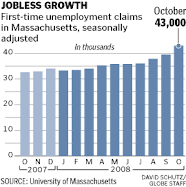






.png)