
www.boston.com/news/local/massachusetts/specials/012609_dimasi/
-

-

-
"Sal’s pal$: DiMasi sends pac funds to friend’s tech firm"
By Casey Ross, Thursday, March 27, 2008, www.bostonherald.com, Local Politics
House Speaker Sal DiMasi has funneled nearly $120,000 in political contributions meant to re-elect Democratic colleagues to the company of a close friend, angering House lawmakers who are accusing DiMasi of using the money to benefit a politically wired pal.
A Herald review of campaign finance records between 2004 and 2007 shows that DiMasi has continually showered huge payments on Sage Systems LLC, a Boston consulting firm co-managed by William Carito, a longtime friend and political adviser.
The payments have sparked heated protests from rank-and-file lawmakers because the money was withdrawn from the Speaker’s Committee for a Democratic House, a political fund controlled by DiMasi that is supposed to help pay for the re-election campaigns of Democratic colleagues.
“He might be helping his friends, but he’s not helping us at all,” said one lawmaker who asked for anonymity.
Several House lawmakers raised concerns about DiMasi’s payments to Carito’s firm, but none would speak about the matter publicly out of fear of political retaliation.
Carito could not be reached for comment. Jane Lane, a spokeswoman for DiMasi’s political committee, said the money spent on Sage Systems provides a discount to help lawmakers purchase the firm’s software, which analyzes voters trends and demographics, and helps lawmakers target mailings to their constituents.
Lane said the speaker’s decision was driven by political strategy, not a desire to help Carito.
“Speaker DiMasi decided that it is far more effective to provide critical campaign support to his members rather than hand out direct contributions, which, under law, are limited to $500,” Lane said in an e-mailed statement.
Some House members who purchased the software said it has provided clear benefits. “The price is extremely good for what you get out of it in terms of constituent services,” said state Rep. James Eldridge (D-Acton), who ran unsuccessfully for the U.S. House and is now running for state Senate.
However, state campaign finance records show that only about 60 of 141 Democratic members of the House, or about 43 percent, have taken advantage of the discount and purchased the software for their re-election campaigns in the past three years.
Meanwhile, scores of lawmakers have given $500 and $1,000 contributions to the Speaker’s Committee for a Democratic House, which is a political action committee and has less restrictive donation rules than committees for individual candidates.
Overall, DiMasi has raised more than $350,000 for the re-election committee since 2005, with about 34 percent of it going to Sage Systems, a private firm just a few blocks from the State House.
There is no evidence DiMasi benefited financially from donating the money to Sage. But lawmakers said his use of the money contrasts sharply with the policy of former House Speaker Thomas Finneran, who used the fund to dole out tens of thousands of dollars in direct donations to House members’ re-election campaigns.
Some Democratic operatives familiar with the fund said DiMasi is trying to be more evenhanded than Finneran, who was at times accused of using the money to funnel donations to political allies instead of distributing it equitably among House Democrats.
Said one Democratic insider, “I’m willing to wager that some of the people complaining now were on the gravy train in past years.”
-
Article URL: http://www.bostonherald.com/news/regional/politics/view.bg?articleid=1083148
-
----------
"DiMasi aide’s film fest nets $50G state grant"
By Dave Wedge, Thursday, March 27, 2008, www.bostonherald.com, Local Politics
A small independent film festival in Falmouth run by one of Speaker Salvatore F. DiMasi’s top aides received a $50,000 state grant last year while larger, more established fests have gone unfunded, the Herald has learned.
The taxpayer-funded grant was tucked into the 2007 budget for the Woods Hole Film Festival, which is run by DiMasi’s chief legislative assistant Judy Laster. Laster, who did not return calls, makes $84,000 a year working for DiMasi but does not take a salary for the nonprofit Woods Hole Film Festival, records show.
The film fest is also a pet project of Christy Cashman, a part-time actress married to DiMasi’s developer pal Jay Cashman.
In a statement, DiMasi spokesman David Guarino said of Laster: “She had no role whatsoever in securing any of the grants received by the festival, and legal counsel for the House of Representatives reviewed her work associated with the festival and determined that it is appropriate.”
Rep. Eric Turkington, chairman of the Legislature’s tourism and arts committee, included the money in a $29 million tourism package approved by the Legislature in 2006. The Woods Hole fest is also slated to get a piece of a new $50,000 grant to be split with similar festivals in Provincetown and on Martha’s Vineyard.
“The idea of promoting film festivals is a good one,” said Turkington (D-Falmouth). “It’s the kind of thing I think can be an economic stimulus for the town.”
According to the nonprofit Woods Hole festival’s most recent filings, officials spent $32,000 in 2005, including $6,452 on travel, $5,142 on supplies and $10,549 on various expenses. Among the miscellaneous expenses were $3,000 for “management fees” and $3,720 for “public relations,” records show.
Film Festival director of development Anne O’Brien said the grant application was filed by the organization’s board - not Laster independently.
“We’re a small nonprofit and we apply for funds where they are available,” she said. “I don’t think there’s anything inappropriate.”
The Boston and Nantucket film festivals are the state’s largest and attract many of Hollywood’s top stars, but officials from both say they have been denied state funding in the past.
The only government money to go to the Boston Film Festival was $15,000 several years ago through the state film office and two $5,000 grants from the Massachusetts Convention Center Authority, spokeswoman Robin Dawson said.
“It’s on my agenda to sit down with the legislators and show them the financials on why this is such a strong benefit for the city,” Dawson said.
Jill Burkhardt, executive director of the Nantucket Film Festival, praised the Woods Hole grant and said the state should make more aid available.
“I find (funding) to be lacking overall in this country, not just in Massachusetts,” Burkhardt said. “Most European film festivals are supported in part by their government. It’s much more difficult to get government funding in the United States.”
-
Article URL: http://www.bostonherald.com/news/regional/politics/view.bg?articleid=1083149
-
----------
(A Boston) GLOBE EDITORIAL
"Big target in ethics dustups"
March 29, 2008
HOUSE SPEAKER Salvatore DiMasi has a big heart when it comes to helping his friends raise money for charities. But his old-school style of politics has put a big target on his back. For the second time in a month, the Massachusetts Republican Party is asking the state Ethics Commission to investigate the powerful North End Democrat.
The speaker's latest woes come courtesy of Cognos ULC, a Canadian software company, which offered generous support over the past several years to a favorite DiMasi charity for family members of police officers killed in the line of duty. Over a similar period, Cognos received $22 million in state contracts, including a $13 million award last year that violated the state's bidding, bonding, and scoring regulations, according to state Inspector General Gregory Sullivan. That last contract has been rescinded. A former Cognos official may also have tried to gain leverage with the state's former chief information officer by insisting that DiMasi favored the firm's bid. DiMasi's office denies intervening in any way for the company.
Only a thorough Ethics Commission investigation will clear up lingering questions. And it shouldn't drag out. If DiMasi did nothing wrong, he shouldn't have to walk under this cloud.
Meanwhile, the speaker can do a lot to avoid both actual and appearances of conflicts of interest. It may be lamentable, but DiMasi may need to distance himself from some of his charitable ventures. When he was a rank-and-file representative and even majority leader, DiMasi's signature on a fund-raising letter didn't overstimulate lobbyists or stir up pursuers of state contracts. But things have changed. In his current position, his priority should be to give the public confidence in state government.
DiMasi is an amiable, long-serving lawmaker who was schooled in an era when politicians saw their first duty as helping people. He would later develop into a policy expert with skill at wielding power. Anyone with that high a political profile must also be prepared to face the toughest scrutiny.
David Guarino, DiMasi's spokesman, says the speaker acted well within the limits of the state's conflict-of-interest law by limiting his role to general solicitation along with other members of the charitable committee. And the speaker, says Guarino, expressly avoided any follow-up solicitations or attempt to target the fund-raising materials to anyone, including those doing business with the state.
DiMasi is comfortable with the ethics statute. It doesn't change quickly. But public opinion shifts more rapidly. And the speaker needs to keep up.
----------
-

-
Dan Bosley or "BUREAUCRAT BOSLEY"
----------
Re: Dan Bosley versus the national Corporate Elite
Wednesday, 19 March, 2008
Dear Dan Bosley:
As I live in Boston's media market, I have heard a lot about casino gambling for the Commonwealth of Massachusetts. I have come to an understanding that the real corporate interests in Massachusetts State Government, much like Connecticut & New Hampshire, are Insurance Companies, which means they set the agenda a push through legislation to fit their designs over the millions of "have-nots" who make them rich. I understand that it is the Insurance Companies that are OPPOSED to Governor Deval Patrick's push for Casinos in Massachusetts. However, other more powerful national corporate interests are pushing for Deval Patrick's proposal - namely: Wealthy National Financial Institutions who profit off of the Casinos in Connecticut, New Jersey & Nevada. While the Corporate Elite in Massachusetts: INSURANCE COMPANIES-- are against the Governor's plan for Casino Gambling, the Corporate Elite in New York City and nationwide are for the governor's plan. So while you are representing the state's Insurance Companies' interests by opposing the governor's plan, you are taking on a bigger lobby nationwide.
It is all very interesting to watch, Dan Bosley. I hope the state's Insurance Companies will reward you with another 50 years of making them rich in the name of economic development. NOT!
In Dissent!
Jonathan A. Melle
----------
"Luck craps out in Massachusetts"
By Rosemarie Stachura
The North Adams Transcript Online
Saturday, March 29, 2008
Well, in Massachusetts it's all over except for the recriminations -- this sinful attempt to bring casinos to our blissful state. The Legislature has spoken.
The Berkshire delegation so righteously proclaimed its disdain for the voters and all but declared the democratic process of majority rule as nonexistent. Bosley, Downing, Speranzo, Guyer and Pignatelli, and, of course, the unelected and self-proclaimed wannabe governor, Salvatore DiMasi, sure showed the elected Gov. Patrick who is running the state!
Whether or not you support the establishment of resort/hotel/casinos within the confines of the state is irrelevant. The mere fact that these gentlemen wielded their might to defeat the governor's bill before it even hit the House floor indicates to me an arrogance that should scare the pants off any ordinary citizen who believes in the power of the vote and believes in fair play. This is truly dirty politics at its very worse!
Aren't you sick and tired of these so-called do-gooders who know what is good and not good for us? They tell us who to vote for, how to think and how our hard-earned dollars should be spent, while they go behind closed doors and make deals that influence their peers to vote their way on a given issue. This is done with complete disregard for and disrespect of their constituents. We all know there were several deals made last week in Boston, and one wonders just how much those deals will cost the taxpayer or affect the taxpayers.
I suppose we should all be grateful that the Legislature has rescued us from a fate worse than death: "casino culture." I have no idea what casino culture is, but it must be pretty bad!
Here in Massachusetts we have been living with "lottery culture" for several years now, all supported by our Berkshire delegation. America, in general, has been dealing with "drug culture" for many decades, with no success. We are embarking on a "cyber fraud culture" which none of our leaders have even begun to address. Berkshire County is not removed from these "cultures," which, by the way, have nothing to do with casinos.
So, what do we do now? Here in Berkshire County we have lost hundreds of jobs in the past several months, mostly due to plant closings. We are now in the throes of a recession, which will wreak a heavy toll on the residents of this county. It comes at a time when costs are higher than ever for products and services. There are more people and businesses exiting the state than are moving into the state. High energy costs and a dearth of available jobs have everyone thinking about how they are going to survive another year. Taxes have always been an issue in Massachusetts. They don't call it Taxachusetts for nothing!
All these issues, and our legislators couldn't even take a long, hard look at a proposal that, while certainly not a panacea, did have some potential to create something more than just service jobs -- like, maybe, construction jobs for at least the two to three years' building phase -- jobs that would have done a lot to ease problems in the western part of the state which includes Springfield and Holyoke. Good construction jobs mean more revenue for the state, but more than that, jobs bring a sense of well-being and worthiness to workers. Boys, what were you thinking?
Mr. Wannabe DiMasi says there are better ways to bring jobs to Massachusetts. Just how long must we wait for these men to make it happen? Wouldn't you just love to know how many jobs the above-mentioned legislators have brought into the state? We know that Bosley has made some trips to other countries, as have, I am sure, DiMasi and the others. Have any of these trips resulted in new businesses or jobs or anything that would add value to our economy in the area of our business or manufacturing environment? If someone out there has information that will indicate this, please tell your constituents. Inquiring minds want to know!
Thus far, all we have seen to stop the bleeding and add revenue to the state coffers is new increases in license fees, new venues in which to peddle lottery tickets, new increases in bridge, tunnel and road tolls and fines for those who, despite the availability of lower-cost health insurance, still cannot afford to buy the plans. Again, boys, what were you thinking?
Because every action has a reaction, here is what I think we can expect, since our legislators so smugly slammed the door in the faces of its voters: The Indian nation will get the permission it needs to build a casino or two, which will afford the state very little in the way of revenues. New Hampshire will build a casino near or on the state line, and that casino will suck up cash from our state much like a Dyson vacuum cleaner. Bus companies, which are supported by the Connecticut casinos, will continue to transport thousands of Massachusetts residents to Connecticut, where their spendable cash will be left for Connecticut to enjoy.
We won't get any new stadium like UConn got from casino revenues. And, of course, property owners in all the towns throughout Massachusetts will suffer increased property taxes because of the state's inability to deliver the funds its so generously promised but so utterly failed to deliver. Boys, what were you thinking?
After nearly eight years of Bush arrogance, incompetence and complete disregard for the lives of everyday American people, many of us have become extremely jaded. We have developed misgivings about our federal government, and, yes, distrust. It would be a sad state of affairs if we were to lose respect for, and develop a feeling of distrust for, our state government as well. Right now, with me, it's a toss-up!
Boys, you had better start thinking. Those jobs you now hold are not a guarantee you'll have them forever!
-
Rosemarie Stachura is chairwoman of the Adams Finance Committee and a frequent Transcript contributor.
-
----------
"State Lottery unveils new Red Sox scratch ticket"
March 31, 2008
By Lisa Wangsness, Boston Globe staff
The Massachusetts Lottery and the Boston Red Sox unveiled a new $20 Red Sox scratch ticket at Fenway Park today.
The ticket offers a $10 million grand prize, which is as large as any instant win ticket prize in the world, officials said. It also offers 20 $1 million prizes and 100 Red Sox road trips.
The new ticket, which will go on sale April 8 – Opening Day – is expected to generate $23 million in aid to Massachusetts cities and towns. Only 10 million of the tickets have been printed and officials said they expected it to sell out by the end of the baseball season.
The $20 ticket is the third and most expensive Red Sox ticket the Lottery has issued. The first was a $5 ticket that went on sale two years ago and which is expected to sell out within the next few months, at which point the lottery will announce the winners of that grand prize, which is a pair of Red Sox season tickets for life.
The Lottery also announced that it is sponsoring a tour of both the 2004 and 2007 World Series trophies, with stops in 30 cities and towns throughout the Commonwealth.
----------
"Lawmakers postpone tax hike debate"
April 8, 2008
By Matt Viser, (Boston) Globe Staff
House Speaker Salvatore F. DiMasi this afternoon postponed a much-anticipated debate on Beacon Hill over whether to approve the state’s biggest tax increase since 2002 amid criticism from all sides of the issue.
The House was expected to begin debate this afternoon on legislation that would allow about $356 million in tax increases for smokers and the state’s largest corporations.
But about 20 to 30 Democratic legislators were challenging DiMasi’s plan for not being aggressive enough. Business leaders and Republicans also offered a pre-emptive strike in the debate around noon, charging that the plan would hurt businesses amid a looming recession.
“We have a fundamental problem with the timing, scope, and nature of the bill,” said House Minority Leader Bradley H. Jones, a North Reading Republican. “This tax package will be nothing but the death knell for the state’s economy.”
Debate on the proposals is now expected to take place on Thursday.
The proposals would tighten corporate tax laws – bringing in $204 million next year – and would raise $152 million by increasing the state’s cigarette tax by $1 per pack. The cigarette increase would give Massachusetts the second highest cigarette tax behind New Jersey, although New York is planning to trump both states with a $2.75-per-pack increase.
DiMasi outlined the proposals two months ago in an effort to compromise with Governor Deval Patrick, who since taking office last year has been calling for closing so-called corporate tax loopholes.
Patrick and DiMasi have both backed a plan to tighten the corporate tax codes, but they have significant differences over how deep corresponding reductions in corporate tax rates should be.
Overall, DiMasi's plan would mean that businesses would pay about $204 million more next year, but by 2011 would be back to what they pay now. Because Patrick's plan does not lower the tax rate as quickly or dramatically, businesses would still end up paying $280 million more once his plan is fully implemented in 2012.
----------
-

-

-
----------
"Sal’s No. 2 raked in felons’ cash: 13 cons have donated $5,800"
By Dave Wedge, April 11, 2008, www.bostonherald.com, Local Politics
House Speaker Sal DiMasi’s second-in-command, Rep. Thomas Petrolati - a driving force behind major legislation on Beacon Hill - has accepted thousands in campaign contributions from reputed mobsters, bookmakers and a who’s who of corrupt Springfield pols, a Herald review has found.
Among the criminals who’ve contributed to Petrolati, the House speaker pro tempore, is Frank Colantoni, who served 12 years in connection with the 1989 mob hit on Patriarca crime family capo William Grasso. Colantoni, who has a rap sheet dating back to 1983, donated $500 to Petrolati’s campaign in 2006, records show.
Reached by phone yesterday, Colantoni said he donated to Petrolati at a friend’s request.
“I don’t even really know the man, but if a friend comes to me and says the guy’s a good guy, help him out. No problem,” Colantoni said. “I don’t think he can do a thing for me.”
A Herald review identified 13 convicted criminals who’ve donated a total of $5,800 to the Ludlow Democrat. Other felons who’ve given to Petrolati after their convictions include:
Anna Santaniello, who was convicted in 1989 of helping run a mob gambling ring;
Disgraced ex-Springfield City Councilor Francis Keough, who is serving three years for extortion for skimming cash from a homeless shelter;
Developer Michael Cimmino, who was convicted in 2004 of illegally putting slot machines in Springfield barrooms;
Restaurant owner Andrew Yee, who was convicted of lying on a loan application in 1990;
Lobbyist Charlie Kingston, a two-time tax cheat.
Reached outside his State House office this week, Petrolati, who is up for re-election, said he didn’t know Colantoni and was “unaware” of any felons on his donor list. Asked if he would return cash contributed by felons, he said: “Absolutely.”
In a statement, Petrolati’s campaign treasurer James Nascimento said: “The Committee to Re-Elect Thomas M. Petrolati . . . has never knowingly accepted donations from previously convicted felons and, now that it has been made aware of the donations, (they) will be given a refund.”
There are no rules against accepting donations from convicted felons. However, many politicians regularly review their donor lists and return contributions from criminals or donors who may pose a conflict of interest.
Pam Wilmot, spokeswoman for the government watchdog group Common Cause, said that although felons’ campaign contributions are legal, they could pose a public relations problem for politicians.
“There is a sensational aspect to having a contribution from somebody who is connected to crime and that is something that can be effectively used by an opponent. And that’s why most politicians steer away from them,” she said.
Petrolati, who worked behind the scenes to help kill Gov. Deval Patrick’s casino plans, also has taken campaign cash from several donors later convicted of felonies. Many are former public officials snared in a sweeping FBI corruption takedown in Springfield.Nascimento did not say if Petrolati would return money from donors convicted of felonies after giving contributions.
Messages left by the Herald for donors were not returned.
-
Article URL: www.bostonherald.com/news/regional/politics/view.bg?articleid=1086418
-
----------
"Tax measure could cost state millions: Late amendment would create break on corporate offshore holdings"
By Matt Viser, (Boston) Globe Staff, April 24, 2008
Governor Deval Patrick's quest to tighten corporate tax laws and reap hundreds of millions of dollars in new revenue might be undermined by a last-minute amendment providing new offshore tax breaks that was tacked onto the legislation by the House, according to state officials.
The complex amendment was backed by the House leadership and approved with little debate during mid-evening voting two weeks ago as representatives were adopting the overall tax package. Several lawmakers said they were unaware of the details of the provision, which was sought by the state's largest business lobbying group.
The provision would permit large corporations to avoid up to $200 million in state taxes a year if they maintain large portions of their business operations overseas, according to an estimate by the state Department of Revenue. The tax-shelter strategy has proved controversial in other states.
Administration officials say the maneuver could essentially make a wash of the revenue raised by corporate tax reform, a cornerstone of Patrick's agenda that was expected to bring in $217 million in the first six months of 2009.
"It would allow companies to shift money overseas and avoid taxes in Massachusetts," Navjeet K. Bal, the state's revenue commissioner, said in an interview yesterday. "This is a real concern for us."
The offshore tax break still must be considered by the Senate, along with the rest of the tax bill, before reaching Patrick's desk. Through a spokesman, Patrick said the administration will lobby senators to change the plan.
"We look forward to continuing to work with the House and the Senate to craft a final loopholes plan that will ensure tax fairness and provide much needed revenue," said the governor's spokesman, Kyle Sullivan.
The state Department of Revenue is not identifying companies that could benefit from the provision, but it points to a lawsuit by Illinois against Wal-Mart and other large corporations that have employed similar offshore tax shelter strategies.
The Massachusetts Budget and Policy Center, which analyzes the state budget and tax policies, is planning to release a report today that details the consequences of the House amendment, which was adopted April 10.
"It looks like what this amendment does is create new opportunities for tax avoidance and new loopholes," said Noah Berger, the executive director of the Boston-based nonprofit. "That goes in exactly the wrong direction."
Representative Daniel E. Bosley, who sponsored the amendment, disputed the state's estimates as inflated and suggested the Department of Revenue's criticism was motivated by other provisions in his amendment that remove some regulatory power from the department.
"I just don't trust their figures," Bosley said of the department. "It's a ridiculous estimate. They're just bad at numbers."
The amendment was sought by the Associated Industries of Massachusetts, according to officials at the organization, which advocates on behalf of the state's business community.
"We don't think this is a particularly good time to be jacking business taxes," said John Regan, an executive vice president of the Associated Industries of Massachusetts.
Since he took office last year, Patrick has sought changes in the tax code to raise more revenue by closing what he considers to be loopholes. But he was repeatedly rebuffed by House lawmakers who said tax increases would send the wrong messages to businesses. When the House signaled it would embrace the plan and voted it through this month, it was considered a major breakthrough.
Under a compromise, the House adopted most of the governor's proposals, which would bring in about $217 million in new revenue during the first six months of 2009. But they could lose $100 million to $200 million every 12 months in the future because of the Bosley amendment, according to state estimates.
There was little public debate on the five-page, highly technical amendment, and it passed on a voice vote, without a roll call vote. Several lawmakers later admitted they did not realize the full extent of what they were voting on.
"It's somewhat embarrassing," said Representative Jay R. Kaufman, a Lexington Democrat who, after the vote, started looking into the issue. "Since it was introduced at the last minute - and there was a desire to get this voted on that day - there was an understanding we would be working with incomplete information."
Senate President Therese Murray declined to comment yesterday, but the Senate's chief budget writer said they would carefully examine the Department of Revenue's concerns.
The Department of Revenue "is our tax collector," said Senator Steven C. Panagiotakos, chairman of the Senate Committee on Ways and Means. "We are going to take what they say very seriously and see what makes sense and what doesn't."
The issue hinges on a complex tax regulation called combined reporting, which is designed to prevent large, multistate corporations from shifting certain profits to other states that have lower tax rates. The House-approved corporate tax legislation would require companies in Massachusetts to combine all income and apportion the Massachusetts share.
But while the overall bill tightened that rule, Bosley's 2,300-word amendment inserted language that could allow certain corporations to shift a large portion of their income to overseas subsidiaries and avoid paying corporate income taxes in Massachusetts.
Several major corporations, including Wal-Mart, McDonalds, and Burlington Northern Santa Fe Corp., have exploited these tax codes in other states, such as Illinois and Minnesota, according to state officials.
Wal-Mart, for example, set up a small real estate office in Florence to control billions of dollars of the retailer's property in the United States, the Wall Street Journal reported in November. The Illinois Department of Revenue last year demanded $26.4 million in back taxes, interest, and penalties in a case that is ongoing.
Bal wrote a letter to the Senate president last week, expressing concern over the changes and citing the Wal-Mart example to illustrate how Massachusetts could lose tax revenue.
"These changes primarily benefit a limited group of very large, sophisticated, multinational businesses," reads the letter, which was obtained by the Globe. "If left unchanged, these changes will materially reduce the additional revenue anticipated from the governor's combined reporting bill by at least $100 million to $200 million annually."
Burlington Northern did not respond to a request for comment yesterday. Public relations officials at McDonald's declined to comment. Wal-Mart said it is paying attention to the Massachusetts legislation.
"Anytime there's a lawful way to reduce our expenses and save money for our customers, we're aware of it," said Daphne Moore, a Wal-Mart spokeswoman.
Proponents say they do not want to tax businesses unfairly on profits, even if they originated in Massachusetts and then shifted to offshore subsidiaries.
"At what point do we break the backs of these businesses and corporations and force them to expand beyond our boundaries?" said Representative John J. Binienda, House chairman of the Joint Committee on Revenue. "If you did every single loophole in the world all at the same time, you'd be having layoffs by these companies. And without these corporations and having these people working we'd be a lot worse off."
-
Matt Viser can be reached at maviser@globe.com.
-
----------
"Worrisome tax break"
The Berkshire Eagle - Editorial
Friday, April 25, 2008
We urge the state Senate not to sign off on the House's bill tightening corporate tax laws without first exploring a late amendment that some House members claim they didn't know the details of before their vote earlier this month. The amendment, which provides new offshore tax breaks for large corporations, could negate Governor Patrick's efforts to generate much-needed new revenue to the state.
The House bill backs the governor's effort to end the system in which companies divide their liabilities among various divisions, some in other states, to reduce their tax burdens, a measure already passed into law by 21 other states. The affected businesses would primarily be large corporations with divisions outside the state, not your typical small Berkshire business. The late add-on in the House would enable corporations to pay less in state taxes if they maintain large portions of their business operations overseas. Again, this provision would almost exclusively benefit large multi-national corporations.
The state Department of Revenue told The Boston Globe that this provision would cost the state about $200 million a year, essentially canceling out the revenue generated from the closing of a so-called "loophole" included in the same bill. Representative Daniel Bosley, a North Adams Democrat who sponsored the amendment, says the DOR's estimates are too high. All the more reason for a thorough vetting in the Senate.
While government should not burden business unduly, it does have the right and obligation to require business to pay its fair share of taxes, just as residents must. Employing strategies in which business divisions in other states or countries are used to reduce taxes paid to Massachusetts cannot be defined as fair.
----------
"Legislative wheels turn out of view: Biggest decisions made secretly on Beacon Hill"
By Matt Viser, (The Boston)Globe Staff, April 25, 2008
Community activist Carl Nilsson stood outside the House chamber late one night this month and spoke with any elected representative who would stop. He asked them to vote against a last-minute corporate tax amendment, one that was heavily influenced by lobbyists and business groups.
But nothing Nilsson said would matter. Behind closed doors, the decision had already been made by a handful of influential lawmakers. By 9 p.m., the five-page, highly technical amendment carried easily on a voice vote, with little public debate.
It demonstrated how the wheels of government turn on Beacon Hill. Most important decisions take place behind closed doors, including those on some of the weightiest topics in recent months: legalizing casinos, levying new taxes, and formulating the $28 billion state budget. In an increasingly common practice, even committee votes are frequently taken via Blackberry and e-mail, with the results released later.
And because the Legislature exempted itself decades ago from the state's open-meeting and public records laws, lawmakers often deliberate in private and keep key documents - schedules, e-mails, even some voting records - hidden from public view.
Democrats, who control the House and Senate, frequently hold closed-door party caucuses to hash out policy details; by the time legislation reaches public view, ready for a vote, the results are typically predetermined.
In the case of the vote Nilsson was watching, the action had serious financial consequences that were unknown that night to many legislators: The Department of Revenue now estimates that the amendment could open the door for up to $200 million in annual tax breaks for large corporations that set up overseas operations.
"It was very frustrating," said Nilsson, campaign director of Neighbor to Neighbor, a nonprofit organization that advocates for low-income families statewide. "Doing these things in the dead of night makes it harder to have a public discussion and for legislators to understand what they're voting for."
It's hardly surprising or new that Massachusetts politics includes hidden agendas and backroom deals, a practice that has been in play since John Hancock became the state's first governor in 1780. But as Massachusetts has once again become virtually a one-party state, there are fewer challenges to open up the process or questions directed at the handful of powerful legislative leaders who dictate the flow of legislation. Some of the means of centralizing authority put in place by former House speaker Thomas M. Finneran have continued under the current speaker, Salvatore F. DiMasi.
"I'm troubled by the current process," said Representative James B. Eldridge, an Acton Democrat. "There is a lot of peer pressure that inhibits members from taking their votes to the House floor, and [unless it's backed by leadership] you don't have a snowball's chance in hell of it passing. Institutionally, the House has grown comfortable with the current system, and it needs to become more open."
The opaque practices continue despite a pledge by DiMasi when he became speaker in 2004. He told colleagues that he would empower rank-and-file legislators, encourage more public policy debate in committees, and "open the windows of this institution and let the light of the 21st century in."
DiMasi declined requests for an interview, but his spokesman released a statement, pointing to efforts to increase openness by improving the Legislature's website and broadcasting 150 hours of committee hearings and floor debate online, "giving the public an unprecedented seat in the hearing room."
"Under Speaker DiMasi, the House has become inarguably more open and transparent to the public," said the spokesman, David Guarino.
Through a spokesman, Senate President Therese Murray also pointed to the online broadcasts of floor debates as evidence of openness.
Governor Deval Patrick, who ran against the "culture on Beacon Hill" and vowed to bring new levels of transparency to government, declined to comment. Patrick has denied several requests for records, including a request from the Associated Press in February for copies of his e-mails and other electronic communications.
If crafting law is like making sausage, the process at the State House makes everything appear to come out like a prepackaged Fenway Frank.
During the highly contentious casino debate, for example, lawmakers spent 13 hours in committee hearings, sustaining themselves on Gatorade and crackers as they listened to anyone who wanted to testify.
But when it came time for deliberations among committee members, there were none. To cast votes, most e-mailed and phoned them in, some not even bothering to show up at the State House.
For John Leschen, a 41-year-old historic preservation contractor from Plympton, this was the first time he had confronted State House procedures, and he expressed disappointment.
Leschen traveled several times to Beacon Hill, meeting with legislators and sitting through hours of hearings, to oppose the governor's plan to license three resort casinos. He was impressed with the amount of time legislators spent on the issue and the knowledge they had amassed, but said it was all for naught.
"It was primarily for show," said Leschen. "These things happened the next day through e-mail, a quick debate, and a couple of votes."
Legislators say e-mail voting is fairly common, particularly on routine matters, and it can come in handy in moving legislation along quickly. But it also means that lawmakers, who earn nearly $60,000 in annual base pay to represent their districts, can avoid airing their views in a public forum.
"In a perfect world, we'd all be there, and we'd all speak great thoughts," said Representative Daniel E. Bosley, a North Adams Democrat and cochairman of the committee that voted on the casino legislation. "But not everyone can be there, and . . . it's a good thing people are given options to vote."
The e-mail voting is used only in legislative committees, which is where lengthy policy discussions typically take place, and not when issues reach the House and Senate floors, where votes are publicly displayed using red and green lights on an overhead board.
There are a variety of other policies that shield lawmakers from public scrutiny or questioning. Photography and video equipment, for example, are, in most cases, banned from the House and Senate chambers. There is a rope line that keeps reporters, photographers, lobbyists, and other members of the public away from the House doors after crucial votes. If legislators want to answer questions, they can walk over to the rope to address the crowd. If they don't, they can slip out a back door.
Several of the House procedures "definitely have a way of making the process neater and smoother, but it's completely legitimate to question whether democracy is well served," said Representative Jay Kaufman, a Lexington Democrat. "If there were more debate, we would be in session longer, and it would be harder for a body of 160 members to follow. But it's definitely marked by less debate."
Years ago, the Legislature routinely debated for weeks over the budget, with spirited floor fights over individual line items. But when Finneran became speaker, House leaders made several changes that made the process quicker and more orderly by consolidating power.
When House members begin debate next week on how $28 billion in taxpayer money should be distributed, they will retreat to a spacious lounge blocked off from the public by a security guard and there decide which budget amendments make the cut.
Members have submitted about 1,500 amendments, but which ones get through is largely determined by the chairman of House Ways and Means, Robert A. DeLeo, Democrat of Winthrop.
In theory, lawmakers can appeal on the House floor. But by that time, most decisions have been made. "It really is a sad state of affairs in how we deal with this," said House minority leader Bradley H. Jones Jr. . "It's not good for democracy."
-
Matt Viser can be reached at maviser@globe.com.
-
www.boston.com/news/local/articles/2008/04/25/legislative_wheels_turn_out_of_view/
-
(Photo of the House Lobby of the State House on Beacon Hill)
Many crucial decisions are made in the House Lobby of the State House, which is off limits to the public and media. (MARK WILSON/GLOBE STAFF/FILE)
-
----------
4/25/2008
Dear Dan "BUREAUCRAT" Bosley:
I read the news article, below, about how you inserted "a last-minute amendment providing new offshore tax breaks" to the House's tax package to raise revenues from wealthy big businesses - or the Corporate Elite in Massachusetts. "The Boston Globe" characterized your INEQUITABLE rider as "the Bosley amendment".
Do not you know whom you are representing on Beacon Hill's State House? You represent Northern Berkshire County & the surrounding areas! The corporate elite does NOT exist in your legislative district! That means that you are NOT representing your legislative district in Boston!
You even support the Massachusetts State Lottery System that is nothing more than a system of regressive taxation! Well, a majority of your constituents are poor!
In Dissent!,
Jonathan A. Melle
----------
The Boston Globe, Op-Ed, SCOT LEHIGH
"One bill's journey through Beacon Hill"
By Scot Lehigh, (Boston) Globe Columnist, April 25, 2008
WELCOME to the Beacon Hill Sausage Factory.
Before we start today's tour, you'd best put on a pair of coveralls and some rubber boots. The process is messy, and you don't want to get splattered.
Oh, yes, and watch out for the mice. They like to skitter out from dark corners and nibble on your wallet.
Today we're going to look at an important piece of legislation as it wends its way through the process. See this smartly designed bill? It's Governor Patrick's plan to boost the life sciences in Massachusetts.
One way it would do so is by letting the Massachusetts Life Sciences Center, a quasi-public agency, spend $500 million in capital funding on projects it judges important, as long as Administration and Finance signs off. That thoughtful legislation disappeared into the factory for months. It's still not finished, but one of the versions that has emerged looks, to use an early life-sciences allusion, a bit like Frankenstein's monster.
See that jovial fellow over there? That's Dan Bosley. He's a highly skilled sausage factory employee - actually, they prefer to call themselves state legislators - from North Adams. Representative Bosley helps run one of the factory's primary earmarking machines, known locally as the Joint Committee on Economic Development and Emerging Technologies.
Let's look at the governor's bill now that Dan's done with it. Why, there's $49.5 million - almost 10 percent of the bond money - earmarked for the construction of a science center at the Massachusetts College of Liberal Arts.
Now, the life sciences initiative is supposed to spur industry clusters and create jobs. Cutting-edge academic work in the field is usually done at big research universities, not small liberal arts colleges. Not even MCLA's biggest booster could plausibly describe the college as a life sciences leader. After all, it doesn't have any graduate programs in science.
Mind you, the college is hardly being neglected. The administration has included about $23 million for MCLA in the higher education bond bill (a sum that has now grown to $31 million in the factory). Based on an actual planning process, that $23 million is for a 28,000-square-foot addition that will let MCLA consolidate its science programs and build modern labs, classrooms, and offices.
So why the additional $49.5 million that's now earmarked for the college?
Well, here's a little quiz to see how well you understand the way the factory works. Where do you suppose the Massachusetts College of Liberal Arts is located? That's right. North Adams.
And where do you suppose Dan Bosley graduated from? North Adams State College, which is now . . . the Massachusetts College of Liberal Arts.
Let's see if we can get close enough to talk to Dan. Watch your fingers, though. If they get caught in his machine, they just might end up earmarked for the Berkshires as well.
So, Dan, how do you justify earmarking $49.5 million for a college that doesn't even have a graduate program in science? "It doesn't have a graduate program," Bosley says, "because they have no life sciences center."
But the point of this bill isn't to start life sciences programs from scratch, but rather to build on the state's existing strengths. "So . . . screw Berkshire County because they don't have anything now, so screw them?"
But what about the millions already in the proper pipeline for the college? If the college gets the $49.5 million, Bosley says, "we wouldn't use [the millions] in the higher ed bond bill."
That's hardly the only earmark in the House bill. Altogether, almost $300 million of the $500 million is specifically earmarked, with nearly all of the rest tagged by the House for a variety of grant or loan programs. (The governor can choose not to spend earmarked money, but he can't use it for other purposes.)
OK, here's the question as we complete today's tour: Now that you've seen sausage being made, how much confidence will you have in the factory's final product?
-
Scot Lehigh can be reached at lehigh@globe.com.
-
----------
City
"MCLA defends science funding: The college could get more than $80 million from the House for facility upgrades"
By Scott Stafford, Berkshire Eagle Staff
Wednesday, April 30, 2008
NORTH ADAMS — In the midst of enrollment growth and increasing student interest in its science and technology programs, Massachusetts College of Liberal Arts is finding itself ill-equipped to satisfy that demand.
With laboratories in buildings that are more than 40 years old, state and college officials argue that the college's facilities limit the potential for students.
And the need is not unique to MCLA, they say. Berkshire County companies, which consistently turn elsewhere for employees with science and technical skills, could start finding those talents closer to home with a well-equipped science program churning out science majors.
This week in Boston, legislators are debating the final budget numbers, which include a proposed $49.5 million for a new science center and $31 million for other facility upgrades at MCLA.
Mary K. Grant, president of the college, said a new science building is long overdue, especially when more students are interested in majoring in science, technology, engineering or math.
In the past five years, the number of students majoring in the sciences has increased 32 percent, with a 26 percent jump coming between 2006 and 2007, according to figures provided by the college.
"Why shouldn't we have the kind of facility in our own backyard — with state-of-the-art equipment that will attract students and faculty?" Grant said in an interview yesterday. "This region should be bold and reach high. It's what we ask our students to do every day."
David M. Rooney, president of the Berkshire Economic Development Corp., said an expanded science curriculum and state-of-the-art science research facility would make Berkshire County an easier sell to attract new businesses and retain existing companies.
"If you want to attract new business, you have to create a sustainable pool of educated, talented individuals," he said. "Increased investment in higher education is an important tool for us, just as connecting eager young minds with practical experience is very important for us."
Under discussion in a House and Senate conference committee is the Life Sciences Bill, which includes MCLA's proposed science building. The Higher Education Bond Bill, which includes the $31 million for the MCLA facility upgrades, has passed both houses and is now in a House and Senate bonding committee.
One promoter of the plan is Fred Clark, chairman of the Massachusetts Board of Higher Education, the board that governs the state's university system.
"We are very anxious to get those bills through before the end of the legislative session," he said. "You can't train a work force for the future in labs that are 50 years old. Those needs have been long-neglected. We absolutely have to provide (MCLA students) with modern facilities to fill the needs of the science-based economy that is growing in Massachusetts."
"This is extremely important to our area and to our students," said state Rep. Daniel E. Bosley, D-North Adams. "The premier liberal arts college in the state is right there in North Adams, so what better place to put a life sciences center than at MCLA?"
He said other legislators are aware that other colleges in the public university system have received "$50 (million) or $60 million" for new campus facilities in recent years. And with the high-tech economic development occurring between Albany and Glens Falls, N.Y., a new facility at MCLA will help the region tap those opportunities with modern training and a ready work force.
And the total amount for MCLA, the sum of the science center and facility upgrades, Bosley said, "isn't enough to do what we need to do."
Last week, a Boston Globe columnist criticized the multimillion-dollar science center plan at MCLA and Bosley's advocacy for it; the North Adams Democrat is an alumnus of the college.
"Berkshire County deserves the same kind of opportunity as the rest of the state does," Bosley said. "I make no apologies, and I think it's grounded in sound reasoning."
One important aspect of a new science center at MCLA would be the community component, Grant noted. Last week, Mount Greylock Regional High School science students visited and conducted experiments in MCLA laboratories that they have not the equipment to do in their own school. But to make room, MCLA science classes had to juggle their laboratory times.
With a new science center, the ability for local schools and local companies to use the facilities would be greatly increased.
"At this point, it's very difficult to do," said Adrienne Wootters, the chairman of the physics department. "The labs are being used all day and into the evening to fit everyone in there. We love to have kids come to visit, but we have to shuffle things around. With a new building, classrooms and labs for local teachers and students would be accessible and useful."
-
To reach Scott Stafford: sstafford@berkshireeagle.com or (413) 664-4995
-
----------
"Just the ticket for brokers: They hire an associate of DiMasi, watch scalping bill pass the House"
By Andrea Estes and Stephen Kurkjian, (The Boston) Globe Correspondent, April 27, 2008
The 2007 Red Sox season was just underway when a group of professional ticket brokers held an unusual meeting in a private room at the Baseball Tavern, the storied bar in the shadows of Fenway Park. The main item on their agenda: How to persuade Massachusetts officials to keep ticket-resale profits rolling.
One man was there with an offer of help. He was not a broker, had no known experience as a political strategist, and has never registered as a State House lobbyist.
But Richard Vitale had something that the two dozen brokers came to believe was even more important to their cause - a close personal and professional relationship with Salvatore F. DiMasi, the speaker of the Massachusetts House. Vitale told the group that he could "do things a registered lobbyist couldn't do - behind the scenes," according to one ticket seller in attendance who asked that his name not be used.
Others present also told the Globe they left the meeting with a clear understanding that Vitale was close to DiMasi. What they did not know when they decided to retain him through his firm, WN Advisors, was just how close. Vitale is the speaker's personal accountant and former campaign treasurer. And he had given DiMasi a $250,000 third mortgage on his North End condominium, according to public records. It was an unorthodox line of credit, apparently at below-market interest rates for such a loan, that DiMasi in an interview ac knowledged he had used.
Vitale's sales pitch worked, and, to a point, his promised efforts on behalf of the brokers may have worked, too.
At the urging of the group's leader, James Holzman, the president of Ace Ticket Worldwide, the brokers paid Vitale what two members in attendance at the meeting that day described as many thousands of dollars to help their cause. Months later, legislation to lift regulations on the ticket resale business glided through the House of Representatives with DiMasi's support. After passing the House, the bill got bottled up in the Senate, where it remains today.
A lobbyist or a strategist
But because Vitale, a Charlestown accountant with the firm of Vitale, Caturano & Co., was not registered as a lobbyist when he helped the brokers with their bill - and because of his financial ties to the speaker - the episode raises questions on how DiMasi and his political allies conduct business on Beacon Hill.
If Vitale was paid more than $5,000 to influence lawmakers - and several brokers briefed on his fee arrangements said he most certainly was - he would have had to register as a lobbyist. And if he was working as a lobbyist, his ongoing financial relationship with DiMasi - namely, the loan -would have run afoul of state conflict of interest laws that prohibit lobbyists from granting anything of value to a public official.
Also, if he had registered as a lobbyist, he would have been required to disclose how much he was paid by the ticket brokers for his services. Failing to register as a lobbyist carries a civil penalty of $500. Violators of conflict-of-interest law face civil fines up to $2,000 and possible criminal prosecution.
Vitale, through a spokesman, denies lobbying. The spokesman, George Regan, said Vitale worked as a "strategist" on the ticket brokers' legislation. Vitale has a "brilliant mind" and had worked as a strategist on other policy issues, Regan said, refusing to identify the other issues. "These are private, confidential matters that one's business does not reveal to the public," said Regan.
Holzman denied that the association hired Vitale because of his ties to DiMasi. He would not comment further or explain why the brokers chose an accountant with no lobbying experience to represent them.
DiMasi said neither he nor anyone on his staff ever spoke with Vitale about the ticket broker legislation; he said he ultimately backed and voted for a bill that favored the brokers because he thought it was good for consumers, too. The speaker said he took out the $250,000 line of credit with his old friend in 2006 because he needed some money, but that their personal and financial connections played no role in the fate of the ticket brokers' Beacon Hill agenda.
"I had no idea that he was working for them or what his relationship was," said DiMasi. "He's never talked to me about any legislation at all."
DiMasi said he borrowed $250,000 from Vitale because Vitale, his financial adviser, counseled him to. He said he did not go to a bank because he thought he would need the money for only a short period of time.
"I was trying to shift gears to get more income from my law office, and thought I could pay off that temporary line of credit," he said, adding that he has made some payments of principal and interest.
"I didn't accept anything from a lobbyist, no," said DiMasi, who was accompanied to an interview by a spokesman, the House legal counsel, and his chief of staff. "It has nothing to do with any legislation or anything I've done up here."
According to the mortgage filed with the Suffolk County Registry of Deeds, repayment of the June 22, 2006 loan - a revolving line of credit for five years - is not due until 2011. It was issued by Washington North Realty Corp., an entity created in the 1980s by Vitale to engage in consumer lending, according to records in the Massachusetts scretary of state's office.
Prime condo loan secured
The loan was unusual in several respects. It was secured by a third mortgage on Dimasi's Commercial Street condominium. According to real estate specialists, third mortgages are rare, and usually done through a private lender. They are essentially unsecured loans, because in the event of a foreclosure it would be unlikely the third lienholder would recoup the investment. Because of the risk, such loans generally carry interest rates that are substantially higher than prevailing mortgage rates, specialists say.
"If you're looking at a third mortgage you're probably looking at 16 or 17 percent, maybe higher," said David Milton, director of the Master of Science in Real Estate Management program at Bentley College.
But in this case, the loan was offered at prime rate, according to DiMasi's statement of financial interest, a public disclosure document he is required to file. At 8.3 percent at the time, the prime rate was significantly lower than what a borrower would ordinarily have been charged for a third mortgage, Milton said. DiMasi told the Globe on Friday that House counsel Louis Rizoli had informed him recently that the interest rate on the Vitale mortgage was actually prime plus 1 or 2 points.
DiMasi already had a $503,000 first mortgage and a $75,000 home-equity second mortgage on the property, which the city of Boston assessed last year at $973,200.
Through his spokesman, Regan, Vitale would not answer questions about the line of credit that he extended to DiMasi. Regan also would not say how Vitale came to be hired by the ticket brokers' group, what specifically he had done on their behalf, with whom he had met, whether he had spoken to DiMasi or any of his lieutenants, or how much he had been paid by the brokers association.
The legislation Vitale's clients sought to influence last year would significantly affect what agents can charge for tickets offered for resale.
Under current law, ticket resellers may charge no more than $2 above a ticket's face value, plus a service charge, though the law is rarely enforced, observers say. Consumer advocates had been pressing for tighter price controls after receiving complaints that tickets to sporting events and concerts were being sold for many times their original price.
By late September 2007, months after the brokers hired Vitale, the measures sought by consumer advocates were dead in the House. And in their place, a broker-friendly bill lifting all pricing restrictions had emerged with a favorable recommendation from the Joint Committee on Consumer Protection and Professional Licensure. A week later, that bill passed the full House.
The committee co-chairman from the House, Democrat Michael J. Rodrigues of Westport, who sponsored the bill, said he pressed the committee members to give it a favorable recommendation and forward it to the full House. Rodrigues said he initially felt that more consumer-oriented pricing restrictions should be placed on ticket sales, but that after hearing testimony during a committee hearing and consulting his staff, he decided to join a movement among several states to remove all pricing controls, and mandate instead that the ticket brokers be licensed and bonded.
"We don't have price controls on any other commodity, not even drugs, yet we try to enforce them on the resale of tickets," Rodrigues said. "It doesn't make any sense and it doesn't work."
Bill stalled in the Senate
Rodrigues said he never met Vitale. He said he spoke to DiMasi about the bill, but that the speaker only asked if there were adequate consumer safeguards in the legislation and never asked him to advance it.
The assumption of the joint committee's Senate co-chairman, Michael Morrissey, who objected to the bill, was otherwise.
"I told him I didn't think it was ready for prime time," said Morrissey. "He said he wanted to take a shot at it. I assume it came from the speaker, though I don't know."
Consumer advocate Colman Herman, who has urged tighter price controls and enforcement on the ticket brokers since 2005, decried the bill that passed the House. "This is a pro-industry bill disguised as pro-consumer," Herman said. In the interview, DiMasi said the bill was good for consumers because it allows them to sell their own tickets over the Internet or outside sporting events and concert halls.
This year, the legislation is languishing in the Senate with uncertain prospects. Morrissey said he plans to propose changes in the Senate that would put caps on ticket prices into the bill.
One of the ticket agents interviewed by the Globe was stunned to learn that the Massachusetts Association of Ticket Brokers was unlikely to have as much success in the Senate as it had in the House.
"Does this mean the bill won't pass?" he asked incredulously.
-
Andrea Estes can be reached at estes@globe.com. Stephen Kurkjian can be reached at kurkjian@globe.com.
-
----------
(A Boston) GLOBE EDITORIAL
"A lobbyist by any other name"
April 30, 2008
HOUSE Speaker Salvatore DiMasi needs to tell his friend Richard Vitale to obey the law. If Vitale received $5,000 or more to influence legislation at the State House, he needs to register as a lobbyist.
Vitale is a successful accountant, and his friendship with DiMasi goes back 20 years. According to a Globe article by Andrea Estes and Stephen Kurkjian, he was hired by ticket resellers to push for legislation that would remove legal impediments to their business. The bill passed the House easily last year, with DiMasi's support, but is stalled in the Senate.
The speaker says he was only interested in helping consumers get tickets. Perhaps so, but Vitale refuses to say what he did to earn his fee. George Regan, his spokesman, says he was a "strategist," not a lobbyist, who has to disclose his work to the secretary of state.
That's a false distinction. The law defines a lobbyist as "a person who for compensation or reward does any act to promote, oppose or influence legislation." Even if Vitale did not directly speak to DiMasi, or any other legislator, about the bill, he would meet the definition if he gave advice that contributed to its passage.
According to Secretary of State William Galvin, lobbyists earned $72 million last year for their work on Beacon Hill. The public needs to know who paid them, how much, and what they did for the money. And lobbyists are closely regulated. They can't, for instance, give legislators those tickets that are the focus of the resellers' business. If Vitale won't reveal what he did, Galvin would be justified in recommending prosecution by the attorney general.
DiMasi has made many friends during his 29-year tenure in the Legislature. Friendship has sometimes seemed to nudge close to political favoritism. Even if that wasn't the case here, the law and the public good demand that Vitale come clean about what he did to earn the resellers' money.
----------
"GOP: Attorney general should investigate House Speaker DiMasi"
May 1, 2008, By Matt Viser, (Boston) Globe Staff
The Massachusetts Republican Party today called for Attorney General Martha Coakley to launch an investigation into House Speaker Salvatore F. DiMasi and his relationship with an unregistered lobbyist.
A Globe story Sunday reported that a group of ticket brokers hired DiMasi’s friend, Richard Vitale, last year to work on their behalf, but that Vitale never registered as a lobbyist. The story said that, beyond their friendship, Vitale also gave DiMasi a $250,000 loan secured by a third mortgage on his North End condo in 2006. It is a violation of the state's conflict-of-interest law for a public official to accept anything from a lobbyist.
"For the people of Massachusetts to have any confidence in their government, they have to believe that their elected leaders are, and will be, held accountable for their actions," Peter Torkildsen, chairman of the state Republican Party, said in a press conference outside the State House. "If members of the House will not hold themselves accountable, we will ask appropriate law enforcement officials to do so."
Coakley's office did not immediately respond to a request for comment.
Vitale told the Globe through a spokesman that he was a strategist, not a lobbyist, for the ticket brokers. Secretary of State William Galvin warned Vitale Monday to register as a lobbyist or face possible penalties.
The Republicans today also asked Coakley to investigate allegations that House members are asking colleagues to vote for them when they are not present. The Boston Herald reported last month that Representative Charles Murphy, a Burlington Democrat, was in the Virgin Islands two weeks ago when he was recorded taking seven roll call votes in the House chamber.
In the last two months, the Republican Party has filed three state Ethics Commission complaints against DiMasi. A spokesman for DiMasi said, "The speaker's actions in these matters were completely appropriate."
In addition to the complaint about the speaker’s relationship with Vitale, Republicans asked the commission to investigate whether DiMasi might have violated the state conflict-of-interest law by attempting to steer a controversial, multimillion dollar contract to Cognos, a Canadian software company with its US headquarters in Burlington.
They also asked the commission to determine if DiMasi accepted a free golf game from Joseph O'Donnell, one of the owners of Suffolk Downs, who was looking to operate a resort casino on the grounds of the East Boston racetrack.
DiMasi has denied acting on behalf of Cognos. With regards to playing golf with O'Donnell, DiMasi has said that he and O'Donnell were longtime friends, and that DiMasi offered to pay O'Donnell for the golf at the time of the outing, and he has since reimbursed him for it. In an interview with the Globe last week, DiMasi said he had no idea Vitale was working on ticket broker legislation pending in the House.
The Globe published a story today about DiMasi’s relationship with Jay Cashman and a bill that was killed that would have blocked a controversial liquefied natural project in Fall River. Cashman sold the terminal developers 73 acres and made a $14.2 million profit, according to a Globe review of real estate and legislative records.
-
House Speaker Salvatore F. DiMasi
-
GOP Chairman Peter Torkildsen
-
www.boston.com/news/local/massachusetts/articles/2008/05/01/dimasi_business_ties_questioned/?page=full
-
www.boston.com/news/local/massachusetts/articles/2008/02/26/gop_aide_calls_for_dimasi_inquiry/
-
www.boston.com/news/local/massachusetts/articles/2008/03/12/state_to_cancel_contract_with_software_firm/?page=full
-
www.boston.com/news/local/massachusetts/articles/2008/04/29/gop_fires_third_salvo_at_dimasi/?page=full
-
----------
"DiMasi business ties questioned: His killing of bill benefited friend"
By Frank Phillips, (Boston) Globe Staff, May 1, 2008
Just months after House Speaker Salvatore F. DiMasi killed a bill that was designed to block a controversial liquefied natural gas project from being built on 73 acres in Fall River, the landowner, Jay Cashman, sold the property to the terminal developers and made a $14.2 million profit, according to a Globe review of real estate and legislative records.
DiMasi's actions, taken in 2006, raise questions not only because of his close relationship with Cashman, a wealthy contractor, but also because DiMasi's wife has been involved for at least two years in what the speaker last week termed a "business relationship" with Cashman and his wife.
Deborah DiMasi and Christy Scott Cashman are launching a cable television show premiering this Sunday night, one produced by a Cashman-owned company. Neither couple would describe the nature of the business relationship, nor say how much money, if any, Deborah DiMasi receives for her role.
"Relationships, money, and influence is what it is all about," said state Representative David B. Sullivan, a Fall River Democrat who, along with other local officials, has strongly opposed the LNG terminal. He said the personal connections between DiMasi and Cashman tainted the terminal legislation: "It smells bad."
DiMasi said in an interview that he was making public policy decisions and that none of his legislative moves were intended to help his friend. In addition, he said, he did not know financial details of Cashman's ownership of the Fall River property at the time.
Passage of the bill would have effectively prohibited the construction of an LNG terminal on the site and would have reduced the potential sale price of the property.
In another move that dismayed some New Bedford-area officials, DiMasi also shepherded legislation through the House last fall that would ease state permitting for a wind farm on Buzzards Bay. Cashman is seeking approval to construct 120 wind turbines in those waters.
DiMasi said he sought to open up Buzzards Bay to wind farm development because he strongly supports alternative energy, not because Cashman was interested in developing the site.
"We don't talk about those things. It was all policy-driven," DiMasi said.
Cashman declined to be interviewed. His spokesman, George Regan, said Cashman did not discuss his financial interest in the LNG terminal in Fall River or in the wind farm in Buzzards Bay with the speaker.
"He goes to great lengths to keep his relationship with the speaker personal," Regan said. "It is not related to business in any way."
While the nature of the cable TV show business relationship is not known, if Deborah DiMasi accepted money in the business relationship, it could pose a violation of state ethics laws that prohibit people with interests before the Legislature from providing anything of more than $50 in value to lawmakers. The prohibition extends to lawmakers' spouses and to their business relationships, as well.
DiMasi, as the public official, is the only one subject to penalties under the ethics law's provisions. Under the ethics rules, if the legislation was general in nature and not intended to benefit Cashman, it would not be a violation. DiMasi said that was precisely the case in these instances, that he was looking at broader public policy regarding both the LNG terminal and the Buzzards Bay wind farm, not trying to help a friend and business associate of his wife.
Violations of the law can draw fines of up to $2,000 and can also trigger criminal prosecutions at the discretion of law enforcement officials.
Cashman and DiMasi have long had close ties. Cashman has supported DiMasi politically, even loaning him his Back Bay mansion for a political event, and they socialize frequently.
DiMasi has previously recognized the potential for questions about his relationship with Cashman, addressing the issue of their friendship and his wife's business connection to the Cashman couple head-on.
In March 2007 DiMasi made an official disclosure to the House clerk outlining the potential for a conflict of interest, including the production company venture that involved the Cashmans and his wife. DiMasi said in his letter to the clerk that he was publicly disclosing some details of the relationship to "dispel the impression" that Cashman could "unduly enjoy my favor" in his duties as speaker. Such a disclosure does not immunize an official from the law's provisions, according to state ethics law.
Deborah DiMasi and Christy Cashman, who co-owns the film company with her husband, are producing a monthly book review program for NECN cable television. The firm, Saint Aire Productions, boasts that the show will "expose . . . the 'naked truth' behind the works of best-selling authors and feature celebrity guests."
"It's a private matter," said Regan, when asked what compensation Deborah DiMasi receives, or who is sponsoring or paying for the show. NECN also declined to comment. .
The show will be taped in the Cashmans' Dartmouth Street mansion. Its first airing is scheduled for this Sunday.
DiMasi already is the subject of State Ethics Commission complaints filed by the state Republican Party alleging that he has used his influence to help friends and associates.
The GOP complained this week, based on a Globe story on Sunday, that the state's association of ticket brokers retained a close associate of DiMasi's to help them with their agenda on Beacon Hill. The associate, Richard Vitale, never registered as a lobbyist; in 2006, Vitale loaned $250,000 to DiMasi based on an unusual third mortgage on DiMasi's North End condominium. DiMasi later supported a bill that strongly favored the ticket brokers' business interests, and it sailed through the House.
An earlier ethics commission complaint followed Globe stories describing how DiMasi had pushed funding for a new $13 million computer program, the contract for which Governor Deval Patrick's administration improperly awarded to a computer company whose lobbyist is a close friend of the speaker. The computer company, Cognos ULC, also has been the lead sponsor of a charity golf tournament chaired by DiMasi.
In each of those instances, DiMasi has denied that he took any actions intended to favor any individuals and said he was acting in the interests of state policy.
Cashman has worked on many taxpayer-funded projects. His company dug the outflow pipes for the Deer Island sewage treatment plant, and it also laid the track for the controversial Greenbush commuter rail line. He was also one of the major contractors on the Big Dig.
Last August, when the Massachusetts Legislature hosted the National Conference of State Legislatures, Cashman allowed DiMasi to use his Back Bay estate for an event to honor other senate presidents, house speakers, and legislative leaders from around the country.
Cashman also donated about $15,000 to the national legislative group for the conference. His cash donation was part of the $400,000 that DiMasi and Senate President Therese Murray raised from Beacon Hill lobbyists, their clients, and corporate interests whose business activities are often tied to legislative actions.
Cashman's firm has made large donations to the Old North Church Foundation, a favorite charity of DiMasi's wife, who is vice chairwoman of the foundation board.
Cashman's profit on the Fall River property stems from his purchase of 73 acres on the banks of the Taunton River, the site of a former oil depot, in 2000 for $2.6 million. He later gave Weaver's Cove Energy an option on the property to build the LNG terminal, a project that was hotly opposed by Fall River political leaders.
In 2006, as the Legislature ended its session, Fall River leaders pushed a bill that Governor Mitt Romney said he would sign if it reached his desk. The bill would have effectively blocked the terminal by imposing height restrictions on ships passing under state bridges.
DiMasi said he killed the bill because Romney refused to accept an amendment that also would have shut down the existing Suez Energy LNG Distrigas terminal on the Mystic River in Everett, a major source of natural gas energy for New England. DiMasi said his North End constituents and other neighborhoods face potential disaster if there were a terrorist attack against the Everett tank. He suggested it would have been inconsistent to block the LNG plan in Fall River and not shut down the Everett site as well.
"If I'm going to protect Fall River, why wouldn't I protect my constituents, my family?" DiMasi said. "If I'm suggesting a facility would be dangerous with LNG coming down the Taunton River, is it any less dangerous in my neighborhood coming through Boston Harbor? No."
DiMasi acknowledged that he never in his nearly 30-year legislative career pushed to close the Everett terminal.
Five months after DiMasi rebuffed Fall River political leaders, Cashman sold the LNG site to Weaver's Cove Energy for $16.8 million. James Grasso, a spokesman for Weaver's Cove, said the demise of the bill blocking the terminal did not play a factor in its decision to buy the land from Cashman. The Weaver Cove's decision to buy the land stemmed from federal regulators' approval two years before, he said.
"I don't think the legislation had any impact," Grasso said.
The LNG project received an unexpected blow in October 2007 when the Coast Guard ruled that it was too risky for LNG tankers to travel in congested areas in the Taunton River. The firm is appealing the decision, while also pressing ahead with alternate plans.
----------
"GOP fires third salvo at DiMasi: State Republicans ask Ethics Commission to investigate a friend on possible lobbying"
By Andrea Estes, (Boston) Globe Staff, April 29, 2008
The state Republican Party yesterday filed its third state Ethics Commission complaint in two months against House Speaker Salvatore F. DiMasi, asking the commission to investigate the actions of DiMasi's friend, Richard Vitale, on behalf of ticket brokers who were seeking favorable legislation on Beacon Hill.
A Globe story Sunday reported that the ticket brokers hired Vitale last year to work on their behalf, but that Vitale never registered as a lobbyist. The story said that, beyond their friendship, Vitale also gave DiMasi a $250,000 loan secured by a third mortgage on his North End condo in 2006. It is a violation of the state's conflict-of-interest law for a public official to accept anything from a lobbyist.
Also yesterday, Secretary of State William F. Galvin warned Vitale to register as a lobbyist or face possible penalties, fines or "additional enforcement action."
"We're taking action," Galvin said. "We've done it before, and we'll do it again. We can't let people collect fees to try to influence public policy without disclosure."
Galvin's office demanded the names of "all executive and legislative officials" Vitale met with or contacted and the dates, a list of all activities concerning ticket sales; the number of hours he spent on these activities, and his "salary, retainers, and any other payments or compensation attributable to lobbying efforts."
Vitale's spokesman, George Regan, declined to comment. Regan said previously that Vitale was not a lobbyist, but a strategist for the group.
Republicans had filed two earlier ethics complaints, also after Globe stories this year, which three state officials who have been briefed on the review said yesterday are already being investigated by the ethics panel.
In one of those complaints, Republicans asked the commission to investigate whether DiMasi might have violated the state conflict-of-interest law by attempting to steer a controversial, multimillion dollar contract to Cognos, a Canadian software company with its US headquarters in Burlington.
They also asked the commission to determine if DiMasi accepted a free golf game from Joseph O'Donnell, one of the owners of Suffolk Downs, who was looking to operate a resort casino on the grounds of the East Boston racetrack.
DiMasi has denied acting on behalf of Cognos. With regards to playing golf with O'Donnell, DiMasi has said that he and O'Donnell were longtime friends, and that DiMasi offered to pay O'Donnell for the golf at the time of the outing, and he has since reimbursed him for it. In an interview with the Globe last week, DiMasi said he had no idea Vitale was working on ticket broker legislation pending in the House.
After the group retained Vitale, a bill favorable to the industry that would lift all price restrictions for any resellers licensed with the state sailed through the House last fall. It is now bottled up in the Senate, where it is unlikely to pass in its current form, according to the Senate chairman of the committee on Consumer Protection and Professional Licensure, Michael Morrissey.
"Speaker DiMasi can't just throw his hands up and claim he had nothing to do with it," charged Republican party spokesman Barney Keller. "This is a speaker who is more controlling than even Tom Finneran, so for him to deny that he had no influence on this bill is laughable.
Asked about the ethics allegations, DiMasi spokesman David Guarino responded, "The speaker's actions in these matters were completely appropriate."
Galvin's office also wrote to James Holzman, the head of ACE Ticket Worldwide, who arranged for the brokers to hire Vitale.
"If you have hired a legislative and/or executive agent who exceeds fifty hours or is compensated $5,000 or more during a six-month reporting period, you must register as a client who employs a lobbyist and report your activity to this office," said the letter, signed by Marie Marra, supervisor, lobbyist section.
Holzman said he hadn't yet received the letter.
-
Andrea Estes can be reached at estes@globe.com.
-
----------
The Boston Globe, Op-Ed, JOAN VENNOCHI
"Power, arrogance, and the speaker"
By Joan Vennochi, Globe Columnist, May 1, 2008
WHEN THE powerful turn into the arrogant, they also risk turning into the ex-powerful.
Salvatore F. DiMasi, the powerful speaker of the Massachusetts House of Representatives, should remember that.
DiMasi has friends who appear to be trading on his influence. But DiMasi arrogantly refuses to acknowledge the risk of his friendly entanglements.
The Globe's Andrea Estes and Stephen Kurkjian recently reported that one friend, Richard Vitale, was hired by ticket resellers to push for legislation that would make it easier for them to do their business. They did so, according to the Globe report, because of Vitale's personal and professional relationship with DiMasi.
Vitale is also the speaker's personal accountant, former campaign manager, and underwriter of a $250,000 third mortgage on DiMasi's North End condominium. He has never registered as a lobbyist and did not do so for his work in 2007 on behalf of the ticket sellers. If he registered as a lobbyist, the loan to DiMasi, obtained at below-market interest rates, would be prohibited by state conflict-of-interest laws.
DiMasi insists that neither he nor his staff ever spoke with Vitale about the ticket broker legislation, and that his personal and financial connections played no role in his support for it. The speaker also said he did not accept the $250,000 loan from a lobbyist.
That's correct, because Vitale calls himself a "strategist," not a lobbyist.
However, Secretary of State William F. Galvin is now asking Vitale to produce the names of executives and legislative officials with whom he met; a list of all activities concerning the ticket resale issue; the number of hours spent on the matter; and the salary, retainers, and other payments or compensation attributable to those efforts.
If he was paid more than $5,000 to influence legislation, Vitale is a lobbyist as defined by state law, no matter what he calls himself.
The Vitale story inspired the state Republican Party to file its third state Ethics Commission complaint against DiMasi, and the GOP will keep the heat on as his ethics problem grows.
Republicans previously asked the commission to investigate whether DiMasi accepted a free golf game from a longtime friend, who is also one of the owners of Suffolk Downs; and whether he steered a multimillion-dollar state contract to a Canadian software company that was also represented by friends of DiMasi.
DiMasi has been blaming people around Governor Deval Patrick for generating negative news about him, as a way to undercut his opposition to the governor's casino gambling bill. But, at a certain point, the source of the attack matters less than the underlying truth of the attack.
The speaker's relationships hand his political enemies some credible ammunition. If he doesn't sense the danger, blame it on the suit of arrogance that seems to come with the speaker's office. DiMasi's predecessors wore it, too.
Thomas M. Finneran and, before him, Charles F. Flaherty were smart, engaging, and powerful leaders who convinced themselves they were invincible. They weren't.
Finneran resigned his House seat in 2004 to take a job as head of the Massachusetts Biotechnology Council. At the time, he was the subject of a federal probe into allegations that he lied under oath during a redistricting lawsuit.
The investigation cast a cloud over his final months as speaker and he ended up pleading guilty to obstruction of justice. Flaherty resigned in 1996, after pleading guilty to tax evasion. He also admitted to ethics violations - accepting gratuities from lobbyists and other interests.
The current speaker isn't invincible either.
A golf game is easy for DiMasi to rationalize. He may also duck accountability for the software contract, since the Patrick administration, not DiMasi, awarded it.
But a direct connection between a piece of legislation and a DiMasi friend is dangerous to the speaker's political health.
Arrogance is no armor against the truth. DiMasi risks losing the speaker's office and the power that comes with it.
-
Joan Vennochi can be reached at vennochi@globe.com.
-
----------
PITTSFIELD, Massachusetts - The Berkshire Eagle, Op-Ed
"Blame all lawmakers, not just DiMasi"
By Robert "Frank" Jakubowicz
Monday, May 05, 2008
One of my pet peeves with the news stories about the Massachusetts House of Representatives is the heaping of the blame for legislative shenanigans almost solely on Speaker Salvatore DiMasi. He is only one out of 160 members, and he cannot do anything without the support of at least a majority of members. When stories are written about DiMasi's pushing or killing legislation, it's a majority of the members who actually make this possible, and they are spared in the media from being equally responsible for what goes on.
A case in point is the Boston Globe's recent series of stories raising questions of possible improper actions and undue influence by DiMasi in the conduct of state business. The first three of such stories resulted in three complaints, according to the Globe, being filed by state Republicans with the state Ethics Commission calling for an in investigation of DiMasi's conduct reported in those stories. But what about the Democratic members of the House? They should also be interested in such an investigation. They are not elected to blindly support a legislative leader, but to represent their constituents in among other things the conduct of proper legislative business.
The Globe has not only run still another story questioning more of DiMasi's conduct, but also an op-ed article by one of its regular columnists highlighting DiMasi as the powerful and arrogant face of the state Legislature responsible for this alleged legislative mischief. A major point missed by this columnist is that a speaker like DiMasi can only do what he does because a majority of the members allow him to act. He could quickly be removed from his office by a simple majority vote.
My point is that the members of the Legislature are equally to blame for the conduct of their leader, but they are happy with the media focus on their leader because it takes the focus off them for allowing their leader to conduct business according to his whims. The Boston Globe stories are all about DiMasi. One is about his role in having the House speedily pass a bill with little debate favoring ticket brokers. He did not pass that bill on his own. The questioned activity is that the ticket group hired DiMasi's accountant, who is also the holder of a third mortgage on DiMasi's condo for $250,000, to help them in this matter.
.
Another story is about DiMasi pushing through the funding for a $13 million computer program from a company whose lobbyist is an alleged "close friend'' of his and the company is the big supporter of a charity golf tournament chaired by DiMasi. Again, DiMasi did not pass the appropriation bill on his own. And this is the way business is conducted because this state continues to have the dubious political distinction of being one of a handful of remaining states where a majority of state lawmakers still allow strong political leaders to run their legislatures virtually as personal fiefdoms.
The operative word is "allow." Every member in the state House of Representatives represents an equal number of constituents. So each representative should theoretically be the equal of every other member. But in reality this is not the case. The major reason for the way business is conducted in the House is the system of legislative perks that are shared by a near majority of veteran members who elect one of their number as speaker and support his actions. The speaker in turn appoints the others to legislative committee chairs, vice-chairs, and leadership positions. These offices afford undue clout over rank and file members to pass pet legislation and additional pay from $7,500 to $25,000.
New members are intimidated by this system for fear of not being able to get some pet legislation passed for their districts. Many such members go along because they are wannabe future legislative leaders who hope to someday benefit by the perks. House members as a whole are happy to have the speaker being made the subject of what is wrong with the Legislature rather than their being held accountable for allowing a leader like DiMasi to do what he does.
.
When I was a member of the House in the 1980s, a group of us rose to oust the then speaker because we wanted to reform the House. We were only able to muster just under 30 votes. But this unexpected move set the House abuzz about change. And an ensuing legislative leadership fight between Speaker Tom McGee and George Keverian, who was ousted from the leadership team, allowed us to vote McGee out as speaker and vote Keverian in as the new speaker.
Initially, we reformed the rules to have committee chairs and leadership positions filled by a vote of the membership. But quicker then expected, the new speaker and his leadership team took over the process which reverted to the old strong speaker format.
It appears that there are no Democratic reformers in this House who would dare question the speaker's actions much less reform the House rules. However, an effort by the media to hold a majority of House members equally accountable with the speaker for legislative mischief might embarrass them into taking action to at least get rid of the strong speaker system.
-
Robert "Frank" Jakubowicz, a Pittsfield lawyer, is a regular Eagle contributor.
-
----------
Newsday.com
WORLD & NATION: AT HOME
Compiled from news dispatches
May 3, 2008
A Massachusetts legislator brought state House proceedings to a halt Friday night when she told colleagues during the budget debate that another lawmaker had threatened to "really hurt" her. Rep. Jennifer Callahan, a Democrat, said a male representative approached her Thursday and started a casual conversation about a health care amendment she had discussed earlier in the week. The tone quickly changed, she said, as he said, "I've been in this building a long time" and added, "I could really hurt you if I wanted to." She did not publicly identify the lawmaker. The allegation was leveled near the end of a long week of budget debate, during which representatives started aligning behind possible successors to House Speaker Salvatore DiMasi, who is facing questions about possible ethical violations. Callahan did not have a chance to elaborate Friday before DiMasi smashed down his gavel and declared, "House will be in a brief recess."
-
newsday.com/news/printedition/nation/ny-usnatl035672013may03,0,3656362.story
-
----------
"A strange and musical week on Beacon Hill"
By Jim O’Sullivan/State House News Service
May 05, 2008, Saugus - "Wicked Local"
Saugus - By Thursday last week, DeBarge, the 1980s Motown chart-climbing family group, was defending Speaker DiMasi.
DeBarge — known for such hits as “Rhythm of the Night” (http://www.youtube.com/watch?v=rXEKhLe0MY0) but sadly flamed out by the late 1980s, just as the speaker was scaling the ranks as judiciary committee chair — was deployed by Rep. Daniel Bosley during a policylicious lecture to reporters on legislation in which a friend of the speaker’s had taken an interest.
Bosley was — unfairly, in the opinion of many — picking on DeBarge as a low-drawing act to make a point about supply and demand in the ticket resale market, and you could tell that the seven chairmen gathered in a dignified, fourth-floor hearing room earnestly wanted to focus on policy, the better to restore to a purer, snow white the speaker’s reputation.
But seven loyal House chairs are no match for the double-barreled enthusiasm of the Boston dailies. And while the House is structured so that leadership dictates policy, the House during budget week is well wired for insurrection. Dealing with problems on at least two tracks, Sal DiMasi now presides over a chamber crowded by mutinous lawmakers.
A series of hurtful revelations about perceived advantages enjoyed on the Hill by DiMasi chums is not as damaging as the prospect that there could be more. House leaders acknowledged that Thursday during their press conference — at which they also attempted to deny that any subterranean tomfoolery was taking place — that members were squirming a little bit under questioning from constituents (voters).
Some DiMasi loyalists accused casino interests of trying to squeeze the Speaker. The next day, May 2, Tom Finneran, who knows a thing or two about a lot of stuff, described DiMasi’s plight as the “accumulation … of fleeting impressions.” Smells like conventional wisdom.
DiMasi sought to solve the one he should be more able to control, telling his deputies to ixnay the down-ballot shenanigans. But the speaker has not, yet, made good on his threat to kick vice-chairs and take names. To nudge him along, supporters of Majority Leader John Rogers broke with Emily Post and called for the speaker to demote their colleagues — Charley Murphy and Steve Canessa could teach Hillary and Barack a thing or two about intramural tension.
Bob DeLeo’s office strayed from message and highlighted how involved the speaker’s office was in a controversial wind farm amendment.
Some reps DiMasi risking the committee posts to which their speaker has appointed them philosophize this way about a possible demotion: If I take a bullet for Bob DeLeo or John Rogers, I am a martyr, virtuous in my sacrifice, and therefore will be rewarded in the afterlife that is a post-DiMasi House.
If I am unlucky enough to back the wrong candidate, I’m pretty well screwed anyway and thusly might as well fling caution to the wind and, to borrow a cliché, jockey with reckless abandon. Put another way: If you can’t beat ’em, split a bottle of red and side order of lyonnaise potatoes with ’em over ribeye.
And, yes, the business of government. In curiously under-the-radar fashion, the House processed the state’s $28 billion operating budget. Media coverage of these decisions about how New England’s largest corporation will function — sleeper but slightly relevant issues like which people get health care, how well the state takes care of its jails, the size and quality of afterschool programs, how many cops are on the street — was scarce.
Members, still working on Friday evening (!), plumped the bill with well over $110 million, and top House Democrats cheerfully ignored Republican members’ queries about how the state would find additional revenues.
While the Senate was quietly retouching its corporate and cigarette tax bill, the House also left some of its less winning decisions until Friday afternoon: canning an effort to pass Jessica’s Law, depositing in a study the governor’s proposed repeal of a property tax exemption for telecommunications firms. The minority leader earlier in the week had compared the deliberations to the Love Boat, presumably with unflattering intent.
But the budget happens every year. A bunch of chairs getting together to defend their speaker so strenuously does not. Similarly, the notion of Bosley, the North Adams Democrat, getting down at a DeBarge concert, on the heels of the startling revelation a few weeks ago that Gov. Patrick went BACKSTAGE at a 50 Cent show, seemed out of place, even in a week that saw a series of unusual events: Robert Parish, Andre Tippett, King Kpoto-Zounme Hakpon III of the Republic of Benin, and Irish Taoiseach Bertie Ahern all stopped by; one rep performed the Heimlich maneuver on another, successfully, in the budgetary situation room; and Barbara Walters confessed to an affair with Ed Brooke, the former state attorney general and U.S. senator.
But, then, this week a lot of House members were thinking the unthinkable.
Patrick says revenues healthy
Gov. Deval Patrick said May 1 that revenues through the all-important month of April continued to beat projections, a trend that has major implications for budget formulations, and appears likely to hold off the possibility of midyear budget cuts. But the state refused to disclose the up-to-date fiscal 2008 figures, even while the House worked through its fiscal 2009 budget.
If revenues hold up through the end of the year, taxpayers will see the first of four prospective incremental rollbacks of the state income tax, the News Service reported April 28. Beacon Hill leaders seem in agreement that, while the state can ill afford to forego revenue, it’s probably best not to intercede with that reduction.
Senate Minority Leader Richard Tisei alleged that a politicized Department of Revenue was withholding the numbers, which he claimed might winnow support for tax increases, but department officials said they just needed more time to crunch the final numbers because it was a “big month.”
GOP has paltry candidate roster
The state Republican Party, with three of its 24 members in the 200-seat Legislature retiring at the end of this year, has again fielded a roster of about 60 candidates for the November elections, leaving little chance that the GOP will make up much ground on Democrat-run Beacon Hill. The ballyhooed “Team Reform” having flunked the 2004 elections, the GOP has little in the way of a successful recent history.
No statewide candidate has yet stepped up for the 2010 elections, and privately Hill Republicans convey little optimism for growing their small minority in the Legislature. This week’s deadline for candidates to submit nomination papers came and went with few waves.
[D]an Haley, an attorney and former top aide to Kerry Healey running to succeed Rep. Paul Loscocco, said, “It’s a tough environment, no doubt about it, but the flip side of that is the state has had a chance to see what one party rule is like, has had a chance to see what the results of that are.”
----------
The Boston Globe
New England in brief
"GOP files new ethics case against DiMasi"
May 6, 2008
The Massachusetts Republican Party yesterday filed another complaint with the state Ethics Commission against House Speaker Salvatore F. DiMasi, the fourth complaint filed by the Republicans in the past two months. The most recent complaint asks the panel to investigate whether DiMasi helped a close friend, contractor Jay Cashman, who earned a $14.2 million profit on the sale of land targeted for a liquefied natural gas terminal in Fall River after DiMasi killed legislation that would have blocked the project. Last week, the state GOP asked Attorney General Martha Coakley to launch a separate investigation into DiMasi's alleged ethical violations. DiMasi has repeatedly said his actions were driven by policy considerations alone.
----------
"DiMasi pays off mortgage loan from friend: Vitale also files as state lobbyist"
By Andrea Estes, (Boston) Globe Staff, May 10, 2008
House Speaker Salvatore F. DiMasi said he paid off the balance of an unusual $250,000 third mortgage on his North End condominium yesterday, after the lender, his close friend Richard D. Vitale, who is under scrutiny for work he did last year on behalf of the state's ticket brokers, registered as a lobbyist.
The moves, made in tandem, were an attempt by DiMasi and Vitale to stay within the bounds of state laws that prohibit anyone from lobbying public officials without registering and bar lobbyists from giving anything to a public official.
Whether the strategy would work remained unclear, however, because Vitale's registration did not cover the time that he worked on behalf of the ticket brokers. Secretary of State William F. Galvin, whose office oversees lobbying rules, said he continues to investigate the matter.
A Globe article two weeks ago said Vitale never registered as a lobbyist despite his efforts on behalf of the brokers in 2007; he was paid to help them win passage in the House of a bill that would essentially deregulate their industry. The article, which also disclosed the $250,000 third mortgage Vitale provided for DiMasi in 2006, sparked the review by Galvin.
Neither DiMasi nor Vitale provided detailed information yester day about their actions, leaving unanswered a number of key questions about their financial relationship and the extent of Vitale's legislative activities. DiMasi also would not say how much he paid off on the $250,000 mortgage.
"As soon as the question arose about the possibility that Mr. Vitale could be a lobbyist, Speaker DiMasi took immediate action to determine how to pay off his loan and has paid off his loan using money from his retirement funds," said DiMasi spokeswoman Victoria Bonney.
Vitale, a Charlestown accountant, registered as a lobbyist for 2008, but he listed no clients, no payments from clients, and no legislation that he is seeking to influence. He did not register for 2007, when he offered to use his influence to assist the ticket brokers.
Vitale's spokesman, George Regan, insisted yesterday that Vitale is not a lobbyist, but said he registered because "we figured it was the easiest thing to do.
"We have a great deal of respect for Secretary of State Galvin, and we don't want any misinterpretation or any problems," Regan said. "This is going forward. The reason we don't list any clients is because we don't have any clients."
Regan said Vitale acted as a business strategist for the ticket brokers. Since House passage, the legislation, which would allow ticket brokers to charge any price in the ticket resale market, has been bottled up in the Senate.
Galvin said yesterday that the law does not distinguish between strategist and lobbyist and added that he believes what Vitale did on behalf of ticket brokers in 2007 constituted lobbying. He said he is awaiting filings from the Massachusetts Ticket Brokers Association, the group that hired Vitale, before deciding whether to take further action.
"The statute speaks of promoting legislation," Galvin said. "Clearly what Mr. Vitale did was to promote legislation. It is no longer in dispute. We'll wait for the additional reports to come in from the other entities and explore them for their thoroughness and completeness."
Last month Galvin's office requested the names of "all executive and legislative officials" whom Vitale met with or contacted and the dates of those contacts; a list of all his activities concerning ticket sales; the number of hours he spent on these activities; and his "salary, retainers, and any other payments or compensation attributable to lobbying efforts."
Through Regan, Vitale has declined to be interviewed by the Globe on those subjects.
Yesterday Donald Stern, a lawyer who represents the ticket brokers, would not say whether the brokers will file as Vitale's employer. Letters sent Tuesday from Galvin's office to Stern and Vitale's lawyer, Richard Egbert, state clearly that both Vitale and the ticket brokers must register for 2007 and 2008.
The Globe reported on April 27 that the loan Vitale gave the speaker in 2006 was a $250,000 revolving line of credit on his North End condo. It is a violation of the state's conflict-of-interest law for a lobbyist to give anything, regardless of value, to a public official. DiMasi said that he was unaware of any work that Vitale did for the ticket brokers and that he accepted nothing from a lobbyist.
Vitale also has worked as DiMasi's accountant and has served as his campaign treasurer. In addition, DiMasi has hosted an annual golf tournament that honors Vitale's brother, a Saugus police officer who died in the line of duty in the 1980s.
The tournament's sole "platinum" sponsor was Cognos ULC, a Canadian software firm that the inspector general's office found was improperly awarded a $13 million state contract last year. The Patrick administration has asked Cognos's new parent company, IBM, to refund the money.
Vitale's accounting firm - Vitale, Caturano & Co. - also sells Cognos products to its clients, according to the company's website.
The state Republican Party has filed a complaint against DiMasi with the State Ethics Commission, asking the commission to investigate Vitale's actions on behalf of the ticket brokers and his financial relationship to the speaker.
"The fact that Mr. Vitale registered as a lobbyist simply acknowledges what everyone knows," GOP spokesman Barney Keller said yesterday. "His change of title only serves to cast a darker cloud over Speaker DiMasi, who still needs to explain how a $250,000 loan from Mr. Vitale doesn't violate state law. "
-
Andrea Estes can be reached at estes@globe.com.
-
----------
"DiMasi attempts to defend his reputation in letter"
May 12, 2008, 12:19 PM, By Andrea Estes, (Boston) Globe Staff
House Speaker Salvatore DiMasi has sent an impassioned letter to legislators, defending himself against recent news articles and complaints from the Republican Party that he allegedly violated the state's conflict-of-interest law by advancing legislation that helped his friends.
"I am outraged that my reputation, my integrity and my good name have been called into question," said DiMasi, in the two-page letter. "I have followed the rules and laws by which we are governed ... I have never strayed and will never stray from these principles."
DiMasi suggested his problems are the result of the "conduct or actions of others.”
“As elected officials, we in the Legislature are all subject to the unfortunate inclination of others to use our name without our knowledge or authorization," he wrote.
Last week, his longtime friend and accountant Richard D. Vitale registered as a lobbyist after the Globe wrote that he was hired by a group of ticket brokers to push legislation that would benefit their industry. However, Vitale, who had also given DiMasi a $250,000 line of credit secured by a third mortgage on his Commercial Street condo, did not list the Massachusetts Association of Ticket Brokers as a client. He listed no clients and no payments.
Richard D. Vitale
A DiMasi spokeswoman last week said DiMasi had recently repaid the loan.
The GOP has also asked the state attorney general to investigate allegations that House members are asking colleagues to vote for them when they are not present. The Boston Herald reported last month that Representative Charles Murphy, a Burlington Democrat, was in the Virgin Islands two weeks ago when he was recorded taking seven roll call votes in the House chamber.
In the last two months, the Republican Party has filed four state Ethics Commission complaints against DiMasi. In addition to the complaint about the speaker’s relationship with Vitale, Republicans asked the commission to investigate whether DiMasi might have violated the state conflict-of-interest law by attempting to steer a controversial, multimillion dollar contract to Cognos, a Canadian software company with its US headquarters in Burlington.
They also asked the commission to determine if DiMasi accepted a free golf game from Joseph O'Donnell, one of the owners of Suffolk Downs, who was looking to operate a resort casino on the grounds of the East Boston racetrack.
DiMasi has denied acting on behalf of Cognos. With regards to playing golf with O'Donnell, DiMasi has said that he and O'Donnell were longtime friends, and that DiMasi offered to pay O'Donnell for the golf at the time of the outing, and he has since reimbursed him for it. In an interview with the Globe last week, DiMasi said he had no idea Vitale was working on ticket broker legislation pending in the House.
The Globe published a story last week about DiMasi’s relationship with Jay Cashman and a bill that was killed that would have blocked a controversial liquefied natural project in Fall River. Cashman sold the terminal developers 73 acres and made a $14.2 million profit, according to a Globe review of real estate and legislative records.
----------
"DiMasi fires back at ethics charges: Calls GOP complaints baseless; faults others; Defends reputation, conduct in office"
By Andrea Estes, Boston Globe Staff, May 13, 2008
House Speaker Salvatore F. DiMasi issued a broad and emotionally worded defense of his conduct in office yesterday, saying he was outraged by accounts that he backed legislation and a state software contract that benefited his friends.
In an extraordinary letter to House colleagues, DiMasi called the charges baseless and suggested that others were to blame for the episodes that have been the subject of reports in the Globe in recent weeks and a subsequent series of State Ethics Commission complaints filed by the state Republican Party. The coverage has also resulted in stepped-up politicking by his would-be successors in the House.
"Like any of us, I do not control the conduct or actions of others," wrote DiMasi, without mentioning names or specific instances. "As elected officials, we in the Legislature are all subject to the unfortunate inclination of others to use our name without our knowledge or authorization."
He also defended his long history of public service.
"I have made my decisions based solely on the best interests of my constituents and the people of the Commonwealth," he wrote. "I have never, ever conducted myself in a way that would favor the interests of any individual.
"All my personal relationships and financial transactions have been at arm's length from any state business, have been fully disclosed to the public, and have never influenced my decisions on any legislative matter," he said. "I am outraged that my reputation, my integrity, and my good name have been called into question."
In an interview in his office, DiMasi returned to the themes in the letter, which he also released to the media.
"I want to be judged by what I do. I can't control what others do," DiMasi said. He added that widespread accounts of unrest in the House over leadership are "overly exaggerated" and that his colleagues support him. He said he plans to seek the powerful speakership again in 2009.
Despite DiMasi's repeated efforts to quell the controversy, it has remained a distraction for the speaker. He canceled a press conference on key legislation yesterday, and he skipped his weekly leadership meeting with Governor Deval Patrick and Senate President Therese Murray. Instead, he spent much of the day meeting with reporters, individually, trying to make his case.
"The speaker asked to postpone those events to later this week and spent all day directly confronting these baseless charges head on," said his spokesman, David Guarino.
DiMasi issued the letter days after he paid off the balance of an unusual $250,000 third mortgage on his North End condo given to him by his close friend and accountant, Richard Vitale. Last week the speaker refused to say how much of a balance he paid off. Yesterday, Guarino said the amount was $178,000, paid from personal retirement funds associated with his law practice.
Vitale, hired by a group of ticket brokers to help with 2007 legislation that would benefit their industry, did not register as a lobbyist until Friday. He registered for 2008, but did not list the Massachusetts Association of Ticket Brokers as a client. He listed no clients and no payments. Through a spokesman, he said he is not actually a lobbyist but filed the paperwork to prevent problems with Secretary of State William F. Galvin. The state's conflict-of-interest law prohibits lobbyists from giving anything to public officials.
DiMasi said in the interview that he had no idea Vitale was working on behalf of ticket brokers last year. "I was very surprised he would be involved," he said. "If he did anything at all and I learned about it, I would have told him not to do it." .
DiMasi said he has not spoken to Vitale about reports that he had worked on legislation for the ticket sellers. "I refuse to talk to him about it," he said, when asked if he had had any contact with Vitale since learning of Vitale's activities.
Meanwhile yesterday, DiMasi backers said they hope the letter will end speculation about the speaker's future and stop the jockeying among members looking to line up behind a successor, either the chairman of the House Ways and Means Committee, Robert DeLeo, or the majority leader, John Rogers.
"This should put an end to the questions about the speaker's integrity and about his seriousness of purpose, " said Representative Jay Kaufman, Democrat of Lexington and chairman of the Joint Committee on Public Service. "But cynics and skeptics abound in this business, and all of us in it know that. It was a very good, straightforward positive response to a lot of negative press. The kind of barrage that he and we have been enjoying is unusual in its intensity, so I think it was appropriate for there to be a forthright response."
But DiMasi opponents said that the letter will not stem the infighting and that the speaker is trying in vain to regain his grip on a situation that has spiraled out of control.
"He's trying to fix his image outside of the State House and to say to people here that he's not going anywhere," said Martin J. Walsh, Democrat of Boston. "He wants everyone to stop politicking, but it's still going on."
A spokesman for the Republican Party, which has filed four ethics complaints against DiMasi, accused the speaker yesterday of grandstanding by writing the letter and ignoring "the gravity of the situation and most of the facts.
"If speaker DiMasi didn't do anything wrong, why did he pay back the $250,000 loan and why did Richard Vitale register as a lobbyist?" said Barney Keller. "Speaker DiMasi's grandstanding . . . indicates that he doesn't have much time left."
Republicans have also asked the State Ethics Commission to investigate whether DiMasi might have violated the state conflict-of-interest law by steering a multimillion dollar contract to Cognos ULC, a Canadian software company with US headquarters in Burlington.
In the interview, DiMasi said he never interfered in the contract process, nor did he contact administration officials on behalf of Cognos. DiMasi's friend, lobbyist Richard McDonough, reported earning $100,000 from Cognos in the year the company received the state contract. And a former administration official has told investigators that a representative selling Cognos software had told her DiMasi wanted Cognos to get the work.
"I would never put myself into a compromising position like that," DiMasi said.
Republicans have also asked the commission to determine if DiMasi accepted a free golf game from Joseph O'Donnell, an owner of Suffolk Downs who sought to operate a resort casino on the grounds of the East Boston racetrack. DiMasi has said that he and O'Donnell were longtime friends, and that DiMasi had offered to pay O'Donnell for the game and has since reimbursed him for it.
The Republicans also asked the ethics panel to look into DiMasi's relationship with the developer Jay Cashman, a close friend of the speaker who made a $14.2 million profit on the sale of a site for a liquefied natural gas project after DiMasi killed a bill that would have blocked the controversial project. DiMasi took those actions though his wife is involved in a business relationship, through a film-production company, with Cashman and his wife.
Yesterday DiMasi continued to refuse to divulge what financial benefits his wife gets from working for the production company and her participation in the book-review program it produces. He also said his public disclosure of his and his wife's relationship with the Cashmans protects him from any potential conflict issues.
He argued that his support and work on the LNG legislation that benefited Cashman was legal because it was "general legislation" and not directed at any specific individuals.
-
Frank Phillips of the Globe staff contributed to this report. Andrea Estes can be reached at estes@globe.com.
-
----------
Beacon Hill
"DiMasi lashes out at critics: The House speaker is 'outraged' by allegations that he's used his post to aid friends and lobbyists"
By Matt Murphy, (Berkshire) Eagle Boston Bureau
Tuesday, May 13, 2008
BOSTON — House Speaker Salvatore F. DiMasi yesterday blasted back at opponents who have accused him of using his power and position to help friends and lobbyists, telling lawmakers in a forceful letter that he was "outraged" by the allegations.
He also downplayed the jockeying going on behind the scenes at the Statehouse by supporters of Majority Leader John Rogers, D-Norwood, and Ways and Means Chairman Robert DeLeo, D-Winthrop, who are both angling to succeed DiMasi.
"I'm not going anywhere," DiMasi told the Associated Press. "The vast majority of members are supporting me. John Rogers and Bob DeLeo are supporting me. We need to put this distraction behind us and move on."
Local lawmakers responding to the letter said it was important for DiMasi to defend himself, but doubted that yesterday's effort to end speculation on his future would stop the whispering in the halls.
"That letter doesn't do anything to put this to bed," said state Rep. William "Smitty" Pignatelli, D-Lenox. "I'm not one to judge. I think it's important to let this go through the process, and this will work itself out one way or another."
Pignatelli went on to say it's sad that some of the criticism has started to go beyond DiMasi and is being directed at his family.
"It's unfortunate. I've been in this business long enough to know when you make it to the top someone will try to bring you down," he said. "But when you live in a glass house, you have to be careful where you shower."
DiMasi broke an extended personal silence on the controversy swirling around his speakership by sending the letter to all House members yesterday morning. He canceled a public announcement scheduled in the afternoon, at which he was supposed to tout a "green jobs" program, and instead spent the day meeting one-on-one with select media.
"I am outraged that my reputation, my integrity and my good name have been called into question," DiMasi wrote. "I have followed the rules and laws by which we are governed by fully disclosing all of my personal financial interests, and by fully disclosing relationships so that there would be no suggestion or any appearance of impropriety."
The unusual communication from the speaker comes as his reputation has been sullied by a string of negative media reports questioning the role he played in legislation that benefited friends and business partners.
The state Republican Party has filed four ethics complaints against DiMasi in response to stories written mostly by the Boston Globe.
DiMasi has been accused of steering a $13 million state contract to a software company represented by his friend Richard Vitale. Vitale's role in representing ticket brokers in support of a ticket resale bill has also been under scrutiny because Vitale, a friend of DiMasi's who gave the speaker a $250,000 third mortgage on his North End condo, never registered as a lobbyist.
DiMasi last week announced he had paid off the mortgage, and Vitale registered as a lobbyist after being warned by Secretary of State William Galvin that he might be breaking the law.
Another friend of DiMasi's, well-known developer Jay Cashman, sold a piece of Fall River property for $14 million to an LNG company after the House passed a bill protecting plans for an LNG terminal in that city.
"The newspaper suggestions and the complaints of the Republican Party are baseless," DiMasi wrote in his letter. "I am angered and hurt by these accusations and innuendoes, as is my family and, I know, many of you."
State Rep. Geoffrey Hall, D-Westford, said he agreed with the speaker when he said the media went out of its way to raise questionable concerns about DiMasi's actions.
"They want to make it seem like seem like there were some improprieties. I talked to people who worked on the legislation and there was no interference," Hall said. "I have no reason not to believe (DiMasi). He's always been upfront with me."
The state GOP, however, refused to back down in light of DiMasi's comments.
"Speaker DiMasi's whitewashing completely ignores the gravity of the situation and most of the facts," said Barney Keller, spokesman for the Republican party.
"Speaker DiMasi's grandstanding today indicates that he doesn't have much time left," Keller continued.
----------
A Boston GLOBE EDITORIAL
"Smoking out DiMasi"
May 13, 2008
HOUSE Speaker Salvatore DiMasi took a step yesterday aimed at regaining control of his restive House and refocusing attention on the issues remaining in this legislative session. The embattled speaker sought to defend his long political career by stating in an unusual open letter to House members that "I have at all times adhered to the highest standards of ethical conduct" and "I have never, ever, conducted myself in a way that would favor the interests of any individual."
But the letter is a political document, not a legal one. For the speaker's sake as well as the public's, the State Ethics Commission needs to move quickly to investigate allegations that have been made against him.
House Republicans have filed four complaints before the commission based on news reports in the Globe and elsewhere that friends or associates of DiMasi's stood to benefit from legislation he advanced through the House. The Ethics Commission has been known to take up to a year or more to investigate such complaints. This is unacceptable with the stakes so high; the House is at risk of paralysis as members gossip about the speaker's fate and some jockey covertly to succeed him. State ethics law is murky enough and has enough exceptions and caveats that it should not be left to amateurs or political opponents to decide if DiMasi is in violation.
For example, there is a matter of timing. It is illegal for an elected official to accept anything of value from a registered lobbyist. DiMasi's friend and accountant, Richard Vitale, gave him a $250,000 loan in 2006. Then, Vitale was hired by a group of professional ticket brokers to help "strategize" how to move a bill through the House that would lift restrictions on their business. (The bill passed the House but is stalled in the Senate.) Vitale has since registered as a lobbyist, but DiMasi repaid the loan on the same day Vitale registered, and Vitale has not disclosed whom he was lobbying for or how much he was paid. The public, and the commission, need to know more.
Another example involves the long friendship between DiMasi and developer Jay Cashman. Under the law, not just DiMasi but members of his family, including his wife, are prohibited from receiving an "unwarranted" benefit because of his official position or an official action he has taken.
The Globe has reported that last year DiMasi pushed an alternative energy bill that would have weakened the state Ocean Sanctuaries Act, making it easier for Cashman to build a proposed 120-turbine wind project in Buzzards Bay. Cashman also profited handsomely - to the tune of $14 million - after a bill was killed in the House that would have blocked the development of a liquefied natural gas project on land Cashman owned in Fall River.
Debbi DiMasi and Christy Cashman are in business together, producing a television program about celebrity authors that they sold to the New England Cable News network and hope to market elsewhere. DiMasi refuses to divulge the details of his wife's business arrangement or how much money has changed hands. He says her business is private, but it is demonstrably not. DiMasi needs to fully disclose the financial details of their arrangement.
The DiMasis' relationships with the Cashmans could pose a serious conflict. But (and there are many "buts" in the state ethics law) the oceans bill could have benefited any developer of alternative energy generally, not just Cashman. And DiMasi said he had legitimate public policy objections to the LNG bill. And even if DiMasi's wife is receiving a benefit from her business relationship with Cashman's wife, is the benefit "unwarranted"? These are all matters for the Commission to sort out.
DiMasi is no reformer. He came into politics to help people, and he has built a web of friendships and favors over the years that could be entirely legitimate. But there is a lot of smoke in DiMasi's chambers. He needs to air it out.
----------
http://www.boston.com/news/daily/12/dimasi_letter.pdf
----------
"Ticket brokers paid Vitale $60,000: DiMasi's friend said he wasn't group's lobbyist"
By Andrea Estes, (Boston) Globe Staff, May 17, 2008
The Massachusetts Association of Ticket Brokers yesterday filed reports with the secretary of state's office indicating it paid Richard D. Vitale $60,000 to work on its behalf in 2007 - contradicting assertions by Vitale that he did not lobby for the group.
The papers filed with William F. Galvin's office show the group paid Vitale's WN Advisors LLC $30,000 between January and June 2007, and another $30,000 between July and December 2007. In addition, the group said it paid an Ohio law firm, Roetzel & Andress, $532 on June 5, 2007, to testify at a legislative hearing.
The association, which said it severed its relationship with Vitale on Tuesday, reported earlier this week that it employed Vitale in 2008 as well, but filings for this year are not due until July.
Vitale, an accountant and close friend of House Speaker Salvatore F. DiMasi, has insisted through spokesman George Regan that he was a "strategist" and not a lobbyist for the group.
Even so, Vitale registered as a lobbyist last week because, Regan said, Vitale wanted to avoid "any misinterpretation" by state regulators.
Vitale registered for 2008 but listed no clients, no payments from clients, and no legislation that he was seeking to influence.
He did not register for 2007, when he pushed legislation that would essentially deregulate the industry by allowing licensed ticket brokers to charge whatever the market would bear. Under existing law, ticket resellers can charge only $2 above a ticket's face value, plus a service charge. The bill passed the House but has been languishing in the Senate since last fall.
In 2006, Vitale gave DiMasi an unusual $250,000 third mortgage on his Commercial Street condo at an interest rate that was below prevailing rates. DiMasi paid off the loan last week, saying he acted as soon as he learned that Vitale might have been a lobbyist. The state's conflict of interest law prohibits lobbyists from giving anything of value to a public official.
On Wednesday, Vitale retired from the Charlestown accounting firm he cofounded, Vitale, Caturano & Co., under pressure from firm partners who warned him to resign or be let go. A spokesman for the firm said he had been working as an employee of the firm since reaching the mandatory retirement age of 62 last year. His photo and profile have been removed from the firm's website.
In a written statement issued yesterday, Regan insisted the ticket brokers' filings were consistent with Vitale's. He pointed to one of several disclaimers in the association's filings, which noted that "No apportionment has been made to determine what amount, if any, is attributable to any lobbying, or if such lobbying activities were in fact performed."
"That doesn't disagree with Mr. Vitale's position that he provided strategic advice rather than lobbying," the Regan's statement said.
But Galvin said there are "inconsistencies" in the reports, which he will try to reconcile next week through "appropriate enforcement action."
He said his office does not distinguish between "strategy sessions and overt lobbying. The statute speaks of promoting legislation. And that's what it appears these payments were for.
"We're going to examine the documents completely " he said, adding that he "appreciates the cooperation of the association" and its lawyer, former US attorney Donald Stern.
-
Andrea Estes can be reached at estes@globe.com
-
www.boston.com/news/local/articles/2008/05/17/ticket_brokers_paid_vitale_60000/
-
----------
"Bill frenzy awaits on Hill: Lawmakers hurry to pass major legislation before the end of this summer's session"
By Steve LeBlanc, Associated Press, (via The Berkshire Eagle Online)
Saturday, May 17, 2008
BOSTON — Suddenly there are signs of life on Beacon Hill as lawmakers sprint to pass major bills before the end of their formal two-year session this summer.
The House recently approved its version of the state budget, the Senate is set to debate its own spending plan on Wednesday and a series of major bills — from a $1 billion life sciences plan to a renewable energy initiative — are picking up speed.
That could spell good news for supporters of the bills — and equally good news for some of the state's top political leaders eager to change the subject.
Chief among them is House Speaker Salvatore F. DiMasi, who cleared his schedule earlier this week to meet one-on-one with reporters in a public relations push to sweep away gathering storm clouds over his office.
DiMasi tried to put to rest a series of nagging ethics questions and reassert control over an increasingly rambunctious House of Representatives. He also was eager to quell talk of a simmering leadership battle between House Ways and Means Chairman Robert DeLeo, D-Winthrop, and House Majority Leader John Rogers, D-Norwood, to replace him.
"There is no speaker's fight going on. This has totally been exaggerated," DiMasi said in an interview with The Associated Press on Monday. "It's minimal, more idle chatter."
To reinforce the message, DiMasi sent a strongly worded letter to House members calling the ethics charges "baseless" and chalking up four ethics investigations requested by Republicans as political attacks.
But the story refused to die. Just two days after DiMasi sent the letter, Rogers, in an interview with the MetroWest Daily News, publicly confirmed he was interested in the speaker's chair, boasting he has "more (votes) than the other guy," referring to DeLeo.
Rogers, who supported DiMasi in 2004 to avoid a speaker's battle, told the paper he was not interested in trying to unseat DiMasi, but wants the job whenever DiMasi decides to leave the powerful post.
DiMasi hopes to refocus attention back on some of his legislative priorities before the session ends in July, including a "green jobs" initiative designed to dedicate $50 million over the next five years to encourage the growth of environmentally friendly jobs, from wind farms to renewable technology.
Ironically, DiMasi had planned a press conference Monday with Gov. Deval L. Patrick and Senate President Therese Murray, D-Plymouth, to push for the legislation — but had to scrap it to deal with questions about his leadership of the House.
Patrick also is eager to chalk up more wins before the session ends. And Patrick, who got off to a rocky start during his first months as governor and was dealt a blow with the defeat of his plan to license three resort-style casinos, could be having more luck.
This past week he announced a final version a bill to borrow $3 billion over the next eight years to repair hundreds of structurally deficient bridges across the state. Patrick called the bill a "robust" solution to fixing the state's crumbling transportation infrastructure.
"It should enable us to get to somewhere between 250 and 300 bridges over the course of the next several years, and create an awful lot of very good jobs along the way," Patrick said.
-
Action also is expected in coming weeks on other bills Patrick supports, including:
* legislation designed to protect the state's coastal waters by requiring that all decisions about development in the state-controlled waters conform to a single management plan. The bill has the backing of Democratic leaders, virtually guaranteeing its passage, and the Senate unanimously approved the compromise version of the bill Thursday;
* a clean energy bill that would require the state to gradually increase its reliance on renewable forms of power, from solar to wind to geothermal. The bill fits in with Patrick's push to make Massachusetts a renewable energy hub for the nation;
* the governor's $1 billion, 10-year life-sciences bill, which he hopes will do for stem cell and other kinds of cutting edge biologically based sciences what he hopes the energy bill will do renewable energy technology.
For Patrick, who's suffered some external and self-inflicted political wounds, the prospect of signing major bills would be a welcome change of pace.
----------
"DiMasi poses referendum on casinos"
By Matt Viser, (Boston) Globe Staff, May 22, 2008
Just two months after defeating Governor Deval Patrick's casino proposal, House Speaker Salvatore F. DiMasi proposed yesterday to reopen the state's heated debate on gambling by putting a nonbinding question on the November ballot.
Senate President Therese Murray said she was open to DiMasi's idea for a referendum, which would probably trigger a frenzy of spending by casino interests trying to sway public opinion.
But Patrick administration officials quickly signaled opposition. They said that Massachusetts residents have already spoken in favor of casino gambling in various public opinion polls and that the state should focus on life sciences and clean-energy legislation for the remainder of the 2008 legislative season.
"Poll after poll has shown solid support for the governor's resort casino proposal," said Daniel O'Connell, Patrick's economic development secretary and chief adviser on gambling issues. "With all due respect to the speaker, we feel that a nonbinding referendum may not be the best course of action at this time."
O'Connell's statement suggested that the administration would wait until at least 2009 to try again in the Legislature.
Putting a question on the ballot would require approval of the House, Senate, and the governor. His aides would not say yesterday whether the governor would veto such a bill because it is not yet known how a referendum question would be worded.
The dynamics of a nonbinding referendum - basically, an official measure of voter sentiment that lawmakers could use, or not, as a guide for action - could draw groups on both sides of the question into an expensive public relations showdown. Casino supporters would be expected to spend heavily.
Under one possible scenario, the Foxwoods and Mohegan Sun casinos in Connecticut might decide to oppose a Massachusetts referendum to stave off regional competition. If they lost and casinos were approved in the Bay State, they could team up with a local partner or forge ahead on their own.
Explaining his surprise move yesterday, DiMasi said in a written statement that he was worried about budget deliberations getting bogged down by casino amendments and passionate debate of the type that gripped Beacon Hill for months until Patrick's plan was defeated in March.
DiMasi released a statement proposing the referendum just before the Senate began debate on the state budget yesterday. Among the items the Senate was considering: a procasino amendment introduced by Senate Republicans.
"I remain opposed to casino gambling," DiMasi said in his statement. "Rather than have our budget negotiations stall over a potential casino impasse, I suggest we put this before the voters in a nonbinding referendum question and reconsider it next year."
The chairman of the Senate Ways and Means Committee, Senator Steven C. Panagiotakos, a Lowell Democrat who supports casinos, first argued in favor of a nonbinding referendum in March, saying House opponents would be persuaded if the public is given a chance to voice its opinion.
"Given the magnitude of what the Senate is considering," DiMasi said, "I would support as a compromise Senator Panagiotakos's proposal to put an advisory question on casinos before voters this fall."
Casino lobbyists, lawmakers, and political observers puzzled over DiMasi's sudden move, because there had been no indications that the Senate was poised to adopt the Republican amendment favoring casinos, and it failed on a 29-to-9 vote later in the day.
Panagiotakos said that if DiMasi is serious, he should file legislation for the referendum and send it to the Senate. A spokesman for DiMasi said the speaker planned to discuss the issue with Murray and Patrick.
"It's an interesting ploy by DiMasi," said the Rev. Richard McGowan, a Jesuit priest and professor of economics who studies gambling at Boston College and who believes that voters would back casinos. "But given DiMasi's status right now, the governor probably thinks he can get a better deal."
Last year, Patrick proposed a plan to license three resort casinos in Western Massachusetts, Southeastern Massachusetts, and metropolitan Boston, which he estimated would generate 20,000 jobs and $2 billion in economic activity. But DiMasi was adamantly opposed to the legislation, saying it would introduce a "casino culture" to Massachusetts.
Since the defeat in March, the governor has sought to focus on other proposals, although earlier this month he told the Brookline Chamber of Commerce that his gambling plan "may yet come back in the Legislature." He did not elaborate.
"Someone said it's like a bad penny that keeps turning up," DiMasi said this week at a breakfast at the UMass Club.
Polling has suggested that state voters are in favor of casino gambling, but not by big margins. A Globe poll last September indicated that 53 percent of Massachusetts residents supported the governor's proposal. That raises the possibility that a nonbinding referendum could slip the other way, against casinos, or that even a victory for casino opponents would be clouded by heavy opposition.
Murray said through a spokesman that she was open to the idea of putting the question to voters Nov. 4.
"If a separate piece of legislation were to be filed by the speaker in regard to a referendum, she would support a full debate by the Senate," said her spokesman, David Falcone.
Secretary of State William F. Galvin said his office would need to be notified by late June in order for the question to join other likely ballot questions, including proposals to eliminate the state income tax and ban greyhound racing.
Ballot questions have had varying degrees of success in other states, said David G. Schwartz, director of the Center for Gaming Research at the University of Nevada, Las Vegas.
"There will be a lot of people trying to make the case pro or con," Schwartz said. "There will be lots of numbers flashed around on both sides. And lots of money."
In 2006, gambling-related ballot questions in five states triggered $53.7 million in spending, according to the National Institute on Money in State Politics. Nearly 90 percent of the money was spent by progambling interests. Still, only one of the five ballot questions was approved.
There was little surprise yesterday that the gambling debate had bubbled up again.
"From day one, my sense was we would probably get a week or a month reprieve, and then we'd be back in one way or another," said Dennis Murphy, the lobbyist for casino and real estate mogul Donald Trump. "It's not going to be shut off quickly."
-
Matt Viser can be reached at maviser@globe.com.
-
----------
"Galvin seeks details on Vitale"
By Andrea Estes, (Boston) Globe Staff, May 22, 2008
Secretary of State William F. Galvin asked Richard D. Vitale's lawyer yesterday to explain why Vitale reported receiving no lobbying income from the Massachusetts Association of Ticket Brokers when the group reported paying him at least $60,000.
The discrepancy is part of a controversy over whether Vitale, a friend of House Speaker Salvatore F. DiMasi's, worked as an unregistered lobbyist in 2007 after lending DiMasi $250,000 in a third mortgage on DiMasi's home in 2006.
"These serious discrepancies require your immediate attention, and failure to do so may result in further enforcement efforts," wrote Alan Cote, director of the Public Records Division of the secretary of state's office, to Vitale's lawyer, Richard Egbert.
Last week, the Ticket Brokers Association reported employing Vitale's firm WN Advisors LLC in 2007 and 2008. The group said that in 2007 it paid $60,000 to WN Advisors, with lobbyists Vitale and attorney John T. McLaughlin. It is not clear whether the group paid WN Advisors additional amounts in 2008, because lobbying reports are not due until next month.
"It's been pretty clear; we've got some discrepancies," Galvin said. "We're going to move on to the next level. We now have evidence that at least $60,000 was expended to influence public policy, and we need to know what the parties were hired to do. The record has to be complete."
Vitale spokesman George Regan said: "We have great respect for Secretary of State Galvin, and obviously we've been trying to supply whatever information he needs and will continue to do so. It's the full focus of our attention to satisfy his needs."
Regan has denied that Vitale did any lobbying, saying he acted as a business strategist for the group.
A bill that would remove any price caps on the resale of tickets passed the House last fall, but has been bottled up since then in the Senate.
-
Andrea Estes can be reached at estes@globe.com.
-
----------
"DiMasi met with friend on legislation: Had denied speaking with Hub contractor"
By Frank Phillips, (Boston) Globe Staff, May 23, 2008
Boston contractor Jay Cashman met privately last fall with House Speaker Salvatore F. DiMasi in a bid to ease permitting rules for wind farms in Massachusetts waters, a meeting that appears to contradict DiMasi's earlier assertion that he never spoke with Cashman, a close friend, about legislation affecting Cashman's business.
Asked last week about Cashman's previously undisclosed presence at the Oct. 18 meeting in DiMasi's State House office, DiMasi confirmed that Cashman was there, but said that they did not specifically discuss Cashman's pending plan to build a wind farm on Buzzards Bay and that he never influenced legislation to help Cashman. In addition to being close friends with the speaker, Cashman has a business relationship with DiMasi's wife, Deborah DiMasi.
"It was not my intention to give the im pression that I didn't meet with Mr. Cashman," DiMasi said. "Whether Cashman was here or not, I believed DeVillars was talking for Cashman's interests." John DeVillars, former state environmental secretary, is a consultant working for Cashman.
That assertion differs with what DiMasi said in a Globe interview in April.
"We don't talk about those things; it was all policy driven," DiMasi said then, when first asked if he had spoken directly to Cashman about the wind project.
A spokesman for Cashman also confirmed that he was at the Oct. 18 meeting and said Cashman has never denied meeting with the speaker on the wind farm legislation. Also present were two top aides to DiMasi and DeVillars. DeVillars declined to comment.
A month after the Oct. 18 meeting, DiMasi inserted language into an energy bill that would loosen permitting rules that would make it easier for Cashman to build 120 turbines.
On another occasion, at a January meeting with House members opposed to the wind farm, DiMasi quoted from a four-page memorandum prepared by Cashman's lawyer, Thomas R. Kiley, to argue in favor of the amendment, according to a legislator who was at that meeting. The memo was contained in packets Cashman had distributed to lawmakers, arguing for DiMasi's amendment.
DiMasi's Oct. 18 meeting with Cashman and his use of the memo show that lobbying contact between Cashman and DiMasi was far greater than DiMasi previously acknowledged.
DiMasi's spokesman, David Guarino, said DiMasi did not remember his use of the memo written by Cashman's lawyer, but added that if he did use it, it was to highlight differences of opinion in general state laws.
DiMasi said he has never taken any actions intended to benefit Cashman financially. The two men are not only friends and political allies, but their wives work together in a TV and film-production business owned by Cashman and his wife, Christy Cashman, creating a risk of conflict of interest in their contacts that DiMasi acknowledged last year in a letter to the House clerk. Cashman, a wealthy Boston contractor with a broad array of major projects around New England, is not required to register as a lobbyist if he is advocating on behalf of his own business.
DiMasi and Cashman have declined to disclose the nature of the business relationship between the Cashmans and Deborah DiMasi, including whether and how much Deborah DiMasi is paid. If Deborah DiMasi accepted money from the Cashmans, it could pose a violation of state ethics laws that prohibit people with interests before the Legislature from providing anything of more than $50 in value to lawmakers or their immediate families. DiMasi, as the public official, is the only one subject to penalties under the ethics law's provisions.
If the interests before the Legislature were general in nature and the legislation DiMasi backed was not intended to benefit a specific Cashman business interest, it would not be a violation, under the ethics rules.
DiMasi has said he did not violate any conflict-of-interest statutes because he publicly disclosed his connections to Cashman and because all of his actions were based on broad policy considerations and not specific to Cashman's business interests.
In an interview with the Globe in April, DiMasi said he had never spoken with Cashman about legislative issues affecting Cashman's financial interests. That assertion was contained in a May 1 Globe report about DiMasi's backing of the wind farm legislation and a separate action he took that kept alive a proposed liquefied natural gas facility in Fall River, where Cashman subsequently sold land for the LNG project and made a $14.2 million profit.
DiMasi said last week that he thought the Globe's questions in April only pertained to speaking with Cashman in social settings about legislation, which he said never happened. As to the presence of Cashman in his office Oct. 18, DiMasi said he invited Cashman to make a formal presentation on general wind farm law. He said it was not unlike a separate meeting he had with developers of Cape Wind, a proposed wind farm in Nantucket Sound.
"I met with Mr. Cashman in my office, like I would with anyone else," DiMasi said. He said that Cashman and DeVillars advocated changes in the statute that governs the siting of wind farm development in ocean sanctuaries.
"They thought it should be clarified . . . and cleaned up of any ambiguity and clearly express the policy intent to create offshore renewable energy," DiMasi said. "We did not discuss anything specific about his projects."
Cashman has declined to be interviewed on the subject. His spokesman, George Regan, said in April that he was uncertain about whether DiMasi was present at any meetings Cashman held to brief House and Senate members on wind farm legislation. Regan said in April that Cashman thought that DiMasi had been present at one of the briefings. "He wasn't absolutely sure," Regan said in April. "He couldn't remember."
Regan said last week that Cashman does not remember details of the Oct. 18 meeting in the speaker's office.
"We've never denied any meeting with the speaker, and in fact we informed the Globe that he met with the speaker's staff and that the speaker may have been present," Regan said. "Jay has taken painstaking efforts to ensure that his friendship with the speaker does not involve any conflict."
Although DiMasi took pains to cast his Oct. 18 meeting with Cashman and DeVillars as general in nature, and the resulting policy as broad, the amendment that he put into the legislation would have allowed renewable energy projects in five specific places on the state's coast, including Buzzards Bay.
DiMasi initially included the measure in a bundle of amendments that were passed without debate. After its first passage in an energy bill in November, DiMasi, facing an uproar from opponents who said they were blindsided by the move, backed off the measure. In January, he pushed it through a second time, attaching it to an oceans policy bill, after a floor debate.
State Republicans have already filed a complaint asking the State Ethics Commission to review the personal and business relationships between the Cashmans and the DiMasis and whether those ties affected legislation.
----------
"IBM, Cognos to refund state $13m: Software contract found in violation Bidding rules seen bypassed"
By Andrea Estes, (Boston) Globe Staff, May 23, 2008
IBM, the corporate parent of Cognos ULC, agreed yesterday to refund Massachusetts $13 million from a software contract that the state Inspector General found was awarded last year in violation of basic bidding rules.
In a four-page agreement hammered out over the past several weeks, IBM and Cognos agreed to return the money within 10 days. In return, Governor Deval Patrick's administration agreed to remove Cognos software from state computers.
Neither Patrick nor IBM executives would agree to interviews on the agreement. They issued statements that stressed that the contract was awarded to Cognos last August, before IBM bought the company in November.
"We won't disclose any information beyond what was revealed and announced in the agreement itself," said IBM spokesman Chris Andrews. "Any other actions are internal matters."
House Speaker Salvatore F. DiMasi had taken a strong interest in the contract last year. The former head of the Information Technology Division told state officials that the middleman in the deal, former Cognos executive Joseph Lally, had bragged about his relationship with DiMasi and suggested that DiMasi wanted the contract to go to Cognos. Cognos also contributed generously over several years to a charitable golf tournament hosted by DiMasi at his home course, the Ipswich Country Club.
DiMasi has strongly denied exerting any influence on behalf of Cognos. DiMasi has said he wanted the state to buy the special software, which allows state officials to track and monitor government services and operations from their desks. But he said he didn't care which vendor was awarded the contract.
The Patrick administration voided the contract in March, demanding a refund after Inspector General Gregory Sullivan found the administration had picked Cognos in an unusually rushed procurement process that bypassed basic bidding rules.
Not only was Cognos the high, rather than the low, bidder, but the bid review took weeks instead of months and did not conform to the requirements contained in a special bond bill that authorized the software purchase, Sullivan found. In addition, when the six-member team evaluating the bids recommended that the process be suspended until state officials could determine how they would use the software, state information technology officials ignored the recommendation and moved ahead with the purchase.
Sullivan launched his investigation last fall, after rival bidders complained and employees raised concerns about the procurement process.
The Patrick administration had also urged Sullivan to step in.
Jack McCarthy, Sullivan's spokesman, said yesterday that he was pleased that IBM is "doing the right thing.
"The inspector general's office laid out a case that demonstrated that procurement rules were not followed," McCarthy said. "We're happy that IBM has decided to recognize that and do the right thing by returning the money to the citizens of the Commonwealth."
According to the agreement released yesterday, the refund does not "reflect any dissatisfaction " with the "quality or functionality" of the software and states that IBM and Cognos will not be prohibited from bidding on future contracts.
The governor's office said the contract will now be rebid, but McCarthy said the inspector general is urging that the administration first determine whether it needs to make such an expensive purchase.
Before rebidding the contract, he said, the state should talk to employees "to see how or if they would use such a type of software."
"If they see a need, they've already discussed running their procurement strategy by the IG's office, and we're happy to work with them to make sure it's done openly, fairly, and competitively."
The $13 million software was intended for use by 20,000 state employees, according to state records, but because of the questions that arose the software was not widely distributed. After the first year, the state planned to pay Cognos an additional $2.45 million a year for support services.
Andrews said Cognos will submit another proposal if the contract is put out to bid again.
Cognos, a Canadian company with US headquarters in Burlington, was the sole "platinum" sponsor of the charity golf event hosted by DiMasi, held to honor the late brother of DiMasi's accountant and former campaign treasurer, Richard D. Vitale.
DiMasi has denied soliciting donations from Cognos or other sponsors, who have included Richard McDonough, a veteran lobbyist who earned $100,000 from Cognos in 2007, and Jay Cashman, another DiMasi friend and major state contractor.
-
Globe correspondent Stephen Kurkjian contributed to this report.
-
----------
The Boston Globe, Op-Ed, SCOT LEHIGH
"Lack of candor hobbles DiMasi"
By Scot Lehigh, May 30, 2008
DARK CLOUDS of doubt surround Sal DiMasi's speakership.
To clear those clouds, the speaker needs to be candid and forthcoming. Instead, DiMasi has sought refuge in the letter of the law, lawyerly hair-splitting, and dubious distinctions.
The latest example: The speaker filed his financial disclosure statement this week, but once again didn't reveal the amount his wife, Deborah DiMasi, makes for her work with Christy Cashman, the wife of contractor Jay Cashman, a close friend of the speaker. Mrs. DiMasi and Mrs. Cashman co-host a television show produced by a company the Cashmans own.
Asked why he hadn't, DiMasi noted that the law doesn't require an elected official to disclose his wife's income. True enough. Still, Deborah DiMasi's compensation is highly relevant, for this reason. Jay Cashman has any number of business interests in this state - and as the Globe's Frank Phillips has reported, those interests have stood to benefit from behind-the-scenes actions the speaker has taken.
Cashman, for example, hopes to build a wind farm on Buzzards Bay. Last year, DiMasi quietly tucked into energy legislation an amendment that, had it become law, would have helped clear the way for such a project.
Queried about that and other actions, DiMasi initially asserted that he and Cashman never discuss the contractor's various plans or projects or legislation affecting them. He has said much the same about other close friends, friends like his accountant and financial adviser Richard Vitale. As Andrea Estes and Stephen Kurkjian have reported in the Globe, Vitale, who in 2006 extended DiMasi a $250,000 third mortgage, was later hired to help the professional ticket brokers in their efforts to lift ticket-resale restrictions.
Vitale's role was news to him, DiMasi would have us believe. "I had no idea that he was working for them . . . ," the speaker said. "He's never talked to me about any legislation at all."
Hmmmm. We do know, however, that DiMasi has talked business with at least one of his powerful friends. In February, Joe O'Donnell, a co-owner at casino-coveting Suffolk Downs, told the Globe that when he and DiMasi golfed, he tried to bring the speaker around on casinos. So there's reason to doubt that DiMasi keeps things as compartmentalized as he claims.
That doubt doubles when it comes to Cashman. Here's what DiMasi said when first asked about Cashman and his business interests: "We don't talk about those things. It's all policy driven," adding in the same April interview that "I don't talk about his business with him and he doesn't talk about it with me."
Problem: As Phillips reported last week, DiMasi met privately with Cashman and his consultant in the speaker's office last October to discuss easing permitting rules for wind farms.
Now, by most conventional understandings, that would seem to fall into the category of discussing Cashman's business interests. Questioned about the meeting, DiMasi maintained that they hadn't specifically talked about Cashman's wind farm plans. Further, he claimed to have thought the Globe's original question pertained only to whether he and Cashman discussed business in social settings.
"It was not my intention to give the impression that I didn't meet with Mr. Cashman," he said.
All that hair-splitting strains credulity. And it raises this question: If DiMasi wasn't trying to be evasive in April, why didn't the speaker mention then that he had met with Cashman in his office?
Hobbled by controversy, DiMasi needs to commit himself to restoring public confidence.
A first step should be full disclosure of any money or other financial benefits his wife, and therefore the DiMasi household, receives from the Cashmans' company.
A second should be a promise to recuse himself from the specifics of issues where any friend stands to benefit.
A third: to ask the State Ethics Commission to include the Cashman matter in its probe, if it hasn't already.
A fourth: to make public all testimony he offers before the commission.
For its part, the commission, whose past investigations have sometimes dragged on like the court case Jarndyce and Jarndyce in "Bleak House," needs to ensure that the various issues surrounding DiMasi are investigated in expeditious fashion, that the facts are fully disclosed - and that its judgment isn't swayed by the shadow of the speaker's power.
-
Scot Lehigh's e-mail address is lehigh@globe.com.
-
----------
-

-
"DiMasi's friend is ordered to explain lobbying income at hearing: Asked to clear discrepancies in offical reports"
By Andrea Estes, (Boston) Globe Staff, June 4, 2008
Secretary of State William F. Galvin ordered yesterday Richard D. Vitale, a close friend of House Speaker Salvatore F. DiMasi, to appear at an extraordinary public hearing tomorrow to explain why he failed to report lobbying income he received from the Massachusetts Association of Ticket Brokers.
Galvin took the step after repeatedly warning Vitale's lawyer, Richard M. Egbert, that Vitale needed to clear up discrepancies between a lobbying report he filed this year that showed he received no income from lobbying and a report from the ticket brokers, who said they paid Vitale's firm, WN Advisors LLC, $60,000 in 2007 to lobby on their behalf.
"We've worked very hard to try to get compliance; our patience is exhausted," Galvin said, adding that it appears from the record thus far that Vitale "violated the lobbyist law."
"We want to ask Mr. Vitale: What did you do, and when did you do it," Galvin said. "We have a signed statement from an employer saying they paid you to lobby. You're saying you didn't."
Despite Galvin's order, it was unclear whether Vitale will appear at the hearing. His spokesman, George Regan, refused to say.
"The situation is in the very capable hands of excellent attorneys," Regan said.
If Vitale refuses to answer questions under oath, Galvin said, he may refer the matter to Attorney General Martha Coakley for prosecution.
Vitale is DiMasi's financial advisor and former campaign treasurer. The Globe reported on April 27 that in 2006, Vitale loaned DiMasi $250,000 in an unusual third mortgage on DiMasi's North End condominium, a loan that was given at a below-market interest rate.
The Globe also reported that last year, without registering as a lobbyist, Vitale helped push legislation that benefited ticket brokers, who were coming under fire for selling tickets to sporting and entertainment events at several times face value. A bill that would allow them to charge any price passed the House last fall with DiMasi's support, but it has languished in the Senate since.
Regan has denied that Vitale lobbied for the ticket brokers, saying he was their business strategist. But Galvin said the ticket brokers' filings make it clear that Vitale was "attempting to influence public policy," the definition of lobbying.
If Vitale had been a registered lobbyist when he worked for the group, he and DiMasi might have violated the state's conflict-of-interest law.
Last month, DiMasi repaid the balance of the loan, which had been issued at the prime rate, according to DiMasi's disclosure forms.
In an interview with the Globe in April, DiMasi said House counsel Louis Rizoli had told him the interest rate was actually higher than prime, prime plus one or two points. But when DiMasi filed his annual statement of financial interest last week, the interest rate was still listed as prime.
Asked about the discrepancy, DiMasi's spokesman, David Guarino, said last week that the interest rate was prime.
A lawyer listed by the ticket brokers association as another representative of WN Advisors LLC told Galvin's office that he addressed association members at two meetings, but did not lobby.
"The comments I made during the first meeting were of a general nature to educate the members . . . about the legislative process," lawyer John T. McLaughlin wrote in a May 30 letter.
"My comments were similar to those a teacher might give to a political science class."
-
Andrea Estes can be reached at estes@globe.com.
-
----------
"DiMasi's friend to defy order to attend hearing on lobbying"
By Andrea Estes, Boston Globe Staff, June 5, 2008
Defying an order from Secretary of State William F. Galvin, Charlestown accountant Richard D. Vitale will refuse to appear at a hearing today to answer questions about allegations that he lobbied on behalf of a group of Massachusetts ticket brokers.
Vitale's lawyer sent a letter yesterday to Galvin's office saying that Vitale was refusing to comply with the order and answer questions under oath because, in the lawyer's opinion, the secretary of state appeared to be overreaching.
"We do not believe that [Galvin] . . . has any authority, statutory or otherwise, to conduct such a hearing," Vitale's lawyer, Richard Egbert, wrote in a letter to the director of Galvin's public records division, Alan Cote.
In response, Galvin accused Vitale and Egbert of making a mockery of state lobbying laws.
"His interpretation of the lobbying laws would make them Swiss cheese," Galvin said in an interview. Galvin said he is not sure what action he will take next.
Among his options, he said, are to disqualify Vitale from working as a lobbyist or to refer the matter to Attorney General Martha Coakley for investigation.
"If they won't cooperate, I'll have no choice but to refer this for criminal prosecution," Galvin said.
The secretary of state's office had scheduled a hearing for this morning to delve into discrepancies between a lobbying report Vitale filed in May and one filed by the Massachusetts Association of Ticket Brokers. The ticket brokers reported that they paid Vitale and his firm, WN Advisors LLC, $60,000 to lobby on their behalf in 2007. But Vitale registered as a lobbyist only for the year 2008 and reported no income or clients.
Vitale, who is House Speaker Salvatore F. DiMasi's close friend and financial adviser, has declined to be interviewed. Through his spokesman, he has said he never lobbied for the group but was a strategist.
Last year Vitale helped the ticket brokers advance legislation that would remove caps on ticket prices. The bill, with DiMasi's support, passed the House last fall, but has been stalled in the Senate for several months.
If Vitale had been a registered lobbyist at the time he was advising the ticket brokers, he could have run afoul of the state's conflict-of-interest law, which prohibits registered lobbyists from giving anything to a public official. In 2006, Vitale gave DiMasi a $250,000 third mortgage at an interest rate that was below prevailing rates on the speaker's North End condo. Last month, after Vitale registered as a lobbyist, DiMasi repaid the loan.
In his legal argument disputing Galvin's order, Egbert said the law only allows the secretary of state to inspect reports and make sure they are filed, but does not give him the power to investigate. Even if a hearing were permitted under the law, Egbert said, Galvin's office had not given Vitale enough time to prepare.
Furthermore, Egbert said that Galvin's office agreed to let Vitale register only for 2008, but is now reneging on the deal, an assertion Galvin denied.
"Your request is a clear breach of the explicit agreement I reached with you and Marie Marra in early May, 2008," Egbert wrote, alluding to the supervisor of Galvin's lobbyist section.
Egbert also asserted that Vitale could not file lobbyist reports for past years because he has not retained any records of his activities.
That also drew a strong response from Galvin. "The assertion he has no records is very hard to believe, given the fact that his profession is an accountant," Galvin said. "It's generally accepted that accountants advise you to keep records, not destroy them. The suggestion that records are being destroyed adds an even greater urgency to our inquiry."
Galvin said officials know "for a fact, admitted by Mr. Egbert, that [WN Advisors] was paid money in 2007."
"That is an indisputable fact," Galvin said. "They clearly were paid by an entity that had an interest in legislation, and that legislation received affirmative treatment in 2007.
"When you cut away all the fancy legal talk it comes down to this: Mr. Vitale is not above the law. We have laws that say that people who get paid to influence public decisions need to tell us not only what they were paid but for what they were paid. Mr. Vitale needs to comply with the law."
-
Andrea Estes can be reached at estes@globe.com.
-
----------
"Galvin cracks down on DiMasi CPA — again: Secretary of State William Galvin is accusing a close friend and accountant to House Speaker Sal DiMasi of trying to skirt state law by filing incomplete reports about his Beacon Hill lobbying activities."
The Boston Herald Online, Wednesday, June 11, 2008
Galvin penned a letter today to the accountant, Richard D. Vitale, to complain that his recent disclosures contain inconsistencies with information filed by the Massachusetts Association of Ticket Brokers, an association he lobbied for in 2007.
The association disclosed that it hired Vitale in early 2007 to push legislation to lift price restrictions on ticket resellers – a move that came just months after Vitale provided DiMasi with a $250,000, cut-rate mortgage loan on his North End condo.
Vitale has failed to acknowledge any of the 2007 lobbying activity, even though the association reported that it paid him $60,000 for his work. The ticket resale legislation passed the House but has been held up in the senate.
“It appears to his office that your client’s filings do not conform to law,” Galvin wrote in a letter to Vitale’s attorney, Richard Egbert. “These discrepancies require your immediate attention and…may result in further enforcement efforts.”
Vitale said through a spokesman that he will comply with requests for further information.
Vitale stepped down last week for the his accounting firm, Vitale Caturano, as legal pressure over his ties to DiMasi threatened to cast a cloud over the firm.
Galvin also sent a letter to John McLaughlin, an associate of Vitale, to inform him that he must register his lobbying activities in 2007 and 2008. The ticket broker association disclosed that McLaughlin had also lobbied on its behalf through Vitale’s firm, WN Advisors.
----------
"Speaker speaks too soon: Won’t even pretend your vote matters"
By Michael Graham, Thursday, June 12, 2008, www.bostonherald.com, Op-Ed
Cynical citizens often say that Massachusetts is run like a Third World country. I disagree.
In Third World countries, they at least pretend that elections matter.
Not Sal DiMasi.
The House speaker has a message for all the cranky taxpayers who are thinking about voting to get rid of the state income tax, and it’s a message we cannot publish in a family newspaper.
DiMasi was asked by the MetroWest Daily News about a petition to repeal the personal income tax that’s likely to appear on the November ballot, and he took the opportunity to remind the naive taxpayers of Massachusetts that when it comes to your tax dollars, we’re gonna do things the DiMasi Way.
“I’m against doing it and I find myself hard-pressed to say that I would try to completely implement an elimination of the income tax,” he said. “I can’t see myself doing that in the future, but I know people are hurting and I know people want to send a message . . . that their taxes are too high.”
Not even in a future where the voters have passed it overwhelmingly, Mistah Speaker?
“I’m hoping the people of Massachusetts don’t vote that way. I’m asking them not to vote that way.”
And there’s the rub. The “problem” with democracy, according to people like DiMasi, is that the voters don’t always heed the advice of their betters. Sometimes the taxpayers decide - foolishly, mind you - that maybe they could spend their own money better than he can.
Silly voters. Where do they get these crazy ideas?
The speaker knows better, and he’s letting taxpayers know it before the first ballot is cast. This is why it’s unfair to compare Sal DiMasi to a Third-World dictator. Unfair to the dictators, that is.
Seriously, do you think Venezuelan strongman Hugo Chavez could get away with announcing in advance that he was dumping the results of an election before they even passed out the ballots? Would Fidel Castro in his heyday have had the nerve to declare Cuban democracy “a nice way to spend a Tuesday, but a total waste of time”?
But the way DiMasi sees it, voting only gets in the way of the important work of democracy, namely spending other people’s money. Why should a little thing like an election matter?
Oh sure, there’s that annoying “rule of law” thing. Read the Massachusetts constitution on the petition process, and it’s full of words like “shall” and “will.” If, for example, the petition repealing the income tax passes, the constitution mandates that the repeal “shall” take effect “in 30 days” after the election.
But state law also requires people who get paid $60,000 to lobby for ticket resellers to register as paid lobbyists.
Power-hungry politicians are nothing new. What makes Massachusetts politicos stand out from the corrupt crowd is their utter shamelessness. If hypocrisy is the homage vice pays to virtue, we are woefully lacking in hypocrites. Whatever happened to the backroom deal? Back then, politicians at least felt enough shame about screwing over the taxpayers that they did it behind closed doors.
Not our speaker. He’s like Eli Wallach, playing the bandito in the movie “The Magnificent Seven,” who grins down at the helpless townspeople he’s pillaging and says “If God did not want them sheared, he would not have made them sheep.”
Massachusetts taxpayers, say “baaaa.”
-
Article URL: www.bostonherald.com/news/opinion/op_ed/view.bg?articleid=1100238
-
----------
"Where were pols on numbers gain?"
The Berkshire Eagle - Letters
Friday, June 13, 2008
After reading that the daily numbers game has progressed to twice daily, I was looking for comments from House Speaker Salvatore DiMasi and State Rep. Dan Bosley condemning such a move. After all, weren't they both concerned about casino gambling infecting and addicting our citizens and creating more poor and homeless people?
Where are they and their blindly loyal followers now with those concerns? It must be the extra $27 million revenue the daily numbers game will bring in that is keeping them quiet. Funny, I thought casino gambling would have strongly exceeded that amount.
I am still waiting for more of Mr. DiMasi's ingenious ideas for raising revenues for the state that are not to the detriment of the taxpayer.
DAN COLELLO
Pittsfield, Massachusetts
----------
The Boston Globe, Op-Ed, JOAN VENNOCHI
"Coakley's political hot potato"
By Joan Vennochi, June 15, 2008
LIKE IT or not, Attorney General Martha Coakley is about to get a political hot potato: a report that raises questions about whether a good friend of House Speaker Salvatore F. DiMasi complied with state lobbying laws.
Richard Vitale, DiMasi's accountant, former campaign manager, and one-time lender, is refusing to tell Secretary of State William F. Galvin what he did for the Massachusetts Ticket Brokers Association. The ticket brokers, meanwhile, filed a report saying that they hired Vitale's firm and paid him $60,000. But the ticket brokers refused to give Galvin any more information, saying he has no legal authority to order hearings or investigate alleged violations of lobbying laws.
By statute, Galvin said his only recourse now is to refer the matter to the attorney general. "I'm not trying to pass the buck. I would have preferred to resolve it. But when you have people who are absolutely not going to cooperate, you can either ignore it or refer it," said Galvin.
The details of who did what and when are important.
In 2006, Vitale loaned DiMasi $250,000, which the speaker recently paid back. The ticket brokers say they hired Vitale's firm in 2007; legislation they support passed the House with DiMasi's support. Vitale registered as a lobbyist for 2008. He denies lobbying in the past, calling himself a "strategist." If Vitale worked as a lobbyist when he loaned DiMasi the money, he would have violated the state's conflict-of-interest law.
Once Galvin files his report, the next step is up to Coakley. Pamela Wilmot, executive director of Common Cause Massachusetts, said Coakley should investigate the matter. "The attorney general is the chief lawyer for the commonwealth. It's her job to enforce the laws. If he [Vitale] refuses to comply with the secretary of state's process, yes, that's a matter for her," said Wilmot.
In April, the Massachusetts Republican Party also asked Coakley to investigate the work Vitale did on behalf of the ticket brokers. At the time, the AG issued a statement that revealed nothing about her intentions.
"It is extremely important that the public have confidence that government and government officials comply with the law when they undertake public business," she said. "We are also aware that there are multiple state agencies with jurisdiction to look into allegations of impropriety or misconduct and we recognize our own responsibilities . . . to respond to and investigate allegations that affect public confidence in the workings of government."
Investigating the powerful can be perilous territory for an attorney general with aspirations for higher office.
When he ran for governor in 1998, Democrat and two-term AG Scott Harshbarger was undermined by fellow politicians, including some in his own party, who resented the cases he brought against their friends. Some high-profile failures helped Harshbarger's critics argue that he prosecuted on less than airtight evidence in order to grab headlines and advance his own political ambition.
Thomas F. Reilly, the attorney general who followed Harshbarger and also ran unsuccessfully for governor, shied away from such cases. Reilly's refusal to prosecute Cardinal Bernard Law over the clergy sexual abuse scandal was a bitter pill for victims to swallow.
Whether Vitale did or didn't comply with laws requiring him to register as a lobbyist is just the tip of a bigger iceberg that is before the state ethics commission.
The ultimate question is whether DiMasi knew of Vitale's dealings with the ticket brokers and whether his mortgage with Vitale violated ethics statutes. It's possible the ethics commission will ultimately refer the matter to Coakley. The US attorney's office could also be involved.
Coakley, who is serving her first term as attorney general, is a political star with a bright future. When the talk turns to potential candidates for governor or US Senate, her name comes up. She has earned her place in the political establishment.
What happened to Harshbarger is a reminder that the establishment doesn't like to be investigated.
But the AG is the people's lawyer. This is one hot potato that must be handled with the people in mind. That means taking on the powerful.
-
Joan Vennochi can be reached at vennochi@gobe.com.
-
----------
"Lobbying laws lack teeth"
The Berkshire Eagle - Editorial
Monday, June 16, 2008
The controversy over whether or not House Speaker Salvatore DiMasi was lobbied by his friend Richard Vitale, who loaned him money at the same time he was employed by the Massachusetts Ticket Brokers Association, has revealed, if nothing else, that the state's lobbying disclosure laws lack muscle. Secretary of State William Galvin was rebuffed by both Mr. Vitale and representatives of the brokers group when he requested they come to his office to discuss their relationship, and Mr. Galvin has no legal recourse to make them do so. In failing to show, said the speaker, they are not only thumbing their noses at him but the "citizens of Massachusetts." Legislation enabling the secretary of state to conduct hearings and issue summonses for witnesses and documents is currently before a House committee, and we hope it will emerge soon for a positive vote of the full Legislature.
----------
"Track slot machine bill appears dead: Lawmakers at odds over fate of gambling measure Proposal caught in House-Senate procedural dispute"
By Matt Viser, (Boston) Globe Staff, June 27, 2008
Like the governor's plan before it, a proposal to install slot machines at the state's racetracks appears to have died for this year, a victim of a procedural dispute.
Representative David L. Flynn, a Bridgewater Democrat who was spearheading the effort, conceded defeat yesterday afternoon on legislation that would have allowed each of the state's four racetracks to install 2,000 slot machines, a plan that proponents said would have generated up to $500 million.
The bill had been considered a long shot, at best, this year, but Flynn had been expecting at least a House floor debate. He acknowledged it was dead just hours after House Speaker Salvatore F. DiMasi said the bill was "in limbo."
"It's very disappointing," said Representative Richard J. Ross, a Wrentham Republican whose district includes Plainridge Racecourse. "We're giving up a big chunk of change."
The bill appears to have died in a disagreement over which committee should consider it. The Senate wanted the bill to go to the Consumer Protection Committee, while the House sent it to the Committee on Emerging Technologies and Economic Development.
Flynn immediately blamed the Senate, singling out Senate President Therese Murray, rather than DiMasi, who had previously promised Flynn to allow the issue to come to the House floor for debate.
"You can't have a hearing on a bill that the Senate has refused to admit," Flynn said in a statement. "But that's OK. I'm going to refile this and have it ready for the '09-'10 session. And by that time I think it is going to be manifestly clear that the financial crisis our state, cities, and towns are now facing has grown exponentially worse."
Murray shot back that the Senate was not the culprit in the measure's demise.
"It is unfortunate that Representative Flynn would make such an accusation," Murray said through her spokesman. "It couldn't be further from the truth. He either misunderstands or has been misinformed."
Track owners had been quietly laying the groundwork for the debate, sending letters this week to all legislators and officials in all 351 cities and towns. The letters detailed how much money local officials would receive if the legislation is approved, and plays up the amount of budget cuts cities and towns are going through.
But there were several major hurdles, including little support from gambling backers who wanted full-blown resort casinos. There are also growing questions about demand for gambling in New England and whether it has reached a pinnacle. Twin River, a lavish slot palace operating at a dog track in Lincoln, R.I., is struggling to remain solvent after an expensive expansion and earlier this month asked state officials for help.
The owners of Twin River want to drastically reduce the percentage of casino proceeds it gives to Rhode Island, from 61 percent to 25 percent. Twin River would give the state a one-time payment of $560 million as part of the deal, but the state would lose money in the long run.
A Twin River spokeswoman has called the situation dire and said the track may have to consider bankruptcy if the state doesn't agree to change its contract.
Connecticut casinos, long cited as some of the most successful in the world, have also suffered declining slot revenues.
Slot machine revenues at the two casinos, Foxwoods and Mohegan Sun, were down 4 percent from July 2007 to May 2008, compared to the same 11-month period a year earlier, according to the Connecticut Division of Special Revenue.
Two of the partners who bought Lincoln Park in 2005 and rejuvenated it as Twin River, Len Wolman and Sol Kerzner, have joined with the Mashpee Wampanoag tribe to push plans for a casino in Middleborough.
Tribe officials say they are not worried about the financial woes of Wolman and Kerzner, who also own several ailing racetracks in Colorado, and would look for additional financial backers if they were unable to finance the $1 billion casino in Massachusetts.
"It's not a concern to the tribe," said Scott Ferson, a spokesman for the tribe. "It's a deal that stands on its own, and the tribe will be the owner and operator of the facility."
Governor Deval Patrick filed legislation last year that would have licensed three casinos in Massachusetts, which he said would create 20,000 permanent jobs and at least $400 million in annual revenue for the state.
While the legislation gained strong support from unions, it was opposed by DiMasi and it did not get a favorable vote from a key legislative committee. Gambling supporters in the House said DiMasi agreed to allow track supporters to bring a slots bill to the floor later in the session. His commitment diverted support from the governor's casino bill, with supporters hoping to bring lucrative slot machines to tracks in their districts in the place of casinos.
"That's actually in limbo right now," DiMasi told reporters yesterday, when asked about the slots legislation. He said it would come to the House for debate only if they can figure out which committee to send the bill to.
Shortly after DiMasi's comments, Flynn issued his statement conceding defeat.
But while any gambling expansion appears unlikely this year, all sides have eyes on the next legislative session, which starts in January.
When the governor was asked this week whether he plans to refile his casino legislation - and tie its proceeds to funding his education initiative - he smiled broadly but would give no further indication of his intentions.
"Everything is on the table," he said.
-
Matt Viser can be reached at maviser@globe.com.
-
----------
(A Boston) GLOBE EDITORIAL
"Loophole after loophole"
June 30, 2008
AS LEGISLATORS have been working to wrap up the state budget, they have also been seeking agreement on changes in corporate taxes that should bring in more money. Unfortunately, one House-backed proposal could provide the tax avoidance lawyers of multinational corporations a new way to reduce their obligations to the state.
The plan from Governor Patrick and legislative leaders is to close corporate tax loopholes while at the same time lowering the 9.5 percent corporate tax rate. The House would lower the rate to 7.5 percent; the Senate to 8 percent. Both chambers are targeting a loophole that allows firms to duck Massachusetts taxes by shifting profits to subsidiaries in other states without corporate taxes. Between the lower rate and the closed loopholes, state coffers could rise anywhere from $135 million to $297 million in the coming fiscal year, according to the Department of Revenue. In future years, the amount would fall as the rate cuts are fully phased in.
The joker in the deck is a proposal backed by Representative Daniel Bosley of North Adams. It would let big corporations evade state taxes by shifting income to overseas affiliates. In one example, Wal-Mart has established a small real estate office in Italy, with responsibility for billions of dollars worth of Wal-Mart property in the United States. The state of Illinois saw this as a tax dodge and fought the big retailer in court.
Bosley says he cannot estimate how much the same provision would cost Massachusetts. But in a letter in April to Senate President Therese Murray, state revenue Commissioner Navjeet K. Bal offered a projection: about $140 million to $170 million. At a time when Massachusetts is trying to keep firms from using other states as safe havens for their profits, it would be self-defeating to open the door to the use of overseas shelters.
As much as corporate leaders say they want transparency and predictability in the tax system, Bosley's provision could well have the opposite effect, judging from the legal wrangles it has caused elsewhere.
Lowering the corporate tax rate is a sensible way to encourage all companies, large and small, to locate and expand in Massachusetts. Closing the loopholes carved out by big corporations' tax attorneys can offset the revenue loss from a lower rate and generate additional funds to cover the rising cost of healthcare, education, and infrastructure maintenance. Plus it is the fair thing to do. It makes no sense at all to negate the benefit of closing some loopholes by creating an entirely new and potentially very costly one. If the conference committee approves the overseas operations provision, Patrick should veto it.
------------
July 21, 2008 - 9:43am
"Being the Speaker’s CoS is like ‘conducting an orchestra’"
By Jeremy P. Jacobs
BOSTON -- Talking with Maryann Calia, it doesn't take long to realize everything that happens on Beacon Hill goes through her at some point. When asked to describe her job as House Speaker Salvatore DiMasi's (D-Boston) chief of staff, Calia relied on metaphors.
"I feel like I'm conducting an orchestra sometimes," she said. "You have to make sure the players are there and that they're all doing their parts. And if you see someone either playing their part too loudly or not playing their part loudly enough, you're the one that has to go in and make sure everything gets back in sync."
Calia, 52, has come a long way in politics since working on her first campaign when she was just 16. Referred to by other representatives as DiMasi's "right hand man," Calia sits at the intersection of politics and policy in Massachusetts. One would be hard pressed to find a staff member that has more influence on what legislation is voted on, what hearings are held and the general direction of the legislature than Calia.
Asked what it feels like to wield the power of the Speaker's office, Calia tries not to let the position go to her head. "You respect everyone," she said, "You're dealing with people that have a lot of good knowledge. These are very informed people. You give them their due respect as well."
And according to state Rep. Daniel Bosley (D-North Adams), the chairman of the Joint Committee on Economic Development and Emerging Technologies, Calia has accomplished that goal. Bosley has worked with Calia on a number of pieces of legislation and had nothing but good things to say about her.
"She's great," he said. "She does a lot of stuff with the administration, scheduling, getting people on the same page. She coordinates everything. She's the person that talks to the chief of staff in the Senate, the governor's people, chairmen, everyone."
"She's just extremely, extremely valuable," he added. "She's sort of a check on everything in the process."
Calia's desk: Politicker PhotoCalia's sparsely decorated but roomy Statehouse office is a testament to how demanding her job is. Her desk is piled high with folders, papers and documents, all for her to review before the legislative session ends on July 31. Calia, however, doesn't seem to let the amount of work bother her and often lets out an infectious laugh that is emblematic of her enthusiasm for her job that began with her first foray into politics when she was 16.
When Calia when is high school in Boston's North End, she took a political science class that assigned her to develop an entire campaign plan for a fictional candidate. Calia immediately fell for the excitement of campaigning.
"I just loved it," she said. "I thought it was great. I just had so much fun doing it."
In particular, Calia liked the public relations aspects of campaigns - dealing with the media, planning events, writing speeches - and quickly began making phone calls for her first campaign, Jack Cole for Boston City Council.
Calia, a self-confessed "political junkie," also realized in that class that she had a knack for politics.
"We had about 40 kids in the class," she said. "They asked us who our congressman was, and I was the only one in the class who knew who he was."
Calia went to Boston College where, after a brief stint as in pre-med, she double majored in political science and communications. When she was just 19, DiMasi, who was then an assistant district attorney, moved into next door and, having heard of her from friends, asked her to write speeches for his 1976 campaign.
DiMasi lost that race, but Calia loved her role in the campaign.
"I got right into the whole thick of things and I was hooked from then," she said. "I just loved political campaigning."
And Calia has been working for DiMasi almost ever since, a job she loves but that comes with its fair share of trials and tribulations.
"It's been great," she said. "Don't get me wrong, there are times when you are pulling your hair out because you don't think you can get something done. But then miraculously you find it in yourself and in the staff to get it done."
When DiMasi was elected in 1978, Calia started out as a legislative aide in his office. It was a tough job, she said, since she was working primarily with constituents and she couldn't always deliver what they wanted.
Calia was ready to leave that position and DiMasi became chair of the committee on criminal justice and offered her a position as research analyst. She saw the role as the perfect combination of politics and policy.
"I found that it was really an extension of what I was doing as far political campaigning and constituent work because it was the real meat and potatoes of what the legislature does," she said.
In that role, she worked collecting petitions from the public, organizing testimonies for the committee's hearings and researched legislation so she could make recommendations to the members of the committee.
It was in that role that her passion shifted from politics to policy - two parts of government that she believes are inseparable.
"They are married in a way," she said. "Unless you are serious about the policy, unless you understand what's happening and unless you're good at what you do as far as policy, you can't run a good campaign. It can't just be rubber stamping what your constituents want because that's not necessarily responsible."
"What people do up here is important because you need to look at other states," she went on. "You have to look at all sides. You may have grassroots advocates coming in on one issue but then big companies come in on the other side of it."
Since becoming DiMasi's chief of staff four years ago, Calia has worked to open up the legislative process to the public. In February of 2007, she brought on David Guarino, a former Boston Herald reporter, to spearhead the speaker's media outreach, which she wanted to be more proactive, instead of reactive.
"Before, I think, it was more crisis management," she said, "not that we don't have crisis management. It's something that we've tried to do from the very beginning. We do such an important job, it's important that people understand how we do it because I don't think the general public does understand it. They don't understand the amount of time and work and energy that goes into making a law."
Calia also charged Guarino with making more of the of the House's proceedings available online. Guarino has since added several aspects to the House's web site, including posting and archiving video of every committee hearing.
Guarino said the shift into politics from covering politics has been smooth largely because of Calia.
"It's been great," he said. "It's a great staff overall and Maryann really keeps it together. This place is like a pressure cooker sometimes...What you really need from someone in this role is someone who can keep their head even as those around them are losing them. She does that because she has the history, the knowledge and the experience to say let's go this way and that has a calming effect on the process in the House and in this office."
Ultimately, the importance of Calia's role in the Massachusetts government isn't lost on her.
"You have to recognize the responsibility of the position," she said. "Sometimes it's a little frightening but if you are serious about it and you put the time in and you are smart about it, then you shouldn't make any mistakes. And nothing is perfect because the law is always evolving; it's a living organism as we say."
-----
Category: LocalTags: Salvatore DiMasi, Maryann Calia, Daniel Bosley
Maryann Calia: Politicker Photo
-
www.politickerma.com/jeremyjacobs/421/being-speaker-s-cos-conducting-orchestra
-
------------
"Firm paid fees to DiMasi friend: $340,000 to lobbyist not reported"
By Andrea Estes, (Boston) Globe Staff, July 23, 2008
Cognos ULC, a Burlington computer software firm, paid lobbyist Richard McDonough hundreds of thousands of dollars to push software contracts with state officials over three years, according to filings the company made this week.
The payments for the years 2004 through 2006 had not previously been reported by Cognos or McDonough, as required by state law.
Secretary of State William F. Galvin ordered McDonough and the company to make public their ongoing relationship after the Globe reported earlier this month that McDonough, a friend of House Speaker Salvatore F. DiMasi, helped the company secure funding for a $4.5 million Department of Education software contract in 2006, even though he was not registered as a lobbyist for the software firm at the time.
Galvin said yesterday that he is reviewing the law and may impose fines - up to $1,200 a year on Cognos and up to $200 a year on McDonough - for each year they failed to file. He said those are the maximum fines permitted under the state's lobbying law.
It would be the second time in recent months that Galvin tried to force compliance with the state's lobbying laws.
In May, Galvin ordered Richard Vitale, another friend of DiMasi's, to report income he received from the Massachusetts Association of Ticket Brokers as he helped the group promote legislation on Beacon Hill favorable to their industry.
After Vitale, who was paid $60,000 by the group, insisted he did not lobby, Galvin referred the matter to Attorney General Martha Coakley for possible criminal prosecution. Her spokeswoman, Emily LaGrassa, declined to comment yesterday. Galvin said his office has not been contacted by the attorney general's office on the matter.
"We're disturbed," Galvin said. "We've seen a pattern emerging of lobbyists not fully reporting their income, whether it's through inadvertence or deliberately. The purpose of the lobbying laws is to provide information to the public while things are occurring, not three years later."
In its filings, Cognos reported paying McDonough $340,200 between 2004 and 2006 as he worked to help the company win software contracts from the state. According to the newly filed reports, Cognos paid McDonough $120,000 in 2006, $120,000 in 2005, and $100,200 in 2004.
In his reports McDonough acknowledged lobbying in 2006 for funding of the Education Department contract, which was contained in a House budget amendment. During the other years, he wrote, he "monitored General Court (Legislature) and executive branch for potential high-tech procurement opportunities."
He was registered as Cognos's lobbyist from 1997 to 2003, but did not register again until 2007, when funding for the state's $13 million software purchase from the company was being approved by the Legislature through a bond bill. It was Cognos's largest contract with the state. During that year, Cognos reported paying McDonough $100,000, less than it paid him in any of the three prior years.
The state canceled the $13 million contract after state Inspector General Gregory Sullivan found it had been awarded in a faulty and rushed process. At the state's request, Cognos's new owner, IBM Corp., refunded the money.
None of the fillings by Cognos or McDonough provided a written explanation for their filing gaps. Neither Cognos officials nor McDonough returned phone calls from the Globe.
If McDonough had refused to respond to Galvin's request, Galvin could have used the most powerful tool he has under existing lobbying law, the authority to suspend a violator's right to lobby for three legislative sessions. McDonough earns hundreds of thousands of dollars a year in fees from a long list of clients, according to lobbying records.
Threatening to suspend Vitale's lobbying rights would have had no effect, Galvin said, because he is an accountant, not a professional lobbyist. The Massachusetts Association of Ticket Brokers, in its filings with Galvin's office, reported paying Vitale's firm, WN Advisors, $30,000 in the first half of 2007 and $30,000 in the second half.
In its most recent filing, submitted July 15, 2008, the ticket brokers reported paying WN Advisors nothing in 2008.
If Vitale had lobbied for the ticket brokers, he may have violated the state's conflict-of-interest law, which prohibits lobbyists from giving anything to public officials.
Vitale, through his firm Washington North Realty Trust, gave DiMasi a below-market-rate third mortgage on his Commercial Street condo in 2006. DiMasi has since paid the money back.
------------
-

-
"More deals for DiMasi's friends: Speaker's associates got work as Cognos got state contract"
By Andrea Estes, (Boston) Globe Staff and Stephen Kurkjian, (Boston) Globe Correspondent, July 30, 2008
Software company Cognos ULC hired House Speaker Salvatore F. DiMasi's law associate, and a key Cognos sales agent hired DiMasi's personal accountant during a period when the firm was winning millions of dollars in state contracts.
The involvement of lawyer Steven J. Topazio and accountant Richard D. Vitale adds two more names to what has become a roster of close DiMasi associates who received Cognos-related money as the company was doing lucrative, though highly controversial, business with the state.
DiMasi took an active interest in a software contract awarded to Cognos in 2007 that has been sharply criticized by the state inspector general and revoked by the state. The contract award is now under investigation by the State Ethics Commission.
Topazio and Vitale could prove problematic for DiMasi because the two maintained business relationships with the speaker as they were accepting money from Cognos or from the company's independent sales agent, Joseph P. Lally.
DiMasi declined to be interviewed or to respond to written questions about the ties between his business associates and Cognos. Lally, through his lawyer, also declined to comment.
Topazio, a lawyer who has maintained a private law practice with DiMasi, acknowledged in an interview that he was hired by Cognos, though he declined to divulge his role, other than to say it related to a "legal matter."
As Lally worked on Cognos contracts, he also paid undisclosed sums for consulting services to a firm founded and operated by Vitale, DiMasi's accountant and former campaign treasurer, according to two people with knowledge of the business relationship.
For Vitale, it is the second known instance in which he was paid by outside interests who were trying to influence State House actions on issues that ultimately the House of Representatives acted upon favorably. The Globe reported in April that Vitale was paid thousands of dollars by an association of ticket brokers to help push through the House legislation that deregulated its industry.
In addition to working as DiMasi's personal accountant, Vitale's financial relationship with DiMasi was expanding around the time of his work with the ticket brokers and Lally. In July 2006, Vitale gave an unusual $250,000 third mortgage to DiMasi at below market rate.
Since the Globe reported in late April on Vitale's work with the ticket brokers and his mortgage loan to DiMasi, Vitale has resigned from his accounting firm, DiMasi has said he paid back the loan in full, and the secretary of state required Vitale to register as a lobbyist and referred the matter to the attorney general for possible prosecution.
Vitale, through his spokesman George Regan, declined to comment this week about his work for Lally. His lawyer, the late Richard Egbert, initially asked for questions in writing with a promise he would answer them. After Egbert received the questions, Regan issued a statement saying, "As we have emphasized for weeks, we are not going to engage in a public dialogue on this matter, nor are we going to respond publicly to every question asked by the Boston Globe." Egbert died last week, apparently of a heart attack.
Topazio, interviewed in his downtown law office, where DiMasi's name is on the entry, confirmed he was paid by Cognos at Lally's behest. Although Topazio and DiMasi have previously shared expenses, Topazio said none of the money he received from Cognos benefited DiMasi financially and denied lobbying the state on Cognos's behalf.
"I know what people will think when they see that I received money from Cognos," he said. "But all I can say is it had nothing to do with any contracts they were seeking from the state or anyone else. All I can say is that it's not what you think."
Topazio would not say how much he received, though two individuals aware of the relationship said it amounted to less than $10,000 annually. He said Lally was referred to him by someone close to the speaker, but he would not identify the person.
With Lally as the high-powered salesman and DiMasi providing a powerful political push for the kind of software that Cognos produced, Cognos was successful in its quest for Massachusetts business, landing at least two major contracts, one for $4.5 million in 2006 for the state Department of Education and then a controversial $13 million contract in 2007 for the Executive Office of Administration and Finance.
Several months before the Patrick administration signed the 2007 contract for "performance management software," DiMasi told a key state technology official that the Commonwealth should purchase such software, without specifically naming Cognos. A 2007 bond bill that paid for the software was approved by the Legislature in a week, with DiMasi's support.
When Lally and Cognos sought funding for the $4.5 million Department of Education contract in 2006, it came in the form of a House budget amendment, which DiMasi described to House colleagues as a priority, according to an official involved in budget deliberations.
While winning the contracts, Lally took aggressive steps to advance Cognos's interests. He boasted to state officials about his ties to DiMasi, offering a job to a key staff member of the Department of Education who oversaw the $4.5 million procurement. Lally and Cognos also sponsored a charity golf tournament hosted by DiMasi, in honor of Vitale's late brother, in 2004, 2005, and 2007.
Also working on Cognos's behalf during this period was lobbyist Richard McDonough, another close friend of DiMasi's, who was paid hundreds of thousands of dollars to help the company secure state work. He failed to report more than $300,000 in lobbying fees until a Globe story earlier this month detailed his extent of his relationship with Cognos.
Topazio and DiMasi have shared a law office since the mid-1980s. Although they were never formally partners, they divided expenses. Sometime after DiMasi was elected speaker in late 2004, Topazio said, DiMasi sold his practice to Topazio and became "of counsel." In that role, he receives a percentage of the fees paid by clients he refers to Topazio. Topazio said he believes all of DiMasi's current law income comes from those fees.
Last year, DiMasi reported earning between $20,000 and $40,000 from his law practice. In 2005 and again in 2006, he reported earning between $60,000 and $100,000, according to state ethics filings.
DiMasi has had a different financial relationship with Vitale. On July 21, 2006, Vitale - through his company, Washington North Realty Trust - gave DiMasi a $250,000 revolving line of credit secured by a third mortgage on the speaker's Commercial Street condo.
Vitale, through a separate company called WN Advisors, worked for Lally's private software resale firm, Montvale Solutions, according to two people with knowledge of the business relationship. Lally had been the Cognos vice president of government sales, and when he left the company earlier that year to go on his own, he was allowed to take several key accounts with him, including the Commonwealth of Massachusetts, which had been his customer.
As a business partner of Cognos, Montvale Solutions was able to generate huge commissions, described by several former employees as 20 to 25 percent of a contract's value. It was Montvale Solutions that acted as a broker for both the $4.5 million Education Department contract and the $13 million contract with the Administration and Finance office.
After rejecting a Globe request for an interview on the Cognos-related payments to his associates, DiMasi asked for written questions, but later refused to answer them or provide a statement. In prior interviews, DiMasi has insisted he never interceded on behalf of Cognos and was unaware that Vitale worked for the ticket brokers. In a letter to House members in May, DiMasi blamed friends and associates for taking advantage of his position, behavior he said he could not control.
"Like any of us, I do not control the conduct or actions of others," wrote DiMasi. "As elected officials, we in the Legislature are all subject to the unfortunate inclination of others to use our name without our knowledge or authorization."
Both the Department of Education and the administration's computer software contracts have drawn controversy in recent months.
In March, the office of Inspector General Gregory Sullivan sharply criticized the administration for rushing through the purchase in violation of basic bidding rules. That contract has been canceled and the money returned to the state.
-
Andrea Estes can be reached at estes@globe.com. Stephen Kurkjian can be reached at kurkjian@globe.com.
-
------------
"Sal DiMasi, Thomas Petrolati raked in $42G as eye bill stalled"
By Dave Wedge, Thursday, July 31, 2008, www.bostonherald.com, Local Politics
House Speaker Salvatore F. DiMasi and his second-in-command hauled in a combined $42,000 in two days from eye doctors and their lobbyists as a law that would hurt their business was condemned to legislative limbo, a Herald review has found.
DiMasi and Speaker Pro Tempore Thomas M. Petrolati (D-Ludlow) raked in the special interest cash from dozens of eye doctors last year as part of an organized campaign to block a bill that would allow optometrists to prescribe eye medicine. Currently, Massachusetts is the only state in the nation where only opthamologists can prescribe medicine for ailments like glaucoma - even though optometrists are authorized to diagnose the disease.
The bill has been stalled on Beacon Hill since January, despite an impassioned plea last month from Rep. Daniel Bosley, who sponsored the proposal. Bosley (D-North Adams) penned a letter signed by 70 lawmakers to DiMasi asking the speaker to release the bill to the Senate, saying the proposed law would make eye care more affordable and accessible, especially for seniors suffering from glaucoma.
“Opthamologists currently enjoy a de facto monopoly on the treatment of glaucoma, causing increased health care costs and decreasing access to care,” Bosley wrote in the June 6 letter. “Allowing optometrists to expand their options would save the commonwealth money as more patients could be treated by optometrists, as opposed to seeking care from a specialist.”
Originally filed in January 2007, the bill has been mired in the House Committee on Second Reading since January. Yesterday, it was moved to the House Committee for Third Reading, where it remained last night.
Two lawmakers with knowledge of the situation, including a member of the Speaker’s leadership team, said DiMasi lieutenants “put a hold” on the bill.
Asked about the donations and the stalled bill, DiMasi spokesman David Guarino responded: “That is one of hundreds of bills still under consideration as our formal sessions end. The speaker has heard from proponents and opponents on this and is still considering the details of the bill.”
The special interest money to DiMasi and Petrolati poured in on two days last year from opthamologists and their lobbyists. DiMasi received a total of $23,650 in campaign cash on Jan. 25, 2007. Petrolati, meanwhile, received $18,650, all of it donated on June 30, 2007, records show.
In 2007, optometrists gave just $1,350 to Petrolati and $900 to DiMasi, records show.
Among those donating to both lawmakers on those days was lobbyist Joseph Grant, who worked against the bill on behalf of the Massachusetts Society of Eye Physicians & Surgeons and the Massachusetts Medical Society.
The two special interest groups have paid Grant a combined $210,000 since 2007, records show. Grant declined to comment.
-
Article URL: www.bostonherald.com/news/regional/politics/view.bg?articleid=1110154
-
------------
The Boston Globe, Op-Ed, JOAN VENNOCHI
"The two sides of DiMasi"
By Joan Vennochi, (Boston) Globe Columnist, July 31, 2008
SAL DIMASI, champion of progressive causes. Sal DiMasi, champion of insider deals.
The two sides of House Speaker Salvatore F. DiMasi are getting equal play this week. Unfortunately for the speaker, the political operator has the potential to cancel out the political crusader.
Liberals shouldn't ignore allegations of ethical lapses, in deference to DiMasi's leadership on issues that matter to them.
Advocates for same-sex marriage rights won a huge victory when the House voted to repeal a 95-year-old law that stopped gay and lesbian couples from most other states from marrying here. It was DiMasi who insisted on bringing the measure to the floor, even though some lawmakers wanted to avoid voting on a gay marriage question just before election season.
Because of his leadership on the repeal of the 1913 law, DiMasi was the hero of the moment for the gay community and liberals generally at the same moment another troubling connection between DiMasi and software company Cognos ULC was revealed.
The speaker's law associate, Steven J. Topazio, was working for the software company as the state was negotiating lucrative contracts with Cognos. And DiMasi's onetime personal accountant, Richard D. Vitale, was hired by a Cognos sales representative during those negotiations. The Globe previously reported that Richard McDonough, a longtime DiMasi friend, also worked as a lobbyist for Cognos.
The Patrick administration, not DiMasi, awarded the contracts. But the web of DiMasi friends connected to the company continues to raise questions about the speaker's role. Under the golden dome, the Cognos saga is undermining DiMasi's hold on the House. Two legislators, Representatives Robert A. DeLeo of Winthrop and John H. Rogers of Norwood, are openly jockeying to succeed him as speaker.
Can DiMasi withstand the internal pressure? He stands a greater chance if liberal constituencies outside the House remain faithful to him. To keep them loyal, he needs to give them what they want, and that he is doing.
A recent post on www.bluemassgroup.com, a compendium of mostly liberal bloggers, thanked DiMasi for his support in repealing the 1913 law that stopped same-sex couples from outside Massachusetts from marrying here. The same post also made a case for the House to take up a global warming solutions act, which caps emissions.
It didn't take long for David Guarino, DiMasi's communications director, to post this response: "Thanks from the speaker's office for the praise, it is appreciated. We do have a lot of work to get to before we end formal sessions, and your priorities are certainly noted - as they were before. On global warming solutions, stay tuned. There is a chance we may yet have something for you there before the session ends."
Sure enough, redrafted global warming legislation was scheduled for debate yesterday in the House.
DiMasi is also working to get additional funding from healthcare providers and insurers to cover healthcare reform costs, another cause dear to Massachusetts liberals.
There's nothing hypocritical or dishonest here. DiMasi is staying true to his liberal roots. But he also knows that every time he plays the advocate for high-profile liberal causes, he forces liberals to consider the cost of losing him as speaker.
Does the gay community want to lose a speaker who will do whatever it takes to guarantee their rights? Do healthcare reform advocates want to lose a leader who pushes the business community to pay its fair share and keeps alive the Massachusetts healthcare reform effort?
What's more important? The policy DiMasi champions for liberal constituencies or the connections he champions for friends?
Should liberals close their eyes to problematic behavior, just as they are doing with another liberal, state Senator James Marzilli? The Arlington legislator has been charged with accosting several women, but refuses to resign even though he has not returned to work since his arrest and has said he will not return.
The double standard is a mistake. Self-interest in the promotion of a certain ideology shouldn't trump accountability for certain actions.
If the contrast between DiMasi's two sides grows sharper, it will get harder to let the speaker off the hook. At least it should.
-
Joan Vennochi's e-mail address is vennochi@globe.com
-
------------
-

-
JOSH REYNOLDS/ASSOCIATED PRESS. Speaker DiMasi with Governor Patrick hailed action July 31 allowing out-of-state gay couples to marry in Massachusetts. (JOSH REYNOLDS/ASSOCIATED PRESS)
-
"How leaders warmed a State House chill: Apologies served Patrick, DiMasi"
By Frank Phillips and Matt Viser, (Boston) Globe Staff, August 22, 2008
For months, the powerful leaders had been at daggers' points, barely speaking while exchanging accusations and recriminations in the press. But in May, Governor Deval Patrick and House Speaker Salvatore F. DiMasi sat down for a private dinner in the North End that has proved crucial to salvaging the first half of Patrick's term.
The restaurant meeting - with no aides, just the governor and speaker - was the keystone in a broad rapprochement, Patrick and DiMasi both said in recent interviews.
"We had a great, quiet, come-to-Jesus kind of conversation with each other," Patrick said.
Coming on the heels of a bitter fight in March over the governor's effort to license casinos, it broke a political impasse that had gripped Beacon Hill and threatened to block many of the governor's initiatives. The high-level heart-to-heart explains in large part how Beacon Hill Democrats managed to wrap up a peaceful legislative session last month after months of disarray and infighting.
"We were both feeling like there was some blood on the floor after the casino vote," the governor said. The meeting, in an undisclosed restaurant on DiMasi's home turf, was preceded by a meeting for drinks a couple of weeks before and an unusual apology from the governor to DiMasi, delivered in a handwritten note that DiMasi still keeps beneath his desk blotter.
"We got together and bared our souls," DiMasi said. "We agreed to apologize for some of the things both of us said, and we agreed to put the past behind us. We decided to get back to work together, to get back to being friends."
Now, nearly four months later, Patrick can point to a host of initiatives - on economic development, tax policy, education, other issues - that had been languishing in the Legislature but were approved in the final weeks of the session. The accomplishments gave the governor a much-needed boost as he moves into the national spotlight next week at the Democratic National Convention in Denver.
"We have seen over the last several months a lot more . . . willingness to compromise and willingness to take his lumps and move on," said Paul Watanabe, a political scientist at the University of Massachusetts at Boston. "That strikes me as reflective of hard work. And the word that comes to mind is maturity."
Patrick's renewed confidence will be tested again in the coming months, as the state faces further fiscal problems and the possibility of emergency budget cuts. In addition, tensions with DiMasi and other lawmakers could easily reignite in 2009 if the governor revives his failed plan to license three casinos, a proposal DiMasi strongly opposes.
In the meantime, however, Patrick is basking in a political resurgence. Those who have worked with him say the diplomatic thaw with DiMasi shows he is learning the complicated dances and arcane customs that govern Massachusetts politics and grease the policy agendas at the State House.
From the sidelines in the battle of wills, Senate President Therese Murray, the other key power figure on Beacon Hill, attributes the decline in friction, in part, to a new governor and the speaker learning to get along.
"Sometimes it is a guy thing, like the new kid on the block," said Murray. "Now they get along very well. They have both gone through a lot."
The shift has been a huge relief for some of Patrick's early supporters.
"In the last couple of months he has shown all the intellectual and political skills, as well as the courage that I saw in him as a candidate," said state Representative Jay Kaufman, a Lexington Democrat. "It took a while to get his feet under him. It is certainly very encouraging."
In his State of the State address in January, Patrick publicly chastised the Legislature for its slow pace in deciding on his proposals, scolding lawmakers for the "cost of inaction." Through late winter and into March, the battle over Patrick's proposal to license casinos made things even worse. DiMasi, using the full weight of his position, crushed the plan with a lopsided vote. Patrick felt that he had been publicly humiliated by the speaker using heavy-handed tactics.
The already tense political climate was exacerbated when the governor left the State House before the final casino vote and traveled to New York to sign a $1.35 million book contract.
DiMasi did not gloat publicly over his victory. Instead, he made the first move to reach out to the governor after their bitter clash. They arranged to meet at the Seaport Hotel for a drink before the governor appeared at an April 24 event there. DiMasi proposed that the two apologize to each other and that they start anew
"I'm glad you said that to me, Sal," Patrick told him.
The next day, Patrick sent the speaker a handwritten note of apology. "I agree the past is the past. Let's move forward in partnership and friendship," he told DiMasi, who shared a portion of the note with the Globe.
DiMasi had a stake in encouraging a thaw. The speaker was facing his own crisis. A series of Globe stories raised questions about whether he influenced legislation or used his position to benefit his friends. The articles contributed to political unrest among his Democratic colleagues in the Legislature.
Patrick, instead of reveling in his rival's political misery, used the opportunity to draw the House leader closer. He suggested that they go to the North End for dinner. The two leaders would not say what was said or even disclose the name of the restaurant.
After that, the two began talking almost daily, having spent the first year speaking mostly through staff. Patrick said he spoke with DiMasi about the death of two members of DiMasi's family.
"He's a human being. I know that was affecting him," Patrick said. "We talked often through that. Sometimes you just pick up the phone in the morning on the way in and check in. He's done the same for me."
The good feelings paid off. As the Legislature rushed to end its session by July 31, Patrick's major priorities began arriving on his desk. In a gesture that captured the new climate, Patrick made a surprise appearance in the House chamber in late July as lawmakers were sprinting toward the conclusion of the session. Proceedings were brought to a halt as he shook hands with lawmakers. When he left, the representatives rose in wild applause.
The governor pointed at DiMasi, who replied with a thumbs up.
As Patrick exited, a choir standing outside in the marble hallway broke into song. Accompanied by a steel-string guitar and a wooden bongo, the choir, on tour from Ireland, sang "May the Road Rise to Meet You."
The governor smiled wide and said, "Thank you. Thank you."
On a stage where he's had his struggles, he could not have appeared happier.
------------
-

-
DiMasi's aide said the speaker would act if necessary.
-
"Speaker cool to a crisis session: Some see bid to curb House rivals"
By Andrea Estes and Matt Viser, Boston Globe Staff, October 22, 2008
House Speaker Salvatore F. DiMasi, facing investigations focused on financial dealings of his close associates, is resisting calls for the Legislature to return to Beacon Hill in emergency session to consider Governor Deval Patrick's plan to address the state's financial crisis.
DiMasi told House members last week in a closed-door caucus that he does not want to risk opening the legislative agenda to issues not related to Patrick's budget-cutting proposals.
But there is a debate at the State House over whether DiMasi is also wary of losing his grip on the House, now that Attorney General Martha Coakley has launched a grand jury to investigate DiMasi's personal accountant and former campaign treasurer, who accepted large payments from businesses seeking state contracts and favorable legislation.
Despite his repeated entreaties for months, DiMasi also has been unable to quell organizing efforts within the House by two people who are vying to succeed him: Robert DeLeo, chairman of the Ways and Means Committee, and John Rogers, the majority leader.
DiMasi's unwillingness to summon lawmakers back to deal with the economic crisis dominating headlines is a source of frustration for some lawmakers as they campaign for reelection in their home districts.
"It's amazing. There is an obvious desire by leadership to avoid our coming together," said Representative Paul Casey, Democrat of Winchester, a sometime critic of DiMasi. "We as a Legislature have looked inept and wary of any action. We want to be proactive, not just victims.
Senate President Therese Murray has not proposed returning in emergency session, but she is open to the idea. "She is ready to bring the Legislature back," said someone who has been briefed on Murray's deliberations.
Jay Kaufman, a Democrat from Lexington and a member of DiMasi's leadership team, said the House members are divided over whether they need to come back early.
"I don't think there's any truth to the story that the reason for not coming back is the speaker's concerns about control," he said. "I've heard nothing to suggest that's true."
Patrick unveiled a plan last week to close a $1.4 billion budget gap through a variety of measures. About one-third of his plan requires approval from the Legislature, including tapping $200 million from the rainy day fund; allowing communities to levy taxes on telephone poles, generating $13 million; and saving the state $28.5 million through restructuring healthcare payments for state employees.
"We need these tools," Patrick said last week. "And we need them soon."
In reality, the question of whether to return for a formal session is largely a political one. The state has enough cash to pay its bills until at least January, when formal sessions start anew.
"I'm not saying it's a bad idea, but I don't see the absolute urgency," said Michael J. Widmer, president of the Massachusetts Taxpayers Foundation. "It can be addressed in January."
Spokesman David Guarino said the speaker "wouldn't hesitate" to bring members back if necessary. In addition, he said, House rules prohibit convening right before or after an election, to prevent lame-duck legislators from voting.
Within weeks, Patrick may also file additional legislation to reorganize and possibly eliminate several state agencies. The measure would require the Legislature to vote yes or no, without any amendments, within 60 days, or it would automatically pass. Such a move would box in the Legislature and probably force members to either return to Beacon Hill or go along with the governor's plan. House and Senate lawmakers are currently weighing whether several noncontroversial aspects of the governor's plan can be handled during informal sessions, when unanimous approval is needed.
But there are other parts of Patrick's plan, especially the telephone-pole tax and the tiered healthcare payments for state workers, that would require formal debate. Several House lawmakers have publicly urged a return to Beacon Hill to deal with the crisis, to deliver for the governor and also demonstrate they are actively working to fix economic problems.
The speaker has not resolved a relatively minor Westwood liquor license dispute that for weeks has blocked the flow of routine informal session business in the House. Managing contentious debate over a budget-balancing package with the full House in attendance would require a much greater degree of political might.
In addition to Coakley's office, four other entities are reviewing the activities of DiMasi's friends and business associates: the FBI, state Inspector General Gregory Sullivan, Secretary of State William F. Galvin, and the State Ethics Commission.
DiMasi was scheduled to speak yesterday at the dedication of a park in honor of former state treasurer Robert Crane, but did not show up. He had a last-minute conflict, Guarino said. Instead, DeLeo addressed the crowd. DiMasi, Guarino said, was planning to speak last night at an event sponsored by the Medford Chamber of Commerce.
------------
"Galvin to investigate payments to lobbyists: DiMasi associates, friends got $1.8m"
By Andrea Estes, Boston Globe Staff, October 11, 2008
Secretary of State William Galvin yesterday said he will investigate payments to friends and associates of House Speaker Salvatore F. DiMasi by a Burlington software company to determine whether the associates violated state law by not reporting more than $1.8 million in lobbying fees.
"If there are significant omissions or misleading statements - these are things we have to evaluate," Galvin said.
Galvin said he will also look at whether the lobbyists received "success fees," that is, fees paid only when something specific - like the awarding of a contract - takes place. Success fees for lobbyists are prohibited by state law.
The Globe reported yesterday that Cognos ULC and its independent sales representative, Joseph Lally, paid more than $1.8 million in undisclosed fees to three friends and business associates of DiMasi as part of a secretive campaign by the company to win $17.5 million in state contracts.
Two of them - DiMasi's accountant Richard Vitale and longtime DiMasi friend and Cognos lobbyist Richard McDonough - received large sums on the same day that the state wired Cognos $13 million as payment for one of the contracts, the largest in the company's history. On that day, Aug. 31, 2007, Vitale received $500,000 and McDonough received $200,000.
Vitale and McDonough said through spokesmen yesterday that they followed all state laws and reported everything to Galvin's office that they were supposed to report. The third associate, longtime DiMasi law associate Steven Topazio, could not be reached.
Attorney General Martha Coakley would not comment. Galvin has referred another case to Coakley regarding Vitale, in which he allegedly lobbied for state ticket brokers without disclosing $60,000 in fees.
"We can't comment right now," said Coakley spokeswoman Emily LaGrassa.
The Republican Party renewed calls yesterday for an investigation by Coakley. "There are enough serious allegations to warrant an investigation by the attorney general," said party spokesman Barney Keller.
House Minority Leader Bradley Jones called the circumstances detailed in the Globe story yesterday "troubling."
"It merits further digging and delving," he said.
But he said he would be more concerned if the Legislature had awarded the contracts to Cognos, instead of Governor Deval Patrick's administration. The two biggest Cognos contracts - a $13 million contract with the Secretary of Administration and Finance and a $4.5 million contract with the education department - both required Legislative funding. DiMasi was a strong advocate of the type of software that Cognos was selling and backed funding for the projects; state officials have told investigators that they believed DiMasi wanted the 2007 contract to go to Cognos.
The $1.8 million in undisclosed payments were discovered by Inspector General Gregory Sullivan, who collected internal Cognos records after the Globe reported in July that Cognos had paid Vitale and Topazio in connection with Massachusetts contracts.
Representatives of Sullivan's office, who detailed the undisclosed payments in a letter to Galvin Thursday, are expected to meet with Alan Cote, head of Galvin's lobbying branch, next week.
Though Topazio told the Globe in July that he never lobbied for Cognos, the company's records show he received $125,000 in lobbying fees over that two-year period, according to Sullivan.
Topazio, a lawyer who shares downtown office space with DiMasi, was paid a $5,000-a-month retainer by Cognos from 2005 until March 2007 - the month the Legislature approved an emergency bond bill that paid for the $13 million technology contract, according to a person who has been briefed on the Cognos records.
Vitale collected $600,000 in fees from Lally over two years - none of which was reported to Galvin's office. McDonough received $1.45 million over five years, $1.1 million of which he did not report to regulators.
Galvin has previously demanded that Vitale and McDonough disclose all their lobbying activities and fees. "There may be issues of perjury here" if they did not fully disclose, said Galvin, whose office regulates lobbyists.
Vitale, DiMasi's former campaign treasurer, gave DiMasi a $250,000 third mortgage on his North End condo in 2006. If Vitale was lobbying for Cognos contracts in 2006, as Sullivan's records suggest, the mortgage would have violated state ethics law. Lobbyists are prohibited from giving anything to a state official.
Vitale spokesman George Regan yesterday refused to say what services Vitale performed, calling it a "private business matter." Regan said the fees he received are not required to be reported to the state.
"Richard Vitale is and has always been a highly respected business professional for over 30 years," said Regan in a written statement. "He has always conformed his conduct to all ethical, legal, and regulatory rules, and standards."
McDonough said through a spokesman that he believes he too reported all the fees he was required to report.
Common Cause executive director Pamela Wilmot yesterday called the Cognos contracts "a terrible deal for the Commonwealth."
She said "success fees" were banned long ago, for good reason.
Under the state's relatively loose lobbying laws, Galvin has few ways to force lobbyists to obey the rules.
He can disqualify registered lobbyists for up to six years for violating any of the reporting rules. In addition, he can impose a fine of up to $5,000 under some circumstances, and he can refer the matter to the attorney general's office for possible prosecution.
For those people who lobby but never register, Galvin's powers are more limited.
He has already tried to force Vitale to report earnings he received from the Massachusetts Association of Ticket Brokers in 2007. But Vitale defied Galvin and refused to show up for a hearing. He insisted the $60,000 he received from the group to help with legislation on Beacon Hill was a fee for strategic help, not lobbying - prompting Galvin to refer the matter to Coakley.
-
Andrea Estes can be reached at estes@globe.com.
-
------------
News: www.politickerma.com, October 23, 2008, 5:13 P.M.
"On blog, Bosley rips Globe for DiMasi coverage"
By Jeremy P. Jacobs, PolitickerMA.com Reporter
State Rep. Dan Bosley criticized the Boston Globe's recent coverage of House Speaker Salvatore DiMasi in remarks on a blog Wednesday.
Bosley, a North Adams Democrat, left a comment on the Massachusetts Liberal blog in response to a post on the Globe's coverage of DiMasi's reluctance to convene a special session to consider the parts of Gov. Deval Patrick's budget cuts that require legislative approval.
Bosley's office confirmed that the comment was left by the legislator.
Below is Bosley's full statement, which also refers to the Globe's coverage of DiMasi's relationship with Richard Vitale. The Globe reported Tuesday that Vitale's business dealings are now being investigated by the attorney general.
"Don't fall victim to the innuendo of the Boston Globe. Yesterday they reported that "sources" said that a grand jury was convened to look into this issue. Today, they report the grand jury formation without the caveat that sources have said this without on the record confirmation. This falls into a familiar pattern that we have seen lately concerning the Speaker and this paper.
Today, "sources" said that the House may not come back because of the leadership jockeying. The only sources that was named for the record denied this allegation, but that didn't stop the story from its negative direction. Tomorrow the Globe will "report" this as fact.
It is a shame that, at a time when many of us are working hard to come up with solutions for coping with the largest budget crisis in the past twenty years, the Globe ignores these attempts in favor of continuing this campaign of suggestion and innuendo. And it is a shame that in a past session of landmark legislative initiatives such as the Senate President [Therese Murray]'s Health Care bill, Gov. [Deval] Patrick's Life Science bill and the Speaker [DiMasi]'s Green community and clean energy bills (to name a few) the Globe has opted for titillation and gossip over news reporting. One wonders how much casino advertising is anticipated by the New York overseers that they should place this much effort into attacking a Speaker that by everyone's estimate has a political philosophy very much in line with (the old Boston directed) Globe ideology."
-
JEREMY P. JACOBS is a PolitickerMA.com Reporter and can be reached via email at jeremy.jacobs@politickerma.com.
-
Reader's Comment:
"Damn straight", posted by Ryan's Take - (10/23/2008) -
when Bosley gets it right, he gets it right.
A) this stuff is about casinos, both the Globe's coverage and the initial stories, which were retribution for the speaker's anti-casino stance.
B) the Globe's coverage has been piss poor. Not only have they ignored the far more important issues - hello, we have a fiscal meltdown! - but the actual articles on the Speaker have been atrocious. Witness the most recent front page one on the Vitale situation, in which they made the intro about the Speaker as well as the headline, while it's VITALE who's under investigation for doing things that were his own doing and had nothing to actually do with the speaker. It's nothing but guilt by association.
-
Source: www.politickerma.com/node/1618
-
------------
"The DiMasi investigation"
The Berkshire Eagle - Editorial
Friday, October 24, 2008
The state doesn't really need the distraction of an investigation into the financial dealings of House Speaker Salvatore DiMasi right now as it explores ways of handling a major economic crisis, but the attorney general has begun one and justifiably so. It might have been avoided had the speaker been more forthcoming and we still hope that he will be.
Attorney General Martha Coakley is investigating how three close associates of the speaker came to receive more than $1.8 million in what Inspector General Gregory Sullivan describes as unreported lobbying expenses from the awarding of a $17.5 million state contract to Canadian software firm Cognos ULC in 2006 and 2007. The three associates are Richard Vitale, Mr. DiMasi's former campaign treasurer, attorney Steven Topazio and lobbyist Richard McDonough. The contract has been canceled and the money returned.
Mr. DiMasi has denied interceding in the matter and says he was unaware of what his associates were doing, but if the speaker could be more informative, an issue that has drawn the interest of the FBI according to state officials could perhaps be resolved after buzzing in the background on Beacon Hill for months. Top officials of the House are angling for position in case Mr. DiMasi resigns, and it would be better if they were focused on important state business.
------------
10/24/2008
Re: Bureaucrat Bosley rips the Boston Globe!
Dear Daniel E "Bureaucrat" Bosley:
You rip the BOSTON GLOBE for covering the CORRUPT House Speaker! That is terrible of you! You should want to not only reform the corruption in Massachusetts State Government, but also, TRANSFORM the structure of top-down, closed door, special interests, elitist governance to giving the people a grassroots voice, transparency in state government, the common good and populism.
The following is my Blog page on your current Speaker, Sal DiMasi - (herein).
The following is my Blog page on you, Dan "BUREAUCRAT" Bosley:
www.jonathanmelleonpolitics.blogspot.com/2007/10/daniel-e-bosley-hypocritical-big.html
After reading my Blog pages on your Speaker and then on yourself, you will see that you are a top-down BUREAUCRAT impostering as a Legislator in order to serve the elitist special interests and the corrupt state government perverse incentives.
You, Daniel E "BUREAUCRAT" Bosley, state:
"It is a shame that, at a time when many of us are working hard to come up with solutions for coping with the largest budget crisis in the past twenty years,..."
Well, that is your deficient public record, NOT the Boston Globe's fault. You have allowed CORRUPTION in Massachusetts State Government and Special Interest politics during your top-down, bureaucratic tenure as a "State Representative".
In closing, if you were honest and had any integrity whatsoever then the many flawed policies that have lead Massachusetts into bankruptcy could have been averted. It is your fault, Dan "BUREAUCRAT" Bosley, that Massachusetts is no longer able to pay its expenses! That is your doing!
In Dissent!
Jonathan Melle
------------
-

-
House Speaker Salvatore F. DiMasi (left) stood with Governor Deval Patrick and Senate President Therese Murray in March. (Suzanne Kreiter/ Globe Staff)
-
"DiMasi refuses to provide records: Ethics panel files motion to force his compliance"
By Andrea Estes and Stephen Kurkjian, Boston Globe Staff And Boston Globe Correspondent, November 3, 2008
House Speaker Salvatore F. DiMasi is refusing to comply with a demand for records from the state Ethics Commission in its conflict-of-interest investigation, leading to a secretive legal showdown that has yet to be resolved, according to officials familiar with the matter.
After DiMasi rebuffed the Ethics Commission and refused to furnish requested documents, lawyers representing the panel filed a motion on Oct. 21 in Suffolk Superior Court to force him to comply, said the officials, who spoke on the condition of anonymity.
The motion, which is pending before Judge Geraldine Hines, was filed under DiMasi's name but was later changed to John Doe, a court official said. Specifically what records the commission's investigators are seeking from DiMasi and his reasons for not complying could not be learned. All of the court documents have been shielded from public view by court orders.
DiMasi spokesman David Guarino declined to comment on the speaker's refusal to cooperate, saying, "The law is very clear: Anything that may or may not be before the Ethics Commission is confidential and there are penalties for anyone who violates that, so we have no comment."
As DiMasi was spurning the ethics panel, his personal accountant, Richard Vitale, unsuccessfully attempted to quash a state grand jury subpoena last week for e-mail records, according to another court official briefed on the matter. The rejection of his motion by a Suffolk Superior Court judge means he will be required to comply with the subpoena and produce the e-mails. Those court proceedings also are not public because of grand jury secrecy rules.
The dual investigations - the Ethics Commission and state Attorney General Martha Coakley's grand jury - are attempting to detail variations on a similar theme: the circumstances of payments made to a close cadre of DiMasi friends from entities seeking to win state contracts or influence legislation on Beacon Hill.
The private legal maneuvering continued last week even as Beacon Hill was publicly rocked by separate allegations in the Legislature, with the arrest of state Senator Dianne Wilkerson on federal bribery charges.
This is not the first time DiMasi has tried to fend off an Ethics Commission inquiry. In 1994, when he was House chairman of the Judiciary Committee, he won a Supreme Judicial Court case in which he challenged the legality of the commission's demand for his records relating to $700 worth of meals, golfing, and entertainment he had accepted from a lobbyist over the two previous years.
This time around, the political stakes are much higher for DiMasi, who is the highest-ranking member of the House and one of the most powerful elected officials in state government. The demand for records from the Ethics Commission came in the form of a summons, which has the same legal effect as a subpoena. If he loses his challenge of the summons, and still refuses to comply, he could be held in contempt of court, according to state law.
"It would be a cause for concern," said House minority leader Brad Jones, of North Reading, when asked to comment on DiMasi's refusal to cooperate.
One DiMasi backer expressed similar sentiments, but insisted on anonymity because the representative remains a loyal DiMasi ally.
"I do believe it will raise questions among the members about why he isn't cooperating," the representative said.
The Ethics Commission is looking into multimillion-dollar state contracts awarded to a software company, Cognos ULC, in 2006 and 2007. Cognos and an independent sales agent paid some of DiMasi's friends and business associates more than $2 million while the software firm was pressing for lucrative state business. DiMasi had been actively pushing other state officials for the exact kind of performance management software that Cognos produces.
One of those friends was Vitale, who was given payments totaling $600,000 by the Cognos sales agent - in two lump sums after Cognos won state contracts. As he was working for Cognos, Vitale had extended DiMasi a highly unusual $250,000 revolving line of credit, secured by a third mortgage on DiMasi's North End condominium. After the Globe reported the existence of the loan in May, DiMasi paid it back, Vitale was dismissed from the Charlestown accounting firm that bore his name, and the Ethics Commission launched its probe.
Vitale is also a central figure in the grand jury investigation headed by the attorney general, officials have previously told the Globe. That inquiry has begun by reviewing Vitale's work on behalf of an association of ticket brokers pushing to gut antiscalping laws on Beacon Hill. Vitale was secretly paid $60,000 by the association a year after Vitale was extending DiMasi the loan.
The scalping measure easily passed the House, though it was bottled up in the Senate.
Vitale's lawyer, Martin Weinberg, filed a motion in Suffolk Superior Court to quash a subpoena that asked for all of Vitale's business e-mail records, according to a court official who spoke on the condition of anonymity. The sealed motion went before Judge Carol Ball, who recused herself because she lives in DiMasi's North End district, a court source said. It was shipped to Judge Charles Spurlock, who initially took the request under advisement, then ruled in favor of the attorney general on Friday, the court official said.
Weinberg refused to discuss the case, but issued the following statement: "Innocent people get investigated by law enforcement. Richard Vitale violated no laws. He is a successful businessman, consultant, and professional with a wide range of prominent clients. Any payments he has ever received from any client were received in full conformity with all ethical, regulatory and legal standards."
Richard Nicolazzo, a spokesman for the accounting firm Vitale Caturano, where Vitale worked before he was forced to resign this year amid the ticket-broker controversy, said the company is cooperating with investigators but declined to say what documents, if any, had been provided.
In addition, two State Police officers visited the company's Charlestown headquarters last week in search of tapes from the security cameras in the building's underground garage, according to an executive familiar with the company. But the troopers left empty-handed after being told the cameras had been installed earlier this year and the tapes were maintained for only short periods of time before being reused, the executive said.
The Globe previously reported that the Ethics Commission and Coakley's office are two of the five agencies looking into the money that some of DiMasi's friends and business associates received from groups with business interests on Beacon Hill. The FBI has also made initial inquiries, according to state and federal sources. And Secretary of State William F. Galvin has been investigating whether Vitale and two other friends of DiMasi's received lobbying fees without reporting them, as required by state law.
Inspector General Gregory Sullivan has been investigating the circumstances surrounding the awarding of two major Cognos contracts - a $4.5 million contract with the education department in 2006 and a $13 million technology contract with the state's Executive Office for Administration & Finance. The latter contract was revoked after a scathing inspector general report, and the money was returned to the state.
DiMasi has denied steering any contracts to Cognos, and said he didn't know his friends were receiving any payments.
Though the contracts were awarded by executive agencies, they required special funding from the Legislature. Former Cognos employees and state officials have said that Joseph Lally, a former company vice president turned independent sales broker, bragged that he was friends with DiMasi and could have money added to the budget for the software.
Vitale and Lally were not the only ones who benefited from the Cognos deals. Steven J. Topazio, a criminal defense lawyer who shares office space with DiMasi, received a $5,000-a-month retainer from Cognos for two years. Topazio has not responded to requests for comments. And lobbyist Richard McDonough, a longtime DiMasi associate and Cognos's lobbyist, received $1.45 million from Cognos and Lally, $1.1 million of which he failed to report to state regulators, according to the Inspector General. McDonough has denied violating any lobbying laws.
-
Andrea Estes can be reached at estes@globe.com. Globe staff writer John A. Ellement contributed to this report.
-
------------
"DiMasi 'very upset' his 'good name' called into question"
November 3, 2008, 4:35 PM, By Matt Viser, Boston Globe Staff
House Speaker Salvatore F. DiMasi this afternoon sought to defend himself against a Globe report that he is refusing to comply with a demand for records from the state Ethics Commission in its conflict-of-interest investigation.
“I’ve always acted in the most ethical ways here in the Legislature,” DiMasi said as he entered Governor Deval Patrick’s office for a weekly leadership meeting. ”And any decision I’ve ever made was in the best interest of the people in the Commonwealth of Massachusetts.”
“I’m very upset that -- and I’m disturbed -- that my good name has been called into question,” he added. “Obviously, you know, I don’t like that. I don’t like that at all. And I will defend myself in that manner in any way I can.”
DiMasi would not answer questions about the commission’s investigation, or even say whether he was cooperating with them, citing the confidential nature of the investigation.
“I really can’t say much about anything,” he said.
He would not answer whether he would run for speaker again in January.
Senate President Therese Murray, as she was entering the meeting, would not answer any questions about DiMasi, saying, “I don’t know anything about that.”
The Globe reported this morning that DiMasi rebuffed the Ethic Commission’s request for documents. Lawyers representing the panel filed a motion on Oct. 21 in Suffolk Superior Court to force him to comply, said officials familiar with the matter who spoke on the condition of anonymity.
The motion, which is pending before Judge Geraldine Hines, was filed under DiMasi's name but was later changed to John Doe, a court official said. Specifically what records the commission's investigators are seeking from DiMasi and his reasons for not complying could not be learned. All of the court documents have been shielded from public view by court orders.
Here is DiMasi’s complete response to questions from reporters this afternoon:
Q: Mr. Speaker, what can you say to the voters of Massachusetts about the report that you’re not cooperating with an ethics committee investigation?
A: Well let me just say, I’ve said this before, that I’ve always acted in the most ethical ways here in the legislature. And any decision I’ve ever made was in the best interest of the people in the Commonwealth of Massachusetts. I’ve said this before and I’ll say it again. You know, I’m very upset that -- and I’m disturbed -- that my good name has been called into question. Obviously, you know, I don’t like that. I don’t like that at all. And I will defend myself in that manner in any way I can.
Q: Are you going to turn over records?
A: You have to understand that, you know, I have always conducted myself in the most ethical way. The problem is that we have laws that say that anything that may or may not be before the ethics commission is confidential. And therefore I won’t violate that either. That’s a violation of the law. So obviously I can’t say anything about that.
Q:You could certainly say if you were cooperating fully with them.
A: I really can’t say much about anything. There is nothing I can tell you about whether there is or isn’t anything before the Ethics Commission because of strict confidentiality, and I think everybody should abide by that. That’s all I can say.
Q: Do you think you could you stay as speaker if you weren’t cooperating with them?
(No response)
Q:Do you plan to run again in January for speaker?
(No response)
Q:What about any records, Sal. Are you going to turn over records they asked for?
A: “I can’t confirm anything that might be before them.”
-----
-
House Speaker Salvatore F. DiMasi said, ''I've always acted in the most ethical ways here in the Legislature.'' (November 3, 2008)
-
"Amid inquiry, DiMasi defends self: Doesn't say why he's resisting request"
By Matt Viser and Andrea Estes, Boston Globe Staff, November 4, 2008
House Speaker Salvatore F. DiMasi sought to defend his reputation yesterday even as he again declined to explain why he is resisting an Ethics Commission demand for his records, a move that has sparked a behind-the-scenes legal struggle with the commission's lawyers.
DiMasi said he would not discuss anything about the Ethics Commission investigation into his relationships with friends and associates seeking favors on Beacon Hill because the commission's work is supposed to be confidential.
"I really can't say much about anything," DiMasi said as he entered Governor Deval Patrick's office for a weekly leadership meeting. "There is nothing I can tell you about whether there is or isn't anything before the Ethics Commission because of strict confidentiality, and I think everybody should abide by that. That's all I can say."
"I'm very upset that - and I'm disturbed that - my good name has been called into question," he added. "Obviously, you know, I don't like that. I don't like that at all. And I will defend myself in that manner in any way I can."
The Globe reported yesterday that DiMasi is refusing to comply with a records request from the state Ethics Commission in its conflict-of-interest investigation of large payments made by business interests to DiMasi's close friends and associates. Lawyers repre senting the panel filed a motion Oct. 21 in Suffolk Superior Court to force him to comply, said officials familiar with the matter who spoke on the condition of anonymity.
There were rumblings among House members yesterday about the political consequences for DiMasi.
Some said they were nervous about voting for DiMasi if he decides to ask his colleagues to reinstall him as speaker in January. Others said they were getting questions about the speaker in their districts.
But while some stalwart DiMasi supporters said privately that the speaker's hard-line stance against the Ethics Commission investigation gave them pause, none were willing to say anything publicly.
"I have no comment," said Representative John Binienda, a Worcester Democrat and House chairman of the Joint Committee on Revenue. "I don't want to get embroiled in any of that."
The absence of open criticism from House colleagues may be an indication that DiMasi remains strong enough for lawmakers to fear retribution. Another factor that appeared to mute any negative fallout yesterday: Most lawmakers were in their districts preparing for Election Day.
The Republican Party, which filed some of the Ethics Commission complaints against DiMasi after reports in the Globe of payments by business entities to his close associates, criticized the speaker's position.
"There is more than enough to justify an investigation," said Peter Torkildsen, chairman of the Massachusetts Republican Party and a former US representative. "Now that the Ethics Commission is apparently pursuing a real investigation, for anyone to attempt to thwart it goes beyond the original questions about violations of law.
DiMasi did not respond to a question from reporters about whether he planned to run again as speaker in January. But David Guarino, spokesman for the speaker, said later that DiMasi "will absolutely be a candidate for speaker."
"I've always acted in the most ethical ways here in the Legislature," DiMasi told reporters. "And any decision I've ever made was in the best interest of the people in the Commonwealth of Massachusetts."
-
Estes can be reached at estes@globe.com. Viser can be reached at maviser@globe.com.
-
www.boston.com/news/local/articles/2008/11/04/amid_inquiry_dimasi_defends_self/
-
------------
-

-
Photo by Ted Fitzgerald
-
"Sal DiMasi: I’m not leaving: Won’t release records to ethics panel"
By Hillary Chabot, Friday, November 7, 2008, www.bostonherald.com, Local Politics
Facing persistent ethics charges, embattled House Speaker Salvatore DiMasi ushered leadership into his office yesterday to quell growing speculation that he’s leaving, amid rumors that potential successors may try to oust him.
DiMasi, under investigation by the attorney general and Ethics Commission, told his inner circle he is staying and defended his decision to withhold records.
“The speaker is not only staying, he is running for re-election for speaker of the House,” said Rep. Paul Donato (D-Medford), one of the reps who met with DiMasi yesterday.
But as an onslaught of investigations continues to hit the speaker, rumors have circulated that the two lawmakers vying to replace DiMasi won’t wait until he steps down.
“They’re considering overthrowing him,” one lawmaker said on condition of anonymity.
A spokesman for Rep. Robert DeLeo (D-Winthrop) declined comment, while a spokesman for Rep. John Rogers (D-Norwood) heatedly denied any hint of mutiny.
“He’s made it clear he is loyal to the speaker and he would not be a candidate until after the speaker steps down,” a Rogers spokesman said. “Some of (Rogers’) supporters would like to see otherwise, but he’s been clear about it.”
DiMasi met with members of his inner circle along with House counsel to discuss why he won’t release to the Ethics Commission records concerning a multimillion-dollar contract awarded to Cognos, a software company.
“He’s trying to quell this rumor that he’s not releasing (the records) because he’s done something wrong,” said one lawmaker who met with DiMasi yesterday. DiMasi is citing Article 21, a constitutional clause allowing members to withhold certain records.
“He knows this couldn’t come at a worse time, but he’s not going to break confidentiality,” said the lawmaker.
Another lawmaker said speculation of DiMasi’s exit was the talk of Beacon Hill yesterday.
“I think the pressure is certainly building (on the speaker),” said the lawmaker. Two others said DeLeo’s comments in yesterday’s Herald that he would support slots at racetracks as a revenue source signal a growing rift between DiMasi and DeLeo.
“That’s the first time I’ve seen a split like that,” one lawmaker said.
-
Article URL: www.bostonherald.com/news/politics/view.bg?articleid=1130621
-
------------
"Legislature to face fiscal challenges"
By Matt Murphy, [North Adams] Transcript Statehouse Bureau, Friday, November 7, 2008
BOSTON -- Now that the votes have been counted and winners decided, the new state Legislature and Gov. Deval Patrick will walk a thin tight rope for the next two years as they struggle to balance shrinking revenues with the need for key investments in education, roads and public safety.
Much like President-elect Barack Obama and the newly minted Democratic Congress, Massachusetts politicians face of microcosm of the national economic crisis that has already forced the governor to cut about $1 billion from the state budget.
The state Legislature will reconvene in January for the start of a new two-year Legislative session, typically a time when lawmakers file thousands of new bills that help to set the agenda for the next session.
This time around, however, lawmakers find themselves walking into a host of financial problems from day one instead of the surpluses of past years. That climate could force the House and Senate to tackle uncomfortable topics like new taxes, fees or even a revival of the casino gambling debate.
New revenue, according to some lawmakers and policy analysts, will be necessary if the state is to afford investments in programs trumpeted by the governor and others such as pre-kindergarten, road and bridge repair, free community college and community policing.
"It doesn't have the option, I think, of being a do-nothing Legislature," said Paul Watanabe, a UMass Boston political science professor who watches state government. "The nature of its work is not going to be one in which it's busy spending surpluses. Its going to be one in which they have to deal with a pretty significant financial crisis."
The state released it's October revenue figures Tuesday showing a $58 million decline in tax collections over last year and a $123 million decrease in total revenue. The collections did, however, surpass the state's downward adjusted revenue estimate by $10 million, indicating that Patrick's cuts might be enough to carry the state through the rest of the rest of the year.
State Sen. Steven Panagiotakos, however, said no one will really know the extent of the economic meltdown until at least January when early capital gains tax figures become available.
One the House's new members, Representative-elect Jim Arciero, of Westford, already suggested that preserving the local aid and Chapter 70 education funding might be a best case scenario.
"Priorities, everything is based on a tough fiscal climate and now more than ever we're going to need true fiscal discipline to weather this economic storm," he said. "My number one priority and my number one message since the beginning of the campaign is to keep local aid strong and schools strong in the form of Chapter 70, and keeping property taxes low,"
Arciero told supporters Tuesday night. Education Secretary Paul Reville yesterday at a roundtable discussion on the governor's Readiness Project said the administration has no plans of backing off the ambitious 10 year plan, but may look to cost savers like school regionalization and private sector investment first.
Watanabe said tough decisions will have to be made in terms of both cuts to the budget and developing new sources of revenue.
"You almost can't cut your way our of this situation because after the first round of cuts of about $1 billion, it's pretty clear your not cutting fat, but muscle. If you cut any more, you start cutting arteries and if you cut arteries the patient dies," Watanabe said.
He said everything will have to be on the table, including casinos, higher taxes such as the gas tax or sales tax, fees, pension reductions or increased health care premiums.
Patrick has already proposed a new tiered health care plan for state employees that would require those earning more to pay higher premiums. The Legislature will consider that proposal in January.
Democrats increased their majority in the House in Tuesday's election grabbing three open seats that were previously held by Republicans, diminishing their ranks in the House to just 16 of 160. The five Republican members of the state Senate all held on to their seats, but are still greatly outnumbered in the 40-member upper chamber.
In total 17 new faces will arrive on Beacon Hill in January, not necessarily enough to change the dynamic of either the House or the Senate on gambling or other key issues.
Patrick has not made a decision whether to offer a modified casino proposal to the Legislature early next year, but the gambling debate is still far from over.
Less than a full day after Massachusetts voters decided to ban dog racing in the state that could force tracks like Wonderland in Revere and Raynham-Taunton Greyhound Park to close, House Rep. David Flynn called on the governor to lead the push for slot machines at the state's four race tracks.
Flynn's slot machine bill never came up for a vote last session because the House and Senate never agreed on what committee should hear the bill.
Patrick yesterday said he asked Secretary of Labor Suzanne Bump to start developing a plan to implement the ban that "softens" the impact on track workers as much as possible.
He didn't take a position on either slots at the tracks or casino gambling, and Lt. Gov. Tim Murray said no decision has been made.
------------
"DiMasi case casts pall over state representatives"
By Matt Viser, Boston Globe Staff, November 8, 2008
He's been stopped in the hallways, called on the phone. One member, he said, "bared their soul."
State Representative David L. Flynn, the most senior member of the House, said last night that five colleagues have approached him and asked him to serve as interim speaker in the event that House Speaker Salvatore F. DiMasi steps down as a result of the ethics controversies swirling around him.
Flynn's disclosure and the open discussion of DiMasi's future is stark evidence of declining discipline in the chamber and eroding support for DiMasi, who has been speaker since 2004 and has held an iron grip on the chamber.
"It's just getting weirder and weirder up there," Representative Brian Wallace, a South Boston Democrat, said between chuckles. "You don't know what's going to happen next. Everyone's just got to take a deep breath and figure out where we are."
Flynn, who is a golfing partner of DiMasi, said he has no intention of challenging DiMasi and plans to vote for him for another term. "Lightning would have to strike" for him to try to become the House speaker, he said.
Yet, other members continue to ask him to step up, even if it is only to serve several months to clear the way for other candidates.
"I just think there's a general malaise laying over a lot of members," Flynn said. "They would just rather let the dust settle for a little while. They're reluctant to cast a vote. There's a vacuum there and they don't know where to turn to."
The State House has been rocked in recent weeks by ethical scandals, capped last week by allegations that Senator Dianne Wilkerson was taking bribes, in one instance stuffing money down her sweater in a posh Beacon Hill restaurant.
The FBI has blanketed the State House and City Hall with subpoeneas.
In addition, DiMasi and three of his close friends and associates are the subjects of an Ethics Commission probe as well as other investigations relating to large payments the associates received from a software company that won multimillion dollar state contracts.
There has been growing unrest among House lawmakers this week after the Globe reported that the speaker was refusing to cooperate with the Ethics Commission's conflict-of-interest investigation.
On Thursday, DiMasi held closed-door meetings with members of his House leadership team and committee leaders in an effort to shore up support in the chamber.
DiMasi has been invoking a constitutional claim of legislative immunity in his refusal to cooperate with a State Ethics Commission demand for his records.
Constituents are beginning to confront lawmakers, who have said privately that they are worried about voting the reelect DiMasi as speaker in January.
Two top lawmakers - Ways and Means Committee chairman Robert DeLeo and John H. Rogers, the majority leader - have been jockeying to line up support in case DiMasi leaves. Both have said that they would not try to oust DiMasi and that they only want to be ready in case the speaker leaves.
The chamber has been bitterly divided into Rogers and DeLeo camps, but members approaching Flynn could suggest that some are thinking about coming up with a compromise candidate.
Flynn said members were also approaching Representative Daniel Bosley, a North Adams Democrat, and Representative Eugene O'Flaherty, a Chelsea Democrat. Bosley and O'Flaherty could not be reached for comment last night.
A spokesman for DiMasi, David Guarino, declined to comment.
Flynn is a 75-year-old father of nine and grandfather of 28 who is frequently spotted walking through the State House hallways with a beaming grin, shaking hands and joking with colleagues.
The news that Flynn, the House chairman of the Joint Committee on Bonding, Capital Expenditures and State Assets, was being approached by other members was first reported yesterday by State House News. When Flynn got home last night, he said, he had 13 messages on his phone.
If he were to ascend to the speakership, it would have a dramatic impact on the question whether to install slot machines at the state's four racetracks, which he has advocated for years. Flynn's district, which is based in Bridgewater and Raynham, includes the Raynham-Taunton Greyhound Park. DiMasi has opposed any efforts to allow the tracks to install slot machines.
Flynn said he tried to talk to DiMasi Thursday to discuss the situation, but the speaker was in other meetings and the two were not able to get together. Flynn said yesterday that he sent DiMasi a message by fax saying that he still supported the speaker. He also gave him a phone number so DiMasi could contact him when he goes on vacation.
"If something happens in two weeks, I don't care. I won't be there," he said. "I'm going to Florida on vacation with my wife."
-
Matt Viser can be reached at maviser@globe.com.
-
-----
READERS' COMMENTS:
1. We the citizens of Massachusetts- All of us must become involved to assure that rooting out corruption in our state government does not stop. We are the ones who must keep the pressure on. We cannot let people in MA and Boston government control these investigations. The corruption, cronyism, cynicism, extortion, stealing- this is all done with OUR MONEY. Each of us can get involved in some manner, no matter how small.
by GeneA November 08, 4:51 AM 530981 Report Abuse
2. Has the Commonwealth become Rhode Island? Has the Commonwealth become Rhode Island?
by TarheelChief-2 November 08, 4:53 AM 533982 Report Abuse
3. DiMasi should have resigned or have stepped aside temporarily once it became public that a grand jury had been convened to review his personal accountant's role (and DiMasi's?) in the award of a million-dollar state contract. Instead, Speaker DiMasi decided to tough it out. But what does that action really say? It tells the citizens of the Commonwealth --- and every single state representative --- that Sal DiMasi's personal and political comfort is more important than the public good and the reputations of 159 other House members. It is a petty, selfish, cynical act by Sal DiMasi. If the speaker is frog-marched out of the State House, it is going to be very difficult for ANY state representative to explain to his or her constituents why they voted to re-elect DiMasi as speaker. That calls into question the "judgment" of the legislator. Any future opponent will campaign against that legislator's lack of judgment. After all, if they don't possess the judgment to vote against an unethical or corrupt speaker, why would any constituent expect them to have the judgment necessary to vote on critical fiscal, economic and environmental issues? I already wrote my state rep. If he votes for DiMasi as speaker, my wife and I will never vote for him again!
by tallyho57 November 08, 5:35 AM 8233981609272004573 Report Abuse
4. And the beat goes on. Sal's Golf partner to be speaker if Sal steps down. YOU HAVE TO BE KIDDING ME. It is not even the State House anymore. It is called the Beacon Hill gang. Here is a News Flash. NY. Mayor has mention that he wants to put a 6 cent tax on plastic bags at the check out counter he claims that it will generate $16 million. Oh I can't wait till the tax on toilet paper goes Up.
by Tuneefish November 08, 5:40 AM 6042674784191198295 Report Abuse
5. Instead of having wasted the initiative petition on dog racing for the animal rights faction we should initiate an initiative petition calling for term limits. Legislators at all levels of government local, State and Federal have become too comfortable in the "business as usual" mentality. Also rans such as John Kerry, Barny Frank, Sal (Czar) Demasi assume (sadly so) they'll be re-elected. Finneren went to the extent of trying to insure re-election by fashioning redistricting. The founding Fathers never meant "Politician" to be a vocation. In recognition of the dangers of constant re-election after the Reign of FDR term limits were in place for the presidency. Many states have term limits on their governors and some even on legislators. One doesn't have to run for office to get involved they need only pressure for term limits and even simpler dump the incumbents every two years at the ballot box. This isn't a Republican or Democratic problem. There are entrenched charletons on both sides of the aisle.
by XENOPHON November 08, 5:48 AM 534138 Report Abuse
6. DiMasi can always join WRKO with Tommy Finneran. Ah, what a state we live in.... by duckmano November 08, 7:17 AM 443878 Report Abuse
7. Are the taxpayer paying for DiMasi's "spokesperson" Dave Guarino ? Why does Di Masi need a "spokesperson" - can't he speak for himself, he is employed as "Speaker." Isn't Guarino the same spokesperson former AG Reilly employed both in the AG's office, then in his campaign and then back to the AG's office ? The states top law enforcement officials are not mindful of ethical issues and seek to generate press for themselves and their personal ambitions through the use of public office.
Martha Coakley should clean up the corruption instead of running for another office.
It seems absurd to employ someone to say "no comment."
Mike Sullivan US Attorney, gets it. He makes his own announcements but then again, he actually works for the
people.
by Governmentisnotabusiness November 08, 7:29 AM 7818960957304710033 Report Abuse
8. These State Representatives. How pathetic. They feel "lost" without Mista Speekah.
What they need do, of course, is unnatural. It's called "representing". The instruction is in their title, but then again, so are "leaves" - the stuff we endlessly rake.
Which brings up a useful admonition for Beacon Hill do-nothings: don't know what you should be doing with your life? Aimless without someone telling you how to vote? Then leave.
by k1mgy November 08, 7:45 AM 461582 Report Abuse
9. I'll say it again...This is only a part time job. These fools should be working in the DPS like the rest of us contributing to the economy. Beacon Hill is a cesspool of corruption and a drain on the real workers of the commonwealth.
by Frankdec November 08, 8:05 AM 7427916978637232874 Report Abuse
10. Sad to say but term limits are the only thing that will clean up government. Why would DiMasi's constituents vote him out??? While he's very bad for the state and causing very expensive damage he's also very powerful and can bring home the bacon to his district.
They'd be crazy to vote him out!
You'll notice something else, at every level of government and across both aisles, the most corrupt politicians are the ones that have been in office longest: Frank, DiMasi, Kennedy, and let's not forget Stevens up in Alaska - reelected despite being CONVICTED!!!
Term limits now...we need a referendum going.
by LennyM-1 November 08, 8:55 AM 7615459848164192001 Report Abuse
11. The largest collection of unethical dogs in the entire state. Instead of getting rid of the greyhounds last Tuesday, the fools in Massachusetts should have tossed these bums out. I did what I could, but my 1 vote isn't enough. Apparently the voters of Massachusetts feel good about their state legislators. What does that say about the voters? They are absolute imbeciles.
by m-k-ell November 08, 8:58 AM 467768 Report Abuse
12. Elitism. Our moral compass on Beacon Hill spends much of their time deciding what is best for us poor fools. We are indeed fools for re-electing seat warmers. In between elections we wring our hands and gnash our teeth only to re-elect the same losers time after time. The only way to solve this is term limits. I'll gladly hold and circulate a petition to have a worthwhile referendum to instigate term limits. It's way past time to clean House and Senate both here and on Capital Hill. Obama will get little done with entrenched Pols with their own narrow agendas. Many of these people we've elected never held a real job. How on earth can they claim to empathize with us working fools?
by XENOPHON November 08, 9:31 AM 534138 Report Abuse
13. Maybe an investigation should start on DiMasi's "golf partner" who still wholeheartedly supports him and says he would never force him out. I wonder who is paying for those greens fees? What does he have to hide?...as they say, birds of a feather. This whole situation is a total embarassment.
by workerbee2 November 08, 9:53 AM 4845464138119617971 Report Abuse
14. I have an idea...why don't all you whiners get off your asses and do something about it. Get involved with your local town committees and run for office. Or help someone else run for office.
If we don't do anything to root out the bad seeds, how can we blame the system?!
There are plenty of good reps out there and some of them have been in office for several terms.
So, enough of the generalizations, you sound like a bunch of idiots.
by cramizzor November 08, 10:25 AM 438131 Report Abuse
yay! Cramizzor! Exactly my feelings. The people in DeMasi's district need to get rid of this sleazeball and field someone new. yay! Cramizzor! Exactly my feelings. The people in DeMasi's district need to get rid of this sleazeball and field someone new.
by FransBevy November 08, 10:52 AM 447974 Report Abuse
15. However this plays-out, Sal DiMasi has already injured the Commonwealth's ability to conduct its business, because he is stubbornly, arrogantly (cowardly?) clinging to comfort without regard for how continuing in his leadership role is impugning the integrity of the legislature! He appears to be overcome from the smoke from his own exhaust, to expect that his legislative cohorts & the electorate would view his current (in)actions as anything less than a shoot-out with a desperate, cornered crook!
Sal nobody expects you to walk the plank or jump overboard without due process, but we hope that you will quickly realize that you currently do not command the confidence in your integrity needed to lead others effectively. I have to believe that you will receive all the appropriate legal protections & due process throughout what you seem determined to make a very-protracted investigation into your ethics. In the meanwhile, you DO need to relinquish your leadership role, so that the Commonwealth can move forward on addressing needs of the citizens in a time of crisis & critical challenges for the citizens & the government of the Commonwealth!
by deltaman November 08, 10:58 AM 4636540564940682386 Report Abuse
17. Cream not Crap should rise to the top. The political process in this country is BROKEN. Things are even worse in Socialist and Communist systems. The problem is with us, the people. Republicans and Democrats or whatever party you choose are infected like cancer with corrupt and self serving politicians. If you replace the crooks with other crooks you only reinforce the problem. So why do Democrats keep electing the Kennedys? Why do Republicans re-elect Stevens of Alaska even though we KNOW they are FELONS. It is because we, the people are also self serving and so I guess we deserve what we get.
by maddogmazz November 08, 11:25 AM 511585 Report Abuse
18. Wait who is that waiting in the shadows. Is it the one person deidicated to jumping in and saving mass.? is this person, the one to restore honest and integrity to the goverment? Yes it can happen, into the light, enters our hero, I can see it now.
our champion has arrived, drum roll
please, (people going wild)
our new leader, who will guide
us to path of honesty and
integrity.
her excellency
Dianne big W.
by trottier November 08, 11:27 AM 500197 Report Abuse
19. The first order of business in the new legislature should be to vote DiMasi out of the Speaker's chair. He is a disgrace to the institution.
by Krogstad November 08, 11:34 AM 6779084198593846448 Report Abuse
20. Time to clean corruption out of the State House. Where's that UZI again?
by AppletonStreet-2 November 08, 1:11 PM
------------
"Sal DiMasi pooh-poohs State House power struggle"
By Hillary Chabot, Tuesday, November 11, 2008, www.bostonherald.com, Local Politics
Embattled House Speaker Salvatore DiMasi yesterday brushed aside rumors of a divided House seeking to topple him, saying he has strong support despite persistent ethics investigations.
DiMasi, flanked by several of his strongest allies, joked that Rep. David Flynn (D-Bridgewater) suggested serving as interim speaker only to push through a bill the 75-year-old has been trying unsuccessfully to pass - slots at the racetracks.
“I’m as surprised as anybody to read anything in the newspaper that suggests that we’re not working very hard and that we’re not working cooperatively,” DiMasi said, “We need to get the message out that the work is being done . . . That’s what leadership is all about and that’s what we’re doing here in the State House.”
DiMasi, under investigation by the State Ethics Commission and the attorney general, again said he has nothing to hide. But his recent decision to withhold records sparked unrest in the chamber, and Flynn said five representatives approached him asking him to act as interim speaker should DiMasi have to step down.
“My team is here with me, behind me,” DiMasi said yesterday after an economic summit in his office. He declined to comment further on the ethics investigations, citing confidentiality.
Rep. Dan Bosley (D-North Adams) defended the North End Democrat and bashed the media for tarnishing DiMasi’s reputation.
“I’ve dealt with them all over the years over several investigations,” Bosley said. “I think unfortunately these things get into the newspaper. Many times these things go away on their own because there’s no merit to them. Unfortunately, when they get into the newspaper, there’s no place to go to get your reputation back.”
DiMasi also weighed in on Gov. Deval Patrick’s recent ethics task force, saying it may not be necessary considering the state already has the toughest ethics laws in the country.
-

-
House Speaker Salvatore DiMasi said yesterday he has strong support at the State House despite rampant rumors to the contrary.
-
Photos by Angela Rowlings
-

-
Speaker of the House Sal Dimasi speaks during a news conference at the State House, Monday, November 10, 2008.
-
------------
"E-mails counter DiMasi on Cognos: Suggest contract drew his interest"
By Andrea Estes, Boston Globe Staff, November 11, 2008
The state's highest ranking education official wrote an e-mail to subordinates saying that House Speaker Salvatore F. DiMasi was "very interested" in a computer software contract and was "OK with" the winning bidder, Cognos ULC, in an apparent contradiction to the speaker's repeated assertions he played no role in the award.
The e-mail, obtained by the Globe with a public records request, indicates that DiMasi did not want the contract to go to "a bidder he does not have confidence in," and that he used a trusted House lieutenant to intervene with the education commissioner.
As the Department of Education was planning to award the software contract in October 2005, then Commissioner David P. Driscoll sent an e-mail to his staff describing DiMasi's interest in the contract. The e-mail also suggests that Driscoll believed that picking Cognos would help win political support from the speaker for funding.
"The speaker was very inter ested in our bid for the data wharehouse [sic]," Driscoll wrote. "Now - his interest was in making sure we did not pick a bidder he does not have confidence in."
"We are close to awarding the contract to Cognos (which he is OK with) and I believe we could get his support for a $6m supp," Driscoll wrote, referring to a supplemental budget request for the contract.
While a batch of Department of Education e-mails obtained by the Globe fall short of saying that DiMasi specifically pushed for the controversial Cognos contract, they do indicate a level of involvement that the speaker has never publicly acknowledged.
DiMasi has sought to distance himself from controversies involving Cognos, a Burlington company that made nearly $2.2 million in payments to close friends and business associates of DiMasi as it was winning two lucrative state contracts - $1.8 million of which was never disclosed to state regulators.
"Speaker DiMasi had absolutely nothing to do with the awarding of this or any other contract by the administration," his spokesman, David Guarino, said in June when the Globe first reported about the controversial education contract.
Responding to Globe questions last week about the Driscoll e-mails, DiMasi issued a written statement saying that he never intervened on behalf of any contractor.
"As I have said repeatedly, I have never advocated anyone - including former Commissioner Driscoll - for any contract which the administration awarded, period. Anyone who suggests that I had an interest in a specific business or entity which received any state contract is just plain wrong. I remain greatly disturbed that my name and reputation continue to be unfairly called into question through innuendo and distortion."
Driscoll also denied last week that the speaker pushed for Cognos. Asked about the message, he said the speaker simply wanted to make sure the department did not award the contract to a company that had sold software to the court system. The judiciary was dissatisfied with the vendor, Driscoll said. He said he couldn't remember the company's name.
"If the Speaker were ever to say to me 'I think you ought to go with this one or that one,' it would violate a trust we had. It would never have occurred," Driscoll said in an interview last week.
The Driscoll e-mail provides an unusual window into how DiMasi's political leverage was perceived by a top official, Driscoll, who had served under three governors. The content also appears to contradict Driscoll's assertion to a Globe reporter earlier this year that there was no political interest in the awarding of the $4.5m Education Department contract to Cognos.
In late October 2005, a $925,000 contract was awarded to Cognos for a pilot program to test its data warehouse software. The next year, the software contract was expanded at a cost of $4.5 million, paid for through a House Ways and Means budget amendment.
That contract, and a $13 million technology contract awarded Cognos by the Executive Office of Administration & Finance in 2007, are now the subject of investigations by multiple agencies, including the FBI, the state Inspector General, and the state Ethics Commission. The inquiries are focused on DiMasi's close associates who received large, undisclosed payments from Cognos and its sales agent, Joseph Lally.
DiMasi is refusing to cooperate with an Ethics Commission demand for records, telling his colleagues last week in closed-door sessions that he is invoking a constitutional claim of legislative immunity from outside scrutiny of the activities of him and his staff.
Driscoll's e-mail introduces a previously undisclosed intermediary through which DiMasi apparently expressed his interest in the contract: Assistant majority leader Lida Harkins.
"He had Lida Harkins call me twice," Driscoll wrote in his Oct. 16 e-mail.
"I have absolutely no memory of that," Harkins said in an interview last week. "My interest was in being able to secure data we needed to make policy. I probably was asking when it would be ready, when it would be done. It was an interest of mine." Harkins was not on either an education or technology-related legislative committee.
Cognos was chosen over 10 other bidders for a yearlong pilot to test the data warehouse software, which let the department collect, track and share data about students, teachers, and finances collected from districts across the state.
Education department officials chose Cognos for the pilot though it ranked only fifth in raw scoring by a team of bid evaluators, according to documents reviewed last spring by the Globe.
Driscoll told the Globe earlier this year that he had never spoken to DiMasi about the contract and did not even know Lally, the Cognos sales agent who was described by other education officials as having unfettered access to the Education Department's building in Malden.
But in a separate e-mail, written June 10, 2006, Driscoll expresses a familiarity with Lally. He wrote the e-mail to the department's chief information officer as he strategized about how to win funding from the Legislature for the expanded Cognos contract.
"Ironically ran into the real COGNOS lobbyist (Lally takes his orders from him) Richard McDonough (son of the legendary "Sonny" McDonough) and after phone calls and my letter to the Speaker we are expecting . . . a mtg with the speaker in a couple of weeks to talk about about [sic] a supp. Keep confidential," Driscoll wrote.
Driscoll said last week he still doesn't "ever remember meeting or knowing" Lally, and that his name was merely mentioned to him by another state official.
Cognos or Lally paid McDonough, a registered lobbyist who is a close friend of the speaker, $1.45 million; DiMasi's accountant, Vitale, $600,000 in two lump sums; and Steven Topazio, a law associate of DiMasi's, $125,000 in a $5,000 a month retainer, according to records obtained by state Inspector General Gregory Sullivan.
In 2007, as he was seeking the $13 million contract, Lally bragged to state officials about his friendship with the speaker and told some state officials that DiMasi wanted Cognos to get a state contract, according to statements by state officials who have been interviewed by investigators. DiMasi has denied that Lally was speaking for him. Lally also offered a job to the department's chief information officer, Maureen W. Chew, who declined, Chew has told investigators.
Department of Education e-mails also show that IBM, which has since bought Cognos, complained to Driscoll on Jan. 23, 2006 about the bidding process after the contract was awarded to Cognos, saying "it seems difficult to believe that anything in the demonstration or subsequent evaluations could catapult Cognos from number five to number 1."
In a return e-mail sent on Jan. 27, 2006, Driscoll insisted, "It is not true that Cognos was rated #5 at any point. They were either #1 or # 2 in each phase and aspect. . . . I am satisfied that the process was thorough and fair," he wrote.
Driscoll said last week that he didn't remember why he told IBM that Cognos was ranked first or second, when it was actually ranked fifth overall.
-
Globe correspondent Stephen Kurkjian contributed to this report.
-
------------
"The Cognos contract"
The Boston Globe, November 11, 2008
Here is the October 2005 e-mail exchange between then-Education Commissioner David P. Driscoll and members of his staff about getting legislative funding for a software contract that was ultimately awarded to Cognos ULC. Driscoll's e-mail explains House Speaker Salvatore F. DiMasi's influence on the selection of bidders and his OK of Cognos as a recipient of the contract.
From: Driscoll, David P.
Sent: Sunday, October 16, 2005 10:16 AM
To: Smith, Sylvia M.; Nellhaus, Jeffrey M; DeLorenzo, Anthony P; Bickerton, Robert P; Thomson, Carole S; Dow, Juliane; Bynoe, John L
Cc: Winklosky, Melanie S; Perlman, Heidi
Subject: E: H.4440 (SUPP BUDGET)
We may have blown an opportunuity. The Speaker was very interested in our bid for the data wharehouse. Now - his interest was in making sure we did not pick a bidder he does not have confidence in - but nonetheless he had Lida Harkins call me twice. We are close to awarding the contract to Cognos (which he is OK with) and I believe we could get his support for a $6m supp. when the next one is considered which I suspect would be around Feb. if revenues remain up - right Tony? I think we are likely too late now.
From: Smith, Sylvia M.
Sent: Friday, October 14, 2005 2:35 PM
To: Driscoll, David P; Nellhaus, Jeffrey M; DeLorenzo, Anthony P; #Historical Data - NDC; Bickerton, Robert P; Thomson, Carole S; Dow, Juliane; Bynoe, John L
Cc: Winklosky, Melanie S; Perlman, Heidi
Subject: FW: H.4440 (SUPP BUDGET)
Importance: High
Let me know if you are interested in submitting any amendments. Thank you. - Sylvia
From: Coelho, Michael (GOV)
Sent: Friday, October 14, 2005 1:54 PM
To: Flagg, Jennifer (EPS); McMillan, Maura (EPS); Schneider, Ellen (EED); Garrity, Robert (DCC); Giles, Joshua (EHS); Smith, Sylvia M.; Paquette, Catherine (EOT); Stone, Kathryn; Steiner, Bethann (ENV); O'Keefe, Joe (ENV)
Cc: Grew, Matthew (EHS); O'Keefe, John (GOV); Garriepy, David (GOV)
Subject: FW: H.4440 (SUPP BUDGET)
Importance: High
Dear Folks:
Here is the supp that will be debated next Tuesday. Please review ASAP. If there are amendments that absolutely need to be filed, please send them to us for review. Amendments must be filed by Tuesday at noon. - Mike
------------
-

-
''I am not hiding anything,'' House Speaker Salvatore F. DiMasi said yesterday (11/10/2008). (Bill Greene/Boston Globe Staff).
-
"Speaker balks at demand for his records"
By Matt Viser, Boston Globe Staff, November 11, 2008
House Speaker Salvatore F. DiMasi continued to defend his reputation yesterday after refusing to comply with an Ethics Commission demand for his records, a move that has sparked a behind-the-scenes legal struggle with the commission's lawyers and questions among House lawmakers over whether he will remain as speaker.
"I am not hiding anything," said DiMasi, emerging from a meeting with banking officials. "Absolutely not."
DiMasi reiterated his opposition to calling lawmakers back for an emergency formal session to deal with Governor Deval Patrick's plan to close a $1.4 billion budget gap.
"I don't think we should, no," he said. "We just passed most of the governor's plan."
House and Senate lawmakers approved several large components of Patrick's budget plan, but several other items remain.
The State House has been rocked in recent weeks by ethical scandals, capped by allegations that Senator Dianne Wilkerson was taking bribes, in one instance stuffing money in her sweater in a posh Beacon Hill restaurant.
DiMasi and three of his close friends and associates are the subjects of an Ethics Commission investigation as well as other investigations relating to large payments the associates received from a software company that won multimillion-dollar state contracts.
There has been growing unrest among lawmakers after the Globe reported last week that the speaker was refusing to cooperate with the Ethics Commission's conflict-of-interest investigation. DiMasi has been invoking a constitutional claim of legislative immunity in his refusal to cooperate.
Although he said he was not hiding anything, DiMasi would not comment any further on the investigation. "It's going through that process," he said. "The process should take its ordinary course. Other than that, I can't say much more."
In response to the rash of ethics and legal issues on Beacon Hill, the governor last week appointed a 12-member public integrity task force. He wants the group to make recommendations within 60 days to strengthen current laws. DiMasi did not criticize the effort yesterday, but he also said he did not see the need.
"I think we have the toughest laws on ethics in the entire country," DiMasi said. "We have comprehensive, in-depth laws in Massachusetts, and I think they work well."
Several lawmakers have said privately that they are worried about voting for DiMasi as speaker in January.
State Representative David L. Flynn, the most senior member of the House, said on Friday that five colleagues had asked him to serve as interim speaker if DiMasi steps down as a result of the ethics controversies swirling around him.
-
Matt Viser can be reached at maviser@globe.com.
-
------------
"Sal DiMasi to host summit for business"
By Associated Press, Monday, November 10, 2008
House Speaker Salvatore DiMasi is hosting an economic summit with banking and business leaders in his office as the state grapples with the ongoing fiscal downturn.
The meeting comes a week after DiMasi and House leaders sat down with top economists to discuss the state’s financial woes.
Today’s meeting with banking and business leaders includes representatives from state chartered banks and credit unions, local deposit insurance entities and other leaders in the financial services industry.
The closed door meeting in DiMasi’s office will be followed by a press conference.
A final summit is scheduled for next week with business leaders from the life sciences, hospital and medical industries and manufacturing sectors.
-----
"DiMasi: Mass. banks in good shape, able to lend"
By Associated Press, Monday, November 10, 2008
BOSTON - House Speaker Salvatore DiMasi is offering reassuring words about the state’s community banks and credit unions, saying they are in good shape and able to make car, home and business loans.
DiMasi hosted an economic summit in his office Monday with banking and business leaders.
DiMasi said a law passed last year is helping ease the number of foreclosures in Massachusetts by giving homeowners and banks a 90-day period to work out financing problems.
Critics of that law, including Secretary of State William Galvin, have said the state should require those seeking to foreclose on a property to obtain a court order.
------------
News
"Speaker saga continues", By Jeremy P. Jacobs, PolitickerMA.com Reporter
The saga surrounding whether Salvatore DiMasi will face a challenge for his speakership in January continues, as the Boston Globe reports that state Reps. Robert DeLeo and John Rogers are trying to figure out if they have enough support to take on DiMasi.
But the Globe also notes that based on several interviews with lawmakers Wednesday, it appears DiMasi currently has enough backers to retain his post.
All of this speculation comes as DiMasi's, a Boston Democrat, has the state Ethics Commission investigation looking into whether a software company unlawfully sought influence in awarding a state contract by making payments to his associates.
The Globe also reports that supporters of DeLeo, a Winthrop Democrat and chair of the Ways and Means Committee, "have become increasingly confident in his positioning to become the next speaker."
Rogers backers are sorting out how much damage will come from recent allegations that he channeled funds from his campaign account through a consultant to make mortgage payments on a vacation home, the Globe reports, and some of the Norwood Democrat's backers are meeting Thursday at a Beacon Hill restaurant to discuss the situation.
The Globe also notes other representatives who have been mentioned as successors to DiMasi including: Daniel Bosley (D-North Adams), Eugene O'Flaherty (D-Chelsea), John F. Quinn (D-Dartmouth), James Vallee (D-Franklin), Martin Walsh (D-Boston) and David Flynn (D-Bridgewater).
-
JEREMY P. JACOBS is a PolitickerMA.com Reporter and can be reached via email at jeremy.jacobs@politickerma.com.
-
------------
"Trouble in the House"
The Berkshire Eagle - Editorial
Friday, November 14, 2008
The controversy over House Speaker Salvatore DiMasi's possible involvement in the awarding of a state software contract to three business associates has escalated to the point where it threatens to complicate the House's ability to address the complex economic problems that imperil the state. The only person who can quickly defuse this controversy to any extent is the speaker himself, which he shows no inclination to do.
The state inspector general has concluded that the three DiMasi associates received $1.8 million in lobbying fees from Cognos, the software company. The speaker has denied steering the contract, which has since been voided, to Cognos, but the Ethics Commission is pursuing the matter. Unfortunately, Mr. DiMasi is refusing to cooperate with the commission on the grounds that the state constitution grants immunity to the Legislature and its leadership.
What the state constitution does is protect legislators from lawsuits based on their official actions. This protection, which is also granted legislators on the federal level, enables lawmakers to act in the state's interest without fearing that they will be dragged into court and their livelihood threatened by disgruntled constituents. It is hard to imagine government functioning without this provision, and it is disappointing to see the speaker abuse it by insisting that it applies where it clearly does not.
According to Mr. DiMasi's interpretation, a legislator could never be investigated by the Ethics Commission, which, if true, would raise the question of why the commission even exists. His refusal to cooperate with it by providing statements and documentation creates the impression that he has something to hide.
While the national economic crisis dries up state tax revenues and threatens the viability of important programs and aid to communities, the House is focused on a possible leadership battle. House Ways and Means Committee Chairman Robert DeLeo and House Majority Leader John Rogers are circling, and although Mr. DiMasi says he will seek a new two-year term as speaker in January, it is possible that one or both of these potential successors could challenge him. This is not an ideal time for a leadership fight. Nor are these good times in general for the Legislature on the ethics front.
Representative Rogers is nagged by charges that a consultant used funds from Rogers' campaign fund to make a mortgage payment on a Cape Cod home owned by the majority leader. In the Senate, Diane Wilkerson has been indicted on federal bribery charges and Senate President Therese Murray, while not accused of any crimes, was apparently asked by Ms. Wilkerson to secure a liquor license for a person she was allegedly bribed by, according to the FBI, which is seeking the testimony of Ms. Murray and other legislators.
All this comes as Governor Patrick's new task force on public integrity swings into action. The times call for strict regulations on ethics, and their strict enforcement, and we eagerly await the task force's two-month study.
------------
The Boston Globe, Op-Ed, SCOT LEHIGH
"Memo to DiMasi: Come clean or go"
By Scot Lehigh, November 14, 2008
WHEN TOM FINNERAN bid farewell to his House colleagues in December of 2004, he joked that he was leaving three letters for Sal DiMasi, the new speaker, to open in times of trouble. The letter for the first crisis, he said, contained this advice: "Blame your predecessor." The guidance for the second: "Blame the press." And his counsel for the third crisis? "Write three letters." Mr. Speaker, if you can't reassure your members and assuage public doubts about the cloud swirling around you, it's time to get out pen and paper and write your letters.
No one knows where the controversy centering around Cognos ULC and your possible role in the contracts it was awarded will wind up, but this much we do know: It's casting a deepening pall over Beacon Hill.
Determined reporting by the Globe's Andrea Estes has uncovered a troubling pattern of payouts from the Burlington software company or its sales agent to your close associates. You've essentially adopted a Sergeant Schultz defense. That is, I knew naww-thing. And yet, what the rest of us have now learned can't help but make people skeptical.
You pushed for a performance-management software system. Cognos's sales agent, who claimed to be your friend, reportedly spread word that you were specifically interested in Cognos.
Other friends of yours got big - and largely unreported - payments, either from Cognos or its sales agent. A nifty $125,000 went to Steven Topazio, your law associate; a cool $1.45 million landed in the pocket of Richard McDonough, a lobbyist pal; and $600,000 found its way to Richard Vitale, your accountant and former campaign treasurer - and, interestingly, the person who had recently extended you a highly unusual $250,000 third mortgage on your North End condo.
It all smells fishy. No wonder several different state agencies or offices - and perhaps the FBI as well - are looking at various aspects of the tangled affair. And now, Department of Education e-mails suggest that former education commissioner David Driscoll had heard from one of your top lieutenants about another contract Cognos sought. The e-mails also suggest that Driscoll thought those calls were made on your behalf and that picking Cognos would help win your support for more expansive funding.
There may not be a smoking gun yet, but the smoke itself is getting awfully thick.
Perhaps you could overcome all this if you were completely open. That would mean answering all the nagging questions to everyone's satisfaction.
Unfortunately, that's not the course you've chosen. Instead, as Estes has reported, you're battling the Ethics Commission over documents it seeks. And you're falsely asserting that confidentiality requirements keep you from commenting. Asked about the ethics probe last week, you claimed that "the problem is we have laws that say that anything that may or may not be before the Ethics Commission is confidential, and therefore I won't violate that."
That's malarkey. As the commission itself has said, you're not bound by the requirement of confidentiality.
Further, the decision to invoke constitutional privilege to withhold information from the Ethics Commission is hardly yours alone.
"Because the privilege is meant to protect the separation of powers, the ultimate decision rests with the House, not the individual," notes attorney Harvey Silverglate.
The controversy is paralyzing the State House.
"It just keeps getting worse and worse," says one lawmaker who has numbered among your supporters. "People are getting nervous about whether or not they will be able to vote for him in January."
Everyone thinks the real reason the Legislature hasn't been called back into formal session to address several important fiscal issues is that you're worried about what might come of having the members together and talking.
But those conversations are occurring anyway. You might still be able to save the situation.
However, if you can't or won't be candid and forthcoming, then you need to face this reality: It's time to go.
Your best course then would be to announce that you won't seek reelection as speaker come January.
It's your choice. But you have to make it.
And the sooner, the better.
-
Scot Lehigh can be reached at lehigh@globe.com.
-
------------
"DeLeo escalates drive for speaker: Reportedly says he has votes"
By Matt Viser and Andrea Estes, Boston Globe Staff, November 15, 2008
Representative Robert A. DeLeo, escalating his bid to become the next speaker of the House, has begun telling House colleagues that he has rounded up enough votes to win the post if Speaker Salvatore F. DiMasi chooses to depart.
DeLeo's assertions drew a rebuke from his chief rival, House majority leader John Rogers, who said DeLeo is demonstrating "poor leadership and misplaced priorities" by moving aggressively to lock down the job.
Some Rogers supporters said DeLeo was bluffing, that he had not clearly demonstrated he could wrap up the job if it came to a vote of the chamber.
DeLeo held a dinner on Thursday in Worcester, attracting about 70 House members to an expensive restaurant in a 100-year-old restored factory. The number of attendees did not represent the 81 votes he would need to clinch the speaker's gavel, but it was nonetheless a dramatic show of force.
As they dined on filet mignon and drank from an open bar at the Maxwell Silverman's Toolhouse Restaurant, DeLeo told his supporters that he was "comfortable and confident" that he will succeed DiMasi.
DeLeo supporters said the meeting was initially going to involve only lawmakers from central Massachusetts, but ballooned into a dinner involving legislators from across the state. DiMasi was not at the dinner, several legislative sources said.
DeLeo refused to comment yesterday, instead asking surrogates to speak on his behalf. He also declined to release a list of supporters that would confirm the numbers he has been privately touting.
Those in attendance said there was no talk of ousting DiMasi, and some said they would only support DeLeo if DiMasi goes.
"Whenever the current speaker decides to leave, whenever that may be, Bob DeLeo by all indications has the votes to become the next speaker," said Representative Garrett J. Bradley, a Hingham Democrat and a DeLeo supporter. "There was no discussion whatsoever of a takeover of the House. These votes are contingent upon Speaker DiMasi leaving, whenever he decides to leave."
Several attendees said the dinner, which lasted nearly three hours, was designed in part to be a preemptive shot at Rogers or anyone else who might want to face-off against him for the chamber's top position.
Rogers's supporters said yesterday that DeLeo is exaggerating his numbers and called on him to act now if he really believes he has enough votes.
Rogers also blasted DeLeo's assertion that he has the necessary votes.
"It is a revealing example of poor leadership and misplaced priorities by Mr. DeLeo to focus on his political future at a time when the speaker, the minority leader, and a solid majority of the House are more appropriately focused on the future of our constituents and our ability to help them survive these economically troubling times," Rogers said yesterday in a statement.
Even with feverish activity taking place behind the scenes, DiMasi has said that he has no intention of resigning and that he plans to run in January for another two-year term as speaker. His office declined to comment yesterday.
DiMasi has been under intense political pressure because of a State Ethics Commission investigation and a state grand jury investigation into large payments made to his close associates by business entities seeking favorable state action. DiMasi has refused to cooperate with a demand for records by the Ethics Commission, claiming immunity granted to the Legislature and its leaders by the state constitution.
The scene playing out is similar to a speaker's fight in 1996, when Thomas M. Finneran, who was chairman of the Ways and Means Committee, battled with the majority leader, Richard A. Voke, to succeed House Speaker Charles F. Flaherty after he resigned amid a federal probe.
Finneran quickly claimed victory by having his supporters, including an unusual coalition of Democrats and Republicans, stand up behind him. Rogers supporters said DeLeo's action does not carry the same weight.
"We don't believe any of it," said Representative Paul Kujawski, a Democrat from Webster and close Rogers ally. "When Finneran had the votes, he had the 81 people standing behind him and he declared it as such. I haven't seen that happen. Until I see that happen, I doubt that he has 81."
Lawmakers said DeLeo, who has long been said to be DiMasi's chosen successor, would not act so boldly without DiMasi's assent, hosting an expensive dinner to entertain nearly half of the House membership. DeLeo paid for the dinner, which cost nearly $3,000, using his campaign funds, a DeLeo aide confirmed.
Staff members were not invited to the event. Eighty people were served in a fifth-floor private dining room, the restaurant's general manager said.
It is unclear how many of those served were lawmakers, but several who attended said there were 60 to 70 legislators and several DeLeo supporters were not able to attend.
"Bobby has got to make sure he's in a strong position if and when it happens," said Representative Michael J. Moran, a Democrat from Brighton and a DeLeo supporter. "I'm very comfortable in our position. I'm very happy. This is going to be a real seamless transition. I don't see much in the way of a problem here."
DeLeo supporters say he has 75 solid commitments, several others in the works, and will probably gain more in January when newly elected lawmakers are sworn in.
"Tomorrow I am 100 percent certain that if Sal DiMasi were to leave, that Bobby DeLeo absolutely unequivocally wins," Moran said. "There's no question in my mind."
-
Frank Phillips of the Globe staff contributed to this report. Matt Viser can be reached at maviser@globe.com.
-
------------
Burlington, Massachusetts, with news from "The Burlington Union", & www.wickedlocal.com
"DiMasi fighting Ethics Commission"
By Kyle Cheney and Gintautas Dumcius, Monday, November 17, 2008, 7:19 AM
Burlington -
Emerging from his office earlier this week, smiling and accompanied by several loyal supporters, House Speaker Salvatore DiMasi told reporters the work of the House would continue despite an ethics investigation into his relationships that has threatened his hold on power.
“I’m as surprised as anybody to read anything in the newspaper that suggests that we’re not working very hard and that we’re not working cooperatively,” DiMasi said, adding, “We need to get the message out that the work is being done . . . and let the people know that we’re working on their problems out there. That’s what leadership is all about and that’s what we’re doing here in the State House.”
After Gov. Deval Patrick triggered almost $900 million in midyear budget cuts, the Legislature and Patrick agreed to other measures last week, namely draws from rainy day and pension funds, in an attempt to close a $1.4 billion budget gap. The Legislature and its committees are largely inactive though, with a new session starting in January.
The State Ethics Commission is fighting with DiMasi over documents related to their investigation into whether DiMasi associates received possible payments for influencing contracts and legislation. The investigation, along with another reportedly launched by the state attorney general, has largely played out on the front pages of the Boston Globe and has drawn criticism from one top lawmaker.
With representatives Daniel Bosley, Ronald Mariano and Marie St. Fleur standing next to a podium outside the House chamber after an “economic summit” in the speaker’s office, DiMasi emphasized “my team is here with me, behind me.”
As reporters pressed DiMasi about the investigation, Bosley, co-chair of the Committee on Economic Development and Emerging Technologies, quickly stepped in to defend DiMasi, saying lawmakers, particularly committee chairmen, have “all gone through this at one time or another.”
“I’ve dealt with them all over the years over several investigations,” he said, referring to the Ethics Commission, the U.S. attorney’s office, or a federal agency. “I think unfortunately these things get into the newspaper. Many times these things go away on their own because there’s no merit to them. Unfortunately, when they get into the newspaper, there’s no place to go to get your reputation back.”
Bosley, a North Adams Democrat, had sharper words last week, directly accusing the Ethics Commission of illegally leaking information about the investigations.
“While we obviously take our ethics laws very seriously, there are apparently those in the Ethics Commission that are less than rigorous in following their own laws,” Bosley said, responding to a post on the blog, “Massachusetts Liberal,” about DiMasi’s tussles with the Ethics Commission. “These deliberations are supposed to be private in order to protect all parties until there is a final decision in these cases. Yet, it is standard operating procedure to see these things on the front page of the newspapers as they unfold.”
The commission enforces the state’s conflict-of-interest and financial disclosure law, and periodically holds free educational seminars for state, county and municipal employees.
Bosley has declined to be interviewed about the posting. Commission officials did not return phone calls seeking comment.
Rep. Bradley Jones, the House minority leader, said leaks dealing with the investigation are a “legitimate concern,” with stories accusing officials of ethics violations sometimes ending up on the front page and stories clearing them in the back pages. “That can create a penalty that people serve for something that never happened,” he said.
But while saying he doesn’t expect the speaker to “forgo any of his legal rights or prerogatives,” Jones, R-North Reading, said the matters must be resolved quickly and by next year.
“I think the speaker needs to do anything and everything he can to resolve these outstanding matters as quickly as possible,” he said. “They’re absolutely unequivocally hanging over the institution, and that institution is impacted both in terms of the way the public views the institution and the way the public views the members of the institution.”
For his part, DiMasi defended has his decision to withhold certain documents from commission investigators, and remained tight-lipped about the allegations. He and Bosley cited constitutional principles that protect debate in the House chamber and in their offices.
“I really can’t say much more about that. There is a confidentiality aspect to this and there’s also, allegedly, there’s some court documents that are being impounded there,” DiMasi told reporters.
DiMasi also played down recent reports that House Dean Rep. David Flynn was being courted by some members to seek a temporary speakership if DiMasi was forced to step down as a result of State Ethics Commission findings.
“Dean Flynn supports me,” DiMasi said. “He’s a good friend.”
For the dean, a strong supporter of bringing gambling to racetracks, DiMasi joked that an interim speakership would be “a good way to get slot machines.”
Asked about Patrick’s recently convened task force on ethics and integrity, DiMasi said he was confident that Massachusetts has the “toughest laws on ethics in the entire country.”
“I think we have very comprehensive in-depth ethics laws in Massachusetts,” he said. “I think they work well.” DiMasi said Patrick’s task force would “probably look at the legislation we’ve passed in Massachusetts and look at it as a model for the country.”
Patrick has lamented the “pall” cast over the State House by a series of alleged ethical violations by public officials.
His 12-member bi-partisan task force, chaired by his chief legal counsel Ben Clements, is expected to craft legislation updating ethics laws within 60 days.
It is unclear whether meetings of the task force will be open to the public – an aide to Patrick said Monday that those determinations were being made.
------------
Massachusetts
"DiMasi: Ethics changes will be 'considered'"
The Associated Press, Tuesday, November 18, 2008
BOSTON (AP) — House Speaker Salvatore F. DiMasi says any proposed changes to the state's ethics laws will be "fully considered."
DiMasi said the state already has some of the toughest rules in the country, but acknowledged calls for stricter standards by Gov. Deval L. Patrick and legislative leaders.
DiMasi is facing ethics questions over payments close associates received from a computer company that won state contracts.
He made the comment after supporters of a potential successor to his seat, House Majority Leader John Rogers, unveiled an ethics package that would limit the Speakers' terms to three.
------------
The Boston Globe, Op-Ed, SCOT LEHIGH
"Good policy, good politics for DiMasi"
By Scot Lehigh, Boston Globe Columnist, November 21, 2008
SAY THIS about Speaker Sal DiMasi. He is one shrewd pol.
With a single stroke on Wednesday, the embattled speaker has changed the state's policy debate and rearranged the political dynamic on Beacon Hill.
That move: calling for an increase in the state gas tax as an alternative to another hike of turnpike and tunnel tolls.
This is a case where good policy is good politics. Obviously no one wants higher tolls or taxes, but the cost of Big Dig debt and maintenance can't simply be wished away. So the issue is not whether to pay, but rather how to raise the revenue.
It's a travesty to expect commuters from MetroWest and the North Shore to absorb yet another toll hike on behalf of a project whose primary benefits go to those who enter the city on I-93.
Basic fairness dictates that the burden should be spread. Adding toll plazas on I-93 would waste time, energy, and money, however. That leaves a hike in the gas tax as a better alternative.
The governor has been reluctant to embrace the idea. Now, DiMasi has gone where Patrick declines to tread.
Some suspect what we're seeing here is a bad cop, good cop routine, with Patrick pushing an unpopular toll hike to set the stage for DiMasi to step in with a more palatable idea. However, sources close to both men deny that.
DiMasi's stand means the gas tax will be one of the primary topics on Beacon Hill early next year.
"The speaker is taking an important leadership role here," says Mike Widmer, president of the Massachusetts Taxpayers Foundation. "The large proposed toll increase now makes the gas tax a live issue."
Patrick remained noncommittal yesterday. Senate President Therese Murray stressed that she wants to take a comprehensive look at the transportation system before making any decision about new revenues.
"Reforms have got to come first," she told me.
Still, expect DiMasi's announcement to have these political effects.
First, it will strengthen him with House liberals, some of whom are uneasy, if not yet queasy, about the Cognos software-contract controversy that swirls around the House leader. This step, like his efforts for gay marriage and renewable energy and against gambling, underscores what they like about DiMasi: his willingness to push forward on issues they consider important.
"I am delighted that the speaker took the lead on the gas tax," says Representative Ruth Balser, Democrat of Newton. "His forthright stand on finding an equitable solution to the transportation crisis is consistent with four years of leadership on issues of equity."
Second, DiMasi's demarche should make him a particular hero to MetroWest and North Shore legislators, who are feeling the heat from constituents upset about the prospective toll increase. Although high tolls have long been a pressing issue for them, area lawmakers have had little luck in winning top-level support for their cause. Now DiMasi has positioned himself as ready to ride to their rescue.
"Sal really stepped to the plate as a leader looking out for the Commonwealth as a whole," says Representative David Linsky, Democrat of Natick, who is pushing for a gas tax increase to forestall higher tolls.
All of that may well stabilize DiMasi's speakership. House Ways and Means Chairman Robert DeLeo has been trying to send the message that he has wrapped up the votes to succeed DiMasi; even though DeLeo's efforts aren't aimed at challenging the House leader directly, they have helped create the impression that DiMasi's days are limited. But the speaker's gas tax gambit sends a signal that he intends to stay - while giving some legislators a concrete reason to want him to remain at the House helm.
The view here is still that DiMasi needs to clear up public doubts and questions raised by the Cognos controversy, and further, that his insistence that he can't talk about a matter before the Ethics Commission is a transparent dodge.
Let's acknowledge reality, however. At least for the moment, the speaker has changed the subject in a dramatic way.
This was a card skillfully played.
-
Scot Lehigh can be reached at lehigh@globe.com.
-
------------
"Free rides for pols: Lawmakers urge hikes, but won’t feel pinch"
By Dave Wedge, Friday, November 21, 2008, www.bostonherald.com, Local Politics
Top lawmakers poised to slam motorists with toll hikes and a gas tax won’t feel the pain themselves thanks to all-expenses-paid campaign-funded cars - and in some cases, taxpayer-subsidized travel allowances to boot, a Herald review found.
House Speaker Salvatore F. DiMasi pilots an $845-a-month Lincoln Navigator, paid for out of his campaign war chest, and even takes a taxpayer-financed $10-a-day stipend under the controversial “per diem” system. He also paid $2,563 in gas, $261 in tolls and even $83 for car washes out of his campaign account this year, records show.
“The speaker has responsibilities beyond his district,” DiMasi spokesman David Guarino said. “The appropriate way to pay for (the SUV) is out of his campaign funds.” Guarino added that the speaker reimburses his campaign about $800 a year for any personal use of the vehicle.
Other lawmakers who pay for vehicles out of their campaign and also collect taxpayer-funded travel stipends include:
Sen. Joan Menard (D-Fall River), whose campaign covered her $862-a-month Cadillac STS while she collected $3,240 in per diems;
Rep. Paul Kujawski (D-Webster), who charged his $397-a-month Ford to his campaign while collecting $5,220 in per diems; and
Sen. Mark Montigny (D-New Bedford), whose campaign paid for a $471-a-month Infiniti while he collected $2,745 in per diems.
The practice of accepting per diems while paying for a car through a campaign account appears to be an ethical gray area.
According to a 2001 Office of Campaign and Political Finance memo, lawmakers can pay travel costs, including leasing a car, if travel is “related to campaigning for votes” and fund-raising or is used in connection with constituent services.
But, the memo states: “By law, a political committee may not pay for any expense which is otherwise paid, provided or reimbursed by the commonwealth such as a legislator’s per diem for mileage.”
Still, campaign office spokesman Jason Tait said, “There are situations where a lamwaker can accept a per diem and at the same time use their campaign account for travel costs and motor vehicle leases.”
Kujawski said: “I have explained everything and been OK’d through Campaign and Political Finance.”
Asked how he spends his per diems, Kujawski said “tolls, meals and other travel expenses.” The law allows lawmakers to pay for travel, meals and lodging with per diems, which vary based on how far from the State House a lawmaker lives.
Montigny and Menard did not return calls.
House Minority Leader Rep. Bradley H. Jones (R-North Reading) warned against the practice, saying: “I’ve always thought if you’re going to have your campaign pay for your car, you probably shouldn’t take the per diem.”
State GOP spokesman Barney Keller criticized DiMasi, saying, “Considering that Speaker DiMasi likes to talk about raising the gas tax as a fair way to inflict punishment upon the taxpayers, it would appear that his rhetoric is nothing more than hot air.”
Other lawmakers who drive campaign-paid vehicles don’t take the per diem.
Senate President Therese Murray (D-Plymouth) pays for a 2006 Jeep Cherokee as well as new tires, gas, car washes and insurance with campaign funds, but has rejected per diems.
“The president doesn’t take the per diem because she doesn’t want to use taxpayer money to pay for her work travel,” Murray spokesman David Falcone said.
-
Article URL: www.bostonherald.com/news/politics/view.bg?articleid=1133874
-
------------
"Detectives interview DeLeo's lawyer: They ask about ticket resale bill"
By Andrea Estes, Boston Globe Staff, November 26, 2008
The investigation of Richard Vitale, House Speaker Salvatore F. DiMasi's close friend and personal accountant, has led State Police to the House Ways and Means Committee, where they interviewed a lawyer for its chairman, Representative Robert A. DeLeo, about efforts by Massachusetts ticket brokers to gut the state's antiscalping laws.
Last Friday, troopers working with Attorney General Martha Coakley's office visited the home of James Kennedy, the committee's general counsel, said a state official who has been briefed on details of the visit. They asked him about legislation approved by the House last year that benefited the Massachusetts Association of Ticket Brokers, which paid Vitale $60,000 in 2007 to help with its legislative agenda, the official said.
It is the first time the Ways and Means Committee has been the focus of questions about Vitale's work on behalf of the ticket brokers, which is the subject of a state grand jury investigation. It also highlights the role of DeLeo, who is seeking to succeed DiMasi as speaker, in working behind the scenes on ticket resale legislation that is now the subject of the investigation.
As chief lawyer for DeLeo's committee, Kennedy reviewed the bill, which underwent a few key changes before the full House passed it without debate on Oct. 2, 2007. Kennedy was also in a position to know who was involved in the behind-the-scenes discussions about the bill, which essentially would have deregulated the ticket resale industry by allowing licensed brokers to charge any price, regardless of a ticket's face value.
Kennedy did not return phone calls seeking comment. Kennedy, 33, joined DeLeo's staff in 2007, after having worked for several years as a policy staff member for Representative Daniel E. Bosley, chairman of the Joint Committee on Economic Development and Emerging Technologies.
In an e-mailed statement, DeLeo said: "During the five days we had [the] bill in committee, we worked as hard as we could to make it the best bill possible, as we always do."
The bill passed the House nearly unanimously and was sent to the Senate, where it languished before dying at the end of the legislation session. Current law, which is rarely enforced, allows ticket brokers to charge only $2 more than face value, plus a service charge.
Coakley convened a grand jury after Vitale refused demands by Secretary of State William F. Galvin that he report the ticket brokers payments as lobbying fees. Vitale has insisted he did not lobby and has told regulators that he was paid to provide strategic help.
DiMasi has said he didn't know that Vitale was working for the group and had no involvement in the bill's drafting or passage. Vitale has refused all requests for comment. If he registered as a lobbyist, he would have to disclose that information.
The Globe reported in April that Vitale gave DiMasi a $250,000, below-market-rate third mortgage on his North End condo in 2006. The state's conflict-of-interest law makes it illegal for a lobbyist to give anything of value to a public official. DiMasi repaid the loan in May, after the Globe report, which also detailed Vitale's association with the ticket brokers' group.
The bill had its beginnings in 2007, when consumer advocates were pressing for controls on ticket prices, which the advocates said were spiraling out of control.
But by late September, legislation sought by the advocates to control prices was dead in the House. In its place, a broker-friendly bill lifting all price restrictions emerged from the Joint Committee on Consumer Protection and Professional Licensure chaired in the House by Representative Michael J. Rodrigues, Democrat of Westport. The bill allowed any ticket broker who was licensed and bonded to charge whatever the market would bear.
After an Oct. 1 meeting in the speaker's office, with DiMasi present, the ticket brokers' bill was rewritten before emerging the next day from DeLeo's Ways and Means Committee, the state official said.
Under the new bill, there were changes that benefited online ticket sellers like eBay and StubHub. Internet sites were excluded from the requirement that sellers be licensed by the state. The final bill also removed a cap on transaction fees the ticket broker websites could charge consumers of 25 percent of the transaction's value.
Also gone were provisions that would have made it illegal for brokers to secure tickets by bribing employees of venues like sports stadiums or arenas and another that would bar employees of ticket brokers from "intimidating or obstructing" people waiting to buy tickets.
It was unclear yesterday at whose request the changes were made. DiMasi said in an interview last spring that he never met with Vitale about the legislation or pushed it with House members. He said he was concerned about consumer price gouging.
Yesterday, DiMasi spokesman David Guarino said that a meeting like the Oct. 1 session in DiMasi's office was commonplace. "It is not at all unusual for him to be discussing legislation on the eve of floor debate," said Guarino.
Investigators from Coakley's office have also interviewed the two chairmen of the legislative committee that handled ticket resale legislation, Rodrigues and Senator Michael W. Morrissey, Democrat of Quincy.
Rodrigues said he told the investigators that he had never spoken to Vitale or had even heard of him until the first Globe report appeared last April. He told them that he had met with DiMasi on the legislation and that it was he, not DiMasi, who was the driving force behind the bill.
Morrissey said he met with lawyers last week and agreed to provide documents showing the history of ticket broker legislation. He had filed a bill more stringent than the one passed by the House, limiting the amount brokers could charge to twice the face value of the ticket.
"I am cooperating with the attorney general's office in their investigation," Morrissey said, adding that he had never spoken to Vitale about any legislation.
-
Globe correspondent Stephen Kurkjian contributed to this report.
-
------------
"Sal DiMasi’s power hangs in the balance"
By Hillary Chabot, January 2, 2009, www.bostonherald.com, Local Politics
Days before scandal-wracked House Speaker Salvatore DiMasi faces re-election, the weakened Beacon Hill powerhouse could face a full-scale revolt if he tries to restore order and crack down on rebellious members.
DiMasi, up for re-election Jan. 7, vowed last year to punish rivals actively jockeying for his job, but supporters already are plotting action against him if he strips either Majority Leader Rep. John Rogers or Ways and Means Chairman Robert DeLeo - the two men who have fought to succeed him - of their chairmanships.
“It may be his undoing. If he takes Rogers out it angers the Rogers people, if he takes DeLeo out he angers them,” said a DeLeo supporter, adding DeLeo backers already are discussing a plan of action should DeLeo be removed as Ways and Means chairman. “Then the gloves are off. Then we just (gather support) publicly.”
But a top lawmaker said DiMasi - dogged by the roiling succession campaign and eroding support from his members - needs to put an end to the distracting jockeying that has continued even after he begged members to stop.
“It almost seems to me that he has to. He needs to show who’s in charge,” said Rep. Joseph Wagner (D-Chicopee).
The Democratic caucus can vote on DiMasi’s chairmanship choices, and while members may not have enough votes to overrule the speaker’s decisions, they could create enough opposition to cast doubt on DiMasi’s control of the House.
“We could cause a lot of havoc in that caucus,” said a Roger’s supporter. “I don’t think he’ll change anything. Right now he’s just trying to survive.”
DiMasi remains weakened by an ongoing Ethics Commission probe while several friends and associates are facing investigations of their own, including his personal accountant and close ally, Richard Vitale, who was indicted last month on charges he violated lobbying and campaign finance laws.
Committee chairman and DeLeo backer Rep. David Torrisi (D-North Andover) this week became the first to publicly announce he won’t vote to re-elect DiMasi, saying the scandals plaguing the embattled speaker make it difficult for him to remain effective.
If DiMasi is re-elected, he has extensive discretion over chairmanships that pay an extra $7,500 and boost influence and power. He’s expected to make those decisions in late January or early February. Both DeLeo and Rogers say they expect to remain in their posts despite actively lobbying for support after DiMasi asked them not to.
“I haven’t been part of any discussions about the future,” DeLeo said. “I’ve been continuously working on the budget and he hasn’t told me to stop.”
DiMasi spokesman David Guarino declined to comment on the committee assignments, but said DiMasi has broad support. “The speaker is focused on the important issues before the House in the next session and won’t be distracted from the challenges facing the commonwealth,” Guarino said.
-
Article URL: www.bostonherald.com/news/politics/view.bg?articleid=1142545
-
------------
A BOSTON GLOBE EDITORIAL
"Postpone the speaker's vote"
January 6, 2009
THE ARRAIGNMENT scheduled for yesterday of Richard Vitale, a close friend of House Speaker Salvatore F. DiMasi, has been delayed until next week, and his lawyer is fighting to keep details of the case secret. The postponement comes just as the House is preparing to vote on another term for DiMasi as speaker, scheduled for tomorrow. Since House members and the public need to know as much as possible about Vitale's involvement with DiMasi, the House should defer the speaker's vote until after the arraignment.
Vitale - DiMasi's longtime friend, personal accountant, and former campaign manager - was scheduled to be arraigned yesterday in Suffolk Superior Court on alleged violations of lobbying and campaign finance laws. The state attorney general's office planned to file a statement of the case against Vitale at the arraignment.
But Vitale's lawyer, Martin Weinberg, requested that his client's presence at the arraignment be waived because Vitale is vacationing. Prosecutors were prepared to fight the request. Then, Magistrate Gary Wilson postponed the arraignment until next Monday when Vitale will be present - and, as Weinberg requested, Wilson told prosecutors not to file a statement of the case in court.
According to the attorney general's office, the statement of the case includes an outline of the state's evidence after an investigation that included the examination of thousands of e-mails. Except in cases involving sexual abuse, it's rare to have such evidence sealed.
DiMasi has an interest in seeing the attorney general's evidence muzzled as long as possible. Vitale was not registered as a lobbyist while representing the Massachusetts Association of Ticket Brokers. At around the same time, Vitale gave DiMasi an unusual third mortgage on his home, valued at $250,000.
DiMasi has said he knew nothing about Vitale's alleged lobbying activities on behalf of the ticket brokers. However, at the time of Vitale's indictment, Attorney General Martha Coakley said Vitale communicated directly with DiMasi and his top lieutenant, Thomas Petrolati, on legislation sought by the ticket brokers. Coakley said Vitale had numerous direct contacts with DiMasi and Petrolati in meetings and via e-mails, as he lobbied on behalf of the ticket broker association, which paid him $60,000. The House passed the legislation sought by ticket brokers; the Senate did not.
DiMasi is expected to retain the backing of fellow legislators, at least partly out of respect for his commitment to a liberal agenda. But House members should be wary of voting on another term for DiMasi without full knowledge of the information gathered by the attorney general's office.
------------
"Sal DiMasi re-elected by Dems amid questions"
The Associated Press, Monday, January 07, 2009
BOSTON (AP) — Salvatore DiMasi has moved toward certain re-election today after his fellow Democrats voted overwhelmingly to make him their choice for House speaker, despite ethics questions that have dogged him for months.
The Boston Democrat won his party's caucus backing in a voice vote during which no lawmaker called out an objection.
DiMasi faced a second vote later Wednesday before the full chamber, but his re-election was assured. Democrats outnumber Republicans in the House 144-16.
Addressing his fellow Democrats, DiMasi said that when he became speaker four years ago, he thought he was assuming a lonely job with little prospect for friendship because he would inevitably disappoint hopeful members at one time or another.
"I found out that I had a lot of friends, and that was important to me, because in this job, you need a lot of friends — or at least 81 friends," he said to laughter, alluding the majority needed in the 160-member chamber.
DiMasi noted he broke with tradition by not asking members of his leadership team to nominate him. One of them, House Majority Leader John Rogers, has been openly seeking support to succeed DiMasi should he step down, against the speaker's wishes.
The speaker-designate said he was not punishing people like Rogers, but seeking to show the breadth of his support by asking conservative and liberal, black and white, male and female, suburban and urban members to nominate and second his choice.
One of those speakers, Rep. James Fagan, D-Taunton, hinted at the recent controversy, saying, "We need someone who will do that's right because it is right, not because one media outlet or another proposes it."
DiMasi's troubles stem in part from his relationship with Boston accountant Richard Vitale, who has been indicted by a grand jury on charges of using his friendship with DiMasi to benefit ticket brokers seeking to shape ticket-scalping legislation.
On Monday, Vitale succeeded in delaying his arraignment and blocking the release of detailed information in his influence-peddling case until next week.
Other friends of DiMasi are under investigation after allegations they used their friendship with DiMasi to gain payments from a Burlington software company that won a $13 million state contract. Gov. Deval Patrick subsequently canceled that contract.
DiMasi has denied any involvement in either activity.
------------
A BOSTON GLOBE EDITORIAL - "A good chance to clean house" - January 7, 2009
GOVERNOR PATRICK'S task force on public integrity did its part yesterday to identify and address weaknesses in the state's conflict-of-interest and lobbying laws. Now it falls to the Legislature to adopt the sound recommendations aimed at restoring the public's confidence in state government.
With just 60 days to complete the report, the 13-member task force didn't waste any time. The report bluntly notes that the state's civil and criminal penalties for violations of ethics and lobbying laws are weak and ineffective. The task force recommends sharp increases in the criminal penalty for bribery and in civil penalties for violations of the conflict-of-interest laws. The penalty for giving or receiving a bribe to influence an official act would rise to $100,000. It is now $5,000, the lowest in the nation. The task force also wisely recommends granting subpoena power to the secretary of state, who now lacks the clout needed to oversee disclosure requirements for lobbyists.
The task force managed to address an impressive array of issues ranging from enhancing the authority of the state Ethics Commission to closing loopholes now exploited by unregistered lobbyists.
But with the exception of a recommendation to improve searchable online databases of lobbying activities, every recommendation would require action by the Legislature. And state lawmakers are notoriously slow when it comes to cleaning up their own house.
Yesterday, House Speaker Salvatore DiMasi seemed to downplay the report in a statement that promised to review the recommendations but only after citing the "serious challenges" legislators face to balance the budget and reform the state's transportation system. DiMasi, whose personal accountant was indicted recently on charges of violating lobbying and campaign finance laws, is in the middle of an ethics maelstrom kicked up by his friends and associates, who are suspected of collecting questionable fees from a software company seeking state contracts.
The Legislature should be capable of quickly addressing both budgetary matters and ethics reform in the new session, especially since Governor Patrick is providing them an already drafted, comprehensive public integrity bill contained in the report. One section would give state law enforcement officials the power to seek judicial approval to secretly monitor and record conversations during public corruption probes. Most states allow this sensible practice. Another needed change would strengthen the state's illegal gratuity law, which is now so narrowly interpreted by the courts as to be almost meaningless.
The task force is giving legislators a valuable gift - a chance at restoring public confidence. They should accept it.
------------
The Boston Globe, Op-Ed, FRED SALVUCCI
"Don't overlook DiMasi's successes"
By Fred Salvucci, January 7, 2009
IT HAS BEEN hunting season, and the media have been trying to bag their third consecutive Massachusetts speaker of the House through a process of accusation, trial, and conviction by the press.
But driving a speaker from office should not be a spectator sport; it is a political decision, and one that ought to be based on a balanced view of the merits of the speaker's record.
A prophet without honor in his hometown newspapers, Sal DiMasi received national recognition as one of the "Public Officials of the Year" by Governing Magazine, published by the Congressional Quarterly, for his leadership on healthcare. To mention only a few of his most significant achievements:
Universal healthcare. More than 100 years after Bismarck recognized healthcare as a right of citizenship that would strengthen a country, the United States remains the only industrialized nation without a coherent system of universal healthcare. Massachusetts took a leadership position on this fundamental issue, and hopes are high that with the leadership of President-elect Barack Obama and Senator Edward Kennedy there will be federal action on this fundamental issue. DiMasi made the Massachusetts healthcare reform law more progressive and affordable, and is recognized as one of the principal authors of this success.
Gay rights. When the Massachusetts Supreme Judicial Court took the position that prohibiting the right to marry violates the constitutional rights of gay people, the talk-show world insisted that people should be able to vote to deny this right. DiMasi led the successful fight to prevent a constitutional right from being subject to referendum, a victory for protecting the rights of all minorities from the tyranny of the majority and preserving an independent judiciary's actions in defending individual rights.
Casino gambling. The speaker deserves credit for blocking casino gambling legislation, which would have unleashed a gusher of gambling industry lobbying and influence peddling. First, for permits, then for a barrage of advertising aimed at persuading people to gamble away their ability to support their families in pursuit of unearned wealth, all the while with the odds heavily stacked for the casino owners (and a slice for the state).
The whole casino "debate" would have been accompanied by a carefully orchestrated campaign to persuade people that the Commonwealth can get better public services without paying for them, by exploiting the shortsightedness of gambling addicts.
While the focus on DiMasi may raise questions about the judgment of some of his associates, it raises even more questions about the judgment of the rest of us.
Why do the local media, which largely encouraged his positive role in advancing universal healthcare and in blocking a referendum on gay marriage, seem to have amnesia in their current reporting and editorializing? Why are the beneficiaries of his leadership now gaming who the next speaker may be, rather than considering the overall record of the speaker we have?
The enormously positive public benefit of DiMasi's leadership needs to be considered before the media blitz hustles us into driving him from office. Particularly with the economic and fiscal crises facing the Commonwealth, his strong and effective leadership is important to all of us.
Of course, elected officials need to be held accountable for their mistakes as well as their achievements, but the media attention must be balanced in order for the public to make intelligent judgments. Is it too much to ask that both sides of the equation get equal weight? After all, the fall season for big-game shotgun hunting officially ended on Dec 14.
-
Fred Salvucci is a former Massachusetts transportation secretary.
-
------------
The Boston Globe, Op-Ed, JOAN VENNOCHI
"The warped morality on Beacon Hill"
By Joan Vennochi, January 8, 2009
THIS IS WHAT passes for moral clarity on Beacon Hill.
House Speaker Salvatore F. DiMasi is a liberal. So it matters less that he might also be a liar.
That was the thrust of a Globe op-ed by Fred Salvucci, a former state transportation secretary who is an expert on the subject of the importance of ideology. As father of the Big Dig, Salvucci is used to winning praise as a transportation visionary, and escaping blame for any of the project's flaws, at least partly because of his liberal politics.
Many legislators applied that rubric yesterday, as the House overwhelmingly reelected DiMasi as their leader. He supports gay marriage, universal healthcare, and the gas tax. He opposes casino gambling. Therefore, he should be speaker, even if he may be lying about friends who may be lying about cashing in on their friendship with him.
For others, it was just about backing the status quo. In the end, DiMasi won the support of 135 out of 160 representatives. Fourteen members - seven Republicans and seven Democrats - voted present. Another nine Republicans backed Representative Bradley H. Jones Jr., the minority leader. One Democrat, Representative William G. Greene Jr., voted for himself. One legislator was absent.
Afterward, they celebrated by accepting bear hugs from their embattled speaker. "You humble me with your trust," he told them.
DiMasi has not been charged with a crime. So far, he is merely the powerful link to a network of friends who appear to be benefiting from their connections to him. Some friends are under state and federal investigation; one friend, Richard Vitale, has been charged by the state attorney general with violations of ethics and campaign finance laws.
Those probes mean this morality play will not automatically end with DiMasi's reelection to a third term as leader of the House. Some fascinating political theater lies ahead, with several plot lines still under development. Among them:
What happens next week when Vitale is finally arraigned?
On Monday, a Suffolk Superior Court clerk magistrate delayed Vitale's arraignment for a week, and granted his lawyer's request to stop prosecutors from filing a statement of the case in court. That action ensured that House members could vote on DiMasi's reelection without knowing the details of his involvement with Vitale, who was paid $60,000 to represent the Massachusetts Association of Ticket Brokers; Vitale also gave DiMasi a $250,000 mortgage, which the speaker has since paid back. Will the clerk go along with the request of Vitale's lawyer to keep secret the details of communication between DiMasi and Vitale?
If that happens, what's the next step for Attorney General Martha Coakley?
When she indicted Vitale on ethics and campaign finance violations, she said that Vitale communicated directly with DiMasi about legislation sought by the ticket brokers. However, DiMasi has said he did not know Vitale represented the group and never spoke to him about the matter. Will Coakley try to increase the pressure on Vitale? If she does, will Vitale cut a deal to save himself?
How long will US Attorney Michael J. Sullivan remain in that post?
Sullivan's office is investigating a $13 million contract to Cognos ULC, a software firm that paid friends and associates of DiMasi $1.8 million. Vitale, for example, received $600,000 for his work on the Cognos deal, which has since been rescinded. But Sullivan, a Republican appointee, is on the wrong political side of the incoming Obama administration. If Sullivan goes, will the Cognos investigation go with him?
What will be the fate of Governor Deval Patrick's sweeping proposal to overhaul the state's ethics and lobbying laws?
That may be the easiest to predict. In response to Patrick's proposal, DiMasi said the state faces "serious challenges" from the budget to the transportation crisis. "The best way to maintain and build upon the public's trust is by tackling these problems directly," he said.
The speaker knows that political action, not personal morality, counts most on Beacon Hill.
-
Joan Vennochi can be reached at vennochi@globe.com.
-
Correction: House Speaker Salvatore F. DiMasi spoke to a state official about the kind of software Cognos and others make, not about "Cognos software," as I wrote in Sunday's column.
-
------------
"Devoted to DiMasi"

Posted by Dan Wasserman January 7, 2009, 5:29 P.M.
------------
"Sal Dimasi wins, but foes not backing down"
By Hillary Chabot, Thursday, January 8, 2009, www.bostonherald.com, Local Politics
Despite an overwhelming re-election yesterday, hardball jockeying to succeed House Speaker Salvatore DiMasi continued as rumors of his imminent departure persisted.
Some representatives, after DiMasi’s re-election by an impressive 94 percent, returned to recruiting supporters in the struggle to succeed the embattled speaker almost directly after casting a vote for him.
“Oh, yeah. I was doing it an hour ago,” said a supporter of Majority Leader John Rogers (D-Norwood). “It’s not going to stop.”
Rogers and House Ways and Means Chairman Robert DeLeo (D-Winthrop) have been locked in a battle to replace DiMasi if the North End Democrat, embroiled in an ethics investigation, steps down. DiMasi asked both Rogers and DeLeo several times to halt the disruptive lobbying last year, but the power plays continued.
DiMasi told members that he is leaving soon, a DeLeo supportersaid, adding he expects the speaker’s race to continue. DiMasi contradicted those rumors earlier this week, saying he will be around next year.
Rep. Thomas Calter, (D-Kingston), who did not support DiMasi’s re-election yesterday, said the jockeying will continue.
“Although I have great hope that everyone will now settle down to do the people’s work, I fear that we will have more of the same,” Calter said.
Some members brushed off the threat of punishment yesterday, saying the speaker is too weak to shake up the current leadership. A top lawmaker said DiMasi would chastise those jockeying.
“From what I understand, the lobbying better stop. He knows the people who are doing it and he’s not afraid to punish them,” said the top-tier pol.
DiMasi is expected to create the committees, with chairmanships that promise power and an extra $7,000, by early February.
Only nine Democratic representatives did not support DiMasi during the vote yesterday, with eight abstaining and Rep. Bill Greene (D-Billerica) voting for himself. Most of the dissenters said the ethics investigations surrounding DiMasi has hurt his ability to lead.
“I don’t think we have the public’s trust,” said Rep. Jennifer Callahan (D-Sutton), who voted “present.” “For me it was a vote in the affirmative to make sure we’re hearing their voice.”
An emotional DiMasi thanked members for sticking with him during a Democratic caucus preceding the official vote, and asked them to work with him on the slumping economy.
-
Article URL: www.bostonherald.com/news/politics/view.bg?articleid=1143849
-
------------
-

Richard Vitale (David Kamerman/Globe Staff)
-
"DiMasi confidant arraigned; case details kept secret"
January 12, 2009, 11:15 A.M., By Andrea Estes and Andrew Ryan, Boston Globe Staff
A close confidant of House Speaker Salvatore F. DiMasi pleaded not guilty to lobbying and campaign violations today during a brief hearing in which a judge ordered that an outline of the case be kept secret.
"Not guilty" were the only words uttered by Richard Vitale during the proceeding in Suffolk Superior Court. His attorney, Martin Weinburg, successfully argued to the judge that the 18-page statement of the case should not be filed as a public document with the court. Weinburg maintained that the lengthy description of the allegations would be prejudicial to his client and would "harm the uncharged, unindicted people."
Prosecutors from the state attorney general's office argued that it was standard practice to file summaries of cases, which can be useful if there is a change in a proceeding, such as a new judge.
"I don't think it's necessary," said Superior Court Judge Peter Lauriat, who agreed with the defense that an 18-page summary was excessive. If prosecutors deemed it necessary, they could file a one- to two-page statement of the case, Lauriat said.
Vitale, 63, served as DiMasi's accountant and campaign treasurer. DiMasi's spokesman, David Guarino, said on Saturday that Vitale was no longer the speaker's accountant. They severed their business relationship several months ago, Guarino said. DiMasi had not previously disclosed that Vitale was no longer his accountant.
Vitale was indicted Dec. 18 on charges of violating lobbying and campaign finance laws stemming from work on behalf of a ticket brokers’ organization. He is accused of secretly pushing legislation on behalf of the ticket brokers, which included directly lobbying DiMasi and House Speaker pro tempore Thomas Petrolati on several occasions.
Weinberg has described the charges as regulatory offenses and maintained his client had done nothing wrong.
Vitale and his company, WN Advisors, were indicted on 10 counts. The charges include two counts of failing to file timely registration statements; making an illegal agreement for compensation contingent on the passage of legislation; and four counts of making campaign contributions in excess of the $200 maximum per year. WN Advisors is charged with two counts of failing to file timely registration statements and making an illegal agreement for compensation contingent on the passage of legislation.
Vitale is scheduled to return to court on Feb. 9, with a trial date set for June 15. He had been scheduled to be arraigned last Monday, but his attorney asked that his presence at the hearing be waived because he was vacationing with his family. That request was rejected and Vitale was ordered to appear this morning.
Last Monday was the first time that prosecutors attempted to file a statement of the case outlining alleged violations of lobbying and campaign finance laws. Magistrate Gary Wilson sidestepped the issue last week by telling prosecutors not to file the statement of the case in court, a move that kept the document shielded from public view. In the meantime, House members overwhelmingly reelected DiMasi to a third two-year term as speaker.
On Friday, Wilson was removed from Vitale's case because the magistrate donated annually to DiMasi's campaign committee. While Wilson did nothing wrong and acted "by the book," he was removed to avoid "any perception of a conflict of interest," according to Maura Hennigan, Suffolk Superior Court's clerk for criminal business.
------------
A Boston Globe Editorial, Short Fuse, January 11, 2009
"Beacon Hill: Ethics vs. politics"
It didn't take long for Representative James Fagan of Taunton, who chairs the House Committee on Ethics, to shake off the effects of serving on Governor Patrick's high-minded task force on public integrity. One day after Fagan signed off on the report that identified weaknesses in the state's conflict-of-interest and lobbying laws, he moved in caucus to reelect House Speaker Salvatore DiMasi, several of whose close friends are being investigated by state and federal officials on suspicion of influence-peddling on Beacon Hill. One has been charged criminally with trading on his pull with the speaker. Amid the ongoing inquiries, it is unseemly for the House's ethics chief to extend his imprimatur to DiMasi.
------------
"Massachusetts House speaker's friend pleads innocent"
By Steve LeBlanc, Associated Press Writer, January 12, 2009
BOSTON --An accountant accused of using his friendship with House Speaker Salvatore DiMasi to push ticket-scalping legislation and concealing his work as a lobbyist pleaded not guilty Monday, as his lawyer succeeded in blocking the release of more details of the case.
Richard Vitale, of Boston, was arraigned on two counts of failing to register as a lobbyist, one count of making an illegal agreement for compensation contingent on the passage of legislation and four counts of making campaign contributions over the $200-per-year limit for lobbyists.
WN Advisors LLC, an entity owned and controlled by Vitale, was charged with two counts of failing to register and one count of making an illegal agreement for compensation.
Vitale, 63, is accused of using his connections to DiMasi, for whom he once served as campaign treasurer and once gave a $250,000 third mortgage, to win House approval of the legislation. It subsequently stalled in the Senate.
His lawyer, Martin Weinberg, has argued Vitale did not have to register as a lobbyist -- and thus made legal donations -- because he did not exceed a minimum mandatory threshold of 50 hours work on behalf of the ticket brokers.
Weinberg persuaded the court Monday to block public release of an 18-page summary of the case from prosecutors, which he said would prejudice the jury pool. He also said it violated the secrecy of grand jury deliberations and served no practical purpose since there was no bail issue and Vitale said he planned to plead not guilty.
"Someday there will be a trial and Mr. Vitale will need an unbiased jury," Weinberg said.
He also said some of the e-mails referred to in the summary were illegally obtained. A copy of the summary was given by prosecutors to Weinberg, who said he would not release it.
Assistant Attorney General Andrew Rainer argued that courts in Massachusetts have routinely accepted summaries to help decide such issues as setting bail or accepting pleas. He said the case against Vitale includes hundreds of pages of testimony and thousands of pages of discovery.
"There is a reason why the court has welcomed these for years," Rainer said. "We think this is entirely called for due to the nature of the case."
Judge Peter Lauriat disagreed.
"I don't think it's necessary," he said, adding that he might accept a one or two page summary.
The case focuses on Vitale's alleged efforts on behalf of the Massachusetts Association of Ticket Brokers. Prosecutors said WN Advisors was paid a total of $60,000 by the group to promote legislation regulating the resale of tickets to sporting and entertainment events.
Prosecutors said Vitale communicated and met with DiMasi and Speaker Pro Tempore Thomas Petrolati on multiple occasions to promote the bill, delivered printed copies of e-mails from a group representative to Petrolati and forwarded e-mails from the representative to a personal e-mail address of Speaker DiMasi.
On one occasion, they said, Vitale delivered an e-mail which requested specific changes to the bill, which the House of Representatives made before passing it.
Investigators also allege Vitale signed an agreement with the ticket broker's association for an additional $20,000 if the bill passed.
State law prohibits anyone from making an agreement for compensation contingent on the passage or defeat of legislation.
Vitale and WN Advisors face up to $32,000 in fines and two years in prison.
DiMasi declined to comment on the case.
"There's a court process going on and I don't think it's really appropriate for me to comment on a court process so I'll just let that play out," he said.
Although they were barred from submitting their summary of the case, prosecutors filed a list of hundreds of documents they obtained during their investigation. The list offers clues to the scope of their investigation.
Among the documents listed were two e-mails from Vitale to DiMasi's wife Debbie DiMasi. One of the e-mails dated Feb. 2, 2008, included a copy of a separate e-mail from James Holzman, CEO of Ace Tickets and founding member of the Massachusetts Association of Ticket Brokers.
A second e-mail from Vitale from Feb. 8, 2008, to Debbie DiMasi referenced the "ticket law."
There were other e-mails from Vitale to a second friend of DiMasi's, Richard McDonough, who found himself at odds with Secretary of State William Galvin for refusing to detail his lobbying efforts on behalf the software company Cognos ULC while the company was seeking state contracts.
Other documents in the list included:
-- An Aug. 28, 2008, letter to Speaker DiMasi from the state Ethics Commission about incomplete answers on his ethics disclosure form regarding his spouse's business activities;
-- A May 7, 2006, e-mail from Vitale citing "DiMasi/Petro meetings," a reference to Petrolati;
-- A June 22, 2006, promissory note regarding a revolving line of credit to DiMasi and his wife on property on Commercial Street in Boston.
In 2006, Vitale gave DiMasi an unusual $250,000 third mortgage on his Commercial Street condo at an interest rate that was below prevailing rates. The speaker later repaid it.
DiMasi declined to comment on the e-mails to his wife.
"That is also part of the case and that obviously has to be worked out with the court," he said.
Vitale is due back in court on Feb. 9.
------------
-

(Boston Globe Staff / John Tlumacki)
-
The Boston Globe, Op-Ed, SCOT LEHIGH
"An uncertain future for ethics reform"
By Scot Lehigh, Boston Globe Columnist, January 14, 2009
DESPITE the controversy that swirls about him, Sal DiMasi easily won another term as speaker of the House last week.
Now this question looms: Will the recrowned House leader ignore the far too gentle reform impulse on Beacon Hill?
Our story so far: A topflight task force chaired by Ben Clements, the governor's legal counsel, has issued a well-researched and reasoned proposal for strengthening our ethics and lobbying laws.
DiMasi, however, has responded as though the panel had recommended an unnecessary root canal, and without benefit of novocaine. That is, he has made it clear he considers the matter something less than a pressing priority.
Of course, the speaker had previously said that Massachusetts already has some of the toughest ethics laws in the nation.
That's not what the task force found. That group included such respected figures as former attorney general Scott Harshbarger; Joe Savage, erstwhile chief of the public corruption unit for the US attorney's office; Pam Wilmot, executive director of Common Cause Massachusetts; and Charles Baker, CEO of Harvard Pilgrim.
It concluded that our underfunded ethics commission lacks the regulatory and investigative reach necessary to enforce the ethics laws effectively; that the secretary of state doesn't have the tools to enforce our insufficient lobbying laws; that the attorney general's office can't use investigatory methods routinely employed by other states; and that our penalties for ethics and lobbying violations are far below those elsewhere.
How could that be? Well, past efforts to toughen some of those laws have sunk in quicksand because of quiet opposition from defense lawyers in the Legislature.
"I always felt that was a significant issue in terms of the legislative response," says Harshbarger, who as attorney general pushed some similar proposals. "The defense attorneys object to much of this." In that light, it's worth noting that one of the most prominent of the state's lawyer-legislators has long been a certain Salvatore F. DiMasi.
Now, it hardly needs to be said that the Beacon Hill regulars aren't interested in ethics reform. They don't want Bill Galvin, the state's tenacious secretary of state, armed with enforceable subpoena power and the ability to assess civil penalties. They don't want an ethics panel whose summonses are harder to defy. They don't want a more effective attorney general's office. And they certainly don't want steeper penalties for violating ethics and lobbying laws.
That leaves the liberal good government types. It was amusing indeed when, back in 2004, they convinced themselves that because DiMasi was a fellow liberal, he would be a reformer as speaker. Still, DiMasi has tapped a goodly number of them for leadership roles. And since hitting turbulence, his once-leisurely speakership has been energized by a shark's imperative: keep moving or die. On liberal issues like hiking the gas tax as an alternative to higher tolls, he has filled a leadership vacuum.
So, having supported his reelection despite the unresolved questions and investigations, will liberals now hold DiMasi's feet to the fire on ethics reform?
Behold the diplomatic House Democrats.
"I don't think we have to push for it," says Dan Bosley of North Adams, a DiMasi chairman. "I think it is going to come up this year."
"I fully expect we will do ethics reform," says Jay Kaufman of Lexington, another DiMasi chairman, who spoke in favor of DiMasi's reelection in last week's proceedings. "I doubt he will kill this."
"I think we will encourage him that it makes sense to do it," says Ellen Story of Amherst, a vice chairman, who also spoke for DiMasi.
But what if the speaker balks?
"If he absolutely doesn't want to, there is nothing we can do to make him," says Story.
These are good people, but those responses are too diffident. The issue here should be what the public wants, not what DiMasi desires.
And there, Cory Atkins of Concord, who voted present rather than supporting DiMasi last week, has it exactly right.
"Voters have had it," she says. "They want a better way of doing business."
Given the moment, if the liberals insist, they'll be hard to resist.
But the cause calls for less deference and more determination.
-
Scot Lehigh can be reached at lehigh@globe.com.
-
------------
"DiMasi reportedly considers resigning"
By Andrea Estes and Frank Phillips, Boston Globe Staff, January 24, 2009
Embattled House Speaker Salvatore F. DiMasi, dogged by a series of influence-peddling controversies involving close friends, is considering resigning his post as early as next week, according to two members of his leadership team with knowledge of his thinking.
"He has not told anyone definitely what his plans are," said one of the members. "He is considering his options."
"No final decision has been made," said the other leadership team member. Both spoke on the condition of anonymity.
Even without that final decision in place, DiMasi's private deliberations set off pandemonium across Beacon Hill yesterday. His potential successors openly lobbied for support. Rank-and-file legislators burned the phone lines with questions and rampant speculation. DiMasi's office issued a statement referring to "State House rumors and gossip."
"It's been insane," said Representative Martin J. Walsh, a Democrat from Boston. "I'm getting calls from everybody - lobbyists, members, elected officials, staff. If it's just a rumor, a lot of people are sure reacting to it."
At every turn, people saw signs of DiMasi's potential departure. Several DiMasi staff members have been looking for other jobs, according to two state officials who talked on the condition of anonymity. One of his aides has told people he will run for the North End state representative seat that DiMasi has held since 1978, another elected official said.
One rumor even had the clerk's office, in expectation of a resignation letter, staying open late. It wasn't.
DiMasi, who was first elected speaker in 2004 after the departure of Thomas M. Finneran, has been beset by ethics questions in recent months. State and federal grand juries have been investigating payments made to friends and business associates by interests seeking favorable treatment on Beacon Hill.
DiMasi's close friend and former accountant, Richard Vitale, has been indicted by the state grand jury on misdemeanor charges that he secretly lobbied DiMasi and members of the speaker's leadership team on behalf of a group of Massachusetts ticket brokers. Vitale's lawyer, Martin G. Weinberg, has called the charges regulatory offenses and insisted Vitale broke no laws.
A story in Thursday's Globe said that Vitale paid $7,500 in legal debts run up by DiMasi's in-laws.
The story also reported that a DiMasi aide met with the head of the ticket brokers' association at Vitale's office on the same day that DiMasi and his wife signed the paperwork for a $250,000 third mortgage Vitale gave them on their North End condo.
House Ways and Means chairman Robert A. DeLeo, a DiMasi ally and candidate to succeed him, has told several people that he believes DiMasi's departure is imminent, according to one lawmaker who has spoken with DeLeo.
DiMasi's spokesman, David Guarino, sought to tamp down the speculation, issuing the following statement: "The speaker is focused on the important work before the House and won't be distracted by the latest round of State House rumors and gossip."
If DiMasi left, Democratic lawmakers would convene a caucus to choose their candidate and then the full Legislature would vote in the new speaker.
Both DeLeo, and majority leader John H. Rogers, also a candidate for speaker, have been scrambling to shore up support in the event a vote for a new speaker happens quickly.
Both stayed in their State House offices late into the evening, and they both issued statements trumpeting their qualifications.
"As rumors abound, the phone is ringing off the hook," said Rogers in an interview. "During these fiscally tumultuous times members of the House want proven leadership to steer us through these times. . . . That's why they've been calling me all day because of my proven track record as the past chairman of House Ways and Means Committee, offering fiscal recovery budgets that led us out of difficult times."
DeLeo made a similar statement a short while later.
"There have been a lot of rumors swirling around the State House today, but the speaker, to my knowledge, has not issued any statement indicating his intentions," DeLeo said. "I am very encouraged by the increasing and growing support I have among the membership."
Federal authorities are also looking at why Vitale and other associates of DiMasi's, including the lawyer who shared a downtown office with DiMasi, received large payments from Cognos ULC, the software company that won $17.5 million in state contracts in 2006 and 2007.
Vitale received $600,000 from Cognos's sales agent in those years. The lawyer, Steven Topazio, was paid $125,000 between 2005 and 2007.
The amounts were discovered during an investigation by Inspector General Gregory Sullivan.
------------
"DiMasi will resign: Speaker defends record, says ethics issues not forcing him out"
By Frank Phillips, Boston Globe Staff, January 26, 2009
House Speaker Salvatore F. DiMasi plans to resign from his powerful post tomorrow and depart the North End legislative seat he has held for three decades, saying yesterday that he is proud of his record and is departing with his "head high" despite ongoing ethics controversies swirling around him.
DiMasi - the third consecutive Massachusetts speaker to leave under a cloud - was reinstalled as speaker three weeks ago. But he has remained under public scrutiny, an Ethics Commission investigation, and a pair of grand juries looking at the influence-peddling allegations involving his close friends.
"My head is held high and I am proud of my record. That is how I am leaving," DiMasi said in a telephone interview with the Globe late yesterday afternoon, shortly after his staff sent out letters informing all 159 House colleagues of his decision.
The speaker's announcement, which comes at a perilous time for the state's finances, triggered a renewed frenzy of jockeying to succeed him. He plans to give a farewell speech tomorrow, and a House Democratic caucus has been scheduled for Wednesday morning to vote on a replacement.
"I am losing a valued partner and a good friend in the Legislature," Patrick said last night in a statement issued by his office. "Sal DiMasi leaves the House with an impressive and lasting legislative legacy - an architect of health care reform, a protector of marriage equality, and a tenacious representative of his beloved North End."
In the interview, DiMasi denied that the ethics allegations are playing a role in his departure, yet he did not clearly explain the timing. He said that with all the serious fiscal issues facing the state, he decided to step aside for a new speaker who would be fully engaged. He said he plans to return to his private law practice and, possibly, to a job in the healthcare industry.
The speaker blamed most of the ethical controversies plaguing him on "powerful special interests," particularly the gambling industry, which he defied when he blocked Patrick's proposal last year to license resort casinos.
"They are going to be pretty happy by the fact I won't be here," he said. "I can hear the clanking of the slot machines now."
DiMasi suggested that he was the target of enemies who were unhappy with his role in major issues. He pointed to a record that included protecting gay marriage, playing a major role in shaping the state's landmark initiative to extend health coverage to all residents, and defeating resort casinos.
"That is why you are attacked and criticized. It is part of the territory. It is not anything new," he said.
Since March, the Globe has published stories that spurred federal and state criminal investigations of DiMasi's close friends.
His former accountant, Richard Vitale, has been indicted by a state grand jury on misdemeanor charges of secretly lobbying DiMasi on behalf of an association of state ticket brokers. Attorney General Martha Coakley has said Vitale repeatedly contacted DiMasi and other House leaders in his lobbying push, including sending information to DiMasi's personal e-mail account. Her allegations contradicted DiMasi's previous public statements that he knew nothing of Vitale's activities.
A federal grand jury is investigating the activities of Vitale and other close DiMasi associates who lobbied for a $13 million software contract for Cognos ULC. Cognos also was a major supporter of a charity golf tournament chaired by DiMasi.
DiMasi has not been charged with any crimes, although he remains the subject of an Ethics Commission investigation that began after the Globe published the story about the Cognos contract.
DiMasi has insisted repeatedly that he did nothing wrong, and that he played no role in awarding the computer contract. In his letter to his House colleagues, DiMasi again defended his integrity.
"No matter what the cynics and critics will say, all of my actions as state representative and as speaker were based solely on what I thought was the best interests of my district and the people of the Commonwealth," said DiMasi, 63, who has represented the North End and other Boston wards since his election to the House in 1978.
DiMasi is expected to file for his state pension. With his more than 30 years as a state employee, he will get about three-quarters of his average pay over the past three years. He now makes $93,000 a year.
The two most likely successors are House Ways and Means Chairman Robert A. DeLeo, a Winthrop Democrat, and John H. Rogers, a Norwood Democrat. Both men have said in the last several days that they are confident they have the majority votes in the 160-member House. The infighting is getting particularly tough.
DeLeo supporters said last night that DeLeo had wrapped up the post with 86 commitments, and his office released a list of his supporters last night.
Rogers's supporters are pointing out that some of the ticket brokers legislation at the center of the state and federal probes was passed by DeLeo's committee, although no one has accused DeLeo of wrongdoing.
DeLeo's allies, in turn, have pointed out that Rogers is being dogged by campaign-finance questions. He had made undisclosed monthly payments from his campaign funds to a close friend and political consultant who used the money to help him buy a Cape Cod vacation home they say they co-own.
Massachusetts residents have grown accustomed to watching their House speakers leave office while fending off allegations and charges.
Charles F. Flaherty was forced to resign in 1996 when federal prosecutors charged him with income tax violations after months of investigating his relationship with lobbyists.
His successor, Thomas M. Finneran, who grabbed the speaker's post by cobbling together a coalition of Democrats and Republicans, was under federal investigation in 2004 when he resigned to take a high-paying trade association job.
He pleaded guilty to obstruction of justice charges in January 2007 for having lied under oath in a civil suit involving a legislative redistricting plan.
Three weeks ago, DiMasi appeared to be holding on, despite the raft of investigations. He was reelected speaker by an overwhelming majority of his colleagues earlier this month.
But in recent days, DiMasi has confided to allies that he was becoming more and more conflicted about remaining as the House leader, particularly after a Globe story last week that said Vitale had paid $7,500 in legal debts amassed by DiMasi's in-laws.
As word spread last week that the speaker was considering stepping down, the politics at the State House moved into overdrive. Stressed lawmakers huddled in their Beacon Hill offices and made calls from their districts, trying to scope out the shifting landscape.
The stakes for all of them are huge. They are facing a new regime in which a speaker would appoint loyalists to the influential, extra-paying positions, while assigning opponents to the back benches.
"This is personally very dicey for everyone because your future accomplishments and your agenda - your career - are on the line, depending on how you vote," said Representative Paul Kujawski, a Webster Democrat, who is backing House majority leader John H. Rogers. "These decisions are career-makers or career-breakers."
-----
Related Stories:
"House speaker's relationships contributed to his undoing"
By Andrea Estes and Matt Viser, Boston Globe Staff, January 26, 2009
He was a darling of the liberal set, embracing causes whether they were fashionable or not, from universal healthcare to gay and abortion rights.
But House Speaker Salvatore F. DiMasi, steeped in the cozy culture of Beacon Hill during a 30-year career in the House, at times seemed oblivious to appearances. He frequently golfed with those who had business before the state, frolicked on the shores of Puerto Rico with registered lobbyists, and socialized with people who were in a position to benefit from their friendship with him.
It was those associations - including one with his close friend and former accountant, Richard Vitale, indicted last month on charges of lobbying DiMasi on behalf of a group of ticket resellers - that contributed to his undoing. DiMasi said last night that he will resign the seat he has held since 1978.
In doing so, he becomes the third consecutive State House speaker to exit under a cloud of controversy, leaving behind a liberal following that is at once appreciative of his work but frustrated that his departure amid ethics questions has left its agenda vulnerable.
"His legacy is a mixed bag," said David Kravitz, a cofounder of Blue Mass Group, a left-wing blog. "He's got some really impressive achievements in the policy area that he should be proud of, and I think he is. But it's too bad that he ends up leaving under a cloud, and under the pressure of not being able to withstand what appears to be a bunch of ethical problems coming home to roost."
DiMasi's talents were many, perhaps none as envied by his colleagues as his ability to seamlessly cross traditional divides. While the consummate arm-twisting insider on Beacon Hill with a penchant for nice meals and golf at private clubs, he was hailed by his constituents in the North End as the populist champion of the common man. While an occasionally tart-tongued boyo prone to dicey jokes, he was celebrated by liberals for his stands that were nothing if not politically correct.
"No one thought he'd ever be speaker," said Mayor Thomas M. Menino. "Sal came a long way from where he started and became a major figure in government in Massachusetts. It's unfortunate we're losing a good friend of Boston."
When Senate President Therese Murray became the first woman to hold the office, DiMasi compared her with her predecessor, telling reporters, "When I hug her, it will probably be a little bit different. It will probably feel a lot better than [Robert] Travaglini." After hugging Mitt Romney, then governor, in 2004, DiMasi told reporters the only thing he got out of it was "frostbite."
But his easy, flippant style often masked the hard-nosed ways he could persuade his members to toe the line. DiMasi stood in the way of many of Governor Deval Patrick's early priorities, almost single-handedly blocking the governor's proposal to bring casinos to Massachusetts.
In fact, their relationship has been a complex one. When Patrick took office, the first Democrat to be governor in 16 years, DiMasi began taking immediate swipes.
But after the casino defeat - and as DiMasi was increasingly embattled - they met for a private dinner in the North End, where the pair had what the governor described as a "great, quiet, come-to-Jesus kind of conversation."
"Sal has been an absolute hero to the gay community for the last 25 years," said gay rights activist Arline Isaacson, who called his role in the 2007 referendum to defeat gay marriage "absolutely critical."
DiMasi, the state's first Italian-American speaker, was also instrumental in crafting the state's healthcare reform legislation, which advocates have hailed as a national model.
But his long record of legislative achievements may ultimately be marred by the ethical questions that triggered multiple investigations and may have prompted his resignation.
"I would hope and pray that every member of the Legislature who wants to grow up to be a leader pays attention," said Judy Meredith, a longtime human services lobbyist. "They should pay attention to their relationships when they take a loan or golf fees."
-
Matt Viser can be reached at maviser@globe.com. Andrea Estes can be reached at estes@globe.com.
-
Representative Robert A. DeLeo (D-19th Suffolk)
www.boston.com/news/local/speaker_candidates/
-
------------
"Take back the House"
The Berkshire Eagle, Editorial, Tuesday, January 27, 2009
House Speaker Salvatore DiMasi was on the side of the angels on many important issues, and his resignation later today from that important leadership position and from his House seat will constitute a loss in that regard. It is unseemly, however, for the speaker to play the victim, and with Mr. DiMasi becoming the third consecutive speaker to depart with ethics issues encircling him it is apparent that there is something inherently wrong with the way the House is run.
State and federal investigations of close friends of the speaker, most notably Richard Vitale, who has been indicted on charges of secretly lobbying Mr. DiMasi on behalf of an association of ticket brokers, are ongoing. The speaker, who has not fully addressed these charges or cooperated with the Ethics Commission in their exploration of them, said Monday that they had nothing to do with his departure, which was motivated by a desire to have a speaker in place who is fully engaged in the serious fiscal issues facing the state. If that is the case, then why run for another term as speaker just three weeks ago? All that has changed in the interim is a Boston Globe story indicating that Mr. Vitale had paid $7,500 in legal debts amassed by Mr. DiMasi's in-laws.
Mr. DiMasi has fought hard against efforts to bring casinos into the state but he offered no tangible support of his assertion that the casino industry was behind his demise. If this was the case, then why surrender to his enemies given his claim that criticism and attacks are "part of the territory."? We see no evidence of a great man brought down by evil forces.
There is evidence, however, that the speakership is too powerful a position, one that at the least breeds arrogance, and at the worst corruption. We are told it is dangerous for legislators to stand up to the speaker, but there are not enough closet-sized offices to which dissidents can be exiled if there is a rebellion. Time for lawmakers to take back the House.
------------
The Boston Globe, Op-Ed, SCOT LEHIGH
"The road to the DiMasi departure"
By Scot Lehigh, Boston Globe Columnist, January 27, 2009
WHAT CAN you say about Speaker Sal DiMasi on his way out the door?
Well, this, certainly: If self-justification and malarkey were precious metals, DiMasi could pay off his mortgages.
And this: If DiMasi is leaving with his head held high, as he told the Globe on Sunday, then Beacon Hill's standard for highly held heads has hit an all-time low.
In fact, the speaker is resigning amid ethical questions so thick one can scarcely see his head at all, questions which have the state's various investigatory agencies working overtime.
What will come of the various probes involving the speaker and his associates is hard to say.
But let's be clear: what's occasioned DiMasi's precipitous departure a mere three weeks after his reelection as speaker is hardly a sudden desire to turn the House over to a new leader who will be more engaged.
More likely it's the latest revelation from the Globe's Andrea Estes. To wit: In September 2007, Richard Vitale, the now-indicted DiMasi friend and former accountant, paid some $7,500 in debts for the speaker's in-laws. That happened around the same time that prosecutors contend Vitale was illegally lobbying the speaker on behalf of a group of Massachusetts ticket brokers. Vitale, of course, is also the man who in June 2006 extended DiMasi a $250,000 third mortgage, since repaid, on his North End condo.
The speaker has claimed he had no idea Vitale was working for the ticket brokers and that the two never discussed the legislation that group was interested in. Alas for DiMasi, when he uttered those statements, he apparently had no idea that Attorney General Martha Coakley would end up investigating the matter. The version of events her office laid out in indicting Vitale made it impossible for any but the terminally credulous - and certain members of the speaker's leadership team - to believe DiMasi's account.
To sum up in a way that both groups can understand: Compared to Sal, Pinocchio has a petite proboscis.
And then there's the masterpiece of self-justification DiMasi sent around to his colleagues Sunday.
"No matter what the cynics and critics will say, all of my actions as state representative and as speaker were based solely on what I thought was in the best interests of my district and the people of the Commonwealth," he wrote, adding: "I am proud of all I have done and I leave with no regrets, not one."
Those sentiments call to mind a line from the man who once preached at the Old North Church in DiMasi's district.
"The louder he talked of his honor," Ralph Waldo Emerson wrote, "the faster we counted our spoons."
But what's truly comical about DiMasi's departure are his dark mutterings about the potent forces he contends did him in.
"Powerful special interests" like the gaming industry, upset that he had blocked casinos in Massachusetts, were behind most of the ethical controversies swirling about him, he told the Globe.
"Yeah, right," one disgusted state representative said yesterday. "That may work for the people who don't know what's going on, but as for the rest of us, would you just shut up?"
Here's what actually happened. Last spring, after a critical column about DiMasi, a tipster concerned about the cost of the software contract won by Cognos ULC e-mailed the Globe to suggest a closer look. The state's inspector general was already investigating that same matter.
The inspector general's investigation and Estes's reporting peeled back the cover on an undercurrent of cash that had flowed from Cognos or its sales agent to Vitale and other DiMasi friends, including his law associate. Reporting by Estes and Stephen Kurkjian also revealed the role Vitale had played on behalf of the ticket brokers - and the loan he had extended DiMasi.
Once persisent journalism brought those issues to light, other investigations ensued. The idea that gambling interests were somehow behind it all is so absurd that it's hard to think DiMasi himself truly believes it.
Still, if he does, there's a silver lining for him here in Massachusetts.
After November's ballot question, whatever he's smoking may well be legal.
-
Scot Lehigh can be reached at lehigh@globe.com.
-
------------
A BOSTON GLOBE EDITORIAL
"DiMasi's old-school problems"
January 27, 2009
HOUSE SPEAKER Salvatore DiMasi didn't want to be pushed out of office by the controversies swirling around his leadership. So he jumped.
DiMasi's resignation from the Legislature, expected today, is a sad coda on a career marked by many accomplishments. But even if DiMasi is no longer a public figure, the public still needs to know what really went on between DiMasi and certain friends allegedly trying to peddle their influence with him. We expect the ongoing federal and state probes into those relationships to continue, as they should.
DiMasi was an old-school pol with progressive politics. He helped block a constitutional ban on gay marriage, protected abortion rights, pushed financing for green energy, and was a crucial ally in passing the state's landmark healthcare bill - all positions this page enthusiastically supported. But at a minimum, he couldn't see how the actions of his political associates placed him in real or apparent conflicts of interest. A comment yesterday by the disgraced former House speaker Tom Finneran, of all people, put it well: "You have to be toughest on those with whom you are closest," he said during his morning radio show.
DiMasi wouldn't, or couldn't, do that. His questionable actions ranged from the petty (whether he took a free golf game from a friend who wanted a resort casino at Suffolk Downs) to the significant: whether an odd $250,000 third mortgage from his friend and accountant, Richard Vitale, was actually a contribution from a lobbyist, or even given in anticipation of favorable action on legislation of interest to Vitale's clients.
A federal grand jury reportedly is investigating payments to Vitale and other DiMasi associates by a software firm, Cognos ULC, after it received lucrative state contracts. DiMasi has repeatedly said he did not have a hand in awarding the contracts.
Even DiMasi's wife, Debbi, came under scrutiny for a business partnership she has with the wife of developer Jay Cashman, who profited handsomely when a bill to block an LNG project on land Cashman owned in Fall River was killed in the House.
In his resignation letter DiMasi reiterated that all his actions as speaker were "based solely on what I thought was in the best interest" of his district and the state. That may be so, but it is not enough. His statements that he had no idea Vitale was a paid "strategist" for clients with interests before the House lack credibility.
The state is facing one of the worst budget deficits in decades. The transportation system is in crisis. The House vote to choose a successor to DiMasi should not be postponed to allow for more jockeying. But whoever succeeds DiMasi, it is imperative that he or she not go the way of the last three House speakers, who resigned under indictment or a cloud. That will require honesty, caution, and an extra dose of humility.
------------
"House seethes in fight for speaker: DeLeo appears to have the votes; Deep divisions amid fiscal crisis"
By Frank Phillips and Andrea Estes, Boston Globe Staff, January 27, 2009
State Representative Robert A. DeLeo, a politically conservative and personally low-key Democrat from Winthrop, appeared yesterday to have cobbled together enough supporters to secure the speaker's gavel. But his determined quest to succeed Salvatore F. DiMasi stirred the House into a cauldron of infighting, with sharp accusations and deep factional divisions.
The camps of DeLeo and his rival, majority leader John H. Rogers, circulated negative news clippings and traded harsh innuendo as DiMasi tried, with limited success, to broker a peace.
DiMasi and other leaders feared that hard-core Rogers backers would become so alienated by the bitter leadership fight that they would make it difficult for the House to conduct business as the state faces its worst fiscal crisis in decades.
Another wild card in the fast-paced events was a snowstorm forecast for Wednesday. The weather report spurred speculation that DiMasi would seek, at DeLeo's urging, to accelerate the timetable and call for a caucus vote today for a new leader.
After hours of wrangling, DiMasi, who triggered the maneuvers by announcing Sunday that he would resign, stuck to the original schedule. The informal caucus, followed by a formal vote on the House floor, is expected to be held tomorrow.
It was a day in which policy discussion and issues were starkly absent from debate. Rather, the battle between DeLeo and Rogers was about personal loyalties and the potential for future favors, the currency of Beacon Hill.
"We are in deep trouble, and everybody's got to work together," said an obviously frustrated Representative Daniel Bosley, a North Adams Democrat and a close DiMasi ally who jumped onto DeLeo's team only yesterday. Bosley decried the smear tactics employed by both DeLeo and Rogers supporters.
DeLeo supporters passed out articles about campaign finance questions facing Rogers, whose financing for a house on Cape Cod has come under scrutiny. Rogers supporters sought to tie DeLeo to the ethics problems swirling around DiMasi, pointing out that as a committee chairman, DeLeo was involved in the passage of a controversial bill.
DeLeo has worked behind the scenes slowly and methodically for months, trying to line up support in the event of DiMasi's departure. His efforts undermined what Rogers has said was a deal between him and the speaker, reached in 2004 when DiMasi won the job, that Rogers would be DiMasi's successor.
DeLeo appeared to have lined up enough support yesterday to withstand the challenge by Rogers, publicly releasing the names of 92 representatives who have pledged to vote for him.
Rogers has not released a full list of his supporters, and he continued to seek a delay in the vote.
Rogers supporters called publicly for DeLeo to explain his involvement in the controversial ticket broker legislation that is at the center of one of the criminal inquiries into DiMasi's close friends and associates that led to DiMasi's resignation. They circulated an e-mail demanding that DeLeo "clear the air."
"The final ticket scalping legislation was sponsored and substituted on the floor of the House by Chairman DeLeo, which was favorable to the ticket brokers," said the e-mail signed by seven rank-and-file lawmakers. "Does he not know the content of the bill that he authored? That may be even worse than knowing what actually was in the bill."
DiMasi's friend and former accountant, Richard Vitale, was accused last month by Attorney General Martha Coakley of using his influence with DiMasi to push for a bill that would benefit his client, the Massachusetts Association of Ticket Brokers.
The Rogers material also tied DeLeo into the $17.5 million worth of state contracts that went to a computer software company, Cognos ULC. Investigators are looking into fees that DiMasi's friends received for their work for Cognos.
DeLeo insists that no investigators have contacted him.
"This type of gamesmanship is exactly what the people of Massachusetts have said they don't want from their elected leaders," DeLeo said in a statement yesterday. "I am focused on issues, not issuing attack statements. I'm just not interested in playing schoolyard political games when people are hurting across our state and we are expected to try and solve tough problems."
Some of the strained feelings are now directed at DiMasi. Representative Paul Kujawski, a Webster Democrat and a Rogers supporter, said he believes that DiMasi and DeLeo secretly plotted to transfer the speakership before DiMasi was reelected speaker on Jan. 7.
Kukawski and other Rogers supporters said the speaker and DeLeo were plotting to make the transfer after Jan. 7, after newly elected representatives who backed DeLeo were sworn into office and could participate in the leadership vote.
"When we met with [DiMasi] in December and he asked us for his vote, he said: 'I'm not going anywhere. I want to stay,' " said Kujawski, referring to DiMasi. "We believed everything he said, but it looks like he was just orchestrating the handing of the gavel to DeLeo. I feel completely deceived."
Rogers supporters were also upset that DiMasi and DeLeo met in private Saturday to discuss the transfer of power, said State House officials involved in leadership discussions. DiMasi asked DeLeo Saturday to find jobs for DiMasi's staff members in the House after DiMasi's departure, the officials said.
Rogers supporters said that about a dozen of the representatives on a list of DeLeo supporters that DeLeo released Sunday night, moments after DiMasi's resignation announcement, had previously committed to Rogers.
But one of the dozen - Jay Kaufman, Democrat of Lexington - said he had never pledged his support to Rogers.
"I had conversations with John about his candidacy, but was never specifically asked and certainly never committed," Kaufman said. "I give them credit for creativity."
------------
"DeLeo named speaker"
By Matt Murphy, Berkshire Eagle Boston Bureau, Wednesday, January 28, 2009
BOSTON — Sal DiMasi banged the gavel for the final time as speaker of the House on Tuesday, bidding farewell to a job he has held for the past 30 years as a new leader emerged in Rep. Robert DeLeo to take the reins of the House.
DiMasi, 63, in a speech delivered mostly off-the-cuff to his colleagues in the House of Representatives, said he leaves the Legislature proud of his accomplishments hoping people look back on his legacy and say he "did good" for his constituents and the people of Massachusetts.
He said his decision was based on his conclusion that it was time to look for another job and a new challenge. He said it would have been unfair, given the financial challenges facing the state, to remain on if he could not commit to fulfilling his two-year term as speaker. He was re-elected to the post just weeks ago.
DiMasi's remarks did not address the lingering cloud of ethics investigations surrounding him, insisting that he looks at his departure not as a resignation, but as "retirement" after a 30-year career in the Legislature.
"I like to think when I leave I heeded the words of my father and did my job well, and I am certainly proud of what I accomplished here in the House of Representatives," DiMasi said.
DiMasi spoke about growing up in a cold-water flat in Boston's North End, and the pride he felt in having risen to become the first Italian-American speaker of the House.
He received a standing ovation from the nearly full House chamber, delivering hugs to many of his closest friends.
No sooner had DiMasi said good-bye to his colleagues than DeLeo, Ways and Means chairman, emerged from the chamber to claim the mantle as the next leader of the House.
Berkshire County lawmakers largely backed DeLeo in his bid for the top spot over Majority Leader John Rogers, D-Norwood. Rep. William "Smitty" Pignatelli was the lone exception.
Rep. Denis Guyer, D-Dalton, said on Tuesday morning that he had confidence in DeLeo ability to manage the budget and said it was important for lawmakers to get back to work as soon as possible.
DeLeo is expected to be formally voted in as Speaker by the membership this afternoon, in a vote that could change the debate on Beacon Hill with regard to several major issues, including casino gambling. DeLeo, whose district includes the Wonderland and Suffolk Downs tracks, supports slot machines and said he would be open to a discussion about other forms of expanded gaming.
He is also more socially conservative, initially opposing gay marriage before voting to block a Constitutional amendment that would have made it illegal.
DeLeo called himself "more of a moderate than a conservative" with no true ideology.
"I call them as I see them," he said.
Gov. Deval Patrick said earlier this week he was undecided on the future of his casino plan, the same plan DiMasi thwarted last year.
"There is no new proposal right now. It's neither on or off the table," Patrick said. "It's never been about gambling. I'm interested in the revenue, and the jobs."
DeLeo, D-Winthrop, and Rogers have been engaged in a bruising succession battle that ended on Tuesday when Rogers conceded the vote to DeLeo.
"John Rogers just spoke to me in the chamber prior to the speaker's address and he stated that (today) at the caucus he feels that I will be the winning nominee and he is going to urge all of his supporters to support me tomorrow as the next Speaker of the House," DeLeo told reporters after DiMasi's speech.
Rogers said he realized this morning that he would not be able to muster the votes to top DeLeo, who sent out a list of 92 lawmakers Monday backing his candidacy.
"There must be an orderly transition, not for the politicians but for the people," said Rogers, a conservative Democrat. "A prolonged battle is not in the best interest of the House."
Rogers backers on Monday were calling for a delay in the vote to elect a new Speaker until early February when DiMasi associate Richard Vitale returns to court to face charges of campaign finance law and lobbying violations.
Rep. Colleen Garry, D-Dracut, said it was important to make sure DeLeo would not be caught up in the allegations of influence peddling on Beacon Hill that may have prompted DiMasi's departure.
DeLeo addressed those charges on Tuesday, stating that neither Attorney General Martha Coakley nor any other law-enforcement officials have spoken to him in the course of their investigation into whether Vitale wielded his relationship with DiMasi to win support for legislation on behalf his ticket-broker clients.
Other Rogers backers, however, said they looked forward to working with DeLeo and would vote to support him.
"There's winner and loser in this business and I'm ready to move on," said Rep. David Nangle, D-Lowell. "Bob DeLeo has the knowledge, experience with the budget and know-how to hit the ground running."
Nangle said he hated to watch DiMasi leave after working alongside him for many years and respecting his leadership and the way the speaker provided support to his district.
"I wish him well, and maybe now his golf game will get the attention it needs," Nangle joked.
------------
The Boston Globe, Op-Ed, YVONNE ABRAHAM
"How low can we go?"
By Yvonne Abraham, Boston Globe Columnist, January 28, 2009
Can't we do better than this?
There was a lot of love in the House chamber yesterday, as Speaker Sal DiMasi gave his emotional farewell speech.
Today, the bereft legislators he left behind anoint his successor.
There's a lot at stake here. DiMasi is the third speaker in a row to resign under an ethical cloud. As a result, the public standing of legislators has sunk to spectacularly low levels.
So do the lawmakers move to rehabilitate their images? Do they seek a white knight to lead them out of the moral morass? Do they look to transcend their abysmal track record with someone who is entirely above reproach?
They do not.
Instead, they line up behind two men who have been awfully close to the toxic sludge oozing on Beacon Hill lately, if not in it.
Robert DeLeo, Winthrop Democrat and House Ways and Means chairman was said by some to have been DiMasi's candidate. The outgoing speaker affectionately placed his hands on his grinning successor's cheeks in the chamber yesterday.
Today, legislators are set to formalize DeLeo's ascension.
He seems like an affable guy. But the ticket scalping legislation at the center of DiMasi's troubles came out of DeLeo's committee. The attorney general says that legislation was pushed by DiMasi buddy Richard Vitale, a man who gave DiMasi an unusual third mortgage on his North End condo. DeLeo's committee also made last-minute alterations to the legislation that Vitale and his clients wanted.
DeLeo was also ways and means chairman when software company Cognos ULC was awarded millions in state contracts. Investigators are also looking into payments by Cognos to DiMasi's buddies concerning those contracts.
Now, DeLeo says he never met with ticket brokers or Vitale on the ticket legislation. He says he wasn't in the speaker's office when the bill was altered the night before it went before the members.
And he has no memory of the legislation that paved the way for the Cognos windfall, he said. In fact, he told the Globe he didn't even know what Cognos was.
OK, so let's assume DeLeo is telling the truth. But if he's blameless, that would make him clueless.
Then there is the man who conceded the battle to DeLeo yesterday afternoon. That would be House majority leader John Rogers.
It is a testament to the tone-deafness of this body that Rogers was ever a serious contender in the first place.
The gentleman from Norwood is in a bit of a pickle himself. It seems some of his campaign funds went to a friend and political consultant who made 22 mortgage payments on a Cape Cod vacation home Rogers owns. Rogers says it was all perfectly legal.
Still, you would think that even a hint of scandal would make him radioactive on Beacon Hill right now.
You would be wrong.
On Monday afternoon, while Rogers and DeLeo were beating the stuffing out of each other in their battle to succeed DiMasi, a far more mature affair was underway in Room A1 at the State House.
In a hearing on ethics reform, Attorney General Martha Coakley talked about the need for more checks on people who seek undue influence on legislators. Secretary of State William Galvin called for an expansion of the definition of lobbying, so the public can better know who is trying to influence public decisions.
The governor urged lawmakers to act on the legislation within weeks.
DeLeo said yesterday that the ethics reform package would be one of his first priorities.
The best way this DiMasi lieutenant can prove himself and mark a clean break with his institution's inglorious recent history is to make good on his word.
-
Yvonne Abraham is a Globe columnist. She can be reached at abraham@globe.com.
-
------------
The Boston Globe, Op-Ed, SCOT LEHIGH
"Some advice for the next speaker"
By Scot Lehigh, Boston Globe Columnist, January 28, 2009
DEAR Representative DeLeo,
Congratulations. You're about to be elected the next speaker of the Massachusetts House of Representatives.
Or are condolences in order? After all, becoming speaker these days is as risky a means of ascension as marrying Henry VIII once was. The last three House leaders have all left under a cloud.
You'll need to keep your head about you to avoid the mistakes of your predecessors.
For starters, beware the Beacon Hill blindness that so often besets new legislative leaders. Having labored long in relative obscurity, they don't realize their new post is in effect a statewide job - and that it gets a whole different level of media attention.
That was one of Sal DiMasi's mistakes. Accustomed to operating under the radar, he wasn't ready for the scrutiny that comes with being speaker. So prepare yourself. Everyone's watching - and dimes will be dropping.
Then there's what we'll call the Little Match Girl Syndrome. As speaker, you'll often feel like the waif in Hans Christian Andersen's story, peering through the window at a mouth-watering banquet. You'll see the merry gentlemen of the lobby earning megabucks to influence you, while you're beavering away making $96,440.19. It's easy to start thinking, hey, if those guys are living the good life based on their supposed access to me, shouldn't I be doing better?
Thank goodness you don't golf; it's always tempting for a speaker to let others pick up his greens fees. But other perils abound. Like, say, the temptation to fly to some sunny locale, ostensibly to attend a Council of State Governments conference, but actually to party with lobbyists, as Charlie Flaherty did during his speakership. Lord knows, the State Legislative Leaders Foundation - or as it should be called, the Lobby the State Legislative Leaders Foundation - regularly puts on events that provide plausible cover for that sort of travel. But get yourself photographed rubbing shoulders with the special interests that fund that outfit, and you'll find yourself in hot water at home.
Frankly, the wise course is not to pal around with lobbyists at all, but rather to keep them at arm's length.
Understand that the speaker's job is one that takes real work. As former Ways and Means chairman, you likely already know that. Still, DiMasi didn't, despite his long years in the Legislature. He got off to a poor start because he thought Fridays should be golfing holidays.
Don't let your ego go on steroids. Tom Finneran sometimes forgot he was speaker and not king. Lapse into that mindset and you get impatient with criticism or dissent and start thinking the rules don't apply to you. That makes it even easier to stumble, the way Finneran did by lying under oath in a redistricting lawsuit.
Resist the urge to punish your rival's supporters. Yes, your long tussle for the speakership with John Rogers has rubbed feelings raw. But don't consign the talented folks in Rogers's camp to unimportant committees and lousy offices. That's petty - and it will hurt the body you're trying to lead. Talent is already in short enough supply there.
Empower the House. The last time committee chairmen really mattered was under Flaherty. A control freak, Finneran centralized everything - and centralized everything has stayed. Consolidating power is a natural impulse for any speaker, particularly one who has been Ways and Means chief. Resist it. Let your chairmen and chairwomen take real responsibility and initiative. It will make the institution a much better place. And it wouldn't be a bad legacy to be the speaker who restored democracy and debate to the House.
Finally, don't plan on staying forever. Figure out some things you want to do, work hard at them, and then get out.
As you well know, it's hard to cite a successful speaker from the recent ranks.
But on the Senate side, Robert Travaglini was elected president in January of 2003, spent four productive years, and left in March of 2007. He was deemed a big success by everyone. And that's a relatively rare thing for a legislative leader.
In closing, good luck. If past is prologue, you'll need it.
-
Scot Lehigh can be reached at lehigh@globe.com.
-
------------
The Boston Globe, Op-Ed, JOAN VENNOCHI
"Shortcuts are easy if no one cares"
By Joan Vennochi, Boston Globe Columnist, January 29, 2009
IF VOTERS are more interested in Tom Brady's girlfriend than Sal DiMasi's friends, Beacon Hill stays the same.
The faces change, not the culture.
The campaign for real ethics reform began when longtime Secretary of State William F. Galvin challenged Beacon Hill's thriving network of friends with fiscal benefits.
Galvin pushed and House Speaker Salvatore F. DiMasi fell.
But now, how does this story end? With one man's fall from power and grace, or with tougher laws?
Galvin, a former legislator who served with DiMasi, said he called him to wish him well. "I like Sal. He's a nice guy," he said. "This wasn't about Sal . . . It was about complying with the law."
It's also about understanding what gets done in government, how it gets done, and who benefits from it.
A small circle of DiMasi's friends made big money off their friendship.
Richard Vitale was one of them. He was DiMasi's accountant, former campaign manager, and also, it turns out, his private lender. Vitale gave mortgage money to DiMasi and was also hired by a client to use his influence with DiMasi.
Galvin's office oversees the filing of disclosure reports required by lobbyists and those who retain them. He asked Vitale for information about his work on behalf of a client, the Massachusetts Association of Ticket Brokers. Vitale refused to comply, and his lawyer argued that Galvin lacked the authority to make him.
Thwarted in his efforts, Galvin urged Attorney General Martha Coakley to investigate. The AG did. Vitale was indicted and charged with violations of ethics and campaign finance laws. DiMasi has not been charged with anything. But his relationships with Vitale and others drew scrutiny from law enforcement officials. This week, DiMasi resigned.
Because of the ethics concerns swirling around DiMasi and Beacon Hill, Governor Deval Patrick is also promoting a serious reform package that needs approval from lawmakers. New House Speaker Robert DeLeo is pledging to make ethics reform a priority. But there's reason for skepticism, given the track record on Beacon Hill.
"If it doesn't pass soon, it won't pass," Galvin predicted.
If it doesn't pass, blame it on the combination of Beacon Hill culture and public apathy.
Bonds of political loyalty and personal friendship take precedence over other considerations under the Golden Dome. Lawmakers look the other way when a colleague comes under fire, and prefer to give each other the benefit of the doubt. DiMasi's colleagues illustrated the mindset when they gave him the benefit of the doubt three weeks ago and reelected him as speaker.
Beyond that, the public is also less interested in what is happening on Beacon Hill. That allows Beacon Hill to be less interested in what the public thinks, empowering the influence peddlers.
Lobbyists who filed reports with Galvin's office for the first half of 2008 received a total of $38 million - and that, of course, covers only those who filed. Who knows how many influence peddlers consider themselves as Vitale did - a "strategist" not a lobbyist? The proposed ethics package would eliminate the distinction for reporting purposes.
As Galvin points out, if lobbyists/strategists didn't get results, they wouldn't be paid such grand sums of money.
The special interests they represent have the right to hire people to promote their agenda. But the public has the right to know who is being hired, how much they are being paid, and who their friends are.
Will tolls go up or will there be a gas tax increase? Will racetracks get slots? Will casinos sprout in Massachusetts? Will utilities and healthcare providers continue to benefit from deregulation?
There are lobbyists for every cause. They aren't hired to look out for the public interest. They are hired to persuade a legislator to vote a certain way, to change a certain law, to enrich a certain person or entity.
Galvin said the body of law about ethics and lobbying has one goal: to keep the system corruption-free, by demanding transparency.
But the public has to care, or Beacon Hill won't.
-
Joan Vennochi can be reached at vennochi@globe.com.
-
------------
"Pressure is on DeLeo"
The Berkshire Eagle, Editorial, Sunday, February 01, 2009
Robert A. DeLeo, a moderate Democrat from Winthrop regarded as low-key and unaffected by delusions of grandeur, has become the latest speaker of the Massachusetts House. In articulating his goals last week, he did not mention ending at three the streak of Speakers to leave the House ensnared by allegations of questionable ethics, but he should have. The House, during these terrible economic times, needs stability more than ever.
Mr. DeLeo, who was chairman of the House Ways and Means Committee, had been eyeing the speakership along with Majority Leader John Rogers for months as former Speaker Salvatore DiMasi confronted troubling ethics issues. The backstage battle was a nasty one, and the victorious Mr. DeLeo must end it without punishing his rival and his supporters as past speakers have done.
We are encouraged that Mr. DeLeo has promised to pursue ethics reform in the wake of Mr. DiMasi's dismissal of a report from a task force appointed by Governor Deval L. Patrick recommending major changes. The definition of lobbying is too vague and penalties for failing to report lobbying activities are too modest. The Ethics Commission lacks teeth and the secretary of state's office lacks investigatory power. We expect Mr. DeLeo to lead the House in supporting the task force's efforts and it must be as high a priority as the economy because if voters have no confidence in the integrity of the Legislature they will have no faith in its economic solutions.
There is plenty the House, and Senate as well, can do to prevent these all too frequent ethics controversies from afflicting Beacon Hill again. Both the House speaker and Senate president should be made subject to term limits. The collection of power and influence over the long term is inherently corrupting. The Legislature should no longer exclude itself from the main precepts of the open meeting law. Beacon Hill's affection for backroom deals invites both ethics abuses and the skepticism and cynicism of voters.
Opening up the Legislature would draw attention to committee chairmen and empower them in the process. The House in particular has been too centralized since the less than benevolent dictatorship of Speaker Thomas Finneran. Empowering committee chairmen, and by extension committee members, is democratic, and diluting power dilutes the potential for corruption and its partner, arrogance.
The presence of an actual two-party system would be beneficial, but this cannot be legislated. The national Republican Party's incompetence, partisanship and extremism have knocked it out of the American mainstream, let alone the Massachusetts mainstream. Bay State Democrats seem intent on handing Republicans an opportunity, but there is no indication that the GOP is in any shape to grasp it.
Little in Mr. DeLeo's go-along-to-get-along history indicates he is the man for the task ahead, but we are prepared to be surprised. An aggressive House, however, could prod him into becoming that leader so desperately needed for the times ahead.
------------
"Salvatore DiMasi’s computers on lockdown"
By Dave Wedge & Hillary Chabot, Saturday, February 7, 2009, www.bostonherald.com, Local Politics
Computers from the office of former House Speaker Sal DiMasi were removed and secured on the advice of his lawyer in the event information stored on them is needed in ongoing ethics investigations, the Herald has learned.
A source with knowledge of the situation said the several computers were put into a locked storage area at the State House as a precaution. Authorities have subpoenaed documents from DiMasi but have yet to seize any of his computers.
Newly elected Speaker Robert A. DeLeo’s staff has received new computers. DiMasi quit two weeks ago.
A spokesman for DeLeo declined to comment.
DiMasi’s lawyer Thomas Kiley said the former speaker did not take any computers with him when he stepped down last month. Kiley also said he has not received any warrants or subpoenas for DiMasi’s computers and had no knowledge of any law enforcement activity at the speaker’s former office.
The U.S. Attorney’s Office is reportedly probing a $13 million state software contract issued to Cognos during DiMasi’s tenure.
DiMasi has been implicated - although not charged - in a scandal involving passage of legislation to benefit ticket brokers. DiMasi’s longtime friend and former campaign treasurer, Richard Vitale, has been indicted by state Attorney General Martha Coakley on illegal lobbying charges for allegedly pressing lawmakers, including DiMasi, to pass the measure.
-
Article URL: www.bostonherald.com/news/politics/view.bg?articleid=1150554
-
------------
"DeLeo seeks term limits for speaker: Bid is part of his proposal to curtail power of the office"
By Andrea Estes and Matt Viser, Boston Globe Staff, February 6, 2009
Eight years ago, the Massachusetts House of Representatives voted to lift term limits from the job of speaker in a move that critics decried as a power grab by Speaker Thomas M. Finneran, who was quickly dubbed "speaker for life."
Two speakers, two criminal investigations, and two resignations later, the House has had enough.
In a bid to curtail the power of the office, House Speaker Robert A. DeLeo will ask lawmakers next week to vote on a rule that would return an eight-year limit to a speaker's tenure, the same as the state Senate president.
"My major goal right now is to restore the public's trust in state government," DeLeo said in an interview last night. "We have to show that we're moving in a certain direction, and I think this is something the public will appreciate."
It is the first formal initiative offered by DeLeo after his election last week to succeed Salvatore F. DiMasi, who resigned as state and federal investigators probed large payments by business entities that were made to his friends and associates.
In some ways, it is a symbolic move, because most speakers in recent memory left before eight years. The former speaker lasted a little over four years and had just been elected to his third term when he resigned Jan. 27.
Before DiMasi, Finneran also left under the cloud of an investigation, and he pleaded guilty to a federal obstruction of justice charge in January 2007 for trying to conceal his involvement in House redistricting. Finneran was speaker for about 8 1/2 years.
"Is it a symbolic move? Maybe it is," DeLeo said. "But sometimes symbolic moves can do a great deal in instilling public trust."
DeLeo has called ethics reform his top priority and said he considers term limits to be a part of his overall reform package because it would mandate that the powerful position change hands regularly.
"It's important in a position such as speaker for there to be an opportunity for fresh ideas, and the only way you can ensure that is to put term limits on the speaker," DeLeo said. "Sometimes folks feel they're concerned about political figures getting stale. This shows that there's opportunity for change.
"Whether it's president of the United States or speaker of the House, there's an opportunity to bring fresh ideas."
Overhauling the state's ethics and lobbying laws has been a focus on Beacon Hill. In addition to the troubles in the House, state Senator Dianne Wilkerson resigned her post Nov. 19 after being indicted on federal bribery charges.
Governor Deval Patrick has proposed a package of reforms that is pending in the Legislature. In November, followers of DeLeo's rival for speaker, majority leader John Rogers, offered their own term-limit measure.
"I want to congratulate Speaker DeLeo for putting forth an important reform to bring a level of transparency to the office of speaker," said one of the authors, Representative John Quinn of Dartmouth, whose proposal called for a limit of six years, plus the rest of any unexpired term.
"The speaker's position should not be held by the same individual for extensive periods of time," Quinn said. "When the same person is calling the shots, there are no fresh ideas brought into the House."
Representative Ruth Balser of Newton, one of only 15 Democrats who voted to keep term limits in 2001, yesterday welcomed the possible change.
"The job as speaker is an internal position," she said. "It's more like being a chairperson of a board of directors. It's healthier to have that kind of leadership turn over every few years to keep the institution really vigorous."
Garrett Bradley, a Hingham Democrat, said that changing the policy "would signal a fresh start . . .of doing business."
"A lot of people have been looking for that," he said when told of the proposal. "It's important for this speaker to have his own stamp and throw the shutters open, shed some light, and show the public that he knows there's a distrust out there."
But Representative Daniel Bosley, Democrat of North Adams, said he generally opposes term limits.
"You don't want to stifle people who have good ideas," he said. "It's one of those things that we do that gives people this false sense of security that things will change."
Speakers are typically elected for two-year terms, unless they start with a partial term because of a sudden vacancy.
Limits to the House speakership were first imposed in 1985, when George Keverian ran on a rules reform platform and ended Thomas McGee's 10-year tenure, the longest in Massachusetts history. Many members thought McGee had amassed too much power, and once Keverian took over, he set up the four-term limit.
The eight-year limit on the Senate presidency was adopted in 1993 during William Bulger's presidency, although it didn't take effect until after he left.
------------
-

-
Robert A. DeLeo addressed fellow Representatives after a Democratic caucus elected him Speaker of the Massachusetts House of Representatives. (Globe staff/Bill Greene)
-
"To Speaker DeLeo, it's all 'relative'"
boston.com, February 9, 2009
Governor Deval Patrick's speech is peppered with folksy aphorisms, such as "a crisis is a terrible thing to waste," or "life happens while you're making plans."
Former governor Paul Cellucci would take the G's off his words, as did Republican vice presidential nominee Sarah Palin, to sound more like a regular Joe. Mayor Thomas M. Menino talks in a garbled fashion that earned him the nickname "Mumbles."
Newly elected House Speaker Robert A. DeLeo has his own verbal tic: "Relative to . . ."
A state representative for 18 years and former chairman of the House Ways and Means Committee, DeLeo speaks as if he is drafting legislation. He has used the phrase "relative to" in nearly every public appearance since becoming speaker.
"Relative to expanded gambling, you all know that I have been a supporter relative to slots at racetracks, and that we'd like to have some further discussion relative to how to proceed with expanded gambling," he said.
Asked about his priorities as speaker, he said, "The first thing out of the box has to be a discussion relative to ethics reform."
What about the governor's budget proposal? "The biggest issue I had was relative to the stimulus money."
DeLeo's tenure is not even two weeks old, so it's still too early to tell what type of reputation he'll have over the long term - relative to the English language.
-
MATT VISER
-
------------
"Two top Patrick aides to testify: Pair subpoenaed in Cognos probe"
By Andrea Estes, Boston Globe Staff, February 14, 2009
Two of Governor Deval Patrick's top aides have been subpoenaed to appear before a federal grand jury investigating the award of multimillion-dollar state contracts to the software company Cognos, according to officials briefed on the matter.
Patrick's chief of staff, Doug Rubin, and his deputy chief of staff, David Morales, were summoned this week to testify at a date to be determined, the officials said. Both Morales and Rubin have hired private lawyers, who have been assured that the aides are not targets of the probe, one of the officials said.
The grand jury subpoenas serve as a clear sign that federal authorities continue to pursue the Cognos investigation, despite the January departure of former House speaker Salvatore F. DiMasi. Without citing the ethics controversies that swirled around him, DiMasi resigned as state and federal grand juries probed influence-peddling allegations involving some of his closest associates. Cognos was at the center of some of the most serious allegations.
"The administration has received requests for information from the US attorney's office in connection with a pending investigation," Michael Pineault, Patrick's deputy chief legal counsel, said in a statement provided to the Globe last night.
"It has cooperated from the beginning and will continue to cooperate fully with all such requests, including making members of the administration available to investigators to provide information upon request," the statement said. "To avoid jeopardizing the investigation, the administration will not comment on the subject matter of the investigation or the specific requests that have been received."
As two of Patrick's most senior and trusted advisers, Rubin and Morales have their hands on virtually every aspect of the executive operation, including the governor's relationships with members of the Legislature. As DiMasi's aides repeatedly pointed out as the ethics controversies deepened, the Legislature funded the contracts, but it was the executive branch that awarded them.
Rubin and Morales joined the Patrick administration in spring 2007. Morales was previously one of former Senate president Robert E. Travaglini's top aides, while Rubin was the mastermind behind Patrick's surprising election victory in 2006. Both worked to rehabilitate Patrick's image after a series of missteps during his first months in office and have become his most trusted advisers.
The FBI, the US attorney's office, and the state inspector general have been looking into the circumstances surrounding the awarding of two contracts to Cognos, a Canadian software firm with a Burlington office: a $4.5 million education contract awarded in 2006 and a $13 million technology contract awarded in 2007.
Federal authorities launched their investigation after the Globe reported that friends of DiMasi had received huge payments from Cognos or its independent sales agent, Joseph Lally, as the company was pursuing state business.
Inspector General Gregory Sullivan discovered that DiMasi's law associate, Steven Topazio, was on the Cognos payroll, collecting a $5,000-a-month retainer for two years between 2005 and 2007. DiMasi's former accountant, Richard Vitale, received $600,000 from Lally, the bulk of which came on the same day the state wired Cognos its $13 million payment.
Both contracts received the required funding from the Legislature. But after the Globe reported problems with the bidding process, the administration rescinded the $13 million contract and asked IBM, the new parent company of Cognos, to return the money.
DiMasi's former spokesman, David Guarino, has repeatedly said DiMasi had no say over which company got the contract.
A former state technology official - Bethann Pepoli, who worked in both the administrations of former Governor Mitt Romney and Patrick - has told investigators that DiMasi was pressing the administration in 2006 to buy the exact kind of software that Cognos produced.
In a report issued in March, 2008, Sullivan found that the bidding process for the contract was flawed, with scores incorrectly totaled and administration officials rushing to complete the process before knowing how the software was to be used.
At the time the proposals were being reviewed, Patrick was looking to score some legislative victories and repair strained relations with DiMasi.
The contract was originally scheduled to be awarded in May of 2007, but was delayed after a rival bidder and some state employees complained.
-
Andrea Estes can be reached at estes@globe.com.
-
------------
The Boston Globe, Op-Ed, JOAN VENNOCHI
"The case against Vitale"
By Joan Vennochi, Boston Globe Columnist, February 15, 2009
BENDING over backwards to be fair can go too far.
It's getting there in the case of Richard Vitale, the friend and former accountant of ex-Speaker of the House Salvatore F. DiMasi.
Details of the charges against Vitale remain secret, because prosecutors were blocked three times from revealing them in court.
"Feel free to keep working on it," Suffolk Superior Court Judge Peter Lauriat said last week, after refusing to let Assistant Attorney General Edward Bedrosian submit a five-page narrative of the charges against Vitale.
"What Judge Lauriat did was unusual, but not outrageous," said David Yas, a lawyer and the publisher/editor of Massachusetts Lawyers Weekly.
Prosecutors were trying to file a "statement of the case" - a generally short narrative of charges and evidence against a defendant. Defense lawyers don't like them, but "they are typically allowed as a matter of course," said Yas.
Vitale's case isn't typical and never was. After all, it revolves around his alleged interactions with a once-powerful friend who is now an ex-speaker.
In December, Attorney General Martha Coakley charged Vitale with secretly lobbying DiMasi and House Speaker Pro Tempore Thomas Petrolati on behalf of a client, the Massachusetts Association of Ticket Brokers. DiMasi, who allegedly changed proposed legislation to suit the ticket brokers' interest, said he didn't know his friend was working for them. But Coakley said Vitale had numerous direct contacts with both lawmakers. Vitale was paid $60,000 for his services.
A lot has happened since then, most notably DiMasi's dramatic decision to step down on Jan. 27.
Vitale didn't show up on his Jan. 5 arraignment date, but his lawyer successfully fought to keep prosecutors from filing an 18-page document outlining alleged violations of lobbying and campaign finance law. Gary Wilson, the clerk magistrate who made the call, told prosecutors, "It's more than I clearly would need for arraignment."
Two days later, DiMasi was overwhelmingly reelected as speaker, despite a cloud of ethical questions.
Wilson was replaced after it turned out he donated annually to DiMasi's campaign fund.
Lauriat, the judge who replaced Wilson, also refused the 18-page document when Vitale was finally arraigned on Jan. 12; on Feb. 9, Lauriat refused the shorter document. In between Vitale's two court appearances, DiMasi resigned. He has not been charged with anything.
A person with no connection to the AG's office and who is familiar with the 18-page document that prosecutors originally tried to file believes its outline of contacts would have made lawmakers think twice about reelecting DiMasi.
Martin Weinberg, the lawyer who represents Vitale, argued in court that the statement prosecutors tried to enter into the record would promote pretrial publicity that would affect his client's right to a fair trial and would also risk the privacy of third parties who were named, but not charged.
"A lot of people would like a lot more information out there," said Weinberg. "Judge Lauriat's decisions were totally appropriate. He weighed the costs, he weighed the benefits, and he made the right decision."
Lauriat also stopped prosecutors from filing lists of documents and other materials they collected during their investigation. A list of documents they filed last month included phone and bank records, e-mails, invoices, and daily calendars. That list showed that DiMasi and his wife were in Vitale's office to sign papers for a third mortage from Vitale on the same day a DiMasi staffer met with the head of the ticket brokers group.
If Vitale's case goes to trial, much of the information now suppressed would likely be admitted.
As usual with the law, there are two sides as to whether it should be part of the record now. "Prosecutors would say 'It's ridiculous. This is a garden-variety filing.' Defense attornies would say, 'This compromises a fair trial,' " said Yas, of Massachusetts Lawyers Weekly.
It looks like Lauriat is "bending over backwards" to be fair to Vitale, said Yas. It also looks like Lauriat might be bending over backwards to be fair to a former politician who ruled Beacon Hill.
Who will bend over backwards to be fair to the public and its right to know what really happened?
-
Joan Vennochi can be reached at vennochi@globe.com
-
------------
-

-
A BOSTON GLOBE EDITORIAL: Short fuse, February 18, 2009
"Speaker DeLeo: New boss, same as the old boss?"
House Speaker Bob DeLeo sent a disappointing message with two of his recent leadership decisions. First, DeLeo opted to keep Representative Thomas Petrolati as House speaker pro tempore. The post, created by ex-speaker Sal DiMasi and awarded to his loyalist, is the legislative equivalent of a sixth wheel. Meanwhile, DeLeo demoted Representative Dan Bosley from the House chairmanship of Economic Development and Emerging Technologies to vice chairman of a low-level panel. [BUREAUCRAT] Bosley is smart, diligent, and well-regarded, but he was late to throw his support to DeLeo in the fight to succeed DiMasi. To bounce [Daniel E] Bosley while retaining Petrolati suggests that for DeLeo, loyalty trumps talent.
------------
The Phoenix, 2/19/2009 -- "DeLeo's Diverse Team"
In this week's issue of the Boston Phoenix -- out today -- I note that the elevation to Speaker of yet another aging white man, 58-year-old Robert DeLeo, has paradoxically hastened the fall from power of the aging white men in the House. Angelo Scaccia, David Flynn, Dan Bosley, Tom Golden, Jim Fagan, Jim Miceli, Geoff Hall, Stephen Tobin, David Nangle, Joe Wagner... Not a good day for the over-45 white guys.
Moving up were a number of young, black, Hispanic, and/or female reps, including quite a few from right in and around Boston.
I don't want to make it sound like the old white guys' days are done in the House -- they still hold a lot of key positions -- but it's a trend worth noting.
I also look at concerns that environmental advocates have about the new assignments in both chambers -- including the unexpected appointment of East Boston's Anthony Petruccelli to chair the senate environment committee.
Published Feb 19 2009, 07:05 AM by David S. Bernstein
The article is here:
-

-
"Youth infusion: The surprisingly diverse leaders of team DeLeo. Plus, do environmentalists have reason to worry?"
By DAVID S. BERNSTEIN, thephoenix.com, February 19, 2009
As the dust settled from new House Speaker Robert DeLeo's massive re-shuffling of state legislative leadership this past week, insiders and pundits pored over the assignment lists like high priests reading entrails, divining the winners and losers on Beacon Hill — and clues to the style and ideology that might prevail for the new two-year legislative session and beyond.
Largely unnoticed, though, was a trend that mere names on paper failed to convey: the move away from leadership by aging white men.
The state's House of Representatives, as a whole, still looks like a throwback in our new age of government diversity — and the new 58-year-old Speaker is no Barack Obama.
But in DeLeo's restructuring, white, non-Hispanic men older than 45 fell from power in droves. Among those taking their places in leadership roles were a number of ambitious young DeLeo loyalists from Greater Boston. First-time chairs — all under the age of 45 — include Linda Dorcena Forry of Dorchester (Community Development and Small Business), Jeffrey Sánchez of Jamaica Plain (Public Health), and Michael Moran of Brighton (Election Laws). Kathi-Anne Reinstein of Revere, who is 38, is on the leadership team as one of DeLeo's four Division chairs.
In addition to those from the immediate Boston area, the under-45 crowd in the House includes the new majority leader and the new chairs of Ways and Means; Bills in Third Reading; Economic Development and Emerging Technologies; Financial Services; Telecommunication, Utilities, and Energy; and other high-profile committees.
DeLeo, in an interview with the Phoenix after announcing the new assignments, says that he was not specifically looking for young chairs — just people with knowledge on the issues, who were willing to work hard.
One observer suggests this is the "Flaherty model," referring to former Speaker Charlie Flaherty: "Find the people who are serious and smart, put them in positions of power, and give them enough room to either rise or fall."
Sal DiMasi, and Tom Finneran before him, both preferred lower-profile loyalists, who would follow orders from command central.
DeLeo says he wants the new chairs to be leaders in shaping the agenda, and will give them some latitude. "I didn't name them a chair just to be a lapdog of the Speaker," he insists. On the other hand, he says, ideas will have to be vetted through the Speaker and leadership team.
Women are well represented among the leadership positions, despite comprising just a quarter of House Democrats. Close to 60 percent of the female House Democrats have leadership positions, according to Marty Walz of the Back Bay — who was named chair of the Committee on Education.
"I do think it's a benefit" to have women in those positions, says DeLeo. "A lot of these women . . . have been untapped resources, to be very frank with you."
While African-American and Hispanic representatives are still few and far between in the House, DeLeo found spots not only for Forry and Sánchez, but also for Byron Rushing, Cheryl Coakley-Rivera, and Elizabeth Malia.
Walz is also one of several liberal appointments, which sparked interest from those worried the House might take a rightward turn under DeLeo. Another is Alice Wolf, the legendary Cambridge leftie, who at age 75 has received her first chair assignment.
"People don't know how to pin me down [ideologically,]" says DeLeo, who seems to want to be thought of as pragmatic. "I didn't pick people based on ideology. I just want you to work hard."
Of course, the decisions were also based on rewarding those who helped DeLeo rise to Speaker. Some picks, like Walz, suggest that women and young progressives were with DeLeo, at least in part, because they felt he would allow them to thrive. After all, if DeLeo is calling all the shots, it doesn't matter whose faces surround him.
Green concerns
Young Boston-area state senators also made out well, in the relatively limited reshuffling done by State Senate President Therese Murray. Jack Hart of South Boston moved up, and Anthony Petruccelli of East Boston and Anthony Galluccio of Cambridge, each with less than a full term in the chamber, were made chairs of the Environment, Natural Resources, and Agriculture and Higher Education committees, respectively.
Petruccelli's appointment took local environmental advocates by surprise — he has little track record on the issue, and Eastie is not normally thought of as one of the tree-hugging capitals of Massachusetts. And with less than two years in the Senate, Petruccelli doesn't seem to bring much clout to the committee, some say.
Petruccelli realizes that his selection might come as a surprise. "People look at it and scratch their heads out of curiosity," he says.
Adding to environmentalists' worries, DeLeo appointed a new House Environment chair, William Straus of Mattapoiset, who is also largely unknown on the issue.
This is a big shift. The Committee on Environment, Natural Resources, and Agriculture had been co-chaired by State Senator Pam Resor and Representative Frank Smizik, both considered friendly to eco-interests. Resor did not seek re-election in 2008, and Smizik will chair a new House global-warming committee.
Some environmental activists worry that the appointments of Petruccelli and Straus signal that their issues will be moved to the back burner on Beacon Hill, after an extraordinarily productive 2007–'08 session that saw the passage of laws on global warming, ocean management, renewable energy, and green jobs.
It would be easy for the legislature to pat itself on the back and move on. But activists say there's a lot more to be done. "We have a long way to go," says George Bachrach, president of the Environmental League of Massachusetts.
This session's priorities include legislation to protect the state's water supply and to reduce the use of toxins in manufacturing. Bachrach is also hoping to see an increase in spending on environmental issues, which he says are being funded below their 2003 levels. In addition, strong advocates are needed to keep an eye on the implementation of this past session's complex environmental laws.
Petruccelli insists that his appointment is no indication that environment has been moved down the priority list. "To the contrary, I'm excited about the opportunity," he says. "I think this is a hot committee right now."
He also predicts that environmentalists will find him to be a strong ally. "People in East Boston are more interested in environmental issues than people realize," he says, citing as examples Logan Airport, automobile traffic, and beaches.
And Speaker DeLeo says that Straus also has a history of being "extremely interested in the environment."
Susan Reid, of the Conservation Law Foundation in Boston, agrees. "Straus is a pretty smart guy, with a good track record" on pollution issues relating to his home district, she says.
While environmental advocates are cautiously optimistic on Petruccelli and Straus, they are enthusiastic that DeLeo named Smizik chair of the new House Committee on Global Warming. DiMasi chose not to go along with the idea of a new committee this past year, but DeLeo has done so now.
"I told Frank [Smizik] I wanted him to start it up," says DeLeo, "because he has so much experience with the issue." That decision has DeLeo on the Greens' good list — for the moment.
-
To read the "Talking Politics" blog, go to thePhoenix.com/talkingpolitics. David S. Bernstein can be reached at dbernstein@phx.com.
-
------------
"Winds of change blow through a neighborhood: Four candidates vie to forge North End's new identity"
By John C. Drake, Boston Globe Staff, February 27, 2009
For 30 years, former House speaker Salvatore F. DiMasi represented the North End, not just as its legislative emissary on Beacon Hill, but as proud guardian of its Italian-American traditions.
Now that DiMasi is gone, having resigned last month under an ethical cloud, the diverse crop of four candidates vying to succeed him in a special election highlight how the North End and the rest of the House district has been transformed profoundly since DiMasi first won the seat in 1978.
The collection of brick buildings and narrow streets - still strongly identified by outsiders and tourists as Italian pastry shops and restaurants serving pasta and veal - has become, by the accounts of new and old neighborhood leaders alike, "less Italian."
"When Sal took over, it was a mainly Italian immigrant neighborhood," said Salvatore LaMattina, the city councilor who represents the neighborhood.
But that was before Boston's yuppie invasion, before the Big Dig project removed the forbidding elevated highway that separated the neigh borhood from the rest of the city, before cellphones and laptops.
Today, young professionals and college students surf the Internet from the couches and stools of Boston Common Coffee Co. on Salem Street. Residents stroll the aisles of Oh' Naturale, an organic grocery store on Parmenter Street, just off Hanover Street. On a recent afternoon, these businesses bustled while many of the North End staples, Italian coffee shops and bars, played host to only a few patrons.
Salvatore Tecce, owner of Joe Tecce's Ristorante, a North End landmark and site of countless power lunches in its 60 years in the shadow of the Central Artery, said that when DiMasi first was elected it would have been unimaginable for a non-Italian to win public office from the area.
"But it's a more diversified neighborhood now," he said. "You don't have to be Italian anymore to win the neighborhood."
The North End's dominance over the Third Suffolk House District also will be tested in the special election. New South End condos, combined with redistricting changes, have driven up the population in that portion of the district. Of the more than 31,000 registered voters in the district as of last fall, North Enders made up 28 percent while South End residents made up 35 percent, voting rolls show. The rest were spread out among Chinatown, Beacon Hill, and Roxbury.
The candidates vying to succeed DiMasi in the May 19 primary, which will be followed by the June 16 special election, directly reflect the changes.
Only one, a 30-year-old lifelong North End resident, lives in the neighborhood, and he is only partly of Italian heritage. Two of the candidates - one who is running as an openly gay candidate and one who is the only candidate in the race with an Italian last name - live in the South End, which now contains the lion's share of people in the legislative district. A fourth candidate is a Mexican immigrant who lives on Beacon Hill.
Aaron Michlewitz, DiMasi's former constituent services director and a lifelong North End resident, was the first to jump into the race. He's seen firsthand how the neighborhood has changed since - according to family lore - DiMasi sat at his mother's kitchen table to seek her vote when the former speaker won the seat in 1978.
"The one thing that hasn't changed is the strength of the North End, and that was in its people whether it was 100-percent Italian or what it is today," said Michlewitz, whose mother is part-Italian and whose father is of German, Polish, and Jewish ancestry. "The fact that it's such a close-knit community and you really get to know your neighbor."
Ryan Higginson, a 27-year-old South End resident who works at Suffolk University, said he supported DiMasi because of his work on same-sex marriage issues. Higginson is an organizer with Mayor Thomas M. Menino's ONEin3 initiative, which works to get young adults engaged in civic life.
Susan Passoni is a 47-year-old former research analyst for an investment banking firm. Passoni has run twice for a City Council seat that shares portions of the South End with the House seat, giving her name recognition in that section of the city.
"I embrace the fact that this is such a diverse district, and I think it's going to challenge anyone who is elected into this seat," said Passoni.
Lucy Rivera, a 37-year-old Beacon Hill resident and public defender who was born in Mexico City, called herself a progressive and said she was running to try to bring some relief to struggling low-income residents.
"Sal DiMasi left very big shoes to fill," Rivera said.
-
John C. Drake can be reached at jdrake@globe.com.
-
------------
-

-
Robert A. DeLeo (right) succeeded Salvatore F. DiMasi as speaker, raising pay as he took office. (BILL GREENE/GLOBE STAFF/FILE)
-
"On way out, DiMasi left pay raises, promotions: Staff salaries hiked $65,000"
By Andrea Estes, Boston Globe Staff, March 13, 2009
What was a bad week for Salvatore F. DiMasi when he resigned as House speaker turned out to be a great week for a dozen House staff members, who got raises and promotions on DiMasi's way out the door.
On his second to last day in office in January, DiMasi boosted the pay of 10 House employees, including his driver, Daniel Petrigno, whom he made a court officer, one of a cadre of uniformed men and women whose primary responsibility is keeping order in the House.
He gave thousands of dollars in raises to two other court officers and to staff members working for favored committee chairman. The pay increases ranged from 4 to 66 percent and cost $65,000.
That tally increased when his successor, Representative Robert A. DeLeo, assumed office the same week and immediately gave his entire staff raises, some as high as 56 percent. In the following weeks, he hiked the pay of several staff members working for his new leadership team.
It is not unprecedented for a new speaker to give raises to his staff members, to reflect their new responsibilities, nor is it routine. But some questioned whether it was appropriate for an outgoing speaker to be so generous, especially given the ethical cloud hanging over DiMasi when he left, or for any raises to be given at all, in such grim economic times.
"Now is clearly not the time for us in government to be seeking pay raises, " said Representative Karyn Polito, Republican of Shrewsbury. "I'm hearing daily from individuals and families who are suffering more than ever. It is incumbent upon government officials to demonstrate a connection to our constituents. We may need to consider salary freezes, hiring freezes, and furloughs as a way to balance our budget during this crisis."
DeLeo spokesman Seth Gitell defended the raises for aides of the new speaker and the new leadership team, saying in an e-mailed statement that they "reflect entirely new jobs and expanded responsibilities." He said the total amount paid to staff in the speaker's office and House Ways and Means Committee is less than that of their predecessors.
Combined with increases DiMasi gave out in spurts over the past year, the two House speakers bumped staff pay more than $900,000 over the past 11 months as the national economy began a precipitous decline and the state confronted an ever greater deficit.
DiMasi could not be reached for comment.
Many of the increases in staff salaries were made as lawmakers themselves were receiving an automatic 5 percent pay raise in January that added more than $500,000 to the House payroll. Just 17 out of 160 representatives, including Polito, declined the raises, citing the weak economy and the financial struggles of their constituents.
DeLeo was not among those 17.
In his last days in office, DiMasi gave raises to aides of Representative Joseph F. Wagner, Democrat of Chicopee, and Representative John J. Binienda, Democrat of Worcester, according to payroll records. They are chairmen of the transportation and revenue committees. He also increased the hours and pay of an aide to Representative Richard J.Ross, Republican of Wrentham, whose last-minute switch on Governor Deval Patrick's casino plan helped ensure its defeat in committee last year. DiMasi was the proposal's most ardent foe.
He also found a job for defeated Gloucester representative Anthony J. Verga, who started working as a $40,000-a-year senior administrative aide in the House clerk's office on Jan. 7. DiMasi attempted to add a carpenter to the House payroll, according to one legislative official, but was thwarted by DeLeo, who halted the hiring before the man's paperwork was complete.
DiMasi gave a promotion and 3.7 percent raise to his driver, Petrigno, making him a $38,500-a-year court officer.
The House speaker has absolute authority to hire, promote, or grant pay raises. In 2008 DiMasi used that power to reward some and ignore others, handing out more than $700,000 in raises and promotions. In July, DiMasi gave his 19-member staff 6 percent raises. Deputy communications director Victoria Bonney, whose duties expanded last summer, saw her pay jump 35 percent. DiMasi also gave 6 percent raises to the 24 employees of the House human resources department, the House clerk's office, and House counsel's office.
Those employees had last received raises in 2007.
In September, DiMasi gave 3 percent raises to all other lawmakers' staff members and the 17 House court officers. For about two dozen aides, that bump came on top of raises of varying amounts they received earlier in the year, according to payroll records.
In the last few months of his speakership, DiMasi gave out another batch of raises, mostly to aides of his committee chairmen. Conspicuously missing from the list are aides to legislators backing Representative John H. Rogers, then the majority leader, who was battling DeLeo to succeed DiMasi. DeLeo was thought to be DiMasi's choice.
Binienda and Wagner said their ties to DiMasi had nothing to do with the promotions or raises their aides received in DiMasi's final days in office.
Binienda, the former Revenue Committee chairman, said he lost an aide last year and was not permitted to replace him. Because other staff members had to take up the slack, they received increases, he said.
"The hardest thing about being a chairman is keeping your staff happy," said Binienda, who now chairs the Rules Committee.
Wagner said the small raises his aides received were more than offset by cuts he made in other parts of his office budget.
"I'm not sure how many legislators offered to cut staff in response to things happening here economically," Wagner said. "I made that offer. In view of all I did on that front, these [pay raises] were very reasonable."
But Representative Daniel E. Bosley, Democrat of North Adams and one of DiMasi's closest allies, said he specifically did not ask for staff raises, though his employees deserved them.
"We're in fiscal crisis," said Bosley, who chaired the Joint Committee on Economic Development and Emerging Technologies. "We were down two people and didn't ask for permission to hire because we were in a fiscal crisis. My kids were working 12 or 14 hours a day. I would have loved to have given them something, but I chose not to do that."
Since his resignation, DiMasi too has been collecting checks compliments of the Commonwealth. Last month he started receiving a state pension of just under $60,000 a year, according to the State Retirement Board. The benefit is based on 33 years and three months of service. He received credit for a full year of service in 2009, even though he resigned in January.
-
http://people.boston.com/articles/cityandregion/?p=articlecomments&activityId=8206851787602067841
-
------------
"Beacon Hill bubble boys"
The Berkshire Eagle, Editorial, Saturday, March 14, 2009
In the weeks ahead, the Legislature will be asking residents to accept some painful budget cuts and/or tax increases. It will be difficult to sell these actions given the current economic climate, but what makes it even more difficult is the irresponsible behavior of leadership, which doesn't appear to know or care what the people of the state are confronting these days.
On his next to last day in office before abandoning ship in the face of ethics allegations, former House Speaker Salvatore DiMasi boosted the pay of 10 House employees, including his driver, who became a court officer, at a cost of $65,000. The Boston Globe also reported that Mr. DiMasi's successor, Robert DeLeo, gave raises to his entire staff, some as high as 56 percent, the same week, and went on to boost the pay of several staff members on his new leadership team. On top of the fat salaries earned by Governor Patrick's many communications staffers, as reported recently by The Eagle, it is apparent that when it comes to salaries, there are some on Beacon Hill operating as if they are enclosed in a bubble floating through a major economic crisis.
A spokesman for Mr. DeLeo asserted that the salary hikes reflect "new jobs and expanded responsibilities," but the speaker may not be aware that cutbacks and layoffs in the private sector are requiring workers to assume new jobs and expanded responsibilities without additional compensation. The reward for these employees is they get to keep their jobs, which they are glad to have, additional stress aside.
Mr. DiMasi also handed out raises to aides of his committee chairmen, which Representative Daniel Bosley of North Adams did not accept, even though he believed his aides deserved them. Mr. Bosley, who has since lost his chairmanship, told The Globe that he had not sought to fill two vacancies because of the fiscal crisis, and his remaining staffers were working long hours. In declining the raises, it is apparent Mr. Bosley knows that many people in his district are also working long hours for no additional pay. That knowledge apparently escaped consecutive speakers.
Shrewsbury Democrat Karyn Polito told the newspaper the House may need to institute salary and hiring freezes and furloughs to help balance the budget and demonstrate "a connection to our constituents." Without that connection, Beacon Hill can't expect voters to accept realities that elude House leadership.
-
www.topix.net/forum/source/berkshire-eagle/TSF1CO4OOE4RQOOFA
-
------------
-
"Boston celebrates St. Patrick's Day" - 2009
-

-
House Speaker Robert DeLeo showed off his green tie as he spoke. The St. Patrick's Day Breakfast, legendary for its fun and its ability to make light of nearly any hot button issue, dates back to the 1950s. (Bizuayehu Tesfaye/AP Photo)
-
www.boston.com/news/local/massachusetts/articles/2009/03/15/St_Patricks_Day_Boston?pg=8
-
------------
"Former DiMasi aides still on House payroll: Employees given office, but duties are unclear"
By Andrea Estes, Boston Globe Staff, March 19, 2009
Eleven staff members of former House speaker Salvatore F. DiMasi have continued collecting state paychecks and health benefits even though DiMasi resigned under a cloud in January and they have no clearly defined responsibilities at the State House, state officials said.
The arrangement demonstrates how staff members of top lawmakers are sometimes treated more favorably than other state workers whose jobs are eliminated.
Several staff members for House Speaker Thomas M. Finneran, who also resigned amid allegations of ethics violations, were kept on the state payroll for up to four months after he stepped down as speaker, according to House personnel records.
Taxpayers have been paying more than $14,000 a week to keep DiMasi's former aides on the state payroll. The staff members include DiMasi's former chief of staff, deputy chief of staff, policy aides, his former press spokesman, and lower-level administrative secretaries.
DiMasi's successor, House Speaker Robert A. DeLeo, has given the staff members a fourth-floor office. DeLeo's spokesman, Seth Gitell, could not say whether they show up on a daily basis or what they do when they are there.
One of the staff members, who would only comment on the condition that she not be named, said she arrives every day and "does whatever is asked of her."
Another, also speaking on condition of anonymity, said the aides are helping DeLeo with the transition, but Gitell would not verify whether they had any such duties. Two of the staff members are community liaisons who will continue to perform their regular duties until a new representative is elected to succeed DiMasi in June, Gitell said.
"Some staff members of the former speaker are here during a traditional period of transition," Gitell said in an e-mailed statement. "Others remain to provide constituent services for the people of the Third Suffolk District."
He said the payments to the former staff members "will come to an end," but he would not give a specific date.
Yesterday the door to Room 436 was locked at 4 p.m. after two of the staff members, former communications director David Guarino and former deputy communications director Victoria Bonney, left the office. This week Guarino and Bonney announced they have taken new jobs. They will stop collecting checks from the state this week. They declined to comment, referring questions to Gitell.
Although aides of legislators who lose or vacate their seats often stay behind until the end of the term to work with constituents, the concept of paying people after their jobs are eliminated is virtually unheard of in the rest of state government. A spokesman for Governor Deval Patrick said it has never kept anyone on the payroll after jobs were eliminated.
Gitell said aides to other former House speakers remained on the payroll long after their bosses departed, providing termination letters for a handful of aides to Finneran. The letters indicated the staff members kept getting paid until January 2005, four months after their boss resigned as speaker in September of 2004. Finneran, whose former spokesman could not be reached for comment, did not resign his House seat until Dec. 31, 2004.
The state is paying the former DiMasi staff members when thousands of other Massachusetts residents have lost their jobs because of the national recession and skyrocketing unemployment rates.
"Nobody is doing anything to prolong the relationship with the building," said one of the former DiMasi aides. "We are available to do whatever they want us to do. We would still be there, except for the political circumstances. We're hard-working people, like everyone else. All we want is to be able to move on and not be in the news."
Several of the aides did not return phone calls seeking comment. Others had unlisted phone numbers and could not be reached for comment.
Other of DiMasi's former aides are already in new jobs, working either for DeLeo or the House Ways and Means Committee, including two executive secretaries, a researcher, a receptionist, and a policy adviser. One former DiMasi adviser, Christie Hager, who was chief counsel on healthcare, has taken a job at Harvard, Gitell said.
Aaron Michlewitz, who served as DiMasi's constituent services director for 4 1/2 years, quit in February and is running for DiMasi's North End seat.
"I chose to resign because I didn't feel it was appropriate for me to be running for the seat while on the state's payroll," said Michlewitz, one of several candidates in the June special election. He would not comment on the decision by other staff members to remain on the state payroll, saying, "I can only speak for myself."
Republicans and conservative watchdogs yesterday said paying former staff members who have no clear duties sends the wrong message to beleaguered taxpayers facing possible tax hikes, including a proposal to increase the gas tax, and service cuts.
"There should be no talk of tax increases until we eliminate obvious inefficiencies such as we are witnessing here," said David Tuerck, executive director of the Beacon Hill Institute. "This is just one of many instances in which the state is wasting money. It's our position that the state needs to address waste and excessive costs before there is any discussion of a tax increase."
Representative Lewis Evangelidis, a Republican from Holden, said lawmakers seem detached from real-world concerns of their constituents.
"People outside the building are really hurting right now,' he said. "I've never seen people so insecure about their situation and the country as a whole. When they see . . . these types of abuses, it frustrates people. They say, 'We're tightening our belts and saving every penny, and look at the way they're acting up there on Beacon Hill.' We're not living up to the standard that everyone else is."
But Representative Daniel Bosley, Democrat of North Adams, said that keeping a speaker's staff in place during a transition period is a longstanding tradition that makes sense.
"Sal kept Finneran's staff on, and Finneran kept [former speaker Charles] F. Flaherty's staff," said Bosley, a staunch DiMasi ally. "When there is a transition period, if you keep the staff on for a time certain, it gives you an opportunity to tap into the institutional knowledge of the group. If you were coming into a company, you would do the same thing. You would keep valuable staff on."
-
Andrea Estes can be reached at estes@globe.com.
-
-----
"Who's still getting paid"
boston.com, March 19, 2009
Eleven staff members of former House speaker Salvatore F. DiMasi have continued receiving state paychecks, even though they no longer have clearly defined job responsibilities following DiMasi's resignation on Jan. 27. Here is a list of the staff members with their annual rate of pay.
Jason Aluia, deputy chief of staff: $79,500
Victoria Bonney, deputy communications director: $50,000
Maryann Calia, chief of staff: $110,558
Diane Dockery, executive secretary: $58,300
David Guarino, communications director: $97,538
Deborah Ho, community liaison: $39,750
Judy Laster, chief counsel: $89,888
Trecia Puopolo, community liaison: $37,100
Kathleen Quinn, special assistant: $68,900
Daniel Toscano, chief legal counsel: $103,350
Louis Cataldo, part-time aide: $20,092
SOURCE: House speaker's office.
------------
-

-
"DiMasi adviser trades testimony for immunity: Strikes deal to cooperate in federal corruption probe"
By Andrea Estes, Boston Globe Staff, April 1, 2009
A longtime aide and political operative who served as chief counsel in Salvatore F. DiMasi's State House office is cooperating under a grant of immunity with federal authorities investigating the former House speaker and several friends and associates, according to two people briefed on the development.
The immunity agreement means that the aide, lawyer Daniel Toscano, must answer questions, without fear of prosecution, before a grand jury about what he knew of alleged efforts by Richard Vitale, lobbyist Richard McDonough, and others to advance their business interests with the help of the speaker's office.
Toscano's cooperation was confirmed by one current and one former state official; both insisted on anonymity because federal grand jury proceedings are secret.
Precisely what Toscano knows about the controversies swirling around the former speaker is unclear. But his involvement in meetings over ticket-broker legislation was cited in court documents related to a state grand jury indictment against Vitale, DiMasi's close friend and former accountant, who is accused of secretly lobbying the speaker on behalf of the brokers.
Toscano did not return phone calls seeking comment, nor did his lawyer, Robert Griffith. DiMasi's lawyer, Thomas Kiley, declined comment for this report.
Toscano, who worked for DiMasi for 15 years, was one of the speaker's closest advisers, a problem-solver and troubleshooter whom other lawmakers would call when they needed political help from the speaker's office.
He doled out House staff positions and pay raises; he moved legislation up on the House schedule; and he helped secure state jobs for DiMasi's constituents, according to interviews with several lawmakers who requested anonymity because they did not want to appear disloyal to DiMasi.
Toscano also worked for DiMasi in his North End district and even helped organize the annual Columbus Day parade. A skilled golfer, he played frequently with DiMasi or in the speaker's place at charity golf tournaments, one lawmaker said.
As much as anyone on DiMasi's staff, Toscano would know about the office's inner workings and its contacts with DiMasi's associates, lobbyists, and other state officials, several lawmakers and aides said.
"He was involved with everything Sal was doing," one legislator said. "My operating assumption is he knew everything that was going on."
Toscano's name has publicly surfaced in the parallel state investigation of Vitale, who has been indicted by Attorney General Martha Coakley on a charge of working behind the scenes with DiMasi and other lawmakers on behalf of the Massachusetts Association of Ticket Brokers. The brokers were pushing industry legislation in 2006 and 2007, some of which passed the House with DiMasi's blessing but failed in the Senate.
According to documents prosecutors filed in state court, Toscano was the intermediary between Vitale and DiMasi's office as Vitale pressed the ticket brokers' agenda.
He first met with the ticket brokers at Vitale's accounting firm in Charlestown on June 22, 2006, according to the documents. That was the same day that DiMasi and his wife were at Vitale's office to sign papers for a $250,000 third mortgage Vitale gave them on their North End condo, the court documents said.
Toscano also e-mailed Vitale information about ticket resale legislation, sending a spreadsheet of bills that were pending at the time, according to the court records.
And Toscano met with House Speaker Pro Tempore Thomas Petrolati and James Holzman, head of the ticket brokers group, said someone who saw the three meeting in Petrolati's office.
According to a state official, Toscano interceded on behalf of Vitale at least one other time. In 2005, the official said, Toscano called Michael Travaglini, head of the state's Pension Reserves Investment Management Board, and asked Travaglini to meet with Vitale.
The topic, according to the official, was opportunities to invest state pension funds.
Travaglini asked Toscano to have Vitale visit him at the PRIM board office, but Toscano insisted that Travaglini go to Vitale's Charlestown accounting office, the official said. The men discussed how the pension board chooses asset managers. But nothing came of the meeting, said the official.
Federal authorities have been investigating two multimillion-dollar contracts awarded by the state to Cognos, a Burlington software company, in 2006 and 2007. Funding for both contracts, worth $17.5 million, came from the Legislature, and DiMasi expressed interest in the state's purchasing such software.
The Globe reported last year that close friends and allies of DiMasi's - including Vitale, McDonough, and a lawyer who shared an office with him, Steven Topazio - received undisclosed payments from the company or its sales agent, Joseph Lally.
Of DiMasi's staff, only the name of his chief of staff, Maryann Calia, has surfaced in connection with the Cognos contracts, a $13 million technology contract awarded in 2007 and a $4.5 million education contract given out the previous year. Calia worked with the state's Information Technology Division as it moved forward with the $13 million contract for "performance management" software, according to several e-mails obtained by the Globe.
Last week the Globe reported that federal investigators are also reviewing a $1.4 million contract awarded in 2006 to manage the state's Transportation Building. The contract was awarded to a company Vitale and two partners formed just a few months before the selection.
-
www.boston.com/news/local/massachusetts/articles/2009/04/01/dimasi_adviser_trades_testimony_for_immunity/
-
------------
-

-
TOUGH DAYS AHEAD: House Speaker Robert DeLeo talks about the state budget at yesterday’s Boston Chamber of Commerce breakfast yesterday morning. (Photo by Mark Garfinkel)
-
"Robert Deleo vows to review tax credits: Says to brace for gutted budget"
By Hillary Chabot, Wednesday, April 1, 2009, www.bostonherald.com, Local Politics
House Speaker Robert DeLeo vowed yesterday to put all state tax breaks under the microscope to ensure they are benefitting Bay State taxpayers even as he warned of a brutal upcoming budget with cuts “in the billions.”
The review comes after the Herald detailed a new report indicating the state might not get long-term benefits from the million-dollar tax credits meant to lure Hollywood movie makers.
“As part of the discussion, we take a careful look at tax credits to make sure we are getting the most out of our investments,” DeLeo said at a Boston Chamber of Commerce breakfast yesterday morning.
Rep. Jay Kaufman (D-Lexington) said he supports a review of all tax subsidies, including breaks for bio-techs and financial companies.
“The silver lining of our current fiscal crisis is that we have an opportunity to look at every aspect of our revenue policy,” Kaufman said.
DeLeo said he’ll keep a tight rein on earmarks and rainy-day fund spending in the days ahead, adding that Bay Staters will be shocked by the bare-bones budget expected to be released mid-April.
“(The cuts) will total in the billions . . . and they will cut to the very core (of) government’s purpose and mission,” DeLeo said, but later declined to elaborate where the cuts will be.
The Winthrop Democrat added that state revenues have been plummeting so swiftly that revenue figures agreed upon in January will have to be reduced, leaving at least a $3.5 billion budget gap.
“This year the economic situation we find ourselves in, relative to where the governor found himself believe it or not in January, has deteriorated to the point where further cuts may have to be made,” DeLeo said.
DeLeo said he would severely limit the number of earmarks in fiscal year 2010. He warned against depending on the $1.5 billion in federal stimulus cash but said while the funding is flooding the state, lawmakers should dial back their use of the rainy day dough.
DeLeo said he is looking into allowing regionalization in cities and towns, such as combining 911 emergency response teams and potentially even schools.
------------
"Robert DeLeo fund-raisers scrutinized"
By Hillary Chabot, Wednesday, April 8, 2009, www.bostonherald.com - Local Politics
Speaker Robert A. DeLeo, who vowed to bring ethics reform to Beacon Hill, has sponsored a string of high-profile political fund-raisers for House members just before he releases a budget packed with key initiatives for lawmakers and lobbyists.
“There is a perception problem on Beacon Hill between fund raising and special favors being done during the budget process,” said Sen. James B. Eldridge (D-Acton), who recently filed a bill to ban fund raising during budget season.
Even Ways and Means Chairman Rep. Charles A. Murphy (D-Burlington) has gotten in on the act, asking lobbyists and legislators to reach into their pockets for a fund-raiser tonight as he holds the purse strings for many of their favorite initiatives.
“It’s a hold-up,” said one representative about the fund-raisers. “It makes the rest of us look bad.”
Lawmakers even ducked out to attend Rep. Brian S. Dempsey’s fund-raiser at Anthony’s Pier 4 last night during a break in debating a comprehensive transportation reform bill.
Murphy spokesman Scott Ferson pointed out that the upcoming brutally lean budget is unlikely to spare any line items from cuts, and even less likely to contain any goodies.
Larry Carpman, a spokesman for DeLeo’s campaign, said, “All contributions are fully disclosed per the current guidelines. Plus, the speaker has moved quickly to pass new ethics and campaign finance legislation that has been viewed very favorably by outside advocates.”
DeLeo has a fund-raiser scheduled for Tuesday, the day before the budget is scheduled to be released.
The speaker has loaned his name to fund-raising events for members of his leadership team including Reps. Ronald Mariano (D-Quincy), Barry R. Finegold (D-Andover), Robert Spellane (D-Worcester), Michael A. Costello (D-Newburyport), Dempsey, Murphy and others.
Pam Wilmot, executive director at the watchdog agency Common Cause, said while the fund-raisers are legal, the public views them with skepticism as pressure for “earmarks and other goodies.”
Rep. Brian P. Wallace (D-Boston), who had a fund-raiser last month, said the spring fund-raisers are a tradition, and there’s never been any quid pro quo.
“They support me because they believe in me. There’s never been (a feeling) that if you give me money, I’ll do what you want,” Wallace said.
------------
"PENSION TENSION" - A BOSTON GLOBE EDITORIAL
"A lemon, veiled as reform"
The Boston Globe, Editorial, April 14, 2009
THE HOUSE could try to hoodwink the public today by passing a pension reform bill that applies only to new hires in the public sector. If so, it would expose House Speaker Robert DeLeo's repeated promises to restore the public's trust as so much double-talk.
It appeared that Governor Patrick, the Senate, and the House were on the same course to put an end to the abuses in the public pension system. Each had targeted the "one day, one year" rule that allows elected officials to gain a full year of creditable pension service by working a single day in the calendar year. An end was finally in sight to retirees who game the system by combining two separate public pensions to unfairly increase their allotments. Wages, at long last, would be clearly defined to prohibit padding of pensions with transportation and housing allowances.
That all changed yesterday, when the House advanced its pension reform bill. It includes all of the high-profile reforms. But unlike the recently passed Senate bill, which specifically covers current workers, the House bill limits the reforms to new hires.
The House speaker may believe that applying the reforms to current workers would be an infringement of their contractual rights. But the Senate and governor's office examined the same legal issue and arrived at the opposite conclusion. A modification in retirement law is both legally defensible and reasonable if it is necessary to maintain the integrity of the retirement system.
Any pension reform bill must cover both current and future employees if trust is to be restored. Perhaps the House speaker feels constrained by his own interpretation of contract law. But the public will see this in a different light - another trick by the folks who brought us decades of pension pranks.
------------
"DeLeo‘s bare-bones ’10 budget: ‘It’s not pretty’"
By Hillary Chabot, Wednesday, April 15, 2009, www.bostonherald.com - Local Politics
House Speaker Robert DeLeo (D-Winthrop) unveiled a stark $27.44 billion budget riddled with deep cuts today, eliminating budgetary sacred cows such as the Quinn bill, and slashing local aid by 25 percent.
“I think today will put it all into perspective,” DeLeo said about the bare-bones budget. “This is a severe budget based on severe times.”
House Ways and Means Chair Charles Murphy (D-Burlington) said he made $1.8 billion in cuts and used about $1.5 billion in federal stimulus funding to close a $3.6 billion budget deficit. The rest of the gap was filled with additional federal money and by withholding payments to the rainy day fund.
“It’s not pretty but that’s what we got,” Murphy said. “We looked at every line item and made a decision.”
Education for local cities and towns is level-funded at $3.95 billion, while the lottery and additional assistance that makes up so-called local aid was slashed by 25 percent. The budget also forces all state employees to pay 30 percent of their health insurance. The percentage is more than double what many pay now.
“It’s a fiscal reality. We have to live within our means,” said Murphy.
Murphy wiped out 55 line items, including the controversial Quinn bill, originally enacted in 1970 to pay police who further their education. The $54.5 million cut would leave many cities and towns, such as Lowell, on the hook for the bill.
Boston police could lose as much as $10 million because they have no such contract provision.
Other line items erased include a $10 million rate relief for Massachusetts Water Resource Authority users and a $5.5 million Tufts School of Veterinary Medicine program. Gov. Deval Patrick saw many of his initiatives slashed, including a youth summer jobs and his Commonwealth Corps program.
Murphy didn’t include additional taxes or earmarks in the budget, which is $700 million below last year’s. DeLeo, however, didn’t rule out an eventual tax hike.
“I’m not going to say there won’t be a vote, but we have to be careful,” DeLeo said, adding he is unsure whether members would approve a tax increase “There are families out there that are hurting.”
Murphy also fully funded the snow and ice removal at $75 million and gave $192 million to court appointed lawyers, two line items that are notoriously underfunded.
------------
"DeLeo's aide goes before US panel: Grand jury hears of Cognos bids; Lawmaker is also said to testify"
By Andrea Estes, Boston Globe Staff, April 16, 2009
House Speaker Robert A. DeLeo's chief of staff and a state representative with close ties to former speaker Salvatore F. DiMasi testified this week before a federal grand jury investigating the awarding of two multimillion-dollar state contracts to the software company Cognos, several officials confirmed yesterday.
James Eisenberg, who has served as DeLeo's chief of staff since the speaker chaired the House Ways and Means Committee, appeared before the grand jury on Tuesday after being subpoenaed by federal authorities. According to DeLeo spokesman Seth Gitell, Eisenberg was told by his lawyers that he is not a target of the probe and was subpoenaed primarily to produce records from the Ways and Means Committee.
Representative Lida Harkins, the assistant majority leader under DiMasi, also appeared before the grand jury, according to officials who did not want to be identified because the grand jury's proceedings are confidential.
Harkins, who represents Needham, declined to comment yesterday. Her name was mentioned in a state education department e-mail, obtained by the Globe last fall, which indicated she had contacted the department about a Cognos contract on DiMasi's behalf .
Gitell said that DeLeo's office is cooperating fully with the US attorney's office on the investigation, "including making members of the office available to investigators to provide information upon request.
"To avoid jeopardizing the investigation, the speaker's office will not comment on the subject matter of the investigation or the specific re quests that have been received," Gitell said.
Investigators have been looking into why Cognos or its independent sales agent, Joseph Lally, paid huge sums of money to close friends and business associates of DiMasi as the company was seeking the two contracts. According to an investigation by state Inspector General Gregory Sullivan, Cognos paid DiMasi's law associate Steven Topazio a $5,000-a-month retainer for two years. Lally paid DiMasi's former accountant Richard Vitale $600,000 over two years and $300,000 to Cognos's lobbyist and DiMasi's friend, Richard McDonough.
Both Cognos deals - a $13 million contract for statewide performance management software and a $4.5 million contract for the education department - required funding by the House Ways and Means Committee. The $13 million contract, which has since been canceled by the state, was paid for through an emergency bond bill, which was approved by the Legislature one week after it was filed in March 2007.
The 2006 education contract was financed through a Ways and Means amendment. The state education department had previously awarded Cognos a contract for a $1 million pilot program in October 2005. The additional money was needed to fund an expansion of the data warehouse project, which collects and tracks data about students, teachers, and finances across the state. That funding came through an amendment filed in April 2006 by then-Representative Robert Coughlin. DiMasi told fellow legislators the amendment was "a priority," according to a state official with direct knowledge of the budget negotiations.
Eisenberg, who has worked for DeLeo since 1999, might have been able to tell investigators whether DiMasi or any of his staffers directed the House Ways and Means Committee to approve the funding. DeLeo became speaker when DiMasi resigned in late January .
In late 2005, as the education department was about to award the software contract for the pilot program, then-education commissioner David Driscoll suggested in an e-mail that Harkins, a trusted DiMasi lieutenant, called him to convey the speaker's interest in the Cognos contract.
"Now - his interest was in making sure we did not pick a bidder he does not have confidence in," wrote Driscoll in October 2005. "He had Lida Harkins call me twice."
Harkins said last fall that she didn't remember placing the calls. If she did call, she said, it was because she - as a former education chairwoman - was pressing the department to find a uniform way to collect data. She said she knew nothing about the contract.
DiMasi, through a spokesman, has denied asking anyone to give contracts to Cognos or approve their funding.
In January, federal investigators issued a general subpoena to the House of Representatives for "all documents and all objects" related to the two contracts, according to DeLeo's office.
Last November, investigators from the state attorney general's office questioned another DeLeo aide, attorney James Kennedy, who served as general counsel to the Ways and Means Committee. He is now general counsel in the speaker's office.
The state investigators were looking into the activities of Vitale, who secretly worked for a group of Massachusetts ticket brokers in 2007. They asked Kennedy about legislation that was approved by the House in October 2007, which removed the state's cap on ticket prices.
The bill had been rewritten after a meeting in the speaker's office, with DiMasi present, and emerged the next day from the Ways and Means Committee.
The bill later died in the Senate.
Vitale was indicted last December and charged with multiple lobbying and campaign finance violations.
A spokesman for US Attorney Michael Sullivan yesterday declined comment on the investigation.
------------
"DeLeo 'open-minded' on sales tax: Speaker rules out income tax hike"
By Matt Viser, Boston Globe Staff, April 22, 2009
House Speaker Robert A. DeLeo said yesterday that he is "open-minded" about raising the Massachusetts sales tax to help the state cope with a historic economic downturn, a sign that representatives will seriously entertain at least a one-cent hike in the sales tax in an upcoming budget debate.
"I'm open-minded towards it, as I am with the others," DeLeo told reporters yesterday, after being asked how he felt about increasing the sales tax.
DeLeo said the only tax increase he has ruled out is a boost in the state income tax, an idea he called "dead on arrival." On all other taxes, he said, "I'm willing to talk."
The House is scheduled to begin debating its budget Monday, a spending plan that is loaded with deep cuts that have drawn protests from social-service advocates, as well as unions. Business groups and state residents have said a recession is the wrong time to raise taxes.
The tax increase that appears to have the most backing is to increase the sales tax from 5 percent to 6 percent, which would raise about $750 million, according to some estimates.
So far, DeLeo and others in his leadership team have avoided taking a strong position. The new speaker, who replaced former speaker Salvatore F. DiMasi in January, appears reluctant to use the full leverage of his office to stake out a position and push it through the House. Next week will provide some of his first big tests.
"There has not been any decisions made," DeLeo said. "But I am meeting constantly . . . to try to formulate some ideas of where the membership lies. This is going to be a very, very interesting debate."
DeLeo also said yesterday that dedicating tax increases to fix the state's transportation problems could be on the table next week during the budget debate, but he would not elaborate. He also refused to say if he is ready to embrace Governor Deval Patrick's call for an increase in the tax on gasoline. Patrick has said the tax should be raised by 19 cents a gallon, but lawmakers have been cool to the proposal.
"Right now there's the income tax, the sales tax, hotel-motel, meals, and everything else in between," DeLeo said after a speech to business and community leaders at the annual meeting of the Massachusetts Taxpayers Foundation. "You could take any one of those and say a certain portion [of the revenues] would be dedicated to transportation needs."
The speaker's refusal to rule out higher taxes was another indication that a tax vote is on the horizon. Lawmakers have filed a slew of proposed amendments to the House budget that would increase taxes. Liberal lawmakers and social-service advocates are pushing for tax increases, saying that the budget cuts unveiled by the House Ways and Means Committee are intolerably deep.
Another sign tax increases are on the Legislature's agenda is a discussion of unpaid furloughs for lawmakers, which would demonstrate that lawmakers are willing to share residents' economic pain.
DeLeo said yesterday that he had asked House personnel to examine putting lawmakers on three to five days of furloughs. It is unclear whether lawmakers would be forced to take the days off, or if they would have to volunteer. The amount of savings that would be produced by furloughs was not available.
"We're working on that now," DeLeo said. "I've already worked with House personnel today, trying to get a feel for savings and what we can do, what's feasible."
The Senate has also been looking at taking furloughs.
"It's a cost-saving option that's on the table," said Senator Steven Panagiotakos, a Lowell Democrat and chairman of the Senate Committee on Ways and Means. "It was just broached but hasn't gotten into detail yet."
Senate President Therese Murray declined to comment.
Lawmakers make a base salary of $61,440. Losing a week's salary would cost each lawmakers about $1,200, and if all 200-members of the Legislature took the hit, it would add up to nearly $240,000. Some lawmakers have rejected a 5.5 percent pay hike this year, although most decided to take the raise.
Patrick announced last week that he would furlough 5,000 executive branch employees for up to five days in response to the state's rapidly declining revenues. Patrick and many in his top staff said they would still come to the office and work for free, rather than take vacation days.
House budget writers released a $27.4 billion budget last week that included drastic cuts across state government, which has prompted public health, social services, and other advocates to call for new taxes to restore some of the funding.
Rank-and-file lawmakers have filed 978 budget amendments, with most of them going toward funding pet projects.
The requests include $20,000 to update the sound system at a school auditorium in Hopedale and $250,000 for the eradication of invasive aquatic species in Lake Cochituate State Park. There is $90,121 to have 14 officers from the State Police Bomb Squad trained by Israeli security services, and $50,000 so that Leicester can study whether it needs a new fire facility.
Other proposals include requiring the state to distribute free transponders, and establishing toll booths on Interstates 93 and 95 at the New Hampshire border.
But the most vigorous debate is expected to be around a wide array of tax-raising amendments, including raising the meals tax from 5 percent to 8 percent, raising the gas tax by 25 cents-per-gallon, and increasing the state's income tax from 5.3 percent to 6.3 percent.
-
Matt Viser can be reached at maviser@globe.com.
-
------------
"Robert DeLeo pushes sales levy over governor’s sin charge: Pols prep tax fight"
By Hillary Chabot, Saturday, April 25, 2009 - www.bostonherald.com - Local Politics
Gov. Deval Patrick squared off against Robert DeLeo yesterday in the first round of what promises to be a bruising battle, pitting the new House speaker’s proposed 1.5-cent hike in the sales tax vs. the governor’s proposed boosts on the booze, sweets and gas levies.
A feisty Patrick demanded lawmakers take up his so-called sin taxes on alcohol and candy yesterday, while jabbing at DeLeo’s plan, saying it would promote the “status quo.”
“I know what we need to do, and they know what we need to do,” Patrick said. “We put particular proposals on the table there, and I’m not ready to start talking about some new proposal until we talk about the ones we put on the table.”
Patrick stopped short of saying he would veto a budget with a sales tax hike, but one Beacon Hill source said administrative officials indicated he would do so in talks with DeLeo (D-Winthrop) and Senate President Therese Murray (D-Plymouth) in the past week.
Leadership members, who met with DeLeo at 10 a.m. yesterday, discussed whether a sales tax increase had the support of two-thirds of the House - the votes necessary to overturn a veto.
Meanwhile, House lawmakers, who huddled for more than four hours yesterday to discuss tax options, privately trashed Patrick’s many tax proposals and publicly hinted they were dead on arrival.
“There’s going to be one vote to ultimately pass this,” said state Rep. Robert Spellane (D-Worcester). “I’m leaning toward the sales tax.”
DeLeo vowed to pass some sort of higher tax for transportation to avoid a $7 toll charge set to take effect July 1, but also is mulling using a portion of the sales tax hike to offset the toll increase instead of Patrick’s proposed 19-cent gas tax hike.
DeLeo met with House leadership members and chairmen yesterday to discuss roughly 70 amendments to increase taxes. Lawmakers, who are scheduled to debate the proposals Monday, failed to come up with a strong consensus, however.
Most lawmakers, from those in leadership to House Minority Leader Brad Jones, said DeLeo’s bare-bones $27.4 billion budget, which featured deep cuts to public safety and human services programs, sparked a need for some revenue.
House Ways and Means Chair Charlie Murphy (D-Burlington) said an income tax increase was off the table, and he considered a 2 percent hike in the sales tax too high. All other proposals were up for debate, he said.
------------
"DeLeo rebuts governor's criticism of tax-hike measure"
By Matt Viser, Boston Globe Staff, 4/28/2009
House Speaker Robert A. DeLeo this afternoon called “unfounded” Governor Deval Patrick’s criticism that the Legislature is not doing enough to overhaul the state's transportation, ethics, and pension laws.
“This is the legislative process,” DeLeo told reporters outside his State House office, as tension mounted over a state sales tax hike approved by the House on Monday night, which Patrick had vowed to veto. “I don’t have the ability just to stay in an office and make an edict and say, ‘This is the way it has to be.’”
DeLeo added, “We have deliberation here, we have debate here, and that’s exactly what we’re doing.”
It was DeLeo’s first comment since the House secured a veto-proof majority to raise the sales tax from 5 percent to 6.25 percent. (Click here to see how your representative voted.) He said that approach was more preferable than to increase a host of tax hikes that Patrick proposed, which included levying new taxes on alcohol, meals, hotels, candy, and gasoline.
“We decided to go a different way,” DeLeo said. “We decided we didn’t want a 19 cent gas tax, we decided we didn’t want a sugar tax. We decided we didn’t want an alcohol tax. We decided that the best and most fiscally prudent way to go was the sales tax we proposed.”
Patrick opposes the plan and sent an ultimatum to all 200 members of the Legislature Monday afternoon, promising to veto the increase unless lawmakers first enact transportation, ethics, and pension law changes he has sought.
"I'm not going to ask the public, and frankly I don't see how any of us can, to pay more money for the status quo," Patrick told reporters today. "The people want change and they deserve it."
DeLeo said he did not know that Patrick was going to send a letter to all 200 members of the Legislature until midmorning yesterday, just before the House was scheduled to begin debating the budget.
“At the end of the day, I am very confident we are going to have true reforms,” DeLeo said. “I’m very proud about what the House of Representatives have done in this relatively short period of time.”
-
Matt Viser can be reached at maviser@globe.com.
-
------------
"Robert DeLeo blasts welfare car program"
By Hillary Chabot, Saturday, May 9, 2009, www.bostonherald.com - Local Politics
House Speaker Robert DeLeo yesterday blasted a Patrick administration program that hands out donated cars and taxpayer-subsidized insurance and AAA memberships to welfare recipients - but he stopped short of slamming the brakes on funding for the plan.
“You want to give people a hand, but how far does that hand extend at the expense of the taxpayer?” DeLeo said yesterday.
“I’m reading your article and I’m not sure we haven’t gone too far,” the Winthrop Democrat added, referring to a Herald report on the program that uses taxpayer dollars to repair donated cars and provide free registration, insurance, excise tax, title and an AAA membership to qualified welfare families.
DeLeo contacted House Ways and Means chairman Charlie Murphy (D-Burlington) about the $400,000 welfare wheels program, saying it doesn’t make sense during a crippling economy when many families have had to halt their own AAA service.
“We’re all looking at our personal lives and seeing where we can cut,” DeLeo said.
But the executive director of the out-of-state charity that fixes up and provides the donated cars defended the Bay State program.
“These cars go to people in rural and suburban areas. If they break down somewhere, we’re talking about $200 in towing right there. That’s probably 40 percent of the money they have for that month,” said David Kronberg, who runs Good News Garage in Vermont.
The nonprofit gets $4,000 from the commonwealth for every car it provides. The Good News Garage, which doesn’t have a shop in Massachusetts, coordinates donations from one of its three locations in Vermont, New Hampshire and Connecticut, and contracts towing and repair work to Bay State garages.
“We don’t receive one car that doesn’t have to be fixed,” Kronberg said. “We run a 72-point inspection to make sure they are safe cars.”
Kronberg insisted the total taxpayer outlay per car - about $6,000, including the costs for the excise tax, insurance and AAA coverage - makes sense because it helps take families off welfare.
“We are really providing some economic opportunities here. We’re happy about saving the taxpayer money, because I think we’re saving hundreds of thousands of dollars,” Kronberg said.
------------
"DiMasi, 3 associates charged with rigging of state contracts: Ex-speaker allegedly got $57,000 payout"
By Andrea Estes and Matt Viser, Boston Globe Staff, June 3, 2009
Former Massachusetts House speaker Salvatore F. DiMasi and three friends were indicted yesterday by a federal grand jury for allegedly orchestrating a scheme that allowed DiMasi to pocket tens of thousands of dollars in payments from a software company while he was using his powerful office to make sure the company won state contracts.
The indictment on a battery of public corruption charges marked yet another stunning turn for a politician who, just a year ago, was considered by many to be the most influential official in the state. Now DiMasi, who resigned in January, faces up to 20 years in prison on each of the seven counts of mail and wire fraud and up to five years for conspiracy. DiMasi yesterday denied wrongdoing.
The indictment paints an unflattering picture of a band of longtime associates, led by DiMasi, successfully plotting - over golf games, at Democratic fund-raisers, and in incriminating e-mails that even referred to the speaker as "Coach" - to rig two computer software contracts, helping assure state approval for them. The charges follow a series of stories in the Globe.
DiMasi's role was to push the performance management software contract through the machinations of state government, according to the indictment.
Joseph Lally, the sales agent for the company, Cognos ULC, applied equal parts pressure and money to the cause, according to the indictment. Cognos lobbyist Richard McDonough and Richard Vitale, DiMasi's former campaign treasurer and accountant, traded on their friendships with the speaker, according to the indictment.
All four received significant payouts when the contracts were signed by the state - $57,000 in the case of DiMasi, much of it in monthly installments, and hundreds of thousands to the other three, according to the indictment. All four were indicted yesterday and appeared in US District Court, tieless and beltless.
A fifth recipient of Cognos money, Steven Topazio, DiMasi's law associate, was not indicted and appears to have been pivotal to the government's case. The indictment alleges that Topazio was a conduit for monthly $4,000 payments to the speaker, under the guise that Topazio was performing corporate law work for Cognos.
"It's about time we got business like this," DiMasi told Topazio, according to the indictment. The associate was not identified in the indictment but the Globe, in stories in July and October, reported that Topazio was on the Cognos payroll.
DiMasi, 64, arrived at the federal court at 2:15 yesterday, accompanied by his wife, Deborah; his lawyer, Thomas Kiley; and his spokesman, David Guarino. After an initial court appearance before US Magistrate Judge Robert Collings, who released each of the men on a $10,000 bond, DiMasi read a brief statement outside the courthouse.
"Every decision I ever made as speaker or state representative was always made in the best interests of my constituents and of the people of the Commonwealth of Massachusetts," DiMasi said, clutching his wife's hand.
After reading his statement, the DiMasis drove off in his lawyer's Jaguar.
The 33-page indictment also portrays officials in Governor Deval Patrick's administration as bowing to intense pressure from DiMasi and his staff to award the larger contract to Cognos. Patrick said last night that when his administration later became aware of problems with the contract, it reported them to the state inspector general.
"Many of these allegations involve events before we got here at the State House," Patrick said. "I'm also proud to say that our team recovered every single dollar that was spent on the contract," Patrick added. One of two contracts was canceled. He would not take further questions about the level of involvement of his staff.
A few months before the contract was awarded, McDonough is alleged to have contacted an unnamed official in the governor's office to let him know the contract "was important to the speaker and wanted to make sure it went to the right vendor." According to prosecutors, DiMasi also met directly with Administration and Finance Secretary Leslie Kirwan, who is not identified by name.
In another instance, Lally wrote in an e-mail to a Cognos executive that he was dealing with a "rogue" secretary - Kirwan, who was expressing reservations about the contract award - and had appealed to her "boss" to help "handle the situation."
The "boss" was not a reference to Patrick but to David Morales, Patrick's deputy chief of staff, said two state officials who have been briefed on details of the investigation. Administration officials declined to make Morales available last night for an interview.
Acting US Attorney Michael Loucks, at a news conference announcing the indictments, said no other officials will face charges in the case.
The indictment provided the first allegations that Cognos money found its way directly to DiMasi. At one point in 2006, when the monthly payments from Cognos did not arrive on time, DiMasi asked Topazio to find out what was wrong, prosecutors alleged. After discovering a bookkeeping error, Cognos sent a $25,000 check to Topazio for the missed payments. DiMasi "wanted all of it," prosecutors alleged, and Topazio gave him the entire amount.
McDonough, a lobbyist and close friend of DiMasi's, was paid $25,000 a month by Cognos; Lally, the Cognos sales agent who helped secure two multimillion-dollar state software contracts for the company, earned more than $2 million in commissions; and Vitale, an accountant and former DiMasi campaign treasurer, made $600,000.
In all, prosecutors identified 80 "overt acts" by the group designed to take advantage of DiMasi's position to obtain contracts from the state, stretching back to 2004.
As far back as October 2006, several months before either contract was signed, DiMasi played golf with the Cognos chief executive at DiMasi's country club in Ipswich, the indictment says. Cognos documents state that Robert Ashe was the company's chief executive at the time.
And when the larger of the two Cognos contracts, a $13 million statewide technology contract, was finally signed in August 2007, the indictment says, a Cognos official sent an e-mail to Lally, saying in part, "Please be sure to thank Dick and Sal for getting the contract closed."
IBM, which purchased Cognos in 2007, did not respond to requests for comment yesterday.
DiMasi's indictment, which follows a series of Globe stories detailing the awarding of the software contracts, makes him the third consecutive House speaker to face criminal charges. DiMasi resigned from the House on Jan. 27 after months of investigations by the state Ethics Commission, the Massachusetts inspector general's office, Secretary of State William Galvin, and the US attorney's office.
DiMasi repeatedly denied ever asking anyone to choose Cognos specifically, although he has acknowledged advocating for the type of software Cognos manufactures. He also denied ever socializing or playing golf with Cognos executives. The company for several years sponsored a golf tournament that DiMasi helped run to honor Vitale's brother, a Saugus police officer killed in the line of duty.
Thomas Drechsler, who represents McDonough, said he was "disappointed" by the indictments and insisted McDonough did nothing wrong. The indictments, he said, charge McDonough with doing "what lobbyists are paid to, lobby on behalf of his clients. That is a constitutional right protected by the First Amendment."
Vitale's lawyer asserted his client's innocence. "Dick Vitale is not a criminal," Martin Weinberg said in a statement. "He is an ethical and principled businessperson. I am confident he will be acquitted."
Lally's lawyer, Robert M. Goldstein, said, "Joe Lally is an accomplished businessman who has excelled in sales with many different companies, including at Cognos. Mr. Lally at all times believed his conduct to be entirely legal, purely ethical, and looks forward to establishing his innocence at trial."
The indictment alleges that from December 2004 through about February 2008, DiMasi, Lally, McDonough, and Vitale conspired to devise a scheme under which DiMasi used his influential position to help Cognos obtain the multimillion-dollar software contracts from the state.
The indictment alleges DiMasi and the others arranged to have Cognos pay $5,000 a month to DiMasi's law associate, Topazio, who is identified only as a "private attorney" in the indictment. Topazio and DiMasi shared office space, and Topazio paid DiMasi referral fees, the Globe has reported. Topazio's lawyer, Frank Corso, could not be reached for comment.
The indictment says that Lally, at the time a Cognos vice president, arranged to have Topazio paid as local counsel for Cognos, even though Topazio protested that he lacked experience in such corporate legal work. No one ever asked Topazio to do actual legal or lobbying work, the indictment says.
DiMasi got the lion's share of the $5,000 payments, according to the indictment. Each time Cognos gave Topazio a $5,000 check, Topazio wrote a check to DiMasi for $4,000, it alleges. DiMasi received a total of $57,000 in proceeds from Cognos, according to the indictment .
The indictment also describes a $250,000 third mortgage Vitale gave DiMasi on his North End condo on June 22, 2006, a month after Vitale formed WN Advisors, the company that received consulting fees from Lally. The indictment did not say how DiMasi benefited from the loan, if at all.
Lally left Cognos in February 2006 to start his own software firm. But before he left he told his replacement "never to cancel" the contract with Topazio, who was a friend to "Sal." But in June 2006, a Cognos official told Lally he was "getting questions as to who he is and what he has done for us. Considering the nature of this relationship, I can't answer those questions."
Lally then responded, "Do I need to talk to someone? I would not cancel this."
In 2006, the indictment alleges, DiMasi made sure that budget amendments provided a $4.5 million earmark to support a Department of Education purchase of Cognos software.
When the monthly checks from Cognos stopped coming near the end of 2006, DiMasi asked Topazio to find out what was wrong, the indictment says.
In an e-mail to a Cognos executive, Lally warned that they had to look into why the payments had stopped, saying, "We don't want to piss anyone off this late in the game," the indictment said.
After discovering the payments had stopped because of a bookkeeping error, Cognos sent a $25,000 check to the lawyer, who gave the entire payment to DiMasi, the indictment says.
The indictment also alleges that DiMasi used his influence to push through an emergency bond bill that contained authorization to spend $15 million on a software contract that was being steered to Cognos.
When a Cognos executive raised concerns that the state's secretary of administration and finance appeared to be stalling the deal, Lally assured him in a June 2007 e-mail that DiMasi would "push it through," the indictment says.
"Sal said when he wants something done within his domain he is ultimately going to get what he wants," Lally wrote in the e-mail, the indictment said.
-
Shelley Murphy of the Globe staff contributed to this report.
-
------------
"DiMasi and his enablers"
The Berkshire Eagle, Editorial, Thursday, June 4, 2009
The filing of criminal charges Tuesday against the third consecutive speaker of the Massachusetts House is the latest embarrassment to strike Beacon Hill, which is slogging through another budget debate while tinkering with reform measures when an overhaul is needed. The sources of the continuing problems in Boston are well-established — institutional arrogance, concentration of power, no checks and balances — but as legislative leaders come and go, they defy solution.
Former Democratic Speaker Salvatore DiMasi and three friends were indicted by a federal grand jury for allegedly concocting a scheme in which the speaker would use his influence to assure that a software company, Cognos ULC, would receive two lucrative state contracts, in exchange for which the speaker would collect thousands of dollars in payments. Mr. DiMasi and his colleagues will have their day in court, at which time they will be confronted by a series of e-mails in which they discuss the contracts as they made their way through the governmental approval process.
Representative David Torrisi told The Boston Globe — which brought the actions of Mr. DiMasi and a series of Beacon Hill abuses to light while the closure threat of The New York Times was hanging over it — that this alleged abuse of power "is not a real reflection of 95 percent of my colleagues," which may be true. But those 95 percent are enablers in the creation and perpetuation of a corrupt system. The legislators who rubber-stamped the Cognos contract will complain that to stand up to the speaker is to invite exile to a back bench and a loss of influence. A speaker, however, cannot punish everyone, and the rank-and-file could by standing up as one reduce the power of an office that appears to cause those who hold it to grow drunk with power.
Senate President Therese Murray recently described Governor Patrick as irrelevant, even though Mr. Patrick was elected to office by Massachusetts voters while Ms. Murray was elected to the Senate by voters in Plymouth and Barnstable and to her leadership position by a handful of senators. This attitude personifies the institutional arrogance that afflicts both branches of the Legislature.
While various reform measures are on the docket at Beacon Hill, they are there almost grudgingly in spite of the obvious need for major change. Legislators remain reluctant to ban all gift-giving, the Diane Wilkerson loophole enabling legislators to accept cash donations from helpful friends remains open, and the Senate actually passed a bill taking enforcement power away from the Ethics Commission, effectively neutering it. Pension "reform" constitutes taking perks away from future state officials, not current ones.
The presence of a real two-party system would prod reform, but a moribund state Republican Party rendered more irrelevant by the destruction of the Republican brand name by its national leaders is in no position to make a difference. Rank-and-file Democrats must clean their own house, and voters await evidence that they are willing and able to do so.
-
www.topix.net/forum/source/berkshire-eagle/T2VOQEAUFS9Q75K8T
-
------------
-

-
OLD FRIENDS: Former House Speaker Charles Flaherty, left, who was indicted in 1996, chats with then-Rep. Salvatore F. DiMasi at the State House. (Photo by Matt Stone)
-
"It’s not who you know, it’s You Know Who"
By Howie Carr
-

-
Thursday, June 4, 2009, www.bostonherald.com - Columnists
-
Will there be a moment of silence observed for “Coach” Sal DiMasi Saturday morning at the state Democratic convention in Springfield?
Or will the indicted ex-House speaker merely have his name read during the roll call for the year’s fallen pols, along with ex-Sen. Dianne Wilkerson of Roxbury, and Boston City Councilor Chuck “Superfly” Turner - excuse me, Superfly is a member of the Green Party.
Perhaps Sal’s solons should wear black armbands on Saturday, the way athletes sometimes do after a member of the team has passed on. Sal was, after all, “the coach,” as his alleged co-conspirators referred to him. Not bad, but I prefer another of Sal’s nicknames, the one Coach’s accountant, Richard Vitale, hung on him in a 2006 e-mail:
“On future e-mails let (another guy) know not to use you-know-who’s name or title.”
So Sal was You Know Who.
You Know Who was weeping buckets after his court appearance Tuesday. And who can blame him - he was for gay marriage, dammit. You Know Who kept it off the ballot. He prevented the voters from getting rid of it. And this is the thanks You Know Who gets from the Beautiful People. Indicted and shunned like he’s Chris Asselin.
The local Democrats’ talking point yesterday was: Gosh, we just had no idea it was this bad. The stuff in this indictment - why, it’s the darnedest stuff we’ve ever read.
As for the Republicans, they announced plans to remind voters next year how almost every single House Democrat in January voted to give You Know Who another term as speaker. Good luck with that one, GOP. This legislative crime wave has been going on since 1996, and here’s what the Republicans have to show for it.
In 1996, when then-Speaker “Good Time“ Charlie Flaherty was indicted, there were 35 Republicans in the House.
In 2006, when ex-Speaker Felon Finneran was indicted, the GOP was down to 21 members.
Now, in 2009, with You Know Who indicted, the Republicans are down to 16 members.
Do you suppose it’s too late to hang a giant banner behind the speaker’s podium out in Springfield? Here are the words I’d like to see behind the podium, You Know Who’s gleeful remark when the $5,000 monthly payoff was set up:
“It’s about time we got business like this.”
Words to live by. Words to be indicted by. Just ask You Know Who.
-
Article URL: www.bostonherald.com/news/columnists/view.bg?articleid=1176677
-
------------
-

-
David Morales reportedly was warned by Henry Dormitzer.
-
"Warning recalled on Cognos bid: Two say Patrick aides knew to expect pressure"
By Andrea Estes, Boston Globe Staff, June 5, 2009
A high-ranking administration official warned Governor Deval Patrick's office about possible political pressure in the multimillion-dollar Cognos software contract, months before the state sealed the deal that set in motion a major corruption scandal, according to two former state officials.
Henry Dormitzer, who served at the time as undersecretary for administration and finance, alerted Patrick's deputy chief of staff, David Morales, in late May or early June 2007 that employees in the state Information Technology Division feared that the contract was being rammed through for Cognos ULC without sufficient scrutiny, the former officials said.
Dormitzer also told Morales that there were rumors in the department that the contract was being pushed by the House speaker at the time, Salvatore F. DiMasi, say the former officials, who spoke on the condition they would not be named. DiMasi was indicted this week, accused of receiving $57,000 in payments from Cognos while steering contract awards to the company.
The conversation between Dormitzer and Morales in 2007 is the first known example of a direct warning delivered to Patrick's office that something was amiss. Patrick's administration awarded the contract in August 2007, but rescinded it seven months later, and the $13 million was eventually returned.
The political fallout over the indictments Tuesday continued yesterday, as Patrick and his aides acknowledged for the first time that the governor himself was interviewed by FBI agents as part of the criminal investigation into the Cognos deal, although he was not subpoenaed before the grand jury.
"We've been through all this with the FBI," Patrick said in an interview yesterday on WTKK-FM. Later, a senior Patrick aide confirmed that an interview between Patrick and the FBI had taken place, but declined to say when and where.
Also yesterday, Patrick and his aides gave a series of evasive answers and refusals to comment when asked whether DiMasi and the governor had ever directly spoken about awarding a contract to Cognos.
"Not so much Cognos," Patrick said in the radio interview, part of a monthly schedule of appearances he keeps with the station. "I certainly knew he was interested in this software."
Approached by a Globe reporter as he was leaving the studio, Patrick said, "We'll leave it at that."
Last night, his chief legal counsel, Ben Clements, issued a statement: "The matter is now pending in federal court, and, in order to respect and protect the integrity of the judicial process, we will not comment further on any specific factual allegations relating to this matter.
Asked separately about the warning from Dormitzer to Morales, Patrick's spokesman, Joseph Landolfi, said, "We are confident that senior administration officials acted appropriately at all times, and two public investigations into this matter have concluded there was no misconduct by any administration official."
Landolfi reiterated the administration's prior statement that the improper contract award was engineered by the former acting head of the Information Technology Division, Bethann Pepoli. Pepoli has not responded to repeated requests for comment.
"The decision to award the contract to Cognos was made solely on the basis of the recommendation of the then acting chief information officer, who withheld information, which the state inspector general in his report confirmed," Landolfi said.
A federal grand jury indicted DiMasi and three close associates Tuesday on corruption charges that allege they orchestrated a scheme that allowed DiMasi to pocket the $57,000 from Cognos while using his office to help the company win state work. Also charged were Cognos sales agent Joseph Lally, lobbyist Richard McDonough, and DiMasi's former accountant, Richard Vitale. Investigators allege that those three pocketed hundreds of thousands of dollars through their work winning state work for Cognos.
Federal authorities have said no one else will be charged in the case, meaning that numerous investigations have cleared the administration of any wrongdoing. But the DiMasi indictment detailed a number of contacts between the Patrick administration and DiMasi, his staff, and the Cognos representatives, raising questions about why the administration awarded the contracts as heavy political pressure was being applied.
The June 2007 warning from Dormitzer, who went on to become Patrick's revenue commissioner and then left government for the private sector, would be another indication that officials in Patrick's executive office ignored or missed red flags in the Cognos contract award.
Dormitzer spoke with Morales after learning of concerns among lower-level administration employees, who had complained in May 2007 that Lally was bullying them to approve the deal, according to one of the former officials.
Some of those employees contacted the state's former chief information officer, Louis Gutierrez, who by then was working in the private sector. Gutierrez, in turn, alerted Dormitzer, the former official said.
Administration officials have insisted they did not know of any irregularites in the contract until after it was signed. They have blamed Pepoli, a holdover from Mitt Romney's administration, for putting together the improper deal and keeping higher-level administrators in the dark.
For example, according to Patrick officials, Leslie Kirwan, the secretary of administration and finance, never received a report from an internal evaluation team recommending that the contract process start over again. The administration has repeatedly declined to make Kirwan or Morales available for interviews.
The public record holds other indications of irregularities, according to a Globe review.
The March 2007 bond bill authorizing $15 million for performance management software (the contract was later reduced to $13 million) contained language that required the state to "develop and adopt procedures to ensure an open and competitive process."
But Pepoli initially sought to award the contract to Cognos directly from a list of approved state vendors. That move was halted by higher-level officials in the administration.
------------
"Sal’s just symptom of a systemic failure"
By Fred Bayles, Saturday, June 6, 2009, www.bostonherald.com - Op-Ed
Former Speaker Sal DiMasi’s federal indictment marks the third time (in a row) that a Massachusetts House speaker has been indicted.
And that points to strong evidence of a systemic failure in the state’s legislative system. Massachusetts has among the least competitive legislative elections in the nation. Incumbents run unopposed year after year. And many of the new legislators come from a sort of State House farm system.
A survey conducted by Boston University State House Program reporter Jack Nicas found that nearly 20 percent of the state’s representatives and senators began their political careers as legislative aides. Indeed, the winner of the Democratic primary for DiMasi’s seat was his legislative aide.
It is no surprise that this closed system gives rise to questionable behavior. There have been cases where representatives and senators have strayed into the gray areas of the Legislature’s relatively loosely defined and regulated ethics regulations. It can be argued that after years in the State House, some representatives develop a sense of power and entitlement; ethics rules can be skirted or rationalized away.
DiMasi’s claim that he has always done what’s best for the state is probably heartfelt. He has been a member of the Legislature for decades. In the powerful office of speaker, his decisions about what is best for the state can cloud the reality that it was also good for his friends.
There is one more point to be made about this affair: the importance of the media as the public’s watchdog. It is doubtful that federal prosecutors would have taken up this case if not for the hard, often thankless spade work of The Boston Globe and Boston Herald. The media is the public’s eye on Beacon Hill.
But sadly the number of reporters on the State House beat has been shrinking. The Cape Cod Times and the Eagle-Tribune of Lawrence are the latest to pull their reporters out of the press gallery. There are no more TV reporters assigned to the State House as a regular beat. More media outlets have cut back on their State House staffs. The once bustling and crowded press room is now a quiet, largely empty space.
Some years ago, in an American Journalism Review article about the decline in statehouse reporting, a state representative from North Carolina recounted how when she began her first term, she was told by a veteran lawmaker that she didn’t have to worry about what the voters back home might think because nobody paid any attention to what was going on in Raleigh.
------------
"Robert DeLeo vows to ‘reverse curse’ in scandal-plagued House"
By Hillary Chabot, Saturday, June 6, 2009, www.bostonherald.com - Local Politics
House Speaker Robert DeLeo broke his silence yesterday in the wake of ex-Speaker Salvatore F. DiMasi’s indictment on public corruption charges, saying he plans to “reverse the curse” on a scandal-magnet office that’s seen his three predecessors toppled in disgrace.
“I’m looking to reverse the curse. The most important thing I can do right now is show that this is a place of ethics, and people follow the rules with integrity,” said DeLeo, invoking the battle cry of Red Sox [team stats] fans before 2004, when the team clinched its first World Series championship in 86 years.
DeLeo, DiMasi’s handpicked successor, admitted he feels immense pressure now that he’s sitting in the hot House seat.
“I’d be less than honest if I told you it wasn’t hard watching the news and hearing people say, ‘What is with that office?’ Since I’ve been here, I have yet to serve with a speaker who has not had some court activity,” DeLeo said.
DiMasi, who plucked the Winthrop Democrat from obscurity to become his powerful Ways and Means chairman, was accused of abusing his power to steer $20 million in software contracts to a politically connected software firm in exchange for nearly $60,000 in kickbacks.
The charges come after DiMasi’s predecessor Thomas M. Finneran struck a plea deal following federal charges brought against him in a legislative redistricting case.
Charles Flaherty, who served as speaker before Finneran, resigned in 1996 after facing tax evasion charges.
“If people don’t have the confidence and trust in the Legislature then we have some serious, serious problems,” DeLeo said, adding he feels like he’s “been kicked in the stomach” when dealing with his one-time ally’s indictment.
DeLeo also defended the status quo when it comes to closed-door ethics meetings, saying the real proof of change will come from a heavily anticipated ethics reform bill.
------------
"Ex-Massachusetts speaker arraigned for corruption"
By Steve LeBlanc, Associated Press Writer, June 8, 2009
BOSTON --Former Massachusetts House Speaker Salvatore DiMasi and three associates have pleaded not guilty to public corruption charges.
DiMasi, Joseph Lally, Richard McDonough and Richard Vitale were arraigned Monday in U.S. District Court in Boston on conspiracy and fraud charges in connection with an alleged bid-rigging scheme.
None of the defendants spoke beyond entering their pleas. All four will remain free on $10,000 bond following their first court appearance last week. The next court date is set for July 24.
Prosecutors say the four schemed to rig two lucrative state contracts for software company Cognos in exchange for payments, with DiMasi allegedly pocketing $57,000.
Lally was a Cognos executive, while McDonough was a lobbyist and Vitale was DiMasi's accountant.
-
www.topix.net/forum/source/berkshire-eagle/T7QBMTP2O5DDU040T
-

-
Former Speaker Salvatore DiMasi and his wife, Debbie, enter the Moakley Courthouse for his arraignment on corruption charges this afternoon (6/8/2009). (Photo by Angela Rowlings)
-
------------
-

-
The former accountant is accused of failing to register as a lobbyist when he promoted the ticket brokers' legislation.
-
"State outlines DiMasi role on ticket bill: Alleges that he, aide much more involved"
By Andrea Estes, Boston Globe Staff, June 19, 2009
Salvatore F. DiMasi and his top lieutenant when he was House speaker, state Representative Thomas M. Petrolati, were far more involved in helping ticket brokers win favorable legislation on Beacon Hill than has been previously disclosed, prosecutors from the office of Attorney General Martha Coakley said in court yesterday.
DiMasi and Richard Vitale, the former speaker’s friend and former accountant who is charged with violating state lobbying and campaign finance laws, discussed the ticket broker legislation several times, even while on vacation together, said Assistant Attorney General Andrew Rainer.
DiMasi, speaking by phone, took part in a meeting when Vitale and the head of the Massachusetts Ticket Brokers Association discussed the bill in Vitale’s Charlestown office, Rainer said. The bill, which removed the cap on consumer ticket prices, passed the House in October 2007, but stalled and eventually died in the Senate.
According to Rainer, DiMasi’s office made changes in the bill at the request of the ticket brokers. The head of the group, Ace Tickets owner James Holtzman, e-mailed Vitale the suggested changes on a Monday and by Friday the “changes requested by the speaker’’ were made, according to House e-mail.
Petrolati was reappointed speaker pro tempore by House Speaker Robert A. DeLeo just months after Coakley said at a December 2008 news conference announcing Vitale’s indictment that he allegedly helped Vitale lobby secretly for the bill. A spokesman for DeLeo said the speaker had no comment on the appointment.
Rainer made the assertions at a hearing in Suffolk Superior Court yesterday on motions filed by Vitale’s lawyer to dismiss the case against his client. Vitale is accused of violating state lobbying laws by failing to register as a lobbyist when he was seeking to promote the ticket brokers bill.
Yesterday’s hearing took place two weeks after DiMasi, Vitale, and two other men were indicted in federal court on corruption charges. They are accused of conspiring to steer state contracts to Cognos, a Burlington software firm. DiMasi has not been charged in the state ticket brokers case.
DiMasi has denied playing any role in moving the ticket brokers bill. He had said he did not know Vitale was working for the group and said he never discussed the bill with Vitale.
Yesterday, DiMasi spokesman David Guarino said that “because neither Speaker DiMasi nor his attorney were in the court, we’re unable to address any of the charges made.’’
Vitale is accused of violating state lobbying laws by failing to register as a lobbyist when he was promoting the ticket brokers bill. The ticket brokers association reported paying him $60,000, but would have paid an additional $20,000 if the bill had become law, according to prosecutors. State law prohibits the payment of success fees, that is, fees that are contingent on the passage of a piece of legislation. He is also charged with violating campaign finance laws by making political donations that exceeded the state’s $200 limit on lobbyists.
His lawyer, Martin Weinberg, argued that Vitale violated no laws because he did not work the minimum number of hours required under current law, 50 hours in six months. And since he was not required to register as a lobbyist, Weinberg said, Vitale could not have violated campaign finance restrictions on lobbyists’ donations. His lobbying work was merely incidental to his work as an accountant and a financial adviser, Weinberg said.
Rainer described Petrolati as having played a key role in pushing the ticket brokers bill. Vitale and Petrolati discussed the bill in the cafeteria of the Dana-Farber Cancer Institute and at Vitale’s office, Rainer said. Vitale had hand-delivered to Petrolati’s office printouts of e-mails from the ticket brokers association regarding the pending legislation, and Vitale gave Holtzman Petrolati’s cellphone number so he could check on the bill’s status when Vitale was out of town.
Petrolati refused requests for comment on the allegations. But his attorney, Jack St. Clair, said Petrolati did not help move the bill and never met with Vitale specifically to discuss the legislation. Petrolati ran into Vitale at Dana-Farber, where Petrolati’s aide was undergoing treatment, he said.
Petrolati met Holtzman at Vitale’s office, but was there to meet with another financial planner to discuss his father’s estate, St. Clair said. “There were no secret meetings,’’ he said.
“He played no integral role, other than to vote on the bill because it was good legislation,’’ he said. “Did Vitale talk to him about it? Absolutely. Was he instrumental in getting it passed? Absolutely not.’’
Weinberg said Vitale’s partners at Vitale Caturano knew he had a consulting company, WN Advisors, on the side.
In fact, employees of the firm helped set it up, and Vitale gave the firm a percentage of his earnings.
Rainer, however, said Richard Caturano, who helped Vitale found the firm decades ago, was unaware of the side business and testified before the grand jury investigating the arrangement that he had felt betrayed when he discovered the truth.
------------
-

-
JOAN VENNOCHI
The Boston Globe - Op-Ed:
"Friends helping friends"
By Joan Vennochi, Boston Globe Columnist, June 21, 2009
IT’S ALL ABOUT friends helping friends do business with the Massachusetts Legislature.
Salvatore F. DiMasi is now ex-speaker of the House of Representatives for one simple reason: He allegedly helped friends push legislation on behalf of their clients.
Now, lawyers for DiMasi & friends are staking their defense on narrow, technical arguments.
DiMasi acted within the confines of state law when he allegedly took payments from a Canadian software company that ultimately won contracts with the state, said his lawyer, Thomas Kiley.
Richard Vitale, DiMasi’s friend and former accountant, didn’t have to register as a lobbyist when he represented a ticket brokers association, because he worked fewer than the 50 hours that trigger the requirement to register, said his lawyer, Martin Weinberg.
But legal technicalities do not disguise the truth of what seemed to be happening under the Golden Dome.
A powerful House speaker allegedly promoted laws that helped his friends and their clients.
In the case of Cognos ULC, a Canadian software company, DiMasi allegedly got a cut of the money paid to push the company’s interests. That’s why he is charged with conspiracy and fraud.
And in the case of the Massachusetts Ticket Brokers Association, DiMasi and his top lieutenant, Representative Thomas M. Petrolati, were far more involved in helping the group push legislation than was previously disclosed. They discussed the ticket broker legislation several times, even while on vacation. So far, there are no charges against DiMasi regarding this case.
Remember: It’s all about friends helping friends do business with the Massachusetts Legislature.
Vitale represented the ticket brokers. So, when the head of the group e-mailed Vitale with suggested changes on a Monday, the “changes requested by the speaker’’ were made by Friday, says an e-mail presented in court by lawyers for Attorney General Martha Coakley.
Petrolati was reappointed speaker pro tempore by new House Speaker Robert A. DeLeo. Why, given Petrolati’s connection to DiMasi and the ticket brokers? Why has DeLeo hung onto Petrolati, his titular second in command?
Other serious questions arise out of this tangle of Beacon Hill relationships.
Why is Vitale the only one indicted - and on such a secondary charge as failing to file as a lobbyist - when Thursday’s court hearing shows that DiMasi was as intricately involved with the ticket brokers’ legislation as he was with Cognos?
Is Coakley walking yet another line - trying to look tough on white-collar crime while holding back on a true prosecutorial punch?
DiMasi is gone, but has anything changed on Beacon Hill? Is there really a new attitude? An ethics reform bill is still in the works. But it takes more than new law to change old culture.
While it will be interesting to see whether lawmakers act to truly tighten loopholes or whether they duck, all the talk of “ethics reform’’ dodges the real issue.
Certain actions can be deemed “illegal.’’ But in a practical sense, “ethics’’ cannot be decreed. Ethical behavior is a mindset. It’s a way of thinking about right and wrong, with a specific overlay for elected officials.
Who comes first - the people I know or the people I represent, including those who voted for someone else?
What is the definition of loyalty - first helping friends who want something from government or first helping the friendless who need something from government?
What is power - the ability to enrich a small circle of insiders or the strength to say “no’’ to the connected out of respect for the unconnected?
Changing existing law can make it harder for lawyers to find loopholes on behalf of disgraced politicians. But what really must change are public expectations. The voters have been electing people who believe in friends helping friends do business. Beacon Hill’s culture won’t change, as long as Beacon Hill’s players remain the same.
Changing the law is less important than changing the prevailing principles of those who are sent by the people to do the people’s business. The people’s business should be bigger than friends helping friends.
-
Joan Vennochi can be reached at vennochi@globe.com.
-
------------
-

-
The Boston Globe, Op-Ed, JOAN VENNOCHI
"DiMasi and the Italians"
By Joan Vennochi, June 25, 2009
WHEN NEWS of Salvatore F. DiMasi’s indictment broke recently, a friend sent this e-mail: “Bad day for the Italians.’’
This friend is Italian-American, and it was his immediate reaction to the criminal charges filed against the first Italian-American speaker of the House of Representatives.
DiMasi is the third Massachusetts speaker in a row to face indictment. Two predecessors - Thomas M. Finneran and Charles F. Flaherty - pleaded guilty to federal charges. Clearly, political corruption is not limited to any single ethnic group. Over the past year, two Bay State politicians who happen to be African-American were also indicted on federal corruption charges: former state senator Dianne Wilkerson was photographed allegedly stuffing cash into her bra, and investigators accuse Chuck Turner, a Boston city councilor, of taking a $1,000 payoff.
But, the charges against DiMasi, who is basically accused of taking money to rig two state contracts, resonated with my friend for the obvious reason. They conjure up the old stereotype many have of Italian-Americans - that they are tied, personally or through relatives, to criminal activities. While “The Sopranos’’ may be compelling TV, in real life Italian-Americans find it less entertaining when the vowels in their last name automatically spark questions about their ethics.
Mario Cuomo never ran for president, at least partly out of fear that ethnic stereotyping would undermine a national campaign. Inoculated, or so he believed, by a career as a federal prosecutor, Rudy Giuliani did run for president in 2008; but he still ran into some trouble on the integrity issue because of criminal allegations against a business partner.
In Massachusetts, Italian-Americans have been acquiring political power for decades. But they did it quietly. In a 2003 Boston magazine piece headlined “The Godfathers,’’ political reporter Jon Keller noted that Italians “are now as much in charge of this town as the Irish.’’ So, he wondered, “Why are they so shy about it?’’
Probably because they knew if they made too much celebratory noise over their rise, they would be cast as “The Godfathers.’’
For a long time, Irish-Americans dominated Boston politics, and the Yankees - not the ball club, but the so-called WASP elite - controlled politics at the state level. But over time, Italian-Americans made inroads.
Foster Furcolo was the first Italian-American governor, elected in 1956. He was followed by John Volpe in 1960. In 1997, after William F. Weld resigned as governor, his lieutenant governor, Paul Cellucci, became acting governor. Cellucci eventually won election in his own right. He did not let worries of ethnic stereotyping get in the way of his love of horse-racing or his ego. He insisted that he resembled actor Robert DeNiro.
Thomas M. Menino became the first Italian-American mayor of Boston in 1993. He is currently running for a fifth term. When Robert Travaglini was elected Senate president in 2003, he was the first Italian-American to lead a legislative branch.
Then, there was DiMasi, a North End lawmaker for 30 years who became the first Italian-American speaker in 2004. He reveled in his Italian heritage, and embraced the image of a loud, passionate, back-slapping Mediterranean. After he hugged then-Governor Mitt Romney, DiMasi quipped that he got “frostbite.’’ He often reminisced about his humble roots and the cold-water tenement he grew up in with his grandparents, next to the Old North Church.
A February 2008 Boston magazine profile begins with DiMasi walking through his old neighborhood, drinking cappuccino on Hanover Street and basking in the adulation of neighbors who will always call him “Sal.’’
The article captures DiMasi in his glory days, just as news reports were beginning to surface about contracts he appeared to be shepherding through the State House, allegedly to benefit DiMasi and a tight circle of friends.
At that same time, DiMasi was mustering all his formidable power to keep casinos out of Massachusetts. He never fully explained his vehement opposition. But it seems plausible that taking the moral high ground in the gambling debate was his way of separating himself from the darker ethnic stereotypes. Sadly, those stereotypes have now caught up with him.
-
Joan Vennochi can be reached at vennochi@globe.com.
-
------------
The Boston Globe, Op-Ed, PETER LUCAS
"New rules are needed for the head of this House"
By Peter Lucas, July 4, 2009
I ARRIVED at the Massachusetts State House as a young reporter the day after House Speaker John F. Thompson had a brawl with a state banking official in the speaker’s office.
On the losing end of the fist fight with Thompson, the banking bureaucrat grabbed a heavy fire axe from its glass container and threw it at Thompson. Thompson ducked and the axe smashed into the office door, splintering it and sending secretaries scurrying. Welcome to the Massachusetts Legislature, I thought, and keep your head down.
It was not a policy difference that precipitated the fight between the hard drinking Thompson and the brawling banker. No, it was an argument over Thompson romancing the banker’s wife. Anyway, policy or people, nobody fooled with Thompson. He was a hard-drinking ex-Marine who carried shrapnel wounds in his legs from Iwo Jima.
That incident took place in March, 1963. Thompson, who ran the House with an iron fist - hence the nickname Duke, or the Iron Duke - was indicted on corruption charges a year later and was forced to step down as speaker. He died before he could come to trial.
There have been nine speakers from Thompson to recently resigned House Speaker Sal DiMasi, and almost half of them have been indicted on various charges, including DiMasi, who recently resigned from the House before he was indicted of corruption charges last month. The other two were Tom Finneran (obstruction of justice) and Charles Flaherty (tax evasion). Four out of nine, an amazing statistic.
“It is not a healthy job,’’ one longtime State House veteran commented the other day, and it gets less healthy the longer a legislator remains in office. It rarely happens that a newcomer gets in trouble. No, it takes time to accumulate the longevity and power that paves the way toward political arrogance, temptation, and disaster.
Outside of the fact that all nine speakers were Democrats, all were full-time lawmakers who made serving in the House their careers.
It was not meant to be that way. Years ago legislators had jobs away from the State House. Serving in the Legislature was considered to be a part-time job, not a lifetime sinecure. It is, of course, impossible to return to those simpler times. Life and laws are too complicated for that.
But it may be time to address certain structural changes in the Legislature that could be made to remove the temptations that go along with longevity in office.
It is good that ethics laws have been tightened. But in some ways it is like passing more laws making bank robbery illegal. What it comes down to basically is electing people of character to office. Since no one’s good character can be guaranteed, then perhaps certain structural changes could be made so that people do not serve so long that the Legislature becomes their life, job, and home.
One structural change that could work wonders is term limits. Members of the House and Senate could be limited to eight years in office - four successive two-year terms. Another change would be to limit the term of speaker and Senate president to four successive years, or two terms. The turnover would be healthy for the system. Legislators would gain enough knowledge to do the job without hanging on to it for life. Nobody would get too powerful.
Another change would be to initiate a six-month legislative session. There is no reason for the Legislature to be endlessly in session. A shorter session also insures that legislators will return to their districts when State House business is done. Nobody gets in trouble in an empty State House.
It would take a minimum of four years - two legislative sessions - to make these changes through a constitutional amendment. It just might be worth the time and effort. Certainly it is worth talking about.
It is true that speakers of the House in Massachusetts don’t break down doors anymore. They just break your heart.
-
Peter Lucas is a former political reporter for the Boston Herald, the Boston Globe, and the Phoenix. His latest book is “Balkan Caesar.’’
-
------------
"State Capitol Briefs"
By State House News Service - wickedlocal.com/bedford - July 06, 2009
HOUSE SLATES WEDNESDAY FORMAL, AGENDA UNCLEAR
The House will hold a formal session Wednesday, when Boston state representative-elect Aaron Michlewitz, a former aide to ousted Speaker Salvatore DiMasi, is scheduled to take the oath of office. House members, who watched colleagues Rep. Daniel Bosley and Rosemary Sandlin take to email recently to knock Speaker Robert DeLeo’s handling of the chamber’s schedule, said they were unsure what they would be voting on Wednesday. Budget veto overrides were a possibility. “The last I heard, they were thinking about a couple,” said Rep. Frank Smizik (D-Brookline). Gov. Deval Patrick filed a fiscal 2009 spending bill last week, which the House during its nine-minute session Monday morning referred to the Ways and Means Committee. The House also backed off its referral to the Public Health Committee of Rep. Matthew Patrick’s legislation relative to health care on the Cape. The Senate had sent the bill to the Health Care Financing Committee, and the House on Monday relented. An aide to Patrick said the bill creates a single-payer-style system of health care for Barnstable County. The proposed Cape Care Community Health Trust would derive revenue from current state and federal funding and from “community tax support,” proponents say, stripping away “most unpredictable health care costs.” According to the bill itself, “In Barnstable County, the worsening economic pressure on care providers has resulted in out-migration, with diminished access to care. The Cape Care Community Health Trustwill promote the three main pillars of a just, efficient health care system for our residents: cost control and affordability, universal equitable access, and high quality medical care.”
------------
"DeLeo on the down low"
House Speaker Robert DeLeo, hoping to distance himself from the ethical cloud following ex-speaker Sal DiMasi, pledged when he took over in February to make the House open and transparent.
But cracks in that pledge are already showing despite a comprehensive ethics reform bill scheduled to be signed by Gov. Deval Patrick tomorrow.
The most recent is an email penned by legislative veteran Rep. Daniel Bosley (D-North Adams) to DeLeo chief of staff Jim Eisenberg. The terse, two sentence email asked Eisenberg to give lawmakers a heads up as to what issues would be discussed in upcoming caucuses.
In addition to sending the email to Eisenberg, Bosley sent it to every state representative and their staffers.
A legislative aide for a strong DeLeo supporter said the email highlights how many in the House have been feeling — that despite his vow to be more transparent, DeLeo’s process is even more opaque than DiMasi’s.
“It’s as cloistered and close-mouthed as DiMasi ever was,” the aide said.
The email, sent Friday, landed with a thud until Rep. Rosemary Sandlin (D-Agawam) seconded the sentinment today.
“I totally agree with Dan,” she wrote.
-
Source: bostonherald.com/blogs/news/daily_briefing - 6/30/2009
-
READERS' COMMENTS:
Bosley’s a fraud and hypocrite. He takes $ from big business and special interest lobbyists and tries to pass himself off as a reformer? He’s one of crooked ex-Speaker Sal DiMasi’s biggest enablers. Look at some of the legislation he promoted — the economic stimulus giveaway to big business and the energy deregulation gift to the big energy companies. What’d he get in return? Thouands of dollars in campaign contributions. What did WE get in return? A disastrous economy and the 4th highest electric rates in the nation. Thanks for nothing, Dan. You hypocritcal fraud!!!
Comment by lisa2 - July 2, 2009
Well, Bosley has been in the pocket of energy lobbyist forever he is not concerned w/environment or constituents he’s concerned with what Costello and Hickey want.
Comment by krooma8 - July 2, 2009
-
------------
The American Spectator - Political Hay
"Three Times a Felon"
By Daniel J. Flynn on 6.5.2009
When one Massachusetts Speaker of the House gets indicted, it's a local story. When the feds indict three in a row, people outside of New England begin to take notice.
Salvatore DiMasi, speaker of the Massachusetts House of Representatives until his resignation in January, faces twenty years in prison for allegedly taking $57,000 in kickbacks in an elaborate plot that steered much-sought-after government contracts to software company Cognos. "It's about time we got business like this," DiMasi reportedly told an aide.
The federal indictment filed on June 2 alleges, "It was the purpose and object of the conspiracy to enrich its members by improperly using the power, authority, and influence of DiMasi as Speaker of the House to enable Cognos to obtain multi-million dollar software procurements from agencies of the Commonwealth of Massachusetts."
If convicted, DiMasi will be proven not just corrupt but incredibly stupid -- his alleged fees for delivering $20 million to Cognos amount to pennies on the dollar. Perhaps this is a function of supply and demand. In Massachusetts, politicians come cheap. Former state senator Dianne Wilkerson, caught on candid camera allegedly stuffing $1,000 into her bra, and current Boston City Councilman Chuck Turner, caught on candid camera allegedly taking a $1,000 payoff, currently face federal corruption charges that they attempted to use their elected offices to obtain a six-figure liquor license for a club called, appropriately enough, Déjà Vu.
It's not only the corruption and stupidity that galls, but the conceit. Massachusetts voters, like Yogi Berra, are experiencing déjà vu all over again. DiMasi's predecessor, Speaker Obstruction of Justice, pled guilty to a federal felony just two years ago, and his predecessor, Speaker Felony Tax Evasion, pled guilty to ethics and tax illegalities in 1996 and then resigned his elected office. Sensing a pattern, Speaker Kickback's successor, longtime ally Robert DeLeo -- nickname TBA -- has distanced himself from the scandal. "He is not a subject, target, or person of interest," DeLeo's lawyer insists. "People from his office produced records [for the feds]. He was never in front of the grand jury."
When Massachusetts looks in the mirror, it sees Minnesota or Nebraska. When everybody else looks at Massachusetts, they see Louisiana or Illinois. A cognitive dissonance persists in which Bay State voters talk good government but continually elect rogues. Though Gerrymandering, "Vote Often and Early for James Michael Curley," and Kennedys stealing a presidential election in Illinois are all part of the local lore, Bay Staters think this is history. It's not, even if their corruption problem has less to do with the ghosts of politics past than with the realities of politics present.
So what's the matter with Massachusetts?
Massachusetts is a one-party state. Its House delegation has been without a Republican for over a decade and its Senate delegation has been all Democrat for over three decades. The Democrats have held complete control of the state legislature for a half century. The last Republican presidential candidate to obtain at least 40 percent of the vote was George H.W. Bush when he ran against not-so-favorite-son Michael Dukakis in 1988. With Democratic officeholders knowing that even Bernie Madoff would best a Republican on Election Day, a few Democrats, unsurprisingly, behave like Bernie Madoff. The check on political shenanigans that competitive elections bestow upon other states just isn't present in Massachusetts.
Not only are disincentives to corruption virtually non-existent on Election Day, they are hard to find in the local criminal justice system as well. Whether one speaks of the three disgraced ex-speakers, or the Boston pol recently caught on camera allegedly stuffing a bribe in her bra, those exposing and prosecuting dishonest government in Massachusetts generally have been the feds. The one-party state has also bequeathed something that the shady businessmen greasing the palms of politicians love: big government. Like Willie Sutton who robbed banks because that is where the money is kept, the companies skimming from the public trough generally feed where the trough overflows. Put another way, there is a reason why Taxachusetts, rather than Live Free or Die New Hampshire, has witnessed a revolving door of criminal speakers.
"We now have had three speakers in a row that have left in shame: [Charlie] Flaherty, [Tom] Finneran, and now DiMasi," Rob Willington, executive director of MassConservatives, points out. "The Republicans can now travel Massachusetts with the message of 'Three Strikes and You're Out' to the voters making the case for a stronger two-party system in the Commonwealth." Alas, Willington explains, the "love my legislator, hate my legislature" mentality exerts a strong pull in the Bay State.
"Power tends to corrupt," Lord Acton taught, "and absolute power corrupts absolutely." Anyone looking for a demonstration of Action's axiom need only look to Massachusetts.
-
Daniel J. Flynn, the author of A Conservative History of the American Left, blogs at www.flynnfiles.com.
-
------------
"More debates in case of former Massachusetts speaker"
Associated Press, Wednesday, July 22, 2009
BOSTON (AP) -- Former Speaker Salvatore DiMasi and his attorney have asked the state Board of Retirement to reinstate his $5,000-a-month pension and challenged concerns from prosecutors that holding a hearing on the pension could damage a pending federal corruption case against DiMasi.
The Boston Democrat and attorney Thomas Kiley said after their hourlong session Wednesday that withholding the money was creating a financial hardship for DiMasi. They also said that delaying a hearing on the pension would deny DiMasi due process.
Prosecutor Michael Loucks argues a hearing will allow DiMasi to gather evidence that could impede prosecution of his bid-rigging case. But Kiley says he is entitled to call witnesses and ask questions of them.
The board did not immediately rule.
-
www.topix.net/forum/source/berkshire-eagle/TTGC8GS8O4D5RU3NB
-
------------
"Feds: DiMasi's lawyer has conflict of interest"
Associated Press, Friday, August 7, 2009
BOSTON (AP) -- Prosecutors have asked a judge to disqualify the lawyer representing former House speaker Salvatore DiMasi in his federal corruption case, because the lawyer also gave advice to a prosecution witness.
Court documents unsealed this week show that Steven Topazio, DiMasi's former law associate, testified that he consulted DiMasi's lawyer, Thomas Kiley, as soon as questions surfaced about Topazio's relationship with the software company whose multimillion dollar state contracts are at the center of the case against DiMasi.
Prosecutors say Topazio was the conduit for monthly $4,000 payments from the company to DiMasi. Topazio is now a government witness.
The Boston Globe reports that prosecutors argue that Kiley has a conflict of interest by representing "two adversely positioned clients."
Kiley refused comment.
-

-
Thomas R. Kiley said he is confident that he is not damaging Salvatore F. DiMasi by defending him.
-
"Lawyer denies violating ethics rules in representing DiMasi: Prosecutors say he has conflict of interest"
By John R. Ellement, Boston Globe Staff, August 8, 2009
The lead lawyer for former House speaker Salvatore F. DiMasi rejected yesterday a motion by federal prosecutors that he be disqualified from the case because he gave legal advice to the prosecution’s star witness.
In papers filed in US District Court, prosecutors contend that Thomas R. Kiley and his partner, William Cintolo, have a conflict of interest that should prompt US District Court Judge Mark Wolf to force them off the case.
But after a hearing in the federal corruption case, during which his ties to the prosecution witness were discussed, Kiley said he is confident that he is not violating ethical rules or damaging DiMasi by defending him.
“If I thought I should get out of the case, I would have done that a long time ago,’’ Kiley said.
At issue is the interaction between the two Boston lawyers and Steven Topazio, who is identified in court papers only as “P.A.’’ Prosecutors have identified Topazio, DiMasi’s former law partner, as the conduit for $4,000 monthly payments allegedly made to DiMasi from Cognos LLC, a Burlington software company that landed state contracts.
In court, Assistant US Attorney S. Theodore Merritt said the move to disrupt DiMasi’s defense team was driven by ethical concerns, not to make the task of convicting DiMasi easier for them.
Wolf agreed with that assertion, saying he was convinced that prosecutors were not using the issue to gain a strategic advantage.
Merritt said in court that Topazio was interviewed by the FBI on Dec. 22, 2008, and testified before a federal grand jury in February. Prodded by Wolf yesterday, Merritt handed over to the defense copies of the FBI report and Topazio’s testimony, so defense lawyers can try to convince Wolf that there is no conflict of interest.
In court papers, prosecutors said Topazio met with Kiley three times, as Topazio tried to learn why he was being pursued by federal investigators.
Also facing corruption charges are DiMasi’s friend and former accountant Richard Vitale; his friend and former Cognos lobbyist Richard McDonough; and Joseph Lally, a former Cognos vice president who secured the state contracts for the firm as an independent sales agent.
The men have all pleaded not guilty and are free pending their trials. After the hearing, DiMasi declined to discuss whether he planned on keeping Kiley, but said he is still following Kiley’s advice. He would not comment on the case.
Prosecutors and defense lawyers agreed the case probably will not go to trial until next summer, because they have to see how the US Supreme Court rules on a legal challenge to a similar federal prosecution in Alaska.
-
John Ellement can be reached at ellement@globe.com.
-
www.boston.com/news/local/massachusetts/articles/2009/08/08/lawyer_denies_violating_ethics_rules_in_representing_dimasi/?comments=all
-
------------
"Feds bring new charge against former speaker DiMasi"
By Andrea Estes and Matt Viser, Boston Globe Staff, October 13, 2009
Federal prosecutors today added new allegations to the indictment against former House Speaker Salvatore F. DiMasi, charging that he had a secret interest in a real estate firm that managed one of the state's signature office buildings.
According to the 38-page superseding indictment, DiMasi had a hidden stake in Genesis Management LLC, a property management company formed in January 2006 by DiMasi's friend and former accountant Richard Vitale and two other partners. The indictment alleges that the partners agreed to pay DiMasi a share of the profits because he "could help Genesis get business."
The new allegations, included in an indictment handed up today in US District Court in Boston, add further intrigue to a political corruption saga that has gripped Beacon Hill for months. DiMasi, for years one of the most powerful politicians in Massachusetts, was reelected in January before resigning weeks later. He was indicted in June and has pleaded not guilty to all charges.
He is accused of pocketing $57,000 that a Burlington software firm funneled to him through an intermediary, a longtime law associate. The software firm, Cognos, won $17.5 million in state contracts while DiMasi and three associates were being paid generously by the company or its sales agent.
The new indictment adds a new count of extortion to the previous charges, which include conspiracy and honest services fraud. Extortion carries a penalty of up to 20 years in federal prison.
Newly disclosed emails between Vitale and one of his partners describe how Genesis was formed. The scheme was cooked up by one of the partners, who urged Vitale to call "since I have an idea about an arrangement which will benefit you, me, (another partner) and Sal." The two other partners were Thomas Neve and Paul Grant.
Another email describes how the profits would be divvied up among the four partners, who put up $15,000 apiece. Vitale put in $30,000 -- $15,000 of which was meant to cover DiMasi's share.
Genesis was awarded a three year-$1.4 million contract to run the state Transportation Building in 2006, just a few months after the company was formed. The firm had also bid on contracts to run other public buildings, including the federal courthouse where DiMasi was indicted earlier this year and where the charges were filed today.
Vitale had materials relating to Genesis delivered by courier to DiMasi at his State House office in February 2006. DiMasi assigned a top, unnamed staffer "to help Genesis in its effort to acquire building management contracts for state, local and federal government buildings," the indictment said.
The charges do not say explicitly how DiMasi helped the company win contracts, if at all.
The Globe reported in March that federal investigators had broadened their probe into the business dealings of DiMasi and his associates to see if DiMasi played a role in securing contracts for Genesis.
At the time, state officials denied ever being contacted by DiMasi or his staff in connection with the state Transportation Building contract.
When it was awarded the contract, Genesis knocked out a company that had held the contract since 1992.
DiMasi, Vitale and two other men-- lobbyist Richard McDonough and Cognos independent sales agent Joseph Lally -- were originally charged with conspiracy for allegedly orchestrating a scheme that allowed DiMasi to pocket tens of thousands of dollars from Cognos while he was using his powerful office to make sure the company won state contracts.
Cognos and Lally allegedly paid more than $1.8 million in undisclosed fees to Vitale and McDonough as the company was seeking millions of dollars in state contracts.
DiMasi's lawyer, Thomas Kiley, said today the new allegations were “not a surprise” because the judge had been urging federal prosecutors to file additional charges soon, if they had them.
“It advances additional theories,” Kiley said. “We will plead not guilty to them and prove our innocence in the court.”
Vitale's lawyer, Martin Weinberg, today repeated his assertion that Vitale did nothing wrong. He has said there was nothing irregular in the awarding of the Transportation Building contract, handed out by the state's Division of Capital Asset Management.
"The government is wrong about its factual allegations and its legal theory, and Vitale vigorously asserts the evidence will demonstrate he's innocent," said Weinberg, adding that it was "ironic" that the government filed charges on the same day the US Supreme Court agreed to review a case against the former chief financial officer of Enron.
Both cases rely on the same law -- the federal honest services fraud statute -- which allows prosecutors to charge officials who they claim have deprived the public of their right to honest government.
During the three-year management agreement, which has since expired, Genesis received a management fee of $70,000 a year and nearly $400,000 to cover the salaries of Genesis on-site property management staff. The company also had the authority to put out bids and award maintenance, operations, and repair work using an annual budget of more than $7 million.
The building, encompassing 900,000 square feet at the corner of Charles and Stuart streets, houses the Executive Office of Transportation, the Massachusetts Turnpike Authority, the Massachusetts Bay Transportation Authority, the Massachusetts Highway Department, a retail and restaurant complex known as CityPlace and a two-level parking garage.
The Globe reported that investigators were also reviewing a 2007 bid by Genesis to operate the Moakley federal courthouse in Boston, where one of the partners had previously worked, the official said. That bid was not successful.
------------
"Don’t worry, Sal Dimasi, it’s 157 years - max!"
By Howie Carr, Thursday, October 15, 2009, www.bostonherald.com - Columnists
Look on the bright side, Mistah Speakah: You’re probably not going to have to do 185 years. Fed time is only 85 percent, which means if you keep your nose clean, you could be back out on the street in a little over 157 years.
The bad news is, sooner or later one of you crooked solons was going to have to do time for your high crimes and misdemeanors.
Good Time Charlie got the broom for his income tax evasion. Felon Finneran got the broom for his obstruction of justice. Now it’s the feds’ turn. Sal is going to be the make-up call.
Hey, Sal, you know who feels your pain - your old client and North End neighbor, Vinnie “Don’t Call Me The Animal” Ferrara. The Animal was in the Mafia and what did he do, 16 years? Zip Connolly’s gangster brother-in-law Arthur Gianelli got 271 months last week, and everyone was amazed.
Do you know how many months are in 185 years? Let me do the math for you - it’s 2,220 months. Compared to that, Gianelli’s sentence is time off for good behavior. The Animal got a slap on the wrist.
I wonder what Sal’s trophy second wife thought when she read that 185-year headline on the front page yesterday. I remember back when I was a TV reporter covering a different Boston corruption case. The guy on trial was one of Mayor Kevin White’s minions - a guy from Brighton named “Squawker.”
Squawker decided to go out on a phony disability pension, claiming he slipped on a patch of ice. Alas, he said the patch was inside, not outside, City Hall. Squawker would take a drink under extreme social pressure. Anyway, he was indicted, and every night, at the end of my liveshot from the courthouse, I’d look sternly into the camera and intone, “If convicted on all charges, Squawker could get up to 150 years in prison.”
After saying that about four nights in a row, the next morning Squawker pulls me aside outside the courtroom.
“Please, I’m beggin’ you,” he said. “Could you lay off the ‘150 years’ bleep? Every night when you say on it on TV, my wife starts bawling.”
And now Sal’s lookin’ at Squawker time, plus 35.
Hey Sal, I was down in Florida over the weekend, and I drove by the golf course where you were going to play with Donald Trump. I thought of you, Sal. Too bad you never got to keep that date, because now it’s going to be a while before you hit the links in Palm Beach.
But don’t worry. When the time gets closer, I’ll call the club to get you a tee time. I’ll be expecting your call . . . in about 150 years.
------------
-

-
FACING CHARGES
Richard Vitale, who is charged with violating state lobbying and campaign finance laws, has denied he acted as a lobbyist and was therefore required to register.
-
"Judge says Vitale got help from lawmakers: Claims by Petrolati, others called into doubt; A window into how ticket-broker bill passed"
By Andrea Estes, Boston Globe Staff, October 31, 2009
Key state lawmakers worked closely with former House speaker Salvatore F. DiMasi on legislation favorable to a ticket brokers group represented by DiMasi’s friend and former financial adviser, Richard Vitale, according to a new, detailed judge’s ruling in the state’s influence-peddling case against Vitale.
The lawmakers - House Speaker Pro Tempore Thomas Petrolati and Westport Democrat Michael Rodrigues - have not been charged with any wrongdoing. But the 40-page ruling this week by Suffolk Superior Court Judge Frank Gaziano, which discloses many aspects of the state prosecutors’ case for the first time, appears to contradict their earlier contentions about their roles.
Petrolati has said he had limited involvement with the bill, and Rodrigues has said DiMasi never asked him to advance it.
Gaziano’s decision, in rejecting Vitale’s requests to dismiss the case, offers an extraordinary glimpse into how the ticket legislation, an idea first floated by Ace Tickets owner James Holzman in 2006, ended up passing in the House of Representatives more than a year later. The bill sought to remove a cap the state places on the prices for which tickets can be resold.
The ruling threatens to cast a new shadow over Beacon Hill after a period of turmoil leaders have sought to move beyond. After DiMasi resigned from the Legislature in January and was indicted in June on separate federal corruption charges, lawmakers vowed to restore public confidence by toughening ethics and lobbying laws. But the allegations contained in Gaziano’s ruling raise new questions about the actions of some who are still in power.
Gaziano details alleged conversations and e-mail exchanges among Vitale, Holzman, and lawmakers about the bill, which passed in the House in October 2007 before dying in the Senate. DiMasi has also not been charged in the ticket brokers case. His lawyer, Tom Kiley, declined comment.
As the bill was languishing in the Consumer Protection Committee in July 2007, the ruling says, Vitale alerted Holzman that DiMasi had spoken to Rodrigues, then-chairman of the Committee on Consumer Protection and Professional Licensure, about moving the legislation along. Rodrigues said Thursday that he did not remember any such conversation.
Vitale also allegedly assured Holzman that he had Petrolati on the case “now on a daily basis.’’ Petrolati, a top DiMasi lieutenant who continues in that role under House Speaker Robert DeLeo, has denied through a lawyer doing anything to help the bill’s prospects. The lawyer, Jack St. Clair, said in June that Petrolati “played no integral role, other than to vote on the bill because it was good legislation.’’
Neither Petrolati nor St. Clair returned calls for comment this week.
According to state prosecutors, Petrolati discussed the legislation in a meeting with Holzman and Vitale at Vitale’s former accounting office in August 2007, and that when an imperfect bill emerged from the Consumer Protection Committee on Sept. 24, Vitale, the next day, instructed his assistant to e-mail Petrolati with Holzman’s concerns “asap . . . personal and confidential.’’ That day, according to Gaziano’s ruling, Vitale and Petrolati spoke by cellphone five times, and Vitale had a package delivered by courier to Petrolati’s State House office.
Later, after the bill stalled, an apparently frustrated Holzman urged Vitale to “tell him [DiMasi] just get the job done and he will be taken care of for a long time with any personal ticket needs.’’
It is illegal to offer something of value to a public official in exchange for an official act.
Holzman’s lawyer, Donald Stern, yesterday denied Holzman was promising DiMasi gifts.
“As Mr. Holzman explained to the prosecutor, there was never a promise or intention to provide Mr. DiMasi with any free tickets in exchange for anything,’’ he said.
Vitale, who is charged with violating state lobbying and campaign finance laws, has denied he acted as a lobbyist and was therefore required to register with the state. In rejecting his argument, Gaziano outlined the extensive efforts Vitale allegedly made to push the bill through the Legislature.
Vitale was paid $60,000 by the ticket brokers and would have been paid an additional $20,000 had the bill become law, state prosecutors say. Success fees are illegal under Massachusetts law.
Before Vitale signed his contract with the Massachusetts Association of Ticket Brokers, he made it clear that he was familiar with the lobbying rules, the decision shows. In an e-mail, he allegedly described the contract as “carefully worded by an attorney who specializes in working with lobbyists etc. It is important that all parties know I am not a lobbyist as they have to register.’’
Gaziano said in his ruling that prosecutors “paint the portrait of a wealthy, well-educated, politically connected individual’’ who had a lawyer and should have known the rules.
“The defendant argues that a person of ordinary intelligence standing in his shoes could not have known he was required to register,’’ the judge wrote. “The defendant’s argument is unpersuasive.’’
Vitale’s lawyer, Martin Weinberg, said he “respectfully disagrees’’ with Gaziano’s ruling.
“We continue to contend the [lobbyist] registration statute in existence at the time lacked the constitutionally required clarity to comport with due process,’’ he said.
According to Gaziano’s ruling, the House Ways and Means Committee, which was chaired at the time by DeLeo, also played a key role in producing the bill the ticket brokers wanted. It was passed by the full House on the same day.
DeLeo spokesman Seth Gitell said in a statement that the bill was amended “on the merits.’’
“At no time did Speaker DeLeo communicate with Sal DiMasi, James Holzman, Richard Vitale, Reps. Rodrigues or Petrolati on the ticket broker bill,’’ he said.
Once the bill emerged from the House, it went to the Senate, where the ticket brokers group was hoping Vitale would have similar success.
But Vitale told the ticket brokers that Senate President Therese Murray had a problem with the legislation, according to the ruling. Vitale allegedly told his clients not to worry - that Murray and DiMasi “have bonded’’ and that they were working on persuading her to pass the bill. “We are on it daily,’’ Vitale told the ticket brokers, the ruling shows.
David Falcone, Murray spokesman, said that Murray and Vitale never spoke and that “the Senate president was always opposed to the bill and the outcome speaks for itself. It was never considered by the Senate.’’
------------
JOAN VENNOCHI
"In Legislature, the flocks tend their leaders"
By Joan Vennochi, The Boston Globe (Online), November 5, 2009
WHEN A smart, progressive, policy-savvy lawmaker like Jay Kaufman backs legislation he calls “obscene,’’ Beacon Hill has a problem.Too many sheep following the leader. “It was a terrible bill,’’ said Kaufman, a Lexington Democrat, about a proposal that promoted the interests of a ticket brokers group represented by Richard Vitale, a close friend of then-House Speaker Salvatore F. DiMasi. “To license the exorbitant use of ticket brokers is incredibly silly. It’s bad public policy . . . obscene.’’
“And I voted for it,’’ he added during a recent visit to the Globe.
The saga of how this bill won approval in the House in 2007 before dying in the Senate still haunts the Massachusetts Legislature.
The bill sought to remove a cap the state places on prices for which tickets can be resold. Vitale was paid by a group representing the ticket-brokers to take up the cause. He was later indicted on charges of violating state lobbying and campaign finance laws.
DiMasi resigned from the Legislature last January and was indicted on separate federal corruption charges. A recent judge’s ruling in the Vitale case draws in two key lawmakers who worked closely with DiMasi - House Speaker Pro Tempore Thomas Petrolati and Westport Democrat Michael Rodrigues. They have not been charged with any wrongdoing, but a 40-page ruling outlines a circle of communication surrounding the legislation that links DiMasi, Vitale, Petrolati, and Rodrigues.
Why did Kaufman back the bill?
“I don’t recall being asked specifically,’’ he said. Instead, he attributes the decision to “my bad judgment’’ and a tendency to trust “the captain of the ship’’ - DiMasi - “and the crew’’ - the leadership team. Only after the Senate rejected the proposal did he realize how bad it was.
“The fact that average ticket buyers would be asked to pay these exorbitant fees to brokers is just unacceptable . . . Anything short of some kind of control doesn’t meet my political smell test,’’ he said.
So, Kaufman voted for a bill that didn’t meet his political smell test, because he didn’t understand it?
“It’s a horrible admission to make,’’ conceded Kaufman, but “yes.’’
The current system doesn’t work. There are as many ticket scalpers as sausage cart vendors at Red Sox games. Boston Police are unable or unwilling to enforce a law that does nothing more than slap a scalper’s wrist. But instead of coming up with a way to protect consumers, House leaders pushed an “obscene’’ proposal.Kaufman blames a process that too quickly spits out too many complex bills for “any one person to master.’’ As he recalls it, this bill was reported out of committee one morning and presented to the full House the same afternoon.But Kaufman, who also teaches a leadership course at Northeastern University, also acknowledges the State House instinct to follow the leader. He calls it a holdover from the days when Speaker Thomas Finneran rewarded those who followed his commands and punished those who didn’t.
In the end, Finneran resigned after a guilty plea in a criminal case about his testimony concerning a legislative redistricting plan. His exit could have inspired more lawmakers to declare their independence. Instead, lawmakers started following DiMasi.
Before DiMasi resigned, 135 of 160 House members - including Kaufman - voted to reelect him as speaker. Kaufman seconded the speech nominating DiMasi to another term.Now, warns Kaufman, until Petrolati’s and Rodrigues’s names are cleared, “there’s a shadow out there in the public arena. It’s disquieting.’’
What’s as disquieting is the go-along culture under the Golden Dome. It’s unchanged. House Speaker Robert A. DeLeo wanted a sales tax hike instead of a gas tax hike. Lawmakers went along with his desire, even those who saw it as Band-Aid over a still-festering wound.
“I have long felt and even included in my seconding speech for Sal DiMasi, that we have not gotten to the point of collaborative leadership,’’ said Kaufman, who, under DeLeo, chairs the committee on revenue.
Voters send representatives to Beacon Hill. Once there, institutional leaders vie for their loyalty.
That’s when the people’s lawmakers start turning into the leader’s sheep.
-
Joan Vennochi can be reached at vennochi@globe.com.
-
------------
"DiMasi, Vitale seek dismissal of charges: They contend fraud law vague"
By Andrea Estes, Boston Globe Staff, November 11, 2009
Former House speaker Salvatore DiMasi and Richard Vitale, his friend and former financial adviser, asked a federal judge yesterday to dismiss the corruption charges against them, challenging the law that US prosecutors have used to go after politicians and business leaders.
In a 17-page motion filed in US District Court, their lawyers argued that the “honest services fraud’’ law being used to prosecute DiMasi, Vitale, and two other men is “unconstitutionally vague.’’
The defendants are charged with scheming to steer multimillion-dollar contracts to a Burlington software firm, Cognos, in exchange for hundreds of thousands of dollars in payments, including $57,000 for DiMasi. They have been charged under a law that makes criminal “a scheme or artifice to deprive another of the intangible right of honest services.’’
“When taken on its face, the concept of honest services is virtually limitless,’’ wrote attorneys Thomas Kiley and Martin Weinberg, “as almost any act by a state employee, including state legislators and third parties who deal with them, that involves any trace of dishonesty or a remote element of self-interest can be recharacterized as a failure to live up to the fiduciary obligation to provide ‘honest services.’ ’’
DiMasi, Vitale, and two others - Richard McDonough, a former Cognos lobbyist and DiMasi friend, and Joseph Lally, an independent sales agent for the company - are scheduled to be arraigned tomorrow on a superseding indictment handed down in October.
Prosecutors have not yet filed their opposition to the motions.
That indictment added a new charge of extortion to the original charges, issued in June. It also alleged that DiMasi had a secret financial interest in a real estate firm, Genesis Management Group LLC, that managed the state Transportation Building in Park Square. According to the new indictment, the partners agreed to pay DiMasi a share of the profits because he “could help Genesis get business.’’
Lawyers for DiMasi and Vitale also filed a motion to dismiss the new charge involving Genesis, a company that won a three-year, $1.4 million contract to run the Transportation Building a few months after it was formed by Vitale in January 2006.
In the motion, the lawyers asked the judge to “strike all allegations’’ pertaining to Genesis, because prosecutors never demonstrated that DiMasi did anything to help the company win any contracts.
“Nowhere in the indictment does it allege that DiMasi, or anyone acting on his behalf, made so much as a telephone call to promote the prospect of Genesis being awarded contracts to manage government buildings, whether local, state, or federal,’’ the lawyers wrote.
In addition, prosecutors showed no connection between DiMasi’s advocacy for Genesis to DiMasi’s official duties as speaker of the House, Kiley and Weinberg argued. To be charged with honest services fraud in connection with Genesis, they wrote, DiMasi had to do something in his official capacity “to promote Genesis’s efforts to acquire building management contracts.’’
Weinberg has said that Vitale did nothing wrong and that there was nothing irregular when the state Division of Capital Asset Management awarded Genesis the contract in 2006. When Genesis was awarded the job, it beat out a company that had operated the building since 1992.
The Globe reported last March that federal investigators were looking at Genesis and whether DiMasi played a role in getting contracts for the firm. State officials have denied being contacted by DiMasi or his staff in connection with the contract.
------------
"DiMasi to be arraigned in federal court"
By Boston Globe Staff, November 12, 2009
Former House speaker Salvatore F. DiMasi is scheduled to be arraigned today in federal court on charges that he had a secret financial interest in a real estate firm that managed a signature state office building.
According to a 38-page superseding indictment filed last month, DiMasi had a hidden stake in Genesis Management LLC, a property management company formed in January 2006 by DiMasi's friend and former accountant Richard Vitale and two other partners.
The indictment alleges that the partners agreed to pay DiMasi a share of the profits because he "could help Genesis get business." DiMasi, for years one of the most powerful politicians in Massachusetts, is slated to appear in US District Court in Boston.
The former speaker was initially accused of pocketing $57,000 a Burlington software firm funneled to him through an intermediary, a longtime law associate. The software firm, Cognos, won $17.5 million in state contracts while DiMasi and three associates were being paid generously by the company or its sales agent, federal prosecutors say.
DiMasi was indicted in June and has pleaded not guilty to all charges.
------------
"DiMasi loses first battle in corruption case"
By Marie Szaniszlo, Friday, November 13, 2009, bostonherald.com - Local Politics
Former House Speaker Salvatore F. DiMasi suffered the first blow today in what is shaping up to be a long legal battle against federal corruption charges.
U.S. District Court Judge Mark Wolf denied his motion for discovery, which would have given him access to communications between the U.S. Attorney’s Office and the state Retirement Board.
Defense attorney Thomas R. Kiley suggested that prosecutors had influenced the board’s decision to suspend DiMasi’s pension, thus denying him money to pay for his defense.
“The reality is this defendant is being denied the wherewithal to defend himself,” Kiley argued.
But Wolf said a letter prosecutors sent to the board did not ask for DiMasi’s pension to be suspended, pending the outcome of his trial.
Motions to dismiss the case against DiMasi and Richard Vitale, his friend and former financial advisor, are still pending. The two are accused of conspiring to help the Burlington software firm Cognos gain lucrative contracts in exchange for hundreds of thousands of dollars in payoffs, including $57,000 for DiMasi.
------------
"DiMasi says he did not break law"
By Associated Press, Friday, November 13, 2009, bostonherald.com - Local Politics
Lawyers for former Massachusetts House Speaker Salvatore DiMasi have argued that federal corruption charges against him should be dismissed because the state ethics law allows legislators to share legal fees received by an associate in connection with state contracts.
DiMasi and three associates are charged with rigging two state contracts for the Burlington-based software company Cognos in exchange for payments, with DiMasi allegedly getting $57,000. A superceding indictment added an extortion charge, alleging that DiMasi accepted payments from Cognos and a co-defendant, knowing the money was for helping Cognos win the contracts.
During a hearing in federal court Friday, DiMasi’s lawyer said that under a "legislators’ exemption" in the state ethics law, it was acceptable for DiMasi’s former law associate to share legal fees he received from Cognos with DiMasi.
The judge did not immediately rule.
------------
"Vitale loses bid to bar use of e-mail: Messages can be cited in influence-peddling case"
By Andrea Estes, Boston Globe Staff, November 28, 2009
A judge has rejected a plea by Richard Vitale, former House speaker Salvatore DiMasi’s friend and former financial adviser, to bar prosecutors from using his personal e-mails in their influence-peddling case against him.
Suffolk Superior Court Judge Frank Gaziano on Wednesday denied a motion to suppress all evidence seized in a search of Vitale’s former accounting office including the e-mails, which detail Vitale’s alleged secret lobbying efforts on behalf of a group of ticket brokers.
It is the second major setback in recent weeks for Vitale, who is accused of using his friendship with DiMasi and other lawmakers to help the ticket brokers, who were looking to legalize ticket scalping in Massachusetts. Last month, Gaziano turned down multiple motions to dismiss the case, including one that claimed Vitale was being selectively prosecuted, the only person criminally charged under the state’s lobbying law.
Vitale’s lawyer, Martin Weinberg, has called the charges minor “regulatory offenses’’ and argued his client did nothing wrong.
“Although we believe strongly that people should be able to send and receive e-mails in confidence, without the threat of the government’s seizure of these ultimately private communications, we remain confident that the content of the e-mails will exonerate Mr. Vitale of each and every allegation against him,’’ Weinberg said yesterday.
Vitale is also charged in the separate federal corruption case involving DiMasi and three associates, who allegedly conspired to secure multimillion-dollar state contracts for the software company Cog nos.
In his Nov. 25 ruling, Gaziano said prosecutors may use e-mails written by Vitale and his assistant, Vera Copeland, that were seized in an Oct. 31, 2008, raid of the Charlestown offices of Vitale, Caturano & Co., the firm Vitale cofounded decades ago. Vitale had argued that the e-mails were private and beyond the reach of prosecutors.
Electronic correspondence is expected to play a key role in the case, scheduled for trial in March.
The e-mails describe how Vitale lobbied key lawmakers and recognized that he ran a risk of violating the state’s lobbying laws:
In the summer of 2007, when the ticket brokers bill was languishing in a House committee, e-mails between Vitale and Copeland detail his attempts to meet with DiMasi’s top lieutenant, House Speaker Pro Tempore Thomas Petrolati, about the legislation.
In an e-mail dated Sept. 28, 2007, just a few days before the final vote on the bill was taken, Vitale updated Copeland on his efforts.
“I just spoke to him,’’ he wrote, referring to DiMasi. “Call him Monday morning and remind him to have delivered to you the legislation draft and once you get it call Jimmy [Holzman, the head of the ticket brokers group] and arrange to get it to him. Tell Tom [Petrolati] that if Jim has any issues I have given him Tom’s cell phone number since I will be out of town with a six hour time difference,’’ according to court documents.
In a Aug. 6, 2006 e-mail, Vitale wrote that his contract with the ticket brokers, which would pay him $5,000 a month and $20,000 more if the bill was signed into law, had to be “carefully worded’’ so that he didn’t run afoul of state law.
“It is important that all the parties know I am not a lobbyist as they have to register,’’ he wrote. Instead the contract referred to him as “the consultant.’’
The ticket brokers regarded Vitale as their lobbyist, according to court documents. One ticket broker testified before the grand jury that he had “explored other lobbyists and [Vitale’s] cost was very reasonable.’’
DiMasi and Petrolati, who have not been charged in the case, have denied doing anything to help the ticket brokers.
A bill lifting the state’s cap on ticket prices passed the House in October 2007, but stalled when it reached the Senate. In a Jan. 12, 2008, e-mail to Holzman, Vitale reported that DiMasi was attempting to persuade Senate President Therese Murray, whom Vitale referred to as “the witch.
“[DiMasi] is trying to arrange a dinner with the witch to smoke a peace pipe,’’ wrote Vitale, according to prosecutors. Whether that happened is unclear, but the bill died in the Senate.
Vitale, and his company, WN Advisors, were indicted last December on 10 counts including failure to register as a lobbyist and making campaign contributions beyond the $200 limit for lobbyists. He was also accused of signing a contract that included a success fee, which is illegal in Massachusetts.
If convicted, he faces up to $30,000 in fines for the lobbying violations and up to two years in jail and additional fines of up to $2,000 for the campaign violations.
-
Reader's Comment:
dtapb1 wrote:
Petrolati, state Rep. Mike Rodrigues of Westport, and state Rep. Dan Bosley of North Adams are probably starting to hear footsteps. Certainly not Martha Coakley's footsteps, as she's been asleep at the wheel her entire tenure as AG, but the footsteps of federal prosecutors. When you consider the ticket scalping legislation, Bosley's energy deregulation legislation and Bosley's economic stimulus legislation, both promoted by DiMasi and both eerily similar to the ticket boker legislation, you;ve got to fiure the feds are looking into those bills too. After all, those two Bosley bills were enacted into law. And as I remember, it was the industry's separate studies, both presented by their lobbyists to Bosley and the speaker, that Bosley and the speaker THEN used with their House colleagues as impartial expert "evidence" as to why the tax-payer funded giveaways to the energy industry and big business ought to be enacted. It'd be sweet justice if the feds were looking into those "pay to play" charades!!!
------------
"Taxpayers’ bill nearing $378,000 in DiMasi case"
By Andrea Estes, Boston Globe Staff, December 9, 2009
The state House of Representatives has paid private attorneys nearly $378,000 in taxpayer money to represent the speaker’s office in a federal corruption investigation of former House speaker Salvatore DiMasi, newly disclosed records show.
DiMasi handpicked the law firm a few weeks before he resigned on Jan. 27, as the US attorney’s office was stepping up its probe of allegations that the speaker took money from a software company, Cognos, in exchange for helping the firm win state contracts.
The House’s contract with the law firm, Gargiulo/Rudnick, was signed by the House business manager on DiMasi’s last day in office, but all payments to the firm, a total of $377,801, were made after Speaker Robert A. DeLeo took over. The contract is open-ended, and the lawyers could continue to get paid until DiMasi’s case concludes, a House spokesman said.
DeLeo declined to be interviewed, refusing through a spokesman to explain exactly what the firm has done for the money or to whom specifically it has provided legal services. The spokesman, Seth Gitell, said only that the contract, effective Jan. 8, was “to provide legal consultation, analysis, and representation to the House of Representatives.’’
“The contract and monies spent reflect the House’s compliance with the federal investigation into former speaker Salvatore F. DiMasi,’’ Gitell said in a prepared statement. “Throughout the years, government agencies have called upon outside counsel for tasks outside the expertise of in-house counsel. This kind of intensive discovery work is highly specialized and outside the scope of House counsel.’’
He added: “To be clear, these costs were incurred as a result of the federal investigation of the actions alleged to have been taken by the prior speaker.’’
The Gargiulo/Rudnick lawyer who is handing the case, Robert Griffith, also represented DiMasi’s chief legal counsel, Daniel Toscano, when Toscano testified before the federal grand jury investigating DiMasi. Gitell said House funds were not used to pay Toscano’s legal bills.
Neither Griffith nor DiMasi, whose own private attorney is representing him in the corruption probe, returned phone calls seeking comment. DiMasi is currently awaiting trial on corruption charges in US District Court in Boston.
Though the Legislature has a staff of lawyers, both the House and Senate have occasionally hired outside counsel in litigation or criminal investigations. Several lawmakers said yesterday they did not know why outside lawyers were required in this instance or why the costs are so high.
Some lawmakers, both publicly and privately, have questioned whether so much should be spent on legal fees as budgets throughout state government are being slashed and staffers laid off.
“I’m amazed - disgusted is a better word,’’ said Representative Bradley H. Jones Jr. of North Reading, the leading Republican in the overwhelmingly Democratic chamber. “If these are bills incurred by former Speaker DiMasi, why are we paying them? If we had to defend legislation we passed and there’s a court challenge, it would be entirely different.’’
Jones added: “I find it particularly offensive because I’m asking my staff to take a furlough. That everyone has to contribute five days to the Sal DiMasi defense fund is outrageous.’’
It is not only Republicans who have raised objections to the spending. Representative John Quinn, Democrat of Dartmouth, said he was especially angry, because just last week one of his aides was laid off and another had his salary cut.
“It’s unfortunate that many men and women at the State House had to be laid off three weeks before Christmas as a result of former speaker Sal DiMasi’s inappropriate behavior,’’ Quinn said. “This contract should be reviewed by an outside entity to determine whether the taxpayers of the Commonwealth should continue to pay legal fees for the defense of Sal DiMasi.’’
Under the terms of the contract, the bill for Griffith is $300 per hour, an associate costs $225 per hour, and a paralegal $75 per hour.
The expenditure turned up this week, tucked away in a spreadsheet analyzing House expenses that Representative William Brownsberger, Democrat of Belmont, posted on his website. Brownsberger, who declined to comment, had submitted a request for records to the state comptroller’s office to see what legislative expense data were publicly available. The most recent payment to the law firm was Sept. 30.
The $377,000 in payments roughly equals 1,430 hours of legal work, or the equivalent of a lawyer working on the case full-time for 36 weeks. By Sept. 30, the firm would have been under contract for roughly 36 weeks.
Thomas Finneran, the former House speaker who was convicted of obstruction of justice in 2007 in connection with a legislative redistricting plan, also hired private lawyers, at a cost of $243,000, to represent the speaker’s office throughout the case, Gitell said.
The Senate hired outside counsel to respond to subpoenas in the criminal cases against former senators Dianne Wilkerson and James Marzilli, but the amounts were far smaller.
The Senate paid Ropes & Gray $38,445 in fiscal year 2009 to provide legal advice to the Senate Ethics Committee, which was reviewing bribery allegations against Wilkerson and sexual assault charges against Marzilli.
The firm Donoghue Barrett & Singal was paid $12,615 during the same period for “document production assistance in the Wilkerson probe, said Senate counsel Alice Moore.
The office of Governor Deval Patrick did not hire outside lawyers to respond to subpoenas in the DiMasi case.
-
www.boston.com/news/local/massachusetts/articles/2009/12/09/taxpayers_bill_nearing_378000_in_dimasi_case/?comments=all
-
------------
"Former state official fined $3,000 for her role in Cognos scandal"
By Milton J. Valencia, Boston Globe Staff, December 11, 2009
The state Ethics Commission took action yesterday for the first time in the Cognos scandal, fining a former state official who admitted using her position to benefit from the software company.
Bethann Pepoli, the former acting chief information officer for the state information technology division, reached an agreement with the Ethics Commission in which she will pay a $3,000 fine for violating state ethics laws.
Pepoli’s role was minor in the far-reaching scandal that led to the resignation of House speaker Salvatore DiMasi, and she had denied any wrongdoing. She could not be reached for comment yesterday.
In the agreement, she admitted that she asked Cognos to donate $1,300 for a golf outing sponsored by the New England-Canada Business Council, a private nonprofit. She was on the organization’s board of directors, but made the request while serving in her state role and considering awarding a contract for performance management software to Cognos.
She had made the request on May 14, 2007, a month after the state had advertised bids for the software that Cognos produced. And days after the request - the same day that a subcommittee had recommended starting the bidding process over or revising it - Cognos officials notified her that they would donate $1,300.
Cognos was awarded a $13 million contract in August 2007. Not long after, Pepoli, who had been a holdover from the Romney administration, left her position.
“Public employees may not solicit private benefits for themselves or others from people or companies with whom they have official business dealings,’’ Karen L. Nober, executive director of the Ethics Commission, said in a statement.
“Moreover, when the public official then makes a recommendation benefiting the party who has been solicited, legitimate questions may be raised as to whether the public’s business is being conducted fairly.’’
After the bid was awarded, state investigators questioned the process, leading to a scandal that resulted in the resignation of DiMasi and a series of ethics reforms on Beacon Hill.
Pepoli has told investigators that DiMasi had pressured her to buy the type of software that Cognos produced, and that his aides had expressed his interest in that company.
DiMasi was indicted in June on charges of reaping $57,000 in kickbacks from the company as his associates pushed state officials to award contracts to the firm.
Three friends were also indicted. They have all pleaded not guilty.
-
Milton Valencia can be reached at mvalencia@globe.com.
-
------------
-

UP IN ARMS
Some in the House say Speaker DeLeo has not set a clear agenda or provided an advance schedule for sessions.
-
"Frustrated lawmakers block action in House: Demand audit on DiMasi case"
By Frank Phillips, Boston Globe Staff, December 15, 2009
Four Democratic lawmakers, angry over House Speaker Robert A. DeLeo’s refusal to provide an accounting of hundreds of thousands of dollars in tax-funded legal bills linked to indictment of Salvatore F. DiMasi, embarked on a highly unusual insurrection yesterday by blocking all floor action in the House.
The group of four foiled passage of a $41 million spending bill yesterday and vowed to stop any further action in the chamber until DeLeo relents and authorizes an audit of at least $378,000 in bills paid to a private law firm that represented the House over the past year. The firm was hired by DiMasi before his resignation as House speaker and his federal indictment, and it is unclear how the unusually large figure was arrived at.
“We’re just asking for accountability and transparency,’’ said state Representative Lida Harkins, Democrat of Needham. “I get a lot of calls on the misuse of funds from constituents who want to know why their tax dollars are being diverted for legal purposes. And we don’t have any accounting for it.’’
Harkins said the bills from the firm Gargiulo/Rudnick, which amount to about 1,430 hours of legal work or the equivalent of a full-time lawyer for nine months, seem “out of whack’’ for what may have been required. She cited investigations last year into two state senators in which legal bills amounted to a fraction of what Gargiulo/Rudnick charged.
The unusual insurrection comes at a combustible time in Beacon Hill politics. The chamber has seen layoffs of House staff, its leadership has been sharply criticized by Governor Deval Patrick for what he has called inaction, and a group of 30 or so representatives gathered Friday in a sign of increasing dissension among the rank and file.
Amid this unrest, Harkins and three other representatives requested an independent, outside audit of the fees charged by Gargiulo/Rudnick. DeLeo, in turn, sent their request to the House Rules Committee, which is routinely used by House leaders to quietly kill such directives.
Yesterday, DeLeo downplayed his decision to send the audit request to committee, saying it had appeared without any warning and needed to be studied. He said the work by Gargiulo/Rudnick involved helping the House respond to the discovery process, which required specialized legal expertise. The speaker, who took over the House last January when DiMasi resigned, has declined to release the details of the bills, except to say that none of the work was for any individual involved in the case.
“We’ll have to review what they are seeking and act accordingly,’’ DeLeo told reporters. ‘We’ll see how the order goes through the process of going through the House rules review. What the particular order says, I’ll review with the chair of the House Committee on Rules and act accordingly.’’
Meanwhile, Representative Charles A. Murphy, a DiMasi loyalist and the House chairman of the Ways and Means Committee, said that by stalling business, the Harkins group is blocking critical funding for homeless shelters and a $100,000 payment to the family of a Weymouth police officer killed in the line of duty.
“Just because we see the language five minutes before and we didn’t act on it, it is not fair to suggest this is a wrong move by the leadership,’’ Murphy said.
By last night, DeLeo aides circulated a letter that accompanied a subpoena for House records from the US attorney. The letter said, “You are hereby requested not to disclose the existence of this subpoena,’’ and aides implied they were not releasing details of the legal bills because it would provide details of the subpoenas. The letter, though, stated they were not required to comply with the request.
The dissension is expected to continue today. Representative Matthew Patrick, Democrat of Falmouth, said he would introduce another order today and vowed to shut the House session down if he cannot get a vote. Under the rule, any member can block action when the Legislature meets in informal session. The House and Senate have ended the 2009 session and meet in informal sessions only to take up noncontroversial items. Representatives William G. Greene Jr. of Billerica and Thomas M. Stanley of Waltham round out the group of four.
Their move to challenge DeLeo followed a Globe report last week that DiMasi, facing a federal probe that eventually led to his June indictment on corruption charges, had hand-picked the law firm, Gargiulo/Rudnick, to represent the House during the investigation. At the time, the US attorney’s office was preparing its case alleging the former speaker took money from a software firm in exchange for helping it win a state contract.
The flare-up over the legal bills reflects what House insiders say is a small but growing force of dissidents among the Democrats who are willing to challenge DeLeo’s leadership. Harkins said members are upset that DeLeo has not set a clear agenda or provided an advance schedule for the House sessions. She said about 30 members met last Friday to discuss the issues.
“He has some growing problems because of lack of organization and lack of goals and agenda and now lack of accountability,’’ said Harkins, who had backed DeLeo’s rival, former majority leader John H. Rogers, in the struggle to succeed DiMasi.
DeLeo dismissed Harkins’s assertions. “I feel very confident of our support,’’ he said.
-
www.boston.com/news/local/massachusetts/articles/2009/12/15/mass_legislators_press_for_audit_on_house_legal_bills/?comments=all
-
------------
-

House Speaker Robert A. DeLeo
-
"DeLeo changes course, authorizes review of legal bills"
By Globe Staff, December 15, 2009
Massachusetts House Speaker Robert A. DeLeo's office said today that he would appoint an independent attorney to review the hundreds of thousands of dollars the House spent on legal services related to the federal indictment of former speaker Salvatore F. DiMasi.
"Speaker DeLeo believes that at times like these Massachusetts taxpayers have the right to know that their tax dollars are being well-spent," DeLeo's office said in a statement.
The announcement came a day after DeLeo had balked at providing an accounting of the legal spending, a decision that sparked a highly unusual insurrection by four Democratic lawmakers who wanted an audit of at least $378,000 paid to the Gargiulo/Rudnick law firm for representation during the past year.
In protest, the four lawmakers blocked all floor action in the House on Monday and did so again today.
The statement from DeLeo's office this evening said that the third-party attorney would examine the legal contract "with an eye to its scope, scale, performance, and cost."
"If this review uncovers any inappropriate activity -- and there is no indication at this time that it will -- he will seek the strongest possible action under the law. House members and taxpayers deserve nothing less," the statement said.
The Globe reported last week that DiMasi, facing a probe that would eventually result in his indictment on federal corruption charges, had hand-picked Gargiulo/Rudnick to represent the House during the investigation. Federal prosecutors were preparing their case at the time, which alleged that the DiMasi took money from a software firm in exchange for helping it to win a state contract.
The statement, noting that the contract had been signed before DeLeo took over as speaker, said the legal spending "dealt with House efforts to comply with the federal investigation into the prior speaker."
------------
-

-
Speaker Robert A. DeLeo was seen as a consensus builder. (Matthew J. Lee/Globe Staff)
-
"DeLeo does it his way: A low-key speaker, a House divided"
By Jenna Russell, Boston Globe Staff, December 19, 2009
As he rose to power last January, House Speaker Robert A. DeLeo did not look like a leader to inspire sharp divisions. Other legislators described him as approachable and quiet; he promoted himself as a consensus builder.
Nearly a year later, the picture has shifted. DeLeo is fast becoming as polarizing a figure as his brasher and more controversial predecessors, a figure seen by some as low-key and accessible but who is attracting a growing number of critics.
Defenders of DeLeo, a former Winthrop selectman, say he has proven himself steady in a demanding debut, pushing through ethics and pension reforms in his first few months and balancing the budget in the midst of economic crisis. But critics say his retiring style has meant there has been no clear agenda or direction and no break with the secretive, vindictive habits of past speakers.
“After the speaker’s race was over, there was the ability to heal the House, but he didn’t do that,’’ said Representative Lida Harkins, a Needham Democrat and leading DeLeo critic. “I asked a member of the speaker’s team, ‘When are you going to reach out to the other side?’ and the answer was, ‘We’re not going to; we don’t need you.’ ’’
DeLeo, 59, took over after a State House scandal, as former speaker Salvatore F. DiMasi was indicted on federal corruption charges. Many legislators hoped he would usher in a less tumultuous era. He made a strong start, by most accounts, orchestrating a series of legislative reforms, but unrest has grown in recent months. In November, Governor Deval Patrick hammered DeLeo publicly for failing to call legislators back to work on education reform. This month, legislators have railed against his handling of staff layoffs and revelations of hundreds of thousands of dollars in spending by his office on legal fees.
“This fall he seemed adrift,’’ said Representative Bradley Jones Jr. of North Reading, the House Republican leader, “like a ship that lost its motor, going where the tide takes it.’’
DeLeo - and legislators who appreciate his style, including some who did not support him for speaker - say he has brought refreshing qualities to the office.
“He’s been extremely accessible and willing to listen,’’ said Representative Stephen Canessa, who backed DeLeo’s rival for the speaker’s job, Representative John Rogers. “I think he’s done a good job of spreading opportunities for leadership. I have an opportunity by having access to him.’’
DiMasi favored DeLeo to replace him, but there was never any question the new speaker would be different. A low-profile legislator, he made his name as the numbers-crunching chairman of the House Ways and Means Committee. He took only five minutes of questions from reporters after his election was announced last January, and since then, he has made noticeably fewer public appearances than his predecessors. The speeches he has given have contained little news and few announcements of his plans.
He still lives in the same house he grew up in, when his father ran a restaurant at Suffolk Downs. A graduate of Northeastern University and Suffolk University Law School, he has said he prefers pizza to fine dining.
“For the people who say I am low key or simple, they probably know me pretty well,’’ he acknowledged when he became speaker.
Those who knew him before he took the helm call him thorough and hardworking. As a selectman, he brought a legal pad to every meeting with a list of issues residents had raised, said Tom Reilly, a former selectman who served with him. As chairman of the House Ways and Means committee, he worked long hours crafting budgets with his Senate counterpart, Therese Murray.
“You can’t be chair of Ways and Means and not understand how important every line item is, and I think he governs from that,’’ said Murray, now Senate president. “I think he’s more cautious because of it.’’
In an interview last week, DeLeo said people joke about him reading every e-mail he receives, instead of farming the task out to staff.
“I take the job very seriously,’’ he said. “It’s always been my style to talk to people.’’
His intentions may be good, but political realities loom larger, said one specialist.
“There are 160 members there, and it requires some strength,’’ said Maurice Cunningham, a professor at the University of Massachusetts Boston who has watched DeLeo’s leadership. “Where you want to be perceived as accessible and open, you’re going to be perceived as weak.’’
Bizarrely, his public battle with Patrick erupted less than two weeks after the governor brought DeLeo along on a trip to Washington and introduced him to President Obama; DeLeo had told Patrick he had never been to the White House. In the midst of the rift, DeLeo reportedly failed to return a phone call from the governor, a rare breach of etiquette.
In an interview, the governor said they later worked through their differences.
“What it revealed about him is that he isn’t just telling people what to do; he’s persuading them, and listening to them,’’ said Patrick. “This is relatively new for the House, and it takes a little time. I have to balance my respect for that with my impatience.’’
When DeLeo laid off 28 House staff members this month, some legislators were furious that they were not consulted or forewarned and that the departing employees were escorted from the building by uniformed guards. DeLeo said he followed the advice of a lawyer hired to guide the layoffs, with procedures designed to protect the state against lawsuits.
Legislators should have known about the layoffs in advance, said Representative William Greene Jr., a Billerica Democrat who lost staff, just as they should have known about the $378,000 spent on lawyers in the DiMasi investigation.
“No one had any idea that kind of money was being spent,’’ said Greene. “It was never in the open, and for good reason, because we wouldn’t tolerate it. I think the speaker owes us an explanation.’’
DeLeo said the lawyers tracked down thousands of government documents requested by federal investigators and did not defend DiMasi. He said he believes the work is finished. But, reversing himself under pressure this week, he agreed to allow a review of the expenses.
Despite the rising tide of criticism, the speaker said he loves his job.
“I love just traveling the state, and talking and listening to people,’’ he said. “It’s a great reward to hear people say they like my honesty, that I’m tough but I care about people, and that’s just what the state needed.’’
-
Andrea Estes and Matt Viser of the Globe staff contributed to this report. Jenna Russell can be reached at jrussell@globe.com.
-
www.boston.com/news/local/massachusetts/articles/2009/12/19/deleo_does_it_his_way/?comments=all
-
------------
-

-
Pressure is increasing on House Speaker DeLeo for an accounting of the $378,000 in legal payments.
-
"DeLeo’s stance on fees rejected: Detailing expenses would not harm DiMasi case, prosecutors say"
By Andrea Estes, Boston Globe Staff, December 24, 2009
Federal prosecutors have rejected assertions by House Speaker Robert A. DeLeo that detailing hundreds of thousands of dollars in taxpayer-funded legal fees the House racked up in the corruption investigation of former speaker Salvatore F. DiMasi would compromise the criminal case.
DeLeo has been under fire from some House members for refusing to divulge details of $378,000 in legal bills the House has incurred from the law firm Gargiulo/Rudnick since DiMasi left office in January, to help the chamber navigate its legal responsibilities in DiMasi’s case.
Last week, four dissident lawmakers wrote a letter to the US attorney’s office asking for an affirmation of DeLeo’s argument: that disclosing details of the payments would harm the investigation.
“Given the facts presented in the materials which accompany your letter, it does not appear that the government’s case would be affected in any way by such a release,’’ Brian Kelly, chief of the public corruption unit in the US attorney’s office, wrote back Tuesday to the lawmakers, led by state Representative Lida Harkins, a Needham Democrat.
The letter increases pressure on DeLeo for an accounting of the $378,000 in legal payments, which the Globe disclosed earlier this month. “At this point, I can’t think of any reason why the speaker shouldn’t release all of the documents,’’ said Harkins, a frequent DeLeo critic. “We were told we would be obstructing justice, but it sounded like a lot of gibberish to me.
“We’re not asking to disclose details of the case,’’ she added. “We’re asking for the billing information.’’
DeLeo appeared unmoved yesterday by the letter, and gave no indication he would disclose the material anytime soon. Instead, he reiterated a pledge he made last week to appoint an independent lawyer to review the contract. That lawyer, he said, would look at the contract’s “scope, scale, performance and cost.’’
“Speaker DeLeo has enlisted the help of the Massachusetts Bar Association in selecting an independent attorney to perform a third-party review of the House’s legal contract with Gargiulo/Rudnick,’’ DeLeo’s spokesman, Seth Gitell, said in a statement. “He will have no further comment until the attorney is selected, and the review is complete.’’
Gitell said he could not say how much the independent review will cost. In blocking the release of the records, DeLeo last week relied on an internal legal memorandum that said disclosing the material “could be considered a backdoor effort to break the seal of secret federal grand jury proceedings.’’ Making the billing documents public, wrote Acting House Counsel David Namet, “would endanger the House of Representatives to an accusation of obstruction of the grand jury’s inquiries and the ongoing criminal investigation.’’
Namet’s memo said the House paid $83,000 to retrieve more than a half-million e-mails and 100,000 electronic and paper documents that prosecutors subpoenaed in their investigation.
DeLeo, in rejecting calls for information about the legal payments, also referred to a May 2009 federal subpoena for documents issued to the House. In a letter attached to the subpoena, prosecutors asked the clerk “not to disclose the existence of this subpoena . . . to anyone.’’ That letter was sent a month before DiMasi was indicted by a federal grand jury for allegedly accepting payments from a software firm in exchange for helping the company win state work.
State Representative Thomas Stanley of Waltham, who had joined Harkins in pressing DeLeo for an accounting of the payments, called on DeLeo to scrap the audit, release the information, and cancel the contract with the law firm.
“I don’t think we need to waste taxpayers’ money on an audit,’’ he said. “They obviously don’t want to release the information for some reason. Every House member and every taxpayer of Massachusetts is owed this.’’
The lawyer handling the case, Robert Griffith, could not be reached for comment.
The four lawmakers - Harkins, Stanley, Matthew Patrick of Falmouth, and William Greene of Billerica - last week sought to block all floor action on the House, including a critical $42 million spending bill, until DeLeo authorized an audit of the legal bills. The group backed off last Thursday, agreeing to refer the audit order filed by Stanley to the House Rules Committee.
-
www.boston.com/news/local/massachusetts/articles/2009/12/24/deleos_stance_on_fees_rejected/?comments=all
-
------------
-

-
THE SPEAKER’S DEFENSE
Lawyers for Salvatore DiMasi had said the federal case "never crystallizes [allegations] into a coherent theory."
-
"Corruption case against DiMasi detailed: US prosecutors depict workings of a scheme to defraud the public"
By Andrea Estes, Boston Globe Staff, December 28, 2009
Federal prosecutors, in a series of recent court filings, have painted their most detailed portrait to date of the elaborate schemes they say former House speaker Salvatore F. DiMasi and three associates cooked up to profit from his speakership.
The allegations, which come six months after DiMasi and his associates were indicted on corruption charges, depict how DiMasi could have taken bribes from a software firm in return for helping the company win multimillion-dollar state contracts. Using phrases like “quid pro quo bribe,’’ and “concealed conflict of interest,’’ prosecutors call the case “a classic scheme’’ to defraud the public and enrich the defendants.
DiMasi, they charge, “used his official position as speaker of the House to arrange for the passage of legislation in order to obtain financial benefits for himself and his co-conspirators.’’
The court filings respond to objections by defense lawyers who, soon after the indictment last June, called the initial allegations unduly vague, ill-defined, and not fully explained.
DiMasi and the other defendants are charged with steering two contracts worth $17.5 million to Cognos, a Burlington firm, in exchange for hundreds of thousands of dollars in payments, including $57,000 for DiMasi. Also indicted were DiMasi’s friend and former accountant Richard Vitale; DiMasi’s friend and Cognos lobbyist Richard McDonough; and Cognos’s former sales agent, Joseph Lally.
Defense lawyers argue that their clients did nothing wrong and that the money paid to DiMasi and the other defendants represented legitimate legal, consulting, or lobbying fees.
In court papers filed this month, prosecutors for the first time offered their theory about a $250,000 line of credit that Vitale extended to DiMasi in the spring of 2006. The credit line, first disclosed by the Globe last year, was secured by a third mortgage on DiMasi’s North End condo.
Although DiMasi had already allegedly begun to collect payments from Cognos in 2005 - funneled through his law associate Steven Topazio - the prosecutors wrote, “this extra revenue was not sufficient for DiMasi’s financial well-being.’’
To supplement those payments, prosecutors allege, Vitale did two things. They say he provided DiMasi the $250,000 credit line, and made him a silent partner in a real estate management firm, Genesis Management Group LLC. A few months after the company was formed, it won a $1.4 million contract to operate the state’s 900,000-square-foot Transportation Building.
Prosecutors allege Genesis partners tapped DiMasi because they believed he could help the company win government contracts. Though DiMasi allegedly assigned a staffer to help Genesis secure work, prosecutors say they found no evidence that DiMasi or his aide ever succeeded or shared in any profits.
Nevertheless, they wrote, the charges related to Genesis should remain in the case because they show a second way in which DiMasi and Vitale allegedly conspired to profit from his position.
Though the Genesis information was not sufficient to bring additional charges or add new defendants, the allegations are helpful “to fully explain the chain of events that unfolded as part of the charged conspiracy, to show the nature of the illegal relationship between Vitale and DiMasi, and to explain some of their motives and conduct,’’ wrote Assistant US attorneys Theodore Merritt and Anthony Fuller.
Vitale made sure DiMasi was taken care of financially in the spring of 2006, prosecutors argued, because Vitale himself was about to benefit from DiMasi’s ties to Cognos. Shortly after he formed a company, WN Advisors, in June 2006, Vitale was given a consulting contract by Lally, Cognos’s independent sales agent. Lally paid WN Advisors $600,000, allegedly for no other reason than because Vitale was close to DiMasi.
“The allegations and evidence raise a fair inference that the timing of Vitale’s participation was not just a coincidence,’’ prosecutors wrote. “Rather, it was a way for him, as DiMasi’s friend and creditor of sorts, to also become enriched through the Cognos deal.’’
In their motions to dismiss the case filed last month, defense lawyers argued that the charges were overly vague.
“While the indictment contains many page of factual allegations, it never crystallizes them into a coherent theory’’ to prosecute their clients, wrote Thomas Kiley and Martin Weinberg, the lawyers for DiMasi and Vitale, respectively.
Defense lawyers also challenged the so-called honest services fraud law that federal authorities are using to prosecute DiMasi and the others. They say the 28-word law, which makes criminal “a scheme or artifice to deprive another of the intangible right of honest services,’’ is so broad as to be meaningless and does not apply in this case. The law has been used in recent years to go after politicians and business leaders.
Prosecutors defended their use of the honest services fraud statute.
“A multitude of courts have had little difficulty proclaiming the conduct alleged here a violation’’ of that law, prosecutors wrote.
The motions to dismiss are pending before the judge in the case, Chief Judge Mark L. Wolf.
Perhaps more important to the defense lawyers is an expected decision by the US Supreme Court, which has agreed to review unrelated cases challenging the honest services fraud statute. The defense team hopes the law is scrapped or severely limited.
Prosecutors, meanwhile, brought additional charges several months after the original indictment to make sure the case survives if the court somehow invalidates the law.
In a superseding indictment handed down in October, prosecutors charged DiMasi with extortion under the Hobbs Act, which prohibits public officials from accepting payments in return for official acts. That charge carries a penalty of up to 20 years in federal prison.
The new charges, prosecutors said, were added for “legitimate precautionary reasons’’ and to “bolster the government’s case’’ in light of the Supreme Court cases.
-
www.boston.com/news/local/massachusetts/articles/2009/12/28/prosecutors_say_former_mass_house_speaker_others_had_classic_scheme_to_defraud/?comments=all
-
------------
A BOSTON GLOBE EDITORIAL
"DiMasi’s disgraceful fall"
December 30, 2009
FORMER House speaker Salvatore DiMasi didn’t just fall from grace in 2009 - he nosedived. Perhaps the impact of a hard landing will remind elected officials in Massachusetts in 2010 that government is never to be used for personal enrichment.
DiMasi opened the year by resigning from the Legislature during a grand jury investigation into payments to his cronies by a software company, Cognos ULC. DiMasi denied any role in the awards. But in June, the former speaker and three associates, including DiMasi’s former campaign treasurer Richard Vitale, were indicted on charges they crafted a scheme allowing all four men to receive large payouts once the Cognos contracts were inked. DiMasi’s take was $57,000, according to the indictment. The year ended with a series of court filings by federal prosecutors providing the most detailed portrait to date of what they described as “a classic scheme’’ to bamboozle the public.
How could Massachusetts residents help but to lose faith this year in those who govern them? And the public doesn’t even have the luxury of pining away for the good old days. DiMasi’s predecessor, Thomas Finneran, resigned before he was indicted in 2005 on obstruction of justice and perjury charges in connection with a legislative redistricting plan. And in 1996, former House speaker Charles Flaherty agreed to plead guilty to federal income tax evasion. This year’s passage of an ethics bill increasing the penalty for bribery was a welcome break. Yet the culture of corruption persists on Beacon Hill.
The Legislature clings to a complex lattice that obscures public records and makes it difficult to see how government operates. That’s why it is so ironic that lawyers for DiMasi and Vitale would criticize the case against their clients as vague and ill-defined. To their credit, federal prosecutors took serious pains in recent court filings to explain the motives and actions of the relationship between DiMasi and the cronies who allegedly received illegal payments.
Vigilant federal officials also took care to charge DiMasi under the Hobbs Act, which carries a penalty of up to 20 years for a public official who takes a bribe in exchange for an official act. It’s a good insurance policy in the event that the US Supreme Court weakens the “honest services’’ fraud law that federal authorities are using to prosecute DiMasi and his cronies.
It’s been a sorry year for honest government at the state level, redeemed largely by aggressive investigations by the US Attorney’s Office.
-
www.boston.com/bostonglobe/editorial_opinion/editorials/articles/2009/12/30/dimasis_disgraceful_fall/?comments=all
-
------------
NEW ENGLAND IN BRIEF: "4 in House demand account of legal bills"
The Boston Globe, January 7, 2010
Four dissident lawmakers have renewed their call for a full accounting of the $378,000 in legal bills incurred by the House of Representatives in connection with the federal investigation of former House speaker Salvatore F. DiMasi. The House members - Thomas Stanley, Lida Harkins, Matt Patrick, and William Greene - said yesterday that a planned review of the bills by an outside lawyer ordered by House Speaker Robert A. DeLeo is unnecessary and does not assure that the details of the spending will be disclosed. The legislators also demanded that DeLeo disclose how much the outside lawyer, Daniel Crane, will be paid and whether the contract with the firm that ran up the $378,000 in charges, Gargiulo/Rudnick, has been canceled. Seth Gitell, spokesman for DeLeo, said last night that the speaker’s office is “awaiting the results of the third party review.’’
------------
"Prosecutors dispute DiMasi financials"
By Andrea Estes, Boston Globe Staff, January 12, 2010
Federal prosecutors are trying to cast doubt on a contention by former House speaker Salvatore F. DiMasi, who is facing corruption charges, that the suspension of his state pension has left him unable to pay his legal bills.
In a filing made last week, prosecutors pointed to the more than $162,000 in legal fees that DiMasi’s political campaign committee paid his attorney, Thomas Kiley, last year as evidence that he has had the means to afford representation.
DiMasi disclosed the payments by his committee in a year-end report filed with the state Office of Campaign and Political Finance. The campaign committee was dissolved after it ran out of money.
DiMasi filed a motion last year to dismiss the federal corruption case against him, arguing in an affidavit that without his $5,000-a-month pension, suspended by the state Retirement Board in October, he cannot “stage a defense to the charges I believe to be unfounded.’’ He asserted that he was being “denied the wherewithal to defend himself.’’
The Office of Campaign Finance filing, prosecutors wrote on Jan. 7, “apparently calls into question the completeness’’ of DiMasi’s statements. They urged US District Court Chief Judge Mark Wolf to deny DiMasi’s motion to throw out the case.
Kiley insisted yesterday that DiMasi has not paid him for any legal work he has done since the former speaker was indicted in June.
“Everything we said in the affidavit at the time was true and remains true today,’’ Kiley said. “The committee has never paid for any postindictment services, and it is dissolved so it never will.’’
Kiley said he has “not given a thought yet’’ to asking Wolf to choose him to represent DiMasi as a court-appointed lawyer, at taxpayer expense.
The federal indictment charges DiMasi and three associates with scheming to steer state software contracts to Cognos, a Burlington firm, in exchange for hundreds of thousands of dollars in payments. DiMasi; Richard Vitale, his friend and former financial adviser; Richard McDonough, DiMasi’s friend and former Cognos lobbyist; and Joseph Lally, who was an independent sales agent for Cognos, are all charged the case. DiMasi allegedly received $57,000 in payments funneled through a law associate.
A superseding indictment in October added a new extortion charge against DiMasi and alleged he had a secret interest in a real estate management firm, Genesis Management Group LLC, that was selected to operate the state Transportation Building in 2006.
-
www.boston.com/news/local/massachusetts/articles/2010/01/12/prosecutors_dispute_dimasi_financials/?comments=all#readerComm
-
------------
-

-
Salvatore F. DiMasi, left, and Gov. Deval Patrick, right. (Photo by Herald file).
-
"Salvatore DiMasi’s trial could sink Governor Deval Patrick"

By Hillary Chabot, www.bostonherald.com - Local Politics, February 25, 2010
A key defense lawyer in the corruption case against former House Speaker Salvatore F. DiMasi is preparing for trial as early as September in a courtroom drama that could force Gov. Deval Patrick and his former top aides to testify just weeks before the election.
“I think that would be the death blow to his administration,” said Boston University political professor Thomas Whalen. Whalen added that even if Patrick himself isn’t called to the stand, “he’s going to be dealing with the taint of corruption, kind of like the (former state treasurer) Joe Malone syndrome. Even though he wasn’t charged, he still looks like a boob.”
DiMasi is accused of taking $57,000 from the Cognos software firm in exchange for using political influence to secure a $13 million state contract for the company. DiMasi’s former campaign treasurer Richard Vitale, lobbyist Richard McDonough and Cognos sales agent Joseph Lally also were indicted.
“From the defendant’s perspective, we’ll be prepared to defend these charges in the fall of 2010,” Vitale’s lawyer Martin Weinberg told the Herald yesterday, adding it’s too early to say whether he’ll call Patrick to testify. “Both Mr. DiMasi and Mr. Vitale have vigorously asserted they’re not guilty and both intend to trust a jury to decide this case.”
Neither Patrick, whom FBI agents interviewed about the federal corruption case, nor members of his staff have been implicated in any criminal misdeeds connected to the case.
The trial could require prosecutors to prove DiMasi used his influence to secure the contract, however, and the indictment mentions several times that DiMasi, his staffers or others charged contacted members of the Patrick administration about the Cognos contract.
The administration gave final approval of the $13 million contract in August 2007 but rescinded the deal in December after Patrick officials had concerns about the procurement process.
“I think right now it’s all speculation,” said Patrick’s senior campaign adviser, Doug Rubin, who was serving as the governor’s chief of staff when the contract was awarded. “We’ve always said we’re going to fully comply with the investigation.”
Both Rubin and former deputy chief of staff David Morales reportedly went before a grand jury on the case last year. The indictment also details contact between DiMasi and Leslie Kirwan, former administration and finance secretary, who granted the contract and later rescinded the deal.
Patrick indicated during a June 2009 interview aired on WTKK-FM (96.9) that he had communicated with DiMasi about the software.
“Not so much Cognos. I certainly knew he was interested in this software,” Patrick said.
The governor, who is facing three challengers for the Corner Office this year, has shed many of his top staffers since federal authorities filed the indictment in June. Kirwan left for a job at Harvard University, while Morales was shuffled to become the commissioner of health-care policy in January.
------------
"DeLeo to pitch for slots, casinos: Sees gambling at tracks, resorts; revenue to boost jobs, speaker says"
By Michael Levenson, Boston Globe Staff, March 4, 2010
House Speaker Robert A. DeLeo, reigniting what is sure to be a contentious debate, will outline his blueprint for expanded gambling today, saying the state should legalize both slot machines at racetracks and resort-style casinos, according to a person familiar with his plans.
In a speech on job creation to the Greater Boston Chamber of Commerce, DeLeo will propose that the state sell licenses to the developers of slots and casinos, according to the person, who was not authorized to reveal details of the speaker’s plan and asked for anonymity. A portion of that revenue would be dedicated to a special fund to help Massachusetts manufacturers with capital investments, with the goal of keeping struggling employers afloat and encouraging others to move to the state, the person said.
It was unclear how specific DeLeo will be today in unveiling his gambling proposal. The speaker plans to file a bill in the House within the next two weeks.
His speech to the Chamber of Commerce promises to kick off debate on an issue that could dominate the spring agenda at the State House, in the midst of another tough budget year and election-year politicking.
DeLeo - a Winthrop Democrat whose district includes two racetracks, Suffolk Downs in Boston and Wonderland Greyhound Park in Revere - has been a longtime supporter of allowing slots at the tracks. He has signaled for weeks that he intends to include slots as part of the House’s gambling bill.
But that will put him at odds with Governor Deval Patrick, who has been cool to the idea of slot machines and prefers to see resort-style casinos. Patrick has not said definitively, however, that he would veto a bill that authorizes slots.
A Patrick spokesman said last night that the administration would not comment on DeLeo’s proposal, because it had not seen the plan.
Senate President Therese Murray has been open to expanded gambling, but skeptical of slots at the tracks, which critics say do not result in a significant number of new jobs.
It was Patrick who, in 2007, first pushed expanded gaming, as a way to collect some of the revenue that proponents say that states with casinos, particularly Connecticut, get from Massachusetts gamblers.
Patrick proposed building three casinos in three regions of the state, a plan that the governor said would have generated $450 million in revenue, 20,000 jobs, and $2 billion in economic activity. But the House speaker at the time - Salvatore F. DiMasi, a staunch gambling opponent - led the drive by which the House killed the plan, by a vote of 108 to 46, in March 2008.
DiMasi had argued that revenues from the casinos would be offset by a “casino culture’’ of social and economic costs, including lost business at tourist destinations.
Since that defeat, Patrick has backed off the issue, allowing legislators in recent months to take the lead in crafting a new proposal.
The debate is sure to reverberate in the governor’s race, however. Patrick, who is running for reelection, has not made casinos a major part of his platform, cognizant that some of his supporters strongly oppose them.
DeLeo’s speech today is yet another sign that DiMasi’s resignation from the House has dramatically altered the political terrain on Beacon Hill and increased the chances that casino gambling will be legalized in Massachusetts.
State Representative Kathi-Anne Reinstein, a Revere Democrat and gambling supporter, applauded DeLeo for pushing an expansion of gambling.
“It’s a great way to create more jobs and build more jobs for middle-class families,’’ she said.
Opponents, led by the group United to Stop Slots in Massachusetts, have vowed to fight plans to expand gambling, saying that the promised revenues will not materialize and that the social costs will be great.
-
Michael Levenson can be reached at mlevenson@globe.com.
-
www.boston.com/news/local/massachusetts/articles/2010/03/04/deleo_to_pitch_for_slots_casinos/?comments=all#readerComm
-
------------
"DiMasi won’t face Genesis allegations: Prosecutors remove sections of indictment"
By Shelley Murphy, Boston Globe Staff, April 3, 2010
Federal prosecutors have agreed to drop some of the allegations in a sweeping corruption indictment against former House speaker Salvatore F. DiMasi and three associates.
In response to warnings from US District Court Chief Mark L. Wolf, prosecutors advised the court Thursday that they had removed sections of the indictment alleging that DiMasi had a hidden stake in a property management company that won a $1.4 million state contract several months after it was formed by DiMasi’s friend and codefendant, Richard Vitale, and two other partners.
“It’s a significant victory from our perspective,’’ said Boston attorney Thomas R. Kiley, who represents DiMasi and had urged the judge to dismiss the allegations. “Our argument has always been that they just threw these in there to prejudice us.’’
DiMasi, who resigned as speaker in January 2009, was indicted in June on charges that he conspired with Vitale, Joseph Lally, and Richard McDonough between 2004 and 2008 to steer two state contracts worth $17.5 million to Cognos, a Burlington software firm. Lally was an independent sales agent for Cognos, and McDonough was a former lobbyist for the company. DiMasi is accused of receiving $57,000 for using his influence to help Cognos.
The allegations involving the property management firm, Genesis Management LLC, were added to the indictment in October as acts by DiMasi and Vitale that the government argued were part of the conspiracy to win state contracts for Cognos. The government alleged that Vitale and his partners, who formed Genesis in January 2006, agreed to pay DiMasi a share of the profits because he “could help Genesis get business.’’
The Division of Capital Asset Management awarded Genesis a $1.4 million contract to manage the state Transportation Building in 2006. Defense lawyers argued that the indictment should be dismissed or that the Genesis allegations should be stripped because there was no evidence of wrongdoing and no connection to the Cognos allegations.
“We vigorously opposed the inclusion of any allegation about Genesis in the indictment, believing it was an attempt to charge acts regarding a separate company that was far outside the Cognos allegations,’’ Boston attorney Martin G. Weinberg, who represents Vitale, said yesterday.
Last week, Wolf refused to dismiss the indictment or strike the allegations involving Genesis, but he warned prosecutors that they would be risking a mistrial if they failed to prove at trial that they were part of the Cognos conspiracy. Wolf noted that prosecutors advised him in a sealed affidavit that they did not charge DiMasi with criminal acts related to Genesis because they did not have sufficient evidence. The judge said he might hold lengthy hearings on the allegations if prosecutors did not agree to drop them from the indictment.
However, Wolf left open the possibility that he might allow prosecutors to present evidence about DiMasi’s alleged connection to Genesis, on the grounds that they show a pattern of behavior by DiMasi and Vitale.
Prosecutors said they will be asking the judge to let them introduce evidence about Genesis at trial. Defense lawyers said they will argue to keep any reference to Genesis out of the case.
-
www.boston.com/news/local/massachusetts/articles/2010/04/03/dimasi_wont_face_genesis_allegations/?comments=all#readerComm
-
------------
"Ethics panel charges ex-software sales agent: Says he tried to bribe two top state officials"
By Andrea Estes, Boston Globe Staff, April 15, 2010
The state Ethics Commission yesterday charged Joseph P. Lally Jr., a former software company sales agent at the center of a federal corruption case against former House speaker Salvatore F. DiMasi, with trying to bribe two top state officials while seeking a multimillion-dollar public contract.
Lally, who is already under federal indictment with DiMasi for allegedly steering $17.5 million in contracts to the Burlington firm Cognos, now faces fresh allegations from the state, which could result in fines but no state criminal charges.
The Ethics Commission charged that Lally contacted the chief operating officer of the state Information Technology Division and offered him a job at his company, Montvale Solutions. Lally started Montvale after leaving a vice president’s post at Cognos; he was reselling Cognos software at the time and trying to get state business.
Lally further volunteered to help the official, Stuart Lecky, get a new job as chief information officer at the MBTA, the commission charged. The commission said Lally also extended a job offer to a second official, Bethann Pepoli, who was acting chief information officer of the state’s Information Technology Division and oversaw the awarding of the state’s $13 million performance management contract.
According to the Ethics Commission, Lally offered Pepoli a $170,000-a-year job at Montvale. He also asked if she wanted him to have DiMasi recommend her for promotion to Governor Deval Patrick’s administration; she had been a Romney administration holdover and was eventually replaced.
Attorney Robert Goldstein, who represents Lally, said yesterday that his client “has at all times maintained his innocence as to each of these accusations. In fact, at every available opportunity he has requested a speedy trial in the federal court, firmly believing a full and fair consideration of the facts will result in his total exoneration.’’
Two years ago, the Globe reported that Lally offered a job to yet another state official who was in a position to help him win contracts. Maureen Chew, a former state Department of Education administrator, told investigators that she was offered a job by Lally as Cognos was seeking a $4.5 million education contract.
Lally made that offer during a 2006 luncheon meeting and Chew turned him down, she told investigators. She refused to meet with him after that, but Lally went over her head in a successful bid to land the contract.
The Ethics Commission, which has been investigating DiMasi and his relationship with Cognos for two years, has taken no action against the former speaker, who was indicted by federal authorities last year for allegedly accepting $57,000 from the firm in exchange for help securing state contracts.
According to the commission, Pepoli at first did not respond to Lally’s job offers. But in July 2007 — when the bidding process was languishing and the contract not yet awarded — she met Lally at the Parker House. After asking about the status of the contract, Lally again extended a job offer, the commission said. Pepoli told Lally “she would think about it and get back to him,’’ the commission wrote in an 11-page order released yesterday.
Pepoli urged the administration to award the contract to Cognos, even though it had not scored highest in evaluations. The contract was signed in late August of that year. Lally collected $2.8 million from Cognos for his role in securing the contract.
In Lecky’s case, according to the Ethics Commission, Lally first offered him a job in the spring of 2007, before the contract was even put out to bid. In August, while the bidding process was stalled, Lally e-mailed Lecky, letting him know that he heard Lecky was interested in the chief information officer’s job at the MBTA. Lecky said he was unaware the opening even existed. But on Sept. 14, 2007, two weeks after the contract was signed, Lecky sent his resume to the MBTA. He never received a response, the commission said.
The Ethics Commission took no action against Pepoli or Lecky. Pepoli was slapped by the commission with a $3,000 fine last December after admitting she solicited a charitable donation from Cognos for the New England-Canada Business Council, a nonprofit organization with which she was involved.
The commission, which will schedule a public hearing on the charges against Lally within 90 days, has the power only to impose fines. If Lally is found to have violated the law, he could face fines of up to $2,000 for each of five counts.
Ethics Commission spokesman David Giannotti said the case was not referred to law enforcement authorities for criminal prosecution.
------------
-

Speaker DeLeo (Matthew J. Lee/ Boston Globe Staff/ File)
-

Tom Petrolati "gives the House a black eye," says one lawmaker.
-
"DeLeo needs to clean his House"
By Scot Lehigh, Boston Globe Columnist, May 26, 2010
THE STATE’S TOP judges have finally struck a blow against the Commonwealth’s culture of cronyism. Now House Speaker Robert DeLeo needs to do the same.
As the Globe’s Spotlight team just reported, Massachusetts Probation Commissioner John J. O’Brien has been busy playing pack-a-hack with Probation Department jobs, turning that vital agency into a haven for the politically connected.
On Monday, Margaret Marshall, chief justice of the state’s Supreme Judicial Court, and Robert Mulligan, the trial court’s chief justice for administration and management, suspended O’Brien and appointed a special master to investigate the department.
Yet that long overdue move hardly ends the problem. DeLeo needs to clean his own House, which has long made the Probation Department — and, indeed, the entire court staff — a patronage dumping ground. The man who sits atop that shadowy patronage-and-fund-raising empire is the sly legislative insider DeLeo inherited from former Speaker Sal DiMasi and kept as one of his own chief lieutenants: Representative Thomas Petrolati.
Readers who relish the risible may recall the day back in 2005 when DiMasi, now under indictment for corruption, first floated the idea of creating the superfluous position of House speaker pro tem, portraying it as a job for a legislative sage whose perspective and judgment would prove pivotal in guiding the House.
Actually, the post was wired for Petro, the undistinguished legislative throwback from Ludlow who served as DiMasi’s Mini-Me. There are many things one can say about Petro. Few of them, however, would recommend him for a high-profile House leadership role.
“He gives the House a black eye,’’ says one senior lawmaker. “It is time for him to go.’’
On Monday, I asked DeLeo if the time had come to take away Petro’s leadership position. The speaker clung to the judicially initiated investigation the way a man swept away in a flood would to a tree stump.
“Let’s see what happens with the process,’’ he said. “The court system has . . . said they want a process to take a look.’’ But how could the speaker try to present himself as a bit of a reformer when one of his powerful deputies was busy larding up the Probation Department with patronage hires?
“I am not trying to be a bit of a reformer, I am a reformer in terms of what we have done in terms of legislation,’’ DeLeo insisted. “I don’t think whether Tom Petrolati is speaker pro tem or not, that does not diminish anything that we have done relative to the unbelievable reforms that we’ve brought to the House.’’
Unbelievable reforms? Uh-oh. Modesty is usually the first casualty on the ego’s journey from Speaker to King.
Actually, if you stand silently by as a key member of your team helps turn an instrumental department into a crony colony, it very much diminishes the other things you’ve done.
Nor is Petrolati the only House member meddling where he shouldn’t be. As the Globe’s Frank Phillips recently reported, the House budget includes an amendment to force Mulligan and his staff out of rented downtown office space and into ill-suited quarters above the Charlestown District Court.
DeLeo’s office claims that was driven by cost concerns. That sounds plausible. Unless, say, you know that the amendment’s sponsor is Representative Michael Rush. And that Rush is bitter at Mulligan because of a trial court report critical of his father’s controversial tenure as chief probation officer at West Roxbury District Court, a job James Rush landed courtesy of John O’Brien.
DeLeo has signaled he wants to be a different kind of speaker. And until recently, I had thought he was doing a pretty decent job.
But his embrace of the Rush amendment is troubling. And so far, his response to the Probation Department controversy has been thoroughly underwhelming.
As speaker, you are the equivalent of a statewide figure, the person the public rightly holds responsible for the conduct of your chamber. Any bad behavior you tolerate on the part of your members is bad behavior you come to own.
The sooner DeLeo recognizes those realities, the better off he — and the House he leads — will be.
-
Scot Lehigh can be reached at lehigh@globe.com.
-
www.boston.com/bostonglobe/editorial_opinion/oped/articles/2010/05/26/deleo_needs_to_clean_his_house/?comments=all#readerComm
-
------------
"Judge raises conflict of interest concern in DiMasi pension case"
By John R. Ellement, Boston Globe Staff, June 14, 2010
Former House Speaker Salvatore DiMasi's legal fight to resume collecting his state pension was put on hold this morning after a judge raised concerns about having a conflict of interest, according to DiMasi's attorney.
DiMasi has been indicted on federal corruption charges and as a result, the State Retirement Board voted last fall to suspend his state pension of about $5,000 a month.
DiMasi's attorney, Thomas Kiley, said in a telephone interview this morning that he believes the board's actions violated state law and DiMasi's constitutional rights and the former speaker wants a Boston Municipal Court judge to order the board to start paying him again.
Today, however, BMC Judge Raymond Dougan said from the bench that he has had frequent professional contact with DiMasi over the years, and suggested that a judge should be specially appointed to handle the case to avoid any suggestion of conflict of interest, Kiley said.
Kiley said Dougan made it clear that he could dispassionately handle the case, but the judge also said he wanted his judicial superiors to have some time to consider selecting a judge from outside the BMC.
Kiley said that Dougan did not detail what contacts he had with DiMasi. But Kiley said that the former speaker had an active district court practice for 30 years, was often handling cases at the BMC, and was also a member of the Legislature's judiciary committee for many years.
"He is a name that would cause anybody in the judiciary to sit up and say 'Can I hear this impartially?' '' Kiley said. "He (Dougan) didn't recuse himself, but he (rescheduled) so they can consider what they want to do.''
Dougan rescheduled the case for June 30.
A spokesman for state Treasurer Timothy Cahill said today that the board is reviewing Dougan's suggestions. Cahill is the board's chairman and has voted to withhold DiMasi's pension, a spokesman said.
------------
"Former Mass. Speaker DiMasi's PAC ordered closed"
AP via Boston.com - July 6, 2010
BOSTON --Former Massachusetts House Speaker Salvatore DiMasi is facing new troubles, this time from the state Office of Campaign and Political Finance.
The agency has ordered the Boston Democrat's political action committee to pay $5,500 in fines and shut down its operations.
The agreement came after an investigation of the committee's records found what the state described as "numerous discrepancies," including failure to disclose about $18,850 in receipts.
DiMasi's lawyer Thomas Kiley said the errors were clerical and were corrected when brought to the committee's attention.
The agency said its review of DiMasi's Committee to Elect a Democratic House also found $1,500 in excess contributions from individuals, $500 in excess contributions from lobbyists, and $2,500 in excess contributions from other political action committees.
DiMasi is awaiting trial on federal corruption charges.
------------
BOSTON
"Trial date set for former speaker DiMasi"
Boston.com - December 14, 2010
US District Court Judge Mark Wolf has set April 25 as the trial date for former House speaker Salvatore F. DiMasi and three associates charged with corruption in connection with two multimillion dollar state software contracts. Prosecutors have until Feb. 4 to list witnesses who will testify at the trial, which may take a month or longer. Next month, Wolf will hear motions to dismiss the case filed against DiMasi, who is accused of pocketing $57,000 from the Burlington software firm Cognos as it was seeking the contracts in 2006 and 2007.
------------

Pictured from left to right is House Speaker Robert DeLeo, new House Majority Leader Ronald Mariano and new House Ways and Means Committee Chairman Brian S. Dempsey. House of Representatives.
"DeLeo, under fire, shakes up leadership team"
Posted by Andrew Ryan, Boston Globe Metro Desk, By Michael Levenson, Boston Globe Staff, January 28, 2011
House Speaker Robert A. DeLeo, under fire for a patronage scandal at the state Probation Department and facing two ambitious deputies jockeying for their own power, tightened his grip on the House today, demoting would-be successors and promoting loyalists who had helped advance his gambling expansion agenda.
The most dramatic change was the demotion of James E. Vallee, DeLeo’s No. 2, who had been quietly building a political base of his own within the House in hopes of one day becoming speaker when DeLeo retires.
DeLeo handed him a new assignment as chairman of the obscure Committee on Veterans and Federal Affairs. In his place, he installed Ronald Mariano, a Quincy Democrat.
DeLeo also removed Charles A. Murphy, another potential candidate for speaker and a political rival of Vallee's, from his position as chairman of the powerful House Ways and Means Committee.
DeLeo gave him a new job as the House’s No. 3, a position that has a lower profile but keeps him in the speaker’s inner circle.
Murphy and Vallee will both take a pay cut. Vallee, a Franklin Democrat, will lose $15,000 in salary; Murphy, a Burlington Democrat, will lose $10,000.
Asked if he were punishing potential rivals, DeLeo said, "This wasn't a question of that. It was just a question of where I could fit people in to move our agenda forward."
"I feel, at the end of the day, we’ve got a great team, a strong team, and we're looking forward to the session ahead,” DeLeo told reporters after handing out the assignments at a closed-door caucus. “What I did was try to take the talents of the various members and try to put them into various slots.”
DeLeo named Brian S. Dempsey to be the new chairman of the Ways and Means Committee, which puts him in charge of helping write the state budget.
Dempsey, who entered the House with DeLeo in 1991, was the speaker’s top deputy on gambling in the last session, helping him drive legislation through the House that would have legalized casinos and slot machines at the racetracks.
DeLeo shook up his leadership team as he attempts to consolidate his hold on the House while fending off questions about his role in recommending associates and supporters for jobs in the state Probation Department, which is facing multiple investigations for hiring abuses.
Combined with recent moves that Governor Deval Patrick has made to push out Parole Board members, and the heads of some agencies, there is a palpable sense of unease in the corridors of the State House.
------------
"Judge upholds charges against DiMasi: Defense cited Enron case in bid for dismissal"
By Andrea Estes, Boston Globe Staff, January 29, 2011
For months, former House speaker Salvatore F. DiMasi and three associates have been pinning their hopes on a Supreme Court decision in June that limited the scope of the law being used to prosecute them.
Yesterday, in a series of rulings, the judge in the federal corruption case quickly dashed their hopes.
US District Court Chief Judge Mark Wolf refused to throw out any part of the case against the four men, rejecting more than a dozen defense motions to dismiss or limit the charges.
As a result, DiMasi and his codefendants will stand trial in late April on a slew of charges, including wire and mail fraud, extortion, and conspiracy. They are accused of colluding to steer two multimillion-dollar software contracts to Cognos, a Burlington company, in exchange for cash, including $57,000 allegedly funneled to DiMasi through a middleman.
Defense lawyers said they were disappointed but predicted they will prevail when the case goes before a jury.
“The judge has ruled,’’ said DiMasi’s lawyer, Thomas R. Kiley. “I disagree with the judge, but that’s for later.’’
He added, “I’m planning to win at trial.’’
If convicted, DiMasi faces up to 20 years in prison for eight of the nine charges against him. The ninth charge, conspiracy, carries a maximum penalty of five years.
Wolf rejected the argument defense lawyers had been hoping would drastically weaken the government’s case against DiMasi and the others — Richard D. Vitale, DiMasi’s former accountant; Richard W. McDonough, DiMasi’s friend and Cognos’s former lobbyist; and Joseph P. Lally Jr., an independent sales agent who sold the state the two software contracts.
Their lawyers had argued that the indictments against them did not meet the standard set forth by the Supreme Court in a landmark ruling in June. In that case, involving former chief Enron chief executive Jeffrey Skilling, the court found that the law used to prosecute him — the same law being used to charge DiMasi and the others — was too vague. The court ruled that the so-called honest services fraud law should be used only in cases involving bribery or kickbacks.
DiMasi’s lawyers said the indictment in their case did not allege that DiMasi received bribes in exchange for an official action, and should therefore be thrown out.
But Wolf found that the indictment can stand despite the Supreme Court decision. He found that prosecutors are charging that Cognos paid DiMasi and the others substantial sums of money in exchange for his help securing state contracts for the company, which he said constituted bribery.
Thomas Drechsler, McDonough’s attorney, said arguing the motions before the judge was a useful exercise, even if it didn’t result in a dismissal of charges.
“I’m disappointed,’’ he said. “I think this was a valuable process. We’ve received good guidance from the court’’
Wolf also dismissed a defense motion yesterday to find out what legal instructions were provided to the grand jury before it issued its indictments in 2009. Attorney Robert M. Goldstein, who represents Lally, argued that the indictments should be thrown out because the grand jury acted before the Supreme Court ruled in the Skilling case and may have applied an incorrect interpretation of the law.
On Wednesday, Wolf refused to throw another charge in the case, extortion. And he rejected requests by the defense to eliminate from the indictment mention of a $250,000 line of credit prosecutors say Vitale gave DiMasi in the spring of 2006, a month after Vitale formed a consulting company that would later receive $600,000 from Lally after Cognos won state work.
Andrea Estes can be reached at estes@globe.com.
------------
"Patrick may testify in DiMasi trial"
21 April, 2011
BOSTON (State House News Service) - A who’s who of Beacon Hill power players over the past decade – including Gov. Deval Patrick, Speaker Robert DeLeo and Senate President Therese Murray – may be called as witnesses in the trial of former Speaker Salvatore DiMasi, according to lists filed Wednesday by attorneys for DiMasi, his codefendants and prosecutors.
Defense attorneys listed 117 potential witnesses, while prosecutors named 43, including dozens of high profile elected officials and their aides, for the trial that is scheduled to begin next week. Although those included on the list may not be called to testify, attorneys cast a wide net of potential witnesses that could compel testimony from the highest echelons of Beacon Hill, including from those unaccustomed to the public glare.
Defense attorneys describe the names on their list as those “from whom or about whom the jurors are likely to hear during defendants’ respective direct cases.” Prosecutors note that the government “anticipates calling” the witnesses on its list and “reserves the right to supplement, modify, or withdraw witnesses from this list.”
In addition to the big three, defense attorneys have included a handful of current and former lawmakers on their list: Speaker Pro Tempore Patricia Haddad, who represents Somerset, as well as former Sen. Joan Menard, former Sen. Robert Havern, and former Reps. Lida Harkins and Daniel Bosley.
A slew of DiMasi’s former aides – including Maryann Calia, David Guarino, Jason Aluia, Daniel Toscano, and Katie Quinn – also made the defense witness list, while Guarino and former special assistant to DiMasi Quinn also made the prosecution’s list.
James Eisenberg, DeLeo’s chief of staff, who worked as chief of staff in House Ways and Means during DiMasi’s tenure, also made both lists.
Defense attorneys and prosecutors both reserved their right to call Gov. Patrick to the stand, along with many current and former Patrick administration officials. Patrick’s former budget chief Leslie Kirwan – now an assistant dean at Harvard University – is on both lists, as is former chief of staff and current political advisor Doug Rubin, and former deputy chief of staff David Morales, who recently left the administration for the private sector after a stint leading the Division of Health Care Finance and Policy.
Former Patrick communications director Kyle Sullivan, who now works with Rubin as a consultant at Northwind Strategies, was named by the defense.
Mitchell Chester, the current education commissioner, as well as Education Secretary Paul Reville and UMass President Jack Wilson are members of the defense list as well. David Driscoll, education commissioner under Gov. Mitt Romney, may also be called, as a witness for either the defense or prosecution.
Arline Isaacson and Judy Meredith, a pair of Beacon Hill lobbyists previously reported to be eyed by defense attorneys as potential witnesses, are on the list. Richard Arscott, the Legislature’s former IT chief, is on the list, along with former representative, economic development undersecretary and biotech lobbyist Robert Coughlin. House Clerk Steven James is on the list as well.
Prosecutors allege that DiMasi pushed through language clearing a path for lucrative software contracts in exchange for kickbacks funneled through his private law firm. DiMasi, who is standing trial with co-defendants Richard McDonough, a prominent lobbyist, and Richard Vitale, DiMasi’s friend and former accountant, has denied wrongdoing.
As expected, the potential witness list filed by U.S. Attorney Carmen Ortiz included DiMasi’s alleged accomplice Joseph Lally, who pleaded guilty last month to charges of conspiracy, extortion, and mail and wire fraud after selling two multi-million dollar software contracts to the state.
Attorneys for the defense argued unsuccessfully this week to bar Lally from testifying, arguing that prosecutors had essentially bribed Lally with a plea deal that allowed him to keep his North Reading home and $30,000 in bank accounts in exchange for his testimony.
U.S. District Court Judge Mark Wolf, however, upheld the plea bargain in exchange for Lally’s cooperation as a standard, legal deal.
Prosecutors have alleged that Lally helped coordinate a kickback scheme that paid DiMasi tens of thousands of dollars in order to secure $20 million in state contracts for Cognos, a software company for which Lally worked as a sales executive. Lally helped arrange an agreement to funnel funds to DiMasi through a legal services contract with DiMasi's longtime law partner Steven Topazio, prosecutors allege.
In exchange for a recommended sentence of two to three years in prison, Lally agreed to cooperate with the prosecution in building their case against DiMasi, Vitale and McDonough.
Among the 43 names of potential witnesses, the prosecution also lists DiMasi’s former law associate Topazio, who allegedly took $125,000 from Cognos for services he never performed, and forwarded half that money to the former Speaker.
Cognos CEO Robert Ashe is also among those expected to testify for the prosecution.
Though no current members of the Patrick administration aside from the governor were named as possible witnesses for the prosecution, former members like Rubin, Kirwan and Morales could be joined by the likes of David Simas, a former deputy chief of staff and senior advisor to the governor who left Beacon Hill in 2009 to become a policy advisor at the White House to President Barack Obama.
Former state chief information officer Bethann Pepoli, who served under Patrick and former Gov. Mitt Romney, could also be called to testify for the prosecution or the defense.
The witness list also includes the keepers of record at three different banks, including Bank of America, Danversbank and Sovereign Bank, and the record keepers at Verizon and AT&T.
------------

Former House Speaker Salvatore DiMasi, accompanied, left, by his stepdaughter, Ashley, and, right, his wife, Debbie, arrives this morning for opening arguments in his federal corruption trial. (David L. Ryan / Globe Staff)
Politics - "Prosecutor: DiMasi 'found a way' to cash in"
By Milton J. Valencia and Glen Johnson, Boston Globe Staff, May 5, 2011
The federal corruption trial of former House Speaker Salvatore DiMasi began today with a prosecutor declaring "this man found a way to cash in on that office."
Yet a defense attorney took aim at a key government witness, saying, "He's not just a gambler; he's a degenerate gambler."
Addressing a jury of eight men and eight women, Assistant US Attorney S. Theodore Merritt attacked DiMasi after posting a chart outlining the alleged conspiracy — with the former House leader at the top.
Merritt also alleged that DiMasi had tens of thousands of dollars of monthly credit card debt.
Within an hour, one of DiMasi's attorneys, William Cintolo, began the defense case, his voice booming through the courtroom very theatrically. He argued that DiMasi, in the deals under scrutiny, simply advocated for software the state needed, not in a conspiracy to receive bribes.
"Did he advocate? Yeah, he advocated. Because it was the right thing to do," said the attorney.
Then, Thomas Drechsler, attorney for co-defendant Richard McDonough, attacked the credibility of prosecution witness Joseph Lally.
"He's not just a gambler; he's a degenerate gambler. And this is the witness the government has embraced," Drechsler said of Lally.
The opening statements were delivered after US District Court Chief Judge Mark Wolf, who is presiding over the trial, instructed the jurors that "anything the lawyers say is not evidence."
The judge also allowed the reading of the entire indictment against DiMasi and his two co-defendants before opening statements began. That reading included allegations against Lally, a third former co-defendant who has since pleaded guilty to lesser charges and is expected to testify against DiMasi and the other two defendants.
That decision represented a victory for the defense, since those attorneys plan to challenge Lally's credibility.
The first court session ended almost exactly six hours after it began.
"I've been waiting for this day for a long time, so, I'm looking forward to it," DiMasi told reporters as he arrived this morning at the John Joseph Moakley US District Courthouse on Fan Pier.
"I think I'll get a fair trial. I believe in the jury system, and I think it will work out. Just pay close attention to what you hear today," the Boston Democrat added.
DiMasi walked up holding the hand of his wife, Debbie, with his 21-year-old stepdaughter, Ashley, clutching his right elbow.
The trial is expected to last about six weeks.
The former speaker is accused of receiving $65,000 in kickbacks for helping funnel $17.5 million in state contracts to the Burlington software company Cognos.
Richard Vitale, DiMasi's friend and former accountant, and their friend McDonough, a Beacon Hill lobbyist, are charged with extortion and mail and wire fraud, among other charges, for allegedly misappropriating DiMasi's power as speaker.
Lally pleaded guilty in March and is set to testify against the others. Lally worked as an independent sales agent for Cognos and brokered deals that netted him $2.8 million in commissions.
Prosecutors allege he then paid kickbacks to Vitale and McDonough, with some of the money ultimately reaching DiMasi.
His two immediate predecessors as speaker, Charles Flaherty and Thomas Finneran, also faced federal charges but ended up escaping prison time.
Milton J. Valencia can be reached at mvalencia@globe.com. Follow him on Twitter @MiltonValencia. Glen Johnson can be reached at johnson@globe.com. Follow him on Twitter @globeglen.
------------
"Ex-Mass. speaker's trial continues"
May 9, 2011
BOSTON (AP) - The federal corruption trial of former Massachusetts House Speaker Salvatore DiMasi is scheduled to continue.
The Democrat is accused of steering two lucrative contracts to a software firm in exchange for $65,000 in illegal payments.
Attorney Steven Topazio, a former DiMasi law associate, is expected to take the stand in U.S. District Court on Monday.
DiMasi and two co-defendants, lobbyist Joseph McDonough and Richard Vitale, an accountant and close DiMasi friend, have pleaded not guilty. A fourth man charged in the scheme, Joseph Lally, a former salesman for the Cognos software firm, pleaded guilty in a deal that could offer him a lighter prison sentence in exchange for testimony against DiMasi and the others.
Prosecutors have said DiMasi was motivated by deep debt.
------------
"DiMasi Law Associate Testifies In Corruption Trial"
May 10, 2011
BOSTON (AP) — A business associate of former Massachusetts House Speaker Salvatore DiMasi has testified in federal court that he was concerned that he was receiving payments from a software company even though he was doing no work for them.
The Boston Globe reported Tuesday that Steven Topazio, a former law associate of DiMasi, also testified that the former speaker told him that “it’s about time that we started getting business like this.”
Prosecutors allege the software company Cognos paid Topazio $5,000 a month, and that Topazio turned $4,000 over to DiMasi as a “referral fee” as part of a kickback scheme.
Topazio has not been charged and is testifying under immunity.
DiMasi is accused of steering two lucrative contracts to Cognos in exchange for $65,000 in illegal payments. Two co-defendants are also charged.
------------
"Prosecutors wrapping up Mass corruption trial"
By Associated Press - www.bostonherald.com - Local Coverage - May 29, 2011
BOSTON - Federal prosecutors are expected to rest their case this week in the corruption trial of former Massachusetts House Speaker Salvatore DiMasi and two associates.
Gov. Deval Patrick testified on Friday that DiMasi pressed him on several occasions in 2007 to approve a performance management software contract. The administration awarded the $13 million contract to the software firm Cognos but it was later cancelled after questions were raised about it.
Prosecutors allege that DiMasi received kickbacks in exchange for helping steer two state contracts to Cognos.
After the prosecution calls its final witnesses this week, defense lawyers for DiMasi, Richard McDonough and Richard Vitale are expected to begin presenting their case.
McDonough, a Statehouse lobbyist, and Vitale, an accountant, are both close friends of the ex-speaker.
------------
A Boston Globe Editorial
"Patrick, Kirwan offer glimpse into Beacon Hill’s compliancy"
May 31, 2011
THE DARK side of political compromise was on display last week when Governor Patrick and his former budget chief, Leslie Kirwan, testified in the federal corruption case of former House Speaker Salvatore DiMasi, who is charged with using his political office to win a contract worth millions of dollars for Canadian software maker Cognos in exchange for kickbacks. Patrick and Kirwan came across as political enablers.
Kirwan testified that, back in 2007, she didn’t think the Cognos contract was a good deal for the Commonwealth. Yet she approved it anyway. An e-mail gives insight into her mindset at the time; referring to DiMasi, she expressed hope that “the big guy down the hall is happy.’’ Patrick testified that DiMasi leaned on him repeatedly about the software. The governor told his staff he would support it “if we could do it within the rules.’’ Patrick, at the time, was stumbling through his first term in the corner office and was in need of powerful allies in the Legislature.
There is no reason to believe that the governor or Kirwan had any inkling that DiMasi might be benefiting personally from the deal. But each came away from the stand looking like a party to business as usual on Beacon Hill, where the public can be cheated with the wink of an eye, or in an obscure budget amendment. Would it have been too much to ask of the governor or the secretary of administration and finance to dig a little when the most powerful member of the Legislature appeared to be twisting himself into knots for a questionable $15 million contract?
Even if Patrick and Kirwan were too obliging, that in no way exculpates DiMasi if he used his vast informal power for private gain. Still, this is more than a corruption trial to determine the guilt or innocence of DiMasi and a couple of his cronies. It’s a deep look at a political culture intentionally designed to make it hard for outsiders to distinguish a kickback from a referral fee. It’s a look into a toady culture where former state representative Robert Coughlin deemed it an “honor’’ to do the speaker’s dirty work. It’s a lesson on the habits and conditioning of the denizens of Beacon Hill. It’s grotesque.
Governor Patrick is prone to lecture people about slipping into cynicism about state government. But a little healthy skepticism on his part, and on Kirwan’s, would have gone a long way toward solving that problem.
------------
A Boston Globe Editorial
"With DiMasi’s disgrace, it’s time to end the imperial speakership"
June 16, 2011
SAL DIMASI’S conviction yesterday for extortion, wire fraud, and other acts of corruption should spell the end of the imperial speakership on Beacon Hill. DiMasi, who faces up to 20 years in prison, is the third consecutive former House speaker to go down on federal charges. Yet even more so than the tax evasion case against Charlie Flaherty or the perjury case against Tom Finneran, the crooked software deal at issue in the DiMasi case shows what can happen when a single legislative leader controls the body to such an extent that he can wield almost unchecked power behind the scenes — and when other officials flatter him and kowtow to him as a result.
The jury found that DiMasi took kickbacks to steer $17.5 million in contracts to Cognos, a software company based in Burlington. Prosecutors traced the money easily enough; some of it flowed from Cognos to DiMasi’s law partner — who testified that he did no work for the company — to DiMasi himself, under the guise of referral fees. And witnesses from Governor Patrick on down explained how DiMasi had taken an intense interest in an obscure contract that the state didn’t seem to need, and how they let him have it, without digging too deeply about why he wanted it so badly.
After the verdict, DiMasi insisted to reporters everything he did was within the normal course of his job as speaker. “Federal law seems to require something different,’’ he lamented — as if the prohibition on giving state work to a company that’s paying him off were somehow sad and inexplicable. If DiMasi really believes this, it speaks to how few checks there were on the whims of the speaker.
In a statement yesterday, current speaker Robert DeLeo maintained that the kind of corruption on display in the trial is “definitely not business as usual.’’ DeLeo, who seemed entirely too willing to throw his weight around in Probation Department hiring matters, has nevertheless been less heavy-handed and more amenable to ethical reforms than his predecessor.
But avoiding future scandals will take more than just more humility and a greater commitment to transparency. It also requires more courage from everyone else. DiMasi’s trial brought discredit upon Patrick and his team; upon the Democratic legislator who jumped to do DiMasi’s bidding by introducing a budget amendment whose true purpose he didn’t understand; and upon the ostensibly reform-minded Democrats who voted to reinstall DiMasi as speaker in 2009, despite mounting evidence that DiMasi had, at the least, crossed significant ethical bounds.
With veto-proof majorities behind them, legislative bosses on Beacon Hill can wield more power than the governor. Patrick can only veto measures; a legislative kingpin can prevent them from ever seeing the light of day. It’s time for the Democratic Party to demand reforms to curb the kind of power that enabled DiMasi to force dozens of officials — up to and including the governor — to bend to his whims. People who run for office on Beacon Hill need higher aspirations than to take dictation from the speaker.
------------
My Daily Work
"DiMasi guilty"
Posted by Dan Wasserman, The Boston Globe, June 15, 2011

------------
DIMASI CONVICTION
"DiMasi found guilty on 7 of 9 counts in kickback scheme: Ex-House speaker says he will appeal; prosecutors want substantial sentence"
By Milton J. Valencia, Boston Globe Staff, June 16, 2011
A federal jury in Boston found former House speaker Salvatore F. DiMasi guilty yesterday of exploiting one of the most powerful offices in Massachusetts for his own personal gain when he helped a software company win multimillion-dollar state contracts in exchange for kickbacks.
Prosecutors said they will seek a substantial prison sentence for DiMasi, saying he conspired to “line his own pockets.’’
The verdict, after more than 10 hours of deliberations, capped the stunning decline of a leader who served his North End neighborhood for more than 30 years and rose to become the first Italian-American speaker of the state’s House of Representatives.
After the verdict DiMasi, speaking with his lawyers and family nearby, said he did not mean to do anything wrong. “This is an intent crime, and I knew I did not have the requisite intent to commit this crime.’’
He added: “I was a legislator who did the best I could, and I made a lot of good decisions and I helped a lot of people. And I would never have any second thoughts of running for office again.’’
Sentencing is set for Aug. 18. DiMasi said he would appeal.
DiMasi was the third consecutive House speaker guilty of federal charges, and testimony during the eight-week trial painted an unflattering picture of the behind-the-scenes deals that make up the legislative process.
US Attorney Carmen M. Ortiz said that the verdict sent a sharp message to those who would corrupt Beacon Hill.
“Mr. DiMasi abused the power of his office, depriving the citizens of Massachusetts of his fair and honest representation,’’ Ortiz said. “And the jury’s verdict today has demonstrated that, despite having been the powerful speaker of the House, he was still not above the law.’’
Ortiz added, “The voters of Massachusetts put an extraordinary amount of trust in Mr. DiMasi, and he betrayed that trust.’’
DiMasi’s predecessors as speaker, Thomas M. Finneran and Charles F. Flaherty, pleaded guilty to federal charges instead of going to trial and escaped prison sentences. More recently, former state senator Dianne Wilkerson and Boston city councilor Chuck Turner were convicted of taking bribes and sentenced to at least three years in prison.
DiMasi’s convictions carry a maximum sentence of 20 years, but a sentence in the 10-year range is recommended under sentencing guidelines. Ortiz would not say what prosecutors will ask for, but said, “We will be seeking a significant jail sentence.’’
DiMasi, who resigned amid scandal in January 2009, following a series of Globe reports about his relationship with the Burlington-based software company Cognos, sat stone still as the court clerk announced the verdicts of guilty of honest services fraud and extortion. He was convicted of seven of the nine counts he faced.
After the verdict, DiMasi huddled with his wife and his two stepchildren, hugging them as they and other relatives and friends consoled one another.
DiMasi’s longtime friend Richard McDonough, a lobbyist and codefendant, was convicted of six of the eight honest services charges he faced. A third codefendant, DiMasi’s close friend and financial adviser Richard Vitale, was acquitted on all counts.
Vitale appeared somber as he left the courtroom, sharing the hallway with tearful relatives of DiMasi and McDonough.
“Obviously, I’m grateful for myself and thankful to get my life back,’’ he said. “But it pains me greatly that two of my best friends didn’t get the results I did, which I believe they should have.’’
Vitale said he plans to stand by DiMasi and McDonough through the appeals process “to help them fight for their liberty.’’
Vitale’s attorney, Martin Weinberg, called the acquittal “a bittersweet win’’ because of the convictions of his close friends.
“Dick Vitale is an extremely decent man, and I’m just very happy for him that he’s going to walk out of this building free of all of these allegations,’’ said Weinberg.
McDonough declined to comment. His attorney, Thomas Drechsler, said he was disappointed. He said McDonough will probably appeal.
Under the convictions of honest services fraud, jurors sided with prosecutors, finding that DiMasi deprived taxpayers of the honest work he owed them as House speaker by helping Cognos win state contracts in exchange for kickbacks.
Cognos ultimately won two deals with the state: a $4.5 million contract for education software in 2006 and a $13 million deal for statewide performance-management software in 2007.
Prosecutors called 24 witnesses over 16 days of testimony to outline the conspiracy.
DiMasi went to extraordinary lengths to help Cognos win the contracts, according to testimony. In 2006, knowing Cognos was being considered for the education contract, he ensured that an earmark dedicating $4.5 million solely for the product was not trimmed so that Cognos would get all the money. He did so after administration officials had proposed trimming the allocation.
In 2007, witnesses said, DiMasi flexed his political muscle to have language inserted into an emergency bond bill that would provide money for performance management software. He then pushed for officials in the Patrick administration to sign a contract for the software, knowing it would go to Cognos.
After the deals, according to court testimony, DiMasi planned to retire and benefit from the secret payments.
The witnesses included a who’s who in the state’s political establishment. Governor Deval Patrick testified that DiMasi lobbied him for the contract directly, saying it was important for DiMasi, then the speaker, and indicating it could heal a rocky relationship between the two.
But, according to the testimony, DiMasi never seemed to care about the technology after the contract was signed.
Ultimately, the performance management software was never delivered, and the $13 million was refunded after the state inspector general found it had been awarded in a faulty process.
As part of the scheme, DiMasi was paid $65,000 that was funneled through a former law associate, Steven Topazio.
Topazio testified that DiMasi’s associates put him on the Cognos payroll and paid him a regular retainer, though he never performed any work. He then paid DiMasi referral fees from the money he received from Cognos, he told jurors, though he said he did not know of DiMasi’s alleged scheme.
Prosecutors also alleged that DiMasi planned to benefit from $600,000 that was paid to Vitale by Joseph P. Lally Jr., a former Cognos salesman and vice president.
Lally, who at one time was a codefendant in the case, pleaded guilty and testified that he made the payments to Vitale and put Topazio on the payroll, under the understanding that DiMasi would in turn support Cognos.
Defense lawyers sought to undermine Lally’s credibility by showing he was a liar who boasted falsely of his ties to DiMasi. They also say he shaped his testimony for prosecutors in exchange for a reduced sentence: He had faced nine to 12 years in prison. Prosecutors may recommend a sentence of two to three years, according to a plea deal.
Defense lawyers and legal analysts said Vitale’s acquittal and the jury’s decision to find DiMasi and McDonough not guilty on two specific charges related to Vitale and Lally show that jurors agreed in part that Lally was not credible.
But the jury seems to have focused on the testimony of Topazio, who was the original key witness in the indictment, according to analysts and lawyers in the case.
The jury foreman, who was seen leaving the courthouse yesterday, would not comment on deliberations, only saying, “it’s been eight weeks.’’
US District Court Chief Judge Mark L. Wolf thanked jurors after the verdict.
“It’s been a long, hard case,’’ the judge said. “You’ve been extremely attentive deliberating over three days. It’s clear that you carefully considered each of the defendants on each count, which is the very best tradition in this country.’’
Glen Johnson, Michael Levenson, and Shelley Murphy of the Globe staff contributed to this report. Milton Valencia can be reached at mvalencia@globe.com.
A brief history of Salvatore F. DiMasi’s career:
1979 — Elected to the Massachusetts House.
2001 — Elevated to House majority leader.
2004 — Elected House speaker, succeeding Thomas M. Finneran.
2006 — The state approves landmark health care legislation, which DiMasi helped write.
2007 — DiMasi helps block a measure that would have put a gay marriage ban on the 2008 ballot.
2008 — The DiMasi-led House rejects Governor Deval Patrick’s plan to legalize casinos.
March 10, 2008 — The Globe publishes the first in a series of articles on DiMasi’s involvement in a questionable software contract.
Jan. 7, 2009 — House reelects DiMasi to a third term as speaker.
Jan. 27, 2009 — DiMasi resigns, saying his decision is not due to ethical cloud.
June 2, 2009 — A federal grand jury indicts DiMasi and three associates.
June 15 — DiMasi convicted on charges of fraud, conspiracy, and extortion.
— Michael Levenson
------------
"County says DiMasi just business as usual"
By Ned Oliver, Berkshire Eagle Staff, June 17, 2011
PITTSFIELD -- Former Massachusetts House Speaker Salvatore DiMasi's conviction on Wednesday was heralded by prosecutors as another blow to a pervasive "culture of corruption" on Beacon Hill.
Across the state, lawmakers took issue with the characterization, but in the Berkshires, the public was unimpressed by news of yet another corruption conviction in Boston.
"Nothing surprises me about them now," said Roger Sala of Pittsfield. "They're just dishonest."
Jurors convicted DiMasi of conspiracy, extortion and theft of honest services by fraud in a scheme to deliver state contracts worth $17.5 million in exchange for payments to himself and his friends.
The conviction makes DiMasi the third consecutive House speaker to leave office under an ethics cloud, later to be convicted of a felony.
During DiMasi's trial, prosecutors characterized the former speaker's influence-peddling as "business as usual" on Beacon Hill, a charge current House Speaker Robert DeLeo denied.
Tanya Donovan, of Pittsfield, said political scandals make her eyes glaze over.
"Sadly, I totally stopped paying attention," she said. "There's too many things like this going on. I'm done."
Rep. Gailanne M. Cariddi, D-North Adams, said in an email that she had no comment on DiMasi's conviction. No other state representatives from Berkshire County returned The Eagle's calls for comment on Thursday.
Former North Adams state representative, Daniel E. Bosley, said he was disappointed by news of his former colleague's conviction.
"I worked with him for 24 years, it's a very hard thing [to] see," he said.
But Bosley said DiMasi's actions shouldn't cast a cloud over the Legislature as a whole, which he said does good work.
"When there is corruption, there are trials and there are convictions," he said. "I think for the most part, people work very hard to do their jobs. To have a few taint that is very unfortunate.
"It's up to voters to elect good people," he added.
Material from The Associated Press was used in this report.
------------

House Speaker Robert DeLeo and Therese Murray, left. (Photo by Christopher Evans)
"Speaker under scrutiny: Controversial casino debate on tap as ethics questions remain"
By Chris Cassidy, bostonherald.com - Local Politics, June 20, 2011
With three predecessors now felons, House Speaker Robert DeLeo starts this week under a cloud of scrutiny as questions linger from Salvatore DiMasi’s trial and investigators sort through a Probation Department scandal — all while Beacon Hill prepares to get cozy with casino lobbyists.
“I think what came out in the DiMasi trial certainly underscores that certain corporate interests will try to use the system behind closed doors to try to get a special advantage,” state Sen. James Eldridge (D-Acton) told the Herald. “I think that same dynamic exists within the casino industry.”
DeLeo insists legislators have worked hard to reform government. But the six-week trial — ending in DiMasi’s conviction on charges of public corruption, extortion and fraud last week — raised issues in regard to how DeLeo rose to power.
Sworn testimony suggested DiMasi had hand-picked DeLeo well before the North End Democrat announced any plans to leave.
Meanwhile, a grand jury has been probing a patronage scandal within the Probation Department to determine if legislators increased the agency’s budget in exchange for jobs for friends and acquaintances.
DeLeo was one of several top lawmakers named in the Ware report, conducted by an independent investigator, which revealed widespread patronage in the beleaguered department. It found 58 percent of the 12 candidates DeLeo backed for jobs were ultimately hired, placing him amid legislators with the most success. He’s mentioned 41 times in the report by name.
All of this comes while state leaders prepare to iron out high-stakes legislation over casino gambling — a debate expected to heat up later this month and bring intense lobbying.
“What allowing casinos in Massachusetts would be is the government picking winners and losers in terms of where the casinos will be, where the racetracks will be,” said Eldridge, a gaming opponent. “That’s exactly the kind of dynamic that can get a legislator or other elected official in trouble. That’s very disconcerting to me.”
Thomas Whalen, a Boston University political historian called gambling “the most unsavory business around.
“To have the speaker still identify with it undercuts any position of morality, if you will, that he’s trying to stake out for himself on ethics,” Whalen said. “It just looks really bad.”
DeLeo said last week he’s committed to changing the public’s perception of politicians and public employees. The House last month passed Probation Department reforms aimed at creating more transparency in hirings and promotions.
In a statement yesterday, DeLeo said more reform is on the way.
Michael Widmer of the Massachusetts Taxpayers Foundation said he believes both the Legislature and DeLeo are intent on re-establishing credibility.
“The last thing he’s going to want is to have some kind of story five years from now that comes out on his watch,” said Widmer.
------------
"After conviction, DiMasi still fighting to keep $5K monthly pension"
By Kyle Cheney, State House News Service, bostonherald.com - Local Politics, June 27, 2011
Attorney General Martha Coakley is seeking the permission of the Superior Court to suspend the $5,000-a-month pension of former House Speaker Salvatore DiMasi, who was convicted last month of conspiracy, fraud and extortion.
In a June 23 filing to Superior Court assistant clerk Richard Moscato, David Marks, an assistant attorney general in Coakley’s office, urged the court to stay a 2009 Boston Municipal Court ruling that permitted DiMasi to receive his pension while charges against him were pending.
Marks noted that since he retired in January 2009, DiMasi has received $139,621 in pension funds, exceeding his contributions to the pension system during his 30-year public career by more than $12,000.
Marks argued the monthly payments should be held in escrow until DiMasi’s sentence is issued in September. DiMasi has indicated he plans to appeal his convictions in a case that U.S. District Court chief judge Mark Wolf has suggested could reach the U.S. Supreme Court.
DiMasi’s lawyer, Thomas Kiley, has argued that attempts to withhold DiMasi’s pension would be improper before DiMasi has had an opportunity to exhaust all potential appeals and motions.
In his motion, Marks argued that although DiMasi would be required to repay all pension funds he received as a result of his convictions, the former speaker’s shaky finances – which resulted in Kiley being appointed as his lawyer at taxpayer expense – indicate he would likely be unable to repay the funds he’s already obtained.
“Mr. DiMasi does not appear to have the resources to repay pension payments already made to him, to which he may not be entitled, or any restitution for which he may be responsible,” Marks wrote. “Placing future pension payments in escrow will allow the parties the necessary time to determine if Mr. DiMasi is entitled to them, without running the risk that excess payments will not be repaid, or restitution will not be made.”
Coakley’s push to clarify the previous ruling on DiMasi’s pension comes three days before the State Retirement Board is scheduled to meet and vote on whether to strip DiMasi of his pension. The board voted in 2009 to do so but was overturned in 2010 by Boston Municipal Court Judge Lawrence McCormick, who said the board overstepped its bounds by punishing DiMasi based on his indictment.
“The indictment itself is insufficient to lead to a conclusion that the charges are true,” McCormick argued at the time.
But Marks pointed out that McCormick left open the possibility that his decision could be revisited if circumstances changed.
“The facts and circumstances have now changed,” Marks wrote.
Accompanying Marks’s filing was a June 17 letter to DiMasi – two days after his convictions – from Nicola Favorito, the executive director of the State Retirement Board, indicating that the board planned to consider acting to withhold DiMasi’s retirement allowance. DiMasi, Favorito wrote, would have the ability to present testimony at a hearing to defend himself from the loss of his pension, if the board attempts to withhold future payments.
In a response on June 21, Kiley, DiMasi’s attorney, rejected Favorito’s suggestions, calling it “premised on a major error of law.”
“The major error of law is the premise that last week’s jury verdict is a ‘final conviction’ triggering pension forfeiture under [state law],” Kiley wrote. “It is neither a ‘conviction’ nor ‘final.’”
“In this case the mere verdict is not enough; until a sentence is imposed, there is no ‘conviction,’ ” Kiley continued. “Moreover [under state law] it is not enough that there be a conviction, i.e. imposition of sentence. Instead when and if there is a conviction, it must be ‘final.’ Every word in a statute must be given meaning, and in the context of a federal conviction, the plain meaning of ‘final’ is ‘that a judgment of conviction has been rendered, the availability of appeal exhausted ... Any suspension or termination of Mr. DiMasi’s retirement allowance would be unlawful and expose the Board members, yet again, to liability.’ ”
------------
"Convictions of 3 Mass. Speakers show lure of power"
By Steve LeBlanc, Associated Press, July 4, 2011
BOSTON — He's elected by just 1/160 of the state's population, but the Massachusetts House Speaker wields enormous clout over every aspect of Bay State politics.
He -- a woman has yet to fill the office -- can reward supporters with plum committee assignments and extra stipends and punish critics by condemning them to a political Siberia in the Statehouse basement, all while blocking bills he opposes and pushing others to his liking.
Now in the wake of the third straight felony conviction of a Massachusetts speaker, some on Beacon Hill are wondering if the power of the office is just too great a temptation for mischief -- or worse.
The most recent case, the felony conviction of former Democratic House Speaker Salvatore DiMasi on federal corruption charges, is also the most serious and the one that most starkly reveals the power of the office.
The trial not only revealed the ability of the speaker to push his agenda in the 160-member chamber, but also to use that same political muscle to press other state leaders.
During the trial, Massachusetts Gov. Deval Patrick testified about pressure DiMasi put on him to approve one of two state contracts that prosecutors said were part of a kickback scheme that netted DiMasi $65,000 in payments for steering two state contracts worth $17.5 million to a favored software firm.
Patrick said at one breakfast meeting that DiMasi told him, "Don't forget, that contract is important to me." Patrick said he ultimately told his staff to go ahead with the deal.
After she signed off on the agreement, Patrick's budget chief sent an email to a colleague saying, "Everyone is happy. Hope the big guy down the hall is too," referring to DiMasi.
At another point in the trial, former state representative Robert Coughlin testified he agreed to sponsor the first of the two contracts even though he hadn't written the amendment and knew virtually nothing about it.
Coughlin said he was more than happy to please the powerful speaker's office.
"It was an honor to do it," Coughlin testified.
DiMasi, 65, was convicted by a federal jury June 15 on charges of conspiracy, extortion and theft of honest services by fraud. He is set to be sentenced Sept. 8 and could face up to 20 years in prison.
DiMasi's predecessor, former Democratic House Speaker Thomas Finneran, also ran into trouble in part because of the power he wielded as speaker.
Finneran pleaded guilty in 2007 to a federal obstruction of justice charge for giving false testimony in a 2003 lawsuit over a legislative redistricting plan that diluted the clout of minority voters.
He was sentenced to 18 months' unsupervised probation and fined $25,000. He later lost his law license.
The charge against Finneran stemmed from false testimony he gave in a voting rights lawsuit that claimed new legislative district boundaries discriminated against blacks and other minority voters in Boston while protecting incumbents, including himself.
Prosecutors said Finneran lied when he repeatedly denied having seen the redistricting map until it was filed with the House clerk.
Ironically, it was perfectly legal for Finneran to play a role in drafting the map, and prosecutors said they did not believe he intentionally tried to dilute the voting power of minorities.
Finneran said he lied because he was proud to represent a largely minority district and was offended by the lawsuit's claims of racial bias.
Finneran's predecessor, former Democratic Speaker Charles Flaherty, was forced from office after pleading guilty to a federal felony tax charge. Neither Finneran nor Flaherty served prison time.
The hat trick of convictions has again prompted questions about the speaker's clout in the marble-lined halls of the Statehouse.
Patrick said last week that the concentration of power "has concerned me for some time."
"This is not a comment about the worthiness of those leaders or their leadership skills," Patrick said Thursday. "Over time, if I understand it correctly, there's been an awful lot of authority concentrated in the leadership. I don't think that's about party. I think that's about inertia in some respect."
"That's an issue that's worth us all trying to reflect on and think about," he said.
In the wake of DiMasi's conviction, Republican proposed their own slate of ethics changes above and beyond a sweeping ethics overhaul package approved by lawmakers in 2009.
Rep. Daniel Winslow, R-Norfolk, said the past speakers' self-inflicted woes show the corrupting influence of power.
But Winslow said there's plenty of blame to go around. He said the speaker ultimately derives his power from the willingness of rank and file House members to be cowed by that power.
"In many instances the power of the speaker is that power which the membership chooses to give the speaker," he said. "Speakers don't like losing votes. It causes them to stop very short very quickly to find out what happened."
"Speakers like to remain in power and they are going to be mindful of that," he said.
One recent example of the power of the speaker over Massachusetts House members is the issue of casino gambling.
Under DiMasi, the House was opposed to efforts to expand gambling. Under DeLeo the House was suddenly much more amenable, provided the bill allowed slot machines at some of the state's four racetracks.
Two of those racetracks are in DeLeo's district.
A recent investigation into the state Probation Department revealed another aspect of the influence of the speaker's office.
According to the report, 24 of 36 job candidates sponsored by DiMasi were hired, while seven of 12 candidates sponsored by DeLeo were hired, including his godson.
The power of House speakers varies greatly from state to state based on rules and local customs, according to Pam Wilmot, president of Common Cause Massachusetts.
There are states where the speaker has near absolute power and minority party members don't even get recognized in debates. Other states limit the power of leadership, requiring that every vote be a roll call vote -- instead of allowing the speaker to gavel through bills on voice votes.
While the rules in Massachusetts give the speaker tremendous power, Wilmot said, some speakers have been more willing to use that power than others.
She said Finneran -- once dubbed "King Tom" for pushing through a rules change that would have allowed him to remain speaker for life -- was among the most controlling during the years he served as speaker from 1996 to 2004.
By comparison, the current speaker DeLeo is more tolerant of dissent, she said.
Part of the problem is that if a speaker is too lax, the chamber can quickly become ungovernable. If a speaker is too controlling, the chamber can become little more than a reflection of his own personality and agenda.
"You want a balance of getting the benefit of every representative's input and best ideas and having a free and open debate without having total chaos," Wilmot said. "We are pretty far away from chaos."
------------
"Former House speaker DiMasi loses appeal; to be sentenced Sept. 8"
By Milton J. Valencia and John R. Ellement, Boston Globe Staff, August 30, 2011
Former House Speaker Salvatore F. DiMasi today lost his bid for a new trial after a federal judge ruled there was “ample evidence’’ that DiMasi and lobbyist Richard W. McDonough engaged in a “classic scheme’’ to cash in on DiMasi’s power as an elected official.
In a 40-page ruling, Chief US District Court Judge Mark Wolf wrote that after presiding over the trial of DiMasi and McDonough, and as the result of pre-trial rulings he made, he has concluded there is no reason to grant the two men new trials.
Both were charged as part of a plot to sell $17.5 million worth of software from the Canadian firm Cognos to the Massachusetts government.
“In essence, despite the energetic efforts of able and imaginative defense counsel, the government proved to the jury, and the court, that DiMasi and McDonough participated in a classic scheme to sell DiMasi’s official powers as speaker to Cognos and to structure that exchange in a way intended to keep their corrupt conduct from being detected and demonstrated,’’ Wolf wrote.
“That scheme has failed,’’ the judge added.
Wolf said he will proceed with his plans to sentence DiMasi and McDonough in US District Court in South Boston Sept. 8. DiMasi’s convictions carry a maximum sentence of 20 years, but a sentence in the 10-year range is recommended under sentencing guidelines.
Prosecutors have recommended 12 years; the defense has suggested three.
DiMasi and McDonough were convicted on June 15. A third defendant, Richard Vitale, was acquitted of all charges. A fourth man, Joseph Lally, pleaded guilty before trial and testified against his former co-conspirators in return for a reduced sentence.
DiMasi is the third consecutive House speaker guilty of federal charges, and testimony during the eight-week trial painted an unflattering picture of the behind-the-scenes deals that underlay legislative decision making.
As part of the scheme, DiMasi was paid $65,000 that was funneled to him through a former law associate. DiMasi, according to the witnesses at the trial, pushed Governor Deval Patrick’s administration to grant a contract to Cognos. The money was returned after questions were raised about the deal.
In his ruling today, Wolf said he has no doubt that the convictions of the two men were warranted.
“In this case, there was both the direct and circumstantial evidence described above to demonstrate a conspiracy between DiMasi, McDonough, Lally, and Vitale to engage in a scheme involving a series of payments to, and for the benefit of, DiMasi in exchange for the performance of official acts by DiMasi,’’ the judge wrote.
He added, “When viewed in the light most favorable to the verdicts, there was ample evidence for the jury to find beyond a reasonable doubt that DiMasi and McDonough were guilty of all of the charges on which they were convicted.’’
John R. Ellement can be reached at ellement@globe.com.
------------
A Boston Globe Editorial
"For sweeping breach of trust, DiMasi deserves stiff sentence"
August 31, 2011
FORMER HOUSE Speaker Salvatore DiMasi exploited his position to steer two contracts worth $17.5 million to a Burlington software company in exchange for payoffs for himself and his confederates. He set the tone and called the shots. The last thing DiMasi should expect at his sentencing next week is leniency.
Federal prosecutors are recommending a prison term of 12 years and seven months. It would be the most severe federal sentence handed down in a political corruption case in Massachusetts. DiMasi’s attorney argues that a three-year term would be plenty in light of DiMasi’s three decades of public service, which included leadership roles on gay-rights issues and Massachusetts’ near-universal health care plan.
Perhaps the good that DiMasi has done would resonate more forcefully had he acknowledged his guilt and taken responsibility for his actions. But he did neither, insisting to the bitter end that he always acted in the best interests of his constituents.
DiMasi, who is 66, has earned an unprecedented term in prison for abusing the public’s trust from a position of largely unchecked power. And a stiff sentence should help to deter corruption and shake up lawmakers who fashioned themselves in DiMasi’s image.
Twelve years and seven months might seem like an excessive sentence recommendation at first blush. In 2006, former California congressman Randy “Duke’’ Cunningham was sentenced to eight years and four months in prison for taking $2.4 million in bribes from defense contractors and others. DiMasi was convicted of pocketing $65,000. But the total loss to taxpayers exceeded $900,000 after factoring in the payments to DiMasi’s close associates, according to prosecutors. And unlike DiMasi, Cunningham was contrite and entered into a plea bargain.
Former state senator Dianne Wilkerson and former Boston city councilor Chuck Turner were sentenced to 3 1/2 years and three years, respectively, in recent corruption cases. Neither wielded a fraction of the power that DiMasi did. When it came to creating public cynicism and distrust of government, the former speaker remains in a class of his own.
US District Court Chief Judge Mark Wolf is free to deviate up or down from sentencing guidelines, which call for a maximum of 15 years and six months imprisonment. But whatever sentence Wolf imposes, DiMasi will likely serve just 85 percent of it based on the federal good time provision.
The right sentence will send a message that can be heard from every selectman’s hearing room in the Commonwealth to the corridors of power at the State House. And in this case, loud is synonymous with long.
------------
"Former Mass. speaker DiMasi pleads for mercy, tells judge he is a ‘broken man’"
By Milton J. Valencia and John R. Ellement, Boston Globe Staff, 9/8/2011
Former Massachusetts House speaker Salvatore F. DiMasi today described himself as a “broken man’’ as he asked a federal judge to show mercy in sentencing him for collecting bribes while serving as the leader of the House of Representatives.
“I appear before you today a broken man,’’ DiMasi told Chief US District Court Judge Mark L. Wolf. “I have lost everything I have worked so hard for in my life. …They say the road to hell is paved with good intentions. I don’t want to go to hell, and I certainly don’t want to go to prison.”
DiMasi, 66, faces up to 24 years in federal prison if given the maximum for his conviction on public corruption charges.
Also facing sentencing by Wolf is DiMasi’s co-defendant, Richard McDonough, who also asked Wolf for compassion.
“Your honor, I am deeply sorry,’’ said McDonough, 66, who is a Beacon Hill lobbyist. “I hurt a lot of people and made a lot of mistakes.”
McDonough added, “Please be as merciful as you can.”
The five-hour-long hearing concluded just before 6 p.m. today. Judge Wolf set sentencing for 11 a.m. Friday.
A federal jury in June found that DiMasi and McDonough orchestrated a scheme to help a Burlington software company Cognos win two state contracts, totaling $17.5 million, in exchange for secret payments to DiMasi and his associates. The contracts were awarded in 2006 and 2007.
A third co-defendant, DiMasi friend and financial advisor Richard Vitale, was acquitted of all charges.
A fourth man, Cognos salesman Joseph P. Lally Jr., pleaded guilty and cooperated with prosecutors. He testified about the conspiracy, saying the plan called for him to funnel money to DiMasi, McDonough, and Vitale from the commissions he received for selling the Cognos software.
In court today, DiMasi said he was once proud of what he did, proud to be the state’s first Italian-American House speaker.
“How did I go wrong?” he said in court. “I stay awake almost every night, asking myself that question.”
A tearful DiMasi concluded his dramatic appeal to Wolf after pausing to sip from a glass of water.
“The person who I was portrayed as in this courtroom and in the media, is not really who I am,’’ he said.
He said he misunderstood the laws against public corruption. “I should have been paying attention to the spirit of the law,’’ he said. “I couldn’t see the forest through the trees.”
He urged Wolf to decide his fate on his entire life, not just the Cognos chapter.
“When you reflect upon my entire life’s work … I hope you find I am a good man ... a man who deserves your compassion,’’ he told Wolf.
Wolf is presiding over a two-day sentencing hearing for the two men.
DiMasi still had the bearing of an attorney when he addressed Wolf, who has signaled his disdain for technical legal claims made by DiMasi’s defense attorney.
“Show me the state law that says legislators are authorized to take bribes. That’s what this case is,’’ Wolf said from the bench earlier today. “That’s what the jury found.”
Wolf added, “There are people who steal with a tie, there are people who steal with a mask.”
The judge did not say whether he will accept the defense request of three years imprisonment or the recommendation from federal prosecutors that DiMasi spend nearly 13 years in prison.
As the hearing began this afternoon, Wolf steadily rejected several legal arguments made by DiMasi’s attorney, Thomas Kiley, that were aimed at convincing Wolf to limit DiMasi’s prison sentence.
In a major blow to DiMasi, Wolf said he is convinced the evidence against DiMasi warranted the guilty verdict. “I’m satisfied it was proven that Mr. DiMasi caused the payments to Mr. Vitale and Mr. McDonough,” Wolf said.
Lally is slated to be sentenced in October. He could receive 2 to 3 years for his cooperation.
Lawyers for McDonough, 66, have said a sentence of no more than two years would be appropriate for a man who has never been convicted of a crime before.
However, Wolf showed no mercy for McDonough, either, telling the Beacon Hill lobbyist and defense attorney Thomas Drechsler that “I think they knew from Day One they were violating the law.”
Drechsler told Wolf that McDonough could not be compared with former state senator Dianne Wilkerson, who pleaded guilty and was sentenced to 3 1/2 years in federal prison after she admitted to collecting $23,500 in bribes.
Musing from the bench, Wolf said he has sent many people to prison for 10 years, many of whom were Latinos or African-American men who had been convicted of a street crime.
Wolf wondered aloud who was more dangerous – a street criminal or “people who are undermining our democracy by successfully conspiring to sell public office?’’
------------
"DiMasi sentenced to 8 years on corruption charges"
By Milton J. Valencia and Martin Finucane, Boston Globe Staff, 09/09/2011
Former House speaker Salvatore F. DiMasi, a long-time Boston lawmaker who rose to become one of the state’s most powerful politicians, was sentenced today to eight years in federal prison for his June conviction on corruption charges.
US District Court Judge Mark Wolf also ordered DiMasi to serve two years of probation and to forfeit $65,000. DiMasi, who had tearfully pleaded for leniency on Thursday, showed no emotion as Wolf announced the sentence.
“Corruption has very real victims, generally and in this case. ... Mr. DiMasi sold out and betrayed many of the people who wrote lovely letters on his behalf,” Wolf said of the letters of support that were submitted to the court before the sentencing.
Pointing out that DiMasi was the state’s first Italian-American speaker, Wolf said DiMasi’s life had been “a great American story” that had gone wrong.
“As has happened before, this is a dream that’s been corrupted. Unfortunately, none of this is totally new,” he said.
Wolf had said Thursday that DiMasi could be sentenced to 19 to 24 years in prison under federal sentencing guidelines -- far more than the 12 years and 7 months recommended by prosecutors and the three years recommended by DiMasi’s lawyers.
Wolf, however, said he was not bound by the guidelines and might consider outside factors such as the seriousness of the allegations and DiMasi’s three decades of positive service in public office.
“I appear before you today a broken man,’’ DiMasi told Wolf Thursday. “I have lost everything I have worked so hard for in my life. …They say the road to hell is paved with good intentions. I don’t want to go to hell, and I certainly don’t want to go to prison.”
DiMasi and his co-defendant, Richard McDonough, both 66, were convicted by a federal jury in June of conspiracy and honest services fraud. DiMasi was also convicted of extortion. They schemed to help Cognos, a Burlington software company, win two state contracts in exchange for secret payments.
Wolf sentenced McDonough to seven years in prison and ordered him to forfeit $250,000.
Wolf said he would consider whether to let the two men stay free while they appeal, but if he decides against it, they will have to report to prison in six to eight weeks.
Wolf said he could have imposed a tougher sentence because of the actual costs of the contracts to the state.
He also said he had long argued for tougher sentences for white collar crime, particularly public corruption.
The two men were convicted in June for the scheme involving the contracts, which totaled $17.5 million and were awarded in 2006 and 2007.
DiMasi received $65,000 directly and prosecutors say he planned to benefit from hundreds of thousands of dollars that were paid to his associates.
DiMasi resigned and was indicted in 2009, a year after a series of Globe stories exposed the scandal.
A third codefendant, DiMasi friend and financial adviser Richard Vitale, was acquitted of all charges. A fourth man, Joseph P. Lally Jr., pleaded guilty and cooperated with prosecutors.
He testified about the conspiracy, saying the plan called for him to funnel money to DiMasi, McDonough, and Vitale from the commissions he received for selling the Cognos software.
The trial, lasting about seven weeks, gave an ugly picture of behind-the-scenes dealings on Beacon Hill, with a who’s who list of witnesses, including Governor Deval Patrick.
------------

Salvatore DiMasi leaves the Moakley Federal Court after his sentencing yesterday. (John Tlumacki/Globe Staff)
A Boston Globe Editorial
"DiMasi: From the State House to the Big House"
September 10, 2011
Former House Speaker Salvatore DiMasi’s fall from grace is complete after his sentencing yesterday to eight years in federal prison for public corruption and extortion. DiMasi eluded a sentence that could have been three times longer, according to federal sentencing guidelines. Eight years isn’t especially soft. But DiMasi’s position at the pinnacle of political power in Massachusetts and his reluctance to accept full responsibility for his actions argued for a sentence in excess of 10 years. Fittingly, such a sentence would have been the longest one imposed for political corruption in recent times in Massachusetts.
“There are people who steal with a tie, there are people who steal with a mask,’’ said US District Court Judge Mark Wolf. DiMasi was convicted of scheming with associates to award $17.5 million in state contracts in exchange for secret payments. DiMasi is 66. Perhaps this stretch in prison will be long enough for him to acknowledge what he’s done - and understand the damage it caused to Massachusetts.
------------
"State retirement board votes to suspend DiMasi pension"
By Martin Finucane and John R. Ellement, Boston Globe Staff, 09/15/2011
The state retirement board has voted to suspend the pension of convicted former House speaker Salvatore F. DiMasi.
The State Board of Retirement voted unanimously in a meeting this morning. The suspension is effective immediately, and DiMasi will not receive a $5,000 payment he was slated to receive on Sept. 30.
Once one of the state’s most powerful politicians, DiMasi’s precipitous fall from grace continued last week when he was was sentenced last week to eight years in federal prison for his conviction on political corruption charges.
It was the longest federal sentence handed out to an elected official in Massachusetts history.
US District Judge Mark Wolf asked that the Federal Bureau of Prisons incarcerate DiMasi, who had been the state’s first Italian-American speaker, in a federal facility inFort Devens, allowing him to remain close to his wife, who is fighting breast cancer.
DiMasi was also ordered to serve two years of probation upon his release from prison and forfeit $65,000, the amount of money he received in a scheme to steer millions of dollars in state contracts to a Burlington software company.
The retirement board also said it would hold a fact-finding hearing at some future date on the pension of Richard McDonough, DiMasi’s co-defendant.
------------
"DiMasi loses bid to remain free on bail while appealing corruption conviction"
By Milton J. Valencia and Martin Finucane, Boston Globe Staff, 9/23/2011
Former House speaker Salvatore F. DiMasi has lost his bid to remain free while appealing his conviction on corruption charges.
Chief US District Judge Mark Wolf issued the ruling this afternoon in federal court in Boston.
DiMasi was convicted in June and sentenced to eight years in federal prision for engaging in a scheme to steer state software contracts to a Burlington company in exchange for secret payments.
As part of the scheme, DiMasi was paid $65,000 that was funneled to him through a former law associate. DiMasi, according to the witnesses at the trial, pushed Governor Deval Patrick’s administration to grant a contract to the company, Cognos. The money was returned after questions were raised about the deal.
------------
"DiMasi loses bid to stay out of prison while appealing corruption conviction"
By John R. Ellement and Martin Finucane, Boston Globe Staff, 11/15/2011
Former House speaker Salvatore DiMasi today lost his bid to stay out of prison while appealing the federal corruption convictions that leave him facing eight years in federal prison.
The First US Circuit Court of Appeals issued a brief decision this morning denying the request filed by DiMasi and one of his co-defendants, lobbyist Richard W. McDonough.
“We conclude that the appeals do not present a ‘substantial question of law or fact likely to result in ... reversal ... an order for a new trial... a sentence that does not include a term of imprisonment less than the total of the time already served plus the expected duration of the appeal process,’’’ the court wrote.
DiMasi was originally ordered to surrender to the federal Bureau of Prisons on Wednesday, but Chief US District Court Judge Mark Wolf changed the date to Nov. 30, in part to allow for the First Circuit to decide the issue it settled today.
DiMasi’s attorney, Thomas R. Kiley, said today the ruling means the Nov. 30 reporting date for DiMasi is now in force. Kiley said he is also trying to make sure DiMasi is not assigned to the Federal Medical Center at Lexington, Ky.
The Globe reported Nov. 4 that despite a recommendation by Chief US District Court Judge Mark Wolf that DiMasi be imprisoned at the federal facility at Fort Devens in Massachusetts, the Bureau of Prisons had decided to send DiMasi to Kentucky.
Kiley said today that DiMasi had not been formally told to head to Kentucky.
“We’re obviously disappointed,’’ Kiley said of the appeals court ruling. “But we are not deterred. We will persevere with the appeal and, in the end, I hope, obtain the right result.’’
Martin G. Weinberg, McDonough’s appellate attorney, said the decision means McDonough must now report to the Federal Correctional Institution at Fort Dix, N.J., on Nov. 30 to begin his sentence of seven years.
Weinberg emphasized the appeals court ruling does not mean that McDonough’s legal challenge to his conviction will also fail. Instead, he said, the only question addressed by the appeals so far is whether both men should stay free while their appeal makes it way through the court system.
“The record is 7,200 pages and only a small fraction of that was available’’ for the court to review, he said. “We remain firm in believing the merits and strengths of issues that Mr. DiMasi and Mr. McDonough will be raising in their [full] appeal. We remain confident in the legal issues we intend to raise on appeal.’’
According to the US Bureau of Prisons, FCI Fort Dix is a low-security prison for male inmates.
Judge Wolf sentenced DiMasi in September for steering millions of dollars in state contracts to a software company and secretly profiting from the scheme.
Wolf also ordered DiMasi to serve two years of supervised release and to forfeit $65,000. DiMasi was a lawyer and veteran lawmaker who had risen to be one of the state’s most powerful politicians.
Wolf said during sentencing that DiMasi’s life had been “a great American story” that had gone awry. DiMasi had pleaded for leniency before sentencing, describing himself as a “broken man.”
A third defendant in the case, Joseph J. Lally Jr., was sentenced to 18 months, while a fourth, Richard Vitale, was acquitted.
John R. Ellement can be reached at ellement@globe.com.
------------
Sal DiMasi’s new title: Inmate 27317038
The US Bureau of Prisons has assigned the former Mass. House speaker a prison number in anticipation of his incarceration in Kentucky.
Source: Boston.com - November 29, 2011
------------
"DiMasi begins 8-year prison term in federal prison hospital in Kentucky"
By Globe Staff - 11/30/2011
Former House speaker Salvatore DiMasi today kept his date with his federal jailers, and is now being housed in the Federal Medical Center in Lexington, Ky., as he begins his eight-year prison sentence for corruption convictions.
DiMasi, who was scheduled to surrender himself by noon today, arrived at the facility sometime this morning, said Edmond Ross, spokesman for the US Bureau of Prisons. DiMasi’s exact arrival time was not immediately available.
“We are showing that he is now designated at the Lexington medical facility,’’ Ross said in a telephone interview.
The Globe reported today that DiMasi continues to maintain his innocence two months after he tearfully pleaded for a federal judge’s mercy when he was sentenced following his conviction for steering state contracts to a software company.
“I maintain my innocence,’’ DiMasi said in his written statement. “I have never, nor would I ever violate the public’s trust.’’
His defiance was a sharp departure from his Sept. 8 appearance before US District Court Chief Judge Mark L. Wolf, during which DiMasi tearfully called himself a “broken man’’ who deserved the court’s compassion in setting his jail sentence.
“I still believe in the American justice system, and my hope, faith and attention are now focused on the Appeals Court,’’ DiMasi said in a statement released to the Globe Tuesday. “I have abiding faith in that system and place my fate in its hands.’’
DiMasi, 66, once one of the state’s most powerful elected officials, was convicted by a federal jury in June of multiple counts of honest services fraud and conspiracy to defraud taxpayers.
Jurors found he was at the center of a scandal to sell his office by helping a Burlington software company, Cognos, win two state contracts totaling $17.5 million in exchange for hundreds of thousands of dollars in kickbacks to him and his associates.
But DiMasi maintained his innocence and said he was proud of his work in the Legislature, where he rose to become the state’s first Italian-American speaker.
“I have a proud record of accomplishments, including historic health care reform, green jobs, important court reforms, the protection of same sex marriage, and, while I served, the refusal to legalize casino gambling,’’ DiMasi said. “The irony that the casino culture prevailed after so many years just one week before I traveled to Kentucky is certainly not lost on me.’’
------------
"DiMasi removed from Kentucky prison, whereabouts unknown"
By Laurel J. Sweet - bostonherald.com - Local Coverage - February 6, 2012
Former Speaker of the House Salvatore F. DiMasi has left the Federal Medical Center in Lexington, Ky., where he has been imprisoned since Nov. 30, but the convicted extortionist’s whereabouts are unclear.
The Federal Bureau of Prisons inmate locator lists DiMasi as “in transit.” A spokeswoman for the service told the Herald the 66-year-old North Ender is in the custody of the U.S. Marshals, but she was unable to provide his destination.
DiMasi’s attorney, Thomas R. Kiley, was not immediately available for comment.
DiMasi is serving an eight-year sentence for his role in a scam to push two multimillion-dollar software contracts on the state in return for hundreds of thousands of dollars in kickbacks to him and former State House lobbyist Richard W. McDonough of Foxboro.
McDonough, 66, is serving seven years for conspiracy and honest services mail and wire fraud. He remains incarcerated at the Federal Correctional Institution in Fort Dix, N.J.
Both the U.S. Attorney’s Office and Jon Murray, chief of the U.S. Marshals Service in Boston, declined comment.
------------
"DiMasi may testify to US panel"
By Andrea Estes and Shelley Murphy, Boston Globe Staff, February 7, 2012
Barely two months after starting his federal prison sentence, disgraced former House speaker Salvatore F. DiMasi is returning to Massachusetts to testify before a federal grand jury in Worcester, according to a person with direct knowledge of the arrangement, raising the possibility that he may soon provide evidence against his former legislative colleagues in a public corruption probe.
The specific focus of the grand jury could not be confirmed yesterday. But lawyers for US Attorney Carmen M. Ortiz have been presenting evidence to a Worcester grand jury for months in her investigation of rigged hiring and promotion practices in the state Probation Department.
“People are in a state of shock that he’s coming back to testify,’’ said one Beacon Hill lobbyist, who asked not to be named for fear of damaging business relationships. “There are a lot of nervous people around.’’
DiMasi, who served as speaker from 2004 until he was forced to resign in 2009, was one of the main beneficiaries of favoritism in the Probation Department, according to a 2010 independent counsel’s report, obtaining jobs or promotions for at least 24 candidates he supported. DiMasi was so important to John J. O’Brien, the former probation commissioner, that he kept a special spreadsheet of DiMasi’s preferred job candidates titled “DiMasi, Speaker Sal.’’
Grand juries, which are convened by prosecutors to collect evidence for potential criminal charges, conduct their work in secret. As a result, it is possible that DiMasi is to testify in another federal investigation.
Current and former elected officials were stunned by the news that DiMasi could testify and perhaps provide new firsthand details about the cozy relationship between the Legislature and the court system. Beacon Hill has been abuzz for months with rumors that the probation grand jury may soon indict a dozen or more people, including several current and former legislators.
US marshals have removed DiMasi from the Federal Medical Center in Lexington, Ky., where he began serving an eight-year sentence on Nov. 30 following his conviction for steering state contracts to the software company Cognos. Officially, the Bureau of Prisons lists DiMasi as “in transit,’’ but a spokesman confirmed last night that DiMasi had made it to the Metropolitan Detention Center in Brooklyn, N.Y.
The spokesman, Chris Burke, said that federal inmates are often transported by the prison bus system, making stops at various federal detention facilities along the way.
As a result, a federal prisoner’s trip from Kentucky to Worcester can take days or even longer, and it was unclear when DiMasi is expected to testify.
Thomas R. Kiley, DiMasi’s lawyer in the Cognos case, declined to comment on his client’s movements.
But a person with knowledge of the situation said that DiMasi’s move to Massachusetts is to appear before a grand jury. That person and a second who is familiar with ongoing grand jury proceedings declined to be named because they were not authorized to speak publicly about a confidential grand jury issue.
It is unclear whether DiMasi is coming to Massachusetts voluntarily or against his will. Veteran prosecutors say that Ortiz’s office could grant DiMasi immunity from prosecution in the probation case and compel him to testify before the grand jury.
However, it is possible that DiMasi, 66, may have volunteered to testify in hope of shortening his sentence or improving his living conditions. Under federal rules, US attorneys can request a shorter sentence for an inmate “if the defendant, after sentencing, provided substantial assistance in investigating or prosecuting another person.’’
DiMasi might also be allowed to serve his sentence closer to home in return for cooperation, perhaps even at Fort Devens in Ayer, where DiMasi had originally asked to be incarcerated. Joseph P. Lally Jr., the former Cognos salesman who testified against DiMasi, was recently moved out of Fort Devens to a prison in Pennsylvania, clearing one obstacle to transferring DiMasi to the Massachusetts prison. Prison officials do not normally allow inmates to be incarcerated along with key witnesses against them.
DiMasi was part of the legislative leadership in 2001 when his predecessor, Speaker Thomas M. Finneran, pushed through legislation that gave O’Brien enormous control over hiring and promotion of the probation officers who supervise state inmates when they serve their sentences in the community.
O’Brien, a former jogging partner of Finneran, assiduously courted legislators. In 2010, the Globe Spotlight Team reported O’Brien had turned the department into a virtual employment agency for the well-connected few, funneling at least 250 jobs to friends, family, and supporters of court and legislative officials.
Independent counsel Paul F. Ware Jr., appointed by the Supreme Judicial Court to investigate probation hiring practices after the Globe reports, found that O’Brien had set up a fraudulent hiring system complete with thousands of sham interviews with job candidates when finalists had been selected in advance by O’Brien and his lieutenants.
DiMasi, who became speaker after Finneran resigned amid an ethics probe in 2004, had more success getting his candidates hired or promoted than any other legislator, Ware found. Two-thirds of the job candidates DiMasi supported got the job.
DiMasi was in the middle of a bitter 2008 fight to succeed him when supporters of the losing candidate charged that the winner, Robert A. DeLeo of Winthrop, used probation jobs to persuade legislators to back him. Supporters of Representative John H. Rogers of Norwood said DeLeo, then chairman of the House Ways and Means Committee, helped get money added to the probation budget, allowing O’Brien to hire supporters of DeLeo allies in the speakership fight.
DeLeo adamantly denied that jobs were traded for votes.
A lot would be at stake in any grand jury testimony for DiMasi, who continued to maintain his innocence after he tearfully pleaded for a federal judge’s mercy when he was sentenced. If he is unable to negotiate a reduced sentence, the Bureau of Prisons projects that he will not be free until Nov. 17, 2018, when he will be 73.
------------
"State officials revoke former speaker DiMasi's pension"
By Michael Levenson and Martin Finucane, The Boston Globe, August 30, 2012
State pension officials today revoked former House speaker Salvatore F. DiMasi’s annual pension of $60,142, the treasurer’s office said.
DiMasi, once a political powerhouse, is now serving an eight-year sentence in federal prison for corruption. He is also battling cancer.
His pension had already been suspended last September after his sentencing in federal court.
Treasurer Steven Grossman chairs the State Board of Retirement.
In September, after the unanimous suspension vote, Grossman said, “We have a job to do, and first and foremost that is to protect taxpayer’s money. It does not include paying pension benefits to people convicted of a crime in the performance of their office.”
Grossman said at the time that DiMasi had contributed $127,000 to the state pension fund during his years as a state employee and a total of $154,600 had been paid out to him.
DiMasi last week appealed his conviction, arguing that federal prosecutors failed to prove that he knowingly accepted kickbacks in return for using his political power.
DiMasi’s attorney, Thomas R. Kiley, didn’t immediately return a message seeking comment.
------------
DiMasi home sells for more than $1M
By Laurel J. Sweet, BostonHerald.com - January 20, 2013
The posh foreclosed North End pad of ailing and incarcerated former House Speaker Salvatore F. DiMasi has sold for more than $1.1 million, as DiMasi’s lawyers prepare to argue his appeal, the Herald has learned.
The 1,789-square-foot Commercial Street condo — which was assessed at $968,300 when the cancer-stricken convicted politician and his wife were foreclosed on in March — sold to 35-year-old Angelos Patentas, who declined to comment.
DiMasi, 67, is battling Stage 4 throat cancer from behind bars at the Federal Medical Center in Butner, N.C., where he’s expected to remain through 2018. A panel of federal appellate judges are scheduled to hear his bid for a new trial Feb. 5.
DiMasi’s public defender, attorney Thomas R. Kiley, is expected to argue that the $65,000 DiMasi was convicted last year of pocketing was not a bribe to force two multimillion-dollar software contracts through the Legislature, but rather legitimate income from practicing law — what Kiley called in court filings “the everyday occupation of the nation’s part-time state and local lawmakers.”
Kiley maintains that checks DiMasi regularly received from his then-law partner Steven Topazio while Topazio was on retainer to review contracts for the now-defunct software firm Cognos were referral fees that helped supplement DiMasi’s state income. Topazio was never called on to perform any work. DiMasi was found guilty of taking bribes in exchange for persuading state authorities to purchase $4 million worth of Cognos software.
Suffolk Superior Court Judge Geraldine S. Hines authorized East Boston Savings Bank to foreclose on DiMasi’s mortgage last year and sell off his location-rich, one-bedroom flat in the Democrat’s native North End. East Boston Savings filed suit against the destitute DiMasi in 2011 to recover $250,000 in past-due mortgage payments.
------------
"Court upholds Sal DiMasi’s corruption conviction"
By Gary J. Remal, Local Politics, August 22, 2013
Former House Speaker Salvatore F. DiMasi still has options open to him to challenge his 2011 guilty verdict, his lawyer said yesterday after a federal appeals court rejected pleas to overturn his public corruption conviction.
The 1st U.S. Circuit Court of Appeals upheld DiMasi’s conviction and eight-year sentence, as well as the conviction and seven-year sentence of DiMasi’s co-defendant, former State House lobbyist Richard W. McDonough.
“It is disappointing,” said DiMasi attorney Thomas R. Kiley last night. “There are legal steps that can be taken, although that’s something I’ll have to discuss with my client.”
DiMasi has been treated in prison for throat cancer, but Kiley declined to describe how the former Democratic house speaker was doing.
“I’ve never talked about his physical condition,” Kiley said. “That is an issue for the family.”
The court rejected a wide range of arguments made by the defense teams seeking new trials for the two men. DiMasi depended heavily on an argument that the jury should have been told that state law allows legislators to represent clients in business with the state. But the three-judge panel — including former U.S. Supreme Court Justice David H. Souter — shot down that contention.
“There being no indication that Massachusetts law would allow DiMasi not to disclose bribes, there was no error in refusing to instruct the jury on the Massachusetts law as DiMasi requested,” they said.
The two men were convicted for pocketing hundreds of thousands of dollars in bribes and kickbacks for pushing $17.5 million in software contracts through the Legislature on behalf of a Canadian company called Cognos.
------------
"Appeals court denies DiMasi bid for new trial"
By Laurel J. Sweet - The Boston Herald - September 23, 2013
Boston’s federal appeals court has shut the door on ailing former House Speaker Salvatore F. DiMasi’s request that it reconsider overturning his extortion conviction and grant him a new trial.
The cancer-stricken DiMasi’s attorney Thomas R. Kiley was notified late last week that not only have the three appellate judges who rejected his bid for a new trial in February refused to revisit the issue, a majority of the court’s judges have elected not to hear his appeal as a full panel.
DiMasi, 68, has been in treatment for throat cancer at the Federal Medical Center in Butner, N.C., where he is serving an 8-year prison sentence he received in 2011 for pushing two multimillion software contracts on the state, for which prosecutors said he received $65,000 in bribes and kickbacks.
Attempts to reach Kiley yesterday were unsuccessful. DiMasi could still petition the U.S. Supreme Court to review his case.
------------
"DiMasi's appeal to US Supreme Court is denied"
The Associated Press via The Boston Herald, January 27, 2014
BOSTON — The U.S. Supreme Court declined Monday to hear former Massachusetts House Speaker Salvatore DiMasi's appeal of his corruption conviction, effectively closing the door on an appeal of the case itself.
DiMasi's lawyer, Thomas Kiley, said he was disappointed that the petition to review the conviction was rejected. "Today closed a chapter, but we will pursue other avenues open to us," Kiley said, including focusing on how DiMasi is being treated while in confinement. DiMasi, 68, was diagnosed with advanced throat and tongue cancer after he entered federal prison.
DiMasi, a Democrat, was accused of using his political position to push state contracts to the Canadian software firm, Cognos, in exchange for payments of $65,000. He was convicted in 2011 of conspiracy, extortion and theft of honest services by fraud and a bribery charge.
Former Statehouse lobbyist Richard McDonough was also convicted of conspiracy and fraud, and software salesman Joseph Lally pleaded guilty before the trial and was sentenced to 18 months in prison. A third defendant, businessman Richard Vitale, was acquitted.
A federal appeals court upheld DiMasi's conviction in August.
Kiley said DiMasi is an example of "a well-intentioned state official putting themselves in harm's way unknowingly." Kiley argued that the payments were legal referral fees, not bribes.
DiMasi, who resigned in 2009, was the third consecutive Massachusetts speaker to leave office under suspicion of corruption.
He is housed at a medical facility attached to a federal prison in North Carolina. He is set to be released in November 2018.
------------
"Ex-Massachusetts Speaker pays fine after 2011 conviction"
By Associated Press, February 25, 2014
BOSTON — Former Massachusetts House Speaker Salvatore DiMasi has paid the $65,000 fine he was assessed after he was convicted of federal corruption charges in 2011.
The Boston Globe reports that the U.S. attorney's office wrote in a filing Monday that the fine was paid late last month.
The filing comes less than a month after the U.S. Supreme Court declined to hear DiMasi's appeal.
DiMasi, a Democrat, was accused of using his political position to push state contracts to a software firm in exchange for payments of $65,000. He was convicted in 2011 of conspiracy, extortion and theft of honest services by fraud and a bribery charge and sentenced to eight years in prison.
The 68-year-old DiMasi is battling cancer at a prison hospital in North Carolina.
------------
"Massachusetts House Votes To Eliminate Speaker Term Limits"
Steve LeBlanc, Associated Press, January 29, 2015
BOSTON (AP) — Massachusetts lawmakers have voted to eliminate term limits for state House speakers — a change pushed by Democratic Speaker Robert DeLeo, who supported term limits when he was first elected to the powerful post.
The 109-45 vote Thursday was largely on party lines, with Republicans favoring term limits and most Democrats siding with DeLeo.
DeLeo defended his decision earlier Thursday, speaking with reporters after emerging from a closed-door caucus with Democratic lawmakers.
DeLeo said he didn’t feel he was going back on his word, pointing to the experience he’s gained as speaker. The earlier rule that was backed by DeLeo in 2009 limited speakers to four, two-year terms.
Under that rule, DeLeo, elected speaker in 2009, would have to step down in 2017. The change allows the Winthrop Democrat to remain speaker as long as House members continue to elect him.
“From six years in 2009 to hence my opinion has evolved,” DeLeo said. “I wouldn’t say I’m going back on my word as much as the fact that over six years, rightly or wrongly, I have learned … in terms of what the importance is of doing away with the term limits that we have in our rules.”
Democratic supporters of the change said the term limits puts DeLeo at a disadvantage during negotiations with newly elected Republican Gov. Charlie Baker and new Senate President Stanley Rosenberg, an Amherst Democrat, where he could be seen as a lame duck.
Baker steered clear of the debate.
“I’m a big believer in letting the House and the Senate make their own decisions with respect with how they want to manage their affairs and they’ll make whatever decision they think makes sense for them,” Baker said Thursday.
The group Common Cause Massachusetts also opposed the change.
It issued a statement Wednesday arguing in favor of term limits, saying they serve an important function, given that speakers aren’t subject to statewide election. They said without term limits, a speaker must either be deposed, be forced out due to ethical problems or leave of their own will, typically after hand-picking a successor.
DeLeo asked lawmakers in 2009 to reinstitute the eight-year term limit to restore public trust in state government after Democratic predecessors Thomas Finneran and Salvatore DiMasi left the speaker’s office under an ethics cloud.
At the time, DeLeo told The Boston Globe that his proposal to limit the terms of House speakers was largely symbolic, since speakers rarely serve more than eight years.
Massachusetts has a recent history of former speakers running into criminal or ethical trouble.
DiMasi was sentenced in 2011 to eight years in federal prison for using his influence to steer $17.5 million in state contracts to a software firm in exchange for kickbacks.
Finneran, who preceded DiMasi as speaker, was indicted after leaving office for lying during his testimony in a redistricting lawsuit. He eventually pleaded guilty to obstruction of justice.
The speaker who preceded Finneran — fellow Democrat Charles Flaherty — also was forced from office after pleading guilty to a federal felony tax charge.
------------
"Send DiMasi home"
The Boston Herald, Letters, November 14, 2016
The daily list of sufferings that ex-House Speaker Sal DiMasi is going through is so disturbing (“DiMasi’s throat cancer is an everyday struggle,” Nov. 2). He is not a mass murderer, he’s not a rapist or tormentor of children and animals.
His treatment has been excessively harsh, so that a lesson is being made for people in similar positions to think twice before crossing the line. But mother of God the man is withering away. Let him go home and die in peace. Perhaps a lesson in compassion can also be made for those righteous dispensers of punishment.
The man has suffered enough. Let him go.
— Joseph Albiani, Reading
------------
“Send DiMasi home”
The Boston Herald, Letter to the Editor, November 14, 2016
The daily list of sufferings that ex-House Speaker Sal DiMasi is going through is so disturbing (“DiMasi’s throat cancer is an everyday struggle,” Nov. 2). He is not a mass murderer, he’s not a rapist or tormentor of children and animals.
His treatment has been excessively harsh, so that a lesson is being made for people in similar positions to think twice before crossing the line. But mother of God the man is withering away. Let him go home and die in peace. Perhaps a lesson in compassion can also be made for those righteous dispensers of punishment.
The man has suffered enough. Let him go.
— Joseph Albiani, Reading
------------
“Former Speaker DiMasi released from prison”
By Milton J. Valencia, Boston Globe Staff, November 22, 2016
Salvatore F. DiMasi, the former Massachusetts House speaker, was released from a federal prison in North Carolina Tuesday, and will now return home to Melrose where he will be spend the next six months in home confinement.
“Speaker DiMasi has been released, is with his wife, Debbie, and looking forward to getting home,” David Guarino, a family spokesman, told the Globe.
Under an order from US District Court Judge Mark L. Wolf, DiMasi must serve two years of supervised release, the first six months of it confined to his home. DiMasi’s movements will be severely restricted: he may leave home only for emergencies and for medical appointments and religious reasons.
While in prison, the 71-year-old DiMasi was diagnosed with throat cancer and later prostate cancer. The cancers are in remission, authorities say, but the treatment for tongue cancer severely affected his throat and his ability to swallow. He has had choking episodes and has undergone numerous medical procedures to help him swallow and to prevent food from entering his lungs.
DiMasi was sentenced in November 2011 to an eight-year prison term after he was convicted of helping a Burlington software company win $17.5 million in state contracts in exchange for kickbacks.
Milton J. Valencia can be reached at milton.valencia@globe.com.
------------
...more to come!...
------------









.png)








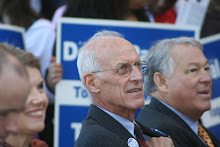

















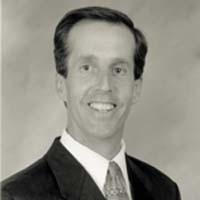










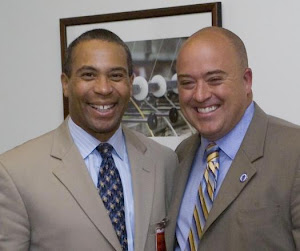










No comments:
Post a Comment