

-
Jonathan Melle
-
-----
"Shh!"
Dr. Ira Katz, head of mental-health services for Veterans Affairs, in an internal e-mail about data showing that 12,000 veterans per year attempt suicide while under departmental treatment. The e-mail has been submitted as evidence in a lawsuit alleging that the VA deliberately concealed the risk of suicide among veterans.
Source: May 5, 2008, NEWSWEEK, Page 27, "Perspectives"
-----
5/3/2008
PLEASE PUBLISH!
The VA is a terrible bureaucracy that gives government a bad name!
The VA's motive in treating veterans is not science, but financial. The more Veterans with disabilities incurred or aggravated by military service receive substandard medical service and that are outprocessed and screwed out of their veterans benefits (like me), the more money the VA saves and can otherwise waste with excessive executive salaries & bonus schemes and also credit card fraud activities by VA bureaucrats--all of which has been recently reported in the news. The bottom-line is that the VA believes they should behave like a greedy insurance company instead of a service provider for Veterans.
In this week's "Newsweek" publication, one of the highlighted quotes is:
"Shh!"
-Dr. Ira Katz, head of mental-health services for Veterans Affairs, in an internal e-mail about data showing that 12,000 veterans per year attempt suicide while under departmental treatment. The e-mail has been submitted as evidence in a lawsuit alleging that the VA deliberately concealed the risk of suicide among veterans.
Source: May 5, 2008, NEWSWEEK, Page 27, "Perspectives".
That pisses me off! We send our young troops off to combat zones and then do NOT provide them with the proper medical treatment when they return home. Instead of saying "Shh!", the VA bureaucracy should be reprimanded by the U.S. President & Congress! What is wrong with our nation!?
In Dissent!
Jonathan A. Melle
Veteran
www.jonathanmelleonpolitics.blogspot.com/2008/04/veterans-affairs-employees-charged-26.html
&
www.jonathanmelleonpolitics.blogspot.com/2007/11/us-army-to-va.html
-----
----------
The Berkshire Eagle, Op-Ed
The treasonous letter
By Michelle Gillett, STOCKBRIDGE, Massachusetts
Tuesday, May 06, 2008
Everyone writes letters to the editor, if not in practice, at least in theory. The letters page of every national and local publication is a forum for citizens with something on their minds. Everyone reads the letters section. Although sometimes, the response can be more than the writer bargained for.
Laura Berg wrote the following to the editor of her local paper, the Alibi in Albuquerque, New Mexico in September, 2005: "As a VA nurse working with returning . . . vets, I know the public has no sense of the additional devastating human and financial costs of post-traumatic stress disorder; now we will have hundreds of thousands of our civilian citizens with PTSD as well as far too many young soldiers, maimed physically or psychologically — or both — spreading their pain, anger and isolation through family and communities for generations. And most of this natural disaster and war tragedy has been preventable . . . how very, very sad! We need to wake up and get real here, and act forcefully to remove a government administration playing games of smoke and mirrors and vicious deceit."
A few weeks after her letter was published, Berg's office computer with all her case files on the veterans she treats was confiscated and VA Secretary James Nicholson requested a thorough investigation of the letter-writing nurse. Berg was shaken and angry even after Mel Hooker, chief of human resource management service at the VA, admitted that no evidence was found implicating the use of Berg's work computer with her letter.
However, in a memo to Berg, he justified the investigation by saying "the agency is bound by law to investigate and pursue any act which potentially represents sedition."
Sedition is a plot or conspiracy to use force to overthrow the government and can result in 20 years in jail. The Alien and Sedition Acts were passed in 1798 by the Federalists and signed into law by John Adams. The acts were designed "to protect the United States from alien citizens of enemy powers and to stop seditious attacks from weakening the government."
But Thomas Jefferson said the Federalists had overstepped their bounds. He declared the Sedition Act invalid not only because it was a violation of the First Amendment to the United States Constitution but because it violated the Tenth Amendment to the Constitution: "The powers not delegated to the United States by the Constitution, nor prohibited by it to the States, are reserved to the States respectively, or to the people."
.
More than 200 years later, a woman who speaks her mind, speaks from her heart and her experience in a letter to the editor is investigated. What is happening to our country when a letter to the editor is construed as an act of treason? Where is Thomas Jefferson when we need him? Even though the VA admitted it was wrong, Berg has been told that it would be preferable if she not mention she works for the VA in future correspondence with editors.
In March, 2006, Amy Goodman interviewed Laura Berg on Democracy Now. Berg told her, "I did not sign away my First Amendment rights as a citizen, by choosing to serve in the federal government and choosing to serve veterans and care for people that have been wounded . . . I have a right to speak my opinion. I have a right to say I'm a V.A. nurse. I do not speak for the V.A. I speak as a public citizen. . . we really need to speak out about this. This is really, really frightening."
A few weeks ago, Laura Berg received the new PEN/Katherine Anne Porter First Amendment Award, which honors a United States citizen or resident who has fought courageously to safeguard the First Amendment's right to freedom of expression as it applies to the written word. PEN Freedom to Write Program Director Larry Siems praised Berg's "determination to express her views in print and courage in the face of the most heavy-handed and overbearing official reaction."
"When Laura Berg sat down to write her letter to the editor, she was enacting her most basic constitutional right and affirming our national faith that exercising this right is an act of patriotism and civic engagement. That her letter was greeted instead as a threat to overthrow the government shows just how far we deviated from our national values in the years following 9/11. Berg's experience is a reminder of how quickly our most basic values can fall victim to exaggerated fears for national security. And her story is a reminder of how much one individual voice can mean in such a time."
The truth of Laura Berg's words is even more resonant three years after she wrote her letter to the Alibi. We are all too aware of the "devastating human and financial costs of post-traumatic stress disorder," and the physical and financial costs of the war. Let's hope we can take her advice and "wake up and get real."
We need not only to remove this government that relies on deceit and fear-mongering, we need to vote for a new one that restores our civility and sense of justice.
-
Michelle Gillett is a regular Eagle contributor.
-
----------
--
The Boston Globe, Page A4, Nation/World, Monday, May 12, 2008
“Pool of disabled veterans grows: Costs are soaring as wars’ toll rises”
By Jennifer C Kerr, Associated Press
WASHINGTON—Increasing numbers of US troops have left the military with damaged bodies & minds, an ever-larger pool of disabled veterans that will cost the nation billions for decades to come – even as the total population of America’s veterans shrinks.
Despite the decline in veterans – as soldiers from World War II & Korea die – the government expects to be spending $59 billion a year to compensate injured warriors in 25 years, up from today’s $29 billion, according to internal documents obtained by the Associated Press. And the Veterans Affairs Department concedes that the bill could be much higher.
Veterans now have worse wounds & more disabilities. In addition, more veterans are aware of the benefits & are quicker to file for them.
Another reason for the higher costs is advanced medical care. Troops come home with severe injuries that might have killed them in earlier wars.
Time is also a factor when it comes to disability compensation costs. Payments tend to go up as veterans age, and an increasing numbers of soldiers from the Vietnam War will be getting bigger payments as they age and are less able to work around their disabilities.
The number of disabled veterans has jumped by 25 percent since 2001 – to 2.9 million – and the cause is no mystery.
“This is a cost of war,” said Steve Smithson, a deputy director at the American Legion. “We’re still producing veterans. We’ve been in a war in Iraq for 5 years now, and the war on terror since 9/11.”
VA & Census Bureau figures show the previous 6-year period, before hostilities in Afghanistan & Iraq, saw a more modest increase of 4 percent in the number of disabled veterans. Veterans can make claims for disability benefits long after their military service has ended.
Today’s veterans – disabled or not – number nearly 24 million. That population is projected by the VA to fall under 15 million by 2033, mostly because of dying World War II & Korean War vets, but costs are expected to rise.
Inflation accounts for a big chunk of the increase. But even when the VA factors out inflation, the compensation for disabled veterans would still grow from $29 billion to $33 billion in today’s dollars.
VA officials declined several requests for interviews. In a written response to handful of questions, the agency noted a few factors at play in the rising costs, such as the aging veterans population, an increase in the number of disabilities claimed, & the severity of injuries sustained.
Smithson said today’s veterans also are filing claims for more disabilities. “It’s not like the WWII generation & the Korean War generation where they weren’t aware of what they could file for,” he said.
--
The Boston Globe, Page A2, Friday, May 16, 2008, “Daily Briefing”
“VA repudiates disability e-mail”
An internal e-mail written by a Veterans Affairs Department employee suggested avoiding a diagnosis of post-traumatic stress disorder for veterans & instead considering a diagnosis that might result in a lower disability payment. The March 20 e-mail had been forwarded to VoteVets.org, a veterans lobbying group, and was distributed yesterday by the group & Citizens for Responsibility & Ethics in Washington. VA Secretary James Peake issued a statement calling the e-mail sender’s suggestions inappropriate & said the employee had been repudiated & was apologetic. The VA did not release the name of the employee. (AP)
--
"VA denies money was a factor in stress disorder diagnoses: Staff psychologist to testify before Senate panel"
By Hope Yen, Associated Press, June 4, 2008
WASHINGTON - A Veterans Affairs psychologist denies that she was trying to save money when she suggested that counselors make fewer diagnoses of post-traumatic stress disorder in injured soldiers.
Norma Perez, who helps coordinate a post-traumatic stress disorder clinical team in central Texas, indicated she might have been out of line to cite growing disability claims in her March 20 e-mail titled "Suggestion." She said her intent was simply to remind staff members that stress symptoms could also be adjustment disorder. The less severe diagnosis could save the VA millions of dollars in disability payouts.
"In retrospect, I realize I did not adequately convey my message appropriately, but my intent was unequivocally to improve the quality of care our veterans received," Perez said in testimony prepared for delivery today before a Senate panel.
The Senate Veterans' Affairs Committee and the VA inspector general are investigating whether there were broader VA policy motives behind the e-mail, which was obtained and disclosed last month by two watchdog groups. The VA has strenuously denied that cost-cutting is a factor in its treatment decisions.
"One question that was raised repeatedly about this latest e-mail was, 'Why would a clinician be so concerned about the compensation rolls?' " said Senator Daniel K. Akaka, Democrat of Hawaii, who chairs the Senate panel. "As an oversight body, we must know whether the actions of these VA employees point to a systemic indifference to invisible wounds."
VA Secretary James B. Peake has called Perez's e-mail suggestion "inappropriate." VA officials this week said her e-mail was taken out of context.
"The e-mail, as characterized by others, does not reflect the policies or conduct of our healthcare system," said Michael Kussman, VA's undersecretary for health, in testimony prepared for the Senate hearing. "We certainly agree that it could have been more artfully drafted."
In her e-mail to staff members at the VA medical center in Temple, Texas, Perez wrote, "Given that we are having more and more compensation-seeking veterans, I'd like to suggest that you refrain from giving a diagnosis of PTSD straight out. . . . We really don't have time to do the extensive testing that should be done to determine PTSD."
Many veterans and injured troops have long alleged that the government might seek to reduce disability costs by assigning a lower benefits rating. Last year, retired Lieutenant General James Terry Scott, chairman of the Veterans' Disability Benefits Commission, said he believed the Army might at least subconsciously consider cost. A lawsuit filed in San Francisco accuses the VA of misclassifying PTSD claims.
In her testimony, Perez said symptoms for PTSD and adjustment disorder are often similar, as are the treatments for them. She said by making an initial diagnosis of a lesser disorder, VA staff can begin treatment right away without going through the arduous process of deeming it PTSD.
Perez also noted that awarding disability benefits is not part of her staff's work, but she did not say why she chose to cite that as a factor in urging fewer PTSD diagnoses. Veterans diagnosed with PTSD are eligible to receive up to $2,527 a month in government benefits.
A recent Rand Corp. study found that about 300,000 US military personnel who served in Iraq or Afghanistan are suffering from PTSD or major depression. Lesser diagnoses in benefits decisions could save the government millions of dollars.
"Although our clinic is a treatment clinic, we all fully support the compensation process and the department's policy of erring in the best interest of the veteran whenever there is any doubt," Perez wrote.
Perez's testimony was made after Peake was called to Capitol Hill last month to answer questions about internal e-mails suggesting that VA officials were hiding the number of veterans who tried to kill themselves. One of the e-mails started with "Shh!" Some lawmakers have said the VA's top mental health official who wrote it, Dr. Ira Katz, should be fired, but Peake has said he has no plans to do so.
--
----------
-

-
Colonel Elspeth Ritchie discussed efforts to understand suicide among US soldiers in Iraq and Afghanistan yesterday. (J. Scott Applewhite/associated press)
-
"Soldier suicide rate hits record high: 115 dead in '07; Army says toll climbing in '08"
By Pauline Jelinek, Associated Press, May 30, 2008
WASHINGTON - Army soldiers committed suicide in 2007 at the highest rate on record, and the toll is climbing ever higher this year as long war deployments stretch on.
At least 115 soldiers killed themselves last year, up from 102 the previous year, the Army said yesterday.
Nearly a third of them died at the battlefront, 32 in Iraq and four in Afghanistan. But 26 percent had never been deployed to either conflict.
"We see a lot of things that are going on in the war which do contribute - mainly the longtime and multiple deployments away from home, exposure to really terrifying and horrifying things, the easy availability of loaded weapons, and a force that's very, very busy right now," said Colonel Elspeth Ritchie, psychiatric consultant to the Army surgeon general.
"And so all of those together we think are part of what may contribute, especially if somebody's having difficulties already," she said at a Pentagon news conference.
Some common factors among those who took their own lives were troubled relationships, work problems, and legal or financial difficulties, officials said.
More US troops also died overall in hostilities in 2007 than in any of the previous years in Iraq and Afghanistan. Violence increased in Afghanistan with a Taliban resurgence, and the rate of deaths of US personnel increased in Iraq even as violence there declined in the second half of the year.
Increasing the strain on the force last year was the extension of deployments from 12 months to 15 months, a practice ending this year.
The 115 confirmed suicides among active-duty soldiers and National Guard and Reserve troops who had been activated amounted to a rate of 18.8 per 100,000 troops - the highest since the Army began keeping records in 1980.
Two other deaths are suspected suicides but are still under investigation.
So far this year, the trend is comparable to last year, said Lieutenant Colonel Thomas E. Languirand, head of command policies and programs.
As of Monday, there had been 38 confirmed suicides in 2008 and 12 more deaths that are suspected suicides under investigation, he said.
The suicide rate continues to rise despite a host of efforts the Army has made to improve the mental health of a force under unprecedented stress from the longer-than-expected war in Iraq and the long and repeated tours of duty it has prompted.
The efforts include more training and education programs for troops and their families. Officials also have hired more mental health workers, increased screening to measure the psychological health of soldiers, and worked to reduce any stigma that keeps them from going for treatment when they have symptoms of depression, anxiety, post-traumatic stress, or other emotional problems.
"More than any time in history, our soldiers and their commanders are armed with information about combat and its impact on psychological health," said Brigadier General Rhonda L. Cornum, assistant surgeon general for force protection.
"We still believe there is more to be done, and we are committed to maximizing prevention" and treating those who need help, she said.
Suicides have been rising nearly each year of the five-year-old war in Iraq and the nearly seven years of war in Afghanistan. The 115 deaths last year and 102 in 2006 followed 85 in 2005 and 67 in 2004. The rate of 18.8 per 100,000 last year compared with a rate of 17.5 in 2006 and 9.8 in 2002 - the first full year after the start of the war in Afghanistan.
The Centers for Disease Control and Prevention said the overall suicide rate in the United States was about 11 per 100,000 in 2004, the latest year for which the agency has figures. The Army said that when civilian rates are adjusted to cover the same age and gender mix that exists in the Army, the civilian rate is more like 19.5 per 100,000.
The Army, which is the largest force serving in both wars, is the only service to release annual figures on suicides it gathers every year by polling troops at the war fronts on mental health issues.
-
www.boston.com/news/nation/washington/articles/2008/05/30/soldier_suicide_rate_hits_record_high/
-
"Other suicide findings"
May 30, 2008
93 of the 115 suicides were active duty troops; 22 were members of the Army National Guard or Reserve who had been mobilized.
Five were women.
There were 166 attempted suicides among troops in Iraq and Afghanistan and 935 in the whole Army.
Young, white, unmarried junior enlisted troops were the most likely to attempt suicide.
Firearms were the most common method for those who killed themselves. Overdoses and cutting were the most common for all attempts.
30 percent of all cases reportedly involved drugs and/or alcohol.
The majority of people who committed suicide did not have known histories of mental disorders.
Seven percent of those who killed or attempted to kill themselves had served multiple tours of duty in the wars.
The highest number of attempts occurred among soldiers who were in the second quarter of their tour.
-
SOURCE: Associated Press
-
www.boston.com/news/nation/articles/2008/05/30/other_suicide_findings/
-
----------
(A Boston) GLOBE EDITORIAL
"The psychological fog of war"
June 11, 2008
THE HARSH emotional and mental costs of sending troops to frequent and long deployments in wars without clear battle lines became apparent last month, when the Pentagon released data on suicides and cases of post-traumatic stress disorder. In 2007, there were 115 suicides among active duty service members, an increase over a total of 102 in 2006 and the highest figure since the Pentagon began keeping data on suicides in 1980. Last year, the services also registered their highest number of post-traumatic stress disorder cases - 14,000, an increase of 46 percent over 2006.
As one step to reduce the pressure on its ranks, the Department of Defense has already announced it would end the 15-month deployments in Iraq required by the surge of 2007. For the longer term, a drawdown in US forces in Iraq would reduce the need for the frequent deployments that are so harmful to service members' family relationships.
Other preventive steps have included recruiting more mental-health professionals and a new Department of Veterans Affairs practice of checking on the condition of every discharged service member, including those who have not reported any health problems. Such calls are aimed at getting care to those who are suffering from the depression, anxiety, emotional numbness, intrusive thoughts, sleeplessness, and nightmares of the stress disorder without reaching out for help.
Between 2003 and 2007, the services have reported a total of 40,000 post-traumatic stress disorder cases. As high as that number is, military officials say it represents just a fraction of the total. One reason troubled service members shrink from seeking help is their fear of hurting their careers. Recently, Secretary of Defense Robert Gates took the laudable step of dropping a requirement that troops list counseling for problems related to combat service in filling out a questionnaire for national security positions.
Last month, two nonprofit organizations, Give an Hour and the American Psychiatric Foundation, announced that they will use a $1 million grant from the Lilly Foundation to recruit and educate volunteer mental health professionals to work with returning service members and their families. While this is a commendable effort to close a gap in services caused by the government's failure to staff up for the mental-health problems that two simultaneous wars inevitably create, troops should not be dependent on volunteers for these services. When it comes to troops and their families reaching out for help, the old expression associated with life in the armed forces - "hurry up and wait" - cannot be tolerated.
----------
"America is failing returning veterans"
The Berkshire Eagle - Letters
Monday, June 16, 2008
Imagine, risking your life fighting for the freedom of your country, only to come home and discover that the battle has just begun. This is what happens to many soldiers who come back to America and end up living on the street. These men and women are our guardians, selflessly risking there lives to protect us, only to find themselves eating out of dumpsters, sleeping in abandoned warehouses, and living in worse conditions then they did when they were fighting in the Middle East. I think that it is appalling. The number of homeless soldiers in America is massive. They are also treated with such disrespect. Why aren't we helping the people who risk their lives for us?
Think about this number: 275,000. Now think about this ratio: 1:4. The first statistic, 275,000, represents how many soldiers are on the streets at one time. This doesn't include the wives and children that many of them have. If we counted them, the numbers would skyrocket to over a million. The other statistic, the ratio of 1:4, represents the percentage of homeless soldiers compared to the percentage of other homeless Americans. That means that 25 percent of all homeless people in America are soldiers and war veterans. However, when people hear these numbers, many of them are not surprised, and do not seem to care. What does this say about America as a whole?
"Coming home can be harder than fighting war," states Private First Class, Herald Noel, one of these unfortunate heroes. This statement is too true. Many say that soldiers are rapidly becoming the next generation of homeless people in America. One source stated, "in the next couple of decades, we could be looking at an epidemic of homeless veterans, and much as 1:2 compared to other homeless individual."
Why are we sending the young men and women who fight for us onto the streets? Ask the people who took away their homes and put them there. We should become more aware of this issue. We should be embracing them, starting fundraisers, opening up homeless veterans shelters, donating supplies to help them. Soldiers are just like us, and they should be given the same rights as us. Why are so many neglected? They have earned the right to have a roof over their head, and a warm bed to sleep in. War veterans have seen more tragedy, more bloodshed, and more violence than most Americans could witness in a hundred lifetimes. We need to help the people who risked their lives for us.
JASMINE BECKER
Pittsfield, Massachusetts
This letter to the editor was written as part of an eighth grade, English Language Arts class project at Herberg Middle School.
----------
The Boston Globe, Op-Ed, JAMES CARROLL
"A blind eye on soldiers' suicides"
By James Carroll, June 30, 2008
'SUPPORT THE troops" is an American lie. This nation is grievously and knowingly failing the young men and women who wear the uniform of its military services, and nothing demonstrates that more powerfully than the suicides of soldiers. According to the Army's own figures, the rate of suicide among active duty personnel nearly doubled between 2001 and 2006. The number then grew even higher in 2007, when suicide ranked third as the cause of death among members of the National Guard. Even if proximate causes vary from war zones to home fronts, such data are anomalous, since suicide rates among soldiers historically go down during wartime, not up.
Veterans, too, are in trouble. In May, the head of the National Institute of Mental Health warned of "a gathering storm." Thomas Insel told the American Psychiatric Association that one in five of the 1.6 million soldiers who have been deployed in Iraq or Afghanistan (or more than 300,000) suffer from post-traumatic stress syndrome or depression. Potentially life-threatening mental disorders, including self-destructive behavior like addiction, raise the prospect, in Insel's words, of "suicides and psychological mortality trumping combat deaths."
As America has steadily averted its gaze from the actualities of its wars in Iraq and Afghanistan, so, too, has the nation refused to look at what is happening to those it sends to fight. Repeated deployments to war zones, combined with meager support upon returning home, are leaving many soldiers adrift. Each one who commits suicide, or attempts to (more than 2,000 last year), shows this. It would be presumptuous to draw conclusions from any single instance of such despair, but taken as a whole, these acts of self-destruction lay bare some difficult truths.
The war in Iraq, in particular, is an exercise in the obliteration of meaning. The war's essence is its lack of essence. The war's catch-22 is that its stated goal is social order, while the American presence itself creates disorder. Our troops know this. They arrive in the war zone with every intention of protecting an innocent population from the enemy, only to discover that the enemy and the population are indistinguishable. "Insurgents" often turn out to be, not ideologues, much less "terrorists," but only cousins of those already killed. Victims and victimizers are alike. Suspicion is ubiquitous. No one trusts Americans. Such contradictions make the war controversial in the United States, but in Iraq they make the soldiers' situation intolerable.
These particular problems exist within a larger context of collapsing sources of meaning. The myths on which the military ethos depend have been broken.
Whatever ethnic fevers grip Iraqis, for example, American soldiers know, if only unconsciously, that the passion for nationhood on which 19th- and 20th-century wars depended is being undercut by the global citizenship of the 21st century. Not since Earth was seen whole from the moon is nationalism what it was. Even more transforming, faith in technological violence as an instrument of justice is being undercut by the catastrophic planetary outcome that can already be anticipated if technological violence is not curbed. The human naiveté that uses violence in the name of ending violence can no longer be sustained. For Americans plunged into the heart of this contradiction, the unbridled violence of their own nation points to the suicide of the very species.
But for American soldiers, it is more personal even than that. For meaning's sake, their purpose has been defined around loyalty. Unit cohesion is the absolute virtue. Thus our soldiers prepare to die not for Iraq, nor even for America, but for one another. "I've got your back," they promise. In combat, such commitment is often heroically fulfilled, but, alas, once the bureaucracy replaces the buddy, loyalty, too, is found to be a lie. Harsh to say, but the American military cares nothing for the individuals who comprise it, only for the mission those individuals, in formation, can accomplish. Hence the shameful exploitation of troops in disabling redeployments, and the resulting abuse of their families. Hence the nation's abandonment of those, who, upon discharge, find no unit, no cohesion, and their backs against the wall. Support the troops? On your bumper.
Suicide is always a tragedy, and, whether accompanied by a note, always a message - one that survivors must read. In the case of soldier suicides, we Americans are all their next of kin. Their despair demands our attention. What are they telling us?
-
James Carroll's column appears regulary in the Globe.
-
----------
"Many veterans may be owed cash: Errors made in clearing claims"
By Anne Flaherty, Associated Press, July 16, 2008
WASHINGTON - Tens of thousands of veterans may not have been paid money owed them by the government because of hasty efforts to clear a massive backlog of claims, House Democrats said yesterday.
In a new report, Democrats found that at least 28,283 veterans had their claims denied at a time when the government had stopped doing quality assurance checks. The Defense Finance and Accounting Service and contractor Lockheed Martin were working feverishly to clear a backlog of claims resulting from changes in the law that made veterans eligible to receive disability and military retirement pay simultaneously.
"Most guys who get a letter saying they get zero money would never challenge it. They wouldn't know how," retired Army Command Sergeant Major Harold Lewis is quoted as saying in the report.
Lewis, who was disabled during the Vietnam War, fought the rejection of his claim and was eventually awarded $15,000.
The assessment was conducted by the House Oversight and Government Reform's domestic policy subcommittee, led by Representative Dennis Kucinich, Democrat of Ohio.
Officials at the defense accounting service and Lockheed Martin said they planned to address the concerns at a hearing today.
Spokesman Tom LaRock said the accounting service has processed more than 229,000 claims and paid out more than $149 million in entitlements. The office has established "a reliable and repeatable process enabling us to adjudicate incoming claims within 30 days of receipt," he said.
In mid-2006, the defense accounting service had hired Lockheed Martin to help it work through the long list of cases. The government identified some 133,000 veterans who were eligible for money through its "VA Retro" program. The list quickly grew by 84,000 more names because newly retired veterans or those with a changed disability status were being added.
Officials finally cleared the backlog this summer.
According to the House investigation, officials reached their goal only after lowering their standards. The defense accounting service was concerned about the number of errors in Lockheed Martin's work, but eventually suspended quality control procedures to prevent further program delays, Democrats said.
----------
"Veterans groups focus on unclaimed remains"
By Associated Press, August 25, 2008
ROCHESTER, N.H. - Now that four forgotten servicemen have been laid to rest, veterans groups are working to make sure others aren't being overlooked.
The veterans, whose cremated remains were abandoned years ago at a Manchester funeral home, were buried with military honors Friday after attempts to contact their survivors failed. Following the efforts by funeral director Arthur Phaneuf and Roger Desjardins, director of the state veterans cemetery, other groups are coming forward to ensure other veterans also are honored.
Dan Meehan of Rochester is state coordinator for the Missing in America Veterans Recovery Program, a national project to find, identify, and properly inter unclaimed cremated remains of forgotten veterans. He plans to contact all funeral homes in New Hampshire to determine whether any have unclaimed remains of service members. Anyone honorably discharged is entitled to free burial in the veterans cemetery.
"We don't want anybody left behind," he said.
Russ Armstrong of Guilford, who serves on the veterans subcommittee for the state Council on Aging, said he wants to recruit representatives from each county to contact their local funeral homes. The group then will work with the veterans cemetery.
"Our approach is one veteran at a time," Armstrong said.
Charles Hafner, president of the New Hampshire Funeral Directors Association, said he believes most funeral directors would support a movement to inter unclaimed remains of veterans "as long as we're fairly certain no family members are going to come forward and object to it."
----------
(A Boston) GLOBE EDITORIAL
"This does not compute for vets"
September 15, 2008
CONGRESS ACTED wisely this year when it pushed through - over the objections of President Bush - a major expansion of the GI Bill's education benefits for veterans. At long last, benefits will be more in line with the cost of public and private higher education.
But the Department of Veterans Affairs has set off alarm bells in Congress and among veterans' organizations by proposing to privatize the administration of the new GI Bill. Congress should block any move by the department that will give an outsourced computer program any voice in determining the eligibility and benefits of veterans.
Currently, VA offices in the states administer the education benefits, a system that veterans' organizations say has worked well. VA employees call veterans to fill in gaps in the applications and, if necessary, help applicants by tracking down information from the Defense Department.
The American Legion veterans organization says it is not against an update in the VA's information technology, but that the 250,000-employee department has the capability already. In particular, the legion says, the VA should draw on the skills of younger veterans who have both IT training and an awareness of the problems veterans face in resuming their lives and pursuing careers and education.
At a congressional hearing Thursday on the VA proposal, the national commander of the American Legion, David K. Rehbein, said the "VA was created to fulfill obligations like this, not to hire someone else to do it."
As advocates for veterans are only too aware, the VA has tried before to privatize an important function, and the results were abysmal. In 2003, the VA paid a defense contractor nearly $300 million for a new system to track hospital supplies. It never worked and ended up endangering patients' health.
At Thursday's hearing, VA official Keith Predigo said the use of a computer program for "minimizing human intervention" is in line with a government-wide goal of Bush's. "Claims that are rejected by the automated process and require a manual eligibility determination will remain the responsibility of trained VA personnel," he said.
But members of Congress are properly skeptical of the plan, not least because the department has no back-up. The new benefits go into effect Aug. 1, 2009, but the department will not require its contractor to prove "functionality" of its system until June 1. That leaves little time to fix snafus. Congress should not let a private contractor spin a telephone-menu tangle around one of its proudest recent achievements.
----------
"Mortgage help for U.S. veterans"
The Berkshire Eagle/The North Adams Transcript - Letters
Tuesday, November 04, 2008
The Veterans' Benefits Improvement Act of 2008 will allow the Veterans Administration to help a substantial number of veterans with sub-prime mortgages refinance into a safer, more affordable VA-guaranteed loan.
Veterans who wish to refinance their sub-prime or conventional mortgage may now do so for up to 100 percent of the value of the property. These types of loans were previously limited to 90 percent of the value. Additionally, Congress raised the VA's maximum loan amount for these types of loans. Previously, these refinancing loans were capped at $144,000. With the new legislation, such loans may be made up to $729,750 depending on where the property is located. These changes will allow more veterans to refinance through VA, allowing for savings on interest and potentially avoiding foreclosure.
For more information, or to obtain help from a VA loan specialist, veterans may call 1-877-827-3702 or visit www.homeloans.va.gov
WILLIAM T. BRADLEY
Adams, Massachusetts
The writer is director of Veterans' Services for Adams.
----------
"Employers, veterans look to fill thousands of jobs"
Updated: 11/13/2008, 6:10 PM, Capital News 9, By: Steve Ference
ALBANY, N.Y. -- For some, it's the beginning of their new life.
"It's a little scary. A bit nervous. Hopefully places like this will help me out," said Eugene Alston, a soon to be veteran of the Navy.
The beginning of their new life, being, of course, the move from the military to the civilian world.
"I served three years on the USS Toledo, United States Submarine," said Alston, holding a folder of resumes. "So, I've been pretty much around the world."
Alston was one of scores to attend a veteran’s job fair in Albany, looking to take his Navy experience and turn it into a solid career.
"I was doing this since I was 18. Transitioning to the civilian world I think is going to be the hardest thing to do," Alston said.
"What you see is a reflection of the economy, number one. You see a lot of veterans looking for jobs," said James McDonough, the State Director of Veterans Affairs.
Little wonder why so many showed up to talk with more than 30 employers, arguing it just makes sense to hire those who have been willing to give all for their country.
Steve Toomey, CSX Military and Diversity Recruitment Manager, said, "Veterans that walk in here are definitely job ready from day one because of their training."
And there are actually a number of job fairs like this happening around the state at the same time. Crucial, because it comes at a time when state jobs are being frozen. State jobs being where veterans have typically looked for employment.
"The employment situation is much more difficult and this is one group of individuals we want to pay special attention to," said State Labor Commissioner M. Patricia Smith.
It may not make it past all the bad economic news we hear so much about, but at least at the job fairs taking place in Buffalo, Syracuse, Albany and New York City, even in the tough economy, there are still jobs out there.
"I'm down to my last resume," said Alston. "I wasn't prepared. I didn't think we'd be that wanted here, but I'm glad.”
This, as some employers look to give veterans a fighting chance, especially with more and more expected to return home in the coming months.
-
http://capitalnews9.com/content/headlines/128016/employers--veterans-look-to-fill-thousands-of-jobs/Default.aspx
-
----------
"Vets Groups Sue VA Over Claims Delays"
(Military.com) Week of November 17, 2008
Two veterans groups, the Vietnam Veterans of America and the Veterans of Modern Warfare, are suing the Department of Veterans Affairs (VA) over what they call "unacceptable delays" in veteran's claims. The lawsuit demands that the VA provide an initial decision on every veteran's claim for disability benefits within 90 days and resolve appeals within 180 days, and seeks relief to provide a lifeline of interim benefits if the VA delays last beyond the limit. For more information, visit the Veterans of Modern Warfare website and the Vietnam Veterans of America website.
----------
"Dept. of Veterans Affairs says it can handle strain of new GI Bill"
By Hope Yen, Associated Press, November 19, 2008
WASHINGTON - The government sought yesterday to dismiss concerns that it might try to delay rollout of the new GI Bill, pledging to be ready to handle growing claims in veterans education benefits after abandoning plans to hire a contractor.
Testifying before a House panel, officials with the Department of Veterans Affairs acknowledged the potential for glitches as they scramble to upgrade government IT systems before the new legislation providing millions of dollars in new GI benefits takes effect next August.
But the VA contended it was on track to implement an IT system "in-house" just one month after abruptly scrapping plans to hire an IT contractor that the government previously contended was critical to get a system up and running on time.
"We have the resources. We have the working functionality," said Keith Wilson, the VA's director of the Office of Education Service, reversing course from earlier comments made by the VA. "We have a full pool of people to do the testing and manage all the efforts under way."
Congress voted in June to dramatically expand the GI Bill, which was first signed into law by President Franklin D. Roosevelt in 1944 for returning World War II veterans but hasn't been updated much since then.
Under the old measure, veterans can receive $1,321 monthly to cover all college expenses. Now, the new GI Bill will cover tuition and fees of any in-state public university. It also provides a monthly housing allowance and a $1,000 yearly stipend for books and supplies.
At least 520,000 veterans are expected to take advantage come next fall, up from about 250,000 who are currently attending colleges and universities on the GI Bill, drawing concern that the VA might not be able to keep up. In September the VA said it would hire an IT contractor due to inadequate staffing and "skill sets" to handle the education benefits at its agency. But amid criticism from veterans advocacy groups and then-Democratic presidential candidate Barack Obama, the VA abandoned those plans in October.
Yesterday, Wilson told the House Veterans subcommittee on economic opportunity that the VA would build on existing government systems to help deliver VA benefits for about two years beginning in August 2009. That process is fully under way with a timetable that will meet the August deadline, he said.
----------
-

-
Former senator Robert J. Dole greets retired Army Gen. Eric K. Shinseki, right, at Shinseki's Senate confirmation hearing. (By Brendan Hoffman -- Getty Images)
-
"Shinseki Says He Would Modernize VA"
By Ann Scott Tyson, Washington Post Staff Writer, Thursday, January 15, 2009; A06
Retired Army Gen. Eric K. Shinseki pledged yesterday to transform the Department of Veterans Affairs into a proactive, "21st-century organization" to meet the needs of a growing population of wounded veterans.
Shinseki, the former Army chief of staff who put his career on the line in 2003 by challenging then-Defense Secretary Donald H. Rumsfeld's estimate of troop numbers required in Iraq, received bipartisan praise as a man of candor and integrity in a Senate confirmation hearing on Shinseki's nomination as VA secretary in the incoming Obama administration.
Sen. Daniel K. Inouye (D-Hawaii) recalled Shinseki's controversial prewar testimony that several hundred thousand troops would be needed to occupy and stabilize Iraq. "He told the truth, and in doing so took a position contrary to the administration," Inouye said. "His honest assessment that more troops would be needed cost him his job, but it is the surest measure of his fitness to serve as a Cabinet member."
Several senators expressed gratitude for Shinseki's willingness to take on the challenges at VA, which is struggling to meet the needs of a growing population of more than 25 million veterans, more of whom are likely to seek benefits as the economy deteriorates. In the hearing before the Senate Committee on Veterans' Affairs, Shinseki pledged to speed up the sluggish process for approving claims, which takes an average of six months; to streamline the transfer of medical and other records from the Defense Department to VA; to better meet the needs of veterans living in rural areas; and to modernize the delivery of benefits.
"We are somewhere back in the 19th century" in terms of the VA claims system, said Sen. Bernard Sanders (I-Vt.). Shinseki agreed, saying one of his top goals is to update VA's information technology network and move toward an electronic records system. "Asking [veterans] to take a number and wait or put up with records that are lost or take six months to adjudicate is not part of the culture I expect," Shinseki said.
"My message would be this: Treat our veterans with respect and dignity," the nominee said. "They're not here begging for a handout."
Shinseki, a native Hawaiian, graduated from West Point in 1965, served two combat tours in Vietnam as an artillery forward observer and cavalry troop commander and, after being wounded twice, "pleaded to stay on active duty," Inouye said. The Army agreed, and Shinseki served as an instructor in the English department of West Point and then rose through the ranks in Army command and staff positions. He commanded the 1st Cavalry Division in 1994 and 1995 and led NATO forces in Bosnia from 1997 to 1998. The following year, he took office as the 34th chief of staff of the U.S. Army.
Forced from that post by Rumsfeld, Shinseki also proved prophetic in warning at his June 2003 retirement ceremony that the Pentagon should "beware a 12-division strategy for a 10-division Army," suggesting that the Army was too small for its current missions. Such caution was vindicated by a decision in early 2007 by Rumsfeld's successor, Robert M. Gates, to permanently expand the Army by 65,000 soldiers over five years.
If confirmed, Shinseki said, he will confront the immediate tasks of formulating a "credible and adequate" 2010 budget request and implementing the new GI bill by August. "The overriding challenge, which I will begin to address on my first day in office, will be to make the Department of Veterans Affairs a 21st-century organization focused on the nation's veterans as its clients."
Sen. Daniel K. Akaka (D-Hawaii), the committee chairman, said that Shinseki's nomination would be scheduled for a vote by the Senate on Jan. 20 and that he anticipated Shinseki's confirmation on Inauguration Day.
The nomination of Shinseki, himself an amputee, will inspire confidence in military veterans, said former Republican senator Robert J. Dole. "Here's a man who's been through it; here's a man who understands it," Dole said at the hearing.
----------
"VA still underbudgeting for vets' healthcare, GAO says: New secretary vows to provide honest figures"
By Hope Yen, Associated Press, January 24, 2009
WASHINGTON - Two years after a politically embarrassing $1 billion shortfall that imperiled veterans healthcare, the Veterans Affairs Department is still lowballing budget estimates to Congress to keep its spending down, government investigators say.
The report by the Government Accountability Office highlights the Bush administration's problems in planning for the treatment of veterans, which President Obama has pledged to fix. It found the VA's long-term budget plan for the rehabilitation of veterans in nursing homes, hospices, and community centers to be flawed, failing to account for tens of thousands of patients and understating costs by millions of dollars.
In its strategic plan covering 2007 to 2013, the VA inflated the number of veterans it would be financially able to treat at hospices and community centers with the budget planned, investigators concluded. At the same time, they said, the VA didn't account for roughly 25,000 - or nearly three-quarters - of its patients who receive treatment at nursing homes operated by the VA and state governments each year.
"VA's use, without explanation, of cost assumptions and a workload projection that appear unrealistic raises questions about both the reliability of VA's spending estimates and the extent to which VA is closing previously identified gaps in noninstitutional long-term care services," according to the 34-page draft report obtained by the Associated Press.
Lawmakers expressed anger, saying they will be watching for new VA Secretary Eric Shinseki to provide a more honest accounting.
"The problems at the VA have been caused by years of mismanagement and putting the bottom line above the needs of our veterans," said Senator Patty Murray, Democrat of Washington. "While we won't fix everything overnight, Secretary Shinseki has pledged honesty and accurate accounting, which are key to realistic budgets and providing the services our veterans have earned."
The VA did not immediately respond to a request for comment.
In the report, the VA acknowledged problems in its plan for long-term care, which accounts annually for more than $4 billion, or 12 percent, of its total healthcare spending. In many cases, officials told the GAO they put in lower estimates to be "conservative" in their appropriations requests to Congress and to "stay within anticipated budgetary constraints."
As to the 25,000 nursing home patients unaccounted for, the VA explained it was usual clinical practice to provide short-term care of 90 days or less following hospitalization in a VA medical center, such as for those who had a stroke, to ensure patients are medically stable. But the VA had chosen not to budget for them because the government is not legally required to provide the care except in serious cases.
"VA supports GAO's overarching conclusion that the long-term care strategic planning and budgeting justification process should be clarified," wrote outgoing VA Secretary James Peake in a response dated Jan. 5. He said the department would put together an action plan within 60 days of the report's release.
In 2005, the VA stunned Congress by suddenly announcing it faced a $1 billion shortfall after failing to take into account the additional cost of caring for veterans injured in Iraq and Afghanistan. The admission, which came months after the department insisted it did not need additional money, drew harsh criticism from both parties.
The GAO later determined the VA repeatedly miscalculated - if not deliberately misled taxpayers - to justify Bush administration cuts to healthcare amid the burgeoning Iraq war.
----------
"Fix veterans' benefits"
The Berkshire Eagle - Letters - Saturday, February 07, 2009
Governor Patrick, with his close ties to President Obama, has an opportunity to be a champion for veterans in Massachusetts and the country at large.
Due to the fact that federal veterans' benefits are so paltry the commonwealth, to keep at least some veterans out of financial distress and off the streets, augments these benefits with a program called Chapter 115.
In this time of renewed civic responsibility and with the new administration sworn to begin to take care of the neglected in America, Governor Patrick should strongly push for total reform of the VA disability system.
As we approach the 200th birthday of Lincoln who swore to care for those who shall have borne the battle, our new president could emulate the Great Emancipator in this regard as he has in so many other symbolic ways.
If federal veterans' benefits truly reflected the costs of living in 2009 and not 1949, Chapter 115 would not be necessary, freeing up these resources for other uses. Most importantly, Massachusetts would be leading the rest of the nation in finally meeting the unpaid obligations this country owes to its veterans.
JIM NORCHI
Pittsfield, Massachusetts
----------
"VA clinic warns of possible contamination"
By Bill Poovey, Associated Press, February 14, 2009
CHATTANOOGA, Tenn. - Thousands of patients at a Veterans Administration clinic in Tennessee may have been exposed to infectious body fluids of other patients when they had colonoscopies in recent years, and VA medical facilities all over the United States are reviewing procedures.
VA officials also said a problem was found with equipment at an ear, nose, and throat clinic at the VA medical center in Augusta, Ga., and 1,800 veterans have been notified they may have been exposed to infection there.
A spokesman at Alvin C. York VA Medical Center in Murfreesboro, Tenn., said the clinic is offering free blood tests and care to all patients whose records show they had colonoscopies between April 23, 2003, and Dec. 1, 2008.
Christopher Conklin said notification letters were sent this week by registered mail to 6,378 patients of the Murfreesboro facility. He said no related health problems have been reported, and every measure is being taken to assure affected veterans are screened. One veteran who received notification, Gary Simpson, 57, said, "The fact that it took five years for them to catch a mistake like that - it seems like somebody should have caught an incorrect valve and incorrect cleaning of the equipment during that time." His wife, Janice, called the discovery "sickening."
Conklin said a valve on equipment used in the colonoscopies was discovered wrongly connected Dec. 1 and the mistake was traced back to April 23, 2003.
A VA statement said that in response to the discovery at Murfreesboro and an inspection that found a problem with endoscopic equipment at the VA medical center in Augusta, Ga., all VA medical centers and outpatient clinics are reviewing procedures.
A VA statement said 1,800 veterans who were treated in Augusta, Ga., from January through November last year in the ear, nose, and throat clinic at the Charlie Norwood VA Medical Center are being notified "that they may have been exposed to infection because the instrument used in the procedure was improperly disinfected." The statement described the risk of infection as "extremely small."
----------
"Army reports more suspected suicides"
By Associated Press, boston.com, March 6, 2009
WASHINGTON - After a sharp spike in soldier suicides in January, the Army said yesterday that there were another 18 suspected suicides last month.
The increase continues a four-year rise in an Army under stress from two wars.
"It's a very high number; it's very disturbing," Colonel Thomas Languirand, head of the Army suicide prevention program, said of February's toll. "We're taking every effort we can think of" to try to bring it down.
The Army usually releases figures on self-inflicted deaths only once a year. But due to the large number of suspected suicides in January - 24 - officials decided to announce monthly figures to focus attention on the problem and on prevention programs available.
Army Vice Chief of Staff General Peter Chiarelli said there were two confirmed suicides in February and 16 suspected but still being investigated - compared with 11 confirmed deaths in the same month of 2008.
Usually the vast majority of suspected suicides are eventually confirmed, but the investigations can take months. When January figures were released last month, officials said there were seven confirmed and 17 pending, a figure updated yesterday to 12 confirmed and 12 pending.
Speaking by telephone to a group of bloggers, Chiarelli noted that officials already have bolstered suicide prevention programs and are having special training sessions this month and next, but he said no one thing can solve the problem.
The military has added mental health staff, operates hotlines for soldiers to call, and has programs to counter stress on the battlefields in Iraq and Afghanistan. There was no breakdown on how many of the suicides happened at the warfront.
Amid stress on the military in fighting the wars, troops are having difficulty keeping their marriages and personal relationships intact and are suffering financial, legal and work problems. Chiarelli said yesterday that unemployment also seemed to be a factor in February suicides among National Guard and Reserve members.
----------
-

-
(Barrie Maguire Illustration)
-
The Boston Globe, Op-Ed, TYLER E. BOUDREAU
"The military's post-traumatic stress dilemma"
By Tyler E. Boudreau, March 9, 2009
WITH ARMY and Marine Corps suicide rates climbing dramatically, surpassing even those killed in Iraq and Afghanistan last month, the nation is increasingly disturbed and demanding treatment for veterans. But these suicide reports highlight an important distinction: A significant portion of those returning from war are not yet veterans; they are still active or reserve service members, which means, above all, that they probably will be going back to one of our theaters of operations. And that means that any treatment for post-traumatic stress will be positioned in direct conflict with the mission itself. As a former Marine captain and rifle company commander, I witnessed this conflict firsthand.
In response to the stigma surrounding post-traumatic stress in the military, Admiral Michael Mullen, chairman of the Joint Chiefs of Staff, said in May 2008, "It's time we made everyone in uniform aware that the act of reaching out for help is, in fact, one of the most courageous acts and one of the first big steps to reclaiming your career, your life, and your future." It is heartening to hear the man at the top speaking so forcefully on this issue. And while Mullen is, no doubt, genuinely concerned for these men and women in uniform, I suspect this issue may not be as simply resolved as he makes it sound.
I was in Iraq in 2004. From the day we had arrived home to the day we were scheduled to return to Iraq was exactly nine months. The pressure to prepare ourselves quickly was intense. When the first Marine came to my office and asked to see the psychiatrist about some troubling issues from our time in Iraq, I was sympathetic. I said, "No problem." When another half dozen or so Marines approached me with the same request, I was only somewhat concerned.
But when all of them and several more returned from their appointments with recommendations for discharge, I'll admit I was alarmed. Suddenly I was not as concerned about their mental health as I was about my company's troop strength. Manpower is not an endless spigot. There are always recruitment strains and so there are limits to how many men are available. My company would be allocated only so many Marines for our deployment. Whatever we lost before embarkation, for whatever reasons, we just went without.
As all those Marines in my company began filtering out, some from essential positions, I started to worry about the welfare of those remaining. I worried, quite naturally, that if the exodus continued, we might not have enough to accomplish our mission or to survive on the battlefield. My sympathies for those individuals claiming post-traumatic stress began to wane. A commander cannot serve in earnest both the mission and the psychologically wounded. When the two come in conflict, as they routinely do as a result of repeated deployments, the commander will feel an internal and institutional pressure to maintain the integrity of his unit. I did. And there begins a grassroots, albeit subconscious, resistance to Mullen's plan to destigmatize the people who seek help. Because as much as I cared about my Marines, it was difficult to look upon those who sought to leave without suspicion or even mild contempt.
In the spring of 2008, RAND released its well-known report in which it estimated that one in five service members returning from war will contend with symptoms of post-traumatic stress or depression. In a typical rifle company, those estimates would represent a loss of at least 30 men. I knew I couldn't afford that. Commanders at every level know it. The military knows it, too; it knows it can't afford a 20 percent reduction in forces and it can be counted on to prevent that from ever happening - even Admiral Mullen. One can only imagine the military's dismay if, through its own rigorous efforts to screen and encourage soldiers to report their invisible wounds, commanders were suddenly faced with hundreds of thousands of troops demanding treatment and discharge.
Where psychological and traumatic brain injuries can still, to some extent, be doubted and debated, and when their treatment stands in opposition to troop strength and to mission accomplishment, the needs of those wounded service members will be subordinated.
The result by necessity, which we are already witnessing today, will be dubious treatment protocols within the military aimed at retention, diagnosed soldiers returning to the battlefield, and a slowly diminished emphasis on screening. It will happen. It has begun already. There will be no policy shift. There will be no change in the language we hear from our leaders. But we will know all too well that our soldiers are still not being properly treated by the ever-increasing number of suicides that occur.
-
Tyler E. Boudreau, a former Marine captain, is the author of "Packing Inferno: The Unmaking of a Marine."
-
----------
-

-
''I am no longer shamed by lack of hair and scar,'' says Judy Szczeblowski, who suffered a brain injury during surgery for a tumor. (Suzanne Kreiter/ Globe Staff)
-
"Instant images, enduring frustrations: Exhibit exposes brain injury woes"
By Irene Sege, Boston Globe Staff, March 12, 2009
When Judy Szczeblowski enrolled in a photography project for survivors of brain injury in 2006, her chin-length hair hid the scar and bald spot that dominate the back of her head, artifacts of the surgery and radiation used to treat a life-threatening brain tumor in 1990. By the time the project ended 10 weeks later, Szczeblowski had cut her hair short enough to expose the entire bald spot.
The photograph Szczeblowski asked her mother to take of the back of her head is on display this week at the State House, part of an exhibit called "Brain Injury X-posed" that features the work of Szczeblowski and seven other long-term survivors.
"I am no longer shamed by lack of hair and scar," Szczeblowski wrote in her caption. "It represents a new freedom, pride in what I have overcome."
At a time when as many as one of every five US service members returning from Iraq and Afghanistan has suffered a traumatic brain injury, the exhibit provides a glimpse of what could lie ahead for some of them. It highlights not only the photographers' new limitations, but also the resilience of their spirits and the brain itself. It offers personal testimony to scientists' emerging understanding that the brain can rebuild cognitive and motor function much longer after the original insult than once believed.
Szczeblowski, who lives in Medfield, was the executive chef at Boston's Algonquin Club when doctors found her brain tumor. Today she works part time at the Sherborn Library. Scott Davis of Natick was a Babson College freshman when he lost control of his car in 1978 and slammed into a tree. He didn't understand his lingering brain injury until 2003, when he lost his job of 18 years at a financial firm for mistakes that could have proved costly if not caught. Today he's a part-time supermarket cashier. Peggi Robart of Newton was a respiratory therapist and clinical educator when a sign on a rental car shuttle bus hit her on the head in 2002. Today she's a volunteer.
Kathleen Donovan, 51, of Natick was assistant manager at a camera store when she suffered a stroke while doctors probed an inoperable brain tumor in 1999. After awakening from a three-month coma needing to relearn how to walk and talk, and spending a year and a half in a wheelchair, she now works part time taking tickets in a movie theater.
Their disabilities are not immediately apparent. Davis, 49, didn't discover until almost two decades after his accident that he has a mild seizure disorder, which he controls with medication. Robart still has trouble reading. Szczeblowski battles daily headaches. They all developed strategies to organize their thinking and master new tasks. They tire easily.
"We don't have crutches or wheelchairs," Davis says. "You can't necessarily look at us and say this person's disabled."
"It's a daily challenge," Robart says, "to push your own envelope but not so much you get a horrible headache or get overwhelmed."
The participants belong to a larger support group sponsored by the Brain Injury Association of Massachusetts. In PhotoVoice, they got disposable cameras, then talked and wrote about the images they made. "We ended up communicating much deeper emotions," says Szczeblowski, 53.
"Not only did we become closer as a group, but we could do more," says Robart, 50. "I could organize better."
In an act of triumph, Robart wore a dress to the exhibit Tuesday. The wounded left side of her brain no longer transmits impulses to her right foot, so for years Robart wore a brace to keep her foot in place and clunky walking shoes, hardly the footwear for dresses. In November, Robart got an electrical device that she straps below her right knee. Whenever she steps with her left foot, the device signals her lamed foot. Robart hopes it will eventually retrain her brain so she will be able to walk without it or her cane.
"In the past we thought people only recovered in the first three to six months. Now we believe people can recover for the first 18 months to two years," says Dr. Ross Zafonte, vice president of medical affairs at Boston's Spaulding Rehabilitation Hospital. "We're finding that isn't even the limit. What if you intervene for a specific deficit? We're showing some of that can be improved."
Robart photographed a ladder resting beyond a patch of mud. "It's a muddy, rutty, hands-and-knees crawl up to the first rung of the ladder that begins to make some semblance of sense - and then you get to begin to really struggle," she wrote.
The group has displayed pieces of their work in a few libraries. In November, 200 people attended a PhotoVoice program at the Newton Free Library that focused on veterans. The State House exhibit marks the first showing of the entire project.
Davis's photo of ducks is the first picture the group discussed, and he likes to think it set the tone for the project. Ducks, Davis wrote, "likely don't have things they can't do that they could do before, and, if they do, they probably don't have near-constant thoughts about them."
Photographs of people who helped her and correspondence with legislators document Donovan's 2 1/2-year struggle to get the one-bedroom apartment she shares with her two cats after living in a nursing home. "I'm tenacious," Donovan says. Her next goal is to become a physical therapy assistant. "Make my life count," she says.
Szczeblowski snapped a picture of her shelf of cookbooks to illustrate what she's lost. A photograph of a perennial garden she's planted outside her apartment captures what she's found.
"Judy the chef. Those words were always together. With PhotoVoice I really cut that cord," Szczeblowski says. "I was happy and content and had built a life as good as the one I'd had."
-
www.boston.com/news/local/massachusetts/articles/2009/03/12/instant_images_enduring_frustrations/
-
----------
-

-
The Miami Veterans Affairs hospital reported it was in the clear, only to discover during a more thorough review in March that endoscopic equipment was not being sanitized as the manufacturer recommended. WFOR-CBS 4.
-
The Miami VA, which this week said it may have exposed thousands to HIV and hepatitis by using improperly sterilized equipment, gave itself a clean bill of health in January.
-
"HIV risk at Miami VA hospital not found until 2nd review"
BY LESLEY CLARK AND FRED TASKER, MiamiHerald.com, Posted on Thursday, March 26, 2009
The Miami Veterans Affairs hospital, which may have exposed thousands of veterans to HIV and hepatitis by using improperly sterilized colonoscopy equipment, gave itself a clean bill of health in January, only to discover problems two months later after a more intensive review, VA officials told U.S. House members in a closed-door briefing Thursday.
The green light came weeks after the Department of Veterans Affairs, in a Dec. 22 alert, warned veterans hospitals nationwide to check for problems associated with colonoscopy equipment. The alert followed similar reported problems at a Tennessee VA clinic that also could have exposed thousands of veterans to hepatitis and HIV.
The Miami hospital reported it was in the clear, only to discover during a more thorough review in March that endoscopic equipment was not being sanitized as the manufacturer recommended. The VA had asked all medical centers to perform a more comprehensive review in mid-March, said Katie Roberts, VA spokeswoman in Washington.
That finding prompted the hospital to send out a letter Monday, alerting about 3,260 people who may have had colonoscopies at the center between May 2004 and March 12, 2009.
Miami VA spokeswoman Susan Ward declined to comment Thursday, and Dr. John Vara, the Miami VA's chief of staff, could not be reached. Roberts confirmed the timeline.
'When the Dec. 22 patient safety alert came out with its questions about processes, there was just this initial response by Miami that `we're OK,' '' Roberts said.
She said the department was conducting an internal investigation and that employees could face disciplinary action if there was cause. ''We don't take this lightly,'' she said.
Members of Congress on Thursday promised hearings into the matter and said they still had questions after the hourlong briefing.
''The more you know, the more you worry about,'' said Rep. Ileana Ros-Lehtinen, R-Miami, who provided details of the meeting. She was one of several South Florida members to attend the briefing convened by U.S. Rep. Steve Buyer, R-Ind., the top Republican on the House Committee on Veterans' Affairs. She was particularly troubled about the timeline that VA officials provided.
Buyer said he is concerned that the Miami case comes on the heels of problems at VA hospitals in Georgia and Tennessee.
''I want the VA to tell us why routine procedures were not in place,'' Buyer said.
William E. Duncan, M.D., associate deputy under secretary for health quality and safety, said in a statement, "We feel that the risk of cross-contamination among patients is small, and many patients are at no risk whatsoever."
"Our proactive monitoring program caught this problem. It's part of our efforts to ensure that veterans who get their care from VA receive the best care available anywhere,'' he added.
U.S. Rep. Kendrick Meek, D-Miami, whose district includes the hospital, said the VA has said it plans to send a team to the Miami hospital to ensure it is complying with proper protocol.
Meek sent out a news release about the problem Monday, after he was alerted to it by the VA. He plans to tour the hospital Friday morning. ''There's only a small likelihood that anyone could be infected, but there is a possibility,'' Meek said. ``The veterans are very concerned, for themselves and their families.''
The Miami problem arose when the tubing, pump and reservoir used in the colonoscopy procedure were rinsed after use but not disinfected as required by the manufacturer. It created a slight chance that back-flow from the pump could carry tiny amounts of virus into the patient.
As of Wednesday, the Miami VA had received 4,300 calls, and about 912 patients had undergone testing, though only 500 were in the at-risk pool of those receiving colonoscopies between May 2004 and March 12. Also, 55 VA employees are in the risk pool of 3,260 people.
As many as half the people in the risk pool may have zero risk because the flushing system identified as the problem was not used or attached during their procedure, but the VA doesn't know which people that includes, so it is offering testing to everyone.
Asked whether anyone in the risk pool carried any infectious disease, the VA suggested that as many as 100 had previously been diagnosed with HIV before getting VA colonoscopies -- creating a slight chance that they could have inadvertently infected others..
Since December, the VA has revealed similar problems with colonoscopy equipment at VA clinics in Murfreesboro, Tenn., and Augusta, Ga. On Thursday, it said 10 of the 6,400 veterans exposed in Murfreesboro and six of the 1,100 veterans exposed in Augusta have since tested positive for viral infection. The 10 who tested positive in Murfreesboro were infected with hepatitis B or C -- none with HIV, a VA spokeswoman said. She didn't have the breakdown for veterans in Augusta.
''There is no way to determine if the positive test results are directly related to the endoscopies at each facility,'' said VA southeast regional spokeswoman Jan Northstar, noting they may have been infected before the procedures or by other means. She said the VA received 4,300 phone calls requesting screening from veterans in Murfreesboro and 675 from Augusta.
''In both Murfreesboro and Augusta, some veterans have declined tests or gotten tested in private healthcare facilities, so we cannot specify the overall number of veterans who were tested,'' Northstar said. ``VA clinicians and infectious-disease experts are working with each veteran to create a plan of care based on their individual results.''
Miami VA officials have assigned additional staff to the Special Care Call Center for Veterans to ask questions or schedule testing. Veterans should call 305-575-7256 or 877-575-7256.
----------
"VA patient contracts HIV after error"
By Associated Press, April 7, 2009
CHATTANOOGA, Tenn. - A Veterans Affairs patient who was among thousands treated with unsterilized equipment has tested positive for HIV, the first such case reported since the department warned veterans they could have been exposed to infectious diseases.
The VA previously reported that hepatitis had been found in 16 patients, but the agency cautioned there was no way to prove that the patients contracted the illnesses because of treatment at their facilities.
In an e-mail late Friday, the agency said it was investigating "the possibility of such a relationship."
The VA earlier this year warned more than 10,000 veterans to get blood tests because they could have been exposed to contamination while getting colonoscopies in Murfreesboro, Tenn., and Miami.
The endoscopic equipment in question was also used at an ear, nose, and throat facility in Augusta, Ga. All three sites failed to properly sterilize the equipment between treatments.
The VA has said it does not yet know whether veterans who were treated with the same kind of equipment at its other 150 hospitals may have been exposed to the same mistake before the department had a nationwide safety training campaign. An agency spokeswoman has said the VA is certain the mistake with the equipment was corrected nationwide by March 14.
The statement Friday did not say where the patient who tested positive for HIV was treated, and the agency did not return telephone and e-mail messages yesterday.
----------
"Obama Pledges New Data System for Veterans"
By David Brown, Washington Post Staff Writer, Friday, April 10, 2009; A02
President Obama said yesterday that his administration will create an electronic record for veterans that will "contain their administrative and medical information from the day they first enlist to the day that they are laid to rest."
Research has shown that the handoff of medical information -- between individuals and hospital systems -- can be dangerous. Incomplete, incomprehensible or misunderstood data can contribute to medical error or substandard care.
While the Defense Department's hospitals and the Veterans Affairs medical system have electronic records, they are not seamlessly connected -- a problem Obama said he is determined to solve.
"Currently, there is no comprehensive system in place that allows for a streamlined transition of health records between DOD and the VA," the president said during a briefing at the Eisenhower Executive Office Building that was attended by the secretaries of those two departments as well as patients and practitioners from Washington area hospitals and military and VA facilities.
"I can't tell you how many stories that I heard during the course of the last several years . . . about veterans who were finding it almost impossible to get the benefits that they had earned despite the fact that their disabilities or their needs were evident for all to see," he said.
Obama has made electronic record-keeping a key feature of his health-care reform effort. There is evidence that electronic medical records reduce errors and waste.
A problem, however, is how the military and VA hospital systems, which use different software, will be able to communicate with each other. While the White House gave no details about how that will be accomplished, integration is the goal.
"I'm asking both departments to work together to define and build a seamless system . . . with a simple goal: When a member of the armed forces separates from the military, he or she will no longer have to walk paperwork from a DOD duty station to a local VA health center. Their electronic records will transition with them," Obama said.
The VA has a highly regarded system that allows a practitioner in any veterans hospital to retrieve data, look at X-rays and even review diagnostic videos. VA hospitals are officially "paperless." Military hospitals, however, use paper and electronic records.
"This new approach incorporates a transition strategy by maintaining a seamless access to all clinically relevant data from both systems, while concurrently building 'common services' between the two," said Cynthia Smith, a Pentagon spokeswoman.
In his remarks, Obama noted the toll of traumatic brain injury and post-traumatic stress disorder on veterans of the wars in Iraq and Afghanistan. He said his 2010 budget contained the largest single-year increase in VA funding in 30 years, with substantial increases for mental health screening and treatment.
----------
-

-
The Alvin C. York Campus of the Veterans Affairs Department in Murfreesboro, Tenn. is seen April 23, 2009. The VA first shocked veterans when it warned thousands of its patients to get blood tests for HIV and hepatitis because they might have been treated with dirty equipment at facilities including the one in Murfreesboro. Now it's frustrating veterans by not providing more information.
(AP Photo/Mark Humphrey)
-
"Magnitude of dirty VA hospital equipment unknown"
By Bill Poovey, Associated Press Writer, Saturday, April 25, 2009
CHATTANOOGA, Tenn. – Thousands of veterans were at first shocked to learn they should get blood tests for HIV and hepatitis because three hospitals might have treated them with unsterile equipment. Now, just a couple of months after the Department of Veterans Affairs issued the dire warnings, veterans are growing frustrated by the lack of information from the tightlipped federal agency.
Nearly 11,000 former sailors, soldiers, airmen and Marines could have been exposed to infectious diseases because three VA hospitals in the Southeast did not properly clean endoscopic equipment between patients. On Friday, the VA revealed that another patient had tested positive for HIV, bringing the total to four such cases among patients who got endoscope procedures at hospitals in Miami, Murfreesboro, Tenn., and Augusta, Ga.
The agency also said a new hepatitis case had been discovered, increasing the number of positive tests to 26. More than 4,270 veterans still have yet to get test results.
Beyond those skimpy facts, the VA has said little else, citing an ongoing investigation.
It hasn't answered questions from The Associated Press about why problems with cleaning the equipment — and possibly co-mingling infectious body fluids — went on for five years at the Miami and Murfreesboro hospitals and about a year in Augusta. The VA also refuses to say if it found similar problems at its other 150 hospitals or if more patients should get blood tests.
The VA has stressed that the positive tests are "not necessarily linked" to medical treatment at its hospitals, and infections don't always cause symptoms and can go undetected for years.
Still, veterans are calling on the agency to release more information.
"This effort must involve continual updates on what the VA is learning about the extent of this situation," Vietnam Veterans of America President John Rowan said in a statement Thursday.
More facts are little comfort, though, to those who are already infected — and those that don't know.
A 60-year-old Navy veteran who had a colonoscopy at a VA hospital last year got an unimaginable phone call recently — a blood test showed he had HIV. A second test by the VA was negative, and now, the Tennessee man doesn't know what to think.
"I screamed out loud, `No' and went over and held my wife and told her what happened," said the veteran, who spoke to The Associated Press on the condition of anonymity because he was afraid of repercussions against himself and his employer. "We had a nice, good cry. The things that go through your mind. You think your whole world is going to end. Her world could end, too."
It was not clear whether the Tennessee man was counted as a positive HIV test by the VA.
The VA said the problems with the endoscopic equipment had gone on for years, but were discovered in December when it learned the Murfreesboro facility wasn't following cleaning procedures the manufacturer recommended. It issued an internal alert for hospitals to check their procedures, and the problem at Augusta was discovered in January.
On Feb. 9, the VA announced a nationwide safety check of endoscopic equipment used in colonoscopies and ear, nose and throat treatments. The procedure involves a narrow, flexible tube fitted with a fiber-optic device such as a telescope or magnifying lens that is inserted into the body.
Some veterans were warned in February to get tested, and more were alerted in March when the Miami hospital backtracked on its previous conclusion that it didn't have a problem.
The day after the first HIV infection became public April 6, the VA announced that its top medical official, Dr. Michael Kussman, was retiring. Kussman still works at the VA but could not be reached for comment. VA spokeswoman Katie Roberts said there was "no connection whatsoever."
The endoscopic equipment is made by Center Valley, Pa.-based Olympus American Inc., and the company has said its recommended cleaning procedures are clear.
The VA and its inspector general have started investigations, and congressional members of the Veterans Affairs Committee have asked for a hearing in late May to discuss how the VA has been handling the problem.
U.S. Rep. Steve Buyer, R-Ind. and ranking member of the committee, said in a statement he and his staff have been briefed weekly by senior VA officials. His office declined to release more information.
Private hospitals have also spread infectious diseases with unsterile equipment, but requirements to report such problems vary by state and there's no national regulation requiring disclosure, according to Barbara Rudolph, director of The Leapfrog Group, which advocates for quality health care.
The VA is providing a hot line for veterans and their families and posts the information it is releasing on its Web site. Because the VA hasn't ruled out other hospitals having had problems, some veterans are wondering if its more widespread.
In Cedar Rapids, Iowa, former Marine Allen Lusk had several colonoscopies at the VA hospital in Iowa City and tested positive for hepatitis B in December.
"I never had it till I started going to the VA," said Lusk, 51.
He started using the VA in 2006 after he was injured when a car fell on him and he didn't have health insurance. After seeing news reports about the contaminated equipment problems elsewhere, Lusk went to his county health department for an HIV test. He tested negative.
"To be honest, I'd like to see them come out and be honest about how big this really is," he said. "It might be embarrassing, but in the long run it might be better for them."
----------
A BOSTON GLOBE EDITORIAL
"When combat stress kills"
May 15, 2009
AMERICANS received a grim reminder this week that, as the wars in Iraq and Afghanistan drag on, death doesn't always come at the hands of an enemy. On Monday, Sergeant John M. Russell shot and killed five fellow servicemen at a mental health clinic at Camp Liberty in Iraq after his commanding officer recommended that he receive psychological counseling and confiscated his weapon.
Russell directed violence at others, but more and more often service members aim weapons at themselves. In 2008, over 140 service members committed suicide, far more than in any year since the statistic has been tracked. This internal wave of violence is a signal that the emotional and mental costs of war are taking a severe toll on American soldiers.
To reduce effects of combat stress, Admiral Michael Mullen, chairman of the Joint Chiefs of Staff, said he would consider increasing time between deployments. This must be tied with an effort to decrease the number of deployments, particularly since the Army's mental health assessment found that soldiers on a third deployment were at much higher risk of mental health issues.
But the stigma of mental health problems prevents too many soldiers from getting help. According to his father, Russell was concerned that by sending him to the clinic, his commanding officer was "setting him up" for discharge. Accessing mental health services must not be seen as a reason for demotion. Already, some leaders are taking initiative to change this. General Carter Ham, the commanding general for the Army in Europe, admitted that he sought counseling after his return from Iraq and told soldiers that he believed he was "a better general because I got some help." These messages from leaders signal that vulnerability to combat stress is part of the job.
Combating stigma must also involve better access to resources. All soldiers get a health assessment after their deployment, but most soldiers only fill out questionnaires. An experimental model at Fort Lewis in Washington called the Soldier Wellness Assessment Pilot Program gives returning soldiers a minimum of a 15-minute face-to-face mental health interview. Doctoral-level medical providers and other services are immediately available for those with symptoms of stress. However, this program is funded not by the Department of Defense, but by a grant from the surgeon general's office. The Pentagon ought to adopt the model more widely.
Until regular care becomes part of the regimen, the burden of identifying service members in mental distress falls on their colleagues and loved ones. This just isn't enough. The profound psychic wounds of those we send to war must be identified and treated in a systematic way.
----------
-

-
"Court rules sick veterans can sue UK"
By Associated Press, June 6, 2009
LONDON - Military veterans who participated in Cold War-era nuclear weapons tests won the right to sue the British Ministry of Defense yesterday for on-the-job hazards.
Britain's High Court ruled that about a thousand veterans and their survivors can pursue their claim for compensation because of exposure to radiation, which has been linked to cancer and other health problems.
The veterans participated in nuclear testing in Australia and on Pacific Ocean islands in the 1950s. They argue the defense ministry was aware of the health risks but failed to adequately protect them.
The British military has said it took the precautions that were acceptable at the time.
Most of the claimants are from Britain, though some are from Fiji and New Zealand.
Other countries have taken steps to compensate nuclear weapons workers. In the United States, workers or their survivors can receive compensation through a program established by Congress nearly a decade ago.
-

-
----------
-

-
Rep. John Hall (D-N.Y.), chairman of a House Veterans' Affairs subcommittee, said the VA needs "a cultural and management sea change." (Dennis Cook - AP)
-
"Groups Urge VA to Reform Disability Claim Procedures"
By Steve Vogel, Washington Post Staff Writer, Thursday, June 25, 2009
Citing a fast-growing backlog of unresolved disability claims, veterans groups and members of Congress are calling for an overhaul of Department of Veterans Affairs procedures for handling cases.
The number of unprocessed disability claims has grown by nearly 100,000 since the beginning of the year and totaled 916,625 as of Saturday, a rise driven in part by increasing numbers of veterans from the Iraq and Afghanistan wars.
Rep. John Hall (D-N.Y.), who last week chaired a House Veterans' Affairs subcommittee meeting titled "Can VA Manage One Million Claims?," said the department needs "a cultural and management sea change."
Veterans "are waiting to have their claims and appeals processed," Hall said at the hearing last Thursday. "They are waiting for compensation. They are waiting for medical assistance and rehabilitation."
The American Legion, the nation's largest veterans service organization, says immediate reform is needed. "As the backlog of claims approaches 1 million, and the needs of deserving veterans go unmet, VA can wait no longer to institute new and workable policies and procedures," said David K. Rehbein, the national commander.
But the VA contends that the 1 million figure is misleading and that, in any event, it is incorrect to refer to it as backlog.
About 234,000 of the unresolved cases involve claims that are awaiting adjustment. An additional 195,000 are on appeal, and about 79,000 are considered miscellaneous. The remaining 410,000 cases are original or reopened claims for disability compensation and represent the "core" of the VA claims inventory, said Michael Walcoff, deputy undersecretary for benefits.
"While we currently have approximately 400,000 claims in our inventory, the majority of these claims are not 'backlogged,' " Walcoff told the subcommittee in prepared testimony. "The inventory is dynamic rather than static. It includes all claims received, whether pending for just a few hours or as long as six months."
Critics accuse the VA of resorting to semantics. "It seems like they're looking at ways to minimize the significance of it," said Steve Smithson, deputy director of veterans affairs and rehabilitation at the American Legion.
"At the end of the day, these are still individual veterans waiting for benefits they were promised," said Meaghan Smith, a spokeswoman for Hall. "If you asked the veteran waiting, he or she would call it a backlog."
For Army veteran David Bohan, who fought with the 1st Infantry Division during the Persian Gulf War, the bottom line is that it takes veterans too long to navigate the system. "This is very frustrating and very time-consuming," Bohan told the subcommittee. "I understand why so many people just give up."
But the VA said veterans have shorter waits, despite the 13.5 percent increase in the number of claims since last year. The average amount of time to resolve disability claims is 162 days, compared with 179 the previous year, according to the VA. About 20 percent of the cases have been pending for more than half a year.
"They have made some progress, but it's still unacceptable," Smithson said. "They need to move forward and not try to explain it away."
The National Veterans Foundation said in a news release that it receives hundreds of calls each month from veterans stuck in the VA claims process.
"This isn't a problem that was created overnight," said Shad Meshad, president of the group. "It's been building for decades. It's bad enough that these young veterans are being held up, but the men and women who served in Vietnam are still getting the short end of the stick, 40 years later."
Some of the delay results from congressionally mandated reforms that force the VA to be less arbitrary about how it reaches decisions, according to testimony at the hearing.
The VA has hired nearly 4,200 additional employees since January 2007, but it takes at least two years to fully train them to process claims, Walcoff said. "We're only now beginning to see the full impact of those employees hired at the outset of this initiative," he said.
Subcommittee members expressed frustration at the rate of progress. "VA seems to be overwhelmed, and it is well past time for frank assessment of what is going on," said Rep. Doug Lamborn (R-Colo.), the ranking member.
Walcoff said VA officials are "not satisfied with current performance and strive for new methods of improvement."
----------
-

-
Angela Peacock spent years with no home after serving in Iraq.
-
"More female veterans are winding up homeless: VA resources strained; many are single parents"
By Bryan Bender, Boston Globe Staff, July 6, 2009
WASHINGTON - The number of female service members who have become homeless after leaving the military has jumped dramatically in recent years, according to new government estimates, presenting the Veterans Administration with a challenge as it struggles to accommodate the hundreds of thousands of returning veterans from Iraq and Afghanistan.
As more women serve in combat zones, the share of female veterans who end up homeless, while still relatively small at an estimated 6,500, has nearly doubled over the last decade, according to the Department of Veterans Affairs.
For younger veterans, it is even more pronounced: One out of every 10 homeless vets under the age of 45 is now a woman, the statistics show.
And unlike their male counterparts, many have the added burden of being single parents.
“Some of the first homeless vets that walked into our office were single moms,’’ said Paul Rieckhoff, executive director and founder of Iraq and Afghanistan Veterans of America. “When people think of homeless vets, they don’t think of a Hispanic mother and her kids. The new generation of veterans is made up of far more women.’’
Overall, female veterans are now between two and four times more likely to end up homeless than their civilian counterparts, according to the VA, most as a result of the same factors that contribute to homelessness among male veterans: mental trauma related to their military service and difficulty transitioning into the civilian economy.
But while veterans’ services have been successfully reaching out to male veterans through shelters and intervention programs, women are more likely to fall through the cracks.
“While the overall numbers [of homeless vets] have been going down, the number of women veterans who are homeless is going up,’’ Peter Dougherty, director of homeless veterans programs at the Department of Veterans Affairs, said in a telephone interview.
The trend has alarmed top lawmakers and veterans groups, who fear that the federal government - which is already straining to care for new veterans suffering from post-traumatic stress disorder, brain injuries, and other physical ailments - is ill-prepared to deal with the special needs of female veterans who find themselves on the street.
Many of them are like Angela Peacock, a former Army sergeant who was diagnosed with PTSD when she returned from Iraq in 2004 and became addicted to pain-killers.
Later evicted from her apartment in Texas, she spent more than two years “couch-hopping’’ between friends and family before moving in as a squatter in an empty house in St. Louis.
“They could kick me out anytime they want,’’ Peacock said in an interview. “I have been clean for two and a half years and am working on getting my life back, but it doesn’t happen overnight.’’
According to the National Coalition for Homeless Veterans, a nonpartisan advocacy group in Washington, about 23 percent of the homeless population in the United States are veterans. Nearly half are from the Vietnam era and three-fourths experience some type of alcohol, drug, or mental heath problem.
Most of the homeless vets, who are estimated by the Veteran’s Administration to number at least 130,000 on any given night nationwide, are men older than 50.
With a new generation of veterans from Iraq and Afghanistan leaving the armed forces, however, the demographics are swiftly changing. And with more women serving on active duty - a full 15 percent of the military is now female - the share of female homeless veterans has grown from about 3 percent a decade ago to 5 percent, according to the VA.
Among younger veterans, meanwhile, the share of women is nearly double, making up 9 percent of homeless veterans under the age of 45.
“There are twice as many under 45 than above,’’ said Dougherty, who is also the executive director of the Interagency Council on Homelessness, which coordinates the federal government’s efforts to combat homelessness.
In recent days, senior members of Congress have called for an expansion of some of the VA’s programs to ensure they are properly suited to meeting the needs of the growing female population.
“Women veterans and veterans with children often have different needs and require specialized services,’’ Senator Patty Murray, a Democrat of Washington and a member of the Senate Veterans Affairs Committee, said in a statement.
Senator Jack Reed, Democrat of Rhode Island and a former Army officer, also believes more women-focused veterans services are needed.
“We need to adapt services for our veterans to reflect this shift and provide more gender-specific resources, such as housing and counseling to prevent female veterans from becoming homeless,’’ Reed said.
For example, Rieckhoff, who served in Iraq before founding the Iraq and Afghanistan veterans group, said female veterans often face unique homelessness risk factors, including sexual assault while in the military and diminished earning potential in civilian life.
But he also believes that the culture of the VA is mostly geared toward meeting the needs of men.
“They are having a tough time evolving to meet the demands of women, who are at a higher risk for homelessness to begin with,’’ Rieckhoff said.
The Obama administration has taken some steps toward combating homelessness among all veterans, including allocating $75 million to public housing authorities in the 50 states, Puerto Rico, and Guam to provide permanent housing and dedicated case managers for an estimated 10,000 veterans.
“For a woman veteran in particular, this is a way for them to have a place to live and not have to ditch the child while they take care of other needs that they have,’’ said Dougherty.
But Murray, Reed, and others say far more needs to be done, especially for homeless veterans with children.
They have sponsored legislation that calls for $50 million in extra funding over the next five years to allow the Veterans Affairs and Labor departments to make special grants to homeless veterans with children, including for transitional housing.
The legislation would also allow the Labor Department to fund facilities that provide job training and child care for female veterans.
-
Bryan Bender can be reached at bender@globe.com.
-
-----
"Women veterans fall through cracks in system"
The Boston Globe, Letters, July 8, 2009
KUDOS TO The Boston Globe for educating the public about the rising numbers of homeless women veterans (Page A1, July 6).
Women veterans often fall through the cracks of a system that has not been built to recognize servicewomen’s accomplishments, sacrifices, or specific needs. The Department of Veterans Affairs has much progress to make in recognizing women’s physical and psychological wounds and awarding women veterans equal disability compensation for their trauma.
Similarly, the epidemic of military sexual trauma - sexual harassment, sexual assault, and rape - has yet to be adequately addressed by the armed forces, the VA, or mainstream veterans’ groups, leading to untreated post-traumatic stress disorder, alcohol and drug abuse, homelessness, and suicide among female and male vets.
But another point needs to be made: One of the reasons women veterans fall through the cracks is that they are rarely given the authority to represent their own issues or advocate for themselves. It’s a shame that reporter Bryan Bender relied heavily on the voices of male veterans who can hardly be considered experts on the needs of women in uniform.
Anuradha Bhagwati
Brooklyn, N.Y.
The writer, a former Marine captain, is executive director of Service Women’s Action Network.
----------
MIT, VA Medical Centers
"Northeastern, VA engineer healthcare collaboration"
Posted by Elizabeth Cooney, boston.com/news/health/blog - July 8, 2009
Boston engineers are joining forces with the nation's largest healthcare system to incorporate lessons learned from other industries into daily patient care, including ways to prevent the kind of safety lapses that could expose patients to potential infection.
Northeastern University will lead one of four collaborations with the Veterans Affairs healthcare systems designed to make care more safe, effective, efficient, and reliable. Through the New England Healthcare Engineering Partnership, engineers from Northeastern will work with the eight hospitals and 37 outpatient clinics that make up the New England Veterans Affairs healthcare system. Grants and matching funds of $3.4 million per year from the VA will support the New England effort, which is based in Boston, for an initial three-year period. MIT and Worcester Polytechnic Institute will also participate.
"Industrial engineers work on improving processes," partnership executive director James Benneyan said. He is a professor of industrial and mechanical engineering at Northeastern and a fellow at the Institute for Healthcare Improvement in Cambridge. "We're the guys doing Six Sigma at GE and the Toyota Production System. The VA already has one of the best healthcare systems and certainly the best information and electronic medical records systems. This is a huge opportunity."
Six Sigma is the name of a famous quality effort to make near-perfect goods by eliminating defects in the production process. Toyota's system eliminates the need for car-parts warehouses by running factories so efficiently that parts are immediately put into cars. Benneyan said in healthcare, waiting rooms could disappear, just like Toyota warehouses, if access and flow were improved so that all patients were seen right away.
Patient safety is a more immediate concern as a team from the new partnership looks into recent problems at three VA hospitals. Colonoscopy equipment was not properly sterilized, putting thousands of veterans in Georgia and Tennessee at risk. Benneyan said the errors -- which may in Tennessee may have stemmed from valves that looked alike but performed differently -- have implications for reusable equipment throughout healthcare. Ideally a solution would make such errors impossible, he said, using as an example fixtures near intensive care unit beds that allow only oxygen and not other gases to be hooked up to the patient because only the oxygen tube will fit.
"We look at potential failures and design processes and systems such that potential failure can never happen," he said. "It's what the airlines and nuclear power do."
----------
"U.S. infidelity to our defenders"
The Berkshire Eagle, Letters to the Editor, Friday, July 10, 2009
The media amply covered the following news items: Governor Sanford's infidelity to his wife, John Edwards' infidelity to his wife, and John Ensign's infidelity to his wife.
Hidden in the folds were two examples of a country's infidelity to those who also took a sacred oath: The Veteran Administration's claims backlog hit 915,000 on May 4, 2009, a 14 percent increase in four months.
In January and February, for the first time in military history, the number of battlefield suicides was higher than the number of combat deaths in the war zones.
JIM NORCHI
Pittsfield, Massachusetts
----------
"Report: VA putting patients at risk of overdose"
By Kimberly Hefling, Associated Press Writer, Friday July 10, 2009
WASHINGTON – Two years after an Iraq war veteran overdosed on medication at a Veterans Affairs facility, the problems blamed in his death have not been corrected at many of the VA's residential treatment sites, a government study found.
The VA's inspector general ordered the review as part of legislation passed to fix problems after the 2007 death of 27-year-old Justin Bailey in a Los Angeles residential facility.
Bailey, a Marine, had surgeries for a groin injury he sustained during the first part of the Iraq war and was diagnosed with post-traumatic stress disorder.
His father, Tony Bailey, later testified before Congress that the day before his son died, he was given five different prescriptions in doses covering 14, 15 and 30 days. The father also said that his son had been in the treatment facility for six weeks, but had yet to see a psychiatrist. He said his son was known to abuse prescription medications and had used illegal drugs.
The inspector general's review says less than half of sites visited had appropriate policies to screen patients. It also says more than 10 percent of patients allowed to give themselves narcotics received more than a week's supply.
"This report indicates what we and the Bailey family feared," said Sen. Daniel Akaka, D-Hawaii, chairman of the Senate Veterans Affairs committee.
Akaka, however, said he was pleased the administration has said it will implement improvements, and he will work to make sure that happens. The IG review said the VA agreed to changes it recommended.
The review was dated June 25, but was released this week.
-
On the Net: Veterans Affairs Department review: http://www.va.gov/oig/54/reports/VAOIG-08-00038-152.pdf
-
----------
"Veterans’ disability claims go neglected: Agency struggles as demand rises"
By James Dao, New York Times, July 13, 2009
He jumped at loud noises, had unpredictable flashes of anger, and was constantly replaying battle scenes in his head. When Damian J. Todd, who served two tours in Iraq with the Marine Corps, described those symptoms to a psychiatrist in January 2008, the diagnosis was quick: He was suffering from post-traumatic stress disorder.
Less swift was the government’s response when Todd submitted, a month later, a disability claim that would entitle him to a monthly benefit check. Nearly 18 months went by before the Department of Veterans Affairs granted it last month, Todd said.
Todd, 33, is part of a flood of veterans, young and old, seeking disability compensation from the department for psychological and physical injuries connected to their military service. The backlog of unprocessed claims for those disabilities is now above 400,000, up from 253,000 six years ago, the agency said.
The department says its average time for processing those claims, 162 days, is better than in at least eight years. But it does not deny that it has a major problem, with some claims languishing for many months in the overtaxed bureaucracy.
“There are some positive signs in terms of what we’re doing,’’ said Michael Walcoff, deputy undersecretary for benefits in the Veterans Benefits Administration. “But we know that veterans deserve better.’’
Walcoff said the department recently finished hiring 4,200 claims processors, but many will not be fully trained for months. The Government Accountability Office reported last year that the Veterans Affairs Department had about 13,000 people processing disability claims.
The larger significance of the backlog, veterans groups and officials said, is that resources for veterans are being stretched perilously thin by a confluence of factors beyond the influx of veterans from Iraq and Afghanistan.
Aging Vietnam veterans with new or worsening ailments are requesting care. Layoffs are driving unemployed veterans into the department’s sprawling health system for the first time. Congress has expanded certain benefits. And improved outreach efforts by the department have encouraged more veterans to seek compensation or care.
Walcoff said most of the 82,000 claims the department received each month were not from veterans returning from the current wars. “We’re still getting a lot of Vietnam vets,’’ he said.
Advocates say the actual backlog is nearing 1 million, if minor claims, educational programs, and appeals of denied claims are considered. They point to the discovery of benefits applications in disposal bins at several department offices last year as evidence of shoddy claims handling. And they assert that they routinely see frustratingly long delays on what seem like straightforward claims.
----------
"VA clinics lack privacy for women, report says"
By ASSOCIATED PRESS, July 15, 2009
WASHINGTON - Veterans Affairs Department hospitals and clinics are not always ensuring that female veterans have privacy when they bathe and receive exams, government auditors said yesterday.
As thousands of female veterans return from Iraq and Afghanistan and enter the VA’s health system, the Government Accountability Office reported that no VA hospital or outpatient clinic under review is complying fully with federal privacy requirements.
GAO investigators found that many VA facilities had gynecological tables that faced the door, including one door that opened to a waiting room. It also found instances where women had to walk through a waiting area to use the restroom, instead of it being next to an exam room as required by VA policy.
At four hospitals investigators visited, women were not guaranteed access to a private bathing facility. In two of those cases, there wasn’t a lock on the door.
Female veterans told the Senate Veterans’ Affairs committee that VA workers need to be better educated about combat situations that women face in the two ongoing wars. Beyond privacy concerns, there are other issues as well, they said, such as a lack of child care at VA hospitals and difficulty in finding diaper-changing tables.
“Many VA facilities are not prepared to accommodate the presence of children,’’ said Kayla Williams, an Iraq veteran and author. “Several friends have described having to change babies’ diapers on the floors of VA hospitals.’’
A majority of the female veterans who have turned up at VA facilities are between the ages of 20 and 29, and on average are much younger than the average male veteran, the GAO survey found. Nearly 20 percent have been diagnosed with post-traumatic stress disorder, and many experienced sexual trauma while serving.
Randall Williamson, director of health care issues at GAO, said although top VA officials are committed to improvements in women’s care, hospitals and clinics were not always taking simple steps to make women more comfortable, such as repositioning exam tables.
Patricia Hayes, chief consultant of the veterans strategic health care group at the VA, said the agency recognizes the care given to women is not as good as what’s offered to men, but it has made changes and will continue to do so.
She said space constraints and the layout of buildings pose challenges, but the VA is putting together long-term plans for construction improvements.
----------
"Rise Seen in Veterans’ Mental Health Diagnoses"
By JAMES DAO, nytimes.com - July 17, 2009
A new study has found that more than one-third of Iraq and Afghanistan war veterans who enrolled in the veterans health system after 2001 received a diagnosis of a mental health problem, most often post-traumatic stress syndrome or depression.
The study by researchers at the San Francisco Department of Veterans Affairs Medical Center and the University of California, San Francisco, also found that the number of veterans found to have mental health problems rose steadily the longer they were out of the service.
The study, released Thursday, was based on the department health records of 289,328 veterans involved in the two wars who used the veterans health system for the first time from April 1, 2002, to April 1, 2008.
The researchers found that 37 percent of those people received mental health diagnoses. Of those, the diagnosis for 22 percent was post-traumatic stress syndrome, or PTSD, for 17 percent it was depression and for 7 percent it was alcohol abuse. One-third of the people with mental health diagnoses had three or more problems, the study found.
The increase in diagnoses accelerated after the invasion of Iraq in 2003, the researchers found. Among the group of veterans who enrolled in veterans health services during the first three months of 2004, 14.6 percent received mental health diagnoses after one year. But after four years, the number had nearly doubled, to 27.5 percent.
The study’s principal author, Dr. Karen H. Seal, attributed the rising number of diagnoses to several factors: repeat deployments; the perilous and confusing nature of war in Iraq and Afghanistan, where there are no defined front lines; growing public awareness of PTSD; unsteady public support for the wars; and reduced troop morale.
Dr. Seal said the study also underscored that it can take years for PTSD to develop. “The longer we can work with a veteran in the system, the more likely there will be more diagnoses over time,” said Dr. Seal, who is co-director of the mental health clinic for Iraq and Afghanistan veterans at the San Francisco veterans medical center.
The new report joins a growing body of research showing that the prolonged conflicts, where many troops experience long and repeat deployments, are taking an accumulating psychological toll.
A telephone survey by the RAND Corporation last year of 1,965 people who had been deployed to Iraq or Afghanistan found that 14 percent screened positive for PTSD and 14 percent for major depression. Those rates are considerably higher than for the general public.
“The study provides more insight as to just how stressed our force and families are after years of war and multiple deployments,” said René A. Campos, deputy director of government relations for the Military Officers Association of America. “Our troops and families need more time at home — more dwell time, fewer and less frequent deployments.”
The study was posted Thursday on the Web site of The American Journal of Public Health.
Dr. Seal cautioned that, unlike the RAND study, the results from her research could not be extrapolated to the roughly 1.6 million veterans who have served in Iraq or Afghanistan because about 60 percent of them were not receiving health care through the veterans system.
But she noted that the number of Iraq and Afghanistan war veterans receiving care through the veterans system was at a historic high, 40 percent, potentially making the study’s results more universal.
The study also found that veterans older than 40 with the National Guard or the Reserves were more likely to develop PTSD and substance abuse disorders than those under 25. A possible reason, Dr. Seal said, is that older reservists go to war from established civilian lives, with families and full-time jobs, making combat trauma potentially more difficult to absorb.
“It’s the disparity between their lives at home, which they are settled in, and suddenly, without much training, being dropped into this situation,” she said.
In contrast, the study found that among active-duty troops, veterans under 25 were more likely to develop PTSD and substance abuse problems than those over 40, possibly because those younger troops were more likely to have been involved in front-line combat, Dr. Seal said.
----------
-

-
Iraq war veteran Carlton Duncan receives treatment from the Soldier On center in Northampton. (Essdras M Suarez/ Globe Staff)
-
"For returning vets, a tragic toll on the roads: Devastating death rate from crashes sounds the alarm at Veterans Affairs"
By Brian MacQuarrie, Boston Globe Staff, July 26, 2009
NORTHAMPTON - For Dominic Taverna, a two-tour Army scout who prowled Iraq for insurgents, the dream of peace and quiet lost some of its appeal when he returned to Revere in 2007.
“I was looking for that rush, and you just couldn’t find it,’’ said Taverna, 28, staring past his folded hands. “You’re driving 90 all the time. You’re hauling ass under overpasses. You just can’t flip a switch.’’
Former Army sergeant Carlton Duncan, 26, nodded knowingly. He would drink too much, Duncan said, before grasping the wheel of his car and driving without any memory of where he went or how he got there.
Dominick Sondrini, 28, a former Marine officer, raced his car for the pure thrill of driving 90 miles per hour, “because I knew I wasn’t going to get in trouble.’’ Police nearly always allowed Sondrini, who would flash his military ID after a traffic stop, to drive away without a ticket, he said.
Dangerous driving is often a byproduct of military bravado, the three veterans said. But among survivors of the wars in Iraq and Afghanistan, the practice is now seen as a deadly crisis, prompting the Department of Veterans Affairs to take unprecedented preventive action.
In the first years after returning from deployment, veterans of the two wars are 75 percent more likely to die in motor vehicle accidents than civilians of comparable age, race, and sex, according to a 2008 VA study. The rate for motorcycle deaths is an astounding 148 percent higher.
The tragic result is that motor vehicle crashes - which already are the top killer of Americans ages 16 to 34, according to the latest federal safety data - are killing newly returned veterans at a devastating rate. The 2008 study, which has yet to be released, analyzed fatalities through 2006.
“You have to look at the situation they’ve been in,’’ said Mel Tapper, who manages the Center for Returning Veterans, based at the VA Medical Center in Jamaica Plain. “They’ve been in an extremely tense, life-threatening situation, where there’s adrenaline that goes through people constantly.’’
Once veterans return to the safety of home and loved ones, that tension - sometimes life-saving in war, but often debilitating in peace - can continue for months or years.
In Massachusetts, car crashes have taken the lives of at least two returning veterans in the past nine months.
On July 10, an Iraq veteran from East Longmeadow was killed in Andover when the driver lost control of the car in which he was riding. Mark Ecker II, 23, who lost both legs after an explosion in Ramadi, had not been wearing a seat belt. On Oct. 21, Boston firefighter Paul Loring, another Iraq veteran, died in a one-car accident when the vehicle he was driving struck a tree in Quincy.
These motor vehicle tragedies have not been linked to reckless behavior. But the deaths are part of the overall fatality rate for men and women returning from combat zones that has alarmed government officials. As a result, the VA has launched a safe-driving initiative in which home-bound veterans are counseled about the risks of careless driving and encouraged to be screened for risky behavior.
Such screening, however, is more easily promoted than practiced. For veterans who have recently left a war zone, making a comfortable readjustment to home life can be maddeningly elusive.
“There’s no violence, no threat, no immediate danger,’’ said Kevin Lambert, a former Marine who counsels veterans at risk of suicide for the state Department of Veterans’ Services, comparing ordinary life to deployment in a war zone.
Lambert, 26, a wounded Iraq veteran, knows the challenges firsthand. The most difficult hurdle, he said, was the unfamiliar “peacefulness’’ he encountered in the United States. “It was very hard to transition to that, because I felt there was something wrong,’’ Lambert said.
Taverna, the former Army scout, said the desk job he took back home became so boring that he would pick bar room fistfights to replace the dangerous excitement of Iraq.
“I was used to that rush,’’ Taverna said. “Fighting is the closest thing to combat.’’
After too much fighting and too much drinking, Taverna sought help from Soldier On, a nonprofit organization that leases space at the VA Medical Center in Northampton to provide shelter, therapy, and medication, if needed, to the physically and emotionally scarred. Duncan, the once-chronic drunk driver, also receives treatment there, where Sondrini, the former Marine, wears a jacket and tie as a case manager.
The personality-altering effects of war service, such as post-traumatic stress disorder and traumatic brain injuries, are known to many recent veterans at Northampton. Trying to suppress those symptoms can encourage alcohol abuse, drug use, and recurrent, self-destructive behavior like speeding.
“Think about it,’’ said Michael Hagmaier, executive vice president of Soldier On. “Many of these veterans had their drivers’ licenses for maybe a year when they went in, so the only real training they’ve had is driving in the desert at 80 miles per hour.’’
Coleman Nee, undersecretary of the state veterans department, concurred that a problem exists. “It’s the bulletproof theory,’’ Nee said. “If I didn’t get killed over there, nothing’s going to happen to me here.’’
The SAVE program, where Lambert works, reaches out to veterans who often have a difficult time seeking help for PTSD and other injuries. In the two years since the program began, Lambert said, SAVE has contacted 7,000 Massachusetts veterans or relatives of service members.
Despite a historic reluctance to seek help, an increasing number of veterans and active-duty personnel appear willing to acknowledge their vulnerabilities.
Dr. Douglas Jacobs, the president of a Wellesley nonprofit that has contracted with the Defense Department for mental health and alcohol-use screening, said the effort has recorded a huge increase in anonymous self-assessments this year. Through the first six months of 2009, the number of screenings through the service, called Military Pathways, has doubled to 31,000.
If respondents score positive on tests for a variety of issues - depression, PTSD, anxiety, and alcohol abuse, for example - they are referred to the appropriate services.
Resources exist in Massachusetts to address reentry issues, said state Representative Harold Naughton Jr., a Clinton Democrat who is House chairman of the Committee on Veterans and Federal Affairs. But questions remain as to whether they are being used as efficiently and effectively as possible, said Naughton, a captain in the Army Reserve.
To that end, Naughton said, an oversight hearing will be held this fall in which outreach programs funded through the state will be asked to justify continued funding of their work.
----------
"6 more cases of botched cancer treatment at Pa. VA"
AP - August 18, 2009
PHILADELPHIA – Six more cases have been found of cancer patients being given incorrect radiation doses at the Veterans Affairs Medical Center in Philadelphia.
The errors happened in a common surgical procedure to treat prostate cancer.
That brings the total to 98 veterans who were given incorrect radiation doses over a six-year period at the hospital.
The program had treated 114 cancer patients before it was halted when the problem surfaced in 2008.
The cases involved brachytherapy, in which implanted radioactive metal seeds are used to kill cancer cells. Most veterans got far less than the prescribed dose while others received too much.
The newly reported cases have been forwarded to the U.S. Nuclear Regulatory Commission from The Department of Veterans Affairs.
___
Information from: The Philadelphia Inquirer, www.philly.com
----------
"Report: Too many vets wait a year for claim"
By Kimberly Hefling, Associated Press Writer, September 23, 2009
WASHINGTON --Too many veterans' disability claims take more than a year to process, the Veterans Affairs Department's inspector general said Wednesday.
An audit released by the VA showed that a year ago, 11,000 veterans had claims pending more than a year. It says the agency awarded retroactive payments totaling about $43 million for about a third of them. Of that total, it says about $14 million was unnecessarily delayed because of deficient claims processing.
Among the worst cases, one veteran was owed nearly $65,000 for a delayed claim, and another veteran waited more than two years for payment, the IG said.
"These delayed benefit payments have the potential to adversely affect the economic status and quality of life for veterans who are eligible for benefits," the IG said.
The report said the VA has made progress in reducing lingering claims, but it's still creating too much of a financial burden for veterans. The VA has hired more claims processors but is struggling with a growing number of claims approaching one million as more veterans file claims who served in the Iraq and Afghanistan wars.
It recommended changes such as improving its workload management.
The VA agreed with most of the IG findings and recommendations, the IG said.
-
On the Net: IG audit on veterans claims:
www.va.gov/oig/52/reports/2009/VAOIG-08-03156-227.pdf
-
----------
-

-
Patrick W. Dunne, under secretary of veterans affairs in charge of benefits administration, will resign early next year. (Alex Wong/Getty Images).
-
"Troubled V.A. Agency Will Get a New Chief"
By JAMES DAO, The New York Times (Online), November 21, 2009
WASHINGTON — The official responsible for the problem-plagued disability compensation system at the Department of Veterans Affairs will resign early next year, the department announced Friday.
The official, Under Secretary Patrick W. Dunne, has run the Veterans Benefits Administration since 2006, a period in which the agency has been swamped by claims not only from wounded Iraq and Afghanistan veterans but also from aging Vietnam veterans. The rise in the backlog of unprocessed claims has fueled bitter complaints from members of Congress and veterans’ advocates.
The benefits administration also came under fire this year when it was late issuing payments to colleges and students under the new G.I. Bill. In response, Eric Shinseki, the secretary of veterans affairs, ordered offices to open on a Saturday to make emergency payments to students.
In announcing Mr. Dunne’s resignation, Mr. Shinseki said: “Pat Dunne has guided the Veterans Benefits Administration through a number of challenges during his tenure as under secretary. I applaud his service and loyalty to our team and thank him for his unfailing commitment to our nation’s veterans.”
A spokeswoman for Mr. Shinseki, Katie Roberts, denied suggestions by veterans’ advocates that Mr. Dunne, a retired Navy rear admiral, had been forced out. “He served the department well,” Ms. Roberts said.
Veterans’ advocates say the benefits administration has been slow to modernize. Revamping the department’s outdated computer technology, along with reducing the claims backlog, is one of Mr. Shinseki’s top priorities.
“Veterans wait an average of six months for an initial answer on a disability claim and another four to five years while they wait for appeals,” said Paul Sullivan, executive director of Veterans for Common Sense.
Mr. Sullivan’s group estimates that the backlog is close to one million claims, though the department says a more accurate measure places it at closer to half a million.
The benefits administration has headquarters separate from those of the Department of Veterans Affairs, and Mr. Sullivan said Mr. Shinseki should require the new under secretary to have offices under the same roof so they can work more closely.
“They need a battle plan to overhaul the V.B.A. and bring them out of 19th-century paper processes,” Mr. Sullivan said.
Ms. Roberts, the secretary’s spokeswoman, said a commission would be assigned the task of recommending a list of potential successors to Mr. Dunne. The post requires Senate confirmation.
----------
"Few veterans seeking review of injury benefits, panel finds: Advocates urge better outreach on eligible claims"
By Kevin Maurer, Associated Press, April 3, 2010
WILMINGTON, N.C. — Only a small fraction of wounded veterans who could get better benefits have applied in the two years since Congress, acting on concerns the military was cutting costs by downplaying injuries, ordered the Pentagon to review disputed claims.
As of mid-March, only 921 veterans have applied out of the 77,000 the Pentagon estimates are eligible, according to numbers provided by the Physical Disability Board of Review. The panel was created in 2008 but started taking cases in January 2009.
More than 230 cases have been decided, about 60 percent in favor of improving the benefits, while 119 cases were dismissed as ineligible.
Advocates and even the board members themselves want the review panel to do a better job of getting the word out.
“Quite frankly, I would like to see more opportunities for us to reach out to these people,’’ said Michael LoGrande, president of the three-member board that has a staff of 10. “But we are doing the best we can with the limited people and resources we have.’’
LoGrande said the board is trying to reach eligible veterans mainly through veterans groups.
At issue are disability ratings based on an injury’s severity and long-term impact. Veterans rated below 30 percent disabled with less than 20 years of service receive a one-time severance payment instead of a monthly retirement check. Also, their health care switches from the military to the strained VA system, and their families lose military health insurance.
A rating above 30 percent means monthly income and military health care for the family.
A disabled service member’s severance pay and monthly retirement is based on active-duty pay, years of service and if the injuries are combat-related.
Congress created the board after investigations found inconsistencies in how the military assigns ratings for the level of disability that soldiers, sailors, airmen, and Marines have before they are discharged. Veterans advocates protested that the military was manipulating disability ratings to save money.
The panel is managed by the Air Force and charged with reviewing appeals from former members of the armed forces who received disability ratings of less than 30 percent from Sept. 11, 2001 to Dec. 31, 2009. Before Congress created the streamlined process, veterans could appeal but were subjected to a lengthy review by a military panel that rarely changed the ratings.
“I think flat out that we’ve done exactly what the Hill wanted and what [the Office of the Secretary of Defense] wanted,’’ LoGrande said, “and it has resulted in a bump in the number of people that flip to a disability retirement.’’
Under the new system, the board makes a recommendation in an average of about eight months. The recommendation is sent to the service secretaries, who more than 90 percent of the time have accepted the board’s review, according to numbers provided by the board.
“I think each of these cases is given substantial rigor,’’ LoGrande said. Veterans advocates say more outreach is needed.
-
www.boston.com/news/nation/articles/2010/04/03/few_veterans_seeking_review_of_injury_benefits_panel_finds/?comments=all#readerComm
-
----------
-

-
“It is just a dark place. Being in the W.T.U. is worse than being in Iraq.” MICHAEL CRAWFORD, an Army specialist who was a sniper in Iraq, above.
-

-
Specialist Michael Crawford with his mother, Sally Darrow, in Michigan. He tried to commit suicide after being transferred to the transition unit. (Stephen McGee for The New York Times)
-
"Feeling Warehoused in Army Trauma Care Units"
By JAMES DAO and DAN FROSCH, New York Times, April 24, 2010
COLORADO SPRINGS — A year ago, Specialist Michael Crawford wanted nothing more than to get into Fort Carson’s Warrior Transition Battalion, a special unit created to provide closely managed care for soldiers with physical wounds and severe psychological trauma.
A strapping Army sniper who once brimmed with confidence, he had returned emotionally broken from Iraq, where he suffered two concussions from roadside bombs and watched several platoon mates burn to death. The transition unit at Fort Carson, outside Colorado Springs, seemed the surest way to keep suicidal thoughts at bay, his mother thought.
It did not work. He was prescribed a laundry list of medications for anxiety, nightmares, depression and headaches that made him feel listless and disoriented. His once-a-week session with a nurse case manager seemed grossly inadequate to him. And noncommissioned officers — soldiers supervising the unit — harangued or disciplined him when he arrived late to formation or violated rules.
Last August, Specialist Crawford attempted suicide with a bottle of whiskey and an overdose of painkillers. By the end of last year, he was begging to get out of the unit.
“It is just a dark place,” said the soldier, who is waiting to be medically discharged from the Army. “Being in the W.T.U. is worse than being in Iraq.”
Created in the wake of the scandal in 2007 over serious shortcomings at Walter Reed Army Medical Center, Warrior Transition Units were intended to be sheltering way stations where injured soldiers could recuperate and return to duty or gently process out of the Army. There are currently about 7,200 soldiers at 32 transition units across the Army, with about 465 soldiers at Fort Carson’s unit.
But interviews with more than a dozen soldiers and health care professionals from Fort Carson’s transition unit, along with reports from other posts, suggest that the units are far from being restful sanctuaries. For many soldiers, they have become warehouses of despair, where damaged men and women are kept out of sight, fed a diet of powerful prescription pills and treated harshly by noncommissioned officers. Because of their wounds, soldiers in Warrior Transition Units are particularly vulnerable to depression and addiction, but many soldiers from Fort Carson’s unit say their treatment there has made their suffering worse.
Some soldiers in the unit, and their families, described long hours alone in their rooms, or in homes off the base, aimlessly drinking or playing video games.
“In combat, you rely on people and you come out of it feeling good about everything,” said a specialist in the unit. “Here, you’re just floating. You’re not doing much. You feel worthless.”
At Fort Carson, many soldiers complained that doctors prescribed drugs too readily. As a result, some soldiers have become addicted to their medications or have turned to heroin. Medications are so abundant that some soldiers in the unit openly deal, buy or swap prescription pills.
Heavy use of psychotropic drugs and narcotics makes it difficult to exercise, wake for morning formation and attend classes, soldiers and health care professionals said. Yet noncommissioned officers discipline soldiers who fail to complete those tasks, sometimes over the objections of nurse case managers and doctors.
At least four soldiers in the Fort Carson unit have committed suicide since 2007, the most of any transition unit as of February, according to the Army.
Senior officers in the Army’s Warrior Transition Command declined to discuss specific soldiers. But they said Army surveys showed that most soldiers treated in transition units since 2007, more than 50,000 people, had liked the care.
Those senior officers acknowledged that addiction to medications was a problem, but denied that Army doctors relied too heavily on drugs. And they strongly defended disciplining wounded soldiers when they violated rules. Punishment is meted out judiciously, they said, mainly to ensure that soldiers stick to treatment plans and stay safe.
“These guys are still soldiers, and we want to treat them like soldiers,” said Lt. Col. Andrew L. Grantham, commander of the Warrior Transition Battalion at Fort Carson.
The colonel offered another explanation for complaints about the unit. Many soldiers, he said, struggle in transition units because they would rather be with regular, deployable units. In some cases, he said, they feel ashamed of needing treatment.
“Some come to us with an identity crisis,” he said. “They don’t want to be seen as part of the W.T.U. But we want them to identify with a purpose and give them a mission.”
Drugs and Addiction
Sgt. John Conant, a 15-year veteran of the Army, returned from his second tour of Iraq in 2007 a changed man, according to his wife, Delphina. Angry and sullen, he reported to the transition unit at Fort Carson, where he was prescribed at least six medications a day for sleeping disorders, pain and anxiety, keeping a detailed checklist in his pocket to remind him of his dosages.
The medications disoriented him, Mrs. Conant said, and he would often wander the house late at night before curling up on the floor and falling asleep. Then in April 2008, after taking morphine and Ambien, the sleeping pill, he died in his sleep. A coroner ruled that his death was from natural causes. He was 36.
Mrs. Conant said she felt her husband never received meaningful therapy at the transition unit, where he had become increasingly frustrated and was knocked down a rank, to specialist, because of discipline problems.
“They didn’t want to do anything but give him medication,” she said.
Other soldiers and health care workers at Fort Carson offered similar complaints. They said that most transition unit soldiers were given complex cocktails of medications that raised concerns about accidental overdoses, addiction and side effects from interactions.
“These kids change their medication like they change their underwear,” said a psychotherapist who works with Fort Carson soldiers and asked that his name not be used because he was not authorized to speak publicly about the transition unit. “They can’t even remember which pills they’re taking.”
Some turned to heroin, which is readily available in the barracks, after becoming addicted to their pain pills, according to interviews with soldiers and health care professionals at Fort Carson.
“We’re all on sleep meds, anxiety meds, pain meds,” said Pfc. Jeffery Meier, who is in the transition unit and said he knew a dozen soldiers in the unit, including a recent roommate, who had used heroin. “The heroin is all that, wrapped into one.”
Fort Carson officials said that addiction to prescription drugs was no more prevalent in the Army than in the civilian world, and that medication was just one element of a balanced treatment that includes therapy.
But they acknowledged that they had found heroin abuse in the transition unit and said they were trying to reduce the use of opiates and synthetic opiates to prevent addiction, not always with success.
“There is active resistance, because they are addicted,” said Lt. Col. Joel Tanaka, the Warrior Transition Battalion surgeon at Fort Carson. “We’ve learned if we don’t assist them and wrap our arms around them, then they go off post and get these drugs illegally.”
Jess Seiwert offers a cautionary tale. A staff sergeant and sniper who was knocked unconscious by roadside bombs in Iraq, he returned to Fort Carson in late 2006 with post-traumatic stress disorder, burns and a variety of aches. Prone to bouts of rage, he often drank himself to sleep and began abusing the painkiller Percocet.
Medical records show that Sergeant Seiwert’s captain thought he was a danger to his wife and needed inpatient psychiatric care. Instead, the sergeant was transferred into Fort Carson’s transition unit in 2008.
In a recent interview, Mr. Seiwert, now discharged from the Army, said he received minimal therapy in the unit but was given ample medication, including the painkillers he abused. “I should have been in inpatient rehab to get me off the drugs,” he said.
Last summer, just months after being medically discharged, he badly beat his wife while bingeing on alcohol and Percocet. He pleaded guilty to a second-degree assault charge and is likely to face five years in prison.
‘Making Things Worse’
Like private outpatient clinics, Warrior Transition Units aim to provide highly individualized care and ready access to case managers, therapists and doctors. But the care is organized in a distinctly Army way: noncommissioned officers, known as the cadre, maintain discipline and enforce rules, often using traditional drill-sergeant toughness with junior enlisted soldiers.
At the top of the command are traditional Army officers, not health care professionals: Brig. Gen. Gary Cheek, head of the Warrior Transition Command, was an artillery officer, and Colonel Grantham an intelligence officer.
Beneath them is what the Army calls its triad of care. Members of the cadre keep a close eye on individual soldiers, much like squad leaders in regular line units. Nurse case managers schedule appointments and assist with medications and therapy. And primary care managers — doctors, physicians’ assistants or nurse practitioners — oversee care and prescribe medicines.
The structure is intended to ensure that every soldier gets careful supervision and that Army values and discipline are maintained. But many soldiers at Fort Carson complained that discipline and insensitive treatment by cadre members made wounded soldiers feel as if they were viewed as fakers or weaklings.
James Agee, a former staff sergeant who transferred into the transition unit after returning from his second tour of Iraq in 2008, said he frequently heard cadre members verbally abuse medicated soldiers who were struggling to get out of bed for morning formation or stay awake for all-night duty.
“They would say, ‘These guys can’t do this because they are crazy,’ ” said Mr. Agee, who received a medical discharge from the Army. “It would make you feel like you were inferior.”
One Army specialist in the unit, who received diagnoses of post-traumatic stress syndrome and traumatic brain injury, said he was ordered to perform 24-hour guard duty repeatedly against the orders of his doctor. The specialist, who asked to remain anonymous because he feared repercussions, said he experienced flashbacks to Iraq during the long hours by himself.
In many cases, the noncommissioned officers have made it clear that they do not believe the psychological symptoms reported by the unit’s soldiers are real or particularly serious. At Fort Hood, Tex., a study conducted just before the shooting rampage there last November — which found that many soldiers in the Warrior Transition Unit thought their treatment relied too heavily on medication — also concluded that a majority of the cadre believed that soldiers were faking post-traumatic stress or exaggerating their symptoms.
Christina Perez, the wife of a transition unit soldier from Fort Carson, said she got into an ugly fight with a member of the cadre who was furious that she had gone over his head to request additional therapy for her husband, a sergeant first class who had sustained a brain injury during one of two tours in Iraq as a tank gunner.
In a meeting, the noncommissioned officer shouted that Ms. Perez’s husband did not deserve his uniform and that he should give it to her instead, Ms. Perez said in a police complaint. No charges were brought.
Eventually her husband, who has headaches and memory loss, was transferred to an inpatient psychiatric clinic in Denver while he awaits a medical discharge. “All they do is make things worse,” Ms. Perez said of the transition unit.
Last year, The Associated Press reported that the transition unit at Fort Bragg in North Carolina had a discipline rate three times as high as the 82nd Airborne Division, the base’s primary occupant.
General Cheek said the Army’s own survey of other major posts showed that discipline rates in transition units were about the same as in regular units.
He asserted that most cadre members, who receive extra pay and training for the job, do their jobs well, working long hours and spending weekends checking on soldiers. Discipline, he said, is a form of tough love.
“If we are going to maintain safe discipline, all rules must apply,” the general said. “We do have an expectation that our soldiers want to get better.”
Bureaucratic Delays
Sgt. Keith Nowicki was an intelligence analyst who was sent back early from his second deployment to Iraq in April 2008 because of severe post-traumatic stress disorder, said his wife, Ashley. Assigned to the Fort Carson transition unit, he spent nearly a year waiting for his medical discharge.
Instead of getting the help he hoped for, he spent much of the time in the unit alone, growing increasingly angry, drinking heavily and abusing Percocet. In early 2009, he separated from his wife. While on the phone with her in March 2009 he shot himself to death. He was due to be discharged at the end of the month.
Though Ms. Nowicki does not attribute her husband’s suicide to the long wait for his discharge, she said the slowness of the process and the lack of support from the transition unit added to his sense of hopelessness.
“It was just a bunch of red tape,” Ms. Nowicki said. “He would spend days trying to track down his own medical records.”
Army officials acknowledged that wait times for medical discharges at Fort Carson had grown. A major reason is that Fort Carson is part of a pilot program with the Department of Veterans Affairs in which the Army and the V.A. collaborate in evaluating soldiers’ injuries. The collaboration between the two bureaucracies is expected to speed up veterans benefits once a soldier leaves the Army, but it can lengthen the initial evaluation period, officials said.
Michael Crawford has been waiting more than a year for his medical discharge. As his anxiety and depression have worsened, so have his problems in the unit. His rank was recently reduced to private in punishment for overstaying leave and using marijuana.
But things are looking up, his mother believes: he will be able to stay with her in Michigan while awaiting his discharge. His mother, Sally Darrow, has already seen one son commit suicide. She believes that Michael would become the second if he had to return to Fort Carson and the transition unit.
“At home, with family and schoolmates, he’s dealing with things better,” Ms. Darrow said. “He’s not safe there.”
-
(comments):
http://community.nytimes.com/comments/www.nytimes.com/2010/04/25/health/25warrior.html
-
----------
"VA quietly giving benefits to Marines exposed to toxic water"
By Barbara Barrett, McClatchy Newspapers, June 20, 2010
WASHINGTON — Former Marine Corps Cpl. Peter Devereaux was told about a year ago that he had just two or three years to live.
More than 12 months later, at 48, he still isn't ready to concede that the cancer that's wasting his innards is going to kill him. He swallows his pills and suffers the pain and each afternoon he greets his 12-year-old daughter, Jackie, as she steps off her school bus in North Andover, Mass.
The U.S. Department of the Navy says that more research is needed to connect ailments suffered by Marines such as Devereaux who served at Camp Lejeune and their families who lived there to decades of water contamination at the 156,000-acre base in eastern North Carolina . Meanwhile, however, the Department of Veterans Affairs has quietly begun awarding benefits to a few Marines who were based at Lejeune.
"Right now, I would venture to say that any Camp Lejeune veteran who files a claim now is presumed to have been exposed to the contaminated drinking water," Brad Flohr , the assistant director for policy, compensation and pension service at the VA, told a meeting of affected Marines and family members in April.
It's estimated that as many as a million people were exposed to the water from the 1950s to the 1980s. The water was laced with trichloroethylene, known as TCE; tetrachloroethylene, known as PCE; benzene and other volatile organic chemicals.
Peter Devereaux doesn't expect to be around for Jackie's college years, but he hopes to be able to pay for them. Along with hundreds of other veterans across the country, he's convinced that contaminated water caused his cancer.
"It's like it's criminal, you know?" said Devereaux, who has male breast cancer.
While the Department of the Navy , which oversees the base, is funding continuing research on the issue, in some cases the VA has acknowledged that as likely as not, some Marine veterans' ailments were caused by drinking and bathing in poisonous water.
Despite the exposure, though, there's no presumption that a veteran's disease was caused by the contamination. Each case is judged on hits own merits, Flohr said.
Still, veterans' advocates have hope.
"It matters. That's an admission, right there," said Jerry Ensminger , a Marine veteran in North Carolina who lost his daughter to leukemia in 1985 after living at Camp Lejeune .
James Watters of Lubbock, Texas , was told in 2008 that he had a year to live. In June 2009 , he learned that the VA had linked his cancer to the Lejeune contamination.
"This thing is huge in its ramifications," Watters said. "I think it just opens the floodgates."
More Marine veterans are learning about what happened years ago at Camp Lejeune .
Two years ago, a new law required the Defense Department to contact veterans through the Internal Revenue Service and tell them about their exposure.
Many veterans interviewed by McClatchy said they had no idea that they'd been exposed until they opened the envelopes in the mail.
"You know what went off in my head? A light bulb," said Allen Menard , 47, of Green Bay, Wis. His doctor had told him years before that his form of non-Hodgkin's lymphoma, mycosis fungoides, was chemical-related.
He filed for VA disability in 2008, blaming his cancer on Lejeune's water, and was at first denied before finally he was granted a full service connection, a recognition that his illness is related to his service, this spring.
"I did my research. I had to fight," Menard said. "I had two professors at Boston University write letters for me."
One of those professors, epidemiologist Richard Clapp , said veterans deserve an answer about what effects the water might have had on their health.
"It's a horrific problem," said Clapp, who serves on a community panel that's studying the Lejeune contamination. "There are lots of people exposed, some to very high levels of these chemicals. Some for short periods for time, some for decades."
The public is only now beginning to realize the extent of the contamination.
Stories among the veterans indicate a handful have been given service connections. Each case means the VA has established that there's at least a 50 percent chance that the veteran's military service caused the ailment.
The awards are inconsistent, however. While a veteran in Wisconsin is offered payment, one in Florida with similar symptoms is denied. The VA doesn't keep track, and Flohr said this spring that he'd just learned about many of the successful appeals.
Legislation in the House of Representatives and Senate would establish presumptions between service connection and illnesses associated with the contamination, but those bills are still pending.
Although advocates are energized by recent VA benefits awards, a McClatchy review of some Veterans Affairs decisions shows that connections to the toxic water at Lejeune have been made in the past.
In 2002, for example, the agency granted a service connection to a veteran with cancer of the hard palate. The veteran, whose name is redacted, had served from 1982 to 1987 at Lejeune. His application was denied in 1995 and again in 1999.
After he sent in medical opinions about the contamination, an appeals board granted the service connection.
Another challenge for Veterans Affairs and federal scientists comes in deciding what diseases might have been caused by which chemical in the water.
For now, Flohr said the VA is trying to educate regional offices around the country. Last month, the agency sent a memo to its regional offices describing contamination of TCE and PCE.
The memo says there may be limited association between those chemicals and cancers of the kidney, breast, bladder, lung or esophagus.
The Veteran Affairs memo doesn't mention benzene, even though federal scientists said a year ago that benzene has emerged as a central suspect in the contamination. Benzene is a known carcinogen.
The distinction about which chemicals were present in the water is important, because they're associated with different diseases.
For years, Marine veteran Michael Schooler suspected that Agent Orange he was exposed to in Vietnam was responsible for his acute myoletic leukemia. Then McClatchy and other news outlets reported this year that benzene has had a far greater significance in the contamination than scientists had previously realized.
"I asked my doctor, 'Does benzene cause it?' " recalled Schooler, 61, of Jasper, Ind. "He lit up like a Christmas tree. He said, 'That's what causes it.'"
Schooler filed an appeal this spring. He expects to learn this month whether the VA will grant the service connection for benzene exposure.
In Massachusetts , Peter Devereaux also waits, drawing on the patience he learned while he was in the Marines.
"I'm terminal," he said. "Being a man, I only want to take care of my wife and daughter, like I always have."
FOR VETERANS WHO MIGHT BE AFFECTED
Veterans who think they might have been affected by contaminated water at Camp Lejeune can apply for service connection health benefits from the U.S. Department of Veteran Affairs . You can apply by filling out VA Form 21-526, Veterans Application for Compensation and/or Pension.
The VA recommends that if you have any of the following material, please attach it to your application:
— Discharge or separation papers (DD214 or equivalent)
— Dependency records (marriage & children's birth certificates)
— Medical evidence (doctor & hospital reports)
Veterans who have applied for benefits related to water contamination at Camp Lejeune say they strongly recommend a medical nexus letter from a doctor.
For more information, contact your local VA office or your local veterans service organization, or go online to http://www.vba.va.gov/VBA/
The Marine Corps also has a website about the Lejeune contamination, www.tftptf.com
----------
"VA to ease rules on posttraumatic stress: Will not require documentation of specific events"
By James Dao, New York Times, July 8, 2010
NEW YORK — The government is preparing to issue new rules that will make it substantially easier for veterans who have been found to have posttraumatic stress disorder to receive disability benefits for the illness, a change that could affect hundreds of thousands of veterans from the wars in Iraq, Afghanistan, and Vietnam.
The regulations from the Department of Veterans Affairs— which will take effect as early as Monday and cost as much as $5 billion over several years, according to congressional analysts — will essentially eliminate a requirement that veterans document specific events like bomb blasts, firefights, or mortar attacks that might have caused post-traumatic stress disorder, an illness characterized by emotional numbness, irritability, and flashbacks.
For decades, veterans have complained that finding such records was extremely time consuming and sometimes impossible. And in the wars in Afghanistan and Iraq, veterans groups assert, the current rules discriminate against tens of thousands of service members — many of them women — who did not serve in combat roles but nevertheless suffered traumatic experiences.
Under the new rule, which applies to veterans of all wars, the department will grant compensation to those with the illness if they can simply show that they served in a war zone and in a job consistent with the events that they say caused their conditions. They would not have to prove, for instance, that they came under fire, served in a front-line unit, or saw a friend killed.
The new rule would also allow compensation for service members who had good reason to fear traumatic events, known as stressors, even if they did not actually experience them.
There are concerns that the change will open the door to a flood of fraudulent claims. But supporters of the rule say the veterans department will still review all claims and thus be able to weed out the baseless ones.
Although applauded by veterans’ groups, the new rule is generating criticism from some quarters because of its cost. Some mental health experts also believe it will lead to economic dependency among younger veterans whose conditions might be treatable.
Disability benefits include free physical and mental health care and monthly checks ranging from a few hundred dollars to more than $2,000, depending on the severity of the condition.
“I can’t imagine anyone more worthy of public largesse than a veteran,’’ said Dr. Sally Satel, a psychiatrist and fellow at the American Enterprise Institute, a conservative policy group, who has written on PTSD. “But as a clinician, it is destructive to give someone total and permanent disability when they are in fact capable of working, even if it is not at full capacity. A job is the most therapeutic thing there is.’’
But Rick Weidman, executive director for policy and government affairs at Vietnam Veterans of America, said most veterans applied for disability not for the monthly checks but because they wanted access to free health care.
“I know guys who are rated 100 percent disabled who keep coming back for treatment not because they are worried about losing their compensation but because they want their life back,’’ Weidman said.
Weidman and other veterans’ advocates said they were disappointed by one provision of the new rule: It will require a final determination on a veteran’s case to be made by a psychiatrist or psychologist who works for the veterans department.
The advocates assert that the rule will allow the department to sharply limit approvals. They argue that private physicians should be allowed to make those determinations as well.
But Tom Pamperin, associate deputy undersecretary for policy and programs at the veterans department, said the agency wanted to ensure that standards were consistent for the assessments.
“VA and VA-contract clinicians go through a certification process,’’ Pamperin said. “They are well familiar with military life and can make an assessment of whether the stressor is consistent with the veterans’ duties and place of service.’’
The new rule comes at a time when members of Congress and the veterans department itself are moving to expand health benefits and disability compensation for a variety of disorders linked to deployment. The projected costs of those actions are generating some opposition, though probably not enough to block any of the proposals.
The largest proposal would make it easier for Vietnam veterans with ischemic heart disease, Parkinson’s disease, and hairy-cell leukemia to receive benefits.
The rule, proposed last fall by the veterans department, would presume those diseases were caused by exposure to Agent Orange, the chemical defoliant, if a veteran could simply demonstrate that he had set foot in Vietnam during the war.
----------
-

-
"Questions loom over drug given to sleepless vets"
By Matthew Perrone, Ap Health Writer, August 30, 2010
WASHINGTON – Andrew White returned from a nine-month tour in Iraq beset with signs of post-traumatic stress disorder: insomnia, nightmares, constant restlessness. Doctors tried to ease his symptoms using three psychiatric drugs, including a potent anti-pyschotic called Seroquel.
Thousands of soldiers suffering from PTSD have received the same medication over the last nine years, helping to make Seroquel one of the Veteran Affairs Department's top drug expenditures and the No. 5 best-selling drug in the nation.
Several soldiers and veterans have died while taking the pills, raising concerns among some military families that the government is not being up front about the drug's risks. They want Congress to investigate.
In White's case, the nightmares persisted. So doctors recommended progressively larger doses of Seroquel. At one point, the 23-year-old Marine corporal was prescribed more than 1,600 milligrams per day — more than double the maximum dose recommended for schizophrenia patients.
A short time later, White died in his sleep.
"He was told if he had trouble sleeping he could take another (Seroquel) pill," said his father, Stan White, a retired high school principal.
An investigation by the Veterans Affairs Department concluded that White died from a rare drug interaction. He was also taking an antidepressant and an anti-anxiety pill, as well as a painkiller for which he did not have a prescription. Inspectors concluded he received the "standard of care" for his condition.
It's unclear how many soldiers have died while taking Seroquel, or if the drug definitely contributed to the deaths. White has confirmed at least a half-dozen deaths among soldiers on Seroquel, and he believes there may be many others.
Spending for Seroquel by the government's military medical systems has increased more than sevenfold since the start of the war in Afghanistan in 2001, according to documents obtained by The Associated Press under the Freedom of Information Act. That by far outpaces the growth in personnel who have gone through the system in that time.
Seroquel is approved to treat schizophrenia, bipolar disorder and depression, but it has not been endorsed by the Food and Drug Administration as a treatment for insomnia. However, psychiatrists are permitted to prescribe approved drugs for other uses in a common practice known as "off-label" prescribing.
But the drug's potential side effects, including diabetes, weight gain and uncontrollable muscle spasms, have resulted in thousands of lawsuits. While on Seroquel, White gained 40 pounds and experienced slurred speech, disorientation and tremors — all known side effects.
Last year, researchers at Vanderbilt University published a study suggesting a new risk: sudden heart failure.
The study in the January 2009 edition of the New England Journal of Medicine found that there were three cardiac deaths per year for every 1,000 patients taking anti-psychotic drugs like Seroquel. Seroquel's unique sedative effect sets it apart from others in its class as the top choice for treating insomnia and anxiety.
AstraZeneca PLC, maker of the drug, said it is reviewing the study. The FDA is conducting its own review, citing the limited scope of the Vanderbilt study.
According to the Veterans Affairs Department, Seroquel is only prescribed as a third or fourth option for patients with difficult-to-treat insomnia stemming from PTSD.
Marine Cpl. Chad Oligschlaeger, 21, was being treated for PTSD when he died in his sleep at Camp Pendleton, Calif., in May 2008. Oligschlaeger was taking six types of medication, including Seroquel, to deal with anxiety and nightmares that followed two tours of duty in Iraq.
The military medical examiner attributed the death to "multiple drug toxicity," indicating that Oligschlaeger, too, died from a drug interaction. Because of the complex reactions between various drugs, medical examiners do not attribute such deaths to any one medication.
After consulting with physicians, parents Eric and Julie Oligschlaeger now believe their son died of sudden cardiac arrest caused by Seroquel.
"Right now, I'm so angry, and I believe someone needs to be held accountable," said Julie Oligschlaeger, of Austin, Texas. "The protocol absolutely has to change."
The Defense Department's deputy director for force health protection, Dr. Michael Kilpatrick, said the government has not seen any increase in dangerous side effects from Seroquel and other drugs.
Physicians interviewed by the AP said they began prescribing Seroquel because it was the only drug that offered relief from the nightmares and anxiety of PTSD.
"By accident, some people were giving them Seroquel for anxiety or depression, and the veterans said, 'This is the first time I have slept six or seven hours straight all night. Please give me more of that.' And the word spread," said Dr. Henry Nasrallah of the University of Cincinnati, who has treated PTSD patients for more than 25 years.
Most of the soldiers and veterans seeking treatment for PTSD do so at hospitals run by the VA or the Defense Department.
The VA's spending on Seroquel has increased more than 770 percent since 2001. In that same time frame, the number of patients covered by the VA increased just 34 percent.
Seroquel has been the VA's second-biggest prescription drug expenditure since 2007, behind the blood-thinner Plavix. The agency spent $125.4 million last fiscal year on Seroquel, up from $14.4 million in 2001.
Spending on Seroquel by the Department of Defense, has increased nearly 700 percent since 2001, to $8.6 million last year, according to purchase records.
Nasrallah and others said they use drugs like Seroquel off-label because so few treatments are approved for PTSD. The FDA has only cleared two drugs for the condition, the antidepressants Paxil and Zoloft, and they do not always work.
The only published study on use of Seroquel for PTSD-related insomnia involved just 20 patients who were followed for six weeks at a VA medical center in South Carolina. The study, which showed moderate improvement in sleep, was funded by AstraZeneca at the request of VA psychiatrist Dr. Mark Hamner, who has studied the use of Seroquel for PTSD.
In his written conclusion, published in 2003, Hamner urged caution in interpreting the results because of the study's small size and short duration.
Hamner is working on larger, federally funded studies of Seroquel. For now, he acknowledges, there is little published research on the use of the drug for PTSD.
"Clinical judgment is really the best we can use at this time because there isn't really a good database to facilitate decision-making," said Hamner, who works at the Ralph H. Johnson Medical Center in Charleston, S.C.
He stressed that VA guidelines require doctors to monitor patients for dangerous side effects with drugs like Seroquel.
The drug, approved in 1997, is AstraZeneca's second-best-selling product, with U.S. sales of $4.2 billion last year. But that success has been marred by allegations that the company illegally marketed the drug and minimized its risks. AstraZeneca agreed to pay $520 million in April to settle federal allegations that its salespeople pitched Seroquel for numerous off-label uses, including insomnia.
Pharmaceutical companies are prohibited from marketing drugs for unapproved uses. AstraZeneca also faces an estimated 10,000 product liability lawsuits, most alleging that Seroquel caused diabetes.
Since White died, his family has been searching for an explanation — and for a way to prevent other deaths.
"We trusted the knowledge of the physicians, that they weren't going to do any harm," White's father said. "And we also trusted the drug companies because that's who provides the research for the physicians. That's what our battle is now: trying to get changes made."
----------
"A Victory for Veterans"
The New York Times, Editorial, May 18, 2011
The United States Court of Appeals for the Ninth Circuit ordered an overhaul of mental health care for veterans, who are killing themselves by the thousands each year because of what the court called the “unchecked incompetence” of the Department of Veterans Affairs.
In a scathing 2-to-1 ruling on May 10, the judges said delays in treating post-traumatic stress disorder and other combat-related mental injuries violated veterans’ constitutional rights. The delays are getting worse as more troops return from Afghanistan and Iraq, the judges said. About 18 veterans commit suicide on an average day.
The government’s obligations are clear. Veterans are entitled by law to be treated for injuries and illnesses. Benefits claims are supposed to be dealt with in days or weeks, but it takes an average of more than four years to fully adjudicate a mental health claim. When a veteran appeals a disability rating, the process bogs down drastically. The problem is an overwhelmed bureaucracy and a chronic inadequacy of resources and planning.
The judges said the system for screening suicidal patients was ineffective, and cited a 2007 inspector general’s conclusion that suicide-prevention measures were mostly absent. The same report found that the veterans department’s regional medical centers have suicide-prevention experts, but its 800 community-based outpatient clinics — which veterans most often use — do not. This crisis plagues active-duty soldiers, too, and the Pentagon has lagged in responding effectively. The government has long known what it was up against with P.T.S.D. and brain injuries — the signature afflictions of current wars.
This new ruling came two years after the appeal was filed, during which lawyers for the government and the nonprofit advocacy organizations that sued, Veterans for Common Sense and Veterans United for Truth, were trying to negotiate a plan for fixing the system. Those negotiations did not succeed, so the judges have remanded the case to the district court to order one.
The government can keep appealing, but it should work with the advocates and enact a plan to fulfill the promise of the veterans affairs secretary, Eric Shinseki, to do better. For 25 million veterans, including 1.6 million who served in Afghanistan and Iraq, the choice is clear.
----------
"Back from war, young vets struggle to find good jobs"
By Matthew A. Ward - Reuters – July 23, 2011
SUFFOLK, Va (Reuters) - Given the high unemployment rate among young male veterans, 25-year-old Thomas Jones and 31-year-old Vincent Moore Jr. are thankful to at least have work at a Suffolk, Virginia video game store.
But acquiring good-paying jobs that match the excitement of the military and the skills they learned during their service has proven more elusive.
"Finding the small-time jobs, maybe at a restaurant or working in retail, is one thing, but a lot of guys out are looking for something a little more permanent," said Jones, an infantryman who served in Iraq and Afghanistan.
The average national unemployment rate for male veterans aged 18-24 who have served their country since September 2001 is staggering: 28.3 percent were out of work in the second quarter of this year, up from 21.9 percent for all of last year, according to the Department of Labor.
Male veterans aged 25-34 have fared slightly better. An average of 14.5 percent were unemployed between April and June of this year, compared to 9.5 percent of non-veterans in the same age group.
Their plight hasn't gone unnoticed. The Department of Veterans Affairs has developed a website linking veterans and employers, and a new pilot program at eight college campuses connects counselors with veterans to help them make the most of their education.
The Chamber of Commerce in March launched Hiring Our Heroes, a year-long program including 100 hiring fairs aimed at helping veterans and their spouses find meaningful employment.
Efforts are particularly focused on young veterans and veterans with disabilities, said Ruth Fanning, director of Veterans Affairs' Vocational Rehabilitation and Employment Service.
"What we're doing is helping them adjust to the fact that they're starting a new career and develop a plan for the best career for them," she said.
Young veterans "are the most vulnerable," she said. "They're least likely to have anything other than entry-level employment in their past."
LINKING SKILLS WITH JOBS
She described a wide range of strategies and tactics used by her staff, including early intervention and outreach to military bases and facilities and helping veterans achieve civilian certifications.
She said the VA and the Defense Department were actively looking at ways to better document for the civilian job market the skills service members learned in the military.
Those with some of the more specialized positions within the military, such as physicians and lawyers, have fared better on the outside than others like computer technicians and medics, she said.
That has certainly been the experience of Moore, who joined the Air Force after high school in 1999 and worked as a medical technician at bases in Georgia, Maryland, Kuwait and Iraq.
He said the experience he gained working in intensive care units and emergency rooms, where he performed tasks beyond the usual range of medical technicians, hasn't translated into landing a job at a civilian hospital. He plans to begin studying nursing this fall.
"The only certification that I left with that was recognizable was my Basic Life Support (CPR) certification," said Moore, whose military service ended in 2009.
"I was also a nationally registered emergency medical technician, but what I found on the outside is that's not even recognizable when you're talking about state (licensing). You have to be state licensed to do anything in the state of Virginia or anywhere else."
Jones, who served four years in the Marines before being discharged last November, struggles to cope with the monotony and low pay of his retail job.
He said his military service taught him problem solving, office administration and leadership, but he doesn't have any tangible proof of those skills to show prospective civilian employers.
He also plans to get more schooling and hopes that a business degree will allow him eventually to run his own restaurant.
Jones said he has encountered the added hurdle of prejudice, despite the fact that the Hampton Roads area where he lives is home to major Navy, Marine Corps, Air Force, Army and Coast Guard installations.
"Jarhead, that's what we're called," he said. "A lot of people are like 'Oh, you're a jarhead, you've got nothing in there. All you know how to do is fight.'"
(Editing by Colleen Jenkins and Tim Gaynor)
----------
"Army suicides set record in July"
By Greg Jaffe, Washington Post, August 12, 2011
The U.S. Army suffered a record 32 suicides in July, the most since it began releasing monthly figures in 2009.
The high number of deaths represents a setback for the Army, which has put a heavy focus on reducing suicides in recent years. The number includes 22 active-duty soldiers and 10 reservists. The previous record was 31, from June 2010.
Army officials cautioned that investigations are underway in most of the deaths to confirm the exact cause.
“Every suicide represents a tragic loss,” Gen. Peter W. Chiarelli, the vice chief of staff of the Army, said in a written statement. “While the high number of potential suicides in July is discouraging, we are confident our efforts . . . are having a positive impact.”
Over the past several years, the Army has launched a major effort to institute new training to improve soldiers’ ability to bounce back from stress, and setbacks in combat and in their personal lives. It has hired hundreds of mental health and substance abuse counselors and has launched a push to convince soldiers that seeking help for mental health problems will not have a negative impact on their careers.
The service also has tapped the National Institute of Mental Health to conduct a five-year, $50 million study and statistical analysis of suicide in the Army, an effort that includes surveys, data mining and medical testing.
Chiarelli, meanwhile, has devoted hundreds of hours to studying the suicide problem and its possible links to post traumatic stress disorder and traumatic brain injuries caused by battlefield explosions.
So far, the efforts have not resulted in a significant change in the suicide rate in the Army. Over the first seven months of 2011, about 160 active-duty and reserve soldiers have committed suicide, which is about on par with the number of troops taking their own lives during the same months in 2009 and 2010.
The Marine Corps, which does not release monthly suicide statistics, has posted annual suicide rates similar to the Army’s.
Senior Army officials had hoped that the slowing pace of combat deployments to Iraq and Afghanistan might reduce the overall strain on the force and help drive down the rate of soldier suicides. The extra time at home, however, does not appear to have had a significant impact on the suicide rate.
In recent years, the Army’s suicide rate has surpassed the rate for the overall population. Comparing suicide rates among soldiers is difficult because the latest national suicide statistics, which are compiled by the Centers for Disease Control and Prevention, are about three years old.
If the suicide rate among troops is compared to a population that is similar to the military in terms of age, race and sex, the rate in the Army and Marine Corps appears to be about the same or slightly lower than the population at large, according to the Rand Corp., a government-funded think tank.
----------
"Military health-care reform leaves wounded warriors entangled in more red tape"
Steve Vogel for The Washington Post, November 18, 2011
Reforms meant to streamline military health care for severely wounded service members have in many cases worsened the bureaucracy, causing duplication, confusion and turf battles, according to families, congressional overseers and advocates for veterans.
After reports that troops recovering from catastrophic wounds at Walter Reed Army Medical Center and other facilities were getting lost in the military's system, a high-profile commission recommended in 2007 that every severely wounded service member be assigned a federal recovery coordinator. This "single point of contact" was to cut red tape and shepherd the wounded through recovery and transition back to military duty or civilian life.
But at least a dozen Defense Department and Veterans Affairs programs have sprung up to coordinate the care.
The proliferation of programs and case managers, intended to better manage health care, "may actually have the opposite effect," Debra Draper, health care director for the Government Accountability Office, told a congressional committee last month.
A Rand Corp. study released last week found more than 200 programs sponsored or funded by the Defense Department to help troops with psychological health and traumatic brain injury, leading to significant duplication within and across branches of service.
The bureaucratic problems for the severely wounded can range from additional paperwork to conflicting guidance.
In one situation, five case managers were working on the same life insurance problem for one person, according to a GAO report.
In another, one service member with multiple amputations was advised by his federal coordinator to retire in order to get VA services but a military coordinator set a goal for him to remain on active duty, greatly confusing the family.
A 'safety net'
Defense Department officials defend the programs, saying the redundancies ensure that recovering troops get help.
"This is an intentional safety net to make sure these people do not fall through the cracks," said Philip Burdette, director of wounded-warrior care for the Defense Department.
Burdette said that when he visits hospitals, he often asks troops and their families how many business cards they have collected from program representatives. "Frequently, the number is in the dozens," he said.
Abbie Holland Schmit, a manager with the Wounded Warrior Project, a nonprofit group that assists injured service members and veterans, said, "I've heard people say I need a case manager to manage my case managers — that's a true statement."
Retired Army Sgt. Ted Wade advocates for reform of the reform.
Wade lost his right arm and suffered traumatic brain injury in a roadside bombing while serving with the 82nd Airborne in Iraq seven years ago. In 2007, he appeared before the commission with his wife Sarah, asking that the system be simplified.
"We were drinking from a fire hose," Sarah Wade recalled.
Now, they say, multiple new programs with overlapping jurisdiction have further confused the situation.
"Things are no more clear to me today than they were back then," she said. The Wades have at least six case managers. Other families have eight or more.
"It really is crazy for someone to have eight," Draper said in an interview. "To have 25, that's a little bit disturbing."
After a Washington Post series in 2007 documented how recovering Army troops and their families at Walter Reed were trapped in a bureaucratic maze, President George W. Bush appointed a commission co-chaired by former senator Robert J. Dole and Donna Shalala, former secretary of health and human services, to investigate military health care.
After the panel issued its report in July 2007, the VA and the Defense departments agreed to establish a cadre of federal recovery coordinators to serve as the single individual individuals responsible for monitoring the severely wounded throughout their hospital treatment, rehabilitation and lives as veterans.
The Dole-Shalala commission urged that the federal program not be placed under the sole control of either VA or Defense, warning that it would jeopardize the joint mission. But the new program was placed under the administrative control of VA and made all federal recovery coordinators VA employees.
From the start, Pentagon officials viewed the federal recovery program as a VA operation geared for veterans rather than active members of the military. They soon set up a separate Defense Department Recovery Coordination Program, which Burdette calls "the logical expansion" of the federal program.
The office now oversees numerous programs administered separately by the services, including the Army Wounded Warrior Program, the Marine Corps Wounded Warrior Regiment, Navy Safe Harbor, Air Force Warrior and Survivor Care Program, Special Operations Command's Care Coalition, and the Army Reserve Wounded Warrior Component.
"The structures that have evolved are not the structures that Dole-Shalala envisioned — they are exactly what they tried to avoid," said Rep. Jeff Miller (R-Fla.), chairman of the House Committee on Veterans' Affairs.
Defense officials say the wounded-warrior programs are needed to help service members who have less-severe injuries and to assist with nonmedical care.
But as the military wounded-warrior programs also assist the most severely wounded, many in the Pentagon saw the federal program as unnecessary.
Federal coordinators have been very helpful to families when assigned to a service member early in recovery, advocates said. But without full support from the Defense Department, the federal coordinators often lack authority.
"What I had hoped would happen was they would be the bureaucracy batterers," Sarah Wade said.
Those with the military wounded-warrior programs have said that because federal recovery coordinators are not in the military chain of command, they should work only with veterans. That means some seriously wounded service members are not referred to the federal program until they leave the military. Advocates say this short-circuits the goal to have federal coordinators involved at the start, build trust and stay with the case throughout.
"People seem like they get possessive over the warriors," said Schmit, an Iraq veteran who worked for the Army's wounded-warrior program. "I know they're meaning well, but it doesn't help the warrior out at the end of the day."
No database lists all the severely wounded, leaving no assurance that all are reaching the federal program.
Burdette said that assigning active-duty troops to a VA-run program could send the wrong message "that they're not going back to their unit."
Nonetheless, in June, Burdette directed the military wounded-warrior commanders to refer all severely wounded who could benefit to the federal program.
The federal program has seen no change in referrals, according to Carol Weese, acting executive director of the Federal Recovery Coordination Program. "We have found some cases where we could have done more earlier if we'd known," she said.
When Ted Wade visited doctors at the new Walter Reed National Military Medical Center in Bethesda last week because of tremors in his amputated shoulder, his federal coordinator was not involved. The military health-care providers do not routinely contact the coordinator, and the Wades have not spoken to her since May.
"This was going to be the person who would come in and challenge them and make sure things got done," Sarah Wade said. "It needed to be someone who could work in multiple agencies and be there for the continuum of care."
Little cooperation
Former Army Sgt. Loyd Sawyer, who threatened suicide upon his return from Iraq in 2007, has tried since August to get an adapter for a sleep apnea machine. After waiting two months for an appointment at a sleep center and six more weeks for approval from the VA medical center in Richmond, he still doesn't have the adapter. "He's not sleeping, so his mental condition is spiraling down again," said his wife, Andrea Sawyer.
She said that her husband's federal coordinator often receives little cooperation from the VA medical bureaucracy. "It's frustrating for us when she gets the phone slammed down on her," Sawyer said. "It requires a lot more trouble than it should."
Said VA spokesman Josh Taylor: "Families like the Sawyers have earned the best care VA can offer, and we are committed to providing it."
Federal recovery coordinators often rely on space provided by the military services at hospitals. According to a GAO report in March, about half of the coordinators said there was a lack of IT support from the Defense Department. One waited more than six weeks for a telephone and a computer.
Lawmakers are frustrated. "After four years, you begin to wonder if it's possible that it will take place," said Rep. Ann Marie Buerkle (R-N.Y.), chairman of the House veterans health subcommittee, which has held two hearings on the issue this year.
In May, Buerkle's subcommittee requested a report on how the programs could be integrated. But the Defense Department and the VA were at such odds that they did not reply until September. The letter, signed by senior VA and Defense officials, said that "while we concur in principle that the establishment of a single recovery coordination program may be the preferred course of action," there was no agreement on how to do it.
"Both departments are taking a hard look at it," Burdette said.
"In some instances, bureaucracies are more powerful than Congress, and if it takes more teeth in the law, I'm willing to do that," said Miller, chairman of the House veterans committee. "We are finding it next to impossible to tear down the walls of bureaucracy between DoD and VA."
----------
"Veterans Department to Increase Mental Health Staffing"
By JAMES DAO, The New York Times, April 19, 2012
The Department of Veterans Affairs will announce on Thursday that it plans to hire about 1,600 additional psychiatrists, psychologists, social workers and other mental health clinicians in an effort to reduce long wait times for services at many veterans medical centers.
The hiring, which would be augmented by the addition of 300 clerical workers, would increase the department’s mental health staff by nearly 10 percent at a time when the veterans health system is being overwhelmed not just by veterans returning from Iraq and Afghanistan, but also by aging veterans from the Vietnam era.
“History shows that the costs of war will continue to grow for a decade or more after the operational missions in Iraq and Afghanistan have ended,” Eric K. Shinseki, the secretary of veterans affairs, said in a statement to be released Thursday. “As more veterans return home, we must ensure that all veterans have access to quality mental health care.”
The announcement comes as the department is facing intensified criticism for delays in providing psychological services to veterans at some of its major medical centers.
The department’s own inspector general is expected to release a report as soon as next week asserting that wait times for mental health services are significantly longer than the department has been willing to acknowledge.
Senator Patty Murray, a Washington Democrat who is chairwoman of the Senate Veterans’ Affairs Committee, has also scheduled hearings next week about the delays.
And last year, the United States Court of Appeals for the Ninth Circuit, based in San Francisco, issued a scathing ruling saying that the department had failed to provide adequate mental health services to veterans.
“No more veterans should be compelled to agonize or perish while the government fails to perform its obligation,” Judge Stephen Reinhardt wrote for the majority. The Obama administration has appealed the ruling.
The veterans department says that it has worked hard to keep pace with the tide of new veterans needing psychological care, increasing its mental health care budget by 39 percent since 2009 and hiring more than 3,500 mental health professionals.
The department says it has also established a policy to do mental health evaluations of all veterans not in crisis within 14 days, a goal it says it meets 95 percent of the time.
However, the inspector general’s report is expected to question the validity of that claim.
One issue confronting the department has been finding enough mental health clinicians to fill job openings, particularly in rural areas. The director of veterans health care in Montana recently was reassigned, for instance, amid complaints that she had been unable to hire psychiatrists to staff a new psychiatric unit.
But department officials said they were confident that they would be able to find qualified mental health clinicians in most regions. Funds for the new jobs will be allocated out of the current department budget, the officials said, and clinicians will be added to all 21 of the department’s service networks.
The vast majority of the new hires, about 1,400, will be patient care providers. But the department also plans to hire more than 100 people for a crisis hot line as well as 100 examiners to review disability compensation and pension claims.
That disability compensation system is struggling with a growing backlog, with nearly 900,000 veterans currently waiting for decisions on their claims.
----------
AP IMPACT: Almost half of new vets seek disability
By MARILYNN MARCHIONE | Associated Press – May 27, 2012
America's newest veterans are filing for disability benefits at a historic rate, claiming to be the most medically and mentally troubled generation of former troops the nation has ever seen.
A staggering 45 percent of the 1.6 million veterans from the wars in Iraq and Afghanistan are now seeking compensation for injuries they say are service-related. That is more than double the estimate of 21 percent who filed such claims after the Gulf War in the early 1990s, top government officials told The Associated Press.
What's more, these new veterans are claiming eight to nine ailments on average, and the most recent ones over the last year are claiming 11 to 14. By comparison, Vietnam veterans are currently receiving compensation for fewer than four, on average, and those from World War II and Korea, just two.
It's unclear how much worse off these new veterans are than their predecessors. Many factors are driving the dramatic increase in claims — the weak economy, more troops surviving wounds, and more awareness of problems such as concussions and PTSD. Almost one-third have been granted disability so far.
Government officials and some veterans' advocates say that veterans who might have been able to work with certain disabilities may be more inclined to seek benefits now because they lost jobs or can't find any. Aggressive outreach and advocacy efforts also have brought more veterans into the system, which must evaluate each claim to see if it is war-related. Payments range from $127 a month for a 10 percent disability to $2,769 for a full one.
As the nation commemorates the more than 6,400 troops who died in post-9/11 wars, the problems of those who survived also draw attention. These new veterans are seeking a level of help the government did not anticipate, and for which there is no special fund set aside to pay.
The Department of Veterans Affairs is mired in backlogged claims, but "our mission is to take care of whatever the population is," said Allison Hickey, the VA's undersecretary for benefits. "We want them to have what their entitlement is."
The 21 percent who filed claims in previous wars is Hickey's estimate of an average for Operation Desert Storm and Desert Shield. The VA has details only on the current disability claims being paid to veterans of each war.
The AP spent three months reviewing records and talking with doctors, government officials and former troops to take stock of the new veterans. They are different in many ways from those who fought before them.
More are from the Reserves and National Guard — 28 percent of those filing disability claims — rather than career military. Reserves and National Guard made up a greater percentage of troops in these wars than they did in previous ones. About 31 percent of Guard/Reserve new veterans have filed claims compared to 56 percent of career military ones.
More of the new veterans are women, accounting for 12 percent of those who have sought care through the VA. Women also served in greater numbers in these wars than in the past. Some female veterans are claiming PTSD due to military sexual trauma — a new challenge from a disability rating standpoint, Hickey said.
The new veterans have different types of injuries than previous veterans did. That's partly because improvised bombs have been the main weapon and because body armor and improved battlefield care allowed many of them to survive wounds that in past wars proved fatal.
"They're being kept alive at unprecedented rates," said Dr. David Cifu, the VA's medical rehabilitation chief. More than 95 percent of troops wounded in Iraq and Afghanistan have survived.
Larry Bailey II is an example. After tripping a rooftop bomb in Afghanistan last June, the 26-year-old Marine remembers flying into the air, then fellow troops attending to him.
"I pretty much knew that my legs were gone. My left hand, from what I remember I still had three fingers on it," although they didn't seem right, Bailey said. "I looked a few times but then they told me to stop looking." Bailey, who is from Zion, Ill., north of Chicago, ended up a triple amputee and expects to get a hand transplant this summer.
He is still transitioning from active duty and is not yet a veteran. Just over half of Iraq and Afghanistan veterans eligible for VA care have used it so far.
Of those who have sought VA care:
—More than 1,600 of them lost a limb; many others lost fingers or toes.
—At least 156 are blind, and thousands of others have impaired vision.
—More than 177,000 have hearing loss, and more than 350,000 report tinnitus — noise or ringing in the ears.
—Thousands are disfigured, as many as 200 of them so badly that they may need face transplants. One-quarter of battlefield injuries requiring evacuation included wounds to the face or jaw, one study found.
"The numbers are pretty staggering," said Dr. Bohdan Pomahac, a surgeon at Brigham and Women's Hospital in Boston who has done four face transplants on non-military patients and expects to start doing them soon on veterans.
Others have invisible wounds. More than 400,000 of these new veterans have been treated by the VA for a mental health problem, most commonly, PTSD.
Tens of thousands of veterans suffered traumatic brain injury, or TBI — mostly mild concussions from bomb blasts — and doctors don't know what's in store for them long-term. Cifu, of the VA, said that roughly 20 percent of active duty troops suffered concussions, but only one-third of them have symptoms lasting beyond a few months.
That's still a big number, and "it's very rare that someone has just a single concussion," said David Hovda, director of the UCLA Brain Injury Research Center. Suffering multiple concussions, or one soon after another, raises the risk of long-term problems. A brain injury also makes the brain more susceptible to PTSD, he said.
On a more mundane level, many new veterans have back, shoulder and knee problems, aggravated by carrying heavy packs and wearing the body armor that helped keep them alive. One recent study found that 19 percent required orthopedic surgery consultations and 4 percent needed surgery after returning from combat.
All of this adds up to more disability claims, which for years have been coming in faster than the government can handle them. The average wait to get a new one processed grows longer each month and is now about eight months — time that a frustrated, injured veteran might spend with no income.
More than 560,000 veterans from all wars currently have claims that are backlogged — older than 125 days.
The VA's benefits chief, Hickey, gave these reasons:
—Sheer volume. Disability claims from all veterans soared from 888,000 in 2008 to 1.3 million in 2011. Last year's included more than 230,000 new claims from Vietnam veterans and their survivors because of a change in what conditions can be considered related to Agent Orange exposure. Those complex, 50-year-old cases took more than a third of available staff, she said.
—High number of ailments per claim. When a veteran claims 11 to 14 problems, each one requires "due diligence" — a medical evaluation and proof that it is service-related, Hickey said.
—A new mandate to handle the oldest cases first. Because these tend to be the most complex, they have monopolized staff and pushed up average processing time on new claims, she said.
—Outmoded systems. The VA is streamlining and going to electronic records, but for now, "We have 4.4 million case files sitting around 56 regional offices that we have to work with; that slows us down significantly," Hickey said.
Barry Jesinoski, executive director of Disabled American Veterans, called Hickey's efforts "commendable," but said: "The VA has a long way to go" to meet veterans' needs. Even before the surge in Agent Orange cases, VA officials "were already at a place that was unacceptable" on backlogged claims, he said.
He and VA officials agree that the economy is motivating some claims. His group helps veterans file them, and he said that sometimes when veterans come in, "We'll say, 'Is your back worse?' and they'll say, 'No, I just lost my job.'"
Jesinoski does believe these veterans have more mental problems, especially from multiple deployments.
"You just can't keep sending people into war five, six or seven times and expect that they're going to come home just fine," he said.
For taxpayers, the ordeal is just beginning. With any war, the cost of caring for veterans rises for several decades and peaks 30 to 40 years later, when diseases of aging are more common, said Harvard economist Linda Bilmes. She estimates the health care and disability costs of the recent wars at $600 billion to $900 billion.
"This is a huge number and there's no money set aside," she said. "Unless we take steps now into some kind of fund that will grow over time, it's very plausible many people will feel we can't afford these benefits we overpromised."
How would that play to these veterans, who all volunteered and now expect the government to keep its end of the bargain?
"The deal was, if you get wounded, we're going to supply this level of support," Bilmes said. Right now, "there's a lot of sympathy and a lot of people want to help. But memories are short and times change."
___
Online:
VA's Home Page http://www.va.gov/
VA budget, performance: http://www.va.gov/budget/report/
IOM Coming Home report: http://books.nap.edu/openbook.php?record_id=12812
Costs of war: http://bit.ly/y5cLsH
Veterans quick facts: http://www.va.gov/vetdata/Quick_Facts.asp
War casualty reports: http://www.defense.gov/news/casualty.pdf
Brain Injury Center: http://www.dvbic.org/
___
Follow Marilynn Marchione's coverage on Twitter at http://twitter.com/MMarchioneAP
----------
"A Disservice to Disabled Troops"
The New York Times, Editorial, May 26, 2012
The Departments of Defense and Veterans Affairs have repeatedly promised to do a better job of handling the medical evaluations of wounded and disabled service members. Instead, they are doing worse.
The processing of disability cases is getting slower, not faster. Efforts to ensure a “seamless transition” out of the military are falling short. Men and women are languishing without treatment, struggling to readjust to civilian lives as they cope with post-traumatic stress disorder, brain injuries, drug addiction and other service-related afflictions. The system that should be producing reliable results is mired in delays and dissatisfaction.
A new report by the Government Accountability Office lays out the problem. In 2007, the two departments began combining their separate, complicated and cumbersome processes for disability evaluations into one system. The system is now in place worldwide, and officials from both departments promised the Senate Veterans’ Affairs Committee a year ago that it had become “more transparent, consistent and expeditious.”
But the accountability office found otherwise. It said processing times for disability cases had actually gone up — to an average of 394 days for active-duty troops and 420 days for National Guard members and reservists in 2011, well over the departments’ goals of 295 and 305 days. In fiscal year 2010, 32 percent of active-duty troops and 37 percent of Guard and Reserve troops completed evaluations and received benefits within established timelines. Last year, those figures fell to a dismal 19 percent and 18 percent.
What’s going on? The report says the causes are not fully understood, but it points to persistent staffing shortages, problems in collecting and reporting data, and differences among the service branches and between the Pentagon and the Veterans Affairs Department in the way cases are diagnosed and tracked. The accountability office says it will make recommendations later this year as it sees whether promised improvements are taking hold, including a hiring push by the Army — a huge source of processing bottlenecks — and the V.A.
Senator Patty Murray, chairman of the Veterans’ Affairs Committee, deserves credit for focusing attention on these and other failings in a series of hearings, including one last Wednesday that examined the bureaucratic delays. She also used the hearing to bring up disturbing reports that doctors at an Army base in Washington State had repeatedly — and wrongly — rejected soldiers’ legitimate post-traumatic stress disorder claims.
Wounded and disabled service members should not be forced to wait endlessly without treatment or benefits while the government evaluates their injuries. Nor should they have to battle their own government for honest treatment. The evaluations should be accurate, not consistently wrong. Ms. Murray noted on Wednesday that there were about 27,000 military personnel in the system, three times the number in 2010. Many more are on the way. “Clearly, much work remains to be done,” she said. She is right. There is no excuse for more backsliding and delay.
----------

James Stanek is helped with his PTSD and physical disabilities by his dog Sarge. (Courtesy Lindsey Stanek)
"VA Cuts Funding for Service Dogs for PTSD Veterans"
By KEVIN DOLAK, abcnews.go.com — Sept. 8, 2012
VA Cites Lack of Evidence to Support Medical Need for PTSD Vets
The Department of Veterans Affairs will no longer cover the cost of service dogs assigned to people with mental disabilities such as post-traumatic stress disorder, according to the Federal Register.
The VA laid out a long list of rules and regulations concerning veterans in need of service dogs on the website Wednesday. There is not enough evidence to support the medical need for the veterans suffering from PTSD, according to the new rules.
"Although we do not disagree with some commenters' subjective accounts that mental health service dogs have improved the quality of their lives, VA has not yet been able to determine that these dogs provide a medical benefit to veterans with mental illness," the VA said.
The new rule takes effect Oct. 5.
The VA will continue to provide service dogs for people with visual, hearing or mobility impairments. But the department said it will be up to the veterans to pay for the service dogs' needs if it is not "clinically prescribed by a veterinarian."
Lindsey Stanek, the CEO of Paws and Stripes, a New Mexico-based nonprofit dedicated to providing service dogs for military veterans, said she finds the Federal Register's conclusions "preposterous," adding that the demand among veterans for service dogs far outweighs VA estimates.
"We have a waitlist that exceeds 600, and we're just one organization," Stanek said in reference to a Federal Registry estimate that "100 new service dogs would be provided to veterans each year."
"That could not be more inaccurate. This need is only going to get bigger and bigger, and it's going to take having this issue get out of hand.
"These disabilities affect the whole family. It's a bigger issue then being stamped and hurried along," she added. "If you can't see something wrong at first glance, it doesn't mean that it isn't there."
Stanek, 26, is not only CEO of Paws and Stripes, but is the wife of a veteran suffering from chronic PTSD. After suffering a brain injury while serving three tours in Iraq, her husband, James Stanek, returned with both mental and physical trauma.
Upon returning from his third tour, James, 32, began to suffer from migraines, blackouts and stress, which became debilitating, his wife said.
To help him adjust to life at home and the challenges of post-traumatic stress disorder, he was introduced to Sarge, a golden retriever-bulldog-Catahoula-mix service dog.
Sarge, 4, is trained to assist Stanek in many facets, including picking up objects, guiding him and providing balance. Lindsey Stanek said her husband is a fall-risk and has a problem with balance resulting from his brain injury. Sarge is able to help him with his balance, as well as help him in and out of chairs.
Sarge is also able to alert Stanek before the onset of a migraine, anxiety attack or a blackout.
"[Sarge] works as a biofeedback tool, so James can pay attention to himself, and so he can square himself away," Lindsey Stanek said.
After seeing what a service dog can provide for veterans on a personal level, the Staneks decided to dedicate themselves to other veterans suffering from physical and mental trauma, so in 2010 they opened Paws and Stripes in Rio Rancho, N.M.
Paws and Stripes uses a unique approach to match veterans who enroll in the program with pre-screened dogs at kill shelters. The veterans are allowed to choose their dogs, at which point both go through a vigorous six-month program with an assigned trainer who is customized to the vet's specific needs.
While Lindsey functions as the CEO, James works as a spokesman and focuses on community awareness for the organization, which relies on no government funding, but fundraising, private donations and grants. The nonprofit also has a director of education, who oversees training, a mental health office staffed by social workers and trainers who go through a full certification process.
"Quality control is important and that's what we strive for," Lindsey Stanek said.
The nonprofit only had one graduate in its first year. They graduate their 25th veteran this year, and will also see their largest graduating class yet.
Although the Department of Veteran Affairs' cutting funding is a setback for the cause, Linsdey Stanek says Paws and Stripes will continue their work as a veterans' advocate.
"We're going to keep moving forward, hoping that the VA will open its eyes to this issue," she said. "More will need them [dogs] than can get them before anyone pays attention to providing this need."
----------
"Mother of Marine Corps veteran Passetto seeks change at Veterans Affairs"
By Jenn Smith, Berkshire Eagle, May 16, 2013
PITTSFIELD -- Patricia Passetto wants change in this country and in how the U.S. Department of Veterans Affairs serves its constituents.
Her son, 28-year-old Marine Corps veteran Edward S. Passetto of Pittsfield, died on Saturday morning in an apparent suicide on Monument Mountain. He had long struggled with post-traumatic stress disorder, anxiety and depression.
On Wednesday, Patricia Passetto met with members of The Eagle staff to champion the legacy of her son and share her frustrations about how people like her son become burdened by the length of time it takes for a veteran's benefit claim to be reviewed, stamped and delivered.
"I want to see changes," said Patricia Passetto, a Lee resident, who had served in the Navy. Her late husband and Edward's father, Michael J. Passetto, had served with the Army.
"I support our military. I support our military men. I do not support our military's process," she said. "The whole administration needs to change."
According to VA data published on March 28, 2013, there were a total of 865,989 claims pending in the Veterans Benefit Administration. The total number of backlogged claims, meaning claims pending longer than 125 days, was 606,007.
The majority of those backlogged claims, 38 percent, come from Vietnam veterans; 22 percent come from veterans of wars in Iraq and Afghanistan; and another 22 percent come from veterans of the Gulf War.
Patricia Passetto called her son, who stood at more than six feet tall, "a big bear that purred. He loved life."
She also said he was the kind of guy who did his homework and was passionate about pursuing what he believed in, including working tirelessly to claim his benefits to support himself and his 3-year-old son.
In an open letter to President Obama, Passetto asked for help because his two-year struggle with the VA system had made him "feel as if I am abandoned by my own country."
Edward Passetto said he filed his first claim for disabilities received while in service in May 2011. Still waiting to receive his claims in April 2013, he said he began another round of phone calls, and also wrote to U.S Rep. Richard Neal's office.
"A week later I receive a call asking for a verification of address. The gentleman on the phone told me that my claim will be done by the first of the month," Passetto wrote in his letter to the president.
"Three weeks went by and I called the VA hotline looking for answers as to why my claim has not moved in the process. The gentleman stated that it would take approximately 120 days for the Boston VA to complete the next step. When asked how long overall it would take, he said it could take another six to eight months. Mr. President, I have waited more than 730 days for my disability claim to be completed patiently."
During that time, Passetto said he had accrued debt he was unable to pay off, went to debt collectors, lost unemployment benefits and also fell behind on his other bills, like rent.
His mother told The Eagle on Wednesday that she recently learned her son's disabilities claim was also levied by the IRS for the back taxes he owed on unemployment since being medically discharged and returning home in March 2011.
She said if veterans have to wait to have their claims filed by multiple offices, veterans should at least have that process clearly explained to them, as well as be given a succinct timeline of the process.
"We have senators and representatives in this country who get benefits handed to them when they walk out the door. Why can't they do that for veterans?" Patricia Passetto said, noting she knew of another woman who has been waiting 10 years for veterans benefits.
"They need to revamp [the system]," she said.
----------
Pittsfield: "Vigil Monday for the late Edward Passetto"
The Berkshire Eagle, May 24, 2013
A vigil honoring the late Edward Passetto will take place at 6 p.m. on Monday at Park Square.
Participants are invited to bring signs with quotes from his letters or accurate statistics regarding his cause.
At dusk, the group will light candles, share memories and have a moment of silence and prayer for Passetto and his loved ones.
Passetto was a 28-year-old Marine Corps veteran who died May 11 in an apparent suicide on Monument Mountain in Great Barrington. He had struggled with post-traumatic stress disorder, anxiety and depression. A Lee native, he resided in Pittsfield.
----------
"Baffling Rise in Suicides Plagues the U.S. Military"
By JAMES DAO and ANDREW W. LEHREN, The New York Times, May 15, 2013
After Specialist Freddy Hook, a medic with the Army’s 82nd Airborne Division, killed himself in 2010, the trail of possible causes seemed long.
He had used illegal drugs: Was it the demons of addiction? His rocky relationship with his fiancée? A wrenching deployment to earthquake-ravaged Haiti or the prospect of an impending tour in Afghanistan?
As with most of suicides plaguing the military today, no one will know for sure.
“There are so many factors,” said his mother, Theresa Taylor, of Lafayette, La. “Everything that was important to him was having problems.”
Of the crises facing American troops today, suicide ranks among the most emotionally wrenching — and baffling. Over the course of nearly 12 years and two wars, suicide among active-duty troops has risen steadily, hitting a record of 350 in 2012. That total was twice as many as a decade before and surpassed not only the number of American troops killed in Afghanistan but also the number who died in transportation accidents last year.
Even with the withdrawal from Iraq and the pullback in Afghanistan, the rate of suicide within the military has continued to rise significantly faster than within the general population, where it is also rising. In 2002, the military’s suicide rate was 10.3 per 100,000 troops, well below the comparable civilian rate. But today the rates are nearly the same, above 18 per 100,000 people.
And according to some experts, the military may be undercounting the problem because of the way it calculates its suicide rate.
Yet though the Pentagon has commissioned numerous reports and invested tens of millions of dollars in research and prevention programs, experts concede they are little closer to understanding the root causes of why military suicide is rising so fast.
“Any one variable in isolation doesn’t explain things,” said Craig J. Bryan, associate director of the National Center for Veterans Studies at the University of Utah. “But the interaction of all of them do. That’s what makes it very difficult to solve the problem. And that’s why we haven’t made advances.”
An emerging consensus among researchers is that, just as among civilians, a dauntingly complex web of factors usually underlie military suicide: mental illness, sexual or physical abuse, addictions, failed relationships, financial struggles. Indeed, the most recent Pentagon report of suicides found that half of the troops who killed themselves in 2011 had experienced the failure of an intimate relationship and about a quarter had received diagnoses of substance abuse.
Studies have also found that certain patterns of suicide among civilians seem intensified within the military. Among civilians, young white males are one of the most likely groups to kill themselves. In the military that group, which is disproportionately represented, is even more likely to commit suicide. Among civilians, firearms are the most common means; in the military, as might be expected, guns are used even more often, in 6 of every 10 instances.
Deployment and exposure to combat can act as catalysts that worsen existing problems in a service member’s life, like drug abuse, or cause new ones, like post-traumatic stress disorder or traumatic brain injuries, which may contribute to suicidal behavior. Indeed, a study published this week in the medical journal JAMA Psychiatry found that troops with multiple concussions were significantly more likely to report having suicidal thoughts than troops with one or no concussions.
Yet deployment and combat by themselves cannot explain the spiking suicide rates, researchers say. Pentagon data show that in recent years about half of service members who committed suicide never deployed to Iraq or Afghanistan. And more than 80 percent had never been in combat.
“This probably is the keenest misconception the public has: that deployment is the factor most related to the increased rates of suicide,” said Cynthia Thomsen, a research psychologist at the Naval Health Research Center in San Diego.
Another question lingers: Is the current trend unique, or typical of war throughout the ages? Because detailed data on military suicides was not collected until after Vietnam, it is impossible to know, though many experts believe that suicides rose during and after the two World Wars, Korea and Vietnam.
What is known is that since 2001, more than 2,700 service members have killed themselves, and that figure does not include National Guard and reserve troops who were not on active duty when they committed suicide.
Suicide among veterans has also risen somewhat since 2001, to an estimated 22 a day, according to the Department of Veterans Affairs.
Just 12 years ago, when the rate of military suicide was so much lower, many experts believed that military culture insulated young people from self-harm. Not only did it provide steady income and health care, structure and a sense of purpose, the reasoning went, military service also screened personnel for criminal behavior as well as for basic physical and mental fitness.
But a decade of war has changed that perception.
“There is a difference between a military at war and a military at peace,” said Dr. Jonathan Woodson, assistant secretary of defense for health affairs. “There is no doubt that war changes you.”
The Loved Ones’ Question
The Pentagon’s 2011 annual report on suicide, the most recent available, paints this picture: About 9 of 10 suicides involved enlisted personnel, not officers. Three of four victims did not attend college. More than half were married. Eight in 10 died in the United States. Most did not leave notes or communicate their intent to hurt themselves.
Each of those suicides comes with its unique set of circumstances, its own theory as to why. But in the voices of loved ones left behind, themes echo. Surprise. Confusion. A relentless question: Could we have done more?
Cpl. Wade Toothman of the Marine Corps deployed to Iraq, where a good friend was killed, and then to Afghanistan, where a roadside bomb blew out one of his eardrums.
After he left the Marines in 2011, he complained of chronic headaches, a possible symptom of a traumatic brain injury. But he did not seek treatment. His mother also worried that he had post-traumatic stress. But he denied it and refused to see a doctor, saying he feared that the diagnosis would make it impossible to get a job. “People will say I’m crazy,” he told her.
Experts say the months just after a service member leaves the military can be a particularly disorienting and even dangerous time. Once cocooned in close-knit units, new veterans must learn to be individuals again, freer yet often more alone, surrounded by a society that knows little about military life.
Once back in his tiny Oklahoma hometown, Prue, Corporal Toothman got bored and moved to Hawaii, where he had been based. But he could not find work, returned to Oklahoma, took a prison-guard job that he hated and talked idly of re-enlisting.
“He was having a hard time being a civilian,” said his mother, Louise Toothman.
She did not realize just how hard. One October weekend in 2012, she went with her son to shop for groceries and pick up the tags for his new pickup truck. He seemed content. “He was making plans,” she said.
Two days later, he killed himself with a shotgun she had given him as a gift.
After his death, she began to uncover clues. Medical records showed that despite his denials about post-traumatic stress, the Marine Corps had treated him for the disorder, including by prescribing him antidepressants.
He also left behind an anguished note that made his mother believe he could not forget seeing a close friend killed in Iraq. “I’ve held a lot of guilt and anger and sadness inside for a very long time,” he wrote her. “I was too ashamed and proud to say it to you.”
“I stopped drinking and tried dealing with it on my own and I failed,” he continued. “I’m sorry I let you down. I was really hoping for some crazy, noble, heroic death. I love you and there’s nothing you or anyone could do. This is my decision. I’m sorry I wasn’t strong enough.”
Ms. Toothman wept as she read his words. “If I had known these things, I would have acted differently,” she said. “I would have been right there.”
Don Lipstein knows that feeling.
His son, Petty Officer Second Class Joshua Lipstein, had been a heavy drinker as a teenager growing up in Wilmington, Del. But motivated by the Sept. 11 terrorist attacks four years earlier, he enlisted in the Navy and joined a riverboat crew that seemed to give him a sense of fulfillment, his father said. He made plans to make the Navy a career.
But during his second Iraq tour, doctors discovered he had a brain tumor and sent him home. In late 2009, he underwent surgery that caused him to lose hearing in one ear. Assigned to a desk job, he seemed headed for a medical discharge. The prospect of losing a career he loved was wrenching.
In the ensuing months, his father recalls, he became dependent on opioid pain killers. He told his father he was not addicted, just self-medicating. But Mr. Lipstein pushed him to enroll in a drug rehabilitation program. It did not help: months afterward, Petty Officer Lipstein started using heroin.
Even the birth of a daughter did not seem to relieve his inner struggles. In March 2011, while he was awaiting his final discharge, he spoke to his father on the phone. Mr. Lipstein could hear the despondency; alarmed, he asked his son to unload his gun.
“Dad,” he replied, “I can’t do that.” He killed himself soon after.
Mr. Lipstein, who speaks and counsels about suicide for the Tragedy Assistance Program for Survivors, a nonprofit organization, says he does not blame the military for his son’s death, noting how much he loved his work.
But he wonders whether commanders missed telltale signs — a problem the Pentagon acknowledges may be widespread. He wonders if he missed them, too.
“I didn’t look at him as suicidal,” he said. “Looking back, there were all kinds of stressors on his life. If I could have considered he was suicidal, could I have done something to prevent it?”
Looking for What Works
For Kathryn Robinson, seeking treatment for her post-traumatic stress disorder and occasional thoughts about suicide was not an issue. Finding a program that worked was.
A member of the Army National Guard, she deployed to Iraq in 2007 as a combat videographer. There, a sniper shot off one of her fingers during a fierce firefight. After active duty, she isolated herself from friends and family and became dependent on antidepressants.
But unlike some veterans, Ms. Robinson, 45, who lives in Detroit, sought treatment repeatedly: a residential program for post-traumatic stress disorder, a women’s trauma recovery program, horse therapy, songwriting therapy, transcendental meditation, running.
Travel seems to work best of all, she said: “I call it trying to outrun the crazy.”
Under intense pressure to expand and improve treatment and prevention programs, the armed services have hired additional mental health counselors, conducted advertising campaigns to encourage troops to seek care and instituted resiliency programs to help them control stress through diet, exercise, sleeping habits, meditation or counseling. Commanders are being instructed on how to identify the telltale signs of suicidal behavior as an early-warning system.
Yet the persistently high suicide rates have raised questions about which, if any, programs work. According to a 2010 report, the Department of Defense had nearly 900 suicide prevention activities, with multiple “inconsistencies, redundancies and gaps” in services.
Some experts say the Pentagon should focus on fewer programs that might have quicker impact. Some studies suggest, for instance, that simply improving sleeping habits can improve mental well-being. Others show that strengthening social connections, such as by having commanders or friends send “caring letters” to troubled service members, can prevent suicide.
But the stubborn nature of the problem is prompting more serious consideration of what suicide prevention experts call “means restriction,” particularly reducing access to privately owned firearms.
“If we want to limit suicide, we should put means restriction at the front because it works,” said Dr. Bryan of the University of Utah.
Indeed, the Pentagon is considering policies to encourage family members to take personal firearms away from suicidal service members. Commanders already have the authority to confiscate military-issue firearms from potentially suicidal service members.
But any such program is sure to be contentious and stir opposition from Second Amendment advocates. Dr. Woodson, the assistant secretary of defense for health affairs, said that the program would be voluntary, but that details were still being developed.
Perhaps the biggest challenge facing the Pentagon is simply getting suicidal service members into treatment. Surveys show that despite campaigns to reduce stigma, many service members continue to believe that treatment will be ineffective or hurt their careers, said Dr. Charles Hoge, a psychiatrist at Walter Reed National Military Medical Center.
“The problem isn’t the specific treatments, but the fact that individuals aren’t seeking care or are dropping out,” Dr. Hoge said. “There’s quite a bit of effort put into addressing stigma. But the fact remains that it is still a big problem.”
Encouraging Help
For that reason, the Pentagon’s first department-wide suicide prevention policy, to be released this year, will require “leaders to foster a command climate that encourages Department of Defense personnel to seek help,” Jacqueline Garrick, acting director of the Defense Suicide Prevention Office, told Congress in March.
Theresa Taylor wonders whether any of that would have saved her son, Specialist Hook, who seemed to fall through one crack after another.
His family had a long history of military service. But his mother, an Air Force veteran, encouraged him to enlist because he was a bright underachiever who used drugs. The military, she hoped, would help him grow up.
For two years, he seemed to thrive as a medic with the 82nd Airborne Division. But in 2010, his life veered wildly off track. He seemed deeply affected by suffering he witnessed during a humanitarian mission to Haiti early that year. Over the following months, there were tensions with his fiancée. An arrest for driving 160 miles an hour. A relapse into drug use.
When he visited his mother in Louisiana in October 2010, he seemed agitated, “not in a good place,” she said. He had begun taking antidepressants and seemed worried that his dream of joining the elite Army Rangers was becoming vanishingly distant. Adding to his stress, he was scheduled to deploy to Afghanistan the next March.
“He didn’t want to go,” Ms. Taylor said. “It didn’t have to do with the war or the Army. He felt like he needed to get his life straight.”
As Christmas approached, Ms. Taylor learned that he had asked his fiancée to enter into a suicide pact. She told his commanders at Fort Bragg, and they promised to put him on suicide watch.
But a mental health professional at the post decided that he was not suicidal and cleared him to go on holiday leave, Ms. Taylor said. Over the next day, he stabbed a drug dealer while trying to reclaim a Rolex watch, a cherished gift that he had traded for drugs, his mother said.
His sergeant, whom he told about the stabbing, took him to turn himself in. But on the way to the police station, Specialist Hook called his fiancée and said, “I’ll see you on the flip side.” Then he stepped from the car and shot himself using a pistol he had taken from a friend. He died on Christmas Day at the age of 20.
Ms. Taylor acknowledged that many of her son’s problems had predated enlistment. But she is haunted by a tape loop of questions about whether she, or her son’s friends, or his commanders, could have done more to help him.
“There is enough blame for everyone to go around,” she said. “The only reason you can blame anyone at all is that he was so young. If he was 40 and pulling these stunts, you’d say he should have learned. But he wasn’t.”
----------
"Mark Hayward's City Matters: Battle with VA a pain for Exeter Navy vet"
By Mark Hayward, NH Union Leader, June 20, 2015
Exeter resident David “Tony” Woody was happy to drive to Manchester on Thursday to show me the result of his June 10 drug test.
“(No substances found), as we expected,” the result reads.
That’s not what it was like four years ago, when Woody — a retired Navy chief petty officer with a service-connected disability — tested positive for cannabis.
Since 2003, he had followed the pain management regimen established by Department of Veterans Affairs doctors in Manchester. Hydrocodone, Oxycodone, morphine sulfate. Then more drugs and antidepressants to combat the side effects of the opioids. In all, his medical record lists 41 prescription drugs.
But when Woody started smoking marijuana — to ease migraines that followed painful VA physical therapy — the VA cut him off.
“They told me no more pain pills and sent me out the door,” Woody recalled.
The message is obvious: If Woody was going to take habit-forming, gateway drugs, he was going to take the ones the VA gave him.
Woody contacted me recently to detail his aggravations and battles with the Manchester VA.
Last year, VA medicine and hospitals were a big issue — deathly long waiting lists, fictional appointment records, bonus-hungry executives. It was so bad that Republicans worked with President Obama on bipartisan reform.
The Manchester VA — a multi-speciality clinic that lacks hospital designation — escaped most of the criticisms, and many local vets sing its praises. But Woody’s notes are sharp.
Complaints he filed last summer are under investigation by the Office of Inspector General. And he has had email exchanges with an undersecretary of health at the VA’s Washington office, Carolyn Clancy.
His issues deal with the Manchester pain clinic. The entire field of pain management has been under question itself, given our country’s addiction to painkillers and heroin.
The Manchester VA does its best to avoid those problems, according to Dr. Richard Siemens, acting chief of staff at the Manchester VA Medical Center. He said clinicians monitor opioid use, and long-term treatment is prescribed only when other pain remedies fail.
“Our goal is to minimize the use of opioid wherever possible. To accomplish this, all care for patients with chronic pain is individualized,” Siemens wrote in an email.
Back to Woody: He is now 58 and spent more than 21 years in the Navy, retiring in 1997. For 18 years, he was a flight engineer on P-3 Orion anti-submarine planes. He served in the Gulf War. He has a host of citations, one for rescuing children from a riptide in Hawaii.
He hurt his back (more correctly, the Navy hurt his back) while volunteering for research work in a centrifuge and ejection simulator. He started taking pain pills in 2003.
Woody said he made the decision to get off VA opioids in 2010, after a naturopath warned him that the medications were killing him.
It took time. He read up on alternative medicine. He changed his diet. He developed his own pain-management system: a daily workout on a tread climber, chiropractic treatment three times a week, acupuncture once or twice a week, weekly massages.
Seem like something his VA would support?
Maybe not. Just as he started weaning himself off the hard drugs, the Manchester VA adopted a policy that said it would pay for outside chiropractic only after other therapeutic treatments failed. Even then, Manchester would pay for 12 weeks, tops. And chiropractic could not be used to enhance a patient’s quality of life, the policy reads.
The policy forced Woody into painful in-house physical therapy. Even VA physical therapists questioned the move.
“I told (Woody) that it was my understanding (as well as that of my co-workers) that the decision to limit fee-basis chiropractic treatment is based solely on budgetary concerns given the current economy,” wrote VA physical therapist Reuck Gilbert in Woody’s medical record in December 2010.
By January 2011 — just three months after it went into effect — the Manchester VA dropped the policy, said public affairs officer Kristin Pressly. The problem: a national VA policy, adopted in 2009, found chiropractic acceptable and forbade barriers to the care.
“When it was discovered that the (policy) wasn’t in concert with the (national) directive, it was rescinded,” Pressly wrote in an email. Nothing has taken its place, she said.
Pressly said the official who implemented the Manchester policy — outgoing chief of staff Andrew Breuder — is scheduled to retire at the end of this month.
Pressly said the VA could not discuss Woody’s treatment because of patient confidentiality regulations.
Eventually, Woody got the VA to approve and pay for his chiropractic care. Without any glitches, of course? Maybe not.
Last month, Woody had to work out a deal with his North Hampton chiropractor. He’d front her $1,000, and she’d repay him when the VA pays the months of back bills that had piled up.
“David and I agreed that for me to be able to continue treatments ... I would require a retainer until the VA has caught up with their payments to me,” reads a letter signed by Tatiana Iwaseczko of Healing Touch Chiropractic.
Pressly said authorizations for outside VA care are up 44 percent this year, but the VA must be accurate, and that can mean submissions and communications between provider and VA.
“On occasion we will have inquiries regarding billing that may delay payment,” Pressly said.
Meanwhile, the Manchester VA’s pain management clinic struggles.
Its authorized staffing level is eight, Pressly said. But it’s down five positions — the VA chief of anesthesiology, three nurse practitioners and an RN — but those positions are being filled.
The remaining pain clinic nurse practitioner can provide evaluations, but anyone seeking “interventional therapy” is sent to another VA or to local clinics that will accept the VA Choice program, Pressly said.
Woody thinks everything is a matter of money. He suspects the VA would rather push vets into in-house physical therapy or medication, which is cheaper.
“I think the administration of the hospital, a lot of it has to do with them getting their bonus,” Woody said. “They don’t (care) about the veterans they’re hurting along the way.”
The VA gets the last word: “Manchester,” Pressly said, “remains committed to ensuring America’s veterans have access to the health care and benefits they have earned and deserve.”
Mark Hayward’s City Matters appears Saturdays in the New Hampshire Union Leader. He can be reached at mhayward@unionleader.com.
----------
"VA problems mount as missteps continue: Hospitals may close, many die waiting for care"
By Matthew Daly, Associated Press, July 18, 2015
WASHINGTON — The Department of Veterans Affairs faces a serious numbers problem — multiple, in fact.
It can’t count how many veterans died while waiting to sign up for health care. It says some VA hospitals may have to close if the agency can’t get $2.5 billion. And a year after scandal rocked the department, congressional Republicans want to know why the number of employees fired is so low.
Congress approved a sweeping overhaul of the department in response to headline-grabbing woes, but the VA continues to be plagued by missteps, including an internal report indicating that nearly one-third of veterans with pending applications for VA health care likely have already died.
VA officials said they were unable to determine how many veterans died, whether they truly were seeking VA health care, or had merely indicated interest in signing up.
To make matters worse, the VA said this week it may have to shut down some hospitals as soon as next month if Congress does not address a $2.5 billion shortfall for the current budget year.
The VA says it needs to cover a budget gap caused by a sharp increase in demand by veterans for health care, including costly treatments for the deadly hepatitis C virus.
The VA’s request has met with resistance from lawmakers in both parties, who fault officials for failing to act earlier on the impending shortfall or fix other problems, including a failed VA hospital project in Denver that is more than $1 billion over budget.
The VA is a ‘‘broken bureaucracy’’ that ‘‘continues to be plagued by a culture of neglect and mismanagement that is denying veterans ... across the United States access to the quality health care that they were promised,’’ said Senator John McCain, a Republican of Arizona and chairman of the Senate Armed Services Committee.
Despite its ongoing problems, the VA says it has made significant progress in the past year to improve its health care system and service delivery and set the course for long-term reform.
‘‘Veterans need VA and many more Americans benefit from VA,’’ said VA Secretary Robert McDonald.
House Republicans have a simple solution — fire more people at the department, and do it now.
Congress made it easier for McDonald to fire senior executives in the overhaul law approved last year, but House Speaker John Boehner, a Republican of Ohio, and other lawmakers say McDonald has been slow to act.
‘‘President Obama promised reform at the VA. It hasn’t happened. He promised accountability. It hasn’t happened,’’ Boehner said at a news conference this week, as leaders announced a House vote later this month on new VA legislation.
By Boehner’s count, only two VA officials have been fired as a result of the uproar over long waits for veterans seeking medical care and falsified records to cover up the delays.
Not so, says the VA.
The VA has pushed for the removal of six senior executives, including four who were fired and two who retired, said spokeswoman Victoria Dillon. One of those fired was Sharon Helman, the former director of the Phoenix VA health care system, the epicenter of the wait-time scandal.
----------
Bad vet “experience”
The Boston Herald, Letters, May 27, 2016
The new head of the Veterans Administration, a so-called superstar from the business world, has determined that the waiting times to see a doctor don’t matter (“VA secretary: Vets’ wait like Disney line,” May 24). What really matters is the “experience” the vet receives. Unfortunately, when the vet is enjoying his/her “waiting” experience they might die because they never got to see a doctor. More vets die waiting for VA treatment than die in combat. But, this is not a problem because they don’t measure wait times at Disney World (actually, they do).
How long can this fiasco continue while these government executives (VA, IRS) continue to lie to the public and do nothing to improve the performance of their agencies while Congress simply lets them get away with it?
When are members of Congress and governors going to speak out about this problem? We have multiple major VA facilities in Massachusetts.
Donald Trump says he will take care of the vets. I hope he knows how serious the problem really is.
William Chapman, Scituate
The writer is a retired Navy captain.
----------
FoxNews.com - VETERANS
"VA takes heat over plan to let nurses treat vets without doc supervision"
By Doug McKelway, Fox News, June 1, 2016
The Veterans Affairs Department is taking heat over a proposal to allow highly trained nurses to act as doctors, and even administer anesthesia without a doctor’s supervision.
The move is part of an effort to reduce what is largely recognized as the VA's greatest problem -- long wait-times for doctor visits. But some see it as an ill-conceived plan that could put veterans at risk.
"When you have a veteran on the operating table with multiple medical conditions, seconds count," said former president of the American Society of Anesthesiologists Dr. Jane Fitch, who was once a nurse herself. "All those years of education and training can make the difference between life and death."
Fitch was among a group of anesthesiologists who gathered at the National Press Club on Wednesday to express opposition to the VA's proposed rule. "For the safety and health of all of our veterans, the proposed policy as written must be stopped," she said.
Over 6,000 of the VA's 93,000 nurses would see their roles expanded under the plan, enabling them to perform diagnostic testing, prescribe medications and even administer anesthesia -- a trend that’s also happening in the private sector.
In the proposed rule, posted in the Federal Register on May 25, the VA noted that Clinical Registered Nurse Anesthesiologists (CRNA's) "have full practice authority in 17 states, while Clinical Nurse Practitioners (NPs) have full practice authority in almost 50% of the nation, which includes 21 states and the District of Columbia."
The proposed rule is also meeting with political opposition. Rep. David Jolly, R-Fla., is outraged by the proposed change -- noting that at a March 2 hearing, he specifically asked VA Secretary Robert McDonald to "describe his position on it."
McDonald responded, "The thing we feel least comfortable about is anesthesiologists." But he left the door open to expanding their physician-like roles in the future, should the need arise.
In an interview with Fox News on Wednesday, Jolly accused McDonald of intentionally misleading Congress in his March 2 testimony. "I would go so far as to say we have been misled as a Congress and as a country by the VA secretary and by the Department of Veterans Affairs, who said they were not going to issue this rule, but in fact did," he said.
Dr. Daniel Cole, the president of the American Society of Anesthesiologists, maintains the proposed rule change is unnecessary. "There is no shortage of physician anesthesiologists in the VA," he said.
He noted there are only seven job openings for anesthesiologists at the VA out of a total number of 1,188 employed -- well below the private hospital average.
The public comment period for the proposed rule change ends on July 25, 2016.
----------
"Tainted water at Camp Lejeune: Veteran fights for disability"
By Mark Hayward, New Hampshire Union Leader, August 4, 2016
RAYMOND — On the one hand, the Department of Veterans Affairs attributes the lung disease that has sickened Terrence Mulligan to the contaminated tap water the former Marine drank while stationed at Camp Lejeune in the 1970s.
So the VA provides his medical treatment, which includes about a dozen medications, doctor appointments, an oxygen tank and a likely lung transplant.
On the other hand, the VA has told Mulligan that he shouldn’t expect the VA to compensate him anytime soon for his inability to work.
The result: The 59-year-old said he struggles to pay his bills and could eventually lose the home where he and his wife have lived for 10 years.
“I’ve been trying this for years, filling out the paperwork, sending it off, getting a rejection,” Mulligan said this week, just days after the VA rejected his latest request. “You almost get the sense they’re waiting for more people to die off.”
Mulligan’s plight is one faced by thousands of Marine Corps veterans who were stationed at Camp Lejeune between 1957 and 1987.
In 1999, the Corps started to inform Camp Lejeune Marines that the water used at the base was contaminated with volatile organic compounds such as trichloroethylene (TCE), a metal degreaser, and perchloroethylene (PCE), a dry cleaning agent.
Critics say the Marines resisted owning up to the contamination for years.
“The Marine Corps has done everything in their power to shirk their responsibility to people exposed at Camp Lejeune,” said Jerry Ensminger, a retired master-sergeant and founder of The Few, The Proud, The Forgotten, which advocates for Lejeune Marines. “The VA, they’ve had to be brought to bear by dragging them in.”
Late last year, VA Secretary Robert McDonald acknowledged that the evidence exists to start disability compensation for veterans such as Mulligan.
“The water at Camp Lejeune was a hidden hazard, and it is only years later that we know how dangerous it was,” said Secretary McDonald. But the VA told the Stars and Stripes website in December that it will be at least a year before it writes and approves regulations needed before the disability program can start.
It means more delays for people who have long suffered from the tainted water.
15 diseases treated
In 2012, President Obama signed a law named after Ensminger’s daughter, who died of childhood leukemia. The VA released a list of 15 diseases that the VA will treat for any Marine who lived at Lejeune for 30 days or more.
They include cancers of the esophagus, breast, lung, kidney, bladder and leukemia; multiple myeloma and scleroderma, female infertility, miscarriage and neuro-behavioral problems.
Nationally, nearly 245,700 people have registered with the Marines as former residents of Camp Lejeune. That includes 1,459 in New Hampshire, according to the Marine Corps website.
“I never thought twice about using it or drinking it,” Mulligan said about the water he drank at Lejeune for about 1 1/2 years.
Since leaving the Marines, he worked in construction and as an X-ray technician. He was a long distance runner and finished one marathon.
But about eight years ago, doctors diagnosed him with scleroderma in his lungs, one of the diseases the VA attributes to Camp Lejuene water.
Mulligan said he battles lupus, arthritis, low platelet counts, and Reynaud’s disease, all auto-immune problems caused by the scleroderma.
He has also battled bill collectors. Unable to work for eight years, he filed for bankruptcy five years ago, along with his wife. He expects to come out of bankruptcy in about a year, he said.
He owes about $6,000 in unpaid mortgage payments, he said, and worries that his bank will eventually come after him. He said he wouldn’t be able to pay it.
Pressing the VA
Mulligan has contacted U.S. Sen. Kelly Ayotte, who wrote him last month to say she was sorry that the VA could not approve his claim at the time.
In a statement to the New Hampshire Union Leader, Ayotte’s office said she is committed to ensuring veterans received the care and benefits they’ve earned.
“I am pressing the VA to resolve the issue that is currently affecting Mr. Mulligan, and will not rest until he receives the care and benefits that are owed to him,” the Republican said in an emailed statement.
Another six constituents have contacted Ayotte about Camp Lejeune water, her office said.
Mulligan lives on Social Security disability, which provides about $1,640 a month. His wife, Linda, retired from her job as a school teacher earlier this year to care for him.
He said a VA disability check would provide about $3,000 a month.
“They should put me on disability,” he said. “They should accept the fact they poisoned us.”
mhayward@unionleader.com
Comments:
Michael Lane said Thursday, August 4, 2016:
"The issue is did the disease manifest itself within 7 years of discharge. If not then he is not eligible for compensation. He should apply for SSI benefits."
"The VA is treating his illness. What he wants, which there are time limits for, is compensation for inability to work. I went to the VA site and used their references. 38 CFR 3.309 and 38 CFR 3.307 list the chronic diseases and time limits that apply for compensation."
ROBERT HOWIE HOWE said Thursday, August 4, 2016:
"Reality is the VA and Congress is evaluating this just like they did for twenty years on Agent Orange. Most Vietnam Vets did not manifest symptoms within 7 years, some never really did, but their kids paid a price. In this issue, the water not only poisoned Marines serving there, but their families in dependent housing, and it was the kids who were impacted with various cancers that brought this to light. In simple terms Congress is not giving money to the VA to pay for this, any actions taken are decisions made by the VA to use funds they already have allocated. If the VBA determines this is service related, which is most likely, with a ruling expected within the next few years, then they will need Congress to give them the money, and they will also have to determine how to take of the spouses and children as they would not be eligible under the VA. That is the big rub here, just like the contaminated water at Pease in dependent housing. The urgency here is keeping this man alive long enough to obtain benefits."
"I am deeply involved with this issue working with the victims, the VA and our NH Congressionals to get this recognized as a disability. For the record I am the official Liaison between the VA and the State Veterans Advisory Committee to the Governor and State Legislature, as well as a veterans Service Officer."
----------

Kate Naylor is the widow of Pete Naylor, a Vietnam veteran who died of cancer that she believes is linked to exposure to agent orange. She is currently fighting the Department of Veterans Affairs for benefits. (Ben Garver — The Berkshire Eagle | photos.berkshireeagle.com)

Kate Naylor has dinner her daughters on Aug. 24 in a kitchen built for her by her late husband, Pete, in the picture to the right. Naylor suspects her husband's cancer was caused by exposure to Agent Orange in Vietnam. (Ben Garver — The Berkshire Eagle | photos.berkshireeagle.com)

Kate Naylor has dinner with her daughters, Erin (center) and Meghan, every week. The family is still grieving from the death of Kate's husband, Peter, a Vietnam veteran who died of cancer they suspect is related to Agent Orange exposure. (Ben Garver — The Berkshire Eagle | photos.berkshireeagle.com)

Kate Naylor has dinner with her daughters, Erin (left) and Meghan. (Ben Garver — The Berkshire Eagle | photos.berkshireeagle.com)

Kate Naylor of Housatonic is the widow of Pete Naylor, who died of cancer. Pete served in Vietnam and Kate believes his esophageal cancer was the result of exposure to Agent Orange. (Ben Garver — The Berkshire Eagle | photos.berkshireeagle.com)
"Agent Orange: A widow fights for compensation"
A widow's battle: One woman struggles for compensation for husband's esophageal cancer
By Eoin Higgins, The Berkshire Eagle, 9/10/2016
GREAT BARRINGTON - When Pete Naylor was diagnosed with esophageal cancer early last year, he and his wife, Kate, leapt into action to make sure the government he had fought for in Vietnam would provide for his treatment — and, in the case of his death, for his family.
"Pete was going to beat this thing," Kate said. "But he wanted us to be protected just in case."
The disease moved quickly. Pete Naylor died on April 11, 2015, just three months after he was diagnosed.
For his wife and two daughters, Meghan and Erin, there's no question that the cancer was caused by his service in Vietnam. Now, they need to convince the Veterans Administration.
It's no small feat, given the VA's reluctance to officially acknowledge a tie between esophageal cancer and the Vietnam-era defoliant Agent Orange. The link has been the subject of scientific studies, litigation and political legislation for decades.
Kate has been fighting to receive death benefits for over a year.
"This is not just for my family," she told the Eagle recently in her kitchen, beside the brick façade her husband built surrounding the stove. "This is about the principle."
Agent Orange, a potent herbicide that kills leaves and foliage on bushes and trees, was used by the U.S. military during the Vietnam War to take away cover from the North Vietnamese. The defoliant was sprayed across approximately 12 percent of the land in Vietnam.
The health effects of the chemical are well documented; the VA today recognizes 14 diseases with direct links to Agent Orange. But esophageal cancer is not on that list.
A SOLDIER'S EXPERIENCE
Pete Naylor was born in Long Beach, N.Y., on March 18, 1947. The second oldest of 13 children, he moved to the Berkshires in 1960. He found school difficult in the area and went to the Cardinal Farley military academy in Rhinebeck, N.Y., starting in 1961.
In July 1968, Pete joined the Army, serving until March 19, 1971. During his service, he spent 11 months in Vietnam as a helicopter crew chief. He met Kate Kane in 1973 after he returned to the Berkshires. They married on Oct. 4, 1975.
Pete was a stonemason by trade, retiring in 2008, though he would continue projects around the house for years. In October 2014, he began to feel unwell.
The disease moved quicker than the family expected. He had trouble eating and had to have food pureed. Within a couple of weeks he was using a feeding tube. The family knew the cancer had spread to his bones.
"It was Stage 4 immediately." Kate said.
The couple went to Dana Farber in Boston to see what could be done. Surgery was out, the doctors said, because the cancer had metastasized. Chemotherapy was the only option.
On April 2, after being met with silence from the VA on their claim, the Naylors asked U.S. Rep. Richard Neal, D-Springfield, for help.
Neal replied on April 6, 2015, that he was looking into the matter, but Kate has not heard back. Requests for comment from Neal's office were not returned.
Pete was admitted into Berkshire Medical Center on April 4, 2015; he died a week later.
"We had time. We talked," Kate said. "We said goodbye."
DOCTOR'S DIAGNOSIS
A month later, on May 5, Kate filed for death pension and accrued benefits relating to the cancer.
On June 9, 2015, the VA denied the Naylors' claims for both accrued benefits and service connection related to the cancer. It cited a lack of evidence tying the disease to Agent Orange.
"The secretary [of the VA] has determined that there is no positive association between herbicide exposure and esophageal cancer," the decision read. "The evidence does not equal or outweigh the evidence against association."
There was no ambivalence in the analysis from Pete Naylor's oncologist at BMC, Dr. Michael DeLeo.
DeLeo's examinations show an otherwise healthy 67-year-old being ravaged by an aggressive cancer of the esophagus. The diagnosis took pains to point out that Pete looked younger than his age and was in excellent health.
The oncologist identified three risk factors he could see for the disease: smoking, alcohol use and Agent Orange. Pete Naylor quit his mild habit of smoking over 25 years before diagnosis and rarely drank alcohol. That only left one likely culprit, the doctor said: exposure to Agent Orange.
DeLeo made that link directly in his postmortem statement provided on April 25, 2015.
"It is my medical oncology opinion that advanced aggressive squamous cell carcinoma esophagus was directly related to Agent Orange exposure, given lack of other significant risk factors noted," DeLeo wrote.
The oncologist's medical opinion was dismissed in the June 9 denial from the VA, which argued that legal precedent allowed the administration to disregard the doctor's opinion when weighed against the "collective view of experts" that there is no link between Agent Orange and esophageal cancer.
The VA did not respond to requests for comment.
LEGAL OPINION
A lawyer who represents veterans says based on the government's own standards, the decision should tilt the decision toward the Naylors.
"The VA uses National Academies of Sciences, Engineering, and Medicine Health and Medicine Division standards to determine if there are links between diseases and Agent Orange," said Adam Luck, a Texas-based attorney whose law firm, Glover & Luck, has represented families denied benefits after their loved ones die of service-related diseases.
Still, when it comes to esophageal cancer, the record is mixed.
On the one hand, Luck said, a connection between the disease and Agent Orange is hard to definitively prove. The sample size, exposure data, and controls for scientific study are complicated by the cancer's aggression and lethality. It's simply not realistic to look at the available information and draw any kind of conclusion.
But on the other hand, that lack of definitive conclusions doesn't mean there's no connection. In fact, data suggests there may indeed be a link between the defoliant and the disease. In the most recent report on the links between Agent Orange and diseases from 2014, the academies found that there was some indication that the defoliant caused cancer. But the report stopped short of making a definite connection due to a lack of overall evidence.
Luck says that leaves the probability for the VA's purposes at "50/50." In that case, he said, the tie goes to the veteran — or it should.
Kate Naylor received benefits for Pete's funeral on June 11, 2015. The VA gave some money to the family for funeral and cemetery costs. Six days later, the VA returned a final payment for the month of April's disability benefits for Pete's tinnitus and Agent Orange-related diabetes mellitus. It was cold comfort, Kate said.
So she filed an appeal with the VA.
That appeal is ongoing. Thus far Kate has only heard that the claim is being processed. She received the most recent update on July 28.
"It's the same old thing," she said. "Jumping through hoops."
WAITING FOR THE VA
Local Vietnam veteran activist John Hardin has seen how slow the VA can be to process. He fought for years for his disability benefits due to service and is still in litigation with the VA over his level of compensation. Hardin said the VA will avoid paying for Agent Orange related illnesses if it can.
"The minute they hear something might not be related to Agent Orange, they cling to that," he said. "If your disease isn't on their list, you're in for a fight."
Rick Francis, a veterans activist from Washington state, agreed. In the early 1980s, Francis started the nonprofit The Blackdog Foundation in response to what he called poor outreach to and treatment of veterans by the VA. It provides post-traumatic stress treatment and domestic abuse prevention services to veterans and their families.
"When you give just enough funding to cover a number so small, when the need is vast, you never have healing," Francis said. "You have a demand for expedience, with an expectation of perfection, that never gets past the blame game."
But there is reason to hope that the VA might provide some healing for Kate Naylor. That hope comes from a former congressman from Wisconsin.
In 2009, U.S. Rep. Steve Kagen sponsored the Thomas G. Schubert Agent Orange Fairness Act. The bill, which was co-sponsored by then-U.S. Rep. Barney Frank, D-Mass., would have added esophageal cancer to the list of Agent Orange-related diseases eligible for compensation.
Unfortunately, the bill never made it to the floor. Kagen told The Eagle this was due to a rule the Democratic majority had instituted that mandated any bill that came before the House floor have secured funding. The bill would have cost $2.1 billion, Kagen said. He and Frank were unable to secure promises of funding. Frank did not return calls seeking comment.
Kagen has been an advocate for veterans in his district and nationally for years. Even now, six years removed from his congressional career, the impulse to help victims of Agent Orange still exists.
"There is no doubt in my mind that exposure to Agent Orange is bad for our health and that one consequence is development of esophageal carcinoma," Kagen said.
When veterans' families are faced with denial of death benefits for esophageal cancer that developed as a result of Agent Orange, he continued, there's a simple solution. The family needs to have the doctor amend the death certificate to read that the cause of death was esophageal cancer caused by Agent Orange.
One of Kagen's constituents did just that in 2008 and won her appeal against the VA. In the decision, the findings of fact clearly state that the amended death certificate was a factor in the decision to award benefits.
Kate is moving forward with amending Pete's death certificate to state that Agent Orange caused the cancer. She is waiting for DeLeo's office to reply to her request that he provide a notarized letter to the Pittsfield City Clerk announcing he wishes to amend the death certificate.
"Fingers crossed," she said.
FIGHTING FOR VETERANS
Kate hopes that her story will encourage other veterans and their families to fight for their compensation under the law.
"It took Pete a long time to embrace his status as a veteran," she said, sitting under a photo of her husband taken during a fishing trip.
Once he did accept his status, though, he embraced it fully. For Pete, she said, taking responsibility for his veterans status and other veterans in the community was part of his DNA.
Pete saw himself as a resource for young men in the area returning from Iraq and Afghanistan, Kate said. He would welcome them into their family home, she said, and let them know they had someone who understood where they were coming from. He would also encourage them to apply for benefits from the VA.
"That's why this fight isn't just for us," she said. "Other veterans should be encouraged to apply for their compensation, too."
ehiggins@berkshireeagle.com @BE_EoinHiggins
----------
“Family of war veteran says needed medical care delayed in battle with VA”
After delays in leukemia treatment, family says pneumonia medication delayed
By Amy Coveno, News Anchor/Reporter, WMUR, March 15, 2017
MANCHESTER, N.H. — A New Hampshire Army combat war veteran is on life support after he was diagnosed with an aggressive, deadly form of leukemia, and his family said he might die after a battle with the Manchester VA Medical Center.
Ryan Goggin was able to get the stem cell transplant he needed to treat his leukemia, but his family said he's now dealing with pneumonia.
Goggin is listed on the Open Burn Pit Registry, a national list of war veterans who were exposed to dangerous chemicals during certain operations. While serving in Iraq, Goggin barely survived when an IED blew up the tank he was in. He returned home with a traumatic brain injury and PTSD.
He was diagnosed last year with leukemia. Doctors agreed that he needed a stem cell transplant, but insurance delays dragged on for more than a year. He finally got the transplant, but his family said another delay might cost him his life.
"He went through six rounds of chemo," said his mother, Michele Goggin. "He went through radiation."
Time was critical, but finding a hospital that would take his military health insurance for the procedure took a year of letters, denials and even an act of Congress.
"Initially, we tried to refer him to our transplant center to get him the best care possible," said Dr. James Schlosser, chief of staff at the Manchester VA. "Our transplant center in Nashville is really state of the art."
But Ryan Goggin wanted to stay closer to his family for treatment. The lifesaving stem cells arrived in Boston on Sept. 19, but at the 11th hour, the VA denied the claim, according to his family.
Each denial forced Ryan Goggin back onto another 30-day cancer treatment. The transplant surgery finally took place in January. He was home for four days before pneumonia attacked his lungs. The expensive steroid medication he needed was delayed, and Michele Goggin said she is outraged.
"You have to go through Veteran's Choice that goes through Tricare that goes through the pharmacy that gives back the prescription to fill it again," she said.
Schlosser said the prescription came through as a routine request, not as an emergency. He said that if the hospital knew it was urgent, the prescription would have been shipped overnight.
"For Ryan, we've really served him very well," Schlosser said. "We've authorized almost the best care in the country here and in Boston."
Another concern for the Goggin family is the approximately $750,000 in unpaid medical bills that they're saddled with.
http://www.wmur.com/article/family-of-war-veteran-says-needed-medical-care-delayed-in-battle-with-va/9137484
*
“Family of war veteran says needed medical care delayed in battle with VA”
Posted March 16. 2017
MANCHESTER, N.H. — A New Hampshire Army combat war veteran is on life support after he was diagnosed with an aggressive, deadly form of leukemia, and his family said he might die after a battle with the Manchester VA Medical Center.
Ryan Goggin was able to get the stem cell transplant he needed to treat his leukemia, but his family said he's now dealing with pneumonia.
*
“Wolfeboro veteran, 30, dies after battle with leukemia”
Ryan Goggin received stem cell transplant in January after long battle with VA
By KC Downey, Digital Media Manager, WMUR, April 1, 2017
WOLFEBORO, N.H. — A combat veteran from Wolfeboro died Friday night [March 31, 2017] after fighting an aggressive form of leukemia.
Ryan Goggin, 30, was an infantryman fighting in Iraq. He suffered a traumatic brain injury when an IED exploded near the tank he was in.
For the past year, he's been fighting an aggressive form of leukemia. His family said Goggin finally received a stem cell transplant in January after a long battle with the Manchester VA Medical Center and his health insurance.
Goggin's family said an infection put him back in the hospital last month and on life support before he died Friday.
A celebration of life is planned for Sunday afternoon at a church in Alton.
----------
“Proposed VA Benefit Cut Angers Elderly, Disabled Vets”
By Richard Sisk, Military.com - 1 June 2017
The plan to cut financial support for aging and disabled veterans included in President Donald Trump's $1.1 trillion federal budget proposal has led to bitterness and confusion among the estimated 225,000 vets who could lose the payments.
The reductions may also trigger a political backlash against the president, who made reforming and increasing support for the Department of Veterans Affairs a major part of his campaign against Hillary Clinton.
"Make that guy in the White House keep his promise to all of us veterans, lest we all fall by the wayside and be left on the battlefield," said a former Army staff sergeant who served in Vietnam.
"Please don't do this to us," said a sailor who served on ships in the Tonkin Gulf during the Vietnam War. "My wife and I already live our later years in constant uncertainty. We thought our VA benefits were fairly safe."
"I have become aware that President Trump's VA budget sets to screw Vietnam veterans first in line by eliminating the unemployability benefit for those of us who actually served and sacrificed who have reached the age of Social Security benefits," said a former Navy lieutenant who flew the EP-3E version of the P-3 Orion surveillance aircraft in Vietnam.
"What can we do? Based on this, veterans would be in better shape if a Democrat had been elected," said another vet. "I voted for Trump because of promises of helping the veterans, not taking away. I surely hope I don't regret voting for him."
The comments came from a flurry of emails from veterans and spouses to Military.com in response to a story last week about the proposal in the White House budget plan to cut the Individual Unemployability (IU) benefit in part to pay for an expansion of the Choice program, which allows veterans to seek health care in the private sector.
Veterans service organizations have also been flooded with calls and emails voicing concerns about the budget proposals and potential cuts to IU benefits.
Veterans eligible now for IU have a 60-100 percent disability rating but are all paid at the 100 percent rate because a service-connected disability makes them unable to work. The budget proposal would cut off IU payments once the veteran reaches the minimum age for Social Security.
The proposed cuts could impact about 225,000 vets currently receiving IU. At a House hearing last month, VA Secretary Dr. David Shulkin said that about 7,000 of those vets are over the age of 80.
The White House Office of Management and Budget proposed a budget for the VA of $186.5 billion for fiscal 2018, which begins Oct. 1, an increase of about 6 percent over fiscal 2017.
OMB projected $3.6 billion in savings from trims to benefits. Much of the savings would go toward a proposed $2.9 billion expansion of the Choice program for fiscal 2018, which begins Oct. 1.
Some of the emails from veterans received by Military.com questioned why IU should be cut to pay for Choice.
"Taking money from me to give to profit-making medical providers is wrong. You are screwing me and my wife," said a former Marine sergeant who served with the 26th Marines at Khe Sanh. "It makes no sense for [the Department of Veterans Affairs] to have to fund the Choice program.
"We did our part by serving, and so many gave their lives. Maybe some of those supporting the bill should visit the VA hospitals with veterans suffering and just waiting for their final call. Then tell their families, 'He was a good man,' " said the sergeant.
Major veterans organizations slammed the budget proposals as soon as they were issued and also questioned Shulkin's push to expand the Choice program.
"We are very concerned the administration's request to make the Veterans Choice Program a permanent, mandatory program could lead to a gradual erosion of the VA health care system," the Veterans of Foreign Wars said in written testimony to a hearing of the House Veterans Affairs Committee last month.
At the same hearing, Rep. Mark Takano, D-Calif., said of the proposed cuts to IU, "If a veteran was provided this benefit because of the inability to maintain gainful employment, particularly at a young age, he or she would not have been able to pay for Social Security or put money into a 401(k) or other retirement savings account."
He asked Shulkin, who was testifying, "If you end the [IU] payments for veterans like this, don't you risk plunging them into poverty?"
Shulkin responded that the VA is "sensitive to the issue" but had to find savings to pay for other programs. The change in eligibility for IU would save an estimated $3.2 billion in fiscal 2018 and $40.8 billion over 10 years, he said.
"This is a way we think of appropriately utilizing the mandatory funds and looking at where we can make the [IU] program more responsible," Shulkin said.
John Rowan, national president of Vietnam Veterans of America, said in a statement to the hearing, "We're extremely alarmed by this budget proposal, because this is the opposite of what President Trump promised veterans."
Many veterans echoed that sentiment.
"I am appalled at the proposed cut," an Air Force veteran said in an email to Military.com. "At first, this cut may seem logical, but the logic is flawed in many cases. Sure, there are some vets with large Social Security benefit checks, but it is also so true that many vets will have such small checks that this cut would leave them destitute."
The wife of a veteran said, "My 70-year-old husband will be one of the thousands to lose his IU benefit if this legislation is approved. Frankly, it would be devastation to us financially."
There was also confusion and anxiety among aging vets about having no way of knowing how the proposals will work out in Congress.
"I have been receiving IU for three years. I also receive [Social Security]," one said. "If IU is cut, how does this affect me?"
Other vets worried about what would happen to their spouses.
"If I die, my wife can apply for the DIC [Dependency and Compensation] benefit, but without the DIC benefit, my wife would only receive my Social Security benefit of around $1,500 a month," a vet said.
"She has told me that if this becomes her income, she will be forced to sell the house and take the selling price of the house and attempt to get into a low-income housing." (DIC is a tax-free benefit paid to eligible survivors of service members who died in the line of duty or veterans whose deaths resulted from a service-related injury or disease.)
At a White House briefing Wednesday, Shulkin said he is fully aware of the veterans service organizations' complaints as he again defended the proposed cuts for IU.
"I have such great admiration and respect for VSOs, and I understand their passion and I share their commitment that it is so important that this country honor its responsibility to our veterans," he said.
However, "that doesn't mean that you don't go back and revisit programs that have been around for a long time and figure out different ways to use those resources, as long as they are directed to helping veterans," Shulkin said. "Now, I understand there's not always going to be agreement. This is Washington, and we're always going to get passion over important topics."
In a statement in response to Shulkin's remarks, American Legion National Commander Charles E. Schmidt said that he welcomed Shulkin's "candor and commitment" to reforming the VA, but "last week, our headquarters was overrun with questions and concerns about the disastrous impact proposed changes to the IU program would have on our aging veteran community.
"We are also alarmed by the cannibalization of services needed for the Choice program," he said. "It is a 'stealth' privatization attempt, which The American Legion fully opposes."
-- Richard Sisk can be reached at Richard.Sisk@Military.com.
----------
June 4, 2017
In Trump's budget proposal, the VA would end the Individual Unemployability (IU) program for elderly, disabled Veterans when they turn to the minimum eligibility age to receive Social Security benefits. The rationale is to use the funds to pay for the Veterans Choice program. If the U.S. Congress approves this proposal, thousands of elderly, disabled Veterans would lose their financial security and earned compensation. Moreover, this proposal may impact the DIC benefits for eligible survivors of the deceased elderly, disabled Veterans' respective family members.
Note: DIC [Dependency and Compensation] is a tax-free benefit paid to eligible survivors of service members who died in the line of duty or veterans whose deaths resulted from a service-related injury or disease.
Trump campaigned on fixing the serious problems and issues with the Department of Veterans Affairs. During his campaign last year, he never said he would end the IU program for elderly, disabled Veterans.
- Jonathan Melle
----------
NEWS ARTICLE:
"This former Marine from Lenox (Massachusetts) says the VA’s policy on travel costs is unfair"
By Larry Parnass, The Berkshire Eagle, October 18, 2022
PITTSFIELD (Massachusetts) — Because they served their country, American veterans are entitled not only to ongoing health care, but help in getting to it. This summer, as gas prices spiked, a glitch in that system began to seriously annoy a Berkshires (Berkshire County, Massachusetts) veteran.
Bruce A. Deloye, who served with the U.S. Marine Corps in the 1950s, grew frustrated with declines in the value of the reimbursements he and others receive for travel in their own vehicles to medical appointments.
Bruce Deloye of Lenox (Massachusetts), a Marine Corps veteran, has been pressing to win an increase in the stipend paid to people for travel to and from care at veterans' hospitals — a goal now embraced by a proposal in Congress. “It is becoming an unbearable burden for veterans,” Deloye said. “They screwed us for two years. That’s what they’re doing to every single veteran.”
While those payments were falling, the per-mile reimbursement rate for government workers, as well as workers in private business reimbursed for use of their vehicles, was rising — due to this year’s big jump in gas costs.
“It is becoming an unbearable burden for veterans,” Deloye told The Eagle. “They screwed us for two years. That’s what they’re doing to every single veteran.”
A bill has been filed in Congress to address the disparity in travel reimbursements — but it remains in committee.
“Why did they hold up so long on this?” Deloye asked. “They’re saving millions of dollars by not paying veterans what they should be getting for their mileage. I think it’s a damn big scandal.”
Reimbursements in retreat
Deloye, 85, travels four to five times a year from his home in Lenox to the VA Central Western Massachusetts Health Care System in Northampton for vision and dental care. He says he had at one time received a $47 reimbursement to travel 98 miles round-trip from his home to the VA. That stipend was cut to $42, he said. Then to $37. Off of that, he says the VA now deducts $6 to $7 per trip.
At that rate, his reimbursement comes to roughly 32 cents per mile for 98 miles. Other routes calculated by Google maps show round-trip travel — from Lenox center to the VA hospital — ranging from 90 to 116 miles.
Deloye says the reduction to $42 per trip came after VA cost-cutters decided he could take a shorter route. When it fell to $37, Deloye says he asked a VA staff member to explain. “She said, ‘We know it’s unfair, but there’s nothing we can do about it.’”
On July 1, [2022], the General Services Administration increased reimbursement rates for use of private vehicles to 62.5 cents per mile, matching the rate set June 9 by the Internal Revenue Service.
The IRS increased that by 4 cents from what had been in place since Jan. 1, [2022].
Those did not apply to veterans traveling to U.S. Department of Veterans Affairs hospitals. If they did, Deloye's reimbursement per medical appointment would have nearly doubled to $61.25. The yearly difference? About $150 for five trips.
Doug Mann, the veterans agent for Lenox, said that unlike those other federal changes, travel reimbursements provided to veterans did not rise.
“They pretty much have kept the VA payments about the same,” Mann said.
Mann and Deloye have pressed for Congressional action and contacted the offices of both U.S. Sen. Ed Markey, D-Mass., and U.S. Rep. Richard Neal, D-Springfield, whose district includes Berkshire County.
Mann faults the Department of Veterans Affairs policy of charging veterans a co-pay that further reduces the travel stipend. “That makes no sense at all,” he said. “That’s robbing Peter to pay Paul.”
Congressional fix
A bill filed in July by U.S. Rep. Julia Brownley, D-Calif., would adjust language in the Caregivers and Veterans Omnibus Health Services Act of 2010 to increase payments to veterans under what’s known as the beneficiary travel program.
Instead of saying the secretary of defense “may” adjust the mileage rate, Brownley’s measure would require that increase to be “at least” equal to the rate set for use of privately owned vehicles by U.S. government employees.
The bill (H.R. 8398) was referred Aug. 16 to the Subcommittee on Health of the House Committee on Veterans' Affairs. It is called the DRIVE Act, for Driver Reimbursement Increase for Veteran Equity Act. It has two co-sponsors, including U.S. Rep. Peter Welch of Vermont.
“Veterans have been cheated out of this mileage since gasoline went up so high. Nobody did anything about it,” Deloye said. “All of a sudden it’s an election year and it comes up.”
“I want to be called a whistleblower,” he said. “Most veterans are so beaten by the system, they just give up. I’ll go down fighting.”
----------
"VA is cutting 10,000 jobs. How are veterans impacted? They won't say."
providencejournal.com - LOCAL - How will it affect Rhode Island veterans?
By Frank Lennon, Special to The Providence [Rhode Island] Journal, May 6, 2024
When the 2025 budget submissions came out in early in March, the VA announced it was cutting 10,000 jobs nationwide – while at the same time going to great pains to assure everyone that these cuts would not have an adverse effect on veteran care. That sounded like spin to me, pushing back against an anticipated negative reaction.
A March 12 [2024] Military Times article confirmed that VA leaders plan to trim about 10,000 full-time jobs “… after last year’s hiring focus led to a larger than expected workforce.” The cuts represent about 2% of the 458,000 VA employees nationwide.
Laura Duke, VA chief financial officer, said the reduction will largely come through attrition – not filling vacant positions – and likely will primarily affect supervisory and support staff.
Duke said planners would target certain regions and specialties as needed: “We’re going to look at individual markets and make sure that we are aligning the staff with areas where veterans are coming in to receive treatments.”
Dr. Shereef Elnahal, the VA's under secretary for health, said, “Decisions on where cuts are made will be up to medical center heads and regional directors."
That makes it pretty clear that staffing will be analyzed market by market, and it sounds as if VA regions and medical centers would have input on where those cuts should be made. I reached out to the Providence VA Medical Center and asked what impact these cuts were expected to have on local operations.
What impact will staff reductions have on the Providence Veterans Administration?
Spokesman John Loughlin replied that this was a national initiative, and he would have to refer my inquiry to Washington.
In my dealings with VA Public Affairs in DC, they seem to consign uncomfortable questions to the abyss, hoping they go away. Often, when they do respond, they have proven to be masters of obfuscation.
I imagine the same question is being asked nationwide, so you would think VA Public Affairs in Washington would have a prepared response.
My pessimism was validated: Five weeks went by with no response from DC.
I followed up with Loughlin again before filing this column.
The national headquarters of Disabled American Veterans commented, “Veterans Affairs faces a significant challenge in implementing these workforce reductions without compromising the quality of care provided to veterans.”
I, for one, will be keeping a watchful eye on the outcome of this initiative.
Where should veterans get medical care: VA staff or private sector?
In the same budget, the VA has requested nearly $150 billion for health care. According to military.com, the VA has allocated $86 billion for care provided in VA hospitals and clinics and $41 billion for private-sector care.
The resulting debate, largely along partisan lines, argued about where veterans should get medical treatment and how to fund that care. Democrats generally want to build up the VA’s in-house staff and treatment capabilities, while Republicans argue that veterans should choose whomever they want to see, even if it’s outside the VA – the option commonly referred to as community care.
Stay tuned, fellow veterans, because the outcome of this debate will shape the way we get our medical care in the future.
VA officials have warned that the department's community care budget is spiraling out of control, especially with the passage of the PACT Act. That legislation broadened coverage for combat vets and also expanded eligibility for VA medical treatment to many new groups. In the last year, the VA has enrolled more than 401,000 new veterans. This taxes both in-house capabilities and the budget for outside services.
Since we apparently don’t have the money to do both, do we provide VA with the necessary resources and staffing to provide direct care? Or do we direct billions of dollars to private-sector health care providers, to ensure that veterans get care when they want it and where they want it?
In a recent hearing before the House Veterans Affairs Committee, VA Secretary Denis McDonough warned against taking money away from VA-provided health services. He argued that continuing to shift in that direction could result in the VA essentially becoming nothing more than a medical insurance entity, managing payments for community care.
A majority of veterans service organizations seem to support McDonough. Disabled American Veterans, Paralyzed Veterans of America and the Veterans of Foreign Wars warned against “overreliance on community care rather than investing in VA's internal capacity.”
Once again, a divided Congress has our future in its hands.
----------


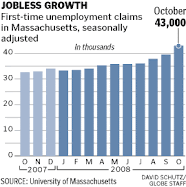








.png)





















































No comments:
Post a Comment