

"Cuts to winter heating aid concern New Englanders"
By Glenn Adams, Associated Press, August 14, 2011
AUGUSTA, Maine—It's been so hot this summer that heat records in some parts of New England melted away with temperatures in the 100-degree range. At the same time, the frigid days of the winter ahead are on the minds of officials in the region's statehouses.
As July went on record the warmest month on record in Portland, Maine, Barack Obama's proposal to chop the budget of the Low Income Home Energy Assistance Program nearly in half hung eerily in the background. Amid the simmering heat, Gov. Paul LePage had some chilling news for people attending a Capitol for a Day meeting in Dover-Foxcroft.
LePage warned that Maine's LIHEAP funding from the federal government could be cut in half, from $54 million for this year to about $26 million. He noted that the reduction could come as the cost of heating fuel rises above last year's level.
An organization that follows those trends agrees. The National Energy Assistance Directors' Association says the average cost of heating a home in New England with oil will be about $2,983 this winter, nearly $650 more than last year. High unemployment and colder-than-average winter temperatures exacerbate the problem for poor families, it notes.
While the president presented his budget in February, congressional review of the allocations is not expected before September. Given past experience, the cuts may not be as severe as states now fear, and the administration has said it's willing to revisit the figures.
In Maine, LePage has pledged to do all he can, despite the state's tight fiscal environment, to prevent people from freezing this winter if the worst comes true.
While it's never too early to think about funding for a program that's critically important in chilly New England, preseason jitters over the program are an annual occurrence. And the usual pattern is for funding to come through -- after pressure is applied from lawmakers from cold states.
"Every president in the last 15 years has proposed cuts in LIHEAP. It's not unusual to see a president knock LIHEAP around," said Richard Moffi, fuel assistance program chief for Vermont, which is looking at a cut in heating assistance from $25.6 million to $11.6 million. "Congress usually comes along and they hold the line."
And as of now, Obama's proposal to cut LIHEAP in half from about $5 billion is just a proposal, says Kirston Figueroa, director of energy and heating services for Maine State Housing, which administers heating assistance.
"It's such a moving target because we never really know until we know," Figueroa said.
Celeste Lovett, New Hampshire's fuel assistance program manager, agreed. Federal figures show New Hampshire's LIHEAP funding could be cut from $36 million to $15 million.
"It's really too soon to tell," Lovett said. "What we've done in New Hampshire is go forward with taking applications."
In Connecticut, the allocation would drop from $98 million to $41 million, Massachusetts from $175 million to $81 million, and Rhode Island from $34 million to $15.4 million.
New Hampshire started accepting applications in mid-July from vulnerable households -- those with residents over age 60, under age 6 or people with disabilities. The application process starts for the general public on Sept. 1.
The Obama administration, questioned about the proposed funding cut, acknowledged that the new LIHEAP figure was based on the expectation that fuel prices would be lower this winter. But in northern New England, they're expected to be in the $4-per-gallon range.
That affects a lot of families. About seven in 10 New England homes use heating oil, the University of New Hampshire's Carsey Institute says. Federal figures from 2007, the latest available, show that just over 355,000 households in the six New England states received LIHEAP assistance.
Federal officials say that the LIHEAP budget proposal for fiscal 2012, which starts Oct. 1, is $2.6 billion. That compares to $4.7 billion for the current fiscal year, said Kenneth Wolfe, a spokesman for the federal Department of Health and Human Services Administration for Children and Families.
-----
"Kerry asks gov't for heating funds"
By Scott Stafford, Berkshire Eagle Staff, October 15, 2011
While in the midst of budget negotiations for fiscal 2012 in the Joint Select Committee on Deficit Reduction, commonly known as the supercommittee, Sen. John Kerry has asked President Barack Obama to set aside $5.1 billion for heating aid in 2013.
That is the level at which LIHEAP was funded in fiscal 2010.
"In light of new and alarming projections about the cost of home heating oil in New England this coming winter, I am writing to appeal early in the budgeting process for special attention to the Low Income Home Energy Assistance Program (LIHEAP) which, as you know, has sustained severe and damaging cuts over the last several years despite a growing need," Kerry wrote in a letter to the president.
Meanwhile, local families and aid agencies are closely watching the price of energy and the thermometer as winter starts closing in. And unless someone acts soon, many local families could find themselves living in the cold.
According to Don Atwater, executive director of the Berkshire Community Action Council, the status of LIHEAP funding for this coming winter is daunting.
"With the federal deficit and the supercommittee, we have no idea what is going to happen this year," he said.
Since the fiscal 2012 budget has not been set, federal programs are funded at 2011 levels through a temporary budget continuance resolution passed by Congress until Nov. 16, Atwater noted. After that, Congress will have to pass another continuation or allow federal programs to end.
The supercommittee was formed to cut $1.5 trillion from the federal deficit as a condition of a compromise budget bill passed by Congress and signed by the president in August. The six Democrats and six Republicans have until Nov. 23 to come up with a plan.
Until then, the fate of the LIHEAP program and its funding will be unknown.
At current funding levels. Atwater noted, the roughly 11,000 Berkshire County applicants for heating aid will receive about $400 in heating aid, Atwater said. Last year it was $1,100 per household.
At that rate, he added, this year’s funding will be exhausted by November, but he is hoping Congress will infuse the program with more cash before that happens.
"Serving on the Joint Select Committee for Deficit reduction, I am particularly aware of our difficult budget situation and the need to make difficult choices now and in the future," Kerry wrote in his letter to the president. "However, I want to stress, as you have, that it is wrong to disproportionately squeeze programs that are a lifeline, literally, for seniors and the working poor who have already been disproportionately hurt by the economic conditions of the last years."
Kerry noted that there are more than 880,000 households in Massachusetts that use home heating oil "to survive our harsh winters -- and with the increase in prices we are already seeing many of them apply for assistance."
Estimates show "the average household will have to spend $2,493 this heating season compared to $2,300 last year," Kerry wrote. "Given these limited family budgets, cuts would mean many may have to choose between heating their homes, cutting back on medications or feeding their families. These are choices American families should never have to make, even in a time of fiscal restraint. Home heating oil is too critical an issue of economic survival for many in New England to have it fall in the order of federal priorities."
According to Chris Farrell, spokesman for Berkshire Gas, the price for natural gas in Berkshire County this winter is expected to remain the same as last winter at $1.39 per therm.
"We will be very close to the current price, barring extremely cold weather," Farrell said. "But we are confident that price will remain stable."
According to a report issued by the U.S. Energy Information Administration on Wednesday, "The average price paid by households in the Northeast this winter for heating oil may be the highest ever, almost $3.71 per gallon, more than double the average cost of natural gas."
That is an increase of more than 10 percent.
The report notes that in seven years, the cost of heating oil has more than doubled.
And given the current federal budget situation, Atwater noted, nobody knows from one month to the next what will happen with LIHEAP, which could force many Berkshire County families into a precarious set of choices -- whether to buy heat, food or health care.
"The deficit is an important issue we need to deal with," Atwater said, "but we’ve got to be careful that it is not done on the backs of the poor."
To reach Scott Stafford: sstafford@berkshireeagle.com or (413) 496-6241.
------------
"Obama 2013 budget would reduce heating aid: Lawmakers say plan poses threat to citizens in need"
By Danielle Ryan - news@seacoastonline.com - February 15, 2012
WASHINGTON — President Barack Obama's budget proposal for fiscal year 2013, unveiled Monday, would reduce the current level of funding for the Low Income Home Energy Assistance Program, which helps to heat the homes of thousands of low-income residents.
The proposal sets funding for LIHEAP at $3 billion for the fiscal year that begins Oct. 1. In budget documents, the Obama administration stressed it is asking for $450 million more than its request for the fiscal year 2012 to "target funds to states with vulnerable households facing high home heating costs for winter 2012-2013." However, Obama's proposed $3 billion still falls short of the nearly $3.5 billion that was eventually approved by Congress for the current fiscal year.
Legislators from cold-weather states are certain to push to increase the president's proposed LIHEAP spending when the issue is before Congress in the coming months. Rep. Frank Guinta, R-N.H., expressed concern over the president's proposal, which he said "would cause hardship for thousands of Granite Staters who rely on LIHEAP to keep their homes warm in winter."
Guinta recently joined Rep. Charles Bass, R-N.H., and other House colleagues in sending a letter to the president to ask that LIHEAP funding at least be maintained at its current level. "Sadly, that isn't reflected in his new budget proposal," Guinta said.
Bass added, "I have serious concerns that his budget request for 2013 will not be enough to help New Hampshire families struggling with high heating costs next winter."
Last month, Sens. Jeanne Shaheen, D-N.H., and Kelly Ayotte, R-N.H., joined 38 other senators in a letter to the president asking that further LIHEAP cuts be avoided.
"While I am still reviewing the full details of the president's budget request, I am concerned that the proposed LIHEAP allocation may not provide sufficient funds for New Hampshire," Ayotte said in a statement. "I will continue my work to responsibly fund LIHEAP and bring greater accountability to the program so that New Hampshire's most vulnerable citizens are not left out in the cold."
Celeste Lovett, fuel assistance program manager at the New Hampshire Office of Energy and Planning, said LIHEAP helped 45,252 families in the state last winter, as compared to 31,956 families to date this winter. New Hampshire has received $14.7 million in LIHEAP funding for the current winter, down from $34 million a year ago, she said.
According to the Campaign for Home Energy Assistance, a national group, Granite State residents who receive help from LIHEAP have incomes less than 200 percent of the federal poverty level.
Joanne Morin, director of the N.H. Office of Energy and Planning, acknowledged the president's proposed budget at least "recognized New England's vulnerability because of dependence on heating oil."
"We anticipate it will be tight this year but we're going to have to wait to see the exact effect," she said. "Although, we do believe we will serve those with incomes 200 percent below the poverty line."
Brandon Avila, a spokesman for the Campaign for Home Energy Assistance, said that while the Obama administration acknowledged energy costs are rising, his group is "still disappointed that the administration hasn't taken into consideration the growing number of households eligible for assistance." The most recent available estimate by the Campaign for Home Energy Assistance indicates 134,200 New Hampshire households were eligible for LIHEAP assistance in 2010.
Avila warned the program will need at least $4.7 billion nationally to function effectively. That is the level at which Congress funded LIHEAP in fiscal year 2011 — about $1.2 billion more than the nearly $3.5 billion being provided nationwide this year, and $1.7 billion above what was proposed by Obama on Monday.
"Anything lower and there's a real concern that a lot of families could be turned away," Avila said of the $4.7 billion.
------------
"Obama’s LIHEAP request gets cold shoulder from New England legislators"
By EDWARD DONGA, Staff Writer, The Nashua Telegraph, April 11, 2013
WASHINGTON – President Barack Obama’s latest request for funding for the Low Income Home Energy Assistance Program again was met with the cold shoulder from legislators representing the cold weather region of New England, including New Hampshire’s two U.S. senators.
Obama’s budget proposal for fiscal year 2014, released Wednesday, requests $2.97 billion for LIHEAP for the year beginning Oct. 1. That’s a slight decrease from the $3 billion Obama requested for the current 2013 fiscal year and is approximately $500 million below the nearly $3.5 billion that Congress approved for this year.
Coincidentally, Obama’s 2014 budget proposal – released more than two months behind schedule, in large part due to last December’s “fiscal cliff showdown” – came on the day declared as “LIHEAP Action Day” by the National Fuel Funds Network. As Obama’s budget was being released, more than 100 representatives of the network – a coalition of nonprofit groups, government agencies and utilities – descended on Capitol Hill to lobby on behalf of increased LIHEAP funding.
“I am deeply disappointed by President Obama’s proposed cuts to LIHEAP,” Sen. Jeanne Shaheen, a frequent ally of the president’s, said in a statement Wednesday. “If enacted, they would have serious consequences for New Hampshire’s most vulnerable citizens who struggle with home energy costs.
“I understand and support efforts to reduce the deficit, but given the economic climate and the rising cost of oil, cutting this critical source of assistance is the wrong way to move forward,” Shaheen, a Democrat, said.
At a budget briefing Wednesday, Department of Health and Human Services officials released figures conceding that New England states would see significant drops in LIHEAP assistance under Obama’s 2014 budget proposal.
New Hampshire would drop from an estimated $26.2 million in the current fiscal year to just over $20.9 million in fiscal 2014. The comparable declines from fiscal 2013 to fiscal 2014 for other New England states would be: Maine, from $38.8 million to $31.2 million; Massachusetts, from $141 million to $112.9 million; Connecticut from $80.4 million to $66 million; Vermont, from $19.7 million to $15.7 million; and Rhode Island from $25.4 million to $20.7 million.
A spokesman for Sen. Susan Collins of Maine, one of the two Republicans in the New England congressional delegation, said Collins is working with Sen. Jack Reed, D-R.I., to increase LIHEAP funding when Congress considers annual appropriations for fiscal 2014.
In a letter sent to the president last December, before the end of the last Congress, 40 senators requested that funding for LIHEAP in fiscal 2014 budget be set at no less than $4.7 billion, close to the program’s high-water mark in fiscal year 2010 – when $5.1 billion was approved by Congress.
Besides Collins, Reed and Shaheen, the signers of the December letter who continue to serve in Congress include U.S. Sens. Patrick Leahy, D-Vt.; Bernie Sanders, I-Vt.; Richard Blumenthal, D-Conn., and Republican Kelly Ayotte.
“As supporters of the LIHEAP program, we are very cognizant of the challenges that our discretionary budgets faces in FY14,” the senators wrote to Obama. “However, we are deeply concerned that funding for the program has declined 32 percent in recent years … at the same time, the number of households eligible for the program continues to exceed those receiving assistance.”
Sen. Elizabeth Warren, D-Mass., who was sworn into office in January, added in a statement Wednesday: “Anyone who has lived through a cold New England winter knows how important it is to keep our homes heated. … I am committed to supporting and strengthening the LIHEAP program.”
While primarily targeted at cold-weather states, LIHEAP provides aid to assist low-income families in the Sun Belt deal with cooling costs during the summer. To be eligible for assistance, a family’s income must be at or below 150 percent of the federal poverty level or 60 percent of a given state’s median income.
------------
"Obama begins political counteroffensive this week"
By Steven R. Hurst, Associated Press, August 14, 2011
WASHINGTON—President Barack Obama launches a political counteroffensive this week, weighed down by a stunted economy, wilting support among some of his most ardent backers, and a daily bashing from the slew of Republicans campaigning for his job.
"We've still got a long way to go to get to where we need to be. We didn't get into this mess overnight, and it's going to take time to get out of it," the president told the country over the weekend, all but pleading for people to stick with him.
A deeply unsettled political landscape, with voters in a fiercely anti-incumbent mood, is framing the 2012 presidential race 15 months before Americans decide whether to give Obama a second term or hand power to the Republicans. Trying to ride out what seems to be an unrelenting storm of economic anxiety, people in the United States increasingly are voicing disgust with most all of the men and women, Obama included, they sent to Washington to govern them.
With his approval numbers sliding, the Democratic president will try to ease their worries and sustain his resurrected fighting spirit when he sets off Monday on a bus tour of Minnesota, Iowa and Illinois. The trip is timed to dilute the GOP buzz emanating from the Midwest after Republicans gathered in Iowa over the weekend for a first test of the party's White House candidates. The state holds the nation's first nominating test in the long road toward choosing Obama's opponent.
"You have just sent a message that Barack Obama will be a one-term president," Minnesota Rep. Michele Bachmann told elated supporters minutes after winning Saturday's Iowa straw poll, essentially a fundraising event that also tests a candidate's organizational and financial strength. She spent heavily and traveled throughout the state where she was born, casting herself as the evangelical Christian voice of the deeply conservative small-government, low-tax tea party wing of the GOP.
Bachmann pulled in 4,823 votes, or 29 percent of those cast, edging out Texas Rep. Ron Paul, who drew 4,671 votes, or 28 percent. But while Democrats probably rejoiced that Bachmann's ultraconservative voice gained strength among Republican contenders, the contest to challenge Obama in November 2012 grew even more jumbled. While the voting was under way in Ames, Iowa, Republicans also had to keep an eye on South Carolina, where Texas Gov. Rick Perry made a cleverly timed entrance into the race.
Like Bachmann and all the other candidates, Perry ravaged Obama. He said the president was presiding over an "economic disaster," in a declaration that stole some of Bachmann's political thunder and undercut the front-runner status of former Massachusetts Gov. Mitt Romney, who didn't compete in the Iowa test vote. Perry clearly cast a broad shadow across the Republican contest.
Obama, expecting the political shelling he would take, fired pre-emptively in his weekly radio and Internet address to the nation on Saturday. He told listeners that it was the Republicans running for president and serving in Congress who were at work crushing voters' hopes and dreams.
The question for Obama and his backers remains: Will he sustain the counterattack? Of late, he's been seen by even his most staunch supporters as too ready to retreat from critical ground when confronted by intransigent Republicans.
Polls show voters hold both parties to blame for the stunted economic recovery, an unseemly political fight over raising the limit on U.S. borrowing, an anemic deal to cut the government deficit, the subsequent and unprecedented downgrade of the country's credit rating, wild stock market gyrations and an unemployment rate stuck above 9 percent.
In the face of that reality, Obama is tacking to put some wind in his re-election sails, apparently convinced that he can gather speed by turning up the attack on Congress.
"You've got a right to be frustrated," the president said in his weekly address. "I am. Because you deserve better. I don't think it's too much for you to expect that the people you send to this town start delivering."
He chastised Republicans for brinksmanship, saying "some in Congress would rather see their opponents lose than see America win."
That's an assessment that has some validity, particularly among the new class of House Republicans who have used their outsized legislative power to stymie Obama at every turn since their election last November.
Working in Obama's favor is a Republican Party still struggling to find a presidential candidate who lights a fire with voters. Questions remain about the appeal of Bachmann and Paul beyond, respectively, the more conservative and libertarian wings of the party.
Former Minnesota Gov. Tim Pawlenty, looking for a strong showing in Iowa to boost his struggling candidacy, ended a distant third with 2,293 votes, or 14 percent. On Sunday, he quit the race.
Former Alaska Gov. Sarah Palin, the GOP's 2008 vice presidential nominee, wasn't on the ballot and isn't a candidate yet. But she showed up at the Iowa State Fair a day before the vote, drawing huge crowds and saying she hadn't ruled out running.
Like Bachmann and Perry, Palin is a tea party favorite, but her coyness about joining the race could hurt her chances should she finally declare.
While Obama's bus tour is meant, in part, to blunt the Iowa Republican festivities, it will have to compete for attention as the country digests Perry's rhetorical assault on Obama's presidency.
Perry, a former Democrat and the nation's longest-serving governor, told his appreciative audience that Obama's government had "an insatiable desire to spend our children's inheritance." He accused Obama of presiding over an "economic disaster" that has been "downgrading our hope for a better future."
"I'll work every day to try to make Washington, D.C., as inconsequential in your lives as I can," Perry said, clearly bowing to his tea party backing. Specifics for turning his promises into realities were absent.
By entering the race on the same day as the Iowa voting, Perry angered some Republicans but saved some campaign cash and energy.
If nothing else, voters won't be able to ignore the fact that Perry's speaking style and swagger are eerily reminiscent of another Texas governor who made the transition to the national stage: President George W. Bush.
With his solid credentials on social as well as economic issues, Perry is an immediate threat to Bachmann, Romney and every other GOP candidate.
Romney did not participate in the Iowa poll, which he won four years ago before dropping out of the race when he failed to catch fire against eventual nominee John McCain. Romney did join all the announced candidates Thursday at an Iowa debate.
But it was his pre-debate visit to the Iowa State Fair that produced a political gift to the Democrats.
Responding to a heckler who challenged him on tax policies that benefit big business, he blurted out that "corporations are people, my friend." The Democratic National Committee quickly used video of that remark in pre-straw poll television ads in Des Moines, the state capital. It was the kind of business-friendly Republican applause line that could haunt him with undecided voters and disaffected Democrats.
Obama and the other GOP hopefuls now face daily scrutiny as well as they try to avoid for the same kind of misstep. That's a nearly impossible task in the long, arduous and expensive path toward the White House.
------------

"Obama departs Washington, heads to Martha’s Vineyard for family vacation"
By Associated Press, August 18, 2011
WEST TISBURY, Massachusetts — President Barack Obama ditched the Beltway grind Thursday to seek the pleasures of summer on the beaches of Martha’s Vineyard, his leisure time competing with a stock market plunge, fears of global recession and restless voters demanding jobs.
The president arrived on this wealthy Massachusetts island retreat Thursday afternoon, where he was joining first lady Michelle Obama and their daughters, Sasha and Malia. They are to spend 10 days in a rented compound.
The departure came after a busy morning in which the president called for Syrian President Bashar Assad to step down and imposed sanctions on the beleaguered Mideast regime. He then met with members of his economic team, which is preparing a jobs package that the president intends to announce shortly after Labor Day.
Obama departed Thursday afternoon wearing business attire — gray suit and tie — that belied his resort destination. Obama was traveling with a handful of aides, including his counterterrorism chief, John Brennan. Though his family was awaiting him on Martha’s Vineyard, the family dog, Bo, traveled with the president on Air Force One.
Republicans complained that the president should stay in Washington to work on the faltering economy.
Criticism of presidential vacations seems unavoidable, but this time Obama leaves with the economy in a particularly precarious state. Morgan Stanley economists warned Thursday that the U.S. and European economies are “dangerously close” to a recession, and Gallup this week put Obama at the lowest approval rating of his presidency in terms of handling the economy — a measly 26 percent.
White House spokesman Josh Earnest said the president would continue meeting with economic advisers throughout his vacation as he prepares for his September jobs speech.
“The president of the United States is the president of the United States wherever he goes,” Earnest said. “I don’t think the American people begrudge the president spending a little time with his wife and daughters at the end of the summer before his daughters head back to school.”
Obama’s vacation will also keep him absent just as the GOP presidential field, led by Rep. Michele Bachmann of Minnesota, Texas Gov. Rick Perry, and former Massachusetts Gov. Mitt Romney, mounts an ever louder attack on his policies. Romney is among those who’ve called on Obama to cancel his vacation and stay in Washington.
The foundering economy and 2012 presidential politics will await Obama when he returns to Washington at the end of next week prepared to give a major economic speech after Labor Day to lay out new jobs initiatives and call for action from Congress, which is also on its annual summer recess.
Until then, Obama, who just returned from a three-day Midwest bus trip focused on the economy, may be hoping for a relatively uneventful break.
As they did last year, the Obamas will stay at the Blue Heron Farm, a multimillion-dollar hideaway with its own gym, basketball court, guesthouse and stretch of beach. Obama last year spent his days on the golf course with a few buddies, venturing out on occasion for a beach picnic with the family, to local restaurants with Michelle and to take Sasha and Malia to a bookstore to pick up some summer reading.
Accustomed to vacationing presidents — it will be Obama’s third straight year on the island and Bill Clinton spent time there, too — the locals were welcoming and unobtrusive — no doubt a welcome change from Obama’s foes on Capitol Hill and on the campaign trail.
------------
"Another year of economic shortfalls predicted"
The Congressional Budget Office says the federal deficit is projected to hit $1.3 trillion in fiscal 2011, the third year of shortfalls at levels not seen since World War II.
By Lisa Mascaro (lisa.mascaro@latimes.com), Los Angeles Times - Washington Bureau (Reporting from Washington), August 25, 2011
A third consecutive year of massive federal deficits and a slumping economy with high unemployment portrays a bleak fiscal outlook for the U.S., promising a divisive political debate this fall over how to get the country back on track.
The Congressional Budget Office said Wednesday (8/24/2011) the federal deficit was projected to hit $1.3 trillion in fiscal 2011, the third year of shortfalls at levels not seen since World War II.
As the economy continues to struggle, unemployment is expected to remain stubbornly high through the end of the year, but dip to 8.5% as the 2012 election approaches, a slight improvement but still high and on par with previous projections by the congressional agency. Polls show jobs remain a top priority for Americans.
Both Democrats and Republicans seized on the report as Congress and President Obama prepare to battle anew over the best approach to improve the economic outlook while reducing the nation's debt.
GOP leaders said the report offered more evidence that the Obama administration's fiscal policies had been a failure. "Where are the jobs?" asked House Speaker John A. Boehner (R-Ohio).
Democrats said it showed the troubled economy could no longer afford tax breaks for the wealthy that expire next year. "The most effective way to reduce our deficit is to put Americans back to work and grow our economy," said Rep. Nancy Pelosi (D-San Francisco), the House minority leader.
Obama is expected to ask Congress for new measures to create jobs — possibly by extending payroll tax breaks, offering companies tax credits for adding employees, and by investing in roads, bridges and school construction projects.
Those options will cost money, and Obama has called for an approach that simultaneously tackles deficits by cutting federal spending elsewhere and increasing tax revenue.
Economists generally support that two-step remedy as appropriate for the times: fiscal stimulus in the short term to keep the economy from slipping further, alongside a long-term plan to reform tax and spending policies to reduce the debt load.
Republicans, though, are in no mood for compromise. Fresh from holding the line on new taxes during the debt ceiling debate, the GOP is pursuing a vision of government that relies on larger tax breaks, spending cuts and regulatory relief to fuel economic growth.
One point is clear: To continue business as usual in Washington would lead to a "bleak" economic outcome, said Douglas W. Elmendorf, director of the Congressional Budget Office.
The dour outlook gives more urgency to the congressional "super committee" on deficit reduction — the new panel that skeptics say will be unlikely to reach a bipartisan agreement in its remaining 10 weeks of work. It has not yet held its first meeting, but on Wednesday its co-chairs, Sen. Patty Murray (D-Wash.) and Rep. Jeb Hensarling (R-Texas), said they were working to ensure the committee "is given every opportunity to succeed."
The committee is tasked with cutting $1.5 trillion from deficits over the next decade through spending cuts, new taxes or a combination of both. If it cannot agree on a proposal for Congress to consider, as many think is likely, automatic spending cuts of a similar size would be triggered, though they would not take effect until 2013. A committee website to take public input could be launched in days.
But the debate over whether to increase taxes has vexed Washington. The tax breaks enacted under the George W. Bush administration expire at the end of 2012, and keeping all of them in place would add about $4 trillion to the deficit over 10 years.
Deficits would plummet in 2013 if all of the Bush-era tax cuts expired, but that is unlikely, as most of the tax breaks go to middle-class families and have bipartisan support. The upper-income tax cuts, though, remain a political dispute.
"There's absolutely no doubt there are profound budget challenges and profound economic challenges," Elmendorf said Wednesday.
The budget office said the record deficits over the last three years stemmed from the "long shadow" cast on the economy from the financial crisis and recession.
Deficits ballooned as the federal government spent money to shore up the economy with the stimulus program, industry bailouts and aid for unemployed Americans. Deficits also rose as tax revenue dropped substantially. The Congressional Budget Office's estimated deficit for 2011 is actually a slight dip from earlier projections.
Part of the problem that lawmakers face in tackling budgetary issues is that their options become increasingly limited as the economy struggles and the fiscal problems deepen, experts say.
For example, the budget accord reached this summer to raise the debt ceiling will help to substantially reduce the nation's future debt load by reducing spending, the report said.
But slashing federal outlays also causes short-term pain as the economy struggles to grow. Federal budget cuts are "weighing on output and employment," Elmendorf said.
------------

Labor economist Alan Krueger was nominated by President Obama to head the White House Council of Economic Advisers. (Larry Downing/Reuters)
"Labor specialist picked to head economic panel"
By Jackie Calmes, New York Times, August 30, 2011
WASHINGTON - In tapping Alan B. Krueger yesterday to chair the Council of Economic Advisers, President Obama picked an economist well known for his studies of labor markets, just as the president is about to announce a renewed push for job-creation policies.
Among the stimulus policies Obama is considering is a temporary tax credit for employers adding to their workforce, an idea Krueger championed in his earlier stint in the administration. Krueger was an assistant secretary and chief economist at the Treasury Department for 17 months, before he returned to his teaching post at Princeton University in 2010. A more modest version of the hiring credit became law, but congressional Republicans blocked its extension last year.
Krueger, if confirmed by the Senate, will find Republicans a force to be reckoned with against the sorts of ideas he is associated with, including a higher minimum wage. Republicans have taken control of the House since he left Washington, and party leaders say they will oppose further stimulus measures.
Their focus is spending cuts, despite widespread calls from economists, including the chairman of Federal Reserve, Ben S. Bernanke, for a more expansive fiscal policy in a period of weak economic growth and stubbornly high unemployment.
Obama, in a speech next week, is expected to call for both temporary tax cuts and spending measures to spur hiring in the short term, and long-term steps to reduce spending and raise revenues once the economy fully recovers. But in nominating Krueger, with his expertise in policies that affect job creation, Obama passed over economists better known for deficit-reduction policies, including Alan J. Auerbach of the University of California Berkeley.
The choice of Krueger more broadly reflects Obama’s desire to strike a balance between job creation and deficit reduction after months in which congressional Republicans successfully forced action only on spending cuts. Krueger, who first joined the administration during the recession, helped design other early stimulus proposals, including the cash for clunkers rebates for new car purchasers, the Build America Bonds program to finance infrastructure projects, and a credit fund for small businesses.
“As one of this country’s leading economists, Alan has been a key voice on a vast array of economic issues for more than two decades,’’ Obama said. “Alan understands the difficult challenges our country faces.’’
The ability to win confirmation was a certain consideration; Krueger was successfully confirmed for his prior post with the Treasury. But the chairmanship of the Council of Economic Advisers is a higher position, and Republicans have become more aggressive about blocking nominees to demonstrate opposition to White House policies. Obama’s pick for Commerce secretary, John E. Bryson, remains in limbo three months after his nomination.
Krueger, 50, would replace longtime Obama adviser Austan Goolsbee, who returned to the University of Chicago. Krueger “is going to be able to hit the ground running immediately,’’ Goolsbee said. “And B, he’s a world-class, respected researcher on job-market policies, job creation, and things of that nature.’’
Krueger would be the second former adviser to the Treasury secretary, Timothy F. Geithner, to take one of the four positions at the core of Obama’s economic circle; the other is Gene B. Sperling, a former Treasury counselor who replaced Lawrence H. Summers as director of the National Economic Council at the White House. That Geithner has two former underlings on Obama’s economic team is further evidence of his influence.
It also reflects Obama’s wish for a collegial economic team after the fractiousness in his first two years, which were marked by tension especially between Summers and the former White House budget director, Peter R. Orszag. Back then, Summers questioned the likely effectiveness and cost of the job credit proposal associated with Krueger, officials say.
Orszag was a student of Krueger’s at Princeton, where Krueger began teaching in 1987. “He was one of my best professors,’’ Orszag wrote in an e-mail.
Conservative economists also applauded the choice, including the top economic advisers under Ronald Reagan and George W. Bush - Martin Feldstein and Gregory Mankiw, respectively.
The cooler reception came from some on the left, who said the moment called for a big-picture macroeconomist who would push for more ambitious initiatives to reduce unemployment.
“The kind of action he’s an aggressive and creative thinker about is relatively small-bore, supply-side changes rather than big-picture efforts to fill the gap,’’ Matthew Yglesias, a senior fellow at the liberal Center for American Progress, wrote in a blog.
------------
"White House creates website for online petitions"
By Darlene Superville, Associated Press, September 1, 2011
WASHINGTON — The White House is making it easier for people to press the federal government to act.
It is bringing that constitutional right to petition one's government into the digital age with a webpage, "We the People," where people can create and sign petitions seeking the government's action on a range of issues.
An official response is guaranteed for any petition that draws enough signatures -- 5,000 names within 30 days -- after it is reviewed by staff and the appropriate policy experts within the Obama administration.
The White House announced the new page, www.whitehouse.gov/wethepeople, on Thursday.
"When I ran for this office, I pledged to make government more open and accountable to its citizens," President Barack Obama said in the announcement. He said the new feature will give Americans "a direct line" to the White House on issues that most concern them.
The online petition program comes as Obama has been urging the public to press their representatives in Congress to act on his ideas for creating jobs and balancing the federal budget.
To emphasize word-of-mouth organizing, a petition's Web address initially will only be known by the person who created it. The address is not supposed to show up anywhere else on the White House website until 150 signatures have been collected.
The first online petitions can be created later this month.
The White House already accepts petitions through its correspondence office and that is not expected to change, officials said.
------------
September 2, 2011
Breaking News from ABCNEWS.com:
Employers Added No New Jobs in August, Unemployment Rate Unchanged at 9.1 Percent, Labor Dept. Reports.
------------
"Obama yields on smog rule in face of GOP demands"
Obama scraps stricter smog regulation, bowing to business, GOP but angering liberal backers
Julie Pace and Dina Cappiello, Associated Press, September 2, 2011
WASHINGTON (AP) -- In a dramatic reversal, President Barack Obama on Friday scrubbed a clean-air regulation that aimed to reduce health-threatening smog, yielding to bitterly protesting businesses and congressional Republicans who complained the rule would kill jobs in America's ailing economy.
Withdrawal of the proposed regulation marked the latest in a string of retreats by the president in the face of GOP opposition, and it drew quick criticism from liberals. Environmentalists, a key Obama constituency, accused him of caving to corporate polluters, and the American Lung Association threatened to restart the legal action it had begun against rules proposed by President George W. Bush.
The White House has been under heavy pressure from GOP lawmakers and major industries, which have slammed the stricter standard as an unnecessary jobs killer. The Environmental Protection Agency, whose scientific advisers favored the tighter limits, had predicted the proposed change would cost up to $90 billion a year, making it one of the most expensive environmental regulations ever imposed in the U.S.
However, the Clean Air Act bars the EPA from considering the costs of complying when setting public health standards.
Obama said his decision was made in part to reduce regulatory burdens and uncertainty at a time of rampant questions about the strength of the U.S. economy.
Underscoring the economic concerns: a new report Friday that showed the economy essentially adding no jobs in August and the unemployment rate stubbornly stuck at 9.1 percent.
The regulation would have reduced concentrations of ground-level ozone, the main ingredient in smog, a powerful lung irritant that can cause asthma and other lung ailments. Smog is created when emissions from cars, power and chemical plants, refineries and other factories mix in sunlight and heat.
Republican lawmakers, already emboldened by Obama's concessions on extending Bush-era tax cuts and his agreement to more than $1 trillion in spending reductions as the price for raising the nation's debt ceiling, had pledged to try to block the stricter smog standards as well as other EPA regulations when they returned to Washington after Labor Day.
A spokesman for House Speaker John Boehner, R-Ohio, had muted praise for the White House Friday, saying that withdrawal of the smog regulation was a good first step toward removing obstacles that are blocking business growth.
"But it is only the tip of the iceberg when it comes to stopping Washington Democrats' agenda of tax hikes, more government `stimulus' spending and increased regulations, which are all making it harder to create more American jobs," said Boehner spokesman Michael Steel.
Thomas Donohue, president of the U.S. Chamber of Commerce, said the move was "an enormous victory for America's job creators, the right decision by the president and one that will help reduce the uncertainty facing businesses."
White House officials said the president's decision was not the product of industry pressure, and they said the administration would continue to fight other efforts by Republicans to dismantle the EPA's authority.
But that was little consolation for many of the president's supporters. The group MoveOn.org issued a scathing statement, saying Obama's decision was one it would have expected from his Republican predecessor.
"Many MoveOn members are wondering today how they can ever work for President Obama's re-election, or make the case for him to their neighbors, when he does something like this, after extending the Bush tax cuts for the rich and giving in to tea party demands on the debt deal," said Justin Ruben, the group's executive director.
The American Lung Association, which had sued the EPA over Bush's smog standards, said it would resume its legal fight now that Obama was essentially endorsing the weaker limit. The group had suspended its lawsuit after the Obama administration pledged to change it.
Obama's decision, in fact, mirrors one made by Bush in 2008. After EPA scientists recommended a stricter standard to better protect public health, Bush personally intervened after hearing complaints from electric utilities and other affected industries. His EPA set a standard of 75 parts per billion, stricter than one adopted in 1997, but not as strong as federal scientists said was needed to protect public health.
In March, the EPA's independent panel of scientific advisers sent a letter to the agency's administrator, Lisa Jackson, saying it was its unanimous recommendation to make the smog standards stronger and that the evidence was "sufficiently certain" that the range proposed in January 2010 under Obama would benefit public health.
But the White House, which has pledged to base decisions on science, said Friday the science behind its initial decision needed to be updated, a process already under way at EPA. The smog standard now is to be revised until 2013.
Whether Obama still occupies the White House at that point depends on the outcome of next year's presidential election.
Cass Sunstein, the head of the White House regulatory office, said changing the smog regulation now, only to have it be reconsidered again in two years, would create unnecessary uncertainty for the private sector and local governments.
The stricter limits initially proposed by Obama would have doubled the number of counties in violation. Smoggy cities such as Los Angeles and Houston would have been joined by counties in California's Napa Valley and one in Kansas with a population of 3,000. They would have had up to 20 years to meet the new limits, once EPA settled on a final number, or would have faced federal penalties.
In his statement, the president said scrapping the stronger smog standards did not reflect a weakening of his commitment to protecting public health and the environment.
"I will continue to stand with the hardworking men and women at the EPA as they strive every day to hold polluters accountable and protect our families from harmful pollution," Obama said.
Even before Friday's decision -- announced as many Americans were paying more attention to their Labor Day weekend plans than the news -- the White House has faced some criticism for its record on the environment. Obama abandoned a campaign pledge to set the first-ever limits on the pollution blamed for global warming, and he announced an expansion of offshore drilling before the Gulf oil spill sidelined those plans.
However, he has successfully taken other steps to reduce air pollution, such as doubling fuel efficiency standards for cars and light trucks, clamping down on pollution from power plants that blows downwind and setting the first national standard for mercury, a toxic metal, from power plants, all in the face of Republican and industry opposition.
The ground-level ozone standard is closely associated with public health -- something the president said he wouldn't compromise in his regulatory review.
------------
"Congress returns, unpopular as well as divided"
By DAVID ESPO - AP Special Correspondent | AP – September 3, 2011
WASHINGTON (AP) — Congress returns to work this coming week, divided over measures to create jobs and scorned by the nation it was elected to help lead.
After a five-week break, Republican and Democratic leaders alike promise action to try and ease the country's 9.1 percent unemployment rate and boost an economy that is barely growing. President Barack Obama goes first on Thursday night with a speech to lawmakers and a prime-time national television audience.
But there is little overlap so far in the measures that Republicans and Democrats are recommending, and the rest of the year-end congressional agenda is top-heavy with items that relate to government spending and less directly to job creation.
A new committee, comprised of lawmakers in both parties from both houses and armed with extraordinary powers, is expected to hold its first meeting this week as it begins work on a plan to make long-term deficit cuts. The panel was created as part of last month's agreement to reduce red ink and avert a government default. It faces a Nov. 23 deadline for action.
More immediately, parts of the Federal Aviation Administration will shut down on Sept. 16 unless Congress approves a measure to keep operations running. Federal money for highway construction jobs runs out two weeks later without separate legislation.
The Obama administration is seeking more money for disaster relief in the wake of Hurricane Irene, and a partial government shutdown would occur on Oct. 1 unless lawmakers enact an interim spending bill to cover most federal agencies.
With any or all of these measures, there is an opportunity for partisan gridlock or compromise, and it isn't entirely clear which an unhappy public might prefer.
In a late-August Associated Press-GfK poll, only 12 percent of those surveyed said they approved of the job Congress is doing, and 87 percent disapproved. A separate Gallup survey, taken in midmonth, found 13 percent approved and 84 percent disapproved.
"Everybody is kind of in trouble with the electorate," said Republican pollster Bill McInturff. He recently distributed an analysis that concluded the negotiating surrounding last month's agreement to avoid a default is an extremely significant event that is profoundly and sharply reshaping views of the economy and the federal government.
"It has led to a scary erosion in confidence in both, at a time when this steep drop in confidence can be least afforded."
But if the public was offended by the bickering before the deal, there isn't there much evidence that the compromise on the nation's borrowing limit did much, if anything, to restore confidence in Congress' ability to address economic problems.
A Fox News poll last month showed opinion was split on the compromise, with Republicans overwhelmingly opposed, independents solidly so and Democrats narrowly in favor. But even those statistics masked a deeper divide.
Based on other surveys, McInturff said, "Republicans disapprove because some didn't think we should have raised the debt ceiling at all ... and others because they believe there should have been substantially more spending cuts than what was in the debt-ceiling vote."
Independents who disliked the compromise tended to say they wanted deeper deficit reductions. Democrats who disapprove did so because "they can't believe the president is negotiating doing this much with the Republicans," he said, which is a far different reason from the one GOP voters cite.
The Fox News survey showed a similar breakdown.
Republicans and Democrats offer different assessments of the state of congressional approval.
"I'm not the least bit surprised that the rating of Congress is abysmal. If we could do the work that we are supposed to be doing in a reasonable and timely way," it would improve, said Sen. Pat Toomey, R-Pa., a first-termer who is a member of the committee charged with finding $1.2 billion or more in deficit reductions.
Senate Majority Leader Harry Reid, D-Nev., had a somewhat different view, telling an audience in his home state: "Everyone complain all you want about Congress. You should complain plenty. But don't think the country is about to fall apart because of what's going on in Washington."
Already, the differences are evident as Obama and congressional leaders ready job creation plans.
House Majority Leader Eric Cantor, R-Va., recently distributed a list of "Top 10 Job-Destroying Regulations" and said the Republican majority would begin voting this month to block them one by one.
Most, including one that Obama ordered scrapped Friday, deal with pollution limits for a variety of industries; two would curtail National Labor Relations Board actions opposed by business.
Separately, Cantor wrote, the House will "pursue tax relief designed to help American employers create middle-class jobs."
Obama, too, is considering tax breaks to provide businesses to hire new employees. He also is expected to call for new spending on construction projects, and to seek an extension of jobless benefits and a temporary payroll tax cut that is due to expire Dec. 31.
To offset those costs, the president is expected to challenge lawmakers on the debt-reduction committee to go beyond its minimum goal of $1.2 trillion in long-term savings.
The panel marks the latest and possibly the last attempt of the year to forge a sweeping agreement that can cut trillions from future deficits. Congress must approve $1.2 trillion in deficit cuts to block across-the-board spending cuts that both sides say they would like to avoid.
There are expressions of optimism, but so far, none of outright success.
Reid put the prospects of a compromise at 50-50.
Toomey said he was "cautiously optimistic."
"We know how difficult this task is going to be, and I am heartened by the strong encouragement I have gotten from my constituents and my colleagues on both sides of the aisle," Rep. Fred Upton, R-Mich., said Friday in a written statement. "We'll begin by identifying those areas where we have common ground, and we are ready to roll up our sleeves and get to work."
------------
"Labor unions adjust to new reality under Obama"
By SAM HANANEL - Associated Press | AP – September 4, 2011
WASHINGTON (AP) — In the early days of the Obama administration, organized labor had grand visions of pushing through a sweeping agenda that would help boost sagging membership and help revive union strength.
Now labor faces this reality: Public employee unions are in a drawn-out fight for their very survival in Wisconsin, Ohio and other states where GOP lawmakers have curbed collective bargaining rights.
Also, many union leaders are grousing that the president they worked so hard to elect has not focused enough on job creation and other bold plans to get their members back to work.
"Obama campaigned big, but he's governing small," said Larry Hanley, president of the Amalgamated Transit Union.
Labor remains a core Democratic constituency and union leaders will stand with Obama in Detroit this Labor Day, where he will address thousands of rank-and-file members during the city's annual parade Monday.
But at the same time, unions have begun shifting money and resources out of Democratic congressional campaigns and back to the states in a furious effort to reverse or limit GOP measures that could wipe out union rolls.
The AFL-CIO's president, Richard Trumka, says it's part of a new strategy for labor to build an independent voice separate from the Democratic Party.
Union donations to federal candidates at the beginning of this year were down about 40 percent compared with the same period in 2009, according to the Center for Responsive Politics. Last month, a dozen trade unions said they would boycott next year's Democratic National Convention in Charlotte, N.C., over frustration on the economy and to protest the event's location in a right-to-work state.
"The pendulum has swung a long way," said Ross Eisenbrey, a vice president of the liberal Economic Policy Institute. "In the next year, I think all unions can really hope for is to keep more bad things from happening and to get as much of a jobs program enacted as possible."
Unions fell short last month in their recall campaign to wrest control of the Wisconsin Senate from Republicans. That fight was a consequence of Gov. Scott Walker's proposal to eliminate collective bargaining rights for public-employee unions as a part of a cost-cutting effort. Now they are spending millions more in Ohio, where they hope to pass a statewide referendum in November that would repeal a similar measure limiting union rights.
It's a far cry from the early optimism unions had after Obama came into office. Back then, unions hoped a Democratic-controlled Congress would pass legislation to make it easier for unions to organize workers. But business groups fought that proposal hard, and it never came to a vote.
Union leaders grew more disappointed when the president's health care overhaul didn't include a government-run insurance option. Then Obama agreed to extend President George W. Bush's tax cuts for the wealthy.
Obama came out in favor of trade agreements with South Korea, Colombia and Panama that most unions say will cost American jobs. Despite campaigning in favor of raising the minimum wage from $7.25 to $9.50 an hour, Obama hasn't touched the issue since taking office.
It didn't help that Obama declined union invitations to go to Wisconsin, where thousands of protesters mobilized against the anti-union measure. Candidate Obama had promised to "put on sneakers" and walk a picket line himself when union rights were threatened.
Obama has handed labor smaller victories that didn't have to go through Congress, like granting the nation's 44,000 airport screeners limited collective bargaining rights for the first time. The National Labor Relations Board and other agencies filled with Obama's appointees have made it easier for unions to organize workers in the airline, railroad and health care industries.
The NLRB has taken a beating from Republicans after filing a lawsuit that accuses Boeing of opening a new plant in South Carolina in retaliation against union workers in Washington state.
"The field has tilted against labor so that whatever small victories they get are just tinkering around the edges and get tremendous pushback by conservatives," said Nelson Lichtenstein, director of the Center for the Study of Work, Labor and Democracy at the University of California, Santa Barbara.
But labor's frustration with Obama reached new heights this summer as Trumka accused him of working with tea party Republicans on deficit reduction instead of "stepping up to the plate" on jobs.
Labor unions and other liberal groups want Obama to push a major stimulus bill with hundreds of billions of dollars in new spending on infrastructure projects like roads, bridges and transit systems. Even if it's rejected in the GOP-controlled House, unions want to see Obama show more leadership and take a bold stand in favor of stimulus spending.
That's not likely to happen. Constrained by budget cuts and a tight debt ceiling, Obama is expected to propose a limited package worth far less than the $787 billion stimulus passed in 2009.
The plan will call on Congress to extend current payroll tax cuts and jobless benefits, spend money for new construction projects and offer incentives to businesses to hire more workers.
James Hoffa, general president of the International Brotherhood of Teamsters, said Obama should challenge businesses with healthy bottom lines to spend more in the U.S. by hiring new workers, building plants and expanding operations. If they don't, Hoffa said, Obama should call them out as disloyal.
"I think the president should challenge the patriotism of these American corporations that are sitting on the sidelines," Hoffa said Sunday on CNN's "State of the Union."
He added, "We've got to turn this around and say, 'Hey, we are an American company. We owe an obligation to America. Let's put America back to work.'"
Labor Secretary Hilda Solis defended Obama from liberal critics, saying the administration has established many programs to create jobs, worked to extend unemployment insurance benefits and helped save the auto industry.
"The president is very concerned about job creation," Solis told reporters at the National Press Club. "That been our priority from day one."
Union face a tougher challenge in the states.
Walker wanted to patch the state's budget shortfall by requiring state workers to pay more for their health care and pension benefits. He said curbing bargaining rights was important in the long term to prevent unions from reversing the move in future negotiations.
Republican Wisconsin state Rep. Robin Vos said the big money spent by pro-labor forces in the recall elections shows "that they're not about protecting workers rights, they're about protecting political power."
"This is the last grasp of those political bosses to be able to showcase why they need to have the political power, and they lost," he said.
Conservatives say Walker's measure has done just what it promised, closing budget shortfalls without laying off teachers and other workers.
"As the changes have had time to sink in, people appear to be accepting it, and it appears to be part of the new status quo," said James Sherk, a policy analyst at the Heritage Foundation.
A measure passed in Tennessee this year ended collective bargaining for teachers unions in the state. In Oklahoma, lawmakers repealed a law that had required large municipalities to collectively bargain with municipal employees.
"The fact that you didn't see much pushback in those states, I think, is significant," Sherk said.
Union leaders see a more sinister plan not only to cut union benefits, but to crush unions altogether, along with their political largesse to Democrats. The Wisconsin law, for example, bans automatic withdrawal of union dues and requires public unions to hold annual votes to avoid decertification.
In Ohio, unions are more hopeful that they can win a November referendum to undo the state's collective bargaining law that passed this spring. A Quinnipiac University poll in July found that 56 percent of Ohio voters say the new collective bargaining law should be repealed, compared with 32 percent who favor keeping it in place.
"A victory in Ohio would be a tremendous shot against the bow of Republicans to not mess with the unions," Lichtenstein said.
It could also help unions show they are still a political force to be reckoned with at both the state and national level.
Associated Press writers Scott Bauer in Madison, Wis., and Julie Carr Smyth in Columbus, Ohio, contributed to this report.
------------
"Tough economic climate as Obama seeks 2nd term"
By CHARLES BABINGTON - Associated Press | AP – September 4, 2011
WASHINGTON (AP) — President Barack Obama faces a long re-election campaign having all but given up on the economy rebounding in any meaningful way before November 2012. His own budget office predicts unemployment will stay at about 9 percent, a frightening number for any president seeking a second term.
Obama's prospects aren't entirely grim, however. The GOP, heavily influenced by the tea party, may nominate someone so deeply flawed or right-leaning that, Democrats hope, Obama can persuade Americans to give him a second chance rather than risk the alternative.
Democrats say the man who ran on hope and change in 2008 will have to claw his way toward a second term with a sharply negative campaign.
The strengths and weaknesses of his prospects seem clear.
Next year's unemployment rate is likely to be the highest in a presidential election since 1940. But the leading Republican contenders have denigrated Social Security, switched positions on critical issues and done other things that might make them ripe targets for Obama's well-funded campaign.
Democratic strategist Doug Hattaway says GOP candidates, including Texas Gov. Rick Perry and former Massachusetts Gov. Mitt Romney, may turn off independent voters with their embrace of tea party stands on taxes, spending and program cuts.
Obama "should lump them all together and make them answer for their slash-and-burn politics," said Hattaway, a former top aide to Hillary Rodham Clinton, Obama's rival for the 2008 Democratic presidential nomination.
To do so, Hattaway said, Obama must link the candidates to congressional Republicans, blamed by Democrats for the nation's stalled job growth and recent downgrade of U.S. creditworthiness.
Making the connection might not prove easy.
Obama's potential challengers have avoided getting dragged into details of the bitter Capitol Hill fights over deficit spending. At least for now, they can lob criticisms at the president while offering few specific, measurable alternatives.
"President Obama oversaw an economy that created zero jobs last month, and that is unacceptable," Romney said Friday.
But the influence of the tea party and other conservative groups may give Obama some openings, by pushing the GOP field so far to the right that the candidates risk alienating vital independent voters.
In a debate last month, the top contenders pledged to oppose a deficit-reduction plan even if it cut $10 in spending for every $1 raised by new taxes. Perry, who entered the race after that debate, also has taken a tough stand against higher taxes.
Obama's team says independents, who might pay scant attention to ideologically driven primaries, will find such positions extreme when they compare the eventual GOP nominee and the president.
Political aide David Axelrod hinted that Obama will try to sharpen his differences with Republicans who insist on spending cuts in virtually every area and who refuse to let tax cuts expire, as scheduled, for the wealthiest.
It's hard "to create an economy in which people can get decent jobs and raise a family at the same time we're cutting back on our commitment to spending on education and research and development that will create innovation and jobs," Axelrod said in an interview.
The Republicans' "essential message is, let's go back to the policies that helped get us in this mess," he said, citing Wall Street deregulation and corporate tax breaks.
If GOP lawmakers, backed by the presidential hopefuls, continue to thwart Obama's bid to mix targeted spending cuts with tax increases, Axelrod said, "we're going to take our case to the American people."
Recent polls underscore Obama's challenge. A Pew Research poll found that 39 percent of independents approve of his job performance, while 52 percent disapprove.
An AP-GfK poll showed a sharp erosion of support for Obama among white voters and women. Less than half of all women and less than half of all men approve of the job he's doing, and only 50 percent of women say he deserves re-election.
But the same polls show that far more voters blame former President George W. Bush more than Obama for the nation's economic woes. Whether that sentiment lingers for 16 more months could prove crucial.
Hattaway said Obama must start by winning back moderates and motivating "millennials," voters in their 20s and early 30s.
"The economy is not going to come roaring back before the election, so he has to give them a vision" for a future with jobs and with social justice for groups, including gays, Hattaway said.
Obama also must try to minimize the frustration among his liberal base supporters, many of whom feel he is too quick to compromise. Some complained loudly Friday when Obama yanked a proposal to tighten federal smog standards.
Questions about the environment, war and foreign affairs will figure into the 2012 race. But all parties agree jobs are the overriding issue.
Analysts differ on what level of unemployment is politically fatal.
President Ronald Reagan handily won re-election in 1984 with unemployment at 7.2 percent, which was down slightly from the rate at the start of his term. President Jimmy Carter lost when unemployment was at 7.5 percent and President George H.W. Bush lost with a similar level, but both faced other problems as well.
Hopeful Democrats say Obama can survive next year if people feel growth is coming soon. Another way to survive is uglier: admitting the economy is a mess, but pressing the case that the GOP alternative is so unacceptable that the incumbent should stay in office, even with no recovery in sight.
Obama's aides say the election will be "a choice, not a referendum." That hints at a bruising effort to divert attention from the president's record and focus on what the Obama campaign believes are the GOP nominee's chief shortcomings.
Democratic optimists feel the GOP nominating process will play into that strategy. The Democratic National Committee issues a steady stream of statements and videos with headlines such as "Romney makes move to embrace Tea Party."
Several Republican candidates, including Romney, Minnesota Rep. Michele Bachmann and Perry, are proven vote-getters at the state level. Soon they will show whether they can handle the scrutiny and grind of a presidential campaign.
Democrats say their records provide much to use against them.
Perry, for instance, has called Social Security "a Ponzi scheme," and said climate change is a "contrived phony mess."
Romney switched his position on abortion, gay rights and gun control after leaving the Massachusetts governor's office and seeking the Republican presidential nod. He also is criticized for his role in Bain Capital, a corporate takeover firm that eliminated jobs in some cases but expanded them in others.
Bachmann has spent only three terms in the House; the last member to go directly to the White House was James Garfield, elected in 1880. If Sarah Palin decides to run, she will be asked why she quit her job as Alaska's governor with more than a year left in her term.
------------
"Obama to exclude Social Security from deficits plan"
By Laura MacInnis | Reuters – September 15, 2011
WASHINGTON (Reuters) - President Barack Obama will not include reforms to the Social Security retirement program in his deficits proposals to Congress next week, the White House said Thursday.
Obama upset many fellow Democrats during this summer's bitter negotiations with Republicans on raising the debt ceiling when he expressed a willingness to change the way government benefits are linked to inflation.
He saw the move as a way to ensure the federal pension program remains viable in the long-term, but liberal supporters who champion entitlement programs for the elderly felt he was giving up too much ground to Republicans.
White House spokesman Amy Brundage said Obama's long-awaited deficit reduction plan, to be unveiled Monday, "will not include any changes to Social Security."
"As the president has consistently said, he does not believe that Social Security is a driver of our near and medium term deficits," she said.
With Obama's shift in stance, the six Democratic members of a congressional "super committee" charged with tackling the federal deficit would not have to make immediate concessions, giving them more negotiating room with their Republican counterparts. The super committee is trying to find more than $1.2 trillion in budget savings over 10 years by November 23.
Obama's change of heart on the inflation formula could help lower the heat from his liberal base, and could also help Democratic members of Congress who are up for re-election.
Obama also expressed a willingness in the summer debt talks with House of Representatives Speaker John Boehner, a Republican, to raise the eligibility age for Medicare health benefits to 67 from 65.
But The Wall Street Journal said Thursday the White House was now looking at cuts to providers and increased premiums for wealthier recipients of Medicare, the healthcare program for the elderly.
A senior administration official said final decisions have not been made about Obama's recommendations to the super committee.
While Obama's proposals will not be binding on the committee, they will likely feed into 2012 campaign rhetoric and give the president an opportunity to counter the Republican image of him as a tax-and-spend liberal.
Obama is expected to recommend more than $3 trillion in budget savings next week, although Republican members of the super committee have already questioned whether that is achievable.
Boehner, the top U.S. Republican, will call Thursday for the super committee to consider tax reform that would close loopholes but not raise rates, as well as changes to entitlement programs such as Medicare and Social Security.
He will also argue in a speech that Republicans and Democrats should work together to reduce business regulations and lower taxes and spending to boost job creation and economic growth, according to a summary provided by his office.
(Additional reporting by Andy Sullivan and Thomas Ferraro; Editing by Ross Colvin and Vicki Allen)
------------
"Obama seeks new minimum tax rate for millionaires: GOP is expected to oppose plan named for Buffett"
By Jackie Calmes, New York Times, September 18, 2011
WASHINGTON — President Obama tomorrow will call for a new minimum tax rate for individuals making more than $1 million a year to ensure that they pay at least the same percentage of their earnings as middle-income taxpayers, according to administration officials.
With a special joint congressional committee just starting work to reach a bipartisan budget deal by late November, the proposal adds a new and populist feature to Obama’s effort to raise the political pressure on Republicans to agree to higher revenues from the wealthy in return for Democrats’ support of future savings from Medicare and Medicaid.
Obama, in a bit of political salesmanship, will call his proposal the Buffett Rule, in a reference to Warren E. Buffett, the billionaire investor who has complained repeatedly that the richest Americans generally pay a smaller share of their income in federal taxes than do middle-income workers, because investment gains are taxed at a lower rate than wages.
Obama will not specify a rate or other details, and it is unclear how much revenue his plan would raise. But his idea of a millionaires’ minimum tax will be prominent in the broad plan for long-term deficit reduction that he will outline at the White House tomorrow.
Obama’s proposal is certain to draw opposition from Republicans, who have staunchly opposed raising taxes on the affluent because, they say, it would discourage investment. It could also invite scrutiny from some economists who have disputed Buffett’s assertion that the megarich pay a lower tax rate overall, because many in that group actually make more from wages than from investments.
In a speech Thursday, John A. Boehner, the House speaker and an Ohio Republican, agreed with Obama that the deficit-reduction committee “can tackle tax reform, and it should,’’ to get rid of many tax breaks and allow for lower marginal rates.
“Tax increases, however, are not a viable option for the joint committee,’’ Boehner said. Instead, he emphasized that meeting the deficit-reduction target should come largely from overhauling benefit programs such as Medicare, Medicaid, and Social Security.
The Obama proposal has little chance of becoming law unless Republican lawmakers bend. But by focusing on the wealthiest Americans, the president is sharpening the contrast between Republicans and Democrats with a theme he can carry into his bid for reelection in 2012.
It could also reassure Democrats who have feared that Obama would agree to changes in programs like Medicare without forcing Republicans to compromise on taxes.
The administration wants such a tax to replace the alternative minimum tax, which was created decades ago to make sure the richest taxpayers with plentiful deductions and credits did not avoid income taxes, but which now hits millions of Americans who are considered upper middle class. Obama has said that many average Americans could see a tax cut if the system is overhauled, since ending many tax breaks would allow for lower rates while raising more revenues from the wealthiest.
The millionaires’ tax is among several changes Obama will propose in urging Congress to overhaul the federal income tax code next year, both to raise revenues for reducing deficits and to make the tax system simpler and fairer, said the administration officials, who agreed to speak in advance of the president’s announcement on condition of anonymity.
The millionaires’ rate would affect only 0.3 percent of taxpayers, they said. That would be fewer than 450,000; 144 million returns were filed for 2010.
Obama’s proposal comes a month after Buffett began reviving his longstanding objection that he and “my megarich friends’’ pay a significantly lower percentage of their income in federal taxes - income and payroll taxes - than everyone else, thanks to the tax code’s favoritism toward the rich, and especially toward investors like him.
“My friends and I have been coddled long enough by a billionaire-friendly Congress. It’s time for our government to get serious about shared sacrifice,’’ he wrote in an opinion article in The New York Times, a complaint he has repeated in talks and interviews since.
Obama has been citing Buffett as he promotes his $447 billion jobs plan. He proposes to offset the cost of that plan and reduce future budget deficits through higher taxes on the wealthy and on corporations after 2013, when the economy will presumably be healthier.
His proposed Buffett Rule puts a new spin on that pitch, as Obama tries to put Republicans in Congress and in the presidential race on the defensive for their rigid stand against higher taxes.
------------
"Obama allows states to opt out of some ‘No Child’ rules"
By Kimberly Hefling, AP Education Writer, September 23, 2011
WASHINGTON (AP) — Nearly everyone agrees the fix needs fixing. The No Child Left Behind law that was supposed to improve American education has left schools grumbling at being labeled ‘‘failures’’ state officials fuming and complaints everywhere about required testing.
But President Barack Obama’s response today— he’s allowing states to opt out — is starting a new round of heated arguments.
There are questions about whether letting states bypass unpopular proficiency standards will help the nation’s schoolchildren. And, even as states clamor to use the new waiver option, some lawmakers say Obama is inserting politics in what had been a bipartisan approach to education.
At the White House, the president said he was acting only because Congress wouldn't. He decried the state of US education and called the ‘‘No Child’’ law — a signature legacy of President George W. Bush’s presidency — an admirable but flawed effort that ended up hurting students instead of helping them.
Obama’s announcement could fundamentally affect the education of tens of millions of children. It will allow states to scrap a key requirement that all children show they are proficient in reading and math by 2014 — if those states meet conditions such as imposing their own standards to prepare students for college and careers and setting evaluation standards for teachers and principals.
Kids will still have to take yearly tests in math and reading, although the administration says the emphasis will be more on measuring growth over time.
The impact on school kids could vary greatly depending on how states choose to reward or punish individual schools. Under No Child Left Behind, children who attend schools deemed failures after a set period of time are eligible for extra tutoring and school choice. Under the president’s plan, it’s up to states granted waivers to decide if they will use those same remedies.
A majority of states are expected to apply for waivers, which would be given to those that qualify early next year.
State officials have long complained that if they had more flexibility, they could implement positive changes. Now, they will have to step up and prove it.
‘‘This is really going to change things because it really does put responsibility squarely on the states,’’ said Amy Wilkins, a vice president at Education Trust, a nonprofit that seeks to raise achievement standards in schools.
Officials from Kentucky, Idaho, Wisconsin and Colorado were among those expressing support for the president’s plan on Friday.
‘‘I look forward to the federal government narrowing its role in education and allowing Tennessee the flexibility to abide by its own rigorous standards,’’ Tennessee Gov. Bill Haslam, a Republican, said at the White House event.
But Rep. John Kline, R-Minn., who chairs the House Education Committee, wrote in an editorial Friday published in The Washington Examiner that the plan ‘‘could mean less transparency, new federal regulations and greater uncertainty for students, teachers, and state and local officials.’’
Sen. Mike Enzi, R-Wyo., the ranking member on the Senate committee that oversees education, said the president’s action ‘‘clearly politicizes education policy, which traditionally has been a bipartisan issue that attracts support from both parties.’’
The president’s plan is likely to feed the story line by Republicans that Obama is aggressively expanding the presidential footprint, particularly since some people might view it as unconstitutional to go around Congress to get around the law, said Frederick Hess director of education policy studies at the American Enterprise Institute
‘‘In pushing this way, the administration makes it likely that education is going to be much more of a partisan divide leading up to the 2012 election,’’ Hess said.
During Thursday night’s campaign debate in Orlando, Fla., the Republican presidential candidates echoed a common refrain about the federal government’s role in education. Mitt Romney said, ‘‘One, education has to be held at the local and state level, not at the federal level.’’ Said Rick Perry, ‘‘The federal government has no business telling the states how to educate our children.’’
Despite allowing states to do away with the approaching 2014 deadline, Obama insisted he was not weakening the law but rather helping states set higher standards. He said that the current law was forcing educators to teach to the test, give short shrift to subjects such as history and science and lower standards as a way of avoiding penalties and stigmas.
In delivering his remarks, the president took a shot at Congress, saying his executive action was needed only because lawmakers have not stepped in to improve the law.
‘‘Congress hasn’t been able to do it. So I will,’’ Obama said. ‘‘Our kids only get one shot at a decent education.’’
Education Secretary Arne Duncan has said the plan would not undermine efforts in Congress because the waivers could serve as a bridge until Congress acts.
The law was approved with strong bipartisan support nearly a decade ago. But its popularity sank as disputes over money divided Congress, schools complained they were being labeled ‘‘failures’’ and questions arose over the testing and teacher-quality provisions.
‘‘Higher standards are the right goal. Accountability is the right goal. Closing the achievement gap is the right goal. And we've got to stay focused on those goals,’’ Obama said. ‘‘But experience has taught us that in its implementation, No Child Left Behind had some serious flaws that are hurting our children instead of helping them.’’
Critics say the law placed too much emphasis on standardized tests, raising the stakes so high for school districts that it may have driven some school officials to cheat.
Duncan has warned that 82 percent of schools next year could fail to reach proficiency requirements and thus be labeled failures, although some experts questioned the figure.
The law has been due for a rewrite since 2007. Obama and Duncan had asked Congress to overhaul it by the start of this school year but a growing ideological divide in Congress has complicated efforts to do so.
The GOP-led House Education Committee has forwarded three bills that would revamp aspects of the law but has yet to fully tackle some of the more contentious issues such as teacher effectiveness and accountability.
Associated Press writers Ben Feller and Julie Pace contributed to this story.
------------
"Congress dodges one crisis, now on to the next"
By DONNA CASSATA - Associated Press | AP – September 27, 2011
WASHINGTON (AP) — One crisis averted, on to the next. The day after Congress managed to avoid a government shutdown — again — Republicans and Democrats stared ahead Tuesday at major fights over spending that underscore a deep divide that's sure to define the fast-approaching national elections.
Monday night, lawmakers had postponed their dispute over whether billions for disaster aid must be paid for with cuts elsewhere in the budget, finessing a pact to keep the government operating.
But tea party-driven Republicans are still insisting on significant spending cuts this fall, with some arguing that a hard-fought congressional agreement this summer to fund the government at $1.043 trillion in 2012 was too generous. Democrats, many of whom complained of too many concessions and reductions in this year's showdowns, are furiously trying to protect government programs.
The next skirmish will be over how and where to spend the new year's budget, with a Nov. 18 deadline for that legislation. President Barack Obama's $447 billion jobs proposal that would cut payroll taxes and increase spending on school construction and other infrastructure has already divided the parties. But the next really big deal is the special 12-member bipartisan supercommittee and whether it can come up with a plan to slash $1.5 trillion over 10 years by Nov. 23 — the day before Thanksgiving.
These fights will unfold against the backdrop of a feeble economy that Obama is desperate to jump-start as he pushes for a second term, and an exasperated electorate that looks at Washington and dislikes what it sees.
"The heat will be on, the heat from the American people," said former Republican Sen. Alan Simpson, who believes Americans struggling economically will be asking, "Why stretch us out like this?"
Lawmakers also will be under pressure from political factions demanding that they stand firm for party beliefs.
"You have to support getting control of excessive spending and debt," said Sal Russo, a longtime Republican operative and founder of the Tea Party Express, a well-funded wing of the populist movement. "Are you helping to solve the problem or making it worse?"
Shortly after Senate votes on Monday, Sen. Mary Landrieu, D-La., thanked party leaders "for helping the Democratic Party find the backbone it needed to fight and win this debate."
The disaster aid dispute that threatened to partially shut down the government this weekend was resolved relatively quickly after a standoff between Democrats and Republicans. The fight, however, was an unpleasant reminder to most Americans of the last-minute maneuvering in April to avert a shutdown and the August showdown over raising the nation's borrowing authority that left financial markets unnerved.
This time, Democrats had spent weeks demanding additional disaster aid in response to hurricanes, tornadoes and other natural disasters that had battered Americans from Vermont to Missouri. Republicans had said the additional aid had to be offset by cuts in energy-related programs that Democrats favored. The Federal Emergency Management Agency had warned that its accounts would be out of money early this week.
A solution to keep the government operating seemed uncertain last week. Then word from the Obama administration that FEMA wasn't in as dire financial straits as many feared proved to be the answer.
On Saturday, the administration told Senate Majority Leader Harry Reid, D-Nev., and Sen. Chuck Schumer, D-N.Y., that FEMA could last until Thursday with the money it had. Specifically, an unknown contractor had come in under budget, freeing some $40 million, said Democratic and Republican congressional aides.
On Sunday morning, Reid reached out to House Speaker John Boehner's staff, informed them of the more promising financial outlook for FEMA and proposed two bare-bones emergency spending bills, one to keep the government operating for a week and another until Nov. 18. Boehner's office contacted Senate Minority Leader Mitch McConnell with the latest developments and proposal.
McConnell's office made a quick check with the Senate Republican vote counter, Jon Kyl of Arizona, on whether such a plan would fly with the GOP.
FEMA was still saying Thursday, possibly Friday, before the money ran out, but a way out had emerged. Within hours on Monday, Democrats and Republicans had agreed on an emergency spending bill to avoid a government shutdown. FEMA would get $2.65 billion in disaster relief assistance in a one-week bill, $1 billion less than approved by tea party Republicans.
Chris Krueger, a political analyst for the brokerage firm MF Global, said, "Both sides are convinced this continued threat of government shutdown benefits no incumbents."
The House, on recess this week, probably will back the one-week measure by voice vote Thursday and vote separately next week to keep the government running through Nov. 18.
"The perils of Pauline," said John Feehery, a Republican political consultant and former congressional aide. "Every new episode has a new cliffhanger."
In a letter dated Sept. 26, Jacob Lew, director of the Office of Management and Budget, wrote congressional leaders that as FEMA approached the last five days of the fiscal year this week, "it appears that weather systems forming off our shores will not significantly affect the United States. That, in combination with FEMA's rigorous cash management mechanism, means" the agency could operate for much of the week.
Congress may have a harder time weathering the storms of budget showdowns, a reality that lawmakers acknowledged.
Sen. Dick Durbin, the No. 2 Senate Democrat, said he traveled through his home state of Illinois this past weekend and when Americans "see us break down into another cussing match over shutting down the government, they say 'for goodness sake, grow up, group up and accept your responsibility."
McConnell, R-Ky., said the "entire fire-drill was completely unnecessary."
With some 80 percent of Americans disapproving of Congress, a remarkable number for a major government institution, outsiders see few winners.
"They don't really realize they are playing Russian roulette," said Robert E. Denton Jr., head of the communications department at Virginia Tech.
------------
"Obama, Congress divided over terror suspects"
By Donna Cassata, Associated Press, October 5, 2011
WASHINGTON—The Obama administration has tracked down and killed Osama bin Laden, Anwar al-Awlaki and other al-Qaida leaders. Yet, in spite of those successes, Republicans and some Democrats in Congress remain intent on challenging the administration's policies for handling captured terror suspects.
Those lawmakers insist that as a post-Sept. 11 nation wages war in Iraq and Afghanistan, captured terror suspects should be held at the U.S. prison at Guantanamo Bay, Cuba, and prosecuted by military tribunal. They have repeatedly rejected President Barack Obama's push to shutter Guantanamo as well as the administration's effort to detain suspects at facilities in the United States and try them in federal courts.
"It's the ultimate NIMBY situation," said Sen. John McCain, R-Ariz., referring to the not-in-my-backyard argument. Guantanamo is "not going to close. ... I favor closing, but I also favor before announcing its closure finding a place where they could be kept."
Facing fierce congressional resistance, the administration has accepted restrictions on detention of terror suspects. Last year's defense bill and the omnibus spending bill that Obama and Congress agreed to in April barred the transfer of terror suspects from Guantanamo to the United States, prevented construction or modification of U.S. facilities to house suspects, and required the defense secretary to notify Congress before moving a terror suspect to a foreign country.
Now, however, the administration is pushing back by opposing detainee provisions in the latest defense bill. The fight could jeopardize the sweeping $683 billion legislation that would authorize spending on military personnel, weapons systems and the two wars in the fiscal year that began Oct. 1.
Citing administration opposition as well as his own reservations, Senate Majority Leader Harry Reid, D-Nev., said Tuesday he would hold up the bill until concerns over the detainee provisions are settled.
Senate Minority Leader Mitch McConnell, R-Ky., on Wednesday called on Reid to let the Senate debate the bill. McConnell said that if Democrats support the White House in bringing "unlawful enemy combatants to the United States for the purpose of detention and civilian trial," they should consider the provision as part of the bill.
The administration insists that lawmakers are trying to tie the hands of the military, law enforcement and intelligence agents after they've succeeded in killing bin Laden in May and al-Awlaki in Yemen last week, delivering two body blows to al-Qaida. Republicans counter that their efforts are necessary to respond to an evolving, post-Sept. 11 threat and that the administration is being too rigid in ignoring viable options like military commissions.
The dispute comes as a Guantanamo Bay prisoner accused of planning the October 2000 attack on the USS Cole prepares to be arraigned later this month before a military judge at the U.S. Navy base. Abd al-Nashiri, who is charged with murder in violation of the law of war for allegedly planning the attack that killed 17 sailors, would face the first death-penalty war crimes trial for a prisoner at Guantanamo under Obama.
The administration also is considering a military trial in the United States for a Hezbollah commander now detained in Iraq.
The administration's opposition to congressional efforts was clearly spelled out by White House counterterror chief John Brennan, who in a Sept. 16 speech at Harvard University argued for a case-by-case approach in prosecuting terrorist suspects.
"We have established a practical, flexible, results-driven approach that maximizes our intelligence collection and preserves our ability to prosecute dangerous individuals," Brennan said. "Anything less -- particularly a rigid, inflexible approach -- would be disastrous."
The disagreement centers on two competing defense bills, one passed by the Republican-controlled House in May, the other produced by the Democratic-controlled Senate Armed Services Committee in June.
Specifically, the administration finds three provisions -- two in the House bill and one in the Senate -- to be the most problematic.
The House bill would prohibit the transfer or release of terror suspects from Guantanamo to the United States and would prohibit the transfer of terror suspects to foreign countries unless the defense secretary makes several certifications to Congress, including the country's record on terrorism and its detention facility. The Senate bill's provision would require military custody for a terror suspect identified as a member of al-Qaida or an affiliate, or an individual who planned or carried out an attack on the United States.
The Obama administration is trying to sway the opposition by arguing that the House provisions would potentially make it impossible to try terror suspects in federal courts, which in some cases could be the better venue for prosecution, an administration official said. The administration, according to the official, also is sketching a scenario that it argues could take place under the Senate provision: The FBI arrests an individual on a terrorism charge and is eliciting critical information on al-Qaida when, suddenly, the interrogation stops and the FBI has to locate someone in the military to take custody of the suspect.
Various departments and agencies have been in touch with congressional committees, spelling out their concerns with the provisions, the official said. The official spoke on condition of anonymity to describe strategy and discuss private conversations.
Civil liberties groups and other organizations also have weighed in on the provisions. Eleven retired generals, admirals and former judge advocate generals have expressed their opposition to the legislation, saying it "would transform our armed forces into judge, jury and jailor for foreign terrorist suspects. The military's mission is to prosecute wars, not terrorists."
The group argued that suspects could be tried in federal courts on such charges as money laundering and trafficking.
"If Al Capone has been a member of al-Qaida, military commissions would not have been able to convict him of tax evasion," they wrote.
Rep. Adam Smith of Washington state, the top Democrat on the House Armed Services Committee, repeatedly points out that the United States has succeeded in more than 400 cases in federal courts, compared with a handful through military commissions -- which largely haven't been operating for about two years during the Obama administration.
"Why take proven tools out of the toolbox?" Smith said. "The FBI has done an amazing job ... the courts have done an amazing job locking them up."
Republicans argue that Americans overwhelmingly back keeping terror suspects at Guantanamo and out of the United States, and the policy should remain no matter what success Obama has had in killing terrorists. There are 171 prisoners at Guantanamo, and the government has said about 35 could eventually face war crimes charges.
"I applaud everybody involved in killing these terrorists of late. We've been seeking them out and killing them for over a decade and we need to continue," said Rep. Tim Griffin, R-Ark., a member of the House Armed Services Committee. "I don't see how that relates to (federal) courts. The way it's currently constituted is working just fine."
Said Sen. Lindsey Graham, R-S.C.: "We have to have a detention system that allows the warfighter an option other than killing a terrorist. If you captured someone tomorrow, where would you put him? The only available jail is Guantanamo Bay."
With some 12 weeks left in the congressional session, Sen. Carl Levin, D-Mich., the chairman of the Senate Armed Services Committee, and McCain, the panel's top Republican, are trying to come up with a compromise to deal with the detainee provision problems.
------------
"Secret U.S. Memo Made Legal Case to Kill a Citizen"
The New York Times - October 8, 2011
The Obama administration’s secret legal memorandum that opened the door to the killing of Anwar al-Awlaki, the American-born radical Muslim cleric hiding in Yemen, found that it would be lawful only if it were not feasible to take him alive, according to people who have read the document.
The memo, written last year, followed months of extensive deliberations and offers a glimpse into the legal debate that led to one of the most significant decisions made by President Obama — to move ahead with the killing of an American citizen without a trial.
The memo provided the justification for acting despite an executive order banning assassinations, a federal law against murder, protections in the Bill of Rights and various strictures of the international laws of war, according to people familiar with the analysis. The memo, however, was narrowly drawn to the specifics of Mr. Awlaki’s case and did not establish a broad new legal doctrine.
------------
"Obama says to keep standing up to Congress on taxes"
By Laura MacInnis | Reuters – December 11, 2011
WASHINGTON (Reuters) - President Barack Obama defended his leadership style on Sunday and said he would keep standing up to Congress as another stand-off over taxes and deficits brewed on Capitol Hill.
In an interview on CBS' "60 Minutes," Obama suggested his wife, Michelle, had mixed feelings about their time in the White House but said he had no hesitation about seeking re-election next year, saying he wanted to finish the job of putting the U.S. economy on stronger, and fairer, footing.
Asked if he'd had any doubts about pursuing a second term, given so many of his supporters have been disappointed by his struggles to get things done in a divided Washington, Obama said: "No."
"Not because our quality of life might not be better if I were not president. Not because Michelle is so enamored with me being president. But because we both think that what we're doing is really important for a lot of people out there," he said, saying it was inevitable his approval ratings would slip once he took office.
"If my goal was to maintain the extraordinary popularity that I had right after I made my convention speech in 2004, then I would have never left the Senate," he said. "I wouldn't have been leading this country, but people would be really attracted, because I wouldn't have had to make any choices and make any decisions and exercise any responsibility. I took a different path. And as Michelle reminds me, 'You volunteered for this thing.'"
A majority of Americans believe Obama does not deserve a second four-year term, according to recent polls, which show only about a third of the country gives the Democrat good marks for his handling of the economy.
The White House has sought to stress that Obama inherited a fragile economy from his Republican predecessor George W. Bush, who also added to the U.S. debtload with aggressive spending on the wars he waged in Iraq and Afghanistan.
But many voters fault Obama for failing to kickstart growth and slash the jobless rate, which at 8.6 percent remains about double the level considered normal for the United States.
Republican contenders for the White House, including Newt Gingrich and Mitt Romney, have said the president was not up to the task of steering the country out of economic crisis.
UNSATISFIED
Obama has also drawn criticism for failing to overcome an impasse with Republicans in Congress, who brought the United States to the verge of sovereign default in August in a fight about U.S. debt levels and then blocked his $447 billion jobs bill to resist tax increases on the wealthy.
With another battle heating up, this time over payroll tax cuts and jobless benefits that Obama wants extended before the end of the year, the president said he would keep pushing for a deal that requires rich Americans to "pay a little more."
Republicans have said that raising taxes on the rich would punish entrepreneurs and dent hiring, and they want to see spending cuts to ensure the payroll and unemployment moves do not add to already-large U.S. deficits.
They have accused Obama of turning his back to Congress and making a series of campaign-style economic speeches on the road instead of sitting down to negotiate workable remedies.
In the CBS interview, the president said that while he wanted to work with Congress on "common sense" solutions, Republicans intent on ousting him had "made a different calculation, which was, 'You know what? We really screwed up the economy. Obama seems popular. Our best bet is to stand on the sidelines, because we think the economy's going to get worse, and at some point, just blame him.'"
He said the American people "shouldn't feel satisfied" at present and he said he would keep pushing Republicans to "get off the dime" about taxes and ask his fellow Democrats in Congress to accept reforms to benefit programs so long as the cuts don't take effect while growth remains weak.
"We've got a lot more work to do in order to get this country and the economy moving in a way that benefits everybody, as opposed to just a few," he said, later adding it would take "more than one term" to fulfill his 2008 campaign pledge to change Washington's culture and put partisanship aside to tackle big problems.
"The one thing I've prided myself on before I was president, and it turns out that continues to be true as president: I'm a persistent son of a gun. I just stay at it. And I'm just going to keep on staying at it as long as I'm in this office," he said.
On Sunday morning, Obama and his family attended a church service near the White House where Reverand Luis Leon referenced the president in a sermon about "disillusionment," saying many people had unfairly expected Obama could cure the United States of all its problems when he took office.
"This is not a political diatribe by the way. It's simply stating the obvious," he said to laughter in the congregation.
(Additional reporting by Anna Yukhananov)
------------
"Reader: New legislation is a cause for action"
The North Adams Transcript, Letter to the Editor, December 27, 2011
To the Editor:
I am feeling a bit like Alice these days, tumbling down the rabbit hole and wondering how deep the rabbit hole goes.
There’s nothing subtle about what’s gone wrong with our country, politics, democracy and economy, and nothing inconspicuous about how we got here. Yet huge numbers of people can’t see it. And perhaps more disconcertingly, larger numbers are just sitting by watching it, "finding it easier to live in the world they’ve been given, than to explore the power they have to change it," to quote Muhammad Ali.
I understand the Machiavellian lust for power and profligate greed. Sadly, they define human history. But, these are "my" times. What I don’t understand is our complacency, lack of outrage and passive acceptance of the severe consequences that befall us due to the egregious misdeeds of the powerful and rich, and our impotence to hold them accountable.
How is it that Bush and Cheney, who admit to ordering crimes against humanity, go unpunished while a private who exposes them faces life in military prison? How is it that those who crashed our economy and stole our money are rewarded and not held accountable while the victims, protesting against their crimes, are subject to paramilitary responses, pepper sprayed and jailed? How is it that our Supreme Court, Congress and two presidents can blatantly violate our Constitution without massive public backlash?
Recently, President Obama signed into law the National Defense Authorization Act. According to this bill, "the U.S. military can now bust down your door at any time (given the proper go ahead by the executive branch), take you away, never charge you with a crime, never give you a trial, and lock you up, torture you, or even kill you," according to a story on dailykos.com. This bill was passed, according to our Congress and president, to "protect" America.
They voted, in violation of the Constitution, to overturn the Bill of Rights and fundamentally change our democracy. In short, the terrorists have won.
"There’s a reason you separate the military and the police. One fights the enemies of the state, the other serves and protects the people. When the military becomes both, the enemies of the state tend to become the people," to quote BattleStar Galactica’s Commander Adama.
If shredding the Constitution doesn’t rile the masses to action, I cannot fathom what will. As I see it, our "only" hope is massive civil disobedience, aka the Occupy Movement. Don’t sit and watch it -- join it and stand-out in protest!
Peter D. May
North Adams, Massachusetts
Dec. 24, 2011
------------
"Obama signs defense bill despite 'reservations'"
By Julie Pace, Associated Press, December 31, 2011
HONOLULU—President Barack Obama signed a wide-ranging defense bill into law Saturday despite having "serious reservations" about provisions that regulate the detention, interrogation and prosecution of suspected terrorists.
The bill also applies penalties against Iran's central bank in an effort to hamper Tehran's ability to fund its nuclear enrichment program. The Obama administration is looking to soften the impact of those penalties because of concerns that they could lead to a spike in global oil prices or cause economic hardship on U.S. allies that import petroleum from Iran.
In a statement accompanying his signature, the president chastised some lawmakers for what he contended was their attempts to use the bill to restrict the ability of counterterrorism officials to protect the country.
Administration officials said Obama was only signing the measure because Congress made minimally acceptable changes that no longer challenged the president's terrorism-fighting ability.
"Moving forward, my administration will interpret and implement the provisions described below in a manner that best preserves the flexibility on which our safety depends and upholds the values on which this country was founded," Obama said in the signing statement.
Signing statements allow presidents to raise constitutional objections to circumvent Congress' intent. During his campaign for the White House, Obama criticized President George W. Bush's use of signing statements and promised to make his application of the tool more transparent.
Obama's signature caps months of wrangling over how to handle captured terrorist suspects without violating Americans' constitutional rights. The White House initially threatened to veto the legislation but dropped the warning after Congress made last-minute changes.
Among the changes the administration secured was striking a provision that would have eliminated executive branch authority to use civilian courts for trying terrorism cases against foreign nationals.
The new law now requires military custody for any suspect who is a member of al-Qaida or "associated forces" and involved in planning or attempting to carry out an attack on the United States or its coalition partners. The president or a designated subordinate may waive the military custody requirement by certifying to Congress that such a move is in the interest of national security.
The administration also pushed Congress to change a provision that would have denied U.S. citizens suspected of terrorism the right to trial and could have subjected them to indefinite detention. Lawmakers eventually dropped the military custody requirement for U.S. citizens or lawful U.S. residents.
"My administration will not authorize the indefinite military detention without trial of American citizens," Obama said in the signing statement. "Indeed, I believe that doing so would break with our most important traditions and values as a nation."
Despite the changes, officials cited serious concerns that the law will complicate and could harm the investigation of terrorism cases.
For example, FBI Director Robert Mueller has said the measure would inhibit his bureau's ability to persuade suspected terrorists to cooperate immediately and provide critical intelligence. He told Congress it wasn't clear how agents should operate if they arrest someone covered by the military custody requirement but the nearest military facility is hundreds of miles away.
Other officials have said agents and prosecutors should not have to spend their time worrying about citizenship status and whether get a waiver while trying to thwart a terror attack.
The administration also raised concerns about an amendment in the bill that goes after foreign financial institutions that do business with Iran's central bank, barring them from opening or maintaining correspondent operations in the United States. It would apply to foreign central banks only for transactions that involve the sale or purchase of petroleum or petroleum products.
Officials worry that the penalties could lead to higher oil prices, damaging the U.S. economic recovery and hurting allies in Europe and Asia that purchase petroleum from Iran.
The penalties do not go into effect for six months. The president can waive them for national security reasons or if the country with jurisdiction over the foreign financial institution has significantly reduced its purchases of Iran oil.
The State Department has said the U.S. was looking at how to put them in place in a way that maximized the pressure on Iran, but meant minimal disruption to the U.S. and its allies.
This week, Iran warned that it may disrupt traffic in the Strait of Hormuz -- a vital Persian Gulf waterway. But on Saturday, Tehran seemed to back off that threat when a commander of its Revolutionary Guard said such discussion is a thing of the past and "belongs to five years ago."
Iran also said Saturday that it had proposed a new round of talks on its nuclear program with the U.S. and other world powers. The invitation would come after the U.N. has imposed four rounds of sanctions. Separately, the U.S. and the European Union have imposed their own tough economic and financial penalties.
The $662 billion bill authorizes money for military personnel, weapons systems, the wars in Afghanistan and Iraq and national security programs in the Energy Department for the fiscal year beginning Oct. 1.
The measure also freezes some $700 million in assistance until Pakistan comes up with a strategy to deal with improvised explosive devices.
Obama signed the bill in Hawaii, where he is vacationing with his family.
------------
"Defense Act threatens our freedoms"
The Berkshire Eagle, Letter to the Editor, January 5, 2012
This is in reference to Don Allen's Dec. 25 letter "Sixth Amendment isn't applicable." Mr. Allen takes issue with a previous letter by Jose Lu who argued that portions of the new defense act violate the Sixth Amendment to the Constitution, citing specifically "In all criminal prosecutions, the accused shall enjoy the right to a speedy and public trial." Mr. Allen rebuts by writing "It seems clear that the Sixth Amendment applies to common criminals, and not to enemies of the U.S."
Actually, Mr. Allen, the Sixth Amendment doesn't apply to criminals either, common or uncommon. It applies to citizens who have only been "accused" of violating United States law. They are not presumed to be criminals; to the contrary, they are presumed innocent until proven guilty, and that can best be determined through "the right to a speedy and public trial."
Taking this further, Mr. Allen believes the Sixth Amendment does not apply to "enemies of the U. S." But it does apply to citizens who have been "accused" of being enemies of the U.S., and these are the very people Mr. Allan wants swept up and held indefinitely without trial.
Mr. Allen seems to assume that innocent people are never arrested or incarcerated, and no one has ever been falsely accused. It's a wonder we have a need for a judicial system at all, so perfect is Mr. Allen's faith in the intentions and judgment of our elected representatives.
And what happens when I demonstrate against going to war with, say, Iran, which might or might not pose a threat to neighboring countries and allies? Will I be considered an enemy of the state because a small cadre of people in power interpret my actions as a threat to national security? And I won't have my day court will I Mr. Allen?
Mr. Allen also supports that part of the defense act that states that citizens may be held in "detention under the laws of war without trial until the end of the hostilities." Perhaps he will define -- in legal terms -- the exact meaning of "hostilities," because, from my point of view, hostilities will not end for generations, if ever. The "war" in Iraq has officially come to an end. The "war" in Afghanistan is winding down. But the "hostilities" with terrorist groups will not. We wear hostilities like a glove.
The level of judgment expressed by Mr. Allan is, unfortunately, not unusual, and those who legislate such dangerous threats to individual freedom count on that. There are those in office today who would love to suppress free speech and this is the document that brings us one step closer to that reality. The enemies of the state, in my mind, are those who conceived, legislated, passed, and support the above-mentioned portions of the new defense act.
JEFFREY REEL
Becket, Massachusetts
------------
"Elizabeth Warren lauds naming of consumer chief"
By Associated Press, Local Politics, bostonherald.com - January 4, 2012
BOSTON — Democratic U.S. Senate hopeful Elizabeth Warren is praising President Barack Obama’s decision to name Richard Cordray as the nation’s chief consumer watchdog over the objections of Senate Republicans.
Warren called Cordray an "exceptional choice" to lead the Consumer Financial Protection Bureau.
Warren, a Harvard professor and consumer advocate, led the push for the new agency and was briefly considered as a candidate to head it.
Warren criticized Republicans for trying to block Cordray’s appointment, saying they were frustrating efforts to hold large banks accountable for bringing the nation’s economy to its knees.
U.S. Sen. Scott Brown, the Republican incumbent Warren is hoping to oust, had already broken with fellow GOP senators and called for an up or down vote on Cordray.
Brown also said he supports Cordray’s nomination.
------------

President Obama makes remarks about government reform in the East Room of the White House on Friday (January 13, 2012). (Doug Mills/The New York Times)
"Obama to Ask Congress for Power to Merge Agencies"
By MARK LANDLER, N.Y. Times, January 13, 2012
WASHINGTON — President Obama announced a new campaign on Friday to shrink the federal government, a proposal notable less for its goal — the fight against bloat has been championed by every modern-day president — than for its challenge to a hostile Congress.
Mr. Obama called on lawmakers to grant him broad new authority to propose mergers of government agencies, which the Congress would have to approve or reject in an up-or-down vote.
The president, announcing the plan at the White House, said he would begin his pruning exercise by folding the Small Business Administration and five other agencies involved in trade and business, into a single agency that would replace the Commerce Department.
The White House said the consolidation would save $3 billion over 10 years and result in the elimination of 1,000 to 2,000 jobs, though he said those reductions would occur through attrition rather than layoffs.
“From the moment I got here, I saw up close what many of you know to be true: the government we have is not the government we need,” Mr. Obama told an audience of small business owners.
It is not clear whether Congress, which has blocked the bulk of Mr. Obama’s legislative agenda, will go along with the initiative. White House officials said that no president since Ronald Reagan has had the so-called “consolidation authority” Mr. Obama is seeking.
Republicans were immediately skeptical. They suggested that the White House was more interested in honing its re-election message than in reducing the size of government.
“Yesterday, President Obama asked for a $1.2 trillion increase in the debt limit, today he is proposing to shrink the federal government,” said Senator John Cornyn, Republican of Texas. “Unfortunately, President Obama does not have much of a record to back up his newfound, election-year enthusiasm for limited government.”
A spokesman for House Speaker John A. Boehner said that Republicans would take a look at the plan.
“We hope the president isn’t simply proposing new packaging for the same burdensome approach,” said the spokesman, Brendan Buck. “However, eliminating duplicative programs and making the federal government more simple, streamlined, and business-friendly is always an idea worth exploring. We look forward to hearing more about his proposal.”
By putting the onus for streamlining government on Congress, however, Mr. Obama was seizing a core issue of Republican presidential candidates like Mitt Romney — the inexorable growth of the federal government — and trying to turn it to his own political advantage.
It was the latest sally by the president, who has gone on the offensive against Congress as he embarks on his re-election bid. He appointed a new head of the Consumer Financial Protection Bureau, Richard Cordray, as well as other appointees to regulatory agencies, during a Congressional recess, to get around the opposition of lawmakers.
Under the terms of the reorganization proposed Friday, six relatively small agencies — the Small Business Administration, the Office of the United States Trade Representative, the Export-Import Bank, the Overseas Private Investment Corporation, and the Trade and Development Agency — would be consolidated into a single agency focused on opportunities for the private sector.
The administrator of the Small Business Administration, currently Karen G. Mills, would be elevated to the cabinet.
To illustrate the tangled maze of government services for businesses, the president gestured toward a screen behind him that showed the dozens of Web sites, offices, and customer service centers that a company must contend with, many with overlapping functions.
Mr. Obama championed the goal of streamlining government during his State of the Union address last year. On Friday, he cited an example of duplication from that speech: the Interior Department oversees salmon in fresh water, while the Commerce Department has jurisdiction over them in salt water.
The president said he would use the “consolidating authority” only for bureaucratic reorganizations that cut costs and made the government more efficient. And he challenged Republican lawmakers to support an idea that they themselves have embraced.
“With or without Congress, I’m going to keep at it, but it would be easier if Congress helped,” Mr. Obama said. “This is an area where we should receive bipartisan support because making our government more responsive and strategic and leaner should not be a partisan issue.”
One government efficiency expert, Jitinder Kohli, applauded the move.
“These efforts to rationalize government are long overdue, frankly,” said Mr. Kohli, a senior fellow at the left-leaning Center for American Progress. “In fiscally tight times, it’s even more important to think carefully about how to deliver savings — and that includes making Web sites easier to use, providing single points of entry and streamlining.”
“In the world of business, reorganization happens all the time, for good reason,” Mr. Kohli added. “The world changes around businesses, and businesses change to better serve the world. But the government is far, far less nimble.”
Still, a body of research throws cold water on the notion that such reorganization leads to lower head counts, more effective departments or cost savings.
“The most important considerations are the costs in wasted time while they do the reorganization, how this changes the politics of the affected agencies in relation to Congress and other executive branch agencies, and how specific the purported benefits of consolidation are,” said Steven M. Teles, an associate professor of political science at Johns Hopkins University. “My gut tells me those benefits will end up being much smaller than advertised, and the costs much larger.”
Daniel W. Drezner, a professor of international politics at Tufts, said” “This is one of those ideas that looks great in abstract. But you’re talking about merging the organizational cultures of five or six agencies. It takes a long time for efficiencies and synergies to work out. They’re not going to play well for a while.”
Nonetheless, Professor Drezner said that having a single body devoted to export promotion made sense.
“If you look at American exports, it’s dominated by big business,” he said. “If you want small and medium enterprises to get more involved in exporting” — a goal of the Obama administration — “having small business and the trade office in the same agency makes sense. So this could be a boon for that.”
Susan C. Schwab, who served as a United States trade representative during the Bush administration, agreed that the move might improve export promotion. But she said that it might do so at the expense of broader trade policy.
“You’d take a small, very efficient agency and have it totally swallowed up by this behemoth,” said Ms. Schwab, who is now a professor of public policy the University of Maryland. “From a trade policy perspective, it makes no sense at all.”
Ms. Schwab added: “Trade policy involves so many different sectors of the economy, and U.S. interests It’s foreign policy. It’s manufacturing. It is services, agriculture, consumers, labor, the environment, intellectual property.”
An agency without a strong trade representative, she said, could end up giving “short shrift” to some concerns.
Annie Lowrey contributed reporting.
------------

------------
"Fed to Maintain Rates Near Zero Through Late 2014"
The New York Times, January 25, 2012
The Federal Reserve said Wednesday that it intends to hold short-term interest rates near zero “at least through late 2014.”
------------

In his State of the Union address Tuesday, President Obama presented a list of economic proposals, including tax code changes.
"In Address, Obama Makes Pitch for Economic Fairness"
By HELENE COOPER, N.Y. Times, January 24, 2012
WASHINGTON — President Obama pledged on Tuesday night to use government power to balance the scale between America’s rich and the rest of the public, trying to present an election-year choice between continued leadership toward an economy “built to last” and what he called irresponsible policies of the past that caused an economic collapse.
Declaring that “we’ve come too far to turn back now,” the president used his final State of the Union address before he faces the voters to showcase the extent to which he will try to contrast his core economic principles with those of his Republican rivals in a time of deep economic uncertainty. While many Americans remain disappointed with the state of the economy and the president’s handling of it, Mr. Obama nonetheless tried to bring into relief the difference between where the country was when he took over and where it is now.
“The state of our union is getting stronger,” he declared in time-honored tradition. “In the last 22 months, businesses have created more than three million jobs.” He pointed to renewed hiring by American manufacturers and — borrowing the “built to last” phrase from the auto industry he helped save — he sketched out, albeit vaguely, what he called a blueprint for economic growth in which the wealthy play by the same rules as ordinary Americans.
Republicans challenged Mr. Obama’s assessment of the economy, and asserted that his policies had made the situation worse. But with their own poll numbers diving, Congressional Republicans were subdued in their response to the speech, careful not to boo or seem disrespectful. And the president disputed their claim that he was practicing the politics of division.
“You can call this class warfare all you want,” Mr. Obama said of his call to create a more even economic playing field. “Most Americans would call that common sense.” He characterized the choice as one between whether “a shrinking number of people do really well while a growing number of Americans barely get by” or his own vision — “where everyone gets a fair shot.”
In returning to his 2008 campaign motif of these being “not Democratic values or Republican values, but American values,” Mr. Obama presented a somewhat modest list of initiatives he could enact through executive authority coupled with more ambitious proposals unlikely to advance in Congress. It was an address meant to show a president still interested in governing and a leader putting the interests of the American middle class at the top of his agenda.
Many of his proposals centered on changes to the tax code, including limiting deductions for companies that move jobs overseas, rewarding companies that return jobs to the United States and increasing taxes on wealthy Americans.
Taking aim at financial institutions that engaged in risky lending practices that many believe tipped the country into financial crisis, Mr. Obama said he was asking Attorney General Eric H. Holder Jr. to create a special unit of federal prosecutors and state attorneys general to expand investigations into abusive lending. The new unit, he said, “will hold accountable those who broke the law, speed assistance to homeowners and help turn the page on an era of recklessness that hurt so many Americans.”
Mr. Obama also proposed a new trade enforcement unit that would add to the number of government investigators pursuing unfair trade practices and that would be responsible for filing lawsuits against foreign countries, namely China. He called for new legislation to make it easier for Americans to refinance their homes if their interest rates are above market rates. And he proposed a bound-to-be-contentious way to allocate any savings from ending the war in Iraq and winding down the war in Afghanistan: by using half of the war savings on infrastructure projects and the other half to reduce the deficit.
“We will not go back to an economy weakened by outsourcing, bad debt and phony financial profits,” Mr. Obama said. Though his advisers have vowed a campaign against Congress, he expressed a willingness to “work with anyone in this chamber” and said he would “oppose any effort to return to the very same policies that brought on this economic crisis in the first place.”
In an emotional moment, Representative Gabrielle Giffords, an Arizona Democrat who was wounded in the Tucson shooting last year, returned for the speech before her imminent resignation from the House to concentrate on her recovery. Although the president is often criticized for his aloofness, he embraced Ms. Giffords for a long 10 seconds, rocking and almost seeming to be dancing with her.
Mr. Obama again proposed changes to the tax code so the wealthy pay more, a position he has indicated he will continue to press in this election year against Republican opposition. He called for Congress to put into place his “Buffett Rule” — named after the Berkshire Hathaway chairman Warren E. Buffett — whereby people making more than $1 million a year would pay a minimum effective tax rate of at least 30 percent in income taxes.
To illustrate his point, he provocatively used Mr. Buffett’s secretary, Debbie Bosanek, as one of his props, seating Ms. Bosanek — whose effective tax rate is higher than Mr. Buffett’s, he has said — in the chamber with the first lady, Michelle Obama.
Mr. Obama’s income tax proposal on Tuesday night was particularly charged, coming as it did less than 24 hours after Mitt Romney, a Republican presidential candidate, released tax returns showing that he and his wife, Ann, had an effective federal income tax rate in 2010 of 13.9 percent and an income ranking among the top one-10th of 1 percent of all taxpayers in 2010.
Mr. Obama would like the new tax to replace the alternative minimum tax, which was created decades ago to make sure that the richest taxpayers with plentiful deductions and credits did not avoid income taxes, but which now affects millions of Americans who are considered upper middle class.
An upbeat Mr. Obama delivered his remarks standing in the chamber of the House of Representatives, an arena ruled by his political adversaries, given the Republican majority that the president and fellow Democrats have criticized as blocking much of the White House agenda.
But in the official Republican response to the address, Gov. Mitch Daniels of Indiana said it had been Congressional Republicans who had acted to improve the economy, only to be thwarted by the president.
“The president did not cause the economic and fiscal crisis that continue in America tonight,” Mr. Daniels said. “But he was elected on a promise to fix them, and he cannot claim that the last three years have made things anything but worse.”
While he was addressing Congress and assembled dignitaries, Mr. Obama was trying to reach the far greater national television audience of American voters, and his speech, while deep in policy initiatives, served in many ways as a prime-time kickoff of his re-election campaign.
In fact, most of the first lady’s guests on Tuesday night came from states that figure heavily in Mr. Obama’s re-election plans. Included were North Carolina, from where Mr. Obama selected both a worker and an employer, to demonstrate the benefits of public-private partnerships, and Florida, from where he chose a homeowner who was able to keep her house thanks to Mr. Obama’s housing refinance program.
Mr. Obama said a major part of his agenda would be the expansion of domestic energy supplies, both from traditional fuels like oil and natural gas and from cleaner sources like wind and the sun. He singled out the rapid growth of domestic natural gas production through the technique known as hydraulic fracturing, or fracking, which the government says has unlocked a 100-year supply that now makes the United States the Saudi Arabia of natural gas.
Reflecting the heavy emphasis on the economy in an election year, the president’s speech was relatively short on national security, where most political observers and indeed his own aides believe his performance has been much stronger than on the economy. In fact, Mr. Obama ended his speech with the American assault last year that finally, after 10 years, killed Osama bin Laden, and talked of that fateful day last May when he monitored the attack from the White House.
He called on the country to emulate the unity of the Navy Seal team that conducted the raid. “When you’re marching into battle, you look out for the person next to you,” the president said, “or the mission fails.”
John M. Broder contributed reporting.
------------
"U.S. Economy Added 243,000 Jobs in January; Unemployment Dips to 8.3%"
The New York Times, February 3, 2012
The United States economy gained momentum in January, adding 243,000 jobs, the second straight month of better-than-expected gains, the Labor Department reported on Friday. The unemployment rate fell to 8.3 percent. The promising jobs numbers came as various economic indicators have painted an ambivalent picture of the recovery’s strength.
------------
"Obama's budget offers short-term help for economy"
By MARTIN CRUTSINGER | Associated Press – February 12, 2012
WASHINGTON (AP) — The president will send Congress a budget that will provide short-term help to a struggling economy while offering a long-term plan to deal with soaring deficits, the White House said Sunday. Republicans attacked the spending blueprint as offering more of the same failed solutions for the economy.
The 2013 budget being released Monday will propose public works spending while seeking tax increases on the wealthy and corporations to claim progress on the federal deficit in his upcoming budget. The spending plan projects a deficit for this year of $1.3 trillion, the fourth straight year of $1 trillion-plus deficits, and $901 billion next year.
Jacob Lew, the president's chief of staff, said the new budget would put the country on track to achieve $4 trillion in deficit reductions over the next 10 years, achieved by raising taxes on the wealthy and trimming government spending. Lew said the president's budget would cut spending by $2.50 for every $1 it raises in new taxes.
"In the long run, we need to get the deficit under control in a way that builds the economy," Lew said during appearances on the Sunday talk shows. "We do it in a way that's consistent with American values so that everyone pays a fair share."
The release of Obama's spending plan for the budget year that begins Oct. 1 marks the official start to an election-year budget battle over taxes and spending as the nation's debt tops $15 trillion.
Republicans on Sunday criticized the document for its proposals to increase spending in such areas as infrastructure and for its tax increases.
House Republicans will put forward a sharp alternative to Obama's plan that will provide deficit reduction through an overhaul of Medicare and other programs and without tax increases.
"We're taking responsibility for the drivers of our debt," said the chairman of the House Budget Committee, Rep. Paul Ryan, R-Wis. "So when the dust settles and people see actually what we're doing, how we're promoting bipartisan solutions."
The president's plan is laden with stimulus-style initiatives, like sharp increases for highway construction, school modernization, and a new tax credit for businesses that add jobs. But it avoids sacrifice, with only minimal curbs on the unsustainable growth of Medicare even as it slaps a 10-year, $61 billion "financial crisis responsibility fee" on big banks to recoup the 2008 Wall Street bailout.
The budget, administration officials say, borrows heavily from Obama's September submission to a congressional deficit "supercommittee" assigned to come up with at least $1.2 trillion in deficit savings as part of last summer's budget-and-debt pact that avoided a first-ever U.S. default on its obligations. The panel deadlocked and left Washington to grapple with bruising across-the-board spending cuts that kick in next January.
Obama's plan predicts deficit savings of more than $4 trillion over a decade, mixing $1 trillion already banked through last summer's clampdown on agency operating budgets with $1.5 trillion in higher tax revenues reaped from an overhaul of the tax code. It also claims savings from reduced war costs and takes just a nip at federal health care programs even as it promises $476 billion for road and other surface transportation programs over six years, a significant increase.
It's already received a chilly reception from Republicans who say Obama isn't doing enough to tame the deficit or curb the rapid growth of benefit programs like Medicare.
The budget will also call for a "Buffett Rule" named after billionaire Warren Buffett that would guarantee that households making more than $1 million a year pay at least 30 percent of their income in taxes.
------------
"Treasury to release corporate tax plan Wednesday"
By Jim Kuhnhenn, Associated Press, February 21, 2012
WASHINGTON — The Obama administration will propose lowering the current 35 percent corporate tax rate, while at the same time eliminating loopholes and subsidies and imposing a minimum tax on the overseas profits of American companies.
Administration officials said the Treasury Department on Wednesday will detail aspects of President Barack Obama's proposed overhaul of the corporate tax system, a plan he broadly outlined in his State of the Union speech last month.
The 35 percent nominal corporate tax rate is the highest in the world after Japan. But deductions, credits and exemptions allow many corporations to pay taxes at a much lower rate.
The administration plan is not likely to go as far as a House Republican proposal to lower the rate to 25 percent. But Treasury Secretary Timothy Geithner told a House committee last week that the administration wants to create more incentives for corporations to invest in the United States.
"We want to bring down the rate, and we think we can, to a level that's closer to the average of that of our major competitors," Geithner told the House Ways and Means Committee.
Treasury will be offering broad principles of its plans but will not offer specific legislation, the administration officials said, speaking on condition of anonymity to describe what the administration will do. As a result, the administration's plan will serve more as a marker in a debate that most expect will extend throughout this year's presidential election with little to no chance of enactment.
The administration officials outlined the plans Tuesday on condition of anonymity ahead of Treasury's announcement.
While providing no specifics, Obama has said corporate tax rates are too high and has proposed eliminating tax breaks for American companies that move jobs and profits overseas. He has also proposed giving tax breaks to U.S. manufacturers, to firms that return jobs to this country and to companies that relocate to some communities that have lost big employers.
White House economic adviser Gene Sperling has said the administration also is seeking a minimum tax on global profits. Currently many corporations do not invest overseas profits in the United States to avoid the 35 percent tax rate.
Many members of both parties have said they favor overhauling the nation's individual and corporate tax systems, which they complain have rates that are too high and are riddled with too many deductions.
The corporate tax debate has also become an element of presidential politics. Former Massachusetts Gov. Mitt Romney has called for a 25 percent rate, former House Speaker Newt Gingrich, R-Ga., would cut the corporate tax rate to 12.5 percent, and former Sen. Rick Santorum, R-Pa., would exempt domestic manufacturers from the corporate tax and halve the top rate for other businesses.
While Obama has been promoting various aspects of his economic agenda in personal appearances and speeches, officials said he was leaving the corporate tax plan to the Treasury Department to unveil, a signal of its lower priority.
Associated Press writer Alan Fram contributed to this report.
------------
"Hard Questions From Supreme Court Justices Over Insurance Mandate"
The New York Times, March 27, 2012
With the fate of President Obama’s health care law hanging in the balance at the Supreme Court on Tuesday, a lawyer for the administration faced a barrage of skeptical questions from the four of the court’s more conservative justices.
------------
"President Obama announces support for gay marriage in reversal of prior stance"
By Tracy Jan, Matt Viser and Callum Borchers, Globe Staff and Globe Correspondent, 05/09/2012
President Obama declared today that he supports gay marriage, reversing his longstanding public statements of supporting equal rights for gay couples that stopped just short of marriage.
In explaining his previous stance, Obama told ABC News, “I’ve been going through an evolution on this issue. I’ve always been adamant that gays and lesbians should be treated fairly and equally,” citing the reversal of the Don’t Ask-Don’t Tell policy that barred openly gay servicemen and women from serving in the military, and the federal government no longer defending the Defense Against Marriage Act.
“I’ve stood on the side of broader equality for the LGBT community,” the president added, “and I’d hesitated on gay marriage in part because I thought civil unions would be sufficient ... and I was sensitive to the fact that for a lot of people, the word ‘marriage’ is something that evokes powerful tradition and religious beliefs.”
But, Obama explained, in speaking with friends, family and neighbors over the course of several years, his position evolved.
“When I think about members of my own staff who are in incredibly committed monogamous relationships, same-sex relationships, who are raising kids together, when I think about those soldiers or airmen or marines or sailors who are out there fighting on my behalf and yet feel constrained, even now that Don’t Ask-Don’t Tell is gone, because they are not able to commit themselves in a marriage, at a certain point I’ve just concluded that for me personally it is important for me to go ahead and affirm that I think same-sex couples should be able to get married,” he said.
ABC reporter Rick Klein noted that Obama stressed in the extended interview, which has yet to air, that his view is a personal one, and that states should decide the issue on their own. But Obama said he’s confident that more Americans will grow comfortable with gays and lesbians getting married, citing his own daughters’ comfort with the concept.
Obama’s stance puts a brighter spotlight on a major social issue that draws a clear contrast with the presumptive Republican presidential nominee Mitt Romney – and could help both candidates energize their bases.
Romney has consistently opposed gay marriage, fighting its legalization in Massachusetts when he was governor and also saying he opposes civil unions.
He told reporters today in Oklahoma City, Ok.: “I have the same view on marriage that I had when I was governor, and that I’ve expressed many times: I believe marriage is a relationship between a man and a woman.”
Earlier, he also addressed the subject during interviews with television reporters in Colorado.
“I do not favor marriage between people of the same gender, and I do not favor civil unions if they are identical to marriage other than by name,” Romney told Denver-based KDVR-TV.
Romney was asked in a separate interview with KCNC-TV why he opposed civil unions even while supporting some domestic partnership benefits for gay couples.
“If a civil union is identical to marriage other than in the name, I don’t support that,” he said. “But I certainly recognize that hospital visitation rights and benefits of that nature may well be appropriate. And states are able to make provisions for determination of those kinds of rights as well as, if you will, benefits that might accrue to state workers.”
Obama made his declaration during a one-on-one interview at the White House with “Good Morning America” co-anchor Robin Roberts. Portions of the interview will air tonight on “Nightline,” and an extended version of the interview will air Thursday on “Good Morning America.”
It also came after advocates on both sides of the issue called on him to clarify his stance.
On Sunday, Vice President Joe Biden made statements that were widely interpreted as an endorsement of gay marriage.
On Monday, Education Secretary Arne Duncan said unequivocally that he believes same-sex couples should have the legal right to marry, and on Tuesday, voters in North Carolina - a pivotal swing state in this fall’s presidential election - approved a constitutional amendment banning gay marriage in that state.
In recent days, Obama spokespeople have tried to make the subtle distinction that the president supports equal rights for same-sex couples who are already married but is not an advocate of gay couples’ right to get married anywhere in the country.
Obama campaign adviser David Axelrod said Monday during a conference call with reporters that Biden’s remarks “were entirely consistent with the president’s position, which is that couples who are married, whether they are gay or heterosexual couples, are entitled to the very same rights and very same liberties.”
“When people are married, we ought to recognize those marriages and the rights to which they’re entitled,” he added.
Biden told NBC’s “Meet the Press” that he is “absolutely comfortable with the fact that men marrying men, women marrying women, and heterosexual men and women marrying [one] another are entitled to the same exact rights, all the civil rights, all the civil liberties.”
In that interview, Biden described the impact on him of a recent visit to the home of a gay couple that had adopted two children. The president, also, has spoken of being influenced by personal encounters with same-sex couples.
“I have been to this point unwilling to sign on to same-sex marriage primarily because of my understandings of the traditional definitions of marriage,” Obama told a group of liberal bloggers in October 2010. “But I also think you’re right that attitudes evolve, including mine. And I think that it is an issue that I wrestle with and think about because I have a whole host of friends who are in gay partnerships.”
During his unsuccessful US Senate campaign against Edward M. Kennedy in 1994, Romney said he would fight harder for the equal rights of gays and lesbians than his more liberal opponent.
But when Romney was campaigning for governor in 2002, he made clear that he opposed gay unions.
“Call me old fashioned, but I don’t support gay marriage nor do I support civil union,” he said during an October 2002 debate. “I do not favor marriage between gays. I think marriage should be preserved for a husband and a wife of different genders.”
After the Supreme Judicial Court in Massachusetts ruled in 2003 that barring gay marriage was unconstitutional, Romney sought several legislative ways to stop gay marriage in the state. He also supported efforts, which were ultimately unsuccessful, to amend the state constitution to ban gay marriage.
Romney has also said he would fight for a federal constitutional ban on gay marriage, and would preserve the Defense of Marriage Act.
Richard Grenell, who was an openly gay spokesman for the American Mission to the United Nations under President George W. Bush, recently quit working for the Romney campaign after his appointment came under fire from social conservatives.
A supporter of same-sex marriage, he had a mixed reaction to Obama’s statement.
“While I am pleased with President Obama’s new decision, it’s important to keep politicians from playing politics with a group’s civil rights,” he said in a statement. “The president’s timing suggests that he is once again more concerned with his own political calculations than with actual equal rights. The president could have evolved when the Democrats controlled the House and the Senate, or even yesterday, before the swing state of North Carolina voted.”
Tracy Jan can be reached at tjan@globe.com. Matt Viser can be reached at maviser@globe.com. Callum Borchers can be reached at callum.borchers@globe.com.
------------
"The Barack Obama Economic Record"
Source: ABC News, June 9, 2012
Since the recession officially ended in June 2009, private companies have added 3.1 million jobs. Largely because of cuts at the state and local level, governments have slashed 601,000 jobs over the same period. According to the government, corporate profits have risen 58 percent since mid-2009.
Obama and his campaign did some cherry-picking to come up with their figure of 4.3 million new private jobs. They counted from the low point for the private sector, in February 2010, ignoring huge job losses in the first year of his presidency. Counting from the end of the recession, private-sector job growth was the considerably smaller 3.1 million.
------------
"U.S. Will Give Immunity to Some Young Illegal Migrants, A.P. Says"
The New York Times, June 15, 2012
The Obama administration will stop deporting and begin granting work permits to younger illegal immigrants who came to the United States as children and have since led law-abiding lives, the Associated Press reported on Friday (6/15/2012).
------------
"Obama super PAC raised $4 million in May, $40 million overall"
By Chris Cillizza, Washington Post, June 20, 2012
Priorities USA Action, the leading Democratic-affiliated super PAC, collected $4 million in May, its best month of fundraising since its inception and a sign, its founders argue, of its growing momentum.
The $4 million haul is roughly equivalent to what the group, which is run by two former Obama White House aides, collected in April and March combined. Sources familiar with its fundraising operation insist that June fundraising will eclipse May. The group has raised $40 million total to date.
The fundraising from Priorities has to be encouraging for Democrats who openly fretted about their ability to keep up with the well-funded conservative super PACs led by American Crossroads and Restore Our Future, which announced today it had raised $5 million in May.
American Crossroads raised $1.2 million in March and $1.8 million in April. The group has yet to release its May fundraising report.
What’s nearly certain to be the case, however, is that Crossroads’ cash on hand total will dwarf that of Priorities, which ended May with $4.5 million on hand. At the end of April, Crossroads had $25.5 million in the bank.
Priorities USA has spent $15 million to date on a series of television ad campaign in conjunction with other members of the progressive coalition. The largest chunk of that money — roughly $10 million — has been spent on an in-progress ad buy in Colorado, Florida, Ohio, Pennsylvania and Virginia that attacks former Massachusetts governor Mitt Romney on his time spent at the head of Bain Capital.
Priorities sources note that the bulk of the anti-Bain messaging against Romney has been carried by their group with the Obama campaign spending roughly $100,000 on its own ads on the topic.
With the Obama campaign publicly acknowledging earlier today that they will be outspent on television in the general election, the success of Priorities USA Action is absolutely essential to fighting Crossroads if not to a draw than something close to it.
May was Priorities best month yet. But they start in a deep financial hole against Crossroads, which has spent more than two years honing its fundraising and political apparatus. Whether they close the gap enough to make a difference between now and November still remains to be seen.
------------
"US budget deficit totals $974B through July"
By CHRISTOPHER S. RUGABER, AP Economics Writer, August 11, 2012
WASHINGTON (AP) — The U.S. federal budget deficit increased $70 billion in July and is on track to top $1 trillion for the fourth straight year.
The deficit for the first 10 months of the 2012 budget year, which ends Sept. 30, totaled $974 billion, the Treasury Department said Friday. That’s 11.5 percent less than the $1.1 trillion gap in the same period last year.
A slightly better economy has boosted income tax receipts, which have increased 6 percent so far this year. Corporate income tax receipts rose nearly 30 percent compared to a year ago. Spending has dipped 0.3 percent.
Still, President Obama will almost certainly face re-election after running $1 trillion deficits each year in office. GOP candidate Mitt Romney has criticized Obama for failing to cut the deficit in half, as he pledged to do during his 2008 campaign.
The White House last month forecast that the budget gap will total $1.2 trillion this year, down from $1.3 trillion in 2011.
This year’s gap is equal to about 7.8 percent of the U.S. economy, down from 8.5 percent in 2011. The Obama administration expects the deficit to fall just under $1 trillion next year, to $991 billion.
Obama and congressional Republicans are at odds over how much to spend, where to cut and whether tax increases should be on the table. Republicans control the House, while Democrats have a slim majority in the Senate.
That gridlock could push the economy over the ‘‘fiscal cliff’’ at year’s end. That’s when tax increases and deep spending cuts will take effect unless Congress reaches a budget agreement.
Both parties oppose the automatic spending reductions because they include deep cuts in defense. If the tax increases and spending cuts take effect, many economists say a recession could follow.
Obama has proposed letting tax cuts approved in 2001 and 2003 expire for couples making more than $250,000. That would generate more than $700 billion over 10 years. He also wants to set a 30 percent tax rate on taxpayers making more than $1 million. That would add $47 billion to government revenue over 10 years.
Republicans have rejected the tax increases and want deeper cuts in government programs. The GOP-controlled House has approved a budget that calls for deep cuts in Medicare and other programs and a new round of tax cuts.
GOP candidate Mitt Romney has also promised to cut spending in order to reduce the budget gap. He has proposed to cap spending at 20 percent of gross domestic product. GDP is the broadest measure of the economy’s output. Spending currently equals about 24 percent of GDP.
Romney hasn’t specified many of the cuts he would make, but has proposed reducing the federal government workforce by 10 percent and eliminating $1.6 billion in Amtrak subsidies.
------------
September 6, 2012
Re: The Democratic Convention
I have been watching the Democratic Convention on TV this week. I like how the Obama campaign showed the value of healthcare reform with a baby who will need a lifetime of care and will receive it thanks to removing caps on insurance coverage. The women's reproductive and healthcare rights are also important. Mitt Romney would appoint conservative Supreme Court Judges who would overturn Roe v. Wade and criminalize abortion. Mitt Romney would defund Planned Parenthood, which helps many low-income women receive healthcare services. I believe that Barack Obama cares about the common person. I believe the opposite about Mitt Romney. I believe that Romney is an elitist who wants to make rich people better off through tax cuts for the wealthy and corporations. Barack Obama will fight for the middle class because he cares about all of the people. When I wanted to run for Berkshire State Senator in early-2004 before I moved to New Hampshire to live with my family, my reasons were two. The first is that I found then-state Senator Andrea Nuciforo to be intolerably corrupt and filled with political ambition. The second reason is that Mitt Romney had been Governor of Massachusetts for over one-year at that point and he made deep cuts to public education, local aid, and other public services that devastaed the cities and towns of Western Massachusetts. Governor Romney's cuts to local aid and schools resulted in sharp tax increases on the local level. The outcome is that Romney's cuts were hidden tax increases. As President, Governor Romney would make cuts that would hurt a lot of people that he doesn't care about. The difference between Mitt Romney and Barack Obama is that President Obama cares about the people through fair and equitable public policies.
- Jonathan Melle
------------

President Obama spoke with David Gregory of NBC's "Meet The Press" in the Blue Room of the White House during an interview taped on Saturday. (Pete Souza/The White House, via NBC).
"Talks on Fiscal Crisis Face Setback That Threatens Deal"
By JONATHAN WEISMAN and JOHN M. BRODER, The New York Times, December 30, 2012
WASHINGTON — Negotiations to reach a last-ditch agreement to head off large tax increases and sweeping spending cuts in the new year broke down, at least temporarily, on Sunday after Republicans requested that a deal include a new way of calculating inflation that would lower payments to beneficiaries programs like Social Security and slow their growth.
A Senate Democratic aide familiar with the talks said the negotiations could resume, and Republican officials hinted that their position was not set in stone. But for now, the Democratic aide said, talks have stopped.
Senator Mitch McConnell, the Republican leader, went to the Senate floor a little after 2 p.m. to say that Republicans had made their last offer at 7:10 the night before and had yet to receive a reply.
“I’m concerned about the lack of urgency. I think we all know we’re running out of time,” Mr. McConnell said.
Senator Harry Reid, the majority leader, responded that “at this stage, we’re not able to make a counter offer.” He said that Mr. McConnell had negotiated in good faith but that “we’re apart on some pretty big issues.”
Mr. McConnell said he had made an emergency call to Vice President Joseph R. Biden Jr. to get the talks started again.
Talks foundered after Republicans dug in in an effort to get the largest deficit reduction deal in the time remaining, according to numerous Republican and Democratic officials familiar with the negotiations. Republicans told Democrats that they were willing to put off scheduled cuts in payments to health care providers who treat Medicare patients but that they wanted spending cuts elsewhere.
But it was the inflation calculation that forced Democrats from the negotiating table. President Obama has said that in a “grand bargain” on deficit reduction, he would go along with the change, which would slow the growth of programs whose outlays rise with consumer prices, and would raise more revenue by pushing people into higher tax brackets.
Democrats said that Mr. Obama and Congressional Democrats would accept that change, called “chained C.P.I.,” only as part of a larger deal that included locking in well more than $1 trillion in revenue over 10 years, along with other Republican concessions. Democrats fear that any such concessions now would only increase demands for addition concessions in the coming weeks, when talks resume on a “grand bargain” to reduce the deficit.
They point to the $1 trillion in spending cuts agreed to last year in the Budget Control Act. Democrats say those should be included in a $4 trillion “grand bargain” package, but Republicans say those cuts should not be part of future negotiations. Republicans would likely do the same if Democrats agree now to concessions on the inflation calculation, Democratic aides said Sunday.
Mr. Reid made clear that Democrats did not intend to include Social Security in any stopgap package. Doing so would make it hard for him to round up votes from his own party, and he has resisted touching Social Security.
“We’re not going to have any Social Security cuts,” Mr. Reid said on the floor.
The breakdown came after Mr. Obama appeared on the NBC program “Meet the Press” on Sunday and implored Congress to act.
“We have been talking to the Republicans ever since the election was over,” Mr. Obama said in the interview, which was taped on Saturday. “They have had trouble saying yes to a number of repeated offers. Yesterday I had another meeting with the leadership, and I suggested to them if they can’t do a comprehensive package of smart deficit reductions, let’s at minimum make sure that people’s taxes don’t go up and that two million people don’t lose their unemployment insurance.”
“And I was modestly optimistic yesterday, but we don’t yet see an agreement,” Mr. Obama said. “And now the pressure’s on Congress to produce.”
Unless Congress acts by midnight Monday, a broad set of tax increases and federal spending cuts will be automatically imposed on Jan. 1, affecting virtually every taxpayer and government program. The spending cuts were put in place earlier this year as draconian incentives that would force the president and lawmakers to confront the nation’s growing debt. Now, lawmakers are trying to keep them from happening, though it seemed likely that the cuts, known as sequestration, would be left for the next Congress, to be sworn in this week.
Both sides worry that the confrontational tone that the president took on “Meet the Press” was not helpful.
Don Stewart, a spokesman for Mr. McConnell, issued a statement criticizing Mr. Obama’s remarks. “While the president was taping those discordant remarks yesterday,” Mr. Stewart said, “Senator McConnell was in the office working to bring Republicans and Democrats together on a solution. Discussions continue today.”
House Speaker John A. Boehner of Ohio, in his comments, pointed to the president as the problem. Republicans have tried to reach an agreement, Mr. Boehner said, but “the president has continued to insist on a package skewed dramatically in favor of higher taxes that would destroy jobs.”
Republicans have blamed Mr. Obama for seeking to punish the wealthy with large tax increases and have accused him of not negotiating in good faith. They say his approach would worsen the deficit by protecting Democratic constituency groups from tax increases and benefit reductions while imposing sharp penalties on farmers and small business owners.
Senator John Barrasso of Wyoming, a member of the Republican leadership, said Sunday on the CNN program “State of the Union” that Mr. Obama was not dealing with the real issue imperiling the economy — the Democrats’ “addiction to spending.”
The president and party leaders in the House and Senate have been seeking a compromise measure that would protect middle-income families from the worst of the tax increases, but there has been no agreement on where to draw the line. With the Bush-era tax cuts expiring, Mr. Obama and Democrats have said they want tax rates to rise on incomes over $250,000 a year; Republicans want a higher threshold, at perhaps $400,000.
As part of the last-minute negotiations, the lawmakers have haggled over unemployment benefits, cuts in Medicare payments to doctors, taxes on large inheritances and limits on the impact of the alternative minimum tax, a parallel income tax system that is intended to ensure that the rich pay a fair share but that is increasingly encroaching on the middle class.
Mr. Obama has said that if talks between the Senate leaders break down, he wants the Senate to schedule an up-or-down vote on a narrower measure that would extend only the middle-class tax breaks and unemployment benefits. Mr. Reid said he would schedule such a vote on Monday absent a deal.
In his comments, Mr. Obama singled out the top Republican leaders — Senator McConnell and Speaker Boehner — for threatening to derail any deal in order to protect the wealthiest Americans.
Under questioning from David Gregory, the host of “Meet the Press,” Mr. Obama would not accept any responsibility for the impasse. He blamed Republican intransigence and political “dysfunction” in Washington, and said he had offered multiple reasonable compromises.
“What is it about you, Mr. President,” Mr. Gregory asked, “that you think is so hard to say yes to?”
“That’s something you’re probably going to have to ask them,” the president responded, “because, David, you follow this stuff pretty carefully. The offers that I’ve made to them have been so fair that a lot of Democrats get mad at me.”
Mr. Obama said the priority for Republicans seemed to be “making sure that tax breaks for the wealthiest Americans are protected.”
At some point, he said, “I think what’s going to be important is that they listen to the American people.”
Another issue dividing Democrats and Republicans is the tax on inherited estates, which currently hits inheritances over $5 million at 35 percent. On Jan. 1, it is scheduled to rise to 55 percent, beginning with inheritances exceeding $1 million.
------------
"Obama signs renewal of foreign surveillance law"
AP - December 30, 2012
WASHINGTON (AP) — President Barack Obama has signed into law a five-year extension of the U.S. government’s authority to monitor the overseas activity of suspected foreign spies and terrorists.
The warrantless intercept program would have expired at the end of 2012 without the president’s approval. The renewal bill won final passage in the Senate on Friday.
Known as the Foreign Intelligence Surveillance Act, the law allows the government to monitor overseas phone calls and emails without obtaining a court order for each intercept.
The law does not apply to Americans. When Americans are targeted for surveillance, the government must get a warrant from a special 11-judge court of U.S. district judges appointed by the Supreme Court.
------------
"Independents" (from a Facebook posting on January 5, 2013).
Excerpt: And the tax policy center has crunched the numbers on what are now the Obama tax cuts.
The deal made the Bush tax cuts permanent for 65 percent of households in the top 2 percent. They are now the baseline.
The cutoff for the estate tax increased from $1 to $5 million, and is now indexed for inflation. That's permanent.
And the very richest households' capital gains taxes were permanently cut from 35 percent to 20 percent.
As for the middle class and working poor, their modest share of the Bush tax cuts are now permanent as well, but because the Dems' payroll tax cut was allowed to expire, their taxes will nonetheless go up.
So: after losing two elections against a candidate who promised to raise taxes on the top 2 percent while protecting the middle class, the fiscal slope resulted in the lion's share of the Bush tax cuts for the wealthiest becoming permanent, and taxes went up on the middle class.
------------

The Cycle on MSNBC on January 8, 2013.
------------

The Cycle on MSNBC on January 16, 2013.

Joined by kids who sent in letters after the tragedy in Newtown, the President issued 23 executive actions to reduce gun violence.
"Obama Urges Congress to Toughen Gun Laws"
The New York Times, January 16, 2013
President Obama called upon Congress on Wednesday to toughen America’s gun laws to confront mass shootings and everyday gun violence, betting that public opinion has shifted enough to support the broadest push for gun control in a generation.
At a White House event at noon, Mr. Obama announced plans to introduce legislation by next week that includes a ban on assault weapons, limits on high-capacity magazines, expanded background checks for gun purchases and new gun trafficking laws to crack down on the spread of weapons across the country.
------------
"Tax Loopholes May Be Next, Obama Says"
By MARK LANDLER, The New York Times, February 3, 2013
WASHINGTON — President Obama said in a televised interview on Sunday that he could foresee a budget deal in Congress that did not include further increases in tax rates but instead focused on eliminating loopholes and deductions.
Mr. Obama has generally insisted that all revenue options, including higher rates, should be considered to slow the rise of federal budget deficits. But in the interview with Scott Pelley of CBS News, he said, “I don’t think the issue right now is raising rates.”
Having just raised rates on people earning more than $450,000 a year, Mr. Obama said the focus now should be on targeted spending cuts and changes to the tax code, which he said favored the wealthy.
“Can we close some loopholes and deductions that folks who are well connected and have a lot of accountants and lawyers can take advantage of so they end up paying lower rates than a bus driver or a cop?” Mr. Obama said in the 10-minute interview in the White House.
“If you combine those things together,” Mr. Obama said, a budget deal could reduce the deficit “without raising rates again.”
Still, Mr. Obama did not rule out tax increases, saying, “There’s no doubt we need additional revenue.”
Republicans, having acquiesced to the tax increase in the year-end budget deal, are now insisting that further deficit reduction must come through spending cuts.
Budget experts say that to raise substantial revenue through loopholes and deductions, lawmakers would have to focus on deductions on mortgage interest payments and charitable donations.
Mr. Obama said the continuing fiscal crisis in Washington was to blame for the contraction in the nation’s economy in the last quarter of 2012.
------------
"Obama Orders Release of Classified Drone Documents to Lawmakers"
The New York Times, February 6, 2013
The White House on Wednesday directed the Justice Department to release classified documents discussing the legal justification for the use of drones in targeting American citizens abroad who are considered terrorists to the two Congressional intelligence committees, according to an administration official.
The White House announcement appears to refer to a long, detailed 2010 memo from the Justice Department’s Office of Legal Counsel justifying the killing of Anwar al-Awlaki, an American-born cleric who had joined Al Qaeda in Yemen. He was killed in a C.I.A. drone strike in September 2011. Members of Congress have long demanded access to the legal memorandum.
------------
"Bernie Sanders: Just say No to any entitlement benefits cuts"
By Greg Sargent, The Washington Post, March 11, 2013
In an interview with me today, Senator Bernie Sanders said that progressive Democratic Senators should be prepared to band together to block any “grand bargain” that includes cuts to entitlement benefits — and even hinted that he and others might filibuster such a deal, if necessary.
As talk increases of White House outreach to Republicans in search of a big deal to replace the sequester, a question has presented itself. Is there any other realistic endgame in this battle, aside from either continued sequestration or a deal to avert it, in which Republicans agree to new revenues in exchange for entitlement cuts, including Chained CPI for Social Security and Medicare means testing? Republicans will never agree to repeal the sequester. So realistically, isn’t the choice between a deal or sequestration limbo, with future budgets configured around lower spending levels, damaging the economy?
Sanders insists to me that this framing — which I had adopted — is the wrong way to look at this fight. Instead, he says Dems must build a coalition to leverage public opinion to force Republicans to accept a resolution that combines judicious spending cuts with new revenues from the rich and corporations — while preserving entitlement benefits.
“It’s a question of making Republicans an offer they can’t refuse,” Sanders tells me. “Their position is no more revenues. You and I know that is not the position of the American people. One in four corporations doesn’t pay any taxes. What Democrats and progressives should say is, `Sorry, we’re not going to balance the budget on the backs of the vulnerable.’” Sanders described the idea of cutting education, Social Security, Medicare and veterans’ benefits as an “obscenity.”
But Republicans don’t care about national public opinion on these matters, I pointed out to Sanders. What if they just say, “we’re sticking with the sequester”? I pressed Sanders on what should happen then. He reiterated that Democrats must not get drawn into this framing, that they should build a coalition — of seniors’ groups, veterans’ groups, progressive groups, etc. — to force the Republicans’ hand, and that they should “go around the country talking about this issue.”
“The alternative is not to go into a back room and negotiate with Boehner; it’s to make our case to the American people,” Sanders said. “I don’t believe there’s a red state in America where people believe you should cut Medicare, Social Security and veterans’ benefits rather than doing away with corporate tax loopholes.”
I asked Sanders if he would filibuster any grand bargain that cuts entitlement benefits. “It’s more than just the filibuster,” he said. “That’s a one day tactic. This is about rallying the American people and winning.” He predicted liberals in the Senate (Jeff Merkley, Sherrod Brown, and Elizabeth Warren come to mind) would likely band together to adopt a range of tactics to block such a grand bargain. “Filibustering may be part of it,” he said.
It’s still unclear to me what the endgame would look like if liberals stick with such a strategy. Republicans could simply continue to support indefinite sequestration rather than agree to anything at all, let alone a deal that includes new revenues but no entitlement cuts. Or if the White House does strike a grand bargain, liberal Dems may ultimately cave and support it. Or if a deal is reached in the Senate, it could pass without liberals. However unclear the way foward remains, it’s undeniably good for progressive Senators to be out there defining the liberal position in the debate in as high-profile a way as possible.
------------

President Obama has named veteran Secret Service agent Julia Pierson as the agency’s first female Secret Service Director.
Source: ABC News, March 26, 2013.
------------
"Veterans Fight Changes to Disability Payments"
ABC OTUS News – news.yahoo.com - March 30, 2013
Veterans groups are rallying to fight any proposal to change disability payments as the federal government attempts to address its long-term debt problem. They say they've sacrificed already.
Government benefits are adjusted according to inflation, and President Barack Obama has endorsed using a slightly different measure of inflation to calculate Social Security benefits. Benefits would still grow but at a slower rate.
Advocates for the nation's 22 million veterans fear that the alternative inflation measure would also apply to disability payments to nearly 4 million veterans as well as pension payments for an additional 500,000 low-income veterans and surviving families.
"I think veterans have already paid their fair share to support this nation," said the American Legion's Louis Celli. "They've paid it in lower wages while serving, they've paid it through their wounds and sacrifices on the battlefield and they're paying it now as they try to recover from those wounds."
Economists generally agree that projected long-term debt increases stemming largely from the growth in federal health care programs pose a threat to the country's economic competitiveness. Addressing the threat means difficult decisions for lawmakers and pain for many constituents in the decades ahead.
But the veterans' groups point out that their members bore the burden of a decade of war in Iraq and Afghanistan. In the past month, they've held news conferences on Capitol Hill and raised the issue in meetings with lawmakers and their staffs. They'll be closely watching the unveiling of the president's budget next month to see whether he continues to recommend the change.
Obama and others support changing the benefit calculations to a variation of the Consumer Price Index, a measure called "chained CPI." The conventional CPI measures changes in retail prices of a constant marketbasket of goods and services. Chained CPI considers changes in the quantity of goods purchased as well as the prices of those goods. If the price of steak goes up, for example, many consumers will buy more chicken, a cheaper alternative to steak, rather than buying less steak or going without meat.
Supporters argue that chained CPI is a truer indication of inflation because it measures changes in consumer behavior. It also tends to be less than the conventional CPI, which would impact how cost-of-living raises are computed.
Under the current inflation update, monthly disability and pension payments increased 1.7 percent this year. Under chained CPI, those payments would have increased 1.4 percent.
The Congressional Budget Office projects that moving to chained CPI would trim the deficit by nearly $340 billion over the next decade. About two-thirds of the deficit closing would come from less spending and the other third would come from additional revenue because of adjustments that tax brackets would undergo.
Isabel Sawhill, a senior fellow in economic studies at The Brookings Institution, a Washington-based think tank, said she understands why veterans, senior citizens and others have come out against the change, but she believes it's necessary.
"We are in an era where benefits are going to be reduced and revenues are going to rise. There's just no way around that. We're on an unsustainable fiscal course," Sawhill said. "Dealing with it is going to be painful, and the American public has not yet accepted that. As long as every group keeps saying, 'I need a carve-out, I need an exception,' this is not going to work."
Sawhill argued that making changes now will actually make it easier for veterans in the long run.
"The longer we wait to make these changes, the worse the hole we'll be in and the more draconian the cuts will have to be," she said.
That's not the way Sen. Bernie Sanders sees it. The chairman of the Senate Committee on Veterans' Affairs said he recently warned Obama that every veterans group he knows of has come out strongly against changing the benefit calculations for disability benefits and pensions by using chained CPI.
"I don't believe the American people want to see our budget balanced on the backs of disabled veterans. It's especially absurd for the White House, which has been quite generous in terms of funding for the VA," said Sanders, I-Vt. "Why they now want to do this, I just don't understand."
Sanders succeeded in getting the Senate to approve an amendment last week against changing how the cost-of-living increases are calculated, but the vote was largely symbolic. Lawmakers would still have a decision to make if moving to chained CPI were to be included as part of a bargain on taxes and spending.
Sanders' counterpart on the House side, Rep. Jeff Miller, R-Fla., the chairman of the House Committee on Veterans' Affairs, appears at least open to the idea of going to chained CPI.
"My first priority is ensuring that America's more than 20 million veterans receive the care and benefits they have earned, but with a national debt fast approaching $17 trillion, Washington's fiscal irresponsibility may threaten the very provision of veterans' benefits," Miller said. "Achieving a balanced budget and reducing our national debt will help us keep the promises America has made to those who have worn the uniform, and I am committed to working with Democrats and Republicans to do just that."
Marshall Archer, 30, a former Marine Corps corporal who served two stints in Iraq, has a unique perspective about the impact of slowing the growth of veterans' benefits. He collects disability payments to compensate him for damaged knees and shoulders as well as post-traumatic stress disorder. He also works as a veterans' liaison for the city of Portland, Maine, helping some 200 low-income veterans find housing.
Archer notes that on a personal level, the reduction in future disability payments would also be accompanied down the road by a smaller Social Security check when he retires. That means he would take a double hit to his income.
"We all volunteered to serve, so we all volunteered to sacrifice," he said. "I don't believe that you should ever ask those who have already volunteered to sacrifice to then sacrifice again."
That said, Archer indicated he would be willing to "chip in" if he believes that everyone is required to give as well.
He said he's more worried about the veterans he's trying to help find a place to sleep. About a third of his clients rely on VA pension payments averaging just over $1,000 a month. He said their VA pension allows them to pay rent, heat their home and buy groceries, but that's about it.
"This policy, if it ever went into effect, would actually place those already in poverty in even more poverty," Archer said.
The changes that would occur by using the slower inflation calculation seem modest at first. For a veteran with no dependents who has a 60 percent disability rating, the use of chained CPI this year would have lowered the veteran's monthly payments by $3 a month. Instead of getting $1,026 a month, the veteran would have received $1,023.
Raymond Kelly, legislative director for Veterans of Foreign Wars, acknowledged that veterans would see little change in their income during the first few years of the change. But even a $36 hit over the course of a year is "huge" for many of the disabled veterans living on the edge, he said.
The amount lost over time becomes more substantial as the years go by. Sanders said that a veteran with a 100 percent disability rating who begins getting payments at age 30 would see their annual payments trimmed by more than $2,300 a year when they turn 55.
------------
"Cancer clinics are turning away thousands of Medicare patients. Blame the sequester."
Posted by Sarah Kliff on April 3, 2013 at 5:46 pm - washingtonpost.com/blogs/wonkblog
Cancer clinics across the country have begun turning away thousands of Medicare patients, blaming the sequester budget cuts.
Oncologists say the reduced funding, which took effect for Medicare on April 1, makes it impossible to administer expensive chemotherapy drugs while staying afloat financially.
Patients at these clinics would need to seek treatment elsewhere, such as at hospitals that might not have the capacity to accommodate them.
“If we treated the patients receiving the most expensive drugs, we’d be out of business in six months to a year,” said Jeff Vacirca, chief executive of North Shore Hematology Oncology Associates in New York. “The drugs we’re going to lose money on we’re not going to administer right now.”
After an emergency meeting Tuesday, Vacirca’s clinics decided that they would no longer see one-third of their 16,000 Medicare patients.
“A lot of us are in disbelief that this is happening,” he said. “It’s a choice between seeing these patients and staying in business.”
Some who have been pushing the federal government to spend less on health care say this is not the right approach.
“I don’t think there was an intention to disrupt care or move it into a more expensive setting,” said Cathy Schoen, senior vice president of the Commonwealth Fund, which recently released a plan for cutting $2 trillion in health spending. “If that’s the case, we’re being penny-wise and a pound-foolish with these cuts.”
Legislators meant to partially shield Medicare from the automatic budget cuts triggered by the sequester, limiting the program to a 2 percent reduction — a fraction of the cuts seen by other federal programs.
But oncologists say the cut is unexpectedly damaging for cancer patients because of the way those treatments are covered.
Medications for seniors are usually covered under the optional Medicare Part D, which includes private insurance. But because cancer drugs must be administered by a physician, they are among a handful of pharmaceuticals paid for by Part B, which covers doctor visits and is subject to the sequester cut.
The federal government typically pays community oncologists for the average sales price of a chemotherapy drug, plus 6 percent to cover the cost of storing and administering the medication.
Since oncologists cannot change the drug prices, they argue that the entire 2 percent cut will have to come out of that 6 percent overhead. That would make it more akin to a double-digit pay cut.
“If you get cut on the service side, you can either absorb it or make do with fewer nurses,” said Ted Okon, director of the Community Oncology Alliance, which advocates for hundreds of cancer clinics nationwide. “This is a drug that we’re purchasing. The costs don’t change and you can’t do without it. There isn’t really wiggle room.”
Okon’s group has sent letters to legislators urging them to exempt cancer drugs from the sequester or, as a back-up, only shave 2 percent off the money they receive to administer the medications.
Doctors at the Charleston Cancer Center in South Carolina began informing patients weeks ago that, due to the sequester cuts, they would soon need to seek treatment elsewhere.
“We don’t sugar-coat things, we’re cancer doctors,” Charles Holladay, a doctor at the clinic, said. “We tell them that if we don’t go this course, it’s just a matter of time before we go out of business.”
Cancer patients turned away from local oncology clinics may seek care at hospitals, which also deliver chemotherapy treatments.
The care will likely be more expensive: One study from actuarial firm Milliman found that chemotherapy delivered in a hospital setting costs the federal government an average of $6,500 more annually than care delivered in a community clinic.
Those costs can trickle down to patients, who are responsible for picking up a certain amount of the medical bills. Milliman found that Medicare patients ended up with an average of $650 more in out-of-pocket costs when they were seen only in a hospital setting.
It is still unclear whether hospitals have the capacity to absorb these patients. The same Milliman report found that the majority of Medicare patients — 66 percent — receive treatment in a community oncology clinic, instead of a hospital.
Non-profit hospitals will likely have an easier time bearing the brunt of the sequester cuts. A federal program known as 340B requires pharmaceutical companies to give double-digit discounts to hospitals that treat low-income and uninsured patients.
Eastern Connecticut Health Network began preparing for additional volume after a local oncology practice sent out notice that it would stop seeing certain cancer patients.
“What we’re trying to do in the hospital is prepare for this,” ECHN spokesman Eric Berthel said. “We’re making sure we have access to the pharmaceutical companies and that we have appropriate staff on hand. We’re hoping the oncology practice will be successful in renegotiating this. It’s so fresh, so we’re pretty unsure.”
Some cancer clinics are counting on the federal government to provide relief, and continuing to see patients they expect to lose money on.
“We’re hoping that something will change, as legislators see the impact of this,” Ralph Boccia, director of the Center for Cancer and Blood Disorders in Bethesda, Md., said. “I don’t think we could keep going, without a change, for more than a couple of months.”
An analysis prepared by his clinic estimates that, if the full 2 percent cut takes effect, between 50 and 70 percent of the drugs it administers would become money losers.
Boccia estimates that 55 percent of his patients are covered by Medicare, making any changes to reimbursement rates difficult to weather.
“When I look at the numbers, they don’t add up,” he said. “Business 101 says we can’t stay open if we don’t cover our costs.”
------------
"Obama offer to slow Social Security payment growth sparks criticism from both parties"
By Rachel Rose Hartman, Yahoo! News | The Ticket – April 5, 2013
Liberals and Republicans alike on Friday criticized President Barack Obama's plan to offer in his budget April 10 an inflation formula that will slow the growth of Social Security and veterans benefits.
Progressives reacted negatively to the news that the president will propose a different way to measure the consumer price index, one referred to as "chained CPI," which is supported by key Republicans in Congress. Chained CPI will lower annual cost-of-living increases for entitlements including Social Security and Medicare and benefits for disabled veterans—reasons why chained CPI is opposed by some Democrats, progressives and others.
A senior administration official said on Friday that chained CPI will be offered in the hopes of getting Republicans to bend on closing tax-cut loopholes for top earners to create revenue and lower the deficit.
Independent Sen. Bernie Sanders of Vermont, one of Congress' most outspoken liberals and a vehement opponent of chained CPI, warned Obama on Friday morning not to renege on his promise to avoid cuts to entitlement programs and veterans benefits as a way to reduce the deficit.
“Millions of working people, seniors, disabled veterans, those who have lost a loved one in combat, and women will be extremely disappointed if President Obama caves into the long standing Republican effort to cut Social Security and benefits for disabled veterans and their survivors through a so-called chained CPI,” he said in a statement.
Others on the "left" also expressed warnings to the president after news of the chained CPI proposal.
"You can't call yourself a Democrat and support Social Security benefit cuts," Stephanie Taylor, Progressive Change Campaign Committee co-founder, said in a statement. "The president is proposing to steal thousands of dollars from grandparents and veterans by cutting cost of living adjustments, and any congressional Democrat who votes for such a plan should be ready for a primary challenge. Social Security is the core of the progressive and Democratic legacy. The president has no mandate to cut these benefits, and progressives will do everything possible to stop him."
Supporters, including many members of Congress, say chained CPI is a more accurate way to measure inflation and reduce spending.
Though the CPI offer is designed to appeal to Republicans, it's nothing new. A chained CPI provision has been part of each of the president's "grand bargain" proposals to Republicans, which they've rejected because of tax raises.
House Speaker John Boehner, as expected, issued criticism on Friday about the president's budget, suggesting the CPI proposal is still just a political move to raise taxes.
"If the president believes these modest entitlement savings are needed to help shore up these programs, there's no reason they should be held hostage for more tax hikes. That’s no way to lead and move the country forward," Boehner said in a statement.
Criticism from both parties was expected, and the president's budget is never passed in full by Congress, but it will play an important role in the negotiating process.
The president's budget, according to the senior administration official, will also:
-Aim to reduce the deficit by $1.8 trillion over 10 years
-Increase tobacco taxes to cover the president's universal pre-K program
-Close a loophole that currently permits individuals to simultaneously collect full disability and unemployment benefits
-Set limits on tax-preferred retirement accounts for millionaires and billionaires
The president's budget by law was due Feb. 4 of this year. Republicans have criticized the administration for missing that deadline for what Republicans contend is a political maneuver designed to put Congress out front in what is expected to be a challenging budget negotiation process.
------------
Obama lied!
In a Sept. 6, 2008, speech to AARP, Obama said: ‘‘John McCain’s campaign has suggested that the best answer for the growing pressures on Social Security might be to cut cost-of-living adjustments or raise the retirement age. Let me be clear: I will not do either.’’
Source: "Obama seeks deal, proposes cuts to Social Security" By JIM KUHNHENN and ANDREW TAYLOR, Associated Press, April 5, 2013.
------------
April 6, 2013
Re: Obama lied!
I regret voting for and supporting Barack Obama for U.S. President. Obama LIED about his support for Social Security and Veterans benefits. I am a Disabled Veteran. My only source of income is my VA & SSA disability pay. Obama's proposal for a Chained CPI will reduce my VA & SSA benefits by thousands of dollars. I served our nation Honorably. Obama should go after all of the corporations who pay no federal taxes. Obama should end the carried interest tax loophole. Obama should go after all of the wealthy people and corporations who put their millions of dollars in offshore accounts. But Obama is doing none of these things. Instead, he is going after the elderly, the disabled, including Veterans like myself, and survivors. I don't believe Obama is a Democrat because Democrats fight for Social Security, Medicare and Medicaid. If I were U.S. President, I would fight for the poor, working class, children, elderly, and Veterans. I am disappointed in Obama.
- Jonathan A. Melle
------------
"Obama plan hits seniors, low-income taxpayers"
By STEPHEN OHLEMACHER, Associated Press, April 5, 2013
WASHINGTON (AP) — President Barack Obama's proposal to change the way the government measures inflation could lead to fewer people qualifying for college grants and anti-poverty programs, reduced benefits for seniors and veterans, and higher taxes for low-income families.
If adopted across the government, the new inflation measure would have far-reaching effects because so many programs are adjusted each year based on year-to-year changes in consumer prices.
Social Security recipients would get smaller benefit increases each year. The federal poverty level would rise by smaller amounts, meaning more people would technically rise out of poverty with only small increases in income.
Taxes would go up because of smaller adjustments to income tax brackets, the standard deduction and the personal exemption amount.
In all, the change would reduce the federal budget deficit by a total of $340 billion over the next decade, according to congressional estimates. However, the White House has said it wants the adjustments to include protections for "vulnerable" recipients, so the savings could be less.
Obama is proposing the new measure of inflation as part of his 2014 budget plan, which is scheduled for release on Wednesday. Obama has already agreed to adopt it twice as part of negotiations with congressional Republicans over reducing government borrowing. Neither of those talks produced an agreement.
Called the Chained Consumer Price Index, the new measure would show a lower level of inflation than the more widely used Consumer Price Index.
The chained CPI assumes that as prices rise, consumers turn to lower-cost alternatives, reducing the amount of inflation they experience. For example, if the price of beef increases while the price of pork does not, people will buy more pork rather than pay the higher beef prices.
The chained CPI is unpopular among many Democrats in Congress and advocates for seniors who complain that it would disproportionately hit low- and middle-income families.
"I am terribly disappointed and will do everything in my power to block President Obama's proposal to cut benefits for Social Security recipients," said Sen. Bernie Sanders, a Vermont independent who caucuses with Democrats. "I also am especially concerned about the impact this change would have on disabled veterans and their survivors."
AARP and other groups have been fighting for years against changing the way inflation is calculated. They argue that seniors don't have the same ability as younger people to buy alternative products, especially health care.
But the new inflation measure is popular among budget hawks in part because it cuts benefits and increases taxes gradually, in ways that might not be readily apparent to most Americans. The savings, however, become substantial over time.
Among the spending cuts over the next decade:
— Social Security: $127 billion.
— Federal retirement programs for military and civilian workers and Supplemental Security Income: $38 billion.
— Medicare and Medicaid: $29 billion.
On average, annual increases in Social Security payments, government pensions and veterans' benefits would be about 0.3 percentage points smaller each year, according to the chief actuary for the Social Security Administration.
The COLA for 2013 was 1.7 percent or about $21 a month for the average Social Security retiree. If the new measure of inflation were in effect, the COLA would have been about 1.4 percent, or a little more than $17 a month. That's $4 less than the current system or about $48 less during the course of a year.
Once the change is fully phased in, Social Security benefits for a typical middle-income 65-year-old would be about $136 less a year, according to an analysis of Social Security data. At age 75, annual benefits under the new index would be $560 less. At 85, the cut would be $984 a year.
The tax increases would start off small, too, but would add up to $142 billion over the next decade, according the Joint Committee on Taxation, the official scorekeeper for Congress.
After 10 years, taxpayers making between $10,000 and $20,000 would see a 14.5 percent increase in their federal taxes with a chained CPI, according to a 2011 analysis. Those making between $30,000 and $40,000 would see a 1.4 percent increase while taxpayers making more than $1 million would get a tax increase of 0.1 percent.
Low-income taxpayers would see the biggest increase because much of their income is not currently subject to the federal income tax. Smaller annual adjustments to the tax brackets would push more of their income into the 10 percent tax bracket.
The wealthiest taxpayers wouldn't feel it as much because most of their income is already taxed at the top rate.
------------
"Obama sends Congress $3.8 trillion spending plan"
By MARTIN CRUTSINGER, AP Economics Writer / April 10, 2013
WASHINGTON (AP) — President Barack Obama sent Congress a $3.8 trillion spending blueprint on Wednesday that strives to achieve a ‘‘grand bargain’’ to tame runaway deficits, raising taxes on the wealthy and trimming popular benefit programs including Social Security and Medicare.
The president’s budget projects deficit reductions of $1.8 trillion over the next decade, achieved with higher taxes, reductions in payments to Medicare providers and cutbacks in the cost-of-living adjustments paid to millions of recipients in Social Security and other government programs.
The budget would also nearly double the federal tax on cigarettes to $1.95 per pack. That money would fund a new pre-school program for 4-year-olds.
The president’s proposed spending for the 2014 fiscal year, which begins Oct. 1, would rise 2.5 percent from this year.
The budget projects a deficit for the current year of $973 billion, falling to $744 billion in 2014. Those would be the first deficits below $1 trillion since 2008. Even with the president’s deficit reductions, the budget projects the red ink would total $5.3 trillion over the next 10 years.
The plan includes a compromise proposal that Obama offered to House Speaker John Boehner during ‘‘fiscal cliff’’ negotiations last December. Boehner walked away from those talks because of his objections to raising taxes on the wealthy.
By including proposals to trim Social Security and Medicare, the government’s two biggest benefit programs, Obama is hoping to entice Republicans to consider tax increases.
‘‘I have already met Republicans more than halfway, so in the coming days and weeks I hope that Republicans will come forward and demonstrate that they’re really as serious about the deficit and debt as they claim to be,’’ Obama said in the White House Rose Garden.
But instead of moving Congress nearer a grand bargain, Obama’s proposals so far have managed to anger both the Republicans, who are upset by higher taxes, and Democrats unhappy about cuts to Social Security benefits.
House Budget Committee Chairman Paul Ryan, R-Wis., rejected the administration’s argument that the refusal of Republicans to consider further tax increases represents inflexibility.
‘‘We Republicans have already done things to move to the middle, to find common ground,’’ Ryan said on MSNBC. ‘‘We really believe if we set the stage right, we can get fundamental tax reform.’’
Senate Republican Leader Mitch McConnell dismissed Obama’s budget as ‘‘not a serious plan. For the most part, just another left-wing wish list.’’
The president’s spending and tax plan is two months late. The administration blames the delay on the lengthy negotiations at the end of December and then fights over the resulting March 1 automatic spending cuts.
The Obama budget proposal will join competing outlines already approved by the Republican-controlled House and the Democratic-run Senate.
Obama’s plan is not all about budget cuts. It also includes an additional $50 billion in spending to fund infrastructure investments, including $40 billion in a ‘‘Fix It First’’ effort to provide immediate money to repair highways, bridges, transit systems and airports nationwide.
Obama’s budget would also provide $1 billion to launch a network of 15 manufacturing innovation institutes across the country, and it earmarks funding to support high-speed rail projects.
The president’s plan to establish a program to offer preschool to all 4-year-olds from low- and moderate-income families would be financed by the higher tax on tobacco, which the administration said would raise $78 billion over a decade.
The administration said its proposals to increase spending would not increase the deficit but rather would be paid for either by increasing taxes or making deeper cuts to other programs.
Among the proposed cuts, the administration wants to trim defense spending by an additional $100 billion and domestic programs by an extra $100 billion over the next decade.
The budget proposes cutting $400 billion from Medicare and other health care programs over a decade. The cuts would come in a variety of ways, including negotiating better prescription drug prices and asking wealthy seniors to pay more.
It would obtain an additional $200 billion in savings by scaling back farm subsidies and trimming federal retiree programs.
The most sweeping proposal in Obama’s budget is a switch in the way the government calculates the annual cost-of-living adjustments for the millions of recipients of Social Security and other benefits. The new method would take into account changes that occur when people substitute goods rising in price with less expensive products. It results in a slightly lower annual reading for inflation.
The switch in the inflation formula would cut spending on government benefit programs by $130 billion over 10 years, although the administration said it planned to protect the most vulnerable, including the very elderly. The change would also raise about $100 billion in higher taxes because the current CPI formula is used to adjust tax brackets each year. A lower inflation measure would mean more money taxed at higher rates.
In the tax area, Obama would raise an additional $580 billion by restricting deductions for the top 2 percent of family incomes. The budget would also implement the ‘‘Buffett Rule’’ requiring that households with incomes of more than $1 million pay at least 30 percent of their income in taxes. Charitable giving would be excluded.
Congress and the administration have already secured $2.5 trillion in deficit reduction over the next 10 years through budget reductions and with the end-of-year tax increase on the rich. Obama’s plan would bring that total to $4.3 trillion over 10 years.
It is unlikely that Congress will get down to serious budget negotiations until this summer, when the government once again will be confronted with the need to raise the government’s borrowing limit or face the prospect of a first-ever default on U.S. debt.
As part of the administration’s effort to win over Republicans, Obama will have a private dinner at the White House with about a dozen GOP senators Wednesday night. The budget is expected to be a primary topic, along with proposed legislation dealing with gun control and immigration.
Early indications are that the budget negotiations will be intense. Republicans have been adamant in their rejection of higher taxes, arguing that the $660 billion increase on top earners that was part of the late December agreement to prevent the government from going over the ‘‘fiscal cliff’’ is all the new revenue they will tolerate.
The administration maintains that Obama’s proposal is balanced with the proper mix of spending cuts and tax increases.
Obama has presided over four straight years of annual deficits totaling more than $1 trillion, reflecting in part the lost revenue during a deep recession and the government’s efforts to get the economy going again and stabilize the financial system.
The Obama budget’s $1.8 trillion in new deficit cuts would take the place of the automatic $1.2 trillion in reductions required by a 2011 budget deal. That provision triggered $85 billion in automatic cuts for the current budget year, and those reductions, known as a ‘‘sequester,’’ would not be affected by Obama’s new budget.
The budget plan already passed by the GOP-controlled House would cut deficits by a total $4.6 trillion over 10 years on top of the $1.2 trillion called for in the 2011 deal. The budget outline approved by the Democratic-controlled Senate tracks more closely to the Obama proposal, although it does not include changes to the cost-of-living formula for Social Security.
Online: http://hosted.ap.org/interactives/2013/us-budget-2013/
Associated Press writers Andrew Taylor, Jim Kuhnhenn, Donna Cassata and Julie Pace contributed to this report.
------------
April 10, 2013
Re: Obama's budget proposal
I am a Disabled Veteran who served our nation Honorably. I am against President Obama's budget proposal because it reduces my disability benefits from Social Security and Veterans Affairs via the proposed Chained CPI. Please oppose Obama's budget proposal. Thank you.
- Jonathan A. Melle
------------
April 10, 2013
Re: Obama's false promise
Obama promised not to cut Social Security benefits when he ran against John McCain in 2008. He lied for his own political interests. Obama should go after all of the corporations that pay little to no federal taxes. Obama should go after all of the millionaires and corporations that hide their money in offshore accounts. Obama should end the carried interest tax loophole. After Obama apologizes for lying to the American people and enacts all of the tax reforms I noted, then he can tell me he is going to cut my disability benefits I earned as a Disabled Veteran who served our nation Honorably.
- Jonathan Melle
------------
There is a huge new middle-class tax increase built into Obama’s proposal to switch to the “chained CPI” method of calculating inflation.
The chained CPI signals a shift in how the federal government will calculate everything from Social Security payouts and congressional pensions to college students’ Pell Grants and veterans’ benefits. Anything tied to cost-of-living increases would be subject to a new formula.
The White House’s budget blueprint suggests that these programs would see $230 billion in costs savings over 10 years. The Congressional Budget Office puts the number at $216 billion.
The CBO also notes, however – and the White House omits – that a switch to the chained CPI will also raise more than $124 billion in new tax revenues.
The money will come pouring in because the consumer price index also controls income tax brackets, tax filers’ standard deductions, nontaxable contribution limits for 401(k) retirement plans, and more.
So millions of individual Americans will see themselves moved involuntarily to higher tax brackets, and middle-class taxpayers in particular will lose some of the tax credits and deductions that they count on.
Source: The Daily Mail via Human Events: Powerful Conservative Voices on April 10, 2013. The article is titled: "Barack Obama’s new middle class tax hike" By John Hayward.
------------
"Obama Budget Opens Rift for Democrats on Social Benefits"
By JACKIE CALMES, The New York Times, April 10, 2013
WASHINGTON — President Obama’s new budget has opened a debate over what it means to be a progressive Democrat in an age of austerity and defines him as a president willing to take on the two pillars of his party — Medicare and Social Security — created by Democratic presidents.
By his gamble on Wednesday in proposing budgetary concessions to Republicans on Social Security, the 1935 creation of President Franklin D. Roosevelt, and Medicare, the legacy of President Lyndon B. Johnson, Mr. Obama has provoked angry supporters on his left to ask whether he is a progressive at all.
The A.F.L.-C.I.O. president, Richard Trumka, in a blistering statement, called the proposed changes “wrong and indefensible.” An e-mail from Representative Alan Grayson, a liberal from Florida, was headlined “President’s Budget Breaks Promise to Seniors.”
But to Mr. Obama, cost-saving changes in the nation’s fastest-growing domestic programs are more progressive than simply allowing the entitlement programs for older Americans to overwhelm the rest of the budget in future years.
Even so, he emphasized that his support is contingent on Republicans agreeing to higher taxes from the wealthy and new spending, in areas like infrastructure, to create jobs.
The president’s views put him at the head of a small but growing faction of liberals and moderate Democrats who began arguing several years ago that unless the party agrees to changes in the entitlement benefit programs — which are growing unsustainably as baby boomers age and medical prices rise — the programs’ costs will overwhelm all other domestic spending to help the poor, the working class and children.
“The math on entitlements is just not sustainable,” said Senator Mark Warner of Virginia, one of the few Democrats to unequivocally endorse Mr. Obama’s budget. “And if you’re not finding ways to reform, where do you squeeze? Well, then you squeeze early-childhood programs, you squeeze Head Start, you squeeze education and veterans.”
“There’s nothing progressive about — and no business argument for — a business or any other enterprise to invest less than 5 percent of its revenues on the education of its work force, its infrastructure and its R & D,” Mr. Warner added. “And that’s what we’re doing.”
The president’s $3.77 trillion budget, with a mix of deficit reduction through spending cuts and tax increases and new spending to spur the economy, projects a $744 billion deficit for the 2014 fiscal year, which begins Oct. 1. That is down from the $973 billion shortfall projected for this fiscal year, after four years of post-recession deficits exceeding $1 trillion.
Representative Nancy Pelosi of California, the Democratic minority leader, has arranged for House Democrats on Thursday to hear a debate on Mr. Obama’s proposed change in the cost-of-living formula that determines Social Security benefits. The debate will pit the A.F.L.-C.I.O. counsel, Damon Silvers, who opposes the change in the formula, and Robert Greenstein, executive director of the liberal Center for Budget and Policy Priorities, which has long supported changes to entitlement programs as part of a bipartisan deal to protect other federal spending on, for example, antipoverty programs, the nation’s infrastructure and education.
It has been evident from his first months in office that the pragmatist in Mr. Obama has made him sympathetic to the thinking of Mr. Greenstein and others. In 2009, Mr. Obama considered proposing the change in the cost-of-living formula for Social Security until Democratic Congressional leaders objected.
But now in his fifth budget and the first of his second term, he has decided over some advisers’ objections to make that proposal — and his brand of pragmatic liberalism — official.
Under the president’s budget, the government would shift in 2015 from the standard Consumer Price Index — used to compute cost-of-living increases for Social Security and other benefits and to set income-tax brackets — to what is called a “chained C.P.I.” The new formulation would slow the increase in benefits and raise income tax revenues by putting some taxpayers into higher brackets sooner, for total savings of $230 billion over 10 years.
While many economists say the new formula is more accurate, opponents say it does not adequately reflect the out-of-pocket health care expenses that burden older Americans. All Social Security beneficiaries would be affected, but Mr. Obama proposes that at age 76 they would get gradual benefit increases to offset the depletion of their private assets or pensions.
In the president’s bid to revive bipartisan talks, his budget includes other proposals from his last compromise offer, made in December to Speaker John A. Boehner, Republican of Ohio, before their private deficit-reduction negotiations collapsed. The president’s budget would save $400 billion from Medicare over a decade, mostly from reductions to hospitals and other health care providers, but also through benefit and premium changes.
The budget’s total 10-year savings would replace the $1.2 trillion in indiscriminate across-the-board cuts, known as sequestration, that took effect March 1 after Mr. Obama and Republican leaders failed to agree on alternative deficit-reduction measures.
By this budget, Mr. Obama has forced the party’s internal fiscal debate to go public to a degree not seen since President Bill Clinton pushed Democrats toward the political center. Until now, attention has focused on the Republicans’ postelection divisions over defining conservatism.
Mr. Clinton’s second-term effort to address the long-term finances of Medicare and Social Security was aborted by his impeachment and then by unexpected budget surpluses that relieved the fiscal pressure to change the programs. Ultimately, Mr. Clinton left office better known for his policy of “Save Social Security First” — that is, save the surpluses to pay the approaching costs of the baby boomers’ retirement rather than use them to cut taxes, as Republicans wanted.
Democratic Congressional leaders were muted in their support for the president’s plan and were troubled that Mr. Obama had made his overture to Republicans without any sign that they would compromise in return.
Their political concerns seemed to be validated when Representative Greg Walden of Oregon, the head of the House Republicans’ campaign committee, said on CNN that the budget was “a shocking attack on seniors.” His words were interpreted as a signal that in the 2014 midterm elections Republican candidates will again accuse Democrats of trying to cut Medicare and Social Security, even though Congressional Republicans led by Mr. Boehner have demanded Social Security and Medicare cuts throughout budget talks of the past two years.
The C.P.I change in particular “was the speaker’s idea,” said Representative Chris Van Hollen of Maryland, the senior Democrat on the House Budget Committee. “And for them to turn around and attack the president for including their proposal in his budget is so hypocritical.”
Mr. Boehner, who was dismissive before the budget’s release, tempered his criticisms afterward. He told reporters that Mr. Obama “does deserve some credit for some incremental entitlement reforms that he has outlined in his budget.”
Some Senate Republicans were complimentary, and later Mr. Obama had a dozen of them to dinner at the White House to discuss the budget, immigration and gun controls. He hopes to persuade enough of them to compromise with Senate Democrats on the issues, putting pressure on House Republicans to go along.
------------
"Routes to a Budget Deal Appear Stalled"
By Nancy Cook | National Journal – April 19, 2013
Just one day after the Senate failed to pass any gun-control measures, the prospect of a spring budget deal seemed equally elusive.
There is no formal budget conference on the horizon between House Republicans and Senate Democrats to reconcile the two parties’ wildly different visions and blueprints for spending and taxes. This is after weeks of both parties promoting the benefits of “regular order,” during which Congress conducts its business through committees instead of looking to leadership to cut deals.
The other path to a budget compromise—the White House’s charm offensive and its private dinners and lunches with lawmakers—seems similarly stalled.
On Wednesday evening, the president’s dinner with 12 Democratic senators at the Jefferson Hotel did not produce any timetable or new plan to avert a massive fight this summer over raising the debt ceiling, according to one attendee, Sen. Debbie Stabenow, D-Mich.
“The president reiterated the fact that he will not negotiate when it comes to a possible default of our country’s finances,” she said.
The two routes to a budget deal—regular order or schmoozing—do not seem to be working, despite Washington’s two-year deep dive into fiscal issues. The White House had hoped that it could cut a budget deal through the Senate by wooing a handful of Republican senators, passing legislation through that chamber, and then forcing the House Republicans to act—a script similar to the fiscal-cliff deal.
Yet that plan seems less likely now after the failure of gun control, in which Sen. Pat Toomey, R-Pa., a fiscal conservative and former super committee member, put forth the legislation. It failed to garner enough support to clear the Senate, or convert a huge number of Republicans, and in that is a lesson for the administration's charm offensive. It shows the difficulty of leaning on individual Republican senators to close a bipartisan deal, one Democratic aide said.
At this point, who else is left to pick up the pieces of a budget compromise, or negotiate with the White House on the debt ceiling, the undoing of the sequester, or a small-scale budget package?
Senate Minority Leader Mitch McConnell has all but dropped out of the fiscal fights to focus on his 2014 reelection campaign. He and Vice President Joe Biden closed deals on the fiscal cliff, the debt ceiling in the summer of 2011, and the 2010 extension of the Bush-era tax cuts.
House Speaker John Boehner and the White House deeply distrust one another after their series of failed negotiations. Other Republican senators, who appear willing to work across the aisle, instead seem focused on immigration reform.
Even among themselves, the Democrats cannot agree on the best way to reduce the deficit. The president’s budget included savings and new revenue from “chained CPI.” This would switch the measure of inflation that the government uses to calculate government benefits, including Social Security.
Democratic leaders such Senate Budget Committee Chairwoman Patty Murray of Washington and Rep. Chris Van Hollen of Maryland, a close White House ally, remain skeptical. “I have big concerns about chained CPI, as to whether it is an accurate and appropriate measure of inflation for seniors,” Van Hollen said Thursday. “Elderly individuals consume a higher percentage of their income on health care, which has a higher rate of cost increase.”
This leaves very little room to eke out a budget deal before this summer. “All of the optics and sparring is really about how to find a path to the two areas we know we have to deal with—the entitlements and tax reform,” said Sen. Ron Wyden, D-Ore., another attendee at the president’s Wednesday dinner.
Despite the low prospects of a budget deal, professional Washington does not seem ready to surrender. The deficit-reduction duo of Simpson and Bowles plan to release new details of their $2.4 trillion deficit-reduction plan on Friday.
“The outside groups are positive. Each one will make a suggestion and with their own analysis, put it forward,” said Sen. Dick Durbin, D-Ill., another dinner attendee.
But as for any budget deal, Durbin seemed unsure. “There is no indication from the other side that they want to actively engage in that,” he said. “But hope springs eternal.”
------------
"PROMISES, PROMISES: Taking the pulse of Obama’s have-it-all campaign promises"
By Associated Press, May 5, 2013
WASHINGTON — Absent a magic potion or explosive economic growth, it was all but inevitable President Barack Obama would have to break some of his campaign promises to keep others. If there’s one thing that distinguished them besides their ambition, it was their incompatibility.
Cut a staggering $4 trillion from deficits while protecting big benefit programs, subsidizing more health care, plowing extra money into education and avoiding tax increases on everyone except the rich? Not on this Earth.
The postelection reality is starting to shake out now, though how it will all settle can’t yet be known.
To reach for his promised deficit reduction, Obama has proposed breaking his tax promise. Toward the same end, his pledge from four years earlier that he wouldn’t trim cost-of-living benefits in Social Security has given way to a proposal to do just that.
None of that might happen.
Republicans, who oppose tax increases, and Democrats, who object to curbs on entitlements, could block his path and in doing so save Obama from breaking his own promises.
If they do, though, that big pledge to bring down deficits by $4 trillion would surely have no hope at all.
That’s the overarching dilemma in a catalog of campaign promises facing varying prospects over the next few years.
Obama is driving toward success on his energy goals. He’s got a decent chance of achieving an immigration overhaul. Activists who once ridiculed his promise to be a “fierce advocate” of gay rights say he’s come around and become just that.
Much else is bogged in the budget swamp or is a nonstarter for one reason or another. Anything costing big money comes with big obstacles, and one promise that cost relatively little, gun control, is dust. Yet Obama, in powering through with his health care overhaul, financial regulation and stimulus spending in his first term, has shown that tough causes aren’t always lost ones.
A look at Obama’s leading promises and what’s happening with them:
Debt:
The promise: Cut deficits by $4 trillion over a decade.
Prospects: Deals with Congress to cap spending and raise taxes on wealthier people, along with the resulting savings on interest payments on the debt, have already achieved a projected $2.6 trillion in deficit reduction for the years ahead. But the rest of the $4 trillion will be tough. To get there, he proposes a 10-year $583 billion tax increase, an additional layer of tax increases from slower indexing of tax brackets for inflation and modest curbs to federal health care programs, all helping to produce further interest savings.
Republicans are so far standing firm against further tax increases and liberal Democrats are a tough sell on trimming entitlement programs and other spending. This, as the Congressional Budget Office warns that “such high and rising debt would have serious consequences” if unchecked. Among those consequences are reduced national savings and investment, a potential fiscal crisis and higher interest costs for the government.
Economy:
The promise: An approach to deficit reduction that doesn’t undermine the recovery or unduly burden the middle class. Also, cut some corporate tax rates, penalize those who shift work overseas and create 1 million manufacturing jobs by 2016.
Prospects: Obama has had mixed success cutting the deficit without slowing growth. He struck a deal with Congress to avoid the “fiscal cliff,” a set of tax increases and spending cuts in January. Businesses responded by stepping up hiring and spending.
But he and Republican leaders allowed Social Security taxes to rise, cutting take-home pay for nearly all working Americans. He wasn’t able to avoid $85 billion in automatic spending cuts that started March 1.
Manufacturing has been creating more jobs but adding 1 million more by 2016 is unlikely. That would require 250,000 new factory jobs per year, nearly double the current pace. Overall, the unemployment rate dropped to 7.5 percent in April, the lowest in four years of recession and ragged recovery. The economy is growing modestly but steadily. It expanded at a 2.5 percent annual rate in the January-March quarter.
Education:
The promise: Raise the high school graduation rate from 78 percent to 90 percent by 2020 and make the country No. 1 in college graduates by that year. Cut federal money to colleges that don’t control tuition costs.
Prospects: A rocky path at best. There’s little momentum in Congress for the spending required, his pledge to make the U.S. first in college graduates is a long shot and tuitions are climbing without the promised federal penalty.
Obama has proposed $36 billion for Pell Grants in 2013. Yet those grants now cover less than one-third of the cost of a four-year public college. In 1980, they covered 69 percent of the costs.
Energy:
The promise: Cut oil imports by half by 2020.
Prospects: He could well deliver on this promise. New drilling technologies have unlocked enormous domestic reserves of crude oil and natural gas. Policies that mandate increasing use of renewable fuels and better vehicle fuel economy have helped slash demand. That has translated into a dramatic reduction in oil imports and increase in diesel and gasoline exports.
But oil and gasoline are global commodities. If Mideast turmoil disrupts oil production there, prices worldwide will rise, even if the U.S. gets little or no oil from that region. The U.S. economy won’t ever be free from the effect of high oil prices. It just may be able to get much less oil from abroad.
Entitlements:
The promise: No cuts in Social Security cost-of-living increases. Protect Medicare from Republican proposals to turn it into a voucher-like program.
Prospects: Obama is ready to break his Social Security pledge from the 2008 campaign. He favors a new measure of inflation that would gradually trim benefit increases in Social Security, Medicare and other programs. The change, if adopted, eventually would cut Social Security benefits $560 a year for an average 75-year-old, $136 for a 65-year-old.
His approach to Medicare savings is different from one proposed by House Republicans to transform the program. He’d cut Medicare payments to service providers and is proposing that a growing share of seniors pay higher premiums over time, based on their incomes. Such Medicare changes were foreseen before the 2012 election. Meantime, Washington is expanding Medicaid to bring in more of the low-income uninsured.
For years, budget hawks have insisted that huge entitlements must be on the table for true fiscal discipline to be achieved. They’re on the table now.
Gay rights:
The promise: Be a “fierce advocate” for gay rights. Obama endorsed gay marriage in 2012.
Prospects: The course for gay marriage will be shaped by the Supreme Court, expected to rule on the matter in June (2013). It’s allowed in 10 states and the District of Columbia; many other states seem unlikely to follow suit unless forced by Congress or the court. But cultural attitudes are changing, as did Obama’s views. His administration argued in favor of gay marriage rights to the court.
It seems unlikely the court will order gay marriage to be legalized in all states but its ruling could help same-sex married couples on estate taxes, Social Security benefits and other tangible matters. In his first term Obama lifted the ban on gays serving openly in the armed forces.
Global warming:
The promise: “Continue to reduce the carbon pollution that is heating our planet.”
Prospects: Obama probably will take more steps to reduce the pollution blamed for climate change, but they are unlikely to be of the scale needed to help much in slowing the heating of the planet. Any policy to reduce heat-trapping pollution will target coal burned by power plants and oil refined for automobiles; those industries have powerful protectors in both parties.
Obama has acted on his own, to increase mileage standards and impose pollution control on future power plants. More such executive action is likely; a law is not.
Gun control:
The promise: Ban assault weapons and high-capacity ammunition magazines, expand background checks, and more, a postelection pledge made after the massacre at Sandy Hook Elementary School in Newtown, Conn.
Prospects: Obama said he would “put everything I’ve got into this.” His everything wasn’t enough. Entrenched support for gun rights and a powerful campaign by the National Rifle Association blocked efforts to pass a single aspect of Obama’s package, the first attempt to significantly change the nation’s gun laws in over two decades.
Polling found as many as 90 percent of those questioned supported expanded background checks, but even that fell short in the Democratic-controlled Senate.
Health care:
The promise: Ensure access to affordable insurance for all and no gutting of Medicare or Medicaid.
Prospects: Obama is likely to achieve his goal of extending coverage to the uninsured. Affordability is another question. Costs are expected to go up, not down, contrary to what Obama promised in his first term.
Some Medicare cuts Obama is willing to enact would hit beneficiaries. Well-to-do seniors and growing numbers of upper middle-class retirees could face higher monthly premiums.
Immigration:
The promise: Overhaul the immigration system to provide eventual citizenship to those who came here illegally, tighten borders and smooth legal immigration.
Prospects: Obama failed to deliver on his first-term promise to rework immigration law. His chances of pulling that off are much better now.
Even with a bipartisan Senate group having released legislation to accomplish those goals, however, success is not certain. Even so, the political climate is ripe for change thanks to a shift in Republican attitudes in 2012, when Latino and Asian voters backed Obama in record numbers.?
Iran:
The promise: “Do what we must to prevent Iran from obtaining a nuclear weapon.”
Prospects: Sanctions are destroying Iran’s economy but not its will to enrich more uranium. By his own timeline, Obama has about a year left to see if diplomacy and sanctions can get Iran to slow its enrichment of uranium and assure the world its nuclear program is peaceful. If the U.S. and its partners cannot succeed, the stage may be set for an American or Israeli military intervention.
Taxes:
The promise: Raise taxes on individuals making more than $200,000 and married couples making more than $250,000. No tax increases for people making less. Ensure millionaires pay at least 30 percent of their income in federal taxes.
Prospects: Obama’s 2014 budget, if passed, would break his promise to avoid any tax increases for middle and low-income people. He proposes a new inflation yardstick that would expose most people to higher income taxes, especially poorer workers.
He kept his promise to raise taxes on the rich, though at different income levels than he laid out in the campaign: $400,000 for individuals, $450,000 for couples. Republicans dismiss his proposed minimum rate for millionaires as a gimmick.
Associated Press writers Dina Cappiello, Philip Elliott, Ricardo Alonso-Zaldivar, Christopher S. Rugaber, Stephen Ohlemacher, Jonathan Fahey, Bradley Klapper, Erica Werner, David Crary, Nedra Pickler, and Andrew Taylor contributed to this report.
------------
"How the sequester endangers America’s future"
By Barbara A. Mikulski, Op-Ed, The Washington Post, May 31, 2013
As the chairwoman of the Senate Appropriations Committee, I am deeply concerned that the American people do not fully understand the long-term effects of cutting $984 billion in spending over 10 years through sequestration. I fear that we are getting so far in the weeds, with our focus on meat inspectors or air traffic controllers, that we are losing sight of the real issues. Here are a few questions about what the sequester will mean over the next decade.
● With tens of thousands of combat veterans home from Iraq and coming home from Afghanistan, is now the time to squeeze funding for the veterans’ health-care system?
● With the American Society of Civil Engineers grading U.S. infrastructure a D-plus, is now the time to cut tens of billions of dollars for rebuilding our roads, sewers, bridges, airports and power grids?
● Is now the time to cut funding for the National Weather Service, when accurate forecasts of severe weather save hundreds of lives every year — through early warnings, as we just saw in Oklahoma — and U.S. industry relies on reliable forecasting every day?
● With the risks to U.S. diplomatic personnel serving overseas, is now the time to cut funding for embassy security?
● Should we be reducing the ability of the FBI and our state and local first responders to react after a terrorist attack and rapidly arrest those responsible?
● If we know that patients with dementia will consume an ever-larger share of our health-care costs, is this the time to cut back on basic medical research?
● No one questions that our information economy demands an educated workforce to compete with China and Europe. So is now the time to cut billions from education and job training?
● With stronger protections along U.S. borders necessary for immigration reform, is now the time to cut funding for the agencies responsible for controlling our borders?
● With North Korea growing ever more pugnacious, Iran developing nuclear weapons, Syria unraveling and terrorists determined to strike within our borders, is now the time to undermine the readiness of our troops by cutting hundreds of billions of dollars from the U.S. defense budget?
● With the economy still struggling, is this the time to cut spending that promotes growth in the short and long term?
I could go on. Sequestration affects every aspect of our nation’s future, from our ability to create good jobs and compete in the global economy to the quality of life of children, seniors and working families across the country. I believe that when confronted with the questions I pose, the majority of Americans would agree that the answer is no.
I will continue to seek out and eliminate wasteful spending by our agencies and departments. But no amount of waste, fraud and abuse in discretionary spending will compensate for the $984 billion looming in cuts if we do not cancel the sequester.
It is important to remember that sequestration does nothing to fix the problem it was created to address: the nation’s long-term fiscal deficit. That deficit exists because of a lack of revenue and the need to responsibly reform our mandatory spending programs. “Discretionary” spending has already been cut by $1.4 trillion, separate and apart from the sequester. The real-world impact is clear and unacceptable: We are sacrificing our current and future economic growth.
I understand that most Americans don’t have time to keep up with the budget battle in Washington. And figures in the billions and trillions hardly seem like real dollars. Perhaps that’s why it was so easy to focus on small issues such as the air traffic controllers — we all understand waiting in line and flight delays. But we “fixed” the Federal Aviation Administration problem for only five months, and we paid for it by cutting FAA programs designed to expand the capacity of U.S. airports and improve safety. The sequester law lasts 10 years and imposes far deeper cuts.
Many long-term consequences of spending cuts if Congress fails to repeal the sequester are less media-friendly than pictures of crowded airports — but that does not make them less important or less real. Families will be unable to obtain affordable housing, children will be denied places in a Head Start classroom, seniors will not be served by Meals on Wheels.
No amount of flexibility can “fix” the sequester. So we can continue down a path of unsustainable cuts to national defense and domestic investments necessary to our future, or we can come together, across party lines, to replace this failed policy with one that will fulfill its intended purpose: responsible, balanced deficit reduction.
The solution to the sequester is not rocket science. We need to come out from behind our talking points and negotiate in good faith. But first we need to stop focusing on the little things and look at the big picture. We can all recognize that the sequester should have no place in America’s future.
Barbara A. Mikulski, a U.S. senator from Maryland, is chairwoman of the Senate Appropriations Committee and the longest-serving woman in Congress.
------------
"Obama defends surveillance effort as 'trade-off' for security"
By Matt Spetalnick and Steve Holland | Reuters - June 7, 2013
SAN JOSE, California (Reuters) - President Barack Obama on Friday staunchly defended the sweeping U.S. government surveillance of Americans' phone and internet activity, calling it a "modest encroachment" on privacy that was necessary to defend the United States from attack.
"Nobody is listening to your telephone calls. That's not what this program is about," Obama told reporters during a visit to California's Silicon Valley. He emphasized that the secret surveillance programs were supervised by federal judges and authorized by Congress, which had been briefed on the details.
Obama's comments came after reports this week in Britain's Guardian newspaper and the Washington Post revealed that the National Security Agency and the FBI had secretly conducted surveillance of Americans' telephone and internet communications activities far beyond what had been made public.
The reports triggered a broad debate about privacy rights and the proper limits of government surveillance in the aftermath of the September 11, 2001, attacks on the United States. They also sent White House officials and congressional leaders scrambling to explain why the government needs to collect information on trillions of phone calls and internet communications.
"In the abstract you can complain about Big Brother and how this is a potential program run amok, but when you actually look at the details, I think we've struck the right balance," Obama said, noting that a secret federal court reviews requests for surveillance and that Congress is briefed on such activity.
He acknowledged having "a healthy skepticism" about the programs before he was first elected in 2008, but that he had since come to the conclusion that such "modest encroachments on privacy" were worth it.
"You can't have 100 percent security and also then have 100 percent privacy and zero inconvenience," Obama said. "We're going to have to make some choices as a society. ... There are trade-offs involved."
U.S. law enforcement and security officials said the government was likely to open a criminal investigation into the leaking of the highly classified documents on the programs to the Post and Guardian.
The officials, who were not authorized to speak publicly, said the agencies that normally conduct such investigations, including the FBI and Justice Department, were expecting a probe into the leaks.
Obama's administration was already embroiled in other privacy controversies involving the searches of telephone records for Associated Press reporters and the phone records and emails of a Fox News reporter as part of leak investigations.
Those controversies, along with a scandal over the Internal Revenue Service's targeting of conservative groups for extra tax scrutiny and questions about the handling of last year's deadly attack on a U.S. diplomatic compound in Benghazi, Libya, have cast a cloud over Obama's second term and his pursuit of budget and immigration reform deals with Republicans.
TAPPING INTERNET TRAFFIC
The Post reported late on Thursday that U.S. authorities had been tapping into the central servers of nine internet companies - including Google, Apple, Yahoo and Facebook - to gain access to emails, photographs and other documents and files that would allow analysts to track a person's movements and contacts.
Hours earlier, the Guardian reported that the NSA had been mining phone records from millions of customers of a subsidiary of Verizon Communications. The Wall Street Journal subsequently reported that the monitoring also included AT&T Inc and Sprint Nextel Corp customers, and that the agency also had cataloged credit-card transactions.
The relationship between the government's surveillance program and the internet companies remained murky on Friday.
Some of the companies named by the Post - Google, Apple, Yahoo and Facebook - denied that the government was able to tap directly into their central servers, as the newspaper reported.
Microsoft said it did not voluntarily participate in any government data collection and only complied "with orders for requests about specific accounts or identifiers.
Facebook Chief Executive Officer Mark Zuckerberg posted a statement saying: "We have never received a blanket request or court order from any government agency asking for information or metadata in bulk, like the one Verizon reportedly received. And if we did, we would fight it aggressively."
The statements from the technology companies seemed to suggest the government had gone to the secret Foreign Intelligence Surveillance Court to obtain orders to force cooperation from some or all of the internet companies.
U.S. officials described the government's collection of trillions of pieces of "metadata" as an effort to build a giant database of communications that can be used as a research tool for investigators when they receive a tip that a foreign terrorism suspect is plotting to attack America.
Such data can be used to track suspects and their communications with others, analysts said. But if investigators want to track people more closely - such as by listening to their phone calls or reading their emails - another court warrant is required.
Obama emphasized that point in describing how his administration had instituted audits of the programs and expanded safeguards designed to ensure they did not overstep their authority.
The programs "do not involve listening to people's phone calls, do not involve reading the emails of U.S. citizens or U.S. residents, absent further action by a federal court that is entirely consistent with what we would do, for example, in a criminal investigation," he said.
The program to collect emails helped foil an Islamist militant plot to bomb the New York City subway system in 2009, U.S. government sources said. They said that was the plot cited by Representative Mike Rogers, chairman of the House of Representatives Intelligence Committee, on Thursday in defense of the surveillance effort.
'SPEAK UP'
Obama challenged members of Congress who did not agree with the effort to "speak up. We're happy to have that debate."
Congressional criticism has been muted, with some Republican and Democrats questioning the programs but most leaders in both parties defending them and saying Congress had been kept informed of their progress.
Senate Majority Leader Harry Reid, a Nevada Democrat, defended on Friday the government's surveillance of phone and internet activity while acknowledging the public's concerns.
"This program, as imperfect as it might be, has done so much to keep America safe. We need to keep the program, so that it can move forward," Reid said in an interview with the Spanish-language network Univision that will air on Sunday.
Members of Congress are routinely briefed by the NSA on secret surveillance programs, but it is not clear how much they knew about the widespread surveillance of internet activity.
Representative Steve Israel, a New York Democrat, said there should be a review of the operations of the Foreign Intelligence Surveillance Courts that oversee and approve the programs.
"Are they working? I think we have to open that process up a little bit more," he said on MSNBC.
Representative Henry Waxman, a California Democrat, said he thought the administration had good intentions but that the program was "just too broad an overreach."
"I think there ought to be some connection to suspicion, otherwise we can say that any intrusion on all of our privacy is justified for the times that we will catch the few terrorists," Waxman told MSNBC.
'EXPONENTIAL GROWTH' UNDER OBAMA
Obama may have to broach the subject of surveillance during his meetings with Chinese President Xi Jinping at a California summit on Friday. U.S. concerns about alleged Chinese hacking of American secrets were expected to be high on the agenda.
The Washington Post said the surveillance program involving internet firms, code-named PRISM and established under Republican President George W. Bush in 2007, had seen "exponential growth" under Obama, a Democrat. It said the NSA increasingly relied on PRISM as a source of raw material for daily intelligence reports to the president.
Erwin Chemerinsky, a law professor at the University of California, Irvine, called the program "deeply disturbing" and beyond what should be constitutionally acceptable.
"It is a huge gathering of information by the federal government. The argument that it protects national security is unpersuasive," he said.
The surveillance disclosures have become a subject of humor on the internet. The Huffington Post, suggesting Obama's security policies had begun to mirror those of his much-criticized predecessor, Bush, greeted readers with a photoshop melding of their pictures with a headline: "George W. Obama."
On YouTube, there was a parody of Verizon's "Can you hear me now?" commercials, with Obama's voice answering in a refrain of his 2008 campaign slogan, "Yes, we can!"
(Additional reporting by Mark Hosenball, Laura MacInnis, Roberta Rampton; Writing by John Whitesides; Editing by David Lindsey, Peter Cooney and Paul Simao)
------------
"Obama Says Income Gap Is Fraying U.S. Social Fabric"
By JACKIE CALMES and MICHAEL D. SHEAR, The New York Times, July 27, 2013
GALESBURG, Ill. — In a week when he tried to focus attention on the struggles of the middle class, President Obama said in an interview that he was worried that years of widening income inequality and the lingering effects of the financial crisis had frayed the country’s social fabric and undermined Americans’ belief in opportunity.
Upward mobility, Mr. Obama said in a 40-minute interview with The New York Times, “was part and parcel of who we were as Americans.”
“And that’s what’s been eroding over the last 20, 30 years, well before the financial crisis,” he added.
“If we don’t do anything, then growth will be slower than it should be. Unemployment will not go down as fast as it should. Income inequality will continue to rise,” he said. “That’s not a future that we should accept.”
A few days after the acquittal in the Trayvon Martin case prompted him to speak about being a black man in America, Mr. Obama said the country’s struggle over race would not be eased until the political process in Washington began addressing the fear of many people that financial stability is unattainable.
“Racial tensions won’t get better; they may get worse, because people will feel as if they’ve got to compete with some other group to get scraps from a shrinking pot,” Mr. Obama said. “If the economy is growing, everybody feels invested. Everybody feels as if we’re rolling in the same direction.”
Mr. Obama, who this fall will choose a new chairman of the Federal Reserve to share economic stewardship, expressed confidence that the trends could be reversed with the right policies.
The economy is “far stronger” than four years ago, he said, yet many people who write to him still do not feel secure about their future, even as their current situation recovers.
“That’s what people sense,” he said. “That’s why people are anxious. That’s why people are frustrated.”
During much of the interview, Mr. Obama was philosophical about historical and economic forces that he said were tearing at communities across the country. He noted at one point that he has in the Oval Office a framed copy of the original program from the March on Washington for Jobs and Freedom 50 years ago, when the Rev. Dr. Martin Luther King Jr. gave his “I Have a Dream” speech.
He uses it, he said, to remind people “that was a march for jobs and justice; that there was a massive economic component to that. When you think about the coalition that brought about civil rights, it wasn’t just folks who believed in racial equality. It was people who believed in working folks having a fair shot.”
For decades after, Mr. Obama said, in places like Galesburg people “who wanted to find a job — they could go get a job.”
“They could go get it at the Maytag plant,” he said. “They could go get it with the railroad. It might be hard work, it might be tough work, but they could buy a house with it.”
Without a shift in Washington to encourage growth over “damaging” austerity, he added, not only would the middle class shrink, but in turn, contentious issues like trade, climate change and immigration could become harder to address.
Striking a feisty note at times, he vowed not to be cowed by his Republican adversaries in Congress and said he was willing to stretch the limits of his powers to change the direction of the debate in Washington.
“I will seize any opportunity I can find to work with Congress to strengthen the middle class, improve their prospects, improve their security,” Mr. Obama said. But he added, “I’m not just going to sit back if the only message from some of these folks is no on everything, and sit around and twiddle my thumbs for the next 1,200 days.”
Addressing for the first time one of his most anticipated decisions, Mr. Obama said he had narrowed his choice to succeed Ben S. Bernanke as chairman of the Federal Reserve to “some extraordinary candidates.” With current fiscal policy measurably slowing the recovery, many in business and finance have looked to the Fed to continue its expansionary monetary policies to offset the drag.
Mr. Obama said he wanted someone who would not just work abstractly to keep inflation in check and ensure stability in the markets. “The idea is to promote those things in service of the lives of ordinary Americans getting better,” he said. “I want a Fed chairman that can step back and look at that objectively and say, Let’s make sure that we’re growing the economy.”
The leading Fed candidates are believed to be Lawrence H. Summers, Mr. Obama’s former White House economic adviser and President Bill Clinton’s Treasury secretary, and Janet Yellen, the current Fed vice chairwoman and another former Clinton official. The president said he would announce his choice “over the next several months.”
More clearly than he did in three speeches on the economy last week — the next is scheduled for Tuesday in Chattanooga, Tenn. — Mr. Obama in the interview called for an end to the emphasis on budget austerity that Republicans ushered in when they captured control of the House in November 2010.
The priority, he said, should be spending for infrastructure, education, clean energy, science, research and other domestic initiatives of the sort he twice campaigned on.
“I want to make sure that all of us in Washington are investing as much time, as much energy, as much debate on how we grow the economy and grow the middle class as we’ve spent over the last two to three years arguing about how we reduce the deficits,” Mr. Obama said. He called for a shift “away from what I think has been a damaging framework in Washington.”
The president did not say what his legislative strategy would be. Even as he spoke, House Republicans were pushing measures in the opposite direction: to continue into the fiscal year that starts Oct. 1 the indiscriminate across-the-board spending reductions — known as sequestration — that Mr. Obama opposes, and to cut his priorities deeper still.
Republicans are also threatening to block an increase in the government’s borrowing limit — an action that must be taken by perhaps November to avoid financial crisis — unless Congress withholds money for his health care law.
Mr. Obama all but dared Republicans to challenge his executive actions, including his decision three weeks ago to delay until 2015 the health care law’s mandate that large employers provide insurance or pay fines. Republicans and some legal scholars questioned whether he had the legal authority to unilaterally change the law.
The delay in the employer mandate, which mostly affects large businesses that already insure workers but are worried about federal reporting requirements, was “the kind of routine modifications or tweaks to a large program that’s starting off that in normal times in a normal political atmosphere would draw a yawn from everybody,” Mr. Obama said.
“If Congress thinks that what I’ve done is inappropriate or wrong in some fashion, they’re free to make that case,” he said. “But there’s not an action that I take that you don’t have some folks in Congress who say that I’m usurping my authority. Some of those folks think I usurp my authority by having the gall to win the presidency.”
The president’s latest campaign for his agenda began as national polls last week showed a dip in his public support. The declines were even greater for Congress and Republicans in particular, in their already record-low ratings.
Mr. Obama said he would push ahead with a series of speeches that lay out his agenda ahead of the fights this fall with Congress. “If once a week I’m not talking about jobs, the economy, and the middle class,” he said, “then all matter of distraction fills the void.”
------------
"Obama Spouts Populism As His Party Tacks Left"
By JOSH BOAK and ERIC PIANIN, The Fiscal Times, August 1, 2013
Democrats are going back to their liberal populist roots, ensuring that the clash against laissez faire Republicans will only get louder and fiercer in the months ahead.
Hardcore progressives appear to be gaining momentum inside Democratic circles, while the centrist movement sparked by Bill Clinton’s ascension to the White House in 1992 seems to be fading. It’s a natural outgrowth of a sluggish economy recovery, decades of flat wages, and the ideological hardening of a GOP base unwilling to compromise on its ideals – even if it might mean another government shutdown.
Freshman Sen. Elizabeth Warren (D-MA), a former Harvard Law professor and champion of consumer rights, has led the charge on making banks that are “too big to fail” extinct. Sen. Sherrod Brown (D-OH) recently circulated a letter calling on President Obama to elevate Federal Reserve vice chairwoman Janet Yellen to the central bank’s top post, instead of West Wing favorite Larry Summers, a former Clinton-era Treasury secretary with ties to Wall Street.
Obama, himself, has adopted populist rhetoric after pursuing economic and budgetary policies in his first term that enraged many on the left. In a series of economic speeches over the past two weeks, he has hammered home the need to raise the minimum wage and spend $50 billion on infrastructure. The president has stopped mentioning the importance of reforming entitlement programs such as Social Security and Medicare—once a necessary piece of reaching any budget deal with congressional Republicans.
His top agenda item is now fixing income inequality.
“Even before the financial crisis hit, we were going through a decade where a few at the top were doing better and better, but most families were working harder and harder just to get by,” Obama said Tuesday in Chattanooga. “And reversing that trend should be Washington’s highest priority. It’s my highest priority.”
Many Senate Democrats applauded the shift in focus, saying that the inequality issue is what unites the party. “He’s focusing on what he’s going to do on everything from tax reform to jobs and job creation,” Brown told The Fiscal Times Wednesday, after the president met with Democrats on Capitol Hill. “He’s saying the right things, and I’m excited about it. It’s a message the country wants to hear.”
“He is really focused on moving forward with the economy, with a focus on growth and jobs,” added Sen. Amy Klobuchar, a liberal Democrat from Minnesota.
Others have noticed the conspicuous absence of entitlement reform in Obama’s speeches. Until recently, the White House had talked up the importance of using chained CPI — a less generous measure of inflation than the existing system—to determine Social Security payments. This olive branch to Republicans designed to help reduce future budget deficits only provoked an uproar from Democrats such as Iowa Sen. Tom Harkin.
Earlier this month, a coalition of progressive groups launched an initiative in support of a pair of Senate bills—one of which Harkin has sponsored—that would increase Social Security benefits.
“Democrats and progressives are merely just following where voters are,” said Neil Sroka, a spokesman for Democracy For America, one of the groups behind the push. “That’s why the president is no longer talking about cutting these programs, because he knows he is on the wrong side of the American people.”
This is not an entirely comfortable transition for a party that until recently was defined by Bill Clinton’s tack to the center to win the presidency in 1992 and 1996.
Entitlement programs are a long-term threat to the federal balance sheet and are projected to cause the national debt to explode after 2023 to levels that could choke off growth. Government trustees estimate that Medicare’s hospital insurance fund will be insolvent by 2026, while Social Security will be grappling with the same problem in 2033.
These two programs are a source of schism inside a party that must deliver on a populist message that increasingly resonates with its base, without reinforcing the worst of stereotypes about Democrats favoring reckless government spending.
Senate Majority Whip Dick Durbin (D-IL) told The Fiscal Times that, “within our caucus there are those who don’t want to touch either of these programs.”
“I know it divides our caucus,” Durbin said. “But I think we have a responsibility to try to find some way to give Social Security and Medicare solvency and longevity. And just to put it in political terms, it makes a lot more sense to do it with a Democratic president than waiting for the next president.”
The populist message increasingly resonates with voters, just as Republicans won a majority in the House in 2010 by insisting that government expenditures must be slashed, Obamacare abandoned, and tax rates cut. The Tea Party conservatives who now dominate the House opposed a fiscal cliff compromise and emergency Eastern Seaboard storm relief earlier this year, revealing a venomous split inside the GOP between lawmakers who value pragmatism and those who believe in ideological purity.
Warren won her Massachusetts Senate seat last year by explicitly defending the role government plays in enabling prosperity, noting the value created by constructing roads and investing in schools. Her win over Republican incumbent Scott Brown helped to embolden progressives on Capitol Hill.
Two major economic factors have also fueled the return of populism for Democrats and their progressive allies.
For starters, the recovery from the 2008 financial meltdown has been uneven. The economy grew at a dismal 1.4 percent clip for the first half of the year, the Bureau of Economic Analysis reported on Wednesday. Housing prices and the stock market are climbing back up, but wages have tumbled for much of the country.
From 2009 to 2011, the wealthiest one percent saw their incomes grow by 11.2 percent, while incomes shrunk by 0.4 percent for the other 99 percent of the country, according to analysis released earlier this year by University of California-Berkley economist Emmanuel Saez.
Focus group data released this month by the progressive Democracy Corps show that Americans increasingly view the economy with a mixture of fear and anger.
Among the major trends identified: People believe they can’t “live off” the new jobs being created because the wages are too low, and they face new expenses with student loans and childcare that previous generations did not. It’s an environment in which Social Security checks no longer supplement a retirement but are the predominant source of cash.
“[T]hese trends have given way to something new altogether that will require a big national reckoning,” Democracy Corps concluded in a report. “Now, working people are beginning to see this squeeze as something permanent, rooted in the character of jobs. The way they live, plan for the future, and talk about finances has shifted. They have permanently downsized their expectations for what they get from the economy.”
Secondly, deficit pressures have been temporarily relieved, making it easier for Democrats and their Senate allies to advocate for more spending. The White House estimated this month that the annual deficit will be $759 billion, about $214 billion lower than projected earlier this year. Republicans can no longer bemoan a deficit that recently topped $1.4 trillion.
This has enabled a move toward more populist economic goals that could define the upcoming debate on lifting the $16.7 trillion debt ceiling and approving a fiscal 2014 budget.
“We have cut the deficit in half,” said Sen. Bernie Sanders (I-VT), a leading progressive who caucuses with the Democrats. “Put that on the front pages of the paper. That’s not insignificant. Let’s talk about unemployment among youth at 20 percent in this country. What about that? So I think we have paid a lot of attention to deficit reduction. We’ve made good success. We’ve got to continue doing it. But now the focus has to be creating millions of jobs.”
------------
"Budget truce seems out of reach as congressional recess looms"
By Lori Montgomery, The Washington Post, August 1, 2013
The House bill would have embraced the sequester, deep automatic budget cuts designed to shrink the federal government. The Senate bill would have ended it, restoring billions of dollars for housing, roads and bridges.
This week, congressional Republicans tacitly rejected both approaches to next year’s budget, leaving frustrated lawmakers wondering how they will manage to keep the government open past September, much less resolve a broader conflict over the rising national debt.
As Congress prepared to leave town for a five-week summer break, the prospects for progress on any front in the endless Washington budget war appeared excruciatingly dim. Without an agreement to deal with the sequester and fund federal agencies in fiscal 2014, the government will shut down Oct. 1 — barely three weeks after lawmakers return to town. A few weeks after that, the Treasury will face the risk of default unless Congress can agree to raise the $16.7 trillion federal debt limit.
Leaders of both parties say they want to avoid those outcomes, either of which could seriously damage the sluggish economic recovery. But Republicans have so far refused to open official negotiations with Democrats, either over a budget blueprint for 2014 or over specific spending bills such as the $54 billion transportation and housing measure that Senate Republicans torpedoed Thursday.
“This is so absurd,” Sen. Susan Collins (R-Maine) lamented after every other member of her party voted to block the bill she had painstakingly drafted with Senate Democrats. Collins is among a growing number of Republicans who say the sequester cuts are damaging the government’s ability to perform essential functions such as educating the children of U.S. soldiers and paying private landlords to house the poor.
If party leaders can’t admit that, Collins said, “I truly don’t know the path forward. I truly don’t. . . . Maybe there will be a grand bargain that will replace all this.”
Just this week, President Obama tried to revive interest in a grand bargain that would pair more tax revenue, long sought by Democrats, with cuts to federal health and retirement benefits long sought by Republicans. During a speech in Tennessee, the president also called for an end to the sequester and sought fresh funding for infrastructure and jobs.
But Republican leaders have so far rejected Obama’s overtures, arguing that ending the sequester — part of a deal to raise the federal debt limit in 2011 — would erode their sole victory in the fight to shrink the size of government. Even approving Collins’s transportation bill would have marked a step backward, said Senate Minority Leader Mitch McConnell (R-Ky.), who twisted the arms of at least four GOP senators who Collins said had pledged to support the measure.
“Regretfully,” McConnell argued in the Senate debate, any vote to ignore the sequester “will be widely viewed throughout the country that we’re walking away from a bipartisan commitment . . . to reduce $2.1 trillion in spending over the next 10 years.”
Senate Budget Committee Chairman Patty Murray (D-Wash.), who worked with Collins to draft the transportation bill, said GOP leaders have maneuvered themselves into a corner. The defeat of the transportation bill came one day after House Republicans refused to support their own version of the measure, which would have set spending on transportation and housing programs at $44 billion next year, nearly 20 percent lower than the Senate bill.
That would have meant cutting grants to state highway departments and slashing community development grants to their lowest level in history, Collins said. After House leaders canceled a vote on the bill, House Appropriations Committee Chairman Harold Rogers (R-Ky.) demanded an end to the sequester, calling it “unrealistic and ill-conceived.”
“The conundrum is that Republicans know sequestration levels don’t work, but they can’t figure out how to open the door to solving this problem,” Murray said. “They have so forcefully fought for the tea party agenda, arguing that there is not one good dime spent at the federal level, that they don’t know how to get off that and move to compromise.”
Obama has opened lines of communication to other GOP lawmakers in an effort to break the deadlock at the top. White House chief of staff Denis McDonough has met several times with House Budget Committee Chairman Paul Ryan (R-Wis.). And he meets regularly with a group of eight Senate Republicans, winnowed from the 24 who had dinner with Obama earlier this year.
That group — dubbed “the Diners Club” — includes Sen. John McCain (Ariz.), which many Democrats take as a heartening sign. In recent months, McCain has emerged as the leader of a bloc of GOP senators who are fed up with tea-party gridlock and have proved willing to cut bipartisan deals to advance an immigration reform bill and several stalled presidential appointments.
The group also includes Sens. Lindsey O. Graham (S.C.), Kelly Ayotte (N.H.), Bob Corker (Tenn.), Johnny Isakson (Ga.), Daniel Coats (Ind.), Ronald H. Johnson (Wis.) and John Hoeven (N.D.) — “the people we can pass stuff with,” said a senior Democratic aide, speaking on condition of anonymity in order to speak candidly.
But after weeks of talks — including two meetings in the past two days with McDonough — McCain said the group has yet to reach agreement on the most basic issues. Should they try to do a small deal first to replace the sequester and negotiate a broader debt-reduction package later, or do both at the same time? And how should they handle the maze of deadlines looming this fall?
“All those moving parts have really inhibited the ability to seriously address it,” McCain said. “What I fear is that we’re going to again come to the edge of the cliff and all of a sudden there’s going to be these midnight meetings.
“That’s the worst way to legislate,” he said. But “right now, I still don’t see the strategy for the path towards result.” He joked: “It’s always darkest before it’s totally black.”
Several Republican senators not involved in those talks, as well as several senior aides in both parties, said the Diners Club talks were not particularly promising. The group, they said, has failed to agree among themselves on an approach to debt reduction, much less one that would be acceptable to the White House and a broad swath of the GOP caucus.
Graham conceded that cutting a narrower deal between members of the group and the White House was not an option. Any deal that involves overhauling entitlement programs and raising fresh tax revenue is likely to be politically explosive. “It’s got to be 75 [votes in the Senate], or none,” he said.
Several senators have begun talking outside the Diners Club channel, notably Saxby Chambliss (R-Ga.) and Mark R. Warner (D-Va.), members of a bipartisan group that worked for months to forge a debt-reduction deal in 2011. But as lawmakers prepared to head home for their break, hope for a quick resolution was in short supply.
Senior GOP aides in the House said they are counting on Obama to agree to extend the sequester past Oct. 1, keeping the government open and giving lawmakers more time to cut a big deal. Meanwhile, even some members of the Diners Club said they were resigned to spending Christmas in the Capitol for a second straight year.
“Oh, I think that’s inevitable,” Isakson said. “Don’t you?”
------------

President Obama spoke at the annual convention for disabled veterans in Orlando, Fla., on Saturday, August 10, 2013. (Brian Blanco/European Pressphoto Agency).
"Obama Assures Disabled Veterans They Will Get Aid"
By JACKIE CALMES, The New York Times, August 10, 2013
ORLANDO, Florida — President Obama on Saturday (August 10th, 2013) assured thousands of disabled veterans meeting here that while the war in Afghanistan was ending, like the one in Iraq before it, the work of helping the wounded warriors of those conflicts “has only just begun.”
Mr. Obama, addressing the annual convention of the Disabled American Veterans, said that his administration was finally shrinking a backlog of years of benefits claims — by 20 percent in the past five months. But new waves of claims were coming in, he added, including from aging Vietnam veterans able to seek help for ailments that may stem from exposure to Agent Orange, and from recent combat casualties suffering from post-traumatic stress disorder or traumatic brain injuries.
“This time of war may be coming to an end, but the job of caring for our veterans goes on,” Mr. Obama said. “And our work caring for our newest veterans has only just begun.”
The president noted that even though the last veteran of World War I died two years ago, survivor benefits still go to the children of those who fought in that war, as well as in the Spanish-American War, and even to the daughter of a Civil War veteran — just as benefits will go to the heirs of what he called “the 9/11 generation.”
Mr. Obama spoke before an estimated 3,400 attendees, joined by his wife, Michelle Obama, who was received warmly, reflecting her work, along with Jill Biden, the wife of Vice President Joseph R. Biden Jr., advocating for military families. From Florida, the Obamas flew to Martha’s Vineyard, in Massachusetts, for an eight-day family vacation.
The president said his administration was committed to increasing spending for veterans’ physical and mental health, education and job assistance; for programs addressing homelessness among veterans; and for hiring more workers at the Department of Veterans Affairs, and paying overtime, to eliminate the claims backlog.
In keeping such promises, Mr. Obama is helped by the fact that spending for veterans is supported by both parties in an otherwise polarized Washington, and was exempted from what Mr. Obama called the “reckless across-the-board budget cuts” known as sequestration, which has strained other military and domestic programs.
Those cuts took effect in March, when Republicans in Congress rejected the president’s proposals for alternative deficit reductions, including tax increases for the wealthiest taxpayers and for some corporations.
Mr. Obama took credit for the exemption, saying, “I made it clear that your veterans’ benefits are secure from this year’s sequester.”
But, in an appeal to veterans to apply pressure on lawmakers ahead of the budget battles to come this fall, he added, “The best way to protect the V.A. care you have earned is to get rid of the sequester altogether.
“Congress needs to come together and agree on a responsible plan that reduces our deficits and keeps our promises to our veterans, and keeps our promises to future generations,” he said, drawing some of the loudest applause he received.
Mr. Obama, who last appeared at the disabled veterans’ convention in 2010, provided his audience with an update on an Army Ranger, Sgt. First Class Cory Remsburg, whom he had spoken of three years ago, after the soldier suffered a traumatic brain injury in Afghanistan. After years of surgery and therapies, he remains blind in one eye and unable to fully move his left side, but he is making progress with speech and movement, Mr. Obama said.
On an overhead video projection, the president could be seen getting emotional for a moment as he recalled meeting Sergeant Remsburg privately in Phoenix on Tuesday — a meeting the White House did not divulge to reporters who were there to cover Mr. Obama’s speech on housing policy.
The wounded warrior slowly stood from a chair with his parents’ help, looked at the president and saluted sharply. “Rangers lead the way,” he said.
“Cory is 30 years old. His recovery, like so many of yours, will last a lifetime,” Mr. Obama said. “And when it comes to our work of making sure that our nation is fulfilling its promises to the men and women who served and sacrificed, America cannot give up either.”
------------
"Obama Wants Military Strike Against Syria, But Will Seek Congressional Approval"
The New York Times, August 31, 2013
President Obama said Saturday that he had decided that the United States should take military action against Syria in response to a deadly chemical weapons attack, but that he would seek Congressional authorization for the use of force.
Mr. Obama said the Congressional leadership planned to hold a debate and a vote as soon as both houses come back in September.
He said he had the authority to act on his own, but believed it is important for the country to have a debate.
------------
"GOP bill would reduce federal retiree benefits to spare Defense from sequester"
By Josh Hicks, The Washington Post, December 4, 2013
Republican lawmakers on Tuesday proposed a bill that would require federal workers to pay more toward their retiree benefits in order to soften sequestration’s blow to the Defense Department over the next two years.
The legislation, introduced by Reps. Jim Bridenstine (R-Okla.) and Doug Lamborn (R-Colo.), adopts several plans from President Obama’s 2014 budget blueprint.
The bill would require federal employees to contribute an additional 1.2 percent of their salaries toward retirement and eliminate the supplemental payments that go to certain federal workers who retire before they are eligible for Social Security benefits.
It would also change how the government calculates cost-of-living adjustments for federal-retiree and Social Security benefits, tying the amount to a less-generous inflation index known as the “chained CPI.”
All of those plans are part of Obama’s 2014 budget proposal.
The legislation would also place a two-year hold on the Defense Department’s spending caps required under the Budget Control Act, which forces across-the-board budget cuts for virtually all federal agencies unless Congress and the White House agree to alternative deficit-reduction measures.
Bridenstine said in a statement on Tuesday that his bill “strengthens defense, reforms entitlements, and reduces the national deficit by $200 billion.” He also accused Obama of “hollowing out our military, emboldening our enemies to be even more aggressive, and encouraging our friends to align with the East.”
Sen. Barbara Mikulski (D-Md.), who heads the Senate Appropriations Committee, criticized the GOP proposal on Wednesday in a letter to the bipartisan conference committee trying to hammer out a budget deal that would avoid another government shutdown.
Mikulski encouraged the group to reject the “draconian proposals to require federal employees to pay substantially more for the retirement” and “reach a deal that acknowledges the value of federal employees.”
Federal employee unions also spoke out against the Republican bill on Wednesday. The National Treasury Employees Union said approving the legislation would be a “significant step backward for a nation whose population already faces a retirement savings crisis.”
“It is well-documented that Americans are not saving enough for retirement, and we should not be taking any steps to make that problem more difficult for working people,” said NTEU president Colleen M. Kelley.
------------

"How to stick it to the poor: A congressional strategy"
By Samantha Paige Rosen, The Week via Yahoo! News, December 9, 2013
The 113th Congress has stuck it to the poor at pretty much every opportunity. In fact, if you take all their past and future plans into account, it looks like they have accomplished that rare feat: To close in on enacting an overarching, radical agenda without control of the Senate or the presidency. How did they do it? Probably by escaping scrutiny through a piecemeal approach to legislation, a president who is willing to meet them halfway, and one diabolic word: Sequester.
Let's drill down into each piece:
1. Kick 'em to the curb
Congress will basically start kicking poor people out of their homes early next year. The idea is, if you can't pay for your home without government assistance, you don't deserve to live in one. In this spirit, budget cuts due to sequestration will take rental assistance vouchers away from 140,000 low-income families by the beginning of next year, making housing more expensive as agencies raise costs to offset the budget cuts. All in all, about three million disabled seniors and families will be affected. The savings? $2 billion, which is pretty much what the government shutdown cost in back-pay to federal workers.
If you're lucky enough to keep your home, don't expect to heat it. Sequester cuts to the Low Income Home Energy Assistance Program (LIHEAP) meant that 300,000 low-income families in 2013 were denied government support for energy costs.
2. Take the food out of their mouths. Literally.
The recent reduction in Supplemental Nutrition Assistance Program (SNAP) benefits has affected more than 47 million Americans and is the largest wholesale cut in the program since Congress passed the first Food Stamps Act in 1964.
The cuts to Food Stamps were implemented on November 1. Yet, Congress won't let the program rest there — House Republicans are pushing to take $39 billion from SNAP over the next decade. If their plan succeeds, the Congressional Budget Office estimates that 3.8 million low-income individuals would lose their benefits in 2014 with 2.8 million more getting kicked off the program each year. SNAP is one of the three most effective anti-poverty programs the government has, keeping four million people out of poverty last year alone. So the initial and further cuts make a lot of sense — if you despise the poor.
And don't worry, other cuts to food programs ensure both the oldest and youngest amongst us won't be spared. Cuts to Meals on Wheels will cost poor seniors four to 18 million meals next year. Meanwhile, the Women, Infants, and Children program (WIC), which provides health care referrals and nutrition to poor pregnant and postpartum women and children up to age five, has grappled with $500 million in cuts this year and faces even deeper ones next. Fair's fair, though.
3. Dim their kids' future
There's nothing that will make our economic future brighter than under-educating our children, right? That's why, again as a result of sequestration, Head Start literally had to kick preschoolers out of their classrooms this March and removed 57,000 children from the program this September (70,000 kids total are will be affected). If this weren't enough, more than half of public schools have fired personnel due to the ominous cuts — and Representative Jim Jordan (R-Ohio) said sequestration "has been one of the good things that has happened." Given that 40 percent of children who don't receive early childhood education are more likely to become a parent as a teenager, 25 percent are more likely to drop out of school, and 70 percent are more likely to be arrested for a violent crime, this is definitely the definition of a "good thing."
4. Erase the roadmap for employment
The United States has one of the stingiest unemployment programs in the developed world and it is getting even stingier. People who have been out of work for 27 weeks or more — 40 percent of the unemployed — have already begun and will continue to lose a large portion of their benefits between January and March. Eight percent of this year's sequestration cuts are coming from unemployment insurance. The logic here is that the program discourages people from looking for work, so why fund something that just makes the unemployed lazier? The evidence, however, proves that government assistance fuels the job searches of these 4.4 million Americans. Yet by the end of December, about 1.3 million will lose their extended jobless benefits if Congress doesn't renew the program. And cuts to the Temporary Assistance for Needy Families program (TANF, or welfare) means there will be even less of safety net to fall back on.
5. Make 'em work till they drop
President Obama put Social Security cuts in his budget for fiscal year 2014, and Republicans are thrilled. Switching to a new formula called Chained CPI would lead to benefit cuts of $230 billion dollars in the next ten years. Apparently, it's Social Security that's driving up the debt, as Speaker of the House John Boehner (R-Ohio) has said. The irony here, according to The New York Times' Paul Krugman, is that while debt can indirectly make us poor if deficits drive up interest rates and discourage productive investment (they haven't), investment is low because the economy is so weak, partly from cutbacks in public spending and investment — the cuts, such as this one, that supposedly protect Americans from a future of excessive debt. Democratic Senators Elizabeth Warren (Mass.) and Tom Harkin (Iowa) have been fighting an uphill battle to boost Social Security benefits. But carry on, Congress. What you're doing really makes sense here.
In just a few short decades, we've gone from LBJ's Great Society, where many of these ideas originated, to this Congress' attacks on the poor. According to the Census Bureau, safety net programs keep tens of millions of Americans out of poverty each year. But that's just not the federal government's priority anymore. This Congress' message: It's every man for himself.
------------
"VA Secretary Eric Shinseki Resigns"
ABC News, May 30, 2014
Embattled VA Secretary Eric Shinseki tendered his resignation today to President Obama, the president announced at the White House.
"He does not want to be a distraction," Obama said. "That was Ric's judgment on behalf of his fellow veterans."
"My assessment was, unfortunately, that he was right. I regret that he has to resign under these circumstances," Obama said after a face-to-face meeting with Shinseki. "I agree, we don't have time for distractions, we need to fix the problem."
The president announced that Deputy Secretary of Veterans Affairs Sloan D. Gibson will serve as acting Secretary.
"Today I want every man and women who've served under our flag to know, whether your tour has been over for decades or is just about to end, we will never stop working to do right by you," Obama said.
Earlier in the day, Shinseki addressed a homeless veterans advocacy group and apologized for the scandal over veterans' wait times for health care and said he was surprised by the "lack of integrity" some VA officials had displayed, announcing a series of actions he's taken since the release of Wednesday's interim findings by the Veterans Affairs Administration's inspector-general investigation.
"I apologize as the senior leader of the Department of Veterans Affairs," Shinseki said.
"I can't explain the lack of integrity among the leaders of some of our health care facilities," Shinseki told the group, calling it something he "rarely encountered" during his time in uniform.
President Obama, in an interview with Kelly Ripa and Michael Strahan, hosts of ABC's "Kelly and Michael," that aired today said: "I don't want any veteran to not be getting the kind of services they deserve."
But the president also had some praise for the embattled VA secretary: "I will say that Eric Shinseki is a American hero, wounded vet, somebody who lead our troops during very difficult times and cares about veterans more than just about anybody I know."
He echoed that sentiment during his remarks at the White House.
"He's a very good man," Obama said of Shinseki. "He's deeply disappointed in the fact that bad news didn't get to him."
ABC's Chris Good and Devin Dwyer contributed reporting.
------------
"President Obama: No Internet Fast Lanes"
By THE EDITORIAL BOARD, New York Times, August 13, 2014
The Federal Communications Commission, which could soon allow phone and cable companies to block or interfere with Internet content, has been deluged with more than a million comments. Last week, President Obama offered some thoughts of his own by saying that the Internet should be left open “so that the next Google or the next Facebook can succeed.”
The F.C.C. is trying to decide whether telecommunications companies should be able to strike deals with powerful firms like Netflix and Amazon for faster delivery of videos and other data to consumers. Mr. Obama’s statement about “the next Google” highlights one of the biggest problems with such agreements: Small and young businesses will not be able to compete against established companies if they have to pay fees to telephone and cable companies to get content to users in a timely manner.
Mr. Obama also argued against efforts by some countries to control and censor information on the Internet. “Closed societies that are not open to new ideas, eventually they fall behind,” he warned.
As a candidate in 2007, Mr. Obama rightly opposed letting telecommunications companies charge “different rates to different websites.” But Tom Wheeler, the chairman of the F.C.C. who was appointed by Mr. Obama, has proposed troubling rules that would allow cable and phone firms to enter into specials with companies like Facebook and Google as long as the contracts are “commercially reasonable.” These rules would effectively allow telecoms to divide the Internet into fast and slow lanes.
The commission has a better option. It can reclassify broadband Internet service as a telecommunications service, which would allow regulators to prohibit phone and cable companies like Verizon and Comcast from engaging in unjust or unreasonable discrimination against content. The F.C.C. wrongly classified broadband as an information service during the administration of George W. Bush, a decision that has limited the F.C.C.’s ability to protect consumers and smaller Internet firms.
Mr. Obama is sending Mr. Wheeler and his fellow commissioners a message. They should pay attention.
------------
"The Great Wage Slowdown of the 21st Century"
By David Leonhardt (@DLeonhardt), NY Times, October 7, 2014
American workers have been receiving meager pay increases for so long now that it’s reasonable to talk in sweeping terms about the trend. It is the great wage slowdown of the 21st century.
The typical American family makes less than the typical family did 15 years ago, a statement that hadn’t previously been true since the Great Depression. Even as the unemployment rate has fallen in the last few years, wage growth has remained mediocre. Last week’s jobs report offered the latest evidence: The jobless rate fell below 6 percent, yet hourly pay has risen just 2 percent over the last year, not much faster than inflation. The combination has puzzled economists and frustrated workers.
Of course, there is a long history of pessimistic predictions about dark new economic eras, and those predictions are generally wrong. But things have been disappointing for long enough now that we should take the pessimistic case seriously. In some fundamental way, the economy seems broken.
I probably don’t need to persuade most readers of this view, so the better way to think about the issue may be to consider the optimistic case. And last week, in his most substantive speech on domestic policy in months, President Obama laid out that case.
It included the usual set of glass-half-full statistics and wishful-thinking proposals that officeholders talk about during political campaigns. More notable, though, was that Mr. Obama – speaking at Northwestern University – explained why he thought wage growth was likely to pick up.
“If we take the necessary steps to build on the foundation,” he said, after a litany of the good news, “I promise you, over the next 10 years we’ll build an economy where wage growth is stronger than it was in the past three decades.”
He may or may not be right about that. But the speech laid out the issues in unusually clear terms. And by any definition, the great wage slowdown – or its end – is one of the most important subjects in the country today.
You can think of Mr. Obama’s argument as falling into two categories (even if he didn’t say so): the reasons that overall economic growth may accelerate, and the reasons that middle- and low-income workers may benefit more from that growth than they have lately. Both factors have contributed to the wage slowdown. The size of the pie hasn’t been growing very fast, and most of the increases have gone to a small share of already well-fed families.
On the growth side of the ledger, both energy and education have been problems. The cost of energy, after temporarily falling in the 1990s, returned to its post-1970s norm in recent years and acted like a tax on the rest of the economy. Education, meanwhile, is the lifeblood of economic growth, allowing people to do entirely new tasks (cure a disease, invent the Internet) or to do old ones with less time and expense. Yet educational attainment has slowed so much that the United States has lost its once-enormous global lead.
On both fronts, the country has been making progress, Mr. Obama rightly noted. The fracking boom and a more modest clean-energy boom have increased this country’s share of energy production and held down costs worldwide. The price of oil has been mostly flat for three years.
And the number of high-school and college graduates is rising. The financial crisis deserves some perverse credit, because it sent people fleeing back to school, much as the Great Depression did. But some of the efforts to improve school performance – by raising standards and accountability – are also playing a role.
Last year, 33.6 percent of 25- to 29-year-olds had a four-year college degree, up from 30.8 percent in 2008, according to the National Center for Education Statistics. That leaves a lot of room for further improvement, but it’s more progress than in prior years. In 2000, the share was 29.1 percent.
Mr. Obama didn’t mention her in the speech, but another reason for optimism at the White House is Janet Yellen, who took over the Federal Reserve this year. Under Ben Bernanke, her predecessor, the Fed was heroically creative in fighting the financial crisis. After the crisis, though, Fed officials made the same mistake repeatedly: overestimating the health of the economy. Ms. Yellen has suggested that she’s learned that lesson and will be even more aggressive about trying to lift growth with low interest rates.
As for the other entry in the ledger, the biggest reason to think economic growth may translate more directly into wage gains is the turnabout in health costs. After years of rapid increases, they have slowed sharply in the last three years. Mr. Obama likes to give more credit to the 2010 health care law than most observers do, but he’s not wrong about the trend’s significance.
Health costs take a direct bite out of paychecks. Employers don’t have some secret stash of money to pay for health insurance; when it becomes more expensive, there is less money left for salaries. It’s no accident that the best period of wage growth in the last 40 years – the late 1990s – was also a period of quiescent health inflation.
If you’re skeptical that these trends are actually encouraging, take a minute to play an alternate-history game. Imagine someone had come to you a few years ago and predicted that health inflation would slow sharply, that the cost of oil would be flat, that the United States would soon produce more oil than it imports and that both the high-school and college graduation rates would rise. Most of us would not have replied: Yeah, that all sounds right.
But here’s where I become less optimistic than the president. Imagine that same prognosticator had added one more bit of clairvoyance: Despite all those positive trends, the real median weekly pay of full-time workers in mid-2014 would be slightly lower than it was in mid-2011. Or than it was in mid-2008, the year before Mr. Obama took office. Or in mid-2000.
It’s certainly possible that we’re on the verge of a pay surge, much as we were in the mid-1990s, when the situation also seemed bleak. It’s also possible that the forces behind the great wage slowdown – from globalization to our often-sclerotic government to (at least for many workers) technological change – are still more powerful than the positive forces. In that case, the wage slowdown won’t end until the country makes much more progress in improving education, cutting medical waste and energy costs and creating a more responsive, nimble government.
Either way, the great wage slowdown, or the end of it, will help set the tone for American life in the coming decade. It has already done so in the century’s first 15 years, causing widespread unhappiness with the country’s direction and leading voters to shift partisan directions multiple times. The political turmoil isn’t likely to end until the economic reality changes.
------------
December 22, 2014
Re: my letter to Congress, Annie Kuster, Jeanne Shaheen, Kelly Ayotte, and the White House
Please introduce a bill in Congress that ensures the annual cost of living adjustments for disabled Veterans like myself not be subject to the chained cpi. Please also state the the annual cola rate be no less than three percent for disabled Veterans like myself. I would also like to know about the status of my Veterans Choice Card for medical care. New Hampshire is the only state in the nation without a full service VA Hospital. I qualify for Veterans Choice medical services because I live far away from a full service VA Hospital. When will I receive my permanent Veterans Choice Card for medical care?
I am also upset that Congress passed a law that deregulates Wall Street's use of derivatives and credit swaps. I am also upset that Congress passed a law that will cut the pensions of multi-employee service workers.
- Jonathan Melle
------------

Rejuvenating the economy figured prominently in Hillary Clinton’s first presidential campaign and could form the foundation of the next one. Stew Milne/Associated Press/File
"Hillary Clinton’s economic approach under scrutiny"
By Ken Thomas, Associated Press via The Boston Globe, DECEMBER 28, 2014
WASHINGTON — If Hillary Rodham Clinton seeks the White House again, her message on the economy could be an important barometer as she courts fellow Democrats.
Members of her party are watching closely how the former secretary of state outlines steps to address income inequality and economic anxieties for middle-class families. Some members of the party’s liberal wing remain wary of Clinton’s ties to Wall Street, six-figure speaking fees and protective bubble.
Clinton is widely expected to announce a presidential campaign next year and remains the prohibitive favorite to succeed President Barack Obama as the party’s nominee in 2016. But how she navigates a party animated by economic populism, an approach personified by Massachusetts Sen. Elizabeth Warren, could represent one of her biggest hurdles. Democrats bruised from GOP gains in the 2014 elections are pushing for big policy changes — raising the minimum wage and pay equity, for example — that favor the declining middle class.
‘‘We don’t win when we play small-ball and calibrate. Why not try to be bold?’’ said Anna Galland of MoveOn.org, which launched a draft campaign to lure Warren into the race.
Warren says she’s not running for president, but her confrontational approach on Wall Street and reducing the gap between the rich and poor has generated a loyal following. She showcased this posture during December’s ‘‘lame duck’’ session of Congress, when she led the charge against a $1.1 trillion omnibus spending bill — ultimately signed by Obama — that repealed part of the Dodd-Frank financial law and loosened contribution caps for some political donors. Clinton has yet to comment on the spending plan.
During the fall elections, Clinton often pointed to the broad prosperity during her husband’s administration and advocated for policies to raise the minimum wage, address pay equity for women and provide paid leave for new mothers.
In a nod to liberals, Clinton has voiced concerns about the concentration of wealth, pointing to the rise in income and wealth to the top 0.01 percent of the population. ‘‘Some are calling it a throwback to the ‘Gilded Age’ of the robber barons,’’ Clinton said in May.
Clinton also has stumbled on the economy. At a fall event, she drew criticism from Republicans when she said ‘‘don’t let anybody tell you that it’s corporations and businesses that create jobs.’’ She quickly cleaned up those comments, arguing that trickle-down economics had failed.
Her supporters point to her 2008 primary campaign, when she scored wins in Ohio and Pennsylvania, as an indicator of how she could connect with working-class families. They also downplay the differences between her and Warren on the economy.
‘‘I think the debate is not going to be about big major fundamental directions for the economy. The disagreement will be how to get there,’’ said former Vermont Gov. Howard Dean, who has backed Clinton.
Clinton could have more opportunities to connect with — or alienate — liberals in 2015.
One moment could come on the nomination of Lazard investment banker Antonio Weiss to lead a Treasury Department office overseeing domestic finance. Weiss, Warren contends, would represent a long line of Wall Street executives who are part of the revolving door between Washington and the financial markets.
Clinton has not yet spoken publicly about Weiss’ nomination.
She remains a favorite of Wall Street from her time representing New York in the Senate. At a recent conference sponsored by the New York Times’ DealBook, Goldman Sachs chairman and CEO Lloyd Blankfein said he had ‘‘always been a fan of Hillary Clinton’’ and argued it was important for political leaders to have relationships with key institutions. ‘‘I certainly don’t think it’s a virtue to declare a big segment of the economy off limits,’’ he said.
Promoting economic growth and wages will also be on the calendar. The AFL-CIO has invited Warren to deliver the keynote address at its national summit on wages in early January, giving her a plum appearance before labor leaders.
About a week later, the Center for American Progress, which was founded by ex-Clinton administration officials, will release a report offering ways to spur middle-class growth, ideas that might guide Clinton’s agenda. The panel is co-chaired by Lawrence Summers, a former Treasury secretary under Bill Clinton.
Tad Devine, an adviser to Vermont Sen. Bernie Sanders, who is considering a 2016 presidential campaign, noted that Bill Clinton campaigned in 1992 as a different kind of Democrat willing to reform welfare and appeal to centrists. This time, he said, Hillary Clinton will need to make a decision of how she will position herself on the economy.
‘‘There is a huge audience right now for people who want to have a completely different economic theory of what’s wrong with the country and how to fix it,’’ Devine said.
------------
March 4, 2015
Re: I agree with Israeli PM Netanyahu on nuclear proliferation
What if the Prime Minister of Israel, Benjamin Netanyahu, is right about nuclear proliferation? What if Iran and other extremist governments dedicated to the destruction of the State of Israel obtain nuclear weapons and then deploy them in a third World War? If the international community fails to stop Iran from obtaining a nuclear weapon, we may be doomed to death and destruction.
I do not understand why this is a political football! President Obama is negotiating with an extremist government with Iran. If I were President, I would not negotiate with any extremist group or government. President Obama is putting the World at risk of a crisis and war. Obama should resign. We need a President who will stand up to extremism!
- Jonathan Melle
------------
March 27, 2015
Re: Israel faces hostile Islamic governments and terrorist groups
I read Alan Chartock's columns about Israeli Prime Minister Benjamin Netanyahu's differences with U.S. President Barack Obama. I listened to both Netanyahu and Obama about our negotiations with Iran over its nuclear program. Netanyahu said that most Israelis and Iranians want peace. But, it is the Islamic governments and terrorist groups that are hostile to Israel. Iran's government is an extremist regime that Obama should not be engaging in diplomacy! Obama believes he can reach an agreement with Iran's leaders about nuclear program. Obama's misguided foreign policy with Iran threatens Israel. And rightfully so. I still believe Obama should resign!
- Jonathan Melle
------------
"Whatever happened to the big, bad federal deficit?"
Spending is up in Congress and only one likely GOP presidential candidate has mentioned the 'd' word. What happened to the red ink menace?
By Peter Grier, Christian Science Monitor, April 15, 2015
Whatever happened to the big, bad federal deficit? You know, the red ink menace that was supposed to devour America’s fiscal future?
We ask because the way Congress is acting the deficit must have gone into hiding. Look at how eager lawmakers were to whoop through the “doc fix,” the big bill averting (permanently) planned reductions in Medicare reimbursements for physicians. It passed the Senate today by a 92-to-8 vote, having squeaked through the House last month, 392-to-37.
Yes, the move is popular, obviously. It resolves an issue that’s been a problem for years. Yet the doc fix is expensive, and only about one-third of its cost is offset by budget cuts. It’ll add some $141 billion to the deficit over the next 10 years.
And that’s not the only up-spending in the works. Add in likely increases in military and domestic spending, and the deficit could go up $100 billion in the next year alone, calculates longtime federal budget expert Stan Collender.
That would be about a 21 percent increase.
“Virtually every policy change that has already or soon will be considered seriously in the House and Senate will make the deficit higher rather than lower,” writes Mr. Collender in Forbes this week.
Why the change in fiscal weather? Reason one is medium-term deficit reduction success. The Great Recession beginning in 2008 caused a huge increase in US red ink as the government struggled with lower tax receipts, higher social program expenses, and big bills for recovery measures. That flood has abated as the economy plods toward recovery. Sequestration budget cuts have also helped.
The annual US budget shortfall is now near its lowest level in six years.
Second, the D.C. influence of the political group most committed to deficit reduction – tea party Republicans – has ebbed. In the House, it’s clear that the tea party can only push Speaker John Boehner so far. They’re unable or unwilling to depose him if he strikes fiscal deals they don’t like. In the Senate, new majority leader Mitch McConnell has deftly isolated the most conservative members of his caucus as he consolidates his position. It’s notable that the eight votes against the doc fix included tea party stalwarts Sen. Mike Lee of Utah and Sen. Ted Cruz of Texas, as well as Sen. Marco Rubio of Florida.
“This round of kick the can on deficit spending had overwhelming support in both parties,” notes Ed Morrissey at the conservative Hot Air site.
Finally, look at the calendar. There’s an election coming up, in case you haven’t heard. Voters do think the budget deficit is important, but that rating is slipping, according to Pew Research polls. The percentage of respondents who mark it a top priority has fallen by eight points since 2013. Other economic issues rank higher, including the state of the economy in general, jobs, and Social Security.
Thus likely Democratic nominee Hillary Rodham Clinton is focusing on a semi-populist economic message, not fiscal hawkdom. Among declared or likely GOP candidates, only New Jersey Gov. Chris Christie has talked deficit reduction specifics, with his (bold) proposal to means-test Social Security benefits.
Like many chronic public policy problems, the deficit is something Washington deals with in cycles. When the alarms are flashing red, something gets done. When the pressure is off, solutions are put off. While it’s an issue whose importance now appears to be on the decline, that could well change as the Social Security and Medicare costs of retiring baby boomers increase. Congressional Budget Office forecasts have the deficit turning up in 2016, and hitting a trillion dollars in 2020, under some scenarios.
“In fact, CBO estimates that the debt will be well over 100 percent of GDP by 2039 under conservative assumptions about spending and revenue,” writes Ron Haskins, a senior fellow in economic studies at the Brookings Institution, in a recent analysis.
------------
"Obama targets hedge funds in personal remarks on poverty, race"
By Jeff Mason, Reuters, May 12, 2015
WASHINGTON (Reuters) - President Barack Obama addressed U.S. struggles with class and race in personal terms on Tuesday and renewed his call to close tax loopholes enjoyed by wealthy hedge fund managers as a way to reduce poverty among Americans.
"The top 25 hedge fund managers made more than all the kindergarten teachers in the country," Obama said at a panel discussion on poverty at Georgetown University. He advocated for a higher tax rate on the fees that hedge fund managers collect.
"If we can’t ask from society’s lottery winners to just make that modest investment, then, really, this conversation is for show."
With police shootings of unarmed black men in the news and roughly a year and a half left in the White House to shape his legacy, Obama and his wife, Michelle, have become increasingly open in their remarks about race.
At the panel discussion, the president defended his practice of encouraging young African American men to take responsibility for their children when they become parents.
"I am a black man who grew up without a father and I know the cost that I paid for that. And I also know that I have the capacity to break that cycle, and as a consequence, I think my daughters are better off," he said to applause.
Obama's comments came a few days after the first lady spoke candidly about the challenges the couple faced as African Americans.
"We’ve both felt the sting of those daily slights throughout our entire lives: the folks who crossed the street in fear of their safety; the clerks who kept a close eye on us in all those department stores; the people at formal events who assumed we were the 'help,'" Michelle Obama said during a commencement address at Tuskegee University in Alabama on Saturday.
The president's remarks covered income inequality as much as racial divides.
He said policy makers had to budget for programs that helped impoverished youth, and he singled out changing tax loopholes such as one on "carried interest" enjoyed by fund managers as a way to help boost resources for such programs.
Obama, who once criticized "fat cat bankers" on Wall Street, has toned down his rhetoric about executive pay in recent years while remaining focused on boosting the middle class. He is likely to continue that focus, along with work on "My Brother's Keeper," a program to help young black men, after leaving the White House.
(Reporting by Jeff Mason; Editing by David Gregorio)
------------
"Bernanke blames Congress as China flexes economic muscles"
AFP, June 2, 2015
Former Federal Reserve chairman Ben Bernanke on Tuesday rebuked US lawmakers for allowing China to steal a march with a new Asian bank that threatens to upend Washington's oversight of the world economic order.
Speaking in Hong Kong, Bernanke also echoed the International Monetary Fund (IMF) in saying China's currency was "much better aligned" today, after Western criticism that Beijing cheats in global trade by distorting the yuan's exchange rate.
With the launch of the Asian Infrastructure Investment Bank (AIIB) and its plans to gradually roll out the yuan as an international currency, China is flexing its economic muscles to the consternation of some US critics.
But, Bernanke said, the US Congress only had itself to blame after refusing to ratify reforms agreed in 2010 that would have given greater clout to China and other emerging powers in the IMF.
It remains "better to have a global unified system" playing to standardised rules, he told an audience of investors on the sidelines of the World Business Forum in Hong Kong.
"But I understand entirely that if the Congress will not allow the (IMF's) governance system to appropriately reflect the changing economic weights, then I understand why other countries would say 'let's take our marbles and go home'," Bernanke said.
"It's not a good development" to have competing institutions, "but I can understand why China and other countries might want to say 'well, we're going to set up our own system'".
- Bernanke defends his record -
However, Bernanke noted that private capital was today vastly bigger than in 1944 when the IMF and World Bank were set up, presenting another outlet for infrastructure borrowing beyond government-backed lenders.
China has won support from Asia and Europe for the new AIIB, which aims to support infrastructure projects across the Asia-Pacific region. But the United States and Japan have shunned the initiative.
The new bank is expected to amplify China's ongoing programme to boost the yuan's international profile, although the government is wary of moving too quickly before the financial system is ready to cope with the stresses of greater openness.
Bernanke said Beijing was right to stick to "incremental steps" that could one day turn the yuan into a major reserve currency alongside the dollar and euro.
The yuan's value, he added, had "appreciated considerably" over the past five years and was closer to fair value. That view is in line with a new IMF appraisal but at odds with the US Treasury, which still insists the currency is too cheap.
Bernanke also defended the unorthodox set of tools he wielded as US Federal Reserve chief in response to the 2008 financial crisis, insisting that quantitative easing had staved off disaster and contrasting his proactive response to Japan's long stagnation and the "passive" European Central Bank at the time.
Detractors of QE were wrong to predict the policy would ignite runaway inflation, and the US economy is now "moving forward pretty well", he said.
But Bernanke declined to forecast when the Fed's ultra-low interest rates might start going up again under his successor, Janet Yellen.
------------
“Playing politics with women's health”
The Berkshire Eagle, Letters, August 4, 2015
To the editor:
The deplorable attacks launched against Planned Parenthood in the last two weeks highlight once again the war on women's health currently underway in Washington D.C.
The threat to defund Planned Parenthood on the basis of false allegations and a deceptive partisan video will result in the loss of vital family planning and sexual health services, cancer screenings, sexually transmitted infection screenings, immunizations, and other preventive health care for nearly 3 million women nationwide if they succeed.
Moreover, it is important to know that the attempt to defund Planned Parenthood on the ostensible basis of these videos is in fact part of a larger effort to completely defund Title X, a public health program enacted under Richard Nixon in 1970 to provide low-income women access to comprehensive family planning services. In June, the House and Senate Appropriations Committees passed their funding bills for fiscal year 2016. The House proposal eliminates all funding for the Title X program, and the Senate version proposed $257.8 million for the program — a 10 percent funding reduction compared with FY 2015.
This move would have devastating consequences for the millions of women and teens who rely on Title X-supported organizations like Tapestry Health and Planned Parenthood for basic health care like pap smears, breast exams and birth control. In Western Ma., Tapestry Health served over 9,100 individuals at our community health clinics last year, with 73 percent of our clients at or below the federal poverty level. Clients seek out these clinics for confidential quality health care and for our skill in working with patients who may need more specialized attention, such as adolescents, people experiencing intimate partner violence, or those struggling with substance use or other complications.
At a time when providers like Tapestry Health and Planned Parenthood face cuts to the Title X family planning program, we must stand together and demand that elected officials stop playing politics with women's health at the federal level.
Cheryl Zoll Florence, Ma., The writer is CEO, Tapestry Health.
------------
Bernie Sanders: “To Rein In Wall Street, Fix the Fed”
By Bernie Sanders, Op-Ed, The New York Times, December 23, 2015
WALL STREET is still out of control. Seven years ago, the Federal Reserve and the Treasury Department bailed out the largest financial institutions in this country because they were considered too big to fail. But almost every one is bigger today than it was before the bailout. If any were to fail again, taxpayers could be on the hook for another bailout, perhaps a larger one this time.
To rein in Wall Street, we should begin by reforming the Federal Reserve, which oversees financial institutions and which uses monetary policy to maintain price stability and full employment. Unfortunately, an institution that was created to serve all Americans has been hijacked by the very bankers it regulates.
The recent decision by the Fed to raise interest rates is the latest example of the rigged economic system. Big bankers and their supporters in Congress have been telling us for years that runaway inflation is just around the corner. They have been dead wrong each time. Raising interest rates now is a disaster for small business owners who need loans to hire more workers and Americans who need more jobs and higher wages. As a rule, the Fed should not raise interest rates until unemployment is lower than 4 percent. Raising rates must be done only as a last resort — not to fight phantom inflation.
What went wrong at the Fed? The chief executives of some of the largest banks in America are allowed to serve on its boards. During the Wall Street crisis of 2007, Jamie Dimon, the chief executive and chairman of JPMorgan Chase, served on the New York Fed’s board of directors while his bank received more than $390 billion in financial assistance from the Fed. Next year, four of the 12 presidents at the regional Federal Reserve Banks will be former executives from one firm: Goldman Sachs.
These are clear conflicts of interest, the kind that would not be allowed at other agencies. We would not tolerate the head of Exxon Mobil running the Environmental Protection Agency. We don’t allow the Federal Communications Commission to be dominated by Verizon executives. And we should not allow big bank executives to serve on the boards of the main agency in charge of regulating financial institutions.
If I were elected president, the foxes would no longer guard the henhouse. To ensure the safety and soundness of our banking system, we need to fundamentally restructure the Fed’s governance system to eliminate conflicts of interest. Board members should be nominated by the president and chosen by the Senate. Banking industry executives must no longer be allowed to serve on the Fed’s boards and to handpick its members and staff. Board positions should instead include representatives from all walks of life — including labor, consumers, homeowners, urban residents, farmers and small businesses.
The Fed must also make sure that financial institutions are investing in the productive economy by providing affordable loans to small businesses and consumers that create good jobs. How? First, we should prohibit commercial banks from gambling with the bank deposits of the American people. Second, the Fed must stop providing incentives for banks to keep money out of the economy. Since 2008, the Fed has been paying financial institutions interest on excess reserves parked at the central bank — reserves that have grown to an unprecedented $2.4 trillion. That is insane. Instead of paying banks interest on these reserves, the Fed should charge them a fee that would be used to provide direct loans to small businesses.
Third, as a condition of receiving financial assistance from the Fed, large banks must commit to increasing lending to creditworthy small businesses and consumers, reducing credit card interest rates and fees, and providing help to underwater and struggling homeowners.
We also need transparency. Too much of the Fed’s business is conducted in secret, known only to the bankers on its various boards and committees. Full and unredacted transcripts of the Federal Open Market Committee must be released to the public within six months, not five years, which is the custom now. If we had made this reform in 2004, the American people would have learned about the housing bubble well in advance of the financial crisis.
In 2010, I inserted an amendment in Dodd-Frank to audit the emergency lending by the Fed during the financial crisis. We need to go further and require the Government Accountability Office to conduct a full and independent audit of the Fed each and every year.
Financial reforms must not stop with the central bank. We must reinstate Glass-Steagall and break up the too-big-to-fail financial institutions that threaten our economy. But we need to start with fundamental change. The sad reality is that the Federal Reserve doesn’t regulate Wall Street; Wall Street regulates the Fed. It’s time to make banking work for the productive economy and for all Americans, not just a handful of wealthy speculators. And it begins by making the Federal Reserve a more democratic institution, one that is responsive to the needs of ordinary Americans rather than the billionaires on Wall Street.
Bernie Sanders is a senator from Vermont and a candidate for the Democratic nomination for president.
------------
"Snoopy the Destroyer"
By Paul Krugman, Op-Ed, The NY Times, April 11, 2016
Has Snoopy just doomed us to another severe financial crisis? Unfortunately, that’s a real possibility, thanks to a bad judicial ruling that threatens a key part of financial reform.
Some background: When catastrophe struck the troubled U.S. financial system in September 2008, the proximate cause was the looming collapse of three companies — none of which were banks in the normal sense of the word, that is, institutions that take deposits and lend them out. One of them was, of course, Lehman Brothers; the other two were The Reserve, a money-market fund, and American International Group, or A.I.G., an insurance company.
Lehman declared bankruptcy, while The Reserve, which had lost money with Lehman, froze customers’ accounts, and was eventually forced into liquidation. A.I.G. was rescued by an $85 billion credit line from the Federal Reserve; in return, the Fed took 80 percent ownership of the company.
The episode showed that traditional financial regulation, which focuses on deposit-taking banks, is inadequate in the modern world. It’s not just that anyone who borrows short term to finance risky investments — which is what Lehman did — creates the same kind of danger as a conventional bank. There’s also a high degree of interconnectedness: A.I.G. wasn’t a bank, but it was selling guarantees on financial assets, and fears that it might fail to honor those guarantees threatened to topple dominoes across the economy.
Oh, and yes, the episode also showed that making the breakup of big banks the be-all and end-all of reform misses the point.
What we need is regulation that limits the risks from nonbank institutions — and the 2010 financial reform tries to do just that. The way it does this is by allowing regulators to designate some firms “systemically important,” meaning that, like A.I.G., their failure or the prospect thereof could threaten financial stability. Once an institution is so designated, it is subject to extra oversight and regulation.
What determines whether a firm is systemically important? There aren’t any cut-and-dried rules — there can’t be, because if there were, corporate lawyers would find ways to evade them. Instead, it’s a judgment call. But financial giants that don’t like being regulated are trying to use litigation to question those judgments.
Which brings us to Snoopy, who has, for reasons I don’t fully understand, long been the emblem of the insurance giant MetLife.
At the end of 2014 the regulators designated MetLife, whose business extends far beyond individual life insurance, a systemically important financial institution. Other firms faced with this designation have tried to get out by changing their business models. For example, General Electric, which had become more about finance than about manufacturing, has sold off much of its finance business. But MetLife went to court. And it has won a favorable ruling from Rosemary Collyer, a Federal District Court judge.
It was a peculiar ruling. Judge Collyer repeatedly complained that the regulators had failed to do a cost-benefit analysis, which the law doesn’t say they should do, and for good reason. Financial crises are, after all, rare but drastic events; it’s unreasonable to expect regulators to game out in advance just how likely the next crisis is, or how it might play out, before imposing prudential standards. To demand that officials quantify the unquantifiable would, in effect, establish a strong presumption against any kind of protective measures.
Of course, that’s what financial firms want. Conservatives like to pretend that the “systemically important” designation is actually a privilege, a guarantee that firms will be bailed out. Back in 2012 Mitt Romney described this part of reform as “a kiss that’s been given to New York banks” (they never miss an opportunity to sneer at this city, do they?), an “enormous boon for them.” Strange to say, however, firms are doing all they can to dodge this “boon” — and MetLife’s stock rose sharply when the ruling came down.
The federal government will appeal the MetLife ruling, but even if it wins the ruling may open the floodgates to a wave of challenges to financial reform. And that’s the sense in which Snoopy may be setting us up for future disaster.
It doesn’t have to happen. As with so much else, this year’s election is crucial. A Democrat in the White House would enforce the spirit as well as the letter of reform — and would also appoint judges sympathetic to that endeavor. A Republican, any Republican, would make every effort to undermine reform, even if he didn’t manage an explicit repeal.
Just to be clear, I’m not saying that the 2010 financial reform was enough. The next crisis might come even if it remains intact. But the odds of crisis will be a lot higher if it falls apart.
------------
Letter: “Report on JPMorgan should worry Americans”
The Berkshire Eagle, 4/27/2016
To the editor:
Last week, the Federal Reserve released a 19-page letter that it and the Federal Deposit Insurance Corporation (FDIC) had issued to Jamie Dimon, the chairman and CEO of JPMorgan Chase & Co., on April 12 as a result of the failure to present a credible plan for winding itself down if the bank failed. The letter included frightening passages and large blocks of redacted material, instilling in any careful reader a sense of panic about the U.S. financial system.
A rational observer of Wall Street's serial hubris might have expected some key segments of this letter to make it into the business press. A mere eight years ago the U.S. experienced a meltdown of its financial system, leading to the worst economic collapse since the Great Depression. President Obama and regulators have been assuring us since that things are under control as a result of the Dodd-Frank reform legislation. But according to the letter the Fed and FDIC issued to JPMorgan Chase, the country's largest bank with over $2 trillion in assets and $51 trillion in notional amounts of derivatives, things are decidedly not under control.
The regulators reveal that they have "identified a deficiency" in Morgan's wind-down plan which if not properly addressed could "pose serious adverse effects to the financial stability of the United States." That statement should strike fear into even the likes of presidential candidate Hillary Clinton who has been tilting at the shadows in shadow banks while buying into the Paul Krugman nonsense that "Dodd-Frank financial reform is working" when it comes to the behemoth banks on Wall Street.
How could one bank, even one as big and global as JPMorgan Chase, bring down the whole financial stability of the U.S.? Because, as the U.S. Treasury's Office of Financial Research (OFR) has explained, five big banks in the U.S. have high contagion risk to each other, and JPMorgan poses the highest risk.
The Federal Reserve and FDIC are clearly fingering their worry beads over the issue of "liquidity" in the next Wall Street crisis. That obviously has something to do with the fact that the Fed has received scathing rebuke from the public for secretly funneling more than $13 trillion in cumulative, below market-rate loans, often at one-half percent or less, to the big U.S. and foreign banks during the 2007-10 crisis.
According to the Office of the Comptroller of the Currency's (OCC) derivatives report, as of Dec. 31, 2015, JPMorgan Chase is only centrally clearing 37 percent of its derivatives, while a whopping 63 percent of its derivatives remain in over-the-counter contracts between itself and unnamed counter-parties. The Dodd-Frank reform legislation had promised the public that derivatives would all become exchange traded or centrally cleared. Indeed, on March 7, President Obama falsely stated at a press conference that when it comes to derivatives "you have clearinghouses that account for the vast majority of trades taking place."
Equally disturbing, the most dangerous area of derivatives, the credit derivatives that blew up AIG and necessitated a $185 billion taxpayer bailout, remain predominately over the counter. According to the latest OCC report, only 16.8 percent of credit derivatives are being centrally cleared. At JPMorgan Chase, more than 80 percent of its credit derivatives are still over-the-counter.
Maybe it's time for the major newspapers to start accurately reporting on the scale of today's banking problem.
Charles Steinhacker, Great Barrington
------------
Our Opinion: “Hillary Clinton is clear choice for US president”
The Berkshire Eagle, Editorial, 9/3/2016
The choice for president of the United States couldn't be more obvious in 2016. There is no reason to wait until November to make our endorsement of Democratic candidate Hillary Clinton in this critical election.
The choice is clear in large part because Democrats are offering an experienced and responsible public official with long experience in domestic and foreign affairs. And it is clear because the Republican Party has countered with Donald Trump, a narcissist, bigot, vulgarian and unethical businessman who has exploited and magnified the worst instincts to be found in America.
Hillary Clinton broke the mold as first lady by becoming involved in policy, and while the health reform measures she was the architect of didn't become law she set the stage for the landmark reforms of President Obama. As a popular senator from New York she worked effectively across the aisle with Republicans, suggesting she could break through the Washington gridlock as president. As secretary of state, she implemented a responsible, realistic foreign policy that was a welcome switch from the cowboy adventurism of the George W. Bush years.
Candidate Clinton actually offers policies, which don't get the attention they should in an election campaign too often dominated by the latest Trump folly. As one example, her economic reform plan, based largely on tax cuts for the middle class, targeted tax hikes, and an ambitious infrastructure improvement plan, is thoughtful and realistic.
As is the case with her husband, Secretary of State Clinton is routinely her own worst enemy. It was a mistake to set up a private email server as secretary of state, a mistake compounded by her reluctance to be forthcoming when the issue emerged. The promised firewall between the secretary of state's office and the Clinton Foundation that would prevent special interest from seeking undo influence wasn't built.
However, everything else concocted by the Clinton-hating, right wing smear machine is nonsense. The investigation of the Benghazi tragedy by several Republican-led committees that could find no culpability by the secretary of state is a prime example.
Her opponent's latest campaign team is trying to rehabilitate his image but the true Trump had long been exposed. His willingness to flip-flop on policies like immigration reform reveal him to be a consummate pol, not the anti-politician he bills himself as.
Mr. Trump's scapegoating of Hispanics, Muslims, blacks, women and others, make him uniquely unfit to lead a diverse nation. His "policies" are barely worthy of the term, as they are generally superficial and subject to dramatic overnight change. His lack of government experience is a weakness, not a selling point, in this complex world. Mr. Trump apparently didn't know as of earlier this month that Russian troops were in Ukraine and his bromance with Russian dictator Vladimir Putin is alarming. More alarming is the thought of this reality TV show host with access to the nuclear codes.
Mr. Trump's business success, such as it is, has been built on the backs of the small businesses he stiffed when he filed for bankruptcy to escape debts. That aside, a recent New York Times investigation found that companies he owns currently have at least $650 million in debt, hardly a recommendation for his ability to handle the U.S. economy. His refusal to release his personal income taxes invites speculation on what more he is trying to hide.
The Eagle is proud to be in the vanguard along with the three other American newspapers that have so far endorsed Hillary Clinton. We believe that in shattering the glass ceiling she has the potential to be a great president.
In contrast, Donald Trump, given his erratic personality, his strongman tendencies, his disdain for the rule of law and the Constitution, and his utter lack of principles, poses a genuine threat to America. His election would be a repudiation of everything the United States has long stood for before the world.
------------

The Capitol is seen from the Russell Senate Office Building on Capitol Hill in Washington. Lawmakers return to Washington on Tuesday for an abbreviated election-season session in which they will likely do what they do best: the bare minimum. In this case, that means preventing the government from shutting down and finally providing money for the government's battle against the mosquito-borne Zika virus. (J. Scott Applewhite — The Associated Press)

In this May 24, 2016 photo, House Speaker Paul Ryan of Wis. faces reporters at Republican National Committee headquarters on Capitol Hill in Washington. Congress has a long to-do list when lawmakers return from a seven-week recess Tuesday, but it's unclear if much of it will get done. Presidential election politics will hover over all business in the month before lawmakers leave Washington again to go home and campaign. (AP Photo/J. Scott Applewhite)

FILE - In this July 12, 2016 file photo, Senate Minority Leader Harry Reid of Nev. pauses during a news conference on Capitol Hill in Washington, Reid says that he and President Barack Obama won't permit a stopgap spending bill this month that kicks Washington's unfinished budget business into next year as some tea party conservatives are demanding. (AP Photo/Manuel Balce Ceneta, File)
“In emergency session, lawmakers likely to do what they do best: the bare minimum”
Headed back into quick session to avert another shutdown, handle Zika funding
By Andrew Taylor, The Associated Press via The Berkshire Eagle, 9/4/2016
WASHINGTON - Lawmakers return to Washington this week for an abbreviated election-season session in which they will likely do what they do best: the bare minimum.
All Congress must do this month is keep the government from shutting down on Oct. 1 and, with any luck, finally provide money for the fight against the mosquito-borne Zika virus. Republicans controlling Congress promise they won't stumble now, but the weeks ahead could prove tricky.
A chief motivation for the September session, especially for Senate Majority Leader Mitch McConnell, R-Ky., is allowing lawmakers to return to campaigning as soon as possible. Republicans are scrambling to hold onto their Senate edge as GOP presidential nominee Donald Trump lags in the polls.
The short-term spending measure is sure to pass. The alternative is that Republicans would get the blame for a government shutdown, as they did in 2013.
But it's a complicated path for the temporary spending bill. Some House conservatives say the measure should last into next year, when there is a new president and a new Congress, and that would block any chance for a session after the Nov. 8 election. Leaders in both parties feel otherwise — as does President Barack Obama — and a temporary measure until December seems to be the consensus.
"We are not doing anything into next year and every Republican should be aware of that right now," said Senate Minority Leader Harry Reid, D-Nev.
Lawmakers left Washington seven weeks ago without resolving a dispute over money for Zika. The virus can cause severe birth defects and is linked to a host of other maladies. Obama asked Congress in February for $1.9 billion in emergency money, but legislation to partially pay for his proposal collapsed in July amid various fights. Among them was a Republican provision to deny money to Puerto Rican affiliates of Planned Parenthood.
Because the shutdown-prevention measure simply has to pass, it's a tempting target for lawmakers seeking to use it as a vehicle for their preferences. For instance, Sen. Bill Cassidy, R-La., is pressing for emergency grants to help communities in his flood-ravaged state to recover.
"I hope we can accomplish that in September," Cassidy said.
But GOP leaders probably will try to keep the spending bill as free of unrelated additions as possible, especially now. If GOP leaders were to grant Cassidy's request, it would make it more difficult to say no to others, such as Democrats seeking money for fixing the lead-tainted water system of Flint, Michigan.
House conservatives are looking to press ahead with impeaching IRS Commissioner John Koskinen over the destruction of agency emails and misleading testimony on whether the tax agency, before his arrival, improperly scrutinized conservative groups seeking nonprofit status. The impeachment drive is a headache for Republicans who believe that Koskinen's conduct isn't serious enough to warrant impeachment, but who may be reluctant to support the Democratic appointee in such a politically charged environment.
In a recent memo, House Majority Leader Kevin McCarthy, R-Calif., said lawmakers will take up legislation regarding the Obama administration's $400 million payment to Iran in January, made immediately after four U.S. prisoners were released. The payment, for undelivered arms to the shah of Iran, was made on the same day of the prisoner release, and Republicans call it "ransom." The as-yet-unreleased legislation is designed to prevent a repeat, but seems like an election-season messaging effort.
McConnell also wants to advance a popular water projects measure. But the priority is to simply adjourn the chamber to allow embattled incumbents such as Sens. Kelly Ayotte, R-N.H., Pat Toomey, R-Pa., and Richard Burr, R-N.C., to get back home and campaign for re-election against the political headwinds created by Trump.
The abbreviated session should give GOP-run committees a final pre-election chance to hold hearings on the Obama administration and other targets such as EpiPen manufacturer Mylan, N.V. That company has come under withering criticism for steep price increases for its life-saving injector, which can stop potentially fatal allergic reactions to insect bites and stings, and foods such as peanuts and eggs.
House Republicans are promising hearings on Hillary Clinton's emails. FBI Director James Comey criticized Clinton's use of a homebrew email server to handle sensitive work-related emails as "extremely careless," but said his agency's yearlong investigation found no evidence of criminal wrongdoing.
Republicans now are demanding that the Justice Department open a new investigation into whether Clinton lied during testimony last year before the House Benghazi committee. They claim the FBI note may show Clinton provided inconsistent answers to questions about her handling of emails containing classified information.
------------

The latest generation of SunPower solar panels are stacked in Positive Energy Solar's warehouse in Albuquerque, N.M. (Susan Montoya Bryan — The Associated Press)

FILE - In this May 14, 2012 file photo, the Reid-Gardner power generating station is seen near a farm on the Moapa Indian Reservation in Moapa, Nev. America has quietly but significantly shifted how and where it gets its energy during Barack Obama's presidency, slicing the nation's pollution of gases that are warming Earth. But experts say it is nowhere near enough and the president deserves only partial credit for an energy revolution. (AP Photo/Julie Jacobson, File)

FILE - In this Oct. 5, 2015 file photo, people learn solar panel installation on the roof of the Coalfield Development Corporation during a class in Huntington, W.Va. Mostly unnoticed amid the political brawl over climate change, America has undergone a quiet transformation in how and where it gets its energy during Barack Obama's presidency, slicing the nation's output of polluting gases that are warming Earth. (AP Photo/David Goldman, File)

A coal miner works next to a drill in an underground coal mine roughly 40-inches-high, in Welch, W.Va. (David Goldman — The Associated Press)
“Obama's energy legacy: Quiet, but big changes”
Quiet but big changes to the industry — and pollution levels
By Seth Borenstein and Josh Lederman, The Associated Press, 9/4/2016
HANGZHOU, CHINA - Mostly unnoticed amid the political brawl over climate change, the United States has undergone a quiet transformation in how and where it gets its energy during Barack Obama's presidency, slicing the nation's output of polluting gases that are warming Earth.
As politicians tangled in the U.S. and on the world stage, the U.S. slowly but surely moved away from emissions-spewing coal and toward cleaner fuels like natural gas, nuclear, wind and solar. The shift has put the U.S. closer to achieving the goal Obama set to cut emissions by more than a quarter over the next 15 years, but experts say it is nowhere near enough to prevent the worst effects of global warming.
The overlooked changes took center stage Saturday in China. Obama and Chinese President Xi Jinping entered the world's two worst polluters into a historic agreement to ratchet down heat-trapping pollution. Obama hailed "the investments that we made to allow for incredible innovation in clean energy."
U.S. Department of Energy statistics show jolts in where America gets its volts:
• In 2008, 48 percent of America's electricity came from coal, the dirtiest power source; now it's about 30 percent. That's less than the combined U.S. output of carbon-free nuclear and renewable energy.
• There are now more than three solar power jobs in the U.S. for every job mining coal.
• In just the first five months of 2016, more solar power was generated than 2006 through 2012.
• In 2008, the U.S. imported about two-thirds of its oil, and politicians spoke longingly of energy independence. Now, America imports less than half its oil.
• U.S. emissions of carbon dioxide — the main greenhouse gas — are down more than 10 percent, and this year is on pace to be the lowest in about a quarter-century.
"There were gigantic changes happening in the energy world, gigantic tectonic changes," said Peter Fox-Penner of the Boston University Institute for Sustainable Energy. "It's a sea change. There is no question."
Facing steep obstacles in Congress, Obama never aggressively pursued new emissions-curbing legislation, aside from a half-hearted attempt at cap-and-trade in his first term that was politically disastrous for Democrats. Instead, he relied on executive authority and regulations at home while largely going above lawmakers' heads by focusing on brokering global deals to curb carbon and other greenhouse gases.
So how much credit does Obama deserve? And how much was completely outside his control? That debate is playing out in Obama's final months in office, as the president tries to go out with a bang on climate and the environment.
Jack Gerard, president of the American Petroleum Institute, the oil and gas lobby, pointed out that Obama pitched his sweeping pollution limits on coal-fired power plants as the main driver of lower future emissions — but the courts have put those rules indefinitely on hold. Meanwhile, emissions have fallen due to a dramatic increase in cleaner-burning natural gas, which Obama was slow to try to regulate.
"We are leading the world in carbon reductions today, and it's driven primarily by cleaner-burning, affordable natural gas that was brought to you by innovation and technological advances in the oil and natural gas industry," Gerard said.
But Brian Deese, Obama's senior adviser, said the seeds of the fracking technology that enabled the natural gas revolution were found in federal Energy Department research conducted in the 1970s. He noted that the people who warned Obama's policies — like his "Clean Power Plan" emissions limits — would be disastrous are the same people now celebrating the natural gas revolution.
"You can't on the one hand argue that the Clean Power Plan is an overarching regulation that's going to impose all these costs, enforce all these changes in the industry, and on the other hand argue that change is happening independent of what government is doing and therefore these regulations are meaningless," Deese said in an interview.
The advent of fracking, or hydraulic fracturing, produced much more natural gas, which became much cheaper and elbowed out coal as America's fuel of choice. That has surprised all sorts of experts.
In 2000, Dana Fisher, director of the University of Maryland's Program for Society and the Environment, predicted the U.S. was unlikely to wean itself off coal because it was cheap and plentiful. And John Reilly of MIT's Joint Program on the Science and Policy of Global Change, predicted heat-trapping gas emissions would grow.
Both admit they were wrong, with an embarrassed Reilly calling the subsequent decline "a dramatic turnaround from what everyone has expected."
Obama had little to do with the fracking boom, except to not get in the way with regulations, energy experts said. But Obama pushed through 2009's stimulus package that goosed spending and research in renewables, like solar, wind and hydro. His administration also increased fuel mileage requirements for cars and trucks and ratcheted up appliance and building energy efficiency standards.
"His war is against fossil fuels, and natural gas is a fossil fuel," said Sen. Jim Inhofe, R-Okla., the Senate's most prominent climate change doubter. "You can't separate that out and say it's somehow different than other fossil fuels. It's not."
Natural gas is a "bridge fuel" from coal, which spews about twice as much heat-trapping carbon dioxide, but America still needs to wean itself from that fossil fuel too, said Granger Morgan, Carnegie Mellon University engineering and public policy professor.
And there are some downsides to these significant changes — like higher power bills in a few places — said Jeff Holmstead, a Bush-era environmental official who lobbies for utilities that depend on coal.
"It's a shame that we've shut down a lot of plants that were continuing to provide low-cost power," Holmstead said.
The change in America's energy supply is still too slow and pollution cuts are not enough to prevent dangerous global warming, Morgan said, adding "but it's certainly better than the alternative, which is continuing to sail on as if we weren't heading into the big storm."
------------
Our Opinion: “Climate change moving faster than accord”
The Berkshire Eagle, Editorial, 9/5/2016
China's decision to sign the Paris climate agreement is a positive step. Global warming, however, is getting ahead of the planet.
President Xi Jinping and President Obama met Saturday to put the world's two largest economies on record in support of the accord. The China's plan is not as specific as is that of the U.S., but that nation's major air pollution problems may spur long overdue change.
Here at home, the New York Times reported this weekend on the issue of flooding in cities along the Eastern seaboard caused by no more than high tides and high winds. Flooding absent storms is an indicator of global warming, and as National Oceanic and Atmospheric Administration scientist William Sweet told the Times, "Once impacts become noticeable, they're going to be upon you quickly. It's not a hundred years off — it's now."
Still with their heads buried in the disappearing sands are Republican congressmen, who are not only denying funding to these communities but rejecting requests by the Navy to address flooding at its coastal bases, including Norfolk, the world's largest naval base. The Navy's proposals to address flooding are part of a "radical climate change agenda," according to Ken Buck, a Republican congressman from Colorado. Money for weapons, but not for flooded bases.
"I'm a Republican, but I also realize, by any objective analysis, the sea level is rising," said Jason Buelterman, the mayor of tiny Tybee Island, which is seeing the road connecting it to the Georgia mainland vanish underwater. There's the real overheated world, and there is the ideological fantasy world of those watching the Atlantic coast start to drown.
------------
Letter: “A swastika in Lee”
The Berkshire Eagle, 9/6/2016
To the editor:
Love trumps hate. That's what our lawn sign said. Not Trump loves hate, not hate loves Trump. Just love trumps hate. Is that a message? Yes, of course. An anti-Trump message? Yes, the GOP presidential candidate alarms us. Which makes the message we received Sunday morning in return even more poignant. (Eagle, Sept. 5).
Swastikas. Thick, fat, black Nazi symbols of hate drawn on both sides of the sign. In Lee, Massachusetts. Somebody took the trouble to pull the sign out, draw a swastika on each side and put the sign back in.
Swastikas. Protesting an anti-Trump message?
Message received.
Reinout van Wagtendonk, Kristine Huffman Lee
------------

Alternative for Germany Party co-chairwoman Frauke Petry

FILE - In this Jan. 12, 2015 file picture a protestor holds a poster with an image of German Chancellor Angela Merkel wearing a headscarf in front of the Reichstag building with a crescent on top during a rally of the group Patriotic Europeans against the Islamization of the West, or PEGIDA, in Dresden, Germany. Words on poster read : "Mrs. Merkel, here is the people." A leading member of the nationalist party Alternative for Germany is facing fierce criticism after calling for a racially charged term once favored by the Nazis to be rehabilitated. Party co-chairwoman Frauke Petry said in an interview published Sunday Sept. 11, 2016 that words such as "voelkisch" should be given "a positive connotation." Frequently used by the Nazis, the term refers to people who belong to a particular race. (AP Photo/Jens Meyer,file)

FILE - The Jan 20, 1983 b/w file photo shows the front page of the Jan. 31, 1933 edition of the German Nazi party newspaper "Voelkischer Beobachter" . Headline reads : SA marches through Brandenburg Gate. At right a picture of Adolf Hitler. A leading member of the nationalist party Alternative for Germany is facing fierce criticism after calling for a racially charged term once favored by the Nazis to be rehabilitated. Party co-chairwoman Frauke Petry said in an interview published Sunday Sept. 11, 2016 that words such as "voelkisch" should be given "a positive connotation." Frequently used by the Nazis, the term refers to people who belong to a particular race. (AP Photo/Heribert Proepper,file)
“Germany nationalist leader seeks renewed use of Nazi-era term”
The Associated Press, 9/12/2016
BERLIN - A leading member of Alternative for Germany, the nationalist party whose recent election successes have shaken the country's political system, faced fierce criticism Monday after calling for a racially charged term once favored by the Nazis to be rehabilitated.
Party co-chairwoman Frauke Petry said in an interview published Sunday that words such as "voelkisch" should no longer be taboo. Frequently used by the Nazis — their party newspaper was called Voelkischer Beobachter — the term refers to people who belong to a particular race. It derives from "Volk," the German for "people."
"We should finally regain a relaxed, not uncritical, but normal way of dealing with our nation and terms such as 'Volk' and words that are derived from it," Petry told weekly newspaper Welt am Sonntag.
Asked whether she would count "voelkisch" among the words that should experience a renewal, Petry said she doesn't use the term herself but dislikes that it is only used negatively.
"Let's work on giving the term a positive connotation," she said.
Her remarks prompted a swift backlash from politicians, commentators and historians who warned that Petry's party was trying to legitimize ideas that were once at the core of Adolf Hitler's Nazi ideology.
"Her statement that one should work on giving the term 'voelkisch' a positive meaning is disgusting," daily Neue Westfaelische wrote in an editorial. The paper said that in its view Petry was trying to blur the lines between conservative and extreme-right opinions.
Volker Beck, a Green Party lawmaker who heads the German-Israeli parliamentary group, called Petry's comments "dangerous arson."
"The voelkisch ideology of the 20th century resulted in national-socialist race hatred and the mass murder of Auschwitz," Beck said.
Alternative for Germany has become a potent electoral force since its founding three years ago, sweeping into four state legislatures this year on a wave of anti-migrant sentiment.
In doing so, the party has tried to portray itself as the only real defender of the German "Volk."
------------
Letter: “CHD addresses opioid prevention, treatment”
The Berkshire Eagle, Letter to the Editor, 9/12/2016
To the editor:
Used properly, the prescription pain pills known as opioids can be highly effective. They are also highly addictive. The United States' surgeon general, Vivek H. Murthy, M.D., recently sent a letter to 2.3 million U.S. physicians asking for their help in solving our nation's opioid addiction epidemic.
Dr. Murthy pointed out that nearly two decades ago, physicians were encouraged to be more aggressive about treating pain. Many were even taught — incorrectly — that opioids are not addictive when prescribed for legitimate pain.
The consequences have been devastating: an epidemic of opioid use that continues to impact communities large and small, rich and poor, around our region and across the United States . No social, racial, gender, age or demographic group is immune.
According to the surgeon general, opioid prescriptions have increased markedly in the past two decades and now nearly 2 million people in America have a prescription opioid use disorder. This is also contributing to increased use of heroin, which is essentially the same chemically as opioid pain pills, and to the spread of HIV and hepatitis C. Nationally, opioid overdose deaths have quadrupled since 1999. Here in Massachusetts, four people die every day from overdose.
The Center for Human Development is pleased that the surgeon general recognizes the opioid epidemic as a national health crisis. We hope that leaders everywhere in the health profession, law enforcement, education and government will join us in fighting the opioid crisis from its foundation:
— We must learn more about pain management and treatment options that minimize or remove the risk of addiction.
— We must all acknowledge, as the surgeon general does, that addiction is a chronic illness, not a moral failing.
— We must work to remove the stigma that too many people attach to addiction so no one feels too ashamed to seek treatment for themselves or for their loved ones.
Treating opioid addiction as a disease is critical, but the long-term solution is prevention. Considering the costs of addiction — in lives shattered and resources consumed, and to individuals, families, communities and our economy — serious prevention efforts will pay for themselves, over and over.
For help with opioid treatment or prevention, please call 844-CHD-HELP (844-243-4357). Reach out any time, day or night. CHD is a powerful tool in the fight against opioid addiction. Use us.
Jim Goodwin, Springfield
The writer is president and CEO of the Center for Human Development, which serves all of Berkshire County.
------------
“Obama ushers in dozens of policies”
With change in administration days away, will they stay seated?
By Juliet Eilperin and Brady Dennis, The Washington Post, January 14, 2017
WASHINGTON - In the past week, President Barack Obama's administration overturned a decades-old policy toward Cuban immigrants, forged two major agreements to address racial bias in big-city police departments and approved an unexpected cut in mortgage rates for hundreds of thousands of low-income and first-time home buyers.
Officials even made time, after years of lobbying, to add the rusty patched bumblebee to the list of endangered species.
In the final days before President Obama leaves office, administration officials are rushing to complete dozens of tasks that will affect millions of lives and solidify the president's imprint on history. But in many cases, their permanence is uncertain, and President-elect Donald Trump is already pledging to undo some of them after taking office.
"He is clearly using executive power aggressively and trying to do as much as possible in his final days," Princeton history and public affairs professor Julian Zelizer said in an email. "It is clear that a president who was once reluctant to use the power of his own office has changed his heart, especially now that he sees a radically conservative Congress and Republican president-elect are getting ready to dismantle much of what he has done."
On Thursday alone, the administration designated three new national monuments and expanded another two in sites ranging from a forest in the Pacific Northwest to a school for freed slaves in South Carolina; took away one of the special immigration privileges Cubans arriving in the United States without visas have enjoyed for 50 years; announced sanctions designations against 18 senior Syrian officials for their role in the use of chlorine as a chemical weapon in 2014 and 2015; awarded the Presidential Medal of Freedom to Vice President Joe Biden; and accused Fiat Chrysler of cheating on national emission standards for some of its diesel trucks.
For weeks, congressional Republicans and members of the Trump transition team have questioned why the White House is pressing ahead given that the GOP will control both the executive and legislative branch for at least the next two years.
On Dec. 5, 23 GOP senators wrote Obama a letter asking that his administration "cease issuing new, non-emergency rules and regulations given the recent election results of November 8."
"It is our job now to determine the right balance between regulation and free market principles and make sure that our federal government no longer stands between Americans and financial success," they wrote.
Many departments have also accelerated hiring in recent weeks, hoping to bring on as many employees as possible in case Trump proceeds with a planned freeze for federal employees. On Tuesday, House Oversight and Government Reform Committee Chairman Jason Chaffetz, R-Utah, wrote the heads of 18 agencies, asking them to provide details on their current hiring practices.
Both Trump and Vice President-elect Mike Pence have vowed to reverse some of Obama's key policies as soon as they take office. But it will be nearly impossible to erase all of them in the months and years ahead, and to achieve the maximum impact, Trump will have to accept new limits on his own power.
The Obama administration's race toward the finish line isn't completely out of the ordinary. Last-minute regulatory actions also spiked in 2008 and in 2000, said Sam Batkins, director of regulatory policy at the conservative American Action Forum, which has long been tracking White House regulations.
But since Oct. 1, Obama has finalized as many economically significant rules — ones with an estimated economic impact of at least $100 million — as George W. Bush did in his final four months in office.
"We find routinely that politics influences things, and this is just a manifestation of it," Batkins said. "We see how politics can bend these levers of policy."
More broadly, Obama has finalized at least 571 major rules while in office, nearly 62 percent more than Bush did during his two terms. And half of the major rules the White House Office of Management and Budget reviewed during the first five-and-a-half years of the administration had an economic impact of at least $1 billion, said Daniel Prez, a policy analyst at the Regulatory Studies Center at George Washington University.
The tempo of federal regulation can work both ways, Batkins noted. While the Obama administration has been feverishly publishing new regulations in the wake of November's election, the same White House wasn't so eager to produce new regulations in the run-up to Obama's reelection in 2012. That October, by Batkins's count, just four rules came out of the White House.
The president and his aides have been unapologetic about the burst of new policies in recent weeks.
"The administration has made a concerted effort to complete important work that was started months or even years ago," said White House spokesman Patrick Rodenbush in an email, adding that when it comes to its most recent rules, "we have followed the same rigorous practices and principles used to develop and review regulations that have been upheld throughout the entirety of this administration and previous administrations."
Housing and Urban Development Secretary Julian Castro, who did not brief members of Trump's transition team before announcing Monday that the Federal Housing Authority would cut interest rates, told reporters that he had "no reason to believe this will be scaled back," adding that the change" offers a good benefit to hard-working American families out there at a time when interest rates might well continue to go up."
But Ben Carson, whom Trump nominated to succeed Castro, told lawmakers Thursday he was "surprised to see something of this nature being done on the way out the door, which of course has a profound effect."
"Certainly, if confirmed I'm going to work with the FHA administrator and other experts to examine that policy," Carson said.
The White House's sense of urgency is probably well founded, given Trump's commitment to try to roll back the policies of the Obama era. And Obama took much the same approach after assuming office in 2009, essentially halting former president George W. Bush's pending regulations.
In a letter on Jan. 20, 2009, then-White House chief of staff Rahm Emanuel wrote to the heads of every federal agency, ordering them to halt any regulations that had yet to be published in the Federal Register and to consider a 60-day extension of the effective date of regulations that had not yet taken effect.
"It is important that President Obama's appointees and designees have the opportunity to approve and review any new or pending regulations," Emanuel wrote at the time.
Such an approach today would effectively freeze an array of Obama policies, including five new Energy Department efficiency standards issued Dec. 28 affecting portable air conditioners, swimming pool pumps, walk-in coolers and freezers, commercial boilers and uninterruptible power supplies. The agency estimates the standards will save U.S. consumers between $15 billion and $35 billion over time, but only one of them is published in the Federal Register so far.
Congressional Republicans are hoping to go further, having passed legislation Jan. 4 that would allow lawmakers to overturn any rule finalized in the last 60 legislative days of Obama's tenure in a single vote, rather than taking them up individually. The White House has pledged to veto the bill, called the Midnight Rule Relief Act, but given that the Senate is not slated to take it up until after Inauguration Day, it could ultimately come to Trump's desk for his signature.
Still, it is unclear whether the new president will sign it. Prez noted that the 1996 Congressional Review Act, which is what allows Congress to reverse a rule within 60 legislative days of its enactment, prohibits agencies from issuing a "substantially similar" rule once it is overturned.
"The Trump administration may very well have different policy preferences for any given area of regulation," he said in an email, "but disapproval via the [Congressional Review Act] would limit the Executive's power to implement its own regulatory agenda for any given issue-area."
On Friday, the Obama administration showed no signs of slowing down.
It filed a defense brief in a lawsuit brought by states over regulation of the nation's rivers and streams, defied industry opposition by publishing a rule intended to keep first responders safer after a deadly 2013 fertilizer facility explosion in Texas, took steps to lift decades-old financial sanctions against Sudan and finalized regulations aimed at cracking down on the inhumane treatment of show horses.
But even as Obama was churning out his final actions, Republican lawmakers on Capitol Hill were taking a first step toward repealing the president's signature health care law, starting to erase his legacy even before his time in office ends.
------------


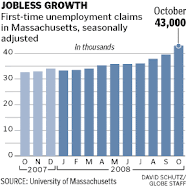







.png)














































No comments:
Post a Comment